
Description
2-[(diphenylmethyl)sulfinyl]acetamide, crystalline powder, 1000 mg package. Material intended exclusively for laboratory and analytical in vitro research. The product is not intended for human or animal consumption, and is not a medicinal product, dietary supplement, foodstuff, or cosmetic.
Three Different Entities That Must Not Be Confused
With this molecule, separating the layers matters more than with any other item in our catalog, because the same chemical name simultaneously functions as the active ingredient of a prescription-only medicinal product. Three contexts, three entirely different legal statuses:
| Entity | What it is | What it concerns |
|---|---|---|
| Chemical substance modafinil, CAS 68693-11-8 |
A chemical concept — a molecule with a defined structure. On its own it is neither a drug nor a reagent; its status is conferred by the form in which it was manufactured and approved. | chemistry, substance registries |
| Medicinal product e.g. Provigil, Modiodal |
A pharmaceutical preparation: a defined pharmaceutical form, manufacturing under GMP, registration documentation, safety surveillance. In Poland, dispensed only on medical prescription. | this is the entity that clinical trials in humans concern |
| Chemical reagent the material offered here |
A material for laboratory and analytical work. It does not have, and cannot have, approval for use in humans or animals — it has no pharmaceutical form and no medicinal product documentation. | analytics, chemistry, reference standards |
The consequence is unambiguous. The study results cited further on this page were obtained either using a registered medicinal product (clinical trials in humans), or using the substance administered to laboratory animals under controlled experimental conditions (preclinical studies). None of these studies was conducted using the analytical reagent, and none of these results carries over to the material offered here. The reagent is not the form in which the substance was ever tested in humans, and it cannot be used in that way.
Reagent Identification Card
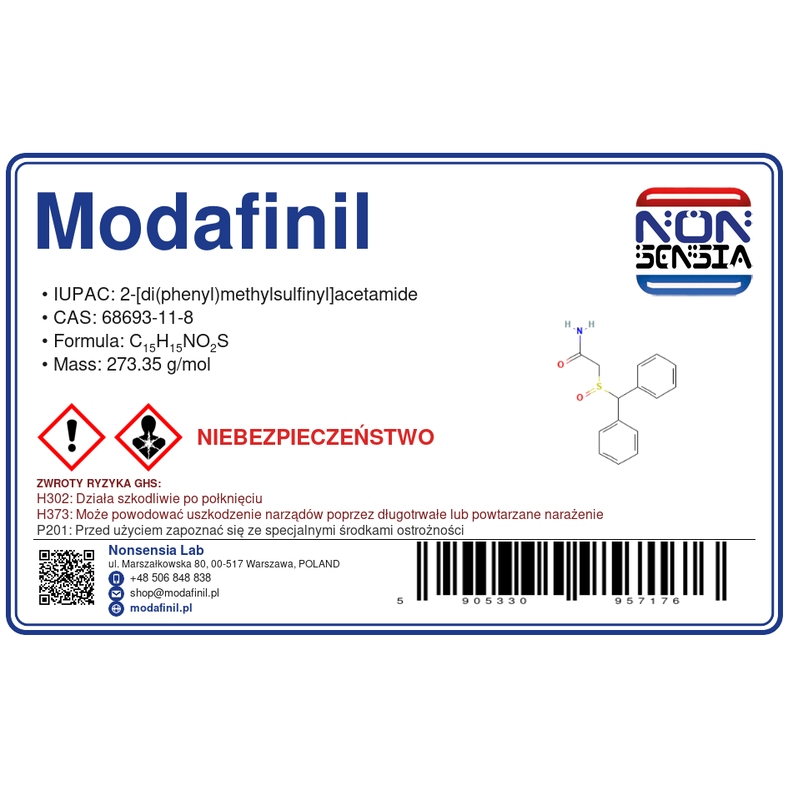
| Systematic name (IUPAC) | 2-[(diphenylmethyl)sulfinyl]acetamide |
|---|---|
| Common name | modafinil |
| CAS number | 68693-11-8 |
| Molecular formula | C15H15NO2S |
| Molar mass | 273.35 g·mol−1 |
| InChIKey | YFGHCGITMMYXAQ-UHFFFAOYSA-N |
| SMILES | C1=CC=C(C=C1)C(C2=CC=CC=C2)S(=O)CC(=O)N |
| PubChem CID | 4236 |
| Form | crystalline powder, white to off-white |
| Purity | ≥ 99% |
| Intended use | research reagent — not for human or animal consumption |
Molecular Lineage: The French Benzhydrylsulfinyl Line
Modafinil was not designed as a molecule from scratch. It is the second link in a short research lineage that developed in France during the 1970s and 1980s, in the laboratories of the Lafon company. The starting point was adrafinil — a compound with the same benzhydrylsulfinyl core, differing only in the terminal group: instead of an amide, it carried a hydroxamic group.
From Adrafinil to Modafinil
The key discovery was that adrafinil is converted into modafinil in the body — meaning that the activity attributed to the first compound largely originates from its metabolite. This precursor-metabolite relationship is still used today in analytical practice: detecting modafinil in a sample does not by itself establish whether modafinil or adrafinil was administered, which is why laboratories assay both compounds in parallel. This is illustrated by the work of Ameline and colleagues on the identification of adrafinil and its metabolite in hair [7], as well as the earlier screening method of Dubey and colleagues covering modafinil, adrafinil, and their metabolites simultaneously [8].
The Core That Defines the Whole Family
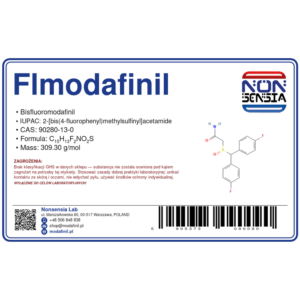
The common element of the family is the benzhydrylsulfinyl moiety: two phenyl rings attached to a single carbon atom, which in turn is bonded to a sulfur atom at the sulfoxide oxidation level. Modifications within this family consist of substituting the rings or replacing the amide terminus — and this is exactly the kind of modification represented by the separately offered flmodafinil, in which both rings carry a fluorine atom in the para position.
Early French pharmacological work on this core dates back to the 1980s — one example is the 1987 study by Chariot and colleagues, comparing modafinil with its derivatives in a rat pancreatic secretion model [5]. For readers seeking historical context, it is worth noting that the literature from this period is largely French-language and indexed under translated titles.
Timeline
| 1970s | work on benzhydrylsulfinyl derivatives in the Lafon laboratories (France); adrafinil is developed |
|---|---|
| late 1970s / early 1980s | modafinil isolated as the active metabolite of adrafinil |
| 1980s | first indexed pharmacological studies on modafinil [5] |
| 1990s | registration as a medicinal product in successive countries; entry into clinical practice for narcolepsy |
| 1999–2005 | development of analytical methods: GC-MS in urine [1], LC-MS in equine urine [2] |
| 2008–2009 | enantioselective methods separating the R and S forms [3], determination of adrafinil by LC-ESI-MS [4] |
| 2021 | mass spectrometry imaging in tissue — study published in Angewandte Chemie [6] |
Chemistry: The Sulfoxide and the Stereogenic Center at Sulfur
Why Sulfur, Not Carbon, Determines Chirality
The most interesting structural feature of this molecule is the sulfur atom. In the sulfoxide moiety, sulfur carries four different substituents — two bonds to the rest of the skeleton, an oxygen atom, and a lone electron pair — which makes it a stereogenic center. Modafinil therefore exists as a pair of enantiomers, and the commercial product is usually a racemic mixture. The R enantiomer is known under a separate common name (armodafinil) and has its own CAS number.
For the laboratory this has a practical consequence: a total (achiral) assay does not establish the enantiomeric ratio. That requires a chiral column and an enantioselective method — such an approach was described by Rao and colleagues for the adrafinil/modafinil pair [3]. If the material is meant to serve as a standard for distinguishing the R and S forms, a chemical-purity declaration alone is not sufficient.
Physicochemical Characteristics
| Parameter | Value | Analytical implication |
|---|---|---|
| Partition coefficient (XLogP) | ≈ 1.3 | moderate lipophilicity — elutes in the mid-range of an RP-HPLC gradient |
| Topological polar surface area | 71.7 Å2 | substantially higher than in cage hydrocarbons; affects retention |
| Hydrogen bond donors | 1 | amide group — N–H band in the infrared |
| Hydrogen bond acceptors | 3 | sulfoxide and amide oxygen |
| Solubility | good in DMSO and methanol; poor in water | prepare stock solutions in an organic solvent |
Why One Molecule Has Dozens of Names
More than twenty trade names are in circulation for preparations containing this active ingredient — among them Provigil, Modiodal, Modalert, Modvigil, Alertec, and Vigil. All of these denote medicinal products, manufactured under pharmaceutical regulations and subject to drug-trade rules — not chemical reagents. We list them solely so that a reader arriving here via one of those terms understands that this page does not concern any of these preparations.
The unambiguous name, independent of commercial or legal context, remains the systematic IUPAC name and CAS number 68693-11-8.
Laboratory Applications of the Reagent
- reference material for confirming identity and purity by HPLC-UV;
- standard in GC-MS methods — the determination technique in a urine matrix was described by Tseng and colleagues [1];
- standard in LC-MS/MS methods, including veterinary toxicology [2];
- material for enantioselective methods separating the R and S forms [3];
- comparison material in anti-doping analytics and forensic toxicology;
- a model compound in research on sulfoxide chemistry and benzhydryl derivatives.
Storage, Handling, and Work Safety
Store in the original, tightly closed packaging, in a dry and cool place, protected from light, separately from food and feed and out of reach of children. Work only under laboratory conditions, using personal protective equipment: gloves, safety goggles, and laboratory clothing; weigh the powder under conditions that limit dust generation. Avoid inhaling dust and contact with skin and eyes. Waste handling — in accordance with the regulations applicable to chemical waste at the site where the research is conducted.
Regulatory Status
The substance is the active ingredient of prescription-only medicinal products dispensed in Poland. Trade in medicinal preparations is governed by separate pharmaceutical-law regulations, and this offer does not concern it. The substance is also listed among substances prohibited in sport. The material offered here is a chemical reagent and has no approval for any use in humans or animals. The buyer is responsible for ensuring that the intended use complies with the law applicable in the destination country.
Frequently Asked Questions
What is the difference between modafinil and armodafinil?
Armodafinil is the single R enantiomer of the same molecule, whereas modafinil is usually a racemic mixture of both forms. The difference lies in the configuration at the sulfur atom, not in the skeleton. Both have separate CAS numbers.
What is the chemical formula and molar mass of modafinil?
C15H15NO2S; molar mass 273.35 g·mol−1. CAS number 68693-11-8, InChIKey YFGHCGITMMYXAQ-UHFFFAOYSA-N.
What is the difference between modafinil and adrafinil?
Adrafinil has the same benzhydrylsulfinyl core but a hydroxamic terminus instead of an amide, and is converted into modafinil in the body. In analytical practice, both compounds are assayed in parallel, because the mere presence of modafinil does not establish which of them was the source [7].
Are Provigil and modafinil the same thing?
Not in the legal sense. Provigil is the trade name of a medicinal product, while modafinil is the name of the active ingredient. The material offered here is not a medicinal product or a substitute for one.
Is the reagent suitable for uses other than laboratory ones?
No. The material is intended exclusively for laboratory and analytical research. It is not intended for human or animal consumption, it is not a drug, dietary supplement, food, or cosmetic, and it must not be used for medical, diagnostic, or consumption purposes.
How should modafinil be stored as a laboratory reagent?
In the original, tightly closed packaging, in a dry and cool place, protected from light, separately from food and feed and out of reach of children.
What solvent should be used to dissolve modafinil for a stock solution?
It dissolves well in DMSO and methanol, and poorly in water. With an XLogP of ≈ 1.3, stock solutions are prepared in an organic solvent.
How is the purity of modafinil confirmed?
By the HPLC-UV method against a reference material; distinguishing the R and S forms requires a chiral column and an enantioselective method — a total (achiral) assay alone does not establish the enantiomeric ratio.
Is a safety data sheet provided with modafinil?
We provide the safety data sheet on request to recipients engaged in research or analytical activity.
Is modafinil legal in Poland?
Modafinil is the active ingredient of prescription-only medicinal products dispensed in Poland; drug trade is governed by separate regulations, and this offer does not concern it. The material offered here is a chemical reagent with no approval for use in humans. The buyer is responsible for ensuring that the intended use complies with the law of the destination country.
What is the modafinil standard used for in an analytical laboratory?
For confirming identity and purity by HPLC-UV, as a standard in GC-MS and LC-MS/MS, as comparison material in anti-doping analytics and forensic toxicology, and as a model compound in sulfoxide chemistry.
References
These items are drawn from the PubMed database and concern the chemistry, analytics, and research history of this molecule. Items [1]–[4] and [6]–[8] are methodological and analytical papers; [5] is a preclinical study in laboratory animals. None of them describes a use of the analytical reagent — they are cited as scientific context and a bibliographic reference, not as information about the properties of the material offered here or as an encouragement toward any use.
- Tseng YL et al. (2005). "Detection of modafinil in human urine by gas chromatography-mass spectrometry." J Pharm Biomed Anal. PMID 15993026.
- McKinney AR et al. (2005). "The detection of modafinil and its major metabolite in equine urine by liquid chromatography–mass spectrometry." Rapid Commun Mass Spectrom. PMID 15834965.
- Rao RN et al. (2009). "Enantioselective separation and determination of adrafinil and modafinil." Biomed Chromatogr. PMID 19353685.
- Rao RN et al. (2008). "LC-ESI-MS determination and pharmacokinetics of adrafinil in rats." J Chromatogr B Analyt Technol Biomed Life Sci. PMID 18723408.
- Chariot J et al. (1987). "Effect of modafinil on pancreatic exocrine secretion in rats. A comparison with related drugs." Fundam Clin Pharmacol. PMID 2893764.
- Philipsen MH et al. (2021). "Mass Spectrometry Imaging Shows Modafinil, A Student Study Drug, Changes the Lipid Composition of the Fly Brain." Angew Chem Int Ed Engl. PMID 34041832.
- Ameline A et al. (2020). "Identification of adrafinil and its main metabolite modafinil in human hair." Forensic Sci Res. PMID 33457050.
- Dubey S et al. (2009). "A novel study of screening and confirmation of modafinil, adrafinil and their metabolite." Indian J Pharmacol. PMID 20407560.
Identification data and computed descriptors from PubChem (CID 4236).
Related Reagents in Our Catalog
- Flmodafinil (CAS 90280-13-0) — an analog with two fluorine atoms in the para positions
- Bromantan (CAS 87913-26-6) — an adamantane derivative, a different structural family
Statement of Intended Use
The material offered here is a chemical reagent intended exclusively for research, analytical, and laboratory purposes. It is not intended for human or animal consumption. It is not a medicinal product, dietary supplement, foodstuff, medical device, or cosmetic. It must not be used for medical, diagnostic, therapeutic, prophylactic, or consumption purposes, administered to humans or animals, applied to the skin, or added to food, beverages, or feed. Sold exclusively to recipients engaged in research, scientific, or analytical activity, who have laboratory facilities and the knowledge required for the safe handling of chemical reagents. The buyer bears sole responsibility for the lawful and safe use of the reagent and for compliance with the regulations applicable in the destination country.