
Description
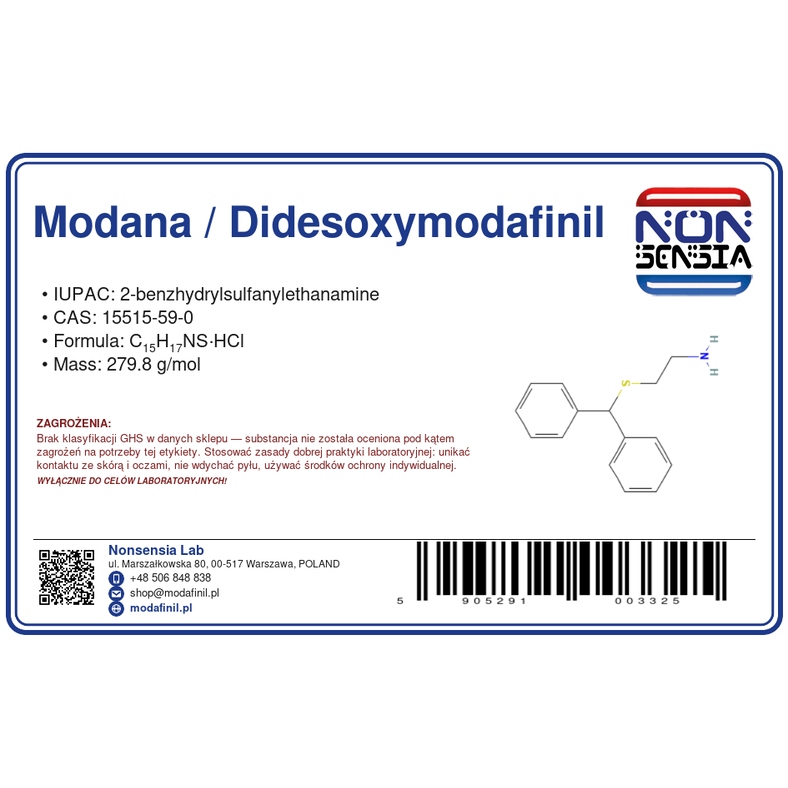
2-(benzhydrylthio)ethylamine (hydrochloride), known in the research-chemical trade as dideoxymodafinil, powder, 1000 mg package. Material intended exclusively for in vitro laboratory and analytical research. The product is not intended for human or animal consumption, and is not a medicinal product, dietary supplement, foodstuff, or cosmetic.
A point that needs to be made upfront
Dideoxymodafinil is in a position hard to find elsewhere in our catalog: the compound has a registered chemical identity but no scientific literature of its own. A PubMed search under every variant of the name — dideoxymodafinil, didesoxymodafinil, 2-(benzhydrylthio)ethylamine, CAS number 15515-59-0, and registry number NSC 96694 — returned not a single paper (as of September 2026).
We state this plainly because it is relevant information before purchasing the material. No pharmacological, toxicological, or clinical study of this compound exists — not in animals, not in cells, not in humans. Everything that can reliably be said below concerns the identity and structure of the molecule, not its biological activity. A page that attributed a mechanism of action or study results to this compound would be doing so without any source backing it — which is why no such content appears here.
We separately flag the origin of the identification data below: for this product no entry yet exists in our shop’s local, verified CAS registry. The data in the identification table comes from a direct query to the PubChem database (CID 279413), carried out while preparing this description — not from memory and not from the supplier’s marketing materials. It concerns the free base of the compound; the molar mass of the hydrochloride form in which the material is offered is a calculated value (free base + HCl), not a separate registry entry.
Three different things that must not be confused
The trade name of this material refers to modafinil, which creates a greater-than-usual risk of confusion. We separate the three contexts right away:
| Entity | What it is | Status for dideoxymodafinil |
|---|---|---|
| Chemical substance 2-(benzhydrylthio)ethylamine, CAS 15515-59-0 |
A chemical concept — a molecule of defined structure, present in the PubChem and US National Cancer Institute registries. On its own it is neither a drug nor a reagent. | yes — this is the only status this molecule actually has |
| Medicinal product | A pharmaceutical preparation: a defined dosage form, manufacturing under GMP, registration dossier, safety oversight. | NO — in any country. Unlike modafinil, this compound has never been registered as a drug and is not its metabolite or pharmacological precursor |
| Chemical reagent the material offered here |
Material for laboratory and analytical work. It does not have, and cannot have, approval for use in humans or animals. | yes — and it is offered solely in this capacity |
The similarity of the name to modafinil is purely structural, not pharmacological. There is nothing here to confuse with a drug, because there is no drug — no registered form of this compound intended for humans exists in any jurisdiction, and no studies attribute any effect in humans or animals to it. Modafinil, referenced further on solely for structural comparison, is a separate chemical entity with its own CAS number (68693-11-8), described on a separate page about modafinil.
Reagent identification card
The data below concerns the free base of the compound and comes from the PubChem database (CID 279413) — this product does not yet have a verified entry in our shop’s local CAS registry, so for calculated fields we state the source explicitly.
| Systematic (IUPAC) name, free base | 2-(benzhydrylthio)ethylamine |
|---|---|
| Common name (reagent market) | dideoxymodafinil (didesoxymodafinil) |
| CAS number, free base | 15515-59-0 |
| Molecular formula, free base | C15H17NS |
| Molar mass, free base | 243.4 g·mol−1 |
| Form offered | hydrochloride (hydrochloric acid salt) |
| Molecular formula, hydrochloride | C15H18ClNS (calculated: free base + HCl) |
| Molar mass, hydrochloride | ≈ 279.8 g·mol−1 (calculated, not a separate registry entry) |
| InChIKey, free base | BIPNUYXEYOEPHN-UHFFFAOYSA-N |
| SMILES, free base | C1=CC=C(C=C1)C(C2=CC=CC=C2)SCCN |
| PubChem CID | 279413 |
| Other registry | NSC 96694 (National Cancer Institute, Developmental Therapeutics Program, USA) |
| Form | powder, per supplier declaration |
| Purity | per the certificate of analysis (CoA) accompanying the batch — we do not state a figure here that is not confirmed in the sources used for this description |
| Intended use | research reagent — not for human or animal consumption |
Chemistry: two fewer oxygen atoms than modafinil
What exactly changed
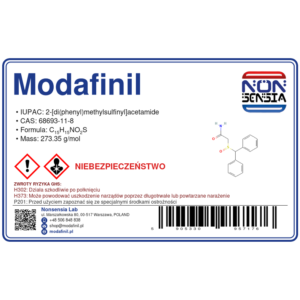
Modafinil is 2-[(diphenylmethyl)sulfinyl]acetamide — a benzhydryl core terminated by a sulfoxide group and an amide. Dideoxymodafinil has an identical benzhydryl core, but differs in two places: the sulfur atom is reduced from a sulfoxide (S=O) to a sulfide (S), and the amide group (–C(=O)NH2) is reduced to an amine group (–CH2NH2). The atomic balance is a loss of two oxygen atoms and a gain of two hydrogen atoms — hence the market name “dideoxy”, even though in the strict chemical sense the second change is not a simple deoxygenation but a reduction of a carbonyl to a methylene.
| Parameter | Modafinil | Dideoxymodafinil | Significance |
|---|---|---|---|
| Molecular formula | C15H15NO2S | C15H17NS | difference: −2×O, +2×H |
| Molar mass | 273.35 | 243.4 | difference approx. 30 — easy distinction by MS without chromatographic separation |
| Group on sulfur | sulfoxide (S=O) | sulfide (S) | a sulfide is not a stereogenic center — see below |
| Terminal group | amide (–C(=O)NH2) | amine (–CH2NH2) | basic nitrogen instead of a neutral one — different behavior in acidic environments |
| XLogP (computed) | ≈ 1.3 | ≈ 3.1 | markedly higher lipophilicity — later elution in RP-HPLC |
| Polar surface area (TPSA) | 71.7 Å2 | 51.3 Å2 | fewer polar groups after the loss of both oxygens |
Why the compound lost its stereogenic center
Modafinil is chiral at the sulfur atom: the sulfoxide carries four different “substituents” (two bonds to the skeleton, an oxygen atom, and a lone electron pair) frozen into a pyramidal geometry — hence the pair of enantiomers and the separate name for the R form (armodafinil). A sulfide does not have this property: with two substituents and two lone pairs, the sulfur atom has a bent geometry (as in ethers), with a plane of symmetry passing through both substituents — such an arrangement is achiral by definition, regardless of the rate of any inversion. This differs from the sulfoxide, where three different “substituents” (including the bond to oxygen) give a pyramidal geometry rigid enough for the configuration to be stable. Dideoxymodafinil therefore has no equivalent of the R/S pair (armodafinil/modafinil), nor the issue of enantiomeric ratio when assessing purity — in this sense it is analytically simpler than modafinil.
Nomenclature and identifiers
- Dideoxymodafinil (didesoxymodafinil) — name used in the research-chemical trade, referring to its structural relationship with modafinil;
- 2-(benzhydrylthio)ethylamine — the systematic IUPAC name of the free base, the only unambiguous one;
- 2-benzhydrylsulfanylethylamine — a variant IUPAC name used by PubChem;
- NSC 96694 — National Cancer Institute registry number (Developmental Therapeutics Program, USA); the compound appears there as a catalog entry, with no associated public literature that could be verified;
- CAS 15515-59-0 — the Chemical Abstracts Service registry number for the free base.
When running a literature search or comparing offers from different suppliers, it is worth combining all the variants — none of them alone returns the complete set of records.
Laboratory use of the reagent
- a reference material for confirming identity by HPLC-UV or LC-MS against the supplier’s declaration;
- a mass standard in LC-MS and GC-MS for distinguishing it from modafinil based on the mass difference (approx. 30 Da) — the distinction does not require chromatographic separation;
- a model compound for studying the effect of reducing a sulfoxide to a sulfide and an amide to an amine on chromatographic retention and mass spectrum within the benzhydryl family;
- a comparison material when searching chemical registries for derivatives and analogs of modafinil.
We do not indicate uses beyond analytics and comparative chemistry. Given the absence of any biological literature for this compound, that would be guesswork, not information.
Storage, handling, and work safety
Store in the original, tightly closed packaging, in a dry and cool place, protected from light, separately from food and feed and out of reach of children. Work only under laboratory conditions, using personal protective equipment: gloves, safety glasses, and laboratory clothing; weigh the powder under conditions that limit dust generation. Avoid inhaling dust and contact with skin and eyes. Handle waste in accordance with the regulations applicable to chemical waste at the site where the research is carried out.
Note on safety data. For a compound with no toxicological literature of its own, hazard data is undetermined. The absence of a documented hazard is not the same as the absence of a hazard — the material should be handled with the caution appropriate for a substance of undetermined profile.
Regulatory status
Dideoxymodafinil is not registered as a medicinal product in any country known to us and has no pharmacopoeial monograph. While preparing this description, we also did not find it on any verified list of controlled substances. The absence of such an entry is not equivalent to an unambiguous legal status in all jurisdictions — the buyer is responsible for checking the legal status in the destination country before ordering. The material offered is a chemical reagent and has no approval for any use in humans or animals.
Frequently Asked Questions
How does dideoxymodafinil differ from modafinil?
The benzhydryl core is identical; there are two differences: the sulfur atom is reduced from a sulfoxide to a sulfide, and the amide group is reduced to an amine. The effect: two fewer oxygen atoms, a molar mass lower by about 30 (free base: 243.4 vs. 273.35), and the loss of the stereogenic center present in modafinil.
Is dideoxymodafinil a drug?
No. It is not registered as a medicinal product in any country and is not a metabolite or pharmacological precursor of modafinil — it is a separate chemical compound with no clinical history of its own. The material offered is a chemical reagent.
Where does the name “dideoxymodafinil” come from?
It is a market name, used by research-chemical suppliers, referring to the loss of two oxygen atoms relative to modafinil. The unambiguous name remains the IUPAC name of the free base: 2-(benzhydrylthio)ethylamine, together with CAS number 15515-59-0.
What is the chemical formula and molar mass of dideoxymodafinil?
Free base: C15H17NS, 243.4 g·mol−1, InChIKey BIPNUYXEYOEPHN-UHFFFAOYSA-N. The form offered (hydrochloride): C15H18ClNS, approx. 279.8 g·mol−1 — a value calculated as the sum of the free base and an HCl molecule, not a separate registry entry.
Are there any scientific studies on this compound?
We did not find any paper in PubMed under any variant of the compound’s name, its CAS number, or its NSC number (as of September 2026). The compound appears only in chemical registries (PubChem, National Cancer Institute), not in the biological literature.
Does dideoxymodafinil have a stereogenic center, like modafinil?
No. Modafinil is chiral at its sulfoxide sulfur atom (pyramidal geometry, three different “substituents”). In dideoxymodafinil, the sulfur is present as a sulfide with bent geometry (two substituents, two lone pairs) — such an arrangement has a plane of symmetry and is achiral by definition, regardless of inversion. The compound has no equivalent of the R/S pair (armodafinil/modafinil).
Is the reagent suitable for uses other than laboratory ones?
No. The material is intended solely for laboratory and analytical research. It is not intended for human or animal consumption, is not a drug, dietary supplement, food, or cosmetic, and may not be used for medical, diagnostic, or consumption purposes.
How should dideoxymodafinil be stored?
In the original, tightly closed packaging, in a dry and cool place, protected from light, separately from food and feed and out of reach of children.
What should dideoxymodafinil be dissolved in?
A higher XLogP (≈ 3.1) than modafinil’s indicates good solubility in organic solvents (e.g. DMSO, methanol) and poor solubility in water for the free base. The hydrochloride form in which the material is offered usually improves water solubility thanks to the protonated amine group — it is worth verifying this experimentally for a specific batch.
Is a safety data sheet provided with dideoxymodafinil?
We provide the sheet on request. We note that for this compound the toxicological data is undetermined — the material should be handled with the caution appropriate for a substance of undetermined profile.
What does CAS number 15515-59-0 mean?
It is the Chemical Abstracts Service registry number assigned to the free base of the compound (2-(benzhydrylthio)ethylamine) — a unique identifier independent of trade name or source language.
Is dideoxymodafinil legal in Poland?
The compound is not registered as a medicinal product, and we did not find it on verified lists of controlled substances, but the absence of such an entry is not equivalent to an unambiguous legal status. The buyer is responsible for checking the legal status in the destination country before ordering.
How can dideoxymodafinil be distinguished from modafinil by mass spectrometry?
Most simply by mass: a difference of about 30 (243.4 vs. 273.35 for the free bases) makes the distinction in LC-MS or GC-MS trivial, without the need for chromatographic separation.
References
For this compound no scientific literature exists that could be cited — a PubMed search under the names dideoxymodafinil, didesoxymodafinil, 2-(benzhydrylthio)ethylamine, CAS number 15515-59-0, and NSC number 96694 returned no results (as of the date this description was prepared, September 2026). Below we list only the sources of the identification data — not studies of the compound.
- Identification data and computed descriptors: PubChem CID 279413.
- National Cancer Institute registry, Developmental Therapeutics Program: NSC 96694 — a catalog entry, with no associated public literature.
- Chemical context of the benzhydrylsulfinyl family and literature on the parent compound — see the Modafinil (CAS 68693-11-8) page.
Related reagents in our catalog
- Modafinil (CAS 68693-11-8) — the parent compound; dideoxymodafinil differs from it by the removal of two oxygen atoms (sulfoxide to sulfide, amide to amine)
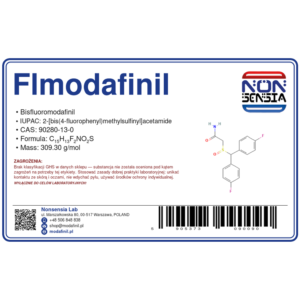
- Flmodafinil (CAS 90280-13-0) — a different direction of modification of the same core: fluorine substitution instead of oxygen removal; like dideoxymodafinil, it was never a drug and has sparse literature
Statement on intended product use
The material offered is a chemical reagent intended solely for research, analytical, and laboratory purposes. It is not intended for human or animal consumption. It is not a medicinal product, dietary supplement, foodstuff, medical device, or cosmetic. It may not be used for medical, diagnostic, therapeutic, preventive, or consumption purposes, administered to humans or animals, applied to the skin, or added to food, beverages, or feed. Sold exclusively to buyers engaged in research, scientific, or analytical activity who have laboratory facilities and the knowledge needed for the safe handling of chemical reagents. The buyer bears sole responsibility for the lawful and safe use of the reagent and for compliance with the regulations in force in the destination country.