
Description
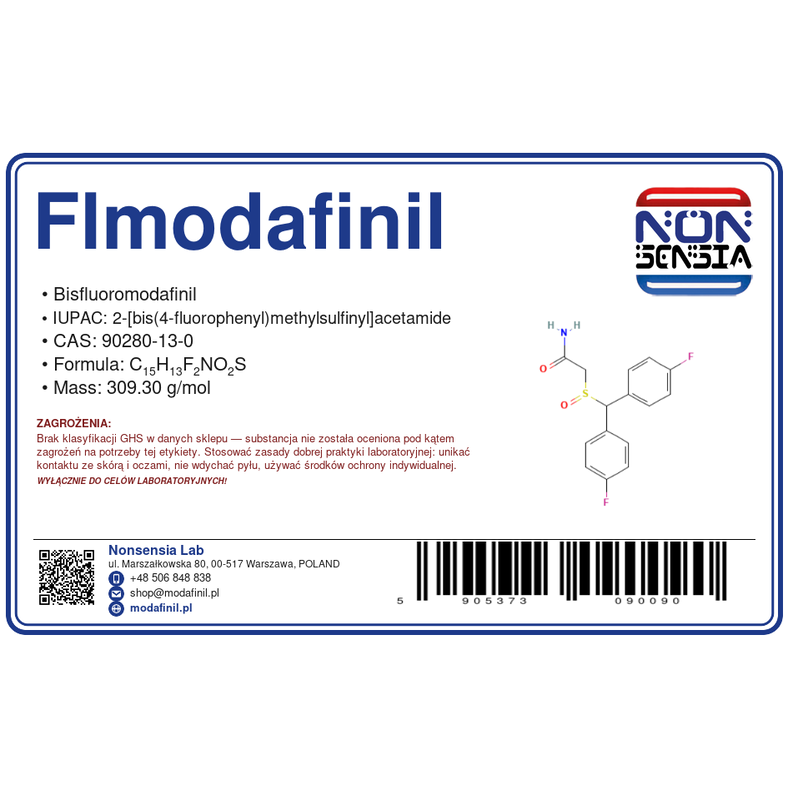
2-[bis(4-fluorophenyl)methylsulfinyl]acetamide, crystalline powder, 1000 mg package. Material intended solely for in vitro laboratory and analytical research. The product is not intended for human or animal consumption, it is not a medicinal product, a dietary supplement, a foodstuff, or a cosmetic.
Something That Needs to Be Said Upfront
Flmodafinil is in an unusual position: it is a compound that is well-defined chemically but almost absent from the peer-reviewed scientific literature. Searching the PubMed database under all of its names – flmodafinil, bisfluoromodafinil, lauflumide, CRL-40,940 – returns only a handful of entries, and these are analytical papers describing detection of the compound, not studies of the compound itself.
We state this directly because it is relevant information for anyone planning to work with this material. There is no body of research to refer to. There are no clinical studies, no pharmacological reviews comparable to those existing for modafinil, and no pharmacopoeial monograph. Everything that can be reliably stated concerns the molecule’s structure and its analytical behavior – and we limit this description to that.
We treat this as a strength of the description, not a shortcoming. A page that attributed to this molecule properties documented for a different one would be misleading.
Three Different Entities That Must Not Be Confused
| Entity | What it is | Status of flmodafinil |
|---|---|---|
| Chemical substance CAS 90280-13-0 |
A chemical concept – a molecule with a defined structure, registered in databases (PubChem, ChemSpider). | yes – this is the only status this molecule actually has |
| Medicinal product | A pharmaceutical preparation: a defined formulation, GMP regime, registration documentation, oversight. | NO – in any country. Unlike modafinil, flmodafinil has never been registered as a drug |
| Chemical reagent the material offered here |
Material for laboratory and analytical work. | yes – and it is offered solely in this capacity |
This distinction matters more here than it does for modafinil. In that case a real medicinal product exists, from which the reagent must be distinguished. Here there is nothing to confuse with a drug, because no drug exists – no registered form of this substance intended for human use exists in any jurisdiction.
Reagent Identification Card
| Systematic name (IUPAC) | 2-[bis(4-fluorophenyl)methylsulfinyl]acetamide |
|---|---|
| Common names | flmodafinil, bisfluoromodafinil, lauflumide |
| Development code | CRL-40,940 |
| CAS Number | 90280-13-0 |
| Molecular formula | C15H13F2NO2S |
| Molar mass | 309.33 g·mol-1 |
| Monoisotopic mass | 309.0635 Da |
| InChIKey | YEAQNUMCWMRYMU-UHFFFAOYSA-N |
| SMILES | C1=CC(=CC=C1C(C2=CC=C(C=C2)F)S(=O)CC(=O)N)F |
| PubChem CID | 13271852 |
| Form | crystalline powder, white to off-white |
| Purity | ≥ 99% |
| Intended use | research reagent – not for human or animal consumption |
What the Two Fluorine Atoms Do
Flmodafinil differs from modafinil by two atoms. The core is identical – a benzhydrylsulfinyl group terminating in an amide – and the modification consists of introducing a fluorine atom at the para position of each of the two phenyl rings. Hence the common name “bisfluoromodafinil”: fluorine twice over.
Measurable Effects, Not Assumed Ones
Para-fluorine substitution is one of the most common modifications in medicinal chemistry and has predictable physicochemical consequences that can be stated without reference to any biological studies:
| Parameter | Modafinil | Flmodafinil | Significance |
|---|---|---|---|
| Molecular formula | C15H15NO2S | C15H13F2NO2S | difference: 2×H → 2×F |
| Molar mass | 273.35 | 309.33 | +35.98 – easy differentiation by MS |
| XLogP | ≈ 1.3 | ≈ 1.9 | higher lipophilicity → later elution in RP-HPLC |
| Polar surface area (TPSA) | 71.7 Å2 | 79.4 Å2 | similar – fluorine does not change the hydrogen-bonding profile |
| Hydrogen bond acceptors | 3 | 5 | the two fluorine atoms are counted as acceptors |
| Rotatable bonds | 5 | 5 | unchanged – fluorine adds no conformational freedom |
Why This Matters for the Laboratory
The 36 Da mass difference makes distinguishing the two compounds in mass spectrometry trivial – no chromatographic separation is required, the ion mass alone suffices. This is the opposite situation to isomeric pairs, where mass settles nothing.
Fluorine does not produce a characteristic isotope pattern. Unlike bromine (two stable isotopes in roughly a 1:1 ratio, as in bromantan), fluorine is practically monoisotopic – 19F accounts for almost 100% of its natural abundance. The presence of fluorine therefore cannot be recognized from an isotope cluster; it must be inferred from the exact mass or confirmed by 19F NMR, a technique for which this compound is a gratifying subject – the two equivalent fluorine atoms give a single, clean signal.
Stereogenic Center
As in modafinil, the sulfur atom in the sulfoxide group carries four different substituents and is a stereogenic center. The symmetrical fluorine substitution on both rings does not eliminate this chirality – the two rings remain equivalent to each other, but the sulfur still carries four different substituents. The material should therefore be treated as a mixture of enantiomers unless the declaration states otherwise.
Nomenclature: Four Names, One Compound
- Flmodafinil – the most common name in commercial circulation;
- Bisfluoromodafinil – a descriptive name indicating the two fluorine atoms;
- Lauflumide – a common name found in some sources;
- CRL-40,940 – the development code from the laboratory work period; the comma-containing spelling is also sometimes written as CRL-40940, which complicates database searches;
- 2-[bis(4-fluorophenyl)methylsulfinyl]acetamide – the systematic IUPAC name, the only unambiguous one.
When conducting a literature search, it is worth combining all variants along with both spellings of the development code – searching solely under the term “flmodafinil” misses some records.
Laboratory Applications of the Reagent
- a reference material for confirming identity and purity by HPLC-UV;
- a standard in LC-MS and GC-MS methods – in particular for distinguishing it from modafinil based on the 36 Da mass difference;
- a subject for 19F NMR – the two equivalent fluorine atoms give a single signal, useful for calibration and method control;
- a comparative material in screening studies of preparations declared to contain modafinil or its analogs;
- a model compound in studies of the effect of fluorine substitution on chromatographic retention within a structural series.
Storage, Handling, and Work Safety
Store in the original, tightly sealed packaging, in a dry and cool place, protected from light, separately from food and feed and out of the reach of children. Work only under laboratory conditions, using personal protective equipment: gloves, safety glasses, and laboratory clothing; weigh the powder under conditions that limit dust generation. Avoid inhaling dust and contact with skin and eyes. Dispose of waste in accordance with the regulations applicable to chemical waste at the site where the research is conducted.
A note on safety data. For compounds with sparse literature, such as this one, toxicological data are incomplete or nonexistent. The absence of documented hazard is not equivalent to the absence of hazard – the material should be handled with the caution appropriate for a substance with an unestablished profile.
Regulatory Status
Flmodafinil is not registered as a medicinal product in any country known to us. It has no pharmacopoeial monograph. The legal status of substances of this type is subject to change under national law – the purchaser is responsible for verifying the legal status in the country of destination before ordering. The material offered is a chemical reagent and holds no approval for any use in humans or animals.
Frequently Asked Questions
How does flmodafinil differ from modafinil?
By two fluorine atoms at the para positions of both phenyl rings. The molecular core is identical. Measurable effects: a molar mass higher by 36 Da (309.33 versus 273.35) and higher lipophilicity (XLogP ≈ 1.9 versus ≈ 1.3), which translates into later elution in reversed-phase chromatography.
Is flmodafinil a drug?
No. Unlike modafinil, which is the active substance of registered medicinal products, flmodafinil has never been registered as a drug in any country. The material offered is a chemical reagent.
Are bisfluoromodafinil, lauflumide, and CRL-40,940 different compounds?
No – these are four names for the same compound with CAS number 90280-13-0.
What is the chemical formula and molar mass of flmodafinil?
C15H13F2NO2S; molar mass 309.33 g·mol-1, monoisotopic mass 309.0635 Da, InChIKey YEAQNUMCWMRYMU-UHFFFAOYSA-N.
Why does the description not include information about effects?
Because no peer-reviewed literature exists for this molecule that would allow anything to be reliably stated, and attributing to it properties documented for modafinil would be misleading. Regardless, the material is a chemical reagent and is not intended for use in humans.
Is the reagent suitable for uses other than laboratory ones?
No. The material is intended solely for laboratory and analytical research. It is not intended for human or animal consumption, it is not a drug, a dietary supplement, a food, or a cosmetic.
How should flmodafinil be stored?
In the original, tightly sealed packaging, in a dry and cool place, protected from light, separately from food and feed and out of the reach of children.
How can flmodafinil be distinguished from modafinil in analysis?
Most simply by mass: the 36 Da difference (309.33 versus 273.35) makes distinguishing them in mass spectrometry trivial – it does not even require chromatographic separation. In addition, flmodafinil elutes later in RP-HPLC due to its higher lipophilicity.
Is the presence of fluorine visible in the isotope pattern?
No. Fluorine is practically monoisotopic (19F ≈ 100%), so it does not produce an isotope cluster. The presence of fluorine must be inferred from the exact mass or confirmed by 19F NMR – the two equivalent atoms give a single clean signal.
Is a safety data sheet provided with flmodafinil?
We provide the sheet on request. However, we note that for this molecule toxicological data are incomplete or nonexistent – the material should be handled with the caution appropriate for a substance with an unestablished profile.
Is flmodafinil legal?
Flmodafinil is not registered as a medicinal product in any country known to us and has no pharmacopoeial monograph. The legal status of substances of this type is subject to change under national law – the purchaser is responsible for verifying the legal status in the country of destination before ordering.
What is the flmodafinil standard used for in the laboratory?
For confirming identity and purity by HPLC-UV, as a standard in LC-MS and GC-MS (differentiation from modafinil by mass), as a subject for 19F NMR, and as a comparative material in screening studies of preparations.
References
Due to the lack of a research corpus for this molecule discussed above, the description is based on registry data and on comparative chemistry with modafinil, for which the literature exists.
- Identification data and computed descriptors: PubChem CID 13271852; ChemSpider 26386803.
- Chemical context of the benzhydrylsulfinyl family and the analytical methods distinguishing its members – see the references under Modafinil (CAS 68693-11-8).
Related Reagents in Our Catalog
- Modafinil (CAS 68693-11-8) – the parent compound of this modification
- Bromantan (CAS 87913-26-6) – an adamantane derivative, a methodological contrast: bromine gives an isotope pattern, fluorine does not
Statement on Product Intended Use
The material offered is a chemical reagent intended solely for research, analytical, and laboratory purposes. It is not intended for human or animal consumption. It is not a medicinal product, a dietary supplement, a foodstuff, a medical device, or a cosmetic. It must not be used for medical, diagnostic, therapeutic, prophylactic, or consumption purposes, administered to humans or animals, applied to the skin, or added to food, beverages, or feed. Sales are made exclusively to customers engaged in research, scientific, or analytical activity who have laboratory facilities and the knowledge required for the safe handling of chemical reagents. The purchaser bears sole responsibility for the lawful and safe use of the reagent and for compliance with the regulations applicable in the country of destination.