
Description
N-(4-bromophenyl)adamantan-2-amine, purity ≥ 99.75%, 1000 mg package. Material intended exclusively for in vitro laboratory and analytical research. The product is not intended for consumption by humans or animals, is not a medicinal product, dietary supplement, foodstuff, or cosmetic.
Reagent Identification Card
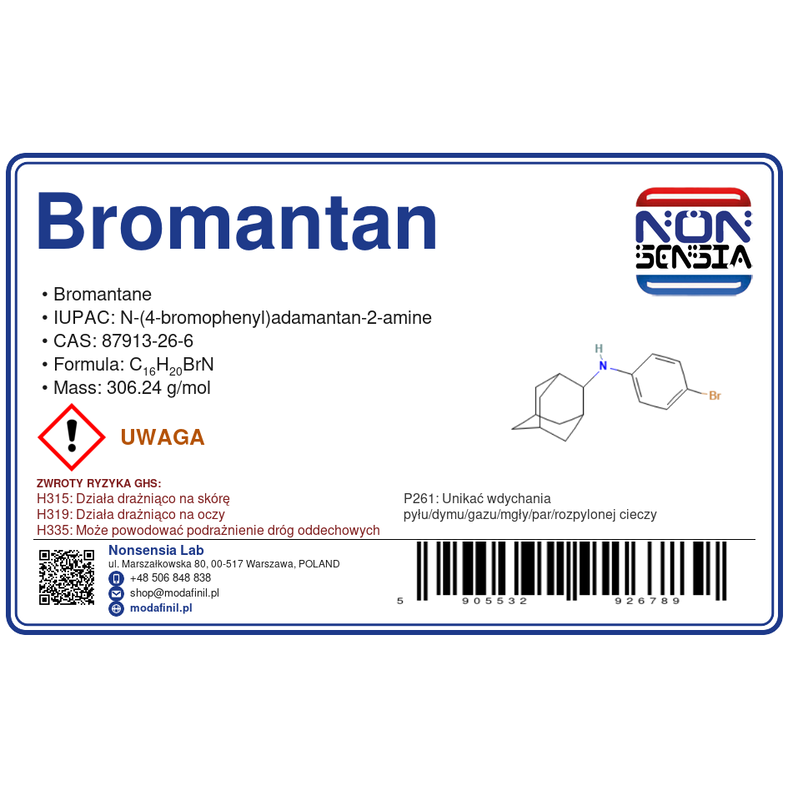
| Systematic name (IUPAC) | N-(4-bromophenyl)adamantan-2-amine |
|---|---|
| Common name | bromantane (bromantan, bromontan) |
| Development code | ADK-709 |
| CAS number | 87913-26-6 |
| Molecular formula | C16H20BrN |
| Molar mass | 306.24 g·mol−1 |
| Monoisotopic mass | 305.0779 Da |
| InChIKey | LWJALJDRFBXHKX-UHFFFAOYSA-N |
| SMILES | C1C2CC3CC1CC(C2)C3NC4=CC=C(C=C4)Br |
| PubChem CID | 4660557 |
| UNII (FDA) | N1ILS53XWK |
| ChEMBL | CHEMBL4303520 |
| MDL number | MFCD02101627 |
| Form | crystalline powder, white to off-white |
| Purity | ≥ 99.75% |
| Intended use | research reagent — not for consumption by humans or animals |
Three Distinct Entities That Must Not Be Confused
With this molecule, confusion is especially easy, which is why we separate the layers from the outset. The same chemical name occurs in three entirely different contexts, with different legal status, different quality control, and different intended use:
| Chemical substance bromantane, CAS 87913-26-6 |
A chemical concept — a defined molecule with a defined structure. On its own it is neither a drug nor a reagent; its status is conferred only by the form in which it was manufactured and approved. |
| Medicinal product Ladasten, registered in the Russian Federation (2009) |
A pharmaceutical preparation: a defined pharmaceutical form, manufacture under pharmaceutical conditions, registration documentation, safety surveillance. It is this entity that the human clinical studies cited in the literature [14][20] concerned. |
| Chemical reagent the material offered on this page |
A material for laboratory and analytical work. It does not and cannot have approval for use in humans or animals: it has no pharmaceutical form, is not subject to pharmaceutical manufacturing conditions, and is not accompanied by medicinal product documentation. |
The consequence is unambiguous and not open to interpretation. The study results cited later on this page were obtained either using the registered medicinal product (human clinical studies), or using the substance administered to laboratory animals under controlled experimental conditions (preclinical studies). None of these studies were conducted using the analytical reagent, and none of these results transfer to the material offered here. The reagent is not the form in which the substance was ever studied in humans, and it cannot be used in that way.
We cite the literature because a reliable description of a laboratory material requires indicating where the knowledge about the molecule came from and where to find it. This is not information about the product’s effects, does not constitute encouragement for any use outside the laboratory, and cannot be the basis for any health-related decision.
Lineage of the Molecule: Where the Adamantane Cage Came From
Bromantane cannot meaningfully be described in isolation from the family it belongs to. The core of the molecule is adamantane — a cage-structured hydrocarbon whose skeleton corresponds to the elementary unit cell of diamond. This compound was isolated from a petroleum fraction in the 1930s, and for the following two decades it remained a laboratory curiosity, since no efficient route to its production existed. The situation changed only with a synthesis developed in the late 1950s using a Lewis-acid-catalyzed rearrangement, which lowered the cost of the material enough that the adamantane cage became an accessible building block for medicinal chemistry.
The consequences were far-reaching. The rigid, strongly lipophilic cage proved to be a convenient structural handle: attaching an amino group to it gave the aminoadamantane derivatives, the best known of which is amantadine. It is this line of research — and not, as is sometimes incorrectly stated, a chance discovery in a single year — that constitutes the real context for the emergence of bromantane.
Bromantane belongs to the 2-aminoadamantanes, a subgroup in which the amino substituent is located at position 2 of the cage rather than at the bridgehead position 1. A 4-bromophenyl ring is attached to the nitrogen atom. This seemingly minor synthetic decision has two consequences relevant to the analytical laboratory: it increases the molecule’s lipophilicity (calculated XLogP ≈ 5) and introduces a bromine atom which, as discussed below, gives a characteristic signature in the mass spectrum.
Timeline: How Knowledge of Bromantane Developed
| 1930s | isolation of adamantane from petroleum |
|---|---|
| late 1950s | efficient synthesis of adamantane; the cage becomes an accessible building block |
| 1960s–1970s | development of aminoadamantane derivatives in medicinal chemistry |
| 1980s | development of the compound under the code ADK-709 in the Soviet actoprotector research program |
| first half of the 1990s | first indexed experimental papers; formation of three research centers |
| 1996 | detection of the substance in anti-doping control samples — the molecule’s international debut |
| 1997 | addition to the list of substances banned in sport |
| 1999–2006 | a series of toxicological and behavioral studies in animals [1][2][3][4][5][6][7] |
| 2004–2005 | gene expression studies using DNA macroarrays at the Ufa center [8][9][10] |
| 2009 | registration of the medicinal product under the trade name Ladasten in the Russian Federation (concerns the pharmaceutical preparation, not the reagent) |
| 2010–2013 | clinical studies using the medicinal product and reviews of the actoprotector category [14][17][20] |
Three Centers That Built the Literature
The literature on bromantane has an unusual geography: it originated almost entirely in three centers of the former USSR, in the Russian language, and a significant portion of it has never been replicated outside that region. For a laboratory using this reagent, this has practical implications — when verifying literature data, one encounters records indexed only by a translated title.
- Moscow — Institute of Pharmacology (later named after V. V. Zakusov). The parent center of the program. This is the source of the studies on the compound’s effects on the cardiovascular and sympatho-adrenal systems of animals [4] and on instrumental conditioning and its autonomic correlates [3], as well as an early analysis of pharmacological properties [1].
- Volgograd — Volgograd Medical Academy. A team focused on toxicology and experimental safety: a comprehensive assessment of animal behavior [5], toxicity after single administration [6], neurological status after two-month administration [7], and studies on the development of rat offspring [11][12][13].
- Ufa — Institute of Biochemistry and Genetics. The latest and methodologically most distinct group. It was here that DNA macroarrays were applied to analyze changes in gene expression in the rat brain following administration of the 2-aminoadamantane compound [8][9], and the induction of genes regulating dopamine biosynthesis was described [10].
Actoprotectors — A Category Without Which This Literature Cannot Be Understood
Bromantane was developed within a pharmacological category that has no exact equivalent in Western classification: actoprotectors. It was defined by purpose rather than by mechanism — the goal was to maintain working capacity under extreme conditions: thermal load, hypoxia, and prolonged exertion. This has a direct bearing on how the sources should be read: the studies were designed around endpoints such as the physical performance of laboratory animals or thermal protection [15][16], rather than around receptor affinity. A reader looking in these papers for modern targeted pharmacology will not find it, because that was not the question being asked. The broader historical context of the adaptogen category and compounds of a similar profile is described in a 2021 review [18], and an assessment of the actoprotective activity of heterocyclic nitrogen derivatives is given in a 2013 paper [17].
A caveat applying to the entire section above. This describes the history of scientific research from 1990–2013. Preclinical studies were conducted in laboratory animals, and studies involving humans used exclusively the registered medicinal product, not the chemical reagent. This is not a description of the properties of the material offered here, does not constitute information about its use, and cannot be the basis for any use outside the laboratory. The reagent offered is not a medicinal product and must not be used in humans or animals.
Why Does One Molecule Have Six Names?
This is one of the more frequent questions when ordering this material, and a source of real mix-ups in orders. All of the terms below refer to the same compound with CAS number 87913-26-6:
- Bromantan — the Polish form, most common in Polish-language literature;
- Bromantane — the English form, present in international databases;
- Bromontan — a transliteration variant from Cyrillic, established in some early English-language publications and still present in indexes today; it is not a different compound or a different salt;
- ADK-709 — the development code from the period of laboratory work;
- Ladasten — the trade name of the preparation registered in the Russian Federation, appearing in the titles of most papers after 2004;
- N-(4-bromophenyl)adamantan-2-amine — the systematic IUPAC name, the only unambiguous one.
This divergence of names has a bibliographic consequence: searching databases only under the term bromantane misses a significant portion of the literature indexed under the trade name. When querying, it is worth combining all the variants.
1996 — An Unusual International Debut
The compound entered international awareness not through pharmacology but through anti-doping control. In the mid-1990s it was detected in samples taken from athletes, and initially it could not be identified — it appeared in laboratories as a previously unknown signal. A year later the substance was added to the list of banned substances, where it remains to this day in the class of masking agents and manipulation methods. From the point of view of an analytical laboratory, this event has a lasting consequence: bromantane has since been a routine reference material in anti-doping control, and its spectra and retention times are part of the standard equipment of reference libraries.
Physicochemical Characteristics and Their Implications for Analytical Work
| Partition coefficient (XLogP, calculated) | ≈ 5 |
|---|---|
| Topological polar surface area (TPSA) | 12 Å2 |
| Hydrogen bond donors | 1 |
| Hydrogen bond acceptors | 1 |
| Rotatable bonds | 2 |
| Heavy atoms | 18 |
| Solubility | good in DMSO and organic solvents; negligible in water |
Lipophilicity. High XLogP and minimal polar surface area mean that in reversed-phase chromatography the compound elutes late. This is sometimes used practically — as a retention marker at the lipophilic end of the range when calibrating RP-HPLC methods. Negligible solubility in water requires that stock solutions be prepared in an organic solvent.
Bromine isotope signature. The most useful analytical feature of this molecule. Bromine occurs as two stable isotopes, 79Br and 81Br, at nearly equal natural abundance. In the mass spectrum this produces a pair of peaks 2 Da apart at roughly 1:1 height — a pattern distinctive enough to distinguish organobromine compounds from background even in complex matrices. For a laboratory implementing GC-MS or LC-MS methods, bromantane is therefore sometimes a convenient control material for checking the correct recognition of isotope clusters.
Cage symmetry. The structure of the adamantane skeleton means that the material does not require enantiomer separation, which simplifies standard qualification compared with many other organic standards.
Laboratory Applications of the Reagent
- reference material for confirming identity and purity by HPLC-UV;
- standard in GC-MS and LC-MS methods, in particular for verifying recognition of the bromine isotope signature;
- comparison material in anti-doping analysis;
- substrate and model compound in studies of adamantane derivative chemistry;
- retention marker for calibrating reversed-phase chromatography methods.
Storage, Handling, and Work Safety
Store in the original, tightly closed packaging, in a dry and cool place, protected from light, separately from food and feed and out of the reach of children. Work only under laboratory conditions, using personal protective equipment: gloves, safety glasses, and laboratory clothing; weigh the powder under conditions that limit dust formation. Avoid inhaling dust and contact with skin and eyes. Waste handling — in accordance with the regulations applicable to chemical waste at the site where the research is conducted.
Regulatory Status
The substance has been on the list of substances banned in sport (category of masking agents and manipulation methods) continuously since 1997. In the Russian Federation, the preparation under the trade name Ladasten obtained registration as a medicinal product in 2009. This is a historical-regulatory fact concerning a different country, a different legal entity, and a different form of manufacture — the registration covered a pharmaceutical preparation in a defined pharmaceutical form, manufactured under pharmaceutical conditions. This registration in no way pertains to the chemical reagent offered here and does not confer upon it any status of a medicinal product. The material offered is a chemical reagent and has no approval for any use in humans or animals.
Frequently Asked Questions
How does bromantane differ from Ladasten?
Nothing, in the chemical sense — it is the same molecule with CAS number 87913-26-6. Ladasten is the trade name of the preparation registered in Russia; bromantane is the common name of the substance. The difference concerns context, not structure. The compound was developed in the 1980s in the Soviet actoprotector research program, under the code ADK-709; the main center was the Moscow Institute of Pharmacology, later named after V. V. Zakusov. The first indexed experimental papers date from the first half of the 1990s. The date 1960, sometimes encountered, concerns the development of other adamantane derivatives, not this compound. C16H20BrN; molar mass 306.24 g·mol−1, monoisotopic mass 305.0779 Da. No. It is a transliteration variant from Cyrillic, present in some early English-language publications. The same CAS number. No. The material is intended exclusively for laboratory and analytical research. It is not intended for consumption by humans or animals, is not a drug, dietary supplement, food, or cosmetic, and cannot be used for medical, diagnostic, or consumption purposes. We offer the reagent in a 1000 mg package; the current price is shown in the product card above. We sell the material only to customers conducting research or analytical activity. In the original, tightly closed packaging, in a dry and cool place, protected from light, separately from food and feed and out of the reach of children. Details are in the storage section above. Well in DMSO and organic solvents, negligibly in water — with XLogP ≈ 5, stock solutions are prepared in an organic solvent. We provide the safety data sheet on request. For compounds with a limited literature base, some toxicological data remain unestablished — the absence of documented hazard is not equivalent to the absence of hazard. By the bromine isotope signature: 79Br and 81Br occur in nearly equal abundance, producing a pair of peaks 2 Da apart in a ratio of roughly 1:1. This is the most convenient identifying feature of this molecule. No. The structure of the adamantane skeleton means that the material does not require enantiomer separation — which simplifies standard qualification compared with many other organic standards. The items below are from the PubMed database and concern the history of research on the molecule. Items [1]–[13] and [15]–[17] and [19] are preclinical studies in laboratory animals. Items [14] and [20] are studies involving humans, conducted using the registered medicinal product (a pharmaceutical preparation in a defined pharmaceutical form) — not using the chemical reagent. Item [18] is a historical review of the category. The entire list is cited as historical-scientific context and a bibliographic reference, not as information about the use of the material offered, nor as encouragement for any use. Identification data and computational descriptors from PubChem (CID 4660557) and the UNII and ChEMBL registries. The material offered is a chemical reagent intended exclusively for research, analytical, and laboratory purposes. It is not intended for consumption by humans or animals. It is not a medicinal product, dietary supplement, foodstuff, medical device, or cosmetic. It must not be used for medical, diagnostic, therapeutic, prophylactic, or consumption purposes, administered to humans or animals, applied to the skin, or added to food, beverages, or feed. Sale is restricted to customers engaged in research, scientific, or analytical activity who have laboratory facilities and the knowledge needed to handle chemical reagents safely. The buyer bears sole responsibility for the lawful and safe use of the reagent and for compliance with the regulations applicable in the country of destination.Who developed bromantane and when?
What is the chemical formula and molar mass of bromantane?
Is bromontan a different compound?
Is the reagent suitable for uses other than laboratory ones?
How much does bromantane cost and in what package sizes is it available?
How should bromantane be stored in the laboratory?
What does bromantane dissolve in?
Is a safety data sheet included with bromantane?
How can bromantane be recognized in mass spectrometry?
Does bromantane require enantiomer separation?
References
Related Reagents in Our Catalog
Statement on the Intended Use of the Product