
Description
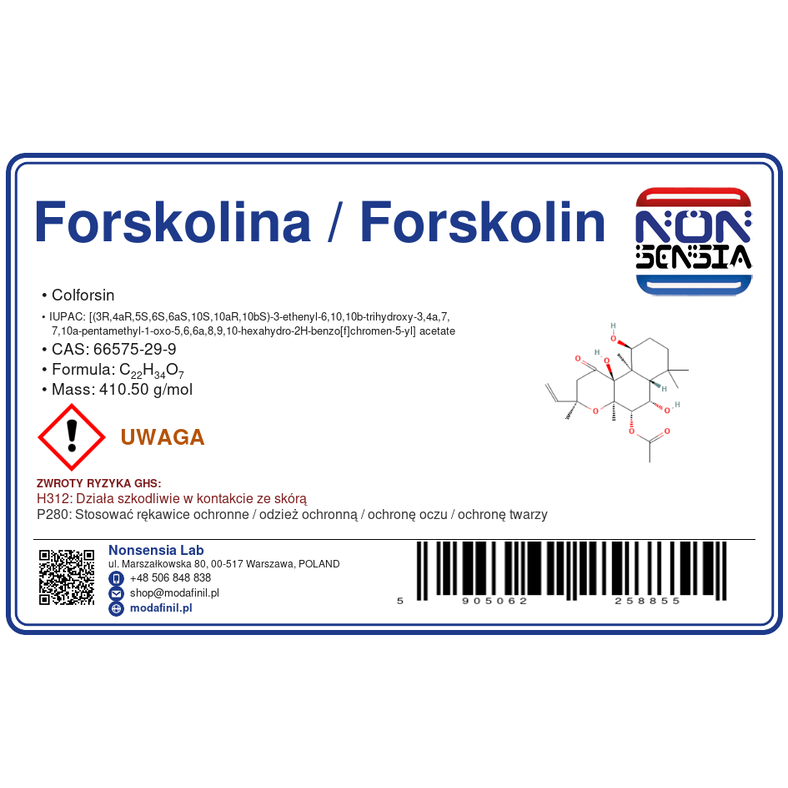
[(3R,4aR,5S,6S,6aS,10S,10aR,10bS)-3-ethenyl-6,10,10b-trihydroxy-3,4a,7,7,10a-pentamethyl-1-oxo-5,6,6a,8,9,10-hexahydro-2H-benzo[f]chromen-5-yl] acetate, more widely known as forskolin, crystalline powder, 1000 mg pack. Material intended exclusively for laboratory and analytical in vitro research. This product is not intended for human or animal consumption; it is not a medicinal product, food supplement, foodstuff or cosmetic.
Three different entities that must not be confused
Forskolin requires the layers to be separated differently from most items in our catalogue — there is no simple “substance — registered medicine” arrangement here. The same molecule is at once a constituent of over-the-counter preparations not regulated as pharmaceuticals and the starting point for the semi-synthesis of a compound that is a registered medicine — under a different name and a different CAS number. The table below separates these contexts:
| Entity | What it is | Status |
|---|---|---|
| Chemical substance forskolin, CAS 66575-29-9 |
A chemical concept — a diterpenoid of defined structure, registered in databases (PubChem, ChEMBL). In itself it is neither a supplement, nor a medicine, nor a reagent; its status is conferred only by the form in which it has been manufactured and placed on the market. | a chemical concept, not a product |
| Extract / commercial preparation standardised extract of Coleus forskohlii root |
A preparation sold over the counter as an aid to weight loss, athletic performance or testosterone levels — without a pharmaceutical regime, without medicinal-product registration documentation, with a forskolin content set by the supplement manufacturer (most often declared as 10–20%). | the human studies cited below concerned this form [13][14][15] |
| Chemical reagent material offered here |
Material for laboratory and analytical work. It does not have, and cannot have, authorisation for use in humans or animals — it has no pharmaceutical form or medicinal-product documentation, nor is it a supplement preparation. | analytics, chemistry, in vitro cell biochemistry |
The consequence is unambiguous. The studies cited further on this page were conducted on finished commercial preparations (extract capsules given to volunteers in a clinical study setting), on isolated cells and membranes in vitro, or on laboratory animals. None of these studies was conducted using the analytical reagent described on this page, and none of their results transfers to the material offered.
A separate matter: colforsin daropate. A chemical derivative of forskolin, obtained by attaching a group that improves water solubility (development code NKH477), is a registered medicine in Japan, administered intravenously in acute heart failure and in cardiac surgery [7][9]. It is a different chemical compound, with a separate CAS number — the registration of that medicine does not in any way concern forskolin as such or the reagent offered here.
Reagent identification sheet
| IUPAC systematic name (chromene nomenclature) | [(3R,4aR,5S,6S,6aS,10S,10aR,10bS)-3-ethenyl-6,10,10b-trihydroxy-3,4a,7,7,10a-pentamethyl-1-oxo-5,6,6a,8,9,10-hexahydro-2H-benzo[f]chromen-5-yl] acetate |
|---|---|
| Systematic name (labdane nomenclature) | 7β-acetoxy-8,13-epoxy-1α,6β,9α-trihydroxylabd-14-en-11-one |
| Common name | forskolin (forskolina), formerly coleonol |
| CAS number | 66575-29-9 |
| Molecular formula | C22H34O7 |
| Molar mass | 410.5 g·mol−1 |
| Monoisotopic mass | 410.2305 Da |
| InChIKey | OHCQJHSOBUTRHG-KGGHGJDLSA-N |
| SMILES (canonical) | CC(=O)OC1C(C2C(CCC(C2(C3(C1(OC(CC3=O)(C)C=C)C)O)C)O)(C)C)O |
| PubChem CID | 47936 |
| ChEMBL | CHEMBL3665034 — status: preclinical, clinical development phase 0 |
| Form | crystalline powder |
| Purity | ≥ 99% |
| Intended use | research reagent — not for human or animal consumption |
Lineage of the molecule: from a root in Lucknow to a tool of cell biochemistry
The history of forskolin begins in a screening programme of medicinal plants, not in a synthetic laboratory. In the 1970s a team at the Central Drug Research Institute in Lucknow (India) examined extracts of Coleus forskohlii root — a plant long used in the folk medicine of the Indian subcontinent — for blood-pressure-lowering activity in animals. The isolated compound was initially named coleonol; the first pharmacological report was published by Dubey and co-workers in 1981 [2]. The name “forskolin” became established later — a summary of this path, from an Ayurvedic remedy to a research tool, was given in the 1985 review by Ammon and Müller [1].
Seamon’s discovery: why chemists started looking for it in every laboratory
The breakthrough was not the isolation of the compound itself but the elucidation of its mechanism. In 1981 Kenneth Seamon and co-workers at the National Institutes of Health showed that forskolin activates adenylate cyclase directly, in cell membranes and cell cultures, bypassing G-protein-coupled receptors [3] — an unusual result, as most activators of this enzyme known at the time acted indirectly, via a receptor. Two years later the same team published a structure–activity relationship study of a series of derivatives, establishing which elements of the skeleton are essential for enzyme activation [4]. Since then forskolin has been a standard biochemical tool for pharmacologically raising cAMP levels in experimental systems — an application distinct from extracts sold as market preparations.
A derivative that reached the clinic — but not the same molecule
Natural forskolin is poorly soluble in water, which limited its usefulness as an intravenously administered medicine. The Japanese pharmaceutical industry developed a derivative with a solubility-enhancing group — development code NKH477, later named colforsin daropate. Hosono and co-workers described its cardiotonic properties in 1992 [7], and subsequent papers compared its action with dobutamine, dopamine and isoproterenol [8][9]. In 2024 a paper appeared evaluating its repurposing in experimental oncology, in ovarian cancer cell lines [10]. This is still a different chemical compound from the reagent offered here.
Timeline
| 1970s | screening of Coleus forskohlii extracts at the Central Drug Research Institute (Lucknow, India); isolation of the compound named coleonol |
|---|---|
| 1981 | first pharmacological publication on coleonol [2]; discovery by Seamon et al. of the mechanism of adenylate cyclase activation [3] |
| 1983 | structure–activity relationship study of forskolin derivatives [4]; first report of intraocular pressure lowering in animals and man [11] |
| 1985 | review “from an Ayurvedic remedy to a modern agent” [1] |
| 1992–1994 | development and study of the water-soluble derivative NKH477 / colforsin daropate [7][8] |
| 1993 | clinical study of an inhaled form of colforsin in asthma, compared with fenoterol [16] |
| 2002 | comparison of colforsin daropate with isoproterenol, dopamine and dobutamine in patients [9] |
| 2005 | clinical study of an oral preparation in overweight and obese men [13] |
| 2006 | the derivative FSK88 described as an inducer of apoptosis in a gastric cancer cell line [18]; clinical study of a preparation in the prevention of asthma attacks [14] |
| 2010 | HPLC-ELSD method for determining forskolin in multi-herbal weight-loss preparations [17]; another clinical study in asthma [15] |
| 2012 | review of the potential of forskolin in ophthalmology [12] |
| 2014–2017 | full elucidation of the forskolin biosynthetic pathway in root cork cells of Coleus forskohlii [5][6] |
| 2024 | repurposing of colforsin daropate tested in experimental oncology [10] |
Research centres and context
The literature on forskolin falls into several clearly distinct strands, pursued at different centres and by different methods:
- India — Central Drug Research Institute, Lucknow. The originating centre: the first isolation and pharmacological description of coleonol came from here [2].
- National Institutes of Health, USA — the Seamon and Daly group. Elucidation of the mechanism at the molecular level: activation of adenylate cyclase in membranes and cells [3] and structure–activity relationships of a series of derivatives [4] — the mechanism that made forskolin a widely used research reagent.
- Japan — pharmaceutical industry, cardiology and anaesthesiology. Development of the water-soluble derivative NKH477/colforsin daropate and its clinical evaluation in heart failure, cardiac surgery and intensive care [7][8][9].
- Mexico — clinical studies in asthma. González-Sánchez and Huerta compared an oral forskolin preparation with standard medicines (sodium cromoglycate, beclomethasone) in the prevention of asthma attacks [14][15].
- Denmark — plant biochemistry and biotechnology (Pateraki et al.). The most recent strand: full elucidation of the forskolin biosynthetic pathway in root cork cells of Coleus forskohlii, opening the way to biotechnological production [5][6].
Caveat applying to this entire section. It describes the history of scientific research from 1981–2024. Animal and cell studies were conducted as preclinical experiments, and studies involving humans — exclusively with finished commercial preparations (oral capsules, an inhaler, injections of the registered derivative), not with the chemical reagent. This is not a description of the properties of the material offered and cannot be the basis for any use of it outside the laboratory.
Chemistry: a highly oxidised labdane skeleton
Why forskolin has two different systematic names
Forskolin is a rare case of a compound for which two separate, fully systematic names are in circulation. The first is based on labdane nomenclature, traditionally used in diterpenoid chemistry: 7β-acetoxy-8,13-epoxy-1α,6β,9α-trihydroxylabd-14-en-11-one. It points directly to the labdane skeleton (a twenty-carbon diterpene with two fused six-membered rings of the trans-decalin type) and the positions of the substituents: the acetate at C7, the C8–C13 oxygen bridge closing the third (tetrahydropyran) ring, three hydroxyls (C1, C6, C9), the ketone at C11 and the double bond at C14, responsible for the vinyl group.
The second name, generated according to IUPAC rules for fused-ring compounds (benzo[f]chromene nomenclature), describes the same skeleton from the standpoint of formal ring fusion, not biosynthetic derivation from labdane. Both refer to exactly the same molecule — the discrepancy arises from two naming conventions used in parallel in the literature, not from the existence of two compounds.
What makes forskolin a rarity among diterpenes
Most natural labdane diterpenoids have a simple oxidation profile — one or two functional groups on the carbon skeleton. Forskolin carries seven oxygen atoms: four in the free hydroxyls and the ketone group, two in the acetate ester, one in the tetrahydropyran ring. This density of functionalisation has analytical significance — the molecule has a high topological polar surface area (113 Ų) despite its extensive hydrocarbon skeleton, which distinguishes it chromatographically from typical, less oxidised plant terpenoids.
Physicochemical characteristics
| Parameter | Value | Implication |
|---|---|---|
| Partition coefficient (XLogP) | ≈ 1 | moderate lipophilicity despite the large carbon skeleton — a result of the dense packing of oxygen groups |
| Topological polar surface area (TPSA) | 113 Å2 | high for a diterpenoid — affects retention in reversed-phase chromatography and the limited solubility in water |
| Hydrogen bond donors | 3 | three free hydroxyl groups — O–H bands in the infrared, sites for chemical derivatisation |
| Hydrogen bond acceptors | 7 | ester, ketone and tetrahydropyran ether oxygens plus the three hydroxyl oxygens |
| Rotatable bonds | 3 | a largely rigid skeleton — rotational freedom limited mainly to the acetate ester |
| Heavy atoms | 29 | a large, multifunctional molecule for a standard analytical reagent |
| Solubility | good in DMSO, ethanol and methanol; poor in water | prepare stock solutions in an organic solvent; it was precisely the limited solubility in water that led to the development of the derivative colforsin daropate for intravenous applications |
Nomenclature and synonyms
The divergence of names here has a different origin from most substances in our catalogue — it is not transliteration or a single manufacturer’s code, but an intersection of botanical, biochemical and registry nomenclature:
- Forskolina / Forskolin — the name most common in current scientific and commercial circulation;
- Koleonol (coleonol) — the original name given by the Lucknow team on isolation of the compound [2]; still encountered in the older literature;
- Colforsin — a synonym of forskolin used particularly in the Japanese and pharmacopoeial literature; note: not to be confused with “colforsin daropate”, which denotes a separate, modified derivative with a different CAS number (see the section “Three different entities”);
- NSC-357088, NSC-375489 — numbers from the National Cancer Institute (USA) registry, assigned to compounds tested in screening programmes;
- CHEBI:42471 — identifier in the ChEBI database (Chemical Entities of Biological Interest);
- 7β-acetoxy-8,13-epoxy-1α,6β,9α-trihydroxylabd-14-en-11-one — the full systematic name in labdane nomenclature, unambiguous together with CAS number 66575-29-9.
When running a bibliographic query it is worth remembering that some older papers (especially from 1977–1985) are indexed only under “coleonol”, not “forskolin” — omitting this variant cuts off access to the original publications from Lucknow.
Laboratory applications of the reagent
- reference material for confirming identity and purity by HPLC, including HPLC with ELSD detection used to determine forskolin in multi-component matrices [17];
- standard reagent for pharmacological activation of adenylate cyclase and raising cAMP levels in cell cultures and membrane preparations in vitro, in line with the mechanism described by Seamon et al. [3];
- model compound in structure–activity relationship studies of labdane diterpenoids [4];
- starting substrate in research on the semi-synthesis of derivatives with altered solubility or activity, following the route that led to colforsin daropate [7] and FSK88 [18];
- standard in LC-MS and UHPLC-QTOF methods for the phytochemical analysis of extracts of plants of the genus Coleus/Plectranthus [19].
Storage, handling and occupational safety
Store in the original, tightly closed container in a dry, cool place protected from light, separately from food and animal feed and out of the reach of children. The acetate ester is sensitive to hydrolysis — moisture and elevated temperature promote decomposition, so dry storage matters more here than for reagents lacking ester groups. Work only under laboratory conditions, using personal protective equipment: gloves, safety glasses and laboratory clothing; weigh the powder under conditions that limit dust formation. Avoid inhaling the dust and contact with skin and eyes. Dispose of waste in accordance with the regulations applicable to chemical waste at the place where the research is conducted.
Hazard classification. According to PubChem data, the material is classified with the GHS07 pictogram (exclamation mark, signal word “Warning”), hazard statement H312 (harmful in contact with skin) and precautionary statement P280 (wear protective gloves, protective clothing and eye and face protection). As of the date the data were retrieved (2026-07-03), the PubChem database contains no LD50 value for this substance — the absence of an entry does not mean an absence of toxicity; always consult the current safety data sheet (SDS) before working with the material.
Regulatory status
Forskolin is not listed in the ChEMBL registry as a registered medicinal substance — the database gives it a preclinical status (ChEMBL CHEMBL3665034, clinical development phase 0). The registered medicine — in Japan, for intravenous administration in acute heart failure — is its derivative, colforsin daropate; this, however, concerns a separate chemical compound, with a different CAS number, not forskolin as such. Extracts of Coleus forskohlii root are moreover sold in many countries as an ingredient of market preparations, under the legal regime governing such trade rather than pharmaceutical law — this offer does not concern those preparations either. The material offered here is a chemical reagent and has no authorisation for any use in humans or animals. The legal status of trade in forskolin and preparations containing it may be subject to changes in national law — the buyer is responsible for checking the legal position in the country of destination before ordering and for ensuring that the intended use of the reagent complies with applicable regulations.
Frequently Asked Questions
What is forskolin and where does it come from?
Forskolin is a naturally occurring labdane diterpenoid, first isolated from the root of the plant Coleus forskohlii at the Central Drug Research Institute in Lucknow (India) in the 1970s, initially under the name coleonol [2].
Is forskolin the same as coleonol?
Yes. Coleonol (koleonol) is the original name given on isolation of the compound in the 1970s; the name “forskolin” became established later and now predominates in the literature. Same CAS number 66575-29-9.
What are the chemical formula and molar mass of forskolin?
C22H34O7; molar mass 410.5 g·mol−1, monoisotopic mass 410.2305 Da. CAS number 66575-29-9, InChIKey OHCQJHSOBUTRHG-KGGHGJDLSA-N.
How does forskolin differ from colforsin daropate?
Colforsin daropate (development code NKH477) is a semi-synthetic derivative of forskolin with an attached group that improves water solubility, developed with intravenous administration in mind [7]. It is a separate chemical compound, with a different CAS number from forskolin — registered as a medicine in Japan, used in acute heart failure.
Is the reagent suitable for uses other than laboratory ones?
No. The material is intended exclusively for laboratory and analytical research. It is not intended for human or animal consumption; it is not a medicine, food supplement, food or cosmetic and must not be used for medical, diagnostic or consumption purposes.
How should forskolin be stored as a laboratory reagent?
In the original, tightly closed container in a dry, cool place protected from light, separately from food and animal feed and out of the reach of children. Because of the acetate ester, which is sensitive to hydrolysis, protection from moisture is particularly important.
What should forskolin be dissolved in to prepare a stock solution?
It dissolves well in DMSO, ethanol and methanol, poorly in water. Stock solutions are prepared in an organic solvent — the limited water solubility is, in fact, the reason a water-soluble derivative was developed for clinical applications (colforsin daropate).
Why does forskolin have two different IUPAC systematic names?
Because two naming conventions for the same skeleton exist in parallel in the chemical literature: the traditional labdane nomenclature (describing biosynthetic origin) and the systematic fused-ring nomenclature of benzo[f]chromenes. Both names refer to exactly the same molecule with CAS number 66575-29-9.
What is forskolin used for in cell biochemistry?
As a research reagent it is a standard tool for the pharmacological activation of adenylate cyclase in cell cultures and isolated membranes in vitro, used in experiments on the cAMP pathway discovered by Seamon et al. [3]. This is an application under laboratory experimental conditions, not a description of effects in humans.
Is a safety data sheet supplied with forskolin?
We provide the safety data sheet on request to recipients engaged in research or analytical activities. The PubChem database gives no LD50 value for this substance — the toxicological data remain partly undetermined.
Is forskolin legal in Poland?
Forskolin is not a registered medicine — that status applies only to its derivative, colforsin daropate, registered in Japan. The material offered is a chemical reagent without authorisation for use in humans. The legal status of trade may be subject to changes in national law; the buyer is responsible for ensuring that the intended use complies with the law of the country of destination.
How is forskolin identified in HPLC analysis and mass spectrometry?
By HPLC with UV or ELSD detection against a reference material, taking into account the high topological polar surface area (113 Ų) that affects retention [17]. In mass spectrometry, the exact mass of 410.2305 Da and the presence of the acetate ester (characteristic loss of a fragment of mass 60) facilitate unambiguous identification in plant matrices.
References
The entries come from the PubMed database. Entries [1]–[6] and [18]–[19] concern chemistry, in vitro mechanism of action and biosynthesis (cells, membranes, plant tissue). Entries [7]–[10] concern colforsin daropate — a medicine registered in Japan with a separate CAS number — studied in patients in hospital settings. Entries [11]–[12] concern ophthalmological applications in animals and (entry 11) partly in humans. Entries [13]–[17] are studies conducted on finished commercial preparations (capsules, an inhaler), not on the analytical reagent. None of these papers describes the use of the reagent offered on this page — they are cited as scientific context, not as information about the properties of the material nor as encouragement of any use.
- Ammon HP, Müller AB (1985). “Forskolin: from an ayurvedic remedy to a modern agent.” Planta Med. PMID 17345261. doi:10.1055/s-2007-969566.
- Dubey MP, Srimal RC, Nityanand S, Dhawan BN (1981). “Pharmacological studies on coleonol, a hypotensive diterpene from Coleus forskohlii.” J Ethnopharmacol. PMID 7193263. doi:10.1016/0378-8741(81)90010-6.
- Seamon KB, Padgett W, Daly JW (1981). “Forskolin: unique diterpene activator of adenylate cyclase in membranes and in intact cells.” Proc Natl Acad Sci U S A. PMID 6267587. doi:10.1073/pnas.78.6.3363.
- Seamon KB et al. (1983). “Structure-activity relationships for activation of adenylate cyclase by the diterpene forskolin and its derivatives.” J Med Chem. PMID 6681845. doi:10.1021/jm00357a021.
- Pateraki I et al. (2014). “Manoyl oxide (13R), the biosynthetic precursor of forskolin, is synthesized in specialized root cork cells in Coleus forskohlii.” Plant Physiol. PMID 24481136. doi:10.1104/pp.113.228429.
- Pateraki I et al. (2017). “Total biosynthesis of the cyclic AMP booster forskolin from Coleus forskohlii.” Elife. PMID 28290983. doi:10.7554/eLife.23001.
- Hosono M et al. (1992). “Cardiovascular and adenylate cyclase stimulant properties of NKH477, a novel water-soluble forskolin derivative.” J Cardiovasc Pharmacol. PMID 1380607.
- Mori M et al. (1994). “Effect of NKH477, a new water-soluble forskolin derivative, on arterial-ventricular coupling and mechanical energy transduction in patients with left ventricular systolic dysfunction: comparison with dobutamine.” J Cardiovasc Pharmacol. PMID 7526066.
- Yoneyama M et al. (2002). “Cardiovascular and adenylate cyclase stimulating effects of colforsin daropate, a water-soluble forskolin derivative, compared with those of isoproterenol, dopamine and dobutamine.” Circ J. PMID 12499623. doi:10.1253/circj.66.1150.
- Knarr MJ et al. (2024). “Repurposing colforsin daropate to treat MYC-driven high-grade serous ovarian carcinomas.” Sci Signal. PMID 39561220. doi:10.1126/scisignal.ado8303.
- Caprioli J, Sears M (1983). “Forskolin lowers intraocular pressure in rabbits, monkeys, and man.” Lancet. PMID 6132271. doi:10.1016/s0140-6736(83)92084-6.
- Wagh VD et al. (2012). “Forskolin: upcoming antiglaucoma molecule.” J Postgrad Med. PMID 23023353. doi:10.4103/0022-3859.101396.
- Godard MP, Johnson BA, Richmond SR (2005). “Body composition and hormonal adaptations associated with forskolin consumption in overweight and obese men.” Obes Res. PMID 16129715. doi:10.1038/oby.2005.162.
- González-Sánchez R et al. (2006). “Forskolin versus sodium cromoglycate for prevention of asthma attacks: a single-blinded clinical trial.” J Int Med Res. PMID 16749416. doi:10.1177/147323000603400210.
- Huerta M et al. (2010). “Forskolin compared with beclomethasone for prevention of asthma attacks: a single-blind clinical trial.” J Int Med Res. PMID 20515580. doi:10.1177/147323001003800229.
- Bauer K et al. (1993). “Pharmacodynamic effects of inhaled dry powder formulations of fenoterol and colforsin in asthma.” Clin Pharmacol Ther. PMID 8422745. doi:10.1038/clpt.1993.11.
- Virgona N et al. (2010). “A rapid HPLC with evaporative light scattering method for quantification of forskolin in multi-herbal weight-loss solid oral dosage forms.” Pharmazie. PMID 20503921.
- Li Z et al. (2006). “A forskolin derivative, FSK88, induces apoptosis in human gastric cancer BGC823 cells through caspase activation involving regulation of Bcl-2 family gene expression, dissipation of mitochondrial membrane potential and cytochrome c release.” Cell Biol Int. PMID 16889987. doi:10.1016/j.cellbi.2006.06.015.
- He L et al. (2019). “Rapid Screening of Forskolin-Type Diterpenoids of Blumea aromatica DC Using Ultra-High-Performance Liquid Chromatography Tandem Quadrupole Time-of-Flight Mass Spectrometry Based on the Mass Defect Filtering Approach.” Molecules. PMID 31450838. doi:10.3390/molecules24173073.
Identification data and computed descriptors from PubChem (CID 47936) and the ChEMBL registry (CHEMBL3665034).
Related reagents in our catalogue
- Caffeine (Kofeina) — a biochemical contrast within the same signalling pathway: forskolin directly activates cAMP synthesis via adenylate cyclase, whereas caffeine slows its breakdown by inhibiting phosphodiesterases — two different points of the same nucleotide turnover cycle
- Tadalafil (CAS 171596-29-5) — a contrast of mechanism within the cyclic nucleotide family: forskolin raises cAMP levels at the synthesis step, tadalafil raises cGMP levels by inhibiting phosphodiesterase PDE5 — separate pathways of the same class of second messengers
Statement of intended use
The material offered is a chemical reagent intended exclusively for research, analytical and laboratory purposes. It is not intended for human or animal consumption. It is not a medicinal product, food supplement, foodstuff, medical device or cosmetic. It must not be used for medical, diagnostic, therapeutic, prophylactic or consumption purposes, administered to humans or animals, applied to the skin, or added to food, beverages or animal feed. Sold exclusively to recipients engaged in research, scientific or analytical activities who have laboratory facilities and the knowledge required to handle chemical reagents safely. The buyer bears sole responsibility for the lawful and safe use of the reagent and for compliance with the regulations in force in the country of destination.