
Description
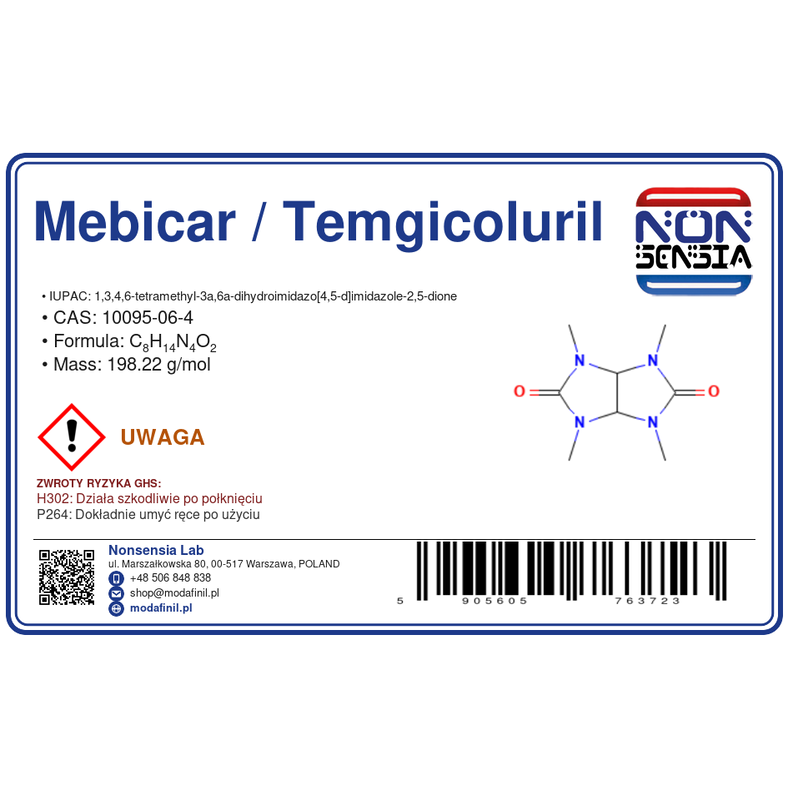
1,3,4,6-tetramethyl-3a,6a-dihydroimidazo[4,5-d]imidazole-2,5-dione (common name: mebicar), crystalline powder, 1000 mg pack. Material intended exclusively for laboratory and analytical in vitro research. This product is not intended for human or animal consumption; it is not a medicinal product, food supplement, foodstuff or cosmetic.
Three different entities that must not be confused
For this molecule, separating the layers is particularly important, because the same chemical name appears in the clinical literature under the trade name of a pharmaceutical preparation. Three contexts, three entirely different statuses:
| Entity | What it is | What it concerns |
|---|---|---|
| Chemical substance mebicar, CAS 10095-06-4 |
A chemical concept — a molecule of defined structure. In itself it is neither a medicine nor a reagent; its status is conferred only by the form in which it has been manufactured and authorised. | chemistry, substance registries |
| Medicinal product Adaptol, tablet form (Olainfarm JSC, Latvia) |
A pharmaceutical preparation manufactured under a pharmaceutical regime, present in the clinical literature under its trade name since at least 2009 [10], used mainly in Russia and some CIS countries. | the human clinical studies cited below concern this entity |
| Chemical reagent material offered here |
Material for laboratory and analytical work. It does not have, and cannot have, authorisation for use in humans or animals — it has no pharmaceutical form or medicinal-product documentation. | analytics, chemistry, reference standards |
The consequence is unambiguous. The study results cited further on this page were obtained either using the registered medicinal product (clinical studies involving humans) or using the substance administered to laboratory animals under controlled experimental conditions (preclinical studies). None of these studies was conducted using the analytical reagent, and none of their results transfers to the material offered. The reagent is not a form in which the substance has ever been studied in humans, and it cannot be used in such a way.
Reagent identification sheet
| Systematic name (IUPAC) | 1,3,4,6-tetramethyl-3a,6a-dihydroimidazo[4,5-d]imidazole-2,5-dione |
|---|---|
| Common names | mebicar, mebikar |
| Chemical class name | tetramethylglycoluril (Temgicoluril) |
| CAS number | 10095-06-4 |
| Molecular formula | C8H14N4O2 |
| Molar mass | 198.22 g·mol−1 |
| Monoisotopic mass | 198.1117 Da |
| InChIKey | XIUUSFJTJXFNGH-UHFFFAOYSA-N |
| SMILES | CN1C2C(N(C1=O)C)N(C(=O)N2C)C |
| PubChem CID | 122282 |
| ChEMBL | CHEMBL4303164 — status: preclinical (max_phase 0) |
| Form | crystalline powder, white to off-white |
| Purity | ≥ 99% |
| Intended use | research reagent — not for human or animal consumption |
Lineage of the molecule: a bicyclic bis-urea of the glycoluril family
The first PubMed-indexed paper on this molecule dates from 1977 and describes it directly as a derivative of bicyclic bis-ureas (bicyclic bis-ureas), placing the then-new compound between the classical tranquillisers and the neuroleptics [1]. Five years later the same team refined the structural classification as a derivative of tetra-N-alkylated bicyclic bis-ureas [3] — a term that corresponds exactly to the core known in organic chemistry as glycoluril: two imidazolidine rings fused along an edge, each terminating in a urea (carbonyl) group.
From glycoluril to mebicar: full methyl substitution
Glycoluril itself (unsubstituted) has been known since the end of the 19th century and today remains primarily a building block in supramolecular chemistry — it is used to synthesise cucurbituril macrocycles, employed as molecular hosts. Mebicar is formed by substituting all four nitrogen atoms with methyl groups (hence the synonym “tetramethylglycoluril”). This seemingly minor modification has a serious structural consequence, described below in the chemistry section: it abolishes the molecule’s ability to act as a hydrogen bond donor.
The first decade of research (1977–1990)
The early papers, published almost exclusively in Russian and indexed under translated titles, built up the pharmacological profile of the compound through successive animal studies: effects on the orienting response and seizure threshold [1], elimination of the fear response in cats without accompanying muscle-relaxant or hypnotic action, and effects on brain noradrenaline and serotonin levels [2], a GABA-ergic component of action [3] and cardiovascular responses [6]. In parallel, the first clinical pharmacokinetic studies were conducted [4].
Timeline
| 1977 | first PubMed-indexed pharmacological publication, classifying the compound as a derivative of bicyclic bis-ureas [1] |
|---|---|
| 1980–1990 | a series of Soviet preclinical studies building the pharmacological, toxicological and cardiological profile [2][3][5][6] |
| 1984 | clinical pharmacokinetic study in patients of an addiction clinic — correlation of pharmacodynamic and pharmacokinetic parameters [4] |
| 1996 | continuation of preclinical research: effect on lipid metabolism in a rat hypokinesia model [7] |
| 2009 | first indexed paper using the trade name of the pharmaceutical preparation (see the table «Three different entities» above) in a clinical context — treatment of ADHD [10] |
| 2011 | comparative studies with classical medicines (amitriptyline, diazepam) in animal models [8]; clinical study of cervicogenic headache [11] |
| 2012–2016 | a series of clinical studies on the use of the pharmaceutical preparation listed in the table «Three different entities» in anxiety disorders of various origins, including a randomised study in chronic cerebral ischaemia [12][13] |
| 2020 | comparative study of mebicar and mianserin in patients with psoriasis and co-existing anxiety [14] |
| 2023–2024 | the most recent clinical papers: combined treatment in hypertension and post-COVID syndrome in older people [15] and a randomised study of anxiety therapy supported by a mobile application [16] |
Research centres and groups that built the literature
As with other molecules of Soviet lineage, the literature on mebicar has a clear geography and divides into several distinct periods and teams:
- The early pharmacological group (1977–1996). The authors Zimakova, Kirshin, Kamburg, Serov and Treskov published in the journals “Farmakologiya i Toksikologiya” and “Byulleten’ Eksperimental’noi Biologii i Meditsiny”, building the basic pharmacological, toxicological and pharmacokinetic profile of the compound [1]–[7].
- The L. Chutko group (from 2009). A team publishing in “Zhurnal Nevrologii i Psikhiatrii im. S. S. Korsakova” (Chutko, Surushkina, Nikishena and co-workers) focused on clinical applications of the pharmaceutical preparation listed in the table «Three different entities» in anxiety disorders in children and adults: ADHD [10], chronic tics [12] and headaches [11].
- The neurological–cardiological group. Researchers such as Vorob’eva and Repina (Sechenov University, Moscow) analysed the use of this pharmaceutical preparation in patients with anxiety-asthenic disorders accompanying chronic cerebral ischaemia, including in one of the few randomised studies in this literature [13].
- Contemporary comparative pharmacology (Kazan). The group of Ziganshina and co-workers compared mebicar directly with classical medicines — amitriptyline and diazepam — in animal models of pain and inflammation, also introducing into the literature the description of mebicar as a “diurnal anxiolytic” (diurnal anxiolytic) [8][9].
Caveat applying to this entire section and to the Timeline. It describes the history of scientific research from 1977–2024. Preclinical studies were conducted on laboratory animals, and studies involving humans — exclusively using the registered medicinal product listed in the table «Three different entities» above, not the chemical reagent. A considerable proportion of the early Soviet papers do not meet modern methodological standards (randomisation, blinding, placebo control group) — the more recent studies of the Moscow group are of this kind [13][16], but most remain observational or open-label. This is not a description of the properties of the material offered and cannot be the basis for any use of it outside the laboratory.
Chemistry: no hydrogen bond donors and the resulting hydrophilicity
Why mebicar does not behave like a typical urea
Classical urea moieties are strong hydrogen bond donors owing to their N–H bonds. In mebicar all four nitrogen atoms of the glycoluril core are fully substituted with methyl groups — there is not a single N–H bond in the molecule. This is reflected directly in the number of hydrogen bond donors in the computed data: HBD = 0, even though structurally the compound remains a bis-urea. This is the most important chemical consequence of full methylation: the molecule loses the ability to form the hydrogen-bond network typical of unsubstituted glycoluril, which translates into different crystallisation and solubility behaviour.
Physicochemical characteristics and their implications for analytical work
| Parameter | Value | Implication |
|---|---|---|
| Partition coefficient (XLogP, computed) | ≈ −0.9 | a distinctly hydrophilic molecule — elutes early in reversed-phase chromatography |
| Topological polar surface area (TPSA) | 47.1 Å2 | moderate despite the absence of donors — the surface is generated solely by acceptors (carbonyl oxygen) |
| Hydrogen bond donors | 0 | no N–H bonds — full methylation of the glycoluril core |
| Hydrogen bond acceptors | 2 | two carbonyl oxygen atoms |
| Rotatable bonds | 0 | rigid, bicyclic skeleton — no conformational freedom |
| Heavy atoms | 14 | a small, compact molecule — mass 198.22 g·mol−1 |
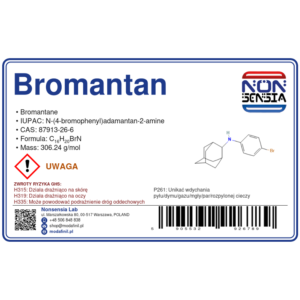
This hydrophilicity clearly distinguishes mebicar from other reagents in our catalogue of similar geographical and temporal lineage. Bromantan (CAS 87913-26-6), an adamantane derivative developed in a similar period of Soviet pharmacological research, has an XLogP ≈ 5 — it is strongly lipophilic. The difference is large enough that the two compounds require entirely different conditions for preparing stock solutions and different gradients in reversed-phase chromatography, despite their related historical context.
Stereochemistry without an unambiguous definition in the registries
The glycoluril core has two ring-junction carbons (positions 3a and 6a) which could in theory be stereogenic centres. In practice, however, the canonical InChI for this CID in PubChem contains no stereochemical layer — unlike, for example, modafinil (CAS 68693-11-8), where the single stereogenic centre at the sulfur atom is unambiguously described and distinguished analytically (enantioselective methods). The symmetry of mebicar’s methyl substitution means that the typical, cis-fused form of the molecule does not in practice require enantiomer separation as part of quality control.
Nomenclature: five names, one compound
- Mebicar — the common name most frequent in the Western literature and in the reagent trade;
- Mebikar — a transliteration variant, present in parallel in PubMed indexes (both variants must be combined in a bibliographic query);
- Temgicoluril — the chemical class name, used interchangeably with the trade name in some more recent publications [16];
- Tetramethylglycoluril — a descriptive name indicating the chemical core and the degree of substitution;
- 1,3,4,6-tetramethyl-3a,6a-dihydroimidazo[4,5-d]imidazole-2,5-dione — the IUPAC systematic name, the only unambiguous one.
In some chemical databases the CAS number 106780-29-4, indicated by PubChem as related, is additionally found for this compound. The material offered on this page is described solely by CAS number 10095-06-4, consistent with the shop’s local chemical identity register — in case of doubt about the identity of a batch, the safety data sheet accompanying the specific delivery is decisive.
Laboratory applications of the reagent
- reference material for confirming identity and purity by HPLC-UV;
- standard in GC-MS and LC-MS methods — a small, compact molecule (198.22 g·mol−1, 14 heavy atoms) with simple, predictable chromatographic behaviour;
- comparator compound in experimental animal pharmacology — in some published studies mebicar served as a reference point compared directly with classical medicines, amitriptyline and diazepam [8][9];
- model material in glycoluril-core chemistry — a structure used in supramolecular chemistry as a building block of cucurbituril macrocycles;
- comparator material in the validation of methods for determining temgicoluril in pharmaceutical matrices.
Storage, handling and occupational safety
Store in the original, tightly closed container in a dry, cool place protected from light, separately from food and animal feed and out of the reach of children. Work only under laboratory conditions, using personal protective equipment: gloves, safety glasses and laboratory clothing; weigh the powder under conditions that limit dust formation. Avoid inhaling the dust and contact with skin and eyes. Dispose of waste in accordance with the regulations applicable to chemical waste at the place where the research is conducted.
Hazard classification. According to PubChem data, the substance is subject to GHS classification with the signal word “Warning”, the GHS07 pictogram, the hazard statement H302 — harmful if swallowed and the precautionary statement P264 — wash hands thoroughly after handling. This is a classification derived from chemical registries, not a substitute for the full safety data sheet, which must be obtained and read before starting work.
Regulatory status
The pharmaceutical preparation listed in the table «Three different entities» above is a registered medicinal product used clinically mainly in Russia and some countries of the former USSR; the manufacturer (Olainfarm JSC, Latvia) and the form (tablets) are indicated in the clinical literature [16]. This offer does not concern that preparation. A discrepancy between registries is worth noting: the international ChEMBL database (CHEMBL4303164) classifies the compound itself as “preclinical” (max_phase = 0) — Western databases do not always reflect drug registrations made outside the FDA/EMA jurisdiction. The material offered is a chemical reagent and has no authorisation for any use in humans or animals. The buyer is responsible for ensuring that the intended use complies with the law in force in the country of destination.
Frequently Asked Questions
Is mebicar a medicine?
The chemical substance itself is not. Under the trade name of a registered pharmaceutical preparation (see the table «Three different entities» above) there exists a medicinal product used clinically mainly in Russia and some CIS countries — the material offered here is a chemical reagent and is not covered by that registration.
What is temgicoluril?
It is another name for the same compound, indicating its membership of the glycoluril family — a bicyclic core built from two fused imidazolidine rings terminating in urea groups. It is sometimes used interchangeably with the trade name of the pharmaceutical preparation (see the table «Three different entities» above) in contemporary clinical publications.
What are the chemical formula and molar mass of mebicar?
C8H14N4O2; molar mass 198.22 g·mol−1, monoisotopic mass 198.1117 Da. CAS number 10095-06-4, InChIKey XIUUSFJTJXFNGH-UHFFFAOYSA-N.
Why is mebicar sometimes called a “diurnal anxiolytic”?
The term appears in the pharmacological literature comparing mebicar with classical medicines — it stems from the profile studied in animal models, without the accompanying hypnotic or muscle-relaxant action characteristic of benzodiazepines [9]. This is a description of the studied medicinal product taken from the scientific literature, not a property of the reagent offered.
To which structural class does mebicar belong?
To the bicyclic bis-ureas of the glycoluril family — two fused imidazolidine rings, fully substituted with four methyl groups on the nitrogen atoms. This classification is already confirmed by the first publication from 1977 [1].
Does mebicar require enantiomer separation as part of quality control?
In practice, no. Although structurally the molecule has two ring-junction carbons that could in theory be stereogenic centres, the canonical PubChem record for this compound contains no stereochemical layer — unlike modafinil, where the stereogenic centre at the sulfur is unambiguously defined and distinguished analytically.
How should mebicar be stored as a laboratory reagent?
In the original, tightly closed container in a dry, cool place protected from light, separately from food and animal feed and out of the reach of children.
Is a safety data sheet supplied with mebicar?
We provide the safety data sheet on request to recipients engaged in research or analytical activities. According to PubChem data, the substance is subject to GHS classification with the signal word “Warning” and the hazard statement H302 (harmful if swallowed).
Is mebicar legal in Poland?
The chemical substance itself is not listed as a controlled substance in the registries known to us. The pharmaceutical preparation listed in the table «Three different entities» is registered and used clinically in Russia — that registration does not cover the chemical reagent offered on this page. The buyer is responsible for checking the legal position in the country of destination before ordering.
What is a mebicar standard used for in an analytical laboratory?
For confirming identity and purity by HPLC-UV, as a standard in GC-MS and LC-MS, as a comparator compound in experimental pharmacology comparing it with classical medicines, and as a model material in glycoluril-core chemistry.
How does mebicar differ in lipophilicity from other reagents in the catalogue?
It is distinctly more hydrophilic: XLogP ≈ −0.9, compared with ≈ 1.3 for modafinil and ≈ 5 for bromantan. This results from the absence of hydrogen bond donors and the small, rigid structure of the molecule — even though all three compounds have a similar Soviet or French research lineage from the same period.
References
The entries come from the PubMed database and concern the chemistry, preclinical pharmacology and history of clinical research on this molecule. Entries [1]–[9] are preclinical studies in laboratory animals and methodological/pharmacokinetic papers; entries [10]–[16] are studies involving humans, conducted exclusively using the registered medicinal product listed in the table «Three different entities» — not using the chemical reagent. The whole is cited as scientific context and a bibliographic pointer, not as information about the use of the material offered nor as encouragement of any use. The list is complete with respect to the queries run in the PubMed database as of 2026-09-06 and has been filtered against entries already cited by another shop offering this reagent.
- Zimakova IE (1977). Pharmacological effects of the new psychotropic preparation, mebikar. Farmakol Toksikol. PMID 598490.
- Val’dman AV, Zaikonnikova IV, Kozlovskaia MM et al. (1980). Characteristics of the psychotropic spectrum of action of mebicar. Biull Eksp Biol Med. PMID 6104993.
- Kirshin SV, Zimakova IE (1982). GABA-ergic component in the action of the tranquilizing agent mebikar. Farmakol Toksikol. PMID 7075749.
- Serov NV, Treskov VG, Berliand AS et al. (1984). Clinical pharmacokinetics of mebikar. Farmakol Toksikol. PMID 6734814.
- Kamburg RA, Zaikonnikova IV (1986). Results of the experimental study and clinical use of the tranquilizer mebikar. Farmakol Toksikol. PMID 3519278.
- Kamburg RA (1990). An analysis of the cardiovascular reactions due to mebikar. Farmakol Toksikol. PMID 2253745.
- Zamakova IE, Salikhova RR, Tagirova TS et al. (1996). Effect of the tranquilizer mebicar on lipid metabolism and lipid peroxidation in a rat hypokinesic model. Biull Eksp Biol Med. PMID 8744131.
- Kaziakhmetova VN, Valeeva IKh, Ziganshina LE (2011). Anti-inflammatory effects of amitriptyline, diazepam and mebicar using model of acute carrageenan-induced paw edema in rats. Eksp Klin Farmakol. PMID 22379877.
- Khaziakhmetova VN, Luchai KV, Ziganshina LE (2015). Experimental comparative study of the analgesic activity of the diurnal anxiolytic mebicar, amitriptyline, and diazepam. Eksp Klin Farmakol. PMID 26036004.
- Chutko LS, Surushkina SIu, Nikishena IS et al. (2009). Adaptol in the treatment of ADHD. Zh Nevrol Psikhiatr Im S S Korsakova. PMID 19738569.
- Tursunova KB, Chutko LS (2011). Adaptol in the treatment of chronic cervicogenic headache. Zh Nevrol Psikhiatr Im S S Korsakova. PMID 21905338.
- Chutko LS, Surushkina SIu, Bykova IuL et al. (2012). Chronic tic disorders in children and adolescents and their treatment with adaptol. Zh Nevrol Psikhiatr Im S S Korsakova. PMID 23330198.
- Vorob’eva OV, Repina VV (2016). An open comparative observational study of the efficacy and safety of adaptol in anxiety-asthenic disorders in patients with chronic cerebral ischemia. Zh Nevrol Psikhiatr Im S S Korsakova. PMID 27070467. doi:10.17116/jnevro20161163120-24.
- Matiushenko VP, Kutasevych YF, Havryliuk OA et al. (2020). Effectiveness of psychopharmacotherapy in psoriasis patients with associated anxiety and depression. Dermatol Ther. PMID 32909641. doi:10.1111/dth.14292.
- Kazakov YM, Potiazhenko MM, Nastroga TV (2023). Treatment optimization in management of combined pathology — arterial hypertension and post-COVID syndrome in elderly patients. Wiad Lek. PMID 37622495. doi:10.36740/WLek202307105.
- Levin OS (2024). Efficacy and quality-of-life impact of a mobile application combined with Adaptol (temgicoluril) therapy in anxiety disorder. Zh Nevrol Psikhiatr Im S S Korsakova. PMID 39113449. doi:10.17116/jnevro202412407198.
Identification data and computed descriptors from PubChem (CID 122282); GHS classification from PubChem; registration status from ChEMBL (CHEMBL4303164).
Related reagents in our catalogue
- Bromantan (CAS 87913-26-6) — a compound of related Soviet research lineage from the same period, but a different chemical class (adamantane) and radically different lipophilicity (XLogP ≈ 5 versus ≈ −0.9 for mebicar)
- Modafinil (CAS 68693-11-8) — a stereochemical contrast: a single, well-documented stereogenic centre at the sulfur atom versus the stereochemistry of the ring-junction carbons in mebicar, which is undefined in PubChem
Statement of intended use
The material offered is a chemical reagent intended exclusively for research, analytical and laboratory purposes. It is not intended for human or animal consumption. It is not a medicinal product, food supplement, foodstuff, medical device or cosmetic. It must not be used for medical, diagnostic, therapeutic, prophylactic or consumption purposes, administered to humans or animals, applied to the skin, or added to food, beverages or animal feed. Sold exclusively to recipients engaged in research, scientific or analytical activities who have laboratory facilities and the knowledge required to handle chemical reagents safely. The buyer bears sole responsibility for the lawful and safe use of the reagent and for compliance with the regulations in force in the country of destination.