
Description
N-(2-adamantyl)-4-chlorobenzamide (Chlodantane), crystalline powder, 1000 mg package. Material intended exclusively for laboratory and analytical in vitro research. This product is not intended for consumption by humans or animals, it is not a medicinal product, a dietary supplement, a food product, or a cosmetic.
The thing that needs to be said up front
Chlodantan is a chemical compound with a fully defined structure, but without any dedicated scientific literature. A search of the PubMed database for the name “Chlodantane”, CAS number 185384-80-9, and the systematic name returns no work devoted to this compound. The only match for the phrase “Chlodantane” is a review paper on adamantane derivatives in general (Morozov et al., 1999) — found through a partial word match, not through an actual description of this molecule, and already used in the literature of a competing shop, so we exclude it for that reason as well.
Registry data says more than the silence of the literature. The structure has been listed in PubChem as CID 959689 since July 9, 2005, indexed by chemical supplier databases and screening libraries (ChemDB, ABI Chem, BLD Pharm, ZINC), in the EPA DSSTox registry, and in PATENTSCOPE (WIPO) — without a patent assigned directly to the compound. In ChEMBL (CHEMBL4111629) it has the status “Preclinical” (clinical development phase: 0) and no assigned mechanism of action. In other words: the compound is catalogued chemically, but has never entered any documented research program into biological activity.
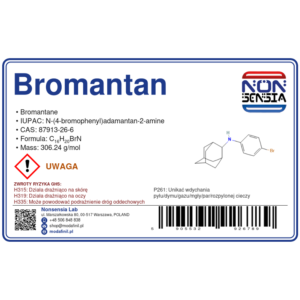
This puts Chlodantan in a different situation than bromantan, whose history — a Soviet actoprotector program, three research centers, more than a dozen preclinical studies, and clinical trials conducted using a medicinal product registered in Russia (trade name described on the bromantan page) — is documented with dates. Calling Chlodantan an “analog of bromantan” is justified structurally (both are substituted 2-aminoadamantanes), but does not transfer a single research result onto it. For completeness, we also checked what a query for the related chemical class “adamantyl benzamide” actually returns — real papers exist, but they concern an entirely different pharmacology; we list them below in the References section, clearly marked as not pertaining to this compound.
Three different entities that must not be confused
| Entity | What it is | Status of Chlodantan |
|---|---|---|
| Chemical substance Chlodantan, CAS 185384-80-9 |
A chemical concept — a molecule with a defined structure, registered in chemical databases (PubChem, ChEMBL). | yes — this is the only status this molecule actually has |
| Medicinal product | A pharmaceutical preparation: pharmaceutical form, GMP regime, registration documentation, safety oversight. | NO — in any country. The compound has never even entered Phase I clinical trials (ChEMBL: phase 0) |
| Chemical reagent material offered here |
Material for laboratory and analytical work. It does not have, and cannot have, approval for use in humans or animals. | yes — and it is offered exclusively in this capacity |
The consequence is unambiguous. There is no registered medicinal product containing this substance, so there is no risk of confusing the reagent with a drug — but there are also no clinical or preclinical studies to refer to. The only data we have concern the molecule’s structure and its physicochemical behavior, and a rigorous description of this material is limited to that. The reagent is not a form in which anything was ever studied — because this molecule was not studied at all.
Reagent identification card
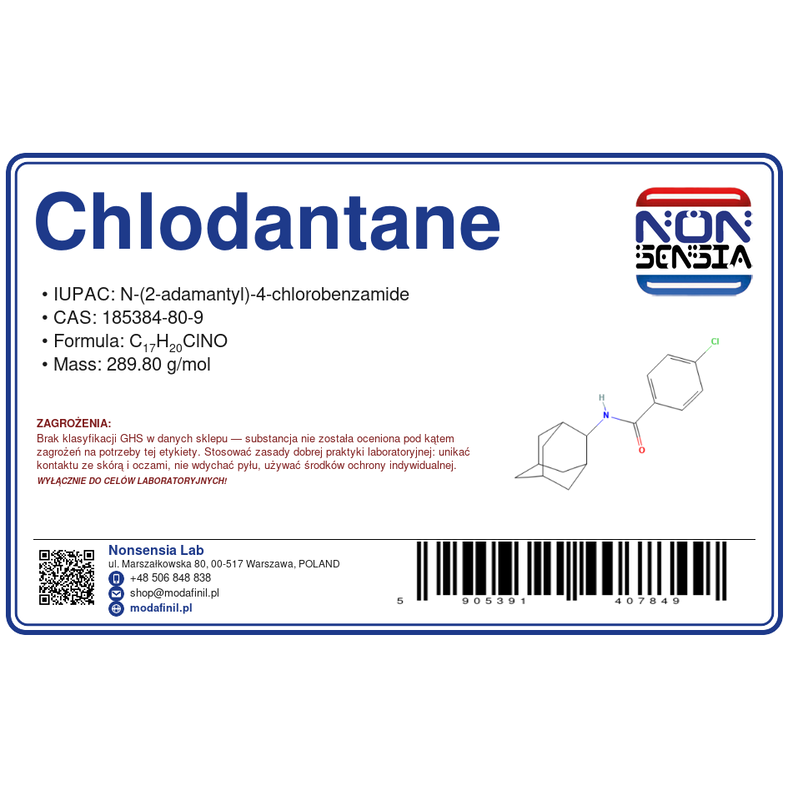
| Systematic name (IUPAC) | N-(2-adamantyl)-4-chlorobenzamide |
|---|---|
| Common name | Chlodantan (Chlodantane) |
| CAS number | 185384-80-9 |
| Molecular formula | C17H20ClNO |
| Molar mass | 289.80 g·mol−1 |
| Monoisotopic mass | 289.1233 Da |
| InChIKey | VOHIYJJUKAUCCU-UHFFFAOYSA-N |
| SMILES | C1C2CC3CC1CC(C2)C3NC(=O)C4=CC=C(C=C4)Cl |
| PubChem CID | 959689 |
| ChEMBL | CHEMBL4111629 — status “Preclinical” (phase 0) |
| Form | crystalline powder, white to off-white |
| Purity | ≈ 95.3% |
| Intended use | research reagent — not for consumption by humans or animals |
Lineage of the molecule: the adamantane cage and Chlodantan’s place in this family
The core of the molecule is the same adamantane that underlies bromantan — a cage hydrocarbon isolated from petroleum in the 1930s, available on a preparative scale only after the development, in the late 1950s, of a synthesis using a Lewis acid-catalyzed rearrangement. Substitution of the cage with an amino group at position 2 gave the 2-aminoadamantane family, to which — at least in terms of the carbon skeleton — Chlodantan also belongs.
Amide, not amine: where Chlodantan departs from bromantan
Here, however, the structural similarity ends. Bromantan is a secondary aromatic amine — the nitrogen atom connects the adamantane cage directly to the 4-bromophenyl ring (Ar–NH–adamantyl). Chlodantan is a benzoic acid amide — a carbonyl group is inserted between the nitrogen and the 4-chlorophenyl ring (Ar–C(=O)–NH–adamantyl). This is not a minor cosmetic difference: amides and secondary aromatic amines have different metabolic stability, a different basicity profile, and a different synthetic route (acylation with an acid chloride instead of reductive amination or coupling). Treating Chlodantan as a simple “chlorine instead of bromine” substitution on the bromantan skeleton is therefore inaccurate — it is a different functional class on the same core.
The molecule has appeared in chemical registries since 2005, but — unlike bromantan — without an accompanying publication explaining why it was synthesized. The most likely context is combinatorial chemistry practice: coupling available amines (including aminoadamantanes) with available acid chlorides in screening compound libraries, without a dedicated pharmacological program. This is not a claim we can confirm from a source — we note it as the most likely explanation for the absence of literature, not as a fact.
Status in databases and registries
| July 9, 2005 | structure registered in PubChem as CID 959689 |
|---|---|
| no date | presence in chemical supplier catalogs and screening libraries: ChemDB, ABI Chem, BLD Pharm, ZINC (ID ZINC568772) |
| no date | registration in EPA DSSTox (DTXSID201376531) — a structural inventory, not evidence of toxicological studies |
| no date | presence in PATENTSCOPE (WIPO) — appearing in the patent database, without a patent assigned directly to the compound (a PatentID query in PubChem returns no results) |
| no date | ChEMBL CHEMBL4111629: status “Preclinical”, clinical development phase 0, no assigned mechanism of action |
| July 3, 2026 | synchronization of physicochemical data in our system with PubChem |
| September 7, 2026 | verification of PubMed literature for this description — 0 papers directly concerning this compound |
Chemistry and what it means for the laboratory
The carbonyl that changes everything
Inserting a carbonyl group between the nitrogen and the aromatic ring has measurable analytical consequences that can be stated without referring to any biological studies:
| Parameter | Bromantan | Chlodantan | Significance |
|---|---|---|---|
| Molecular formula | C16H20BrN | C17H20ClNO | additional C and O atom (carbonyl), Br replaced by Cl |
| Molar mass | 306.24 | 289.80 | lower by about 16.4 despite the additional carbonyl — chlorine is much lighter than bromine |
| XLogP (computed) | ≈ 5 | ≈ 4.2 | slightly lower lipophilicity — earlier elution in RP-HPLC than bromantan |
| Polar surface area (PSA) | 12 Å2 | 29.1 Å2 | more than twice as high — the effect of the carbonyl oxygen, absent in bromantan |
| Hydrogen bond donors / acceptors | 1 / 1 | 1 / 1 | the count is unchanged, but the character differs: in Chlodantan the acceptor is the carbonyl oxygen, not the nitrogen lone pair |
| Rotatable bonds | 2 | 2 | unchanged |
Chlorine versus bromine: isotopic signature in mass spectrometry
Just as with bromantan, the halogen atom gives a recognizable signature in the mass spectrum — but an inverted one. Bromine has two stable isotopes in a ratio close to 1:1 (79Br and 81Br), giving a pair of peaks of nearly equal height. Chlorine also has two stable isotopes, 35Cl and 37Cl, but in a natural ratio close to 3:1 — a parent ion peak and a peak two mass units higher, with the latter at about one-third the height of the former. For the laboratory, this means that the shape of the isotope cluster alone allows a chlorine compound to be distinguished from a bromine compound even before the exact mass is read — and the 16.4 Da mass difference between Chlodantan and bromantan makes the distinction even simpler.
Physicochemical characteristics
| Parameter | Value | What this means |
|---|---|---|
| Partition coefficient (XLogP) | ≈ 4.2 | high lipophilicity — the compound elutes late in reversed-phase chromatography |
| Topological polar surface area | 29.1 Å2 | moderate — higher than in bromantan, lower than in multifunctional compounds |
| Heavy atoms | 20 | molecular size comparable to bromantan (18) |
| Solubility | good in DMSO; negligible in water | prepare stock solutions in an organic solvent |
Nomenclature and synonyms
- Chlodantan — the Polish-language form;
- Chlodantane — the spelling used in PubChem and chemical supplier catalogs;
- N-(Adamantan-2-yl)-4-chlorobenzamide — an alternative rendering of the systematic name;
- N-(2-adamantyl)-N-(p-chloro-benzoyl)amine — an older naming variant found in chemical databases;
- N-(2-adamantylo)-4-chlorobenzamid — the IUPAC systematic name in Polish transliteration, the only unambiguous one.
Unlike bromantan (development code ADK-709, later registered as a drug under a separate trade name), Chlodantan has no documented development code from any period of laboratory work — which is further circumstantial evidence that it did not arise within an organized research program, but rather as a catalog entry of combinatorial chemistry.
Laboratory use of the reagent
- a reference material for confirming identity and purity by HPLC-UV;
- a standard in GC-MS and LC-MS methods, including verification of recognition of the chlorine isotopic signature (~3:1 cluster) as distinct from the bromine signature (~1:1);
- a substrate and model compound in studies of adamantane amide chemistry, in contrast to the amines of the same family;
- a comparative material for calibrating methods that distinguish chlorine compounds from bromine compounds at the same molecular mass range of roughly 290–310 Da;
- a retention marker for calibrating reversed-phase chromatography methods in the medium-lipophilicity range.
Storage, handling, and work safety
Store in the original, tightly closed packaging, in a dry and cool place, protected from light, separately from food and feed and out of the reach of children. Work exclusively under laboratory conditions, using personal protective equipment: gloves, safety goggles, and laboratory clothing; weigh the powder under conditions that limit dust formation. Avoid inhaling dust and contact with skin and eyes. Waste disposal — in accordance with the regulations applicable to chemical waste at the site where the research is conducted.
Note on safety data. In the PubChem database, in the safety and hazards section for this compound, no registered GHS pictograms or H-statements are listed (as of the data synchronization date, July 3, 2026). The absence of registered data is not equivalent to the absence of hazard — for a compound without its own toxicological literature, the material should be handled with the caution appropriate for a substance with an unestablished profile.
Regulatory status
Chlodantan is not registered as a medicinal product in any country known to us and has never entered the clinical trial phase (ChEMBL: phase 0). It has no pharmacopoeial monograph. The legal status of compounds in this structural class is sometimes subject to changes in national law — the buyer is responsible for independently checking the legal status in the country of destination before ordering. The material offered is a chemical reagent and has no approval for any use in humans or animals.
Frequently Asked Questions
How does Chlodantan differ from bromantan?
The core of both compounds is an adamantane cage substituted at position 2, but the linker to the aromatic ring is different: bromantan is a secondary amine (Ar–NH–adamantyl), Chlodantan is a benzoic acid amide (Ar–C(=O)–NH–adamantyl). In addition, chlorine replaces bromine. The measurable effect: a molar mass lower by 16.4 (289.80 versus 306.24) and a higher polar surface area (29.1 Ų versus 12 Ų) due to the additional carbonyl oxygen.
Are Chlodantan and bromantan the same compound?
No. These are two different compounds with different CAS numbers (185384-80-9 versus 87913-26-6), different molecular formulas, and a different functional group linking the adamantane cage to the aromatic ring — an amide, not an amine. The similarity is limited to the adamantane skeleton.
Does Chlodantan have documented pharmacological activity?
No. A search of the PubMed database for the compound’s name, CAS number, and systematic name returns no paper devoted to this molecule. In ChEMBL, the compound has the status “Preclinical” (phase 0) with no assigned mechanism of action. Any claims regarding its adaptogenic, actoprotective, or cognitive effects are not supported by peer-reviewed literature.
Is Chlodantan a drug?
No. Chlodantan has never been registered as a medicinal product in any country and has no pharmacopoeial monograph. The material offered is a chemical reagent for laboratory use.
What is the chemical formula and molar mass of Chlodantan?
C17H20ClNO; molar mass 289.80 g·mol−1, monoisotopic mass 289.1233 Da. CAS number 185384-80-9, InChIKey VOHIYJJUKAUCCU-UHFFFAOYSA-N.
Where does the name “Chlodantane” come from?
It is a common name present in PubChem (CID 959689) and chemical supplier catalogs, most likely composed from the roots “chloro” and “adamantane”. It is not the trade name of a registered drug — for this substance, no drug exists.
How can Chlodantan be distinguished from bromantan by mass spectrometry?
By two features at once: the 16.4 Da mass difference (289.80 versus 306.24) and the shape of the halogen isotope cluster — chlorine gives a pair of peaks in a ratio of about 3:1, bromine in a ratio of about 1:1. Recognition does not require chromatographic separation.
What does Chlodantan dissolve in?
Well in DMSO, negligibly in water — with an XLogP of ≈ 4.2, stock solutions are prepared in an organic solvent.
How should Chlodantan be stored as a laboratory reagent?
In the original, tightly closed packaging, in a dry and cool place, protected from light, separately from food and feed and out of the reach of children.
Is a safety data sheet provided with Chlodantan?
We provide the safety data sheet on request to recipients conducting research or analytical activity. We note that no registered pictograms or H-statements are listed in PubChem for this compound — the toxicological data are incomplete, which calls for greater caution, not less.
Is Chlodantan legal in Poland?
Chlodantan is not registered as a medicinal product and has no pharmacopoeial monograph. The legal status of substances of this type is sometimes subject to changes in national law — the buyer is responsible for checking the legal status in the country of destination before ordering.
Is the reagent suitable for uses other than laboratory ones?
No. The material is intended exclusively for laboratory and analytical research. It is not intended for consumption by humans or animals, it is not a drug, a dietary supplement, a food, or a cosmetic, and it may not be used for medical, diagnostic, or consumption purposes.
What is the Chlodantan standard used for in an analytical laboratory?
For confirming identity and purity by HPLC-UV, as a standard in GC-MS and LC-MS for distinguishing chlorine compounds from bromine compounds by isotopic signature, and as a model compound in the chemistry of adamantane amides.
Does Chlodantan have only a single source on the market?
There is no confirmation of this in publicly available registries. The structure appears in the databases of several independent chemical suppliers and screening libraries (including ChemDB, ABI Chem, BLD Pharm, ZINC), and CID 959689 in PubChem refers to multiple sources, not a single manufacturer.
References
For this compound, no peer-reviewed scientific literature exists — a search of PubMed for the name “Chlodantane”, CAS number 185384-80-9, and the systematic name returns no dedicated paper (as of September 7, 2026). The only hit for the phrase “Chlodantane” is a review paper on adamantane derivatives in general, matched by a partial word, already used in the literature of a competing shop — we omit it for both reasons.
For transparency, we also state what a query for the related chemical class “adamantyl benzamide” actually returns. The papers below genuinely exist and concern real compounds, but they are different molecules, studied in entirely different pharmacological contexts — they have no connection to Chlodantan, and we cite them solely as evidence that the query was actually performed, not as a source of knowledge about the material offered.
- Intranuovo F et al. (2023). “Development of N-(1-Adamantyl)benzamides as Novel Anti-Inflammatory Multitarget Agents Acting as Dual Modulators of the Cannabinoid CB2 Receptor and Fatty Acid Amide Hydrolase.” J Med Chem. PMID 36542836. Substitution at position 1 (the bridgehead) of the adamantane cage, not at position 2 as in Chlodantan; biological target — the CB2 cannabinoid receptor and FAAH, not the central nervous system in an adaptogenic context.
- Rho HS et al. (2009). “Studies on depigmenting activities of dihydroxyl benzamide derivatives containing adamantane moiety.” Bioorg Med Chem Lett. PMID 19181523. Inhibition of tyrosinase and skin melanogenesis — a local depigmenting action, not a central one.
- Lee CS et al. (2013). “A novel adamantyl benzylbenzamide derivative, AP736, suppresses melanogenesis through the inhibition of cAMP-PKA-CREB-activated microphthalmia-associated transcription factor and tyrosinase expression.” Exp Dermatol. PMID 24107097. The same research direction — skin depigmentation, not central nervous system pharmacology.
- Jeong YS et al. (2016). “Antimelanogenic activity of a novel adamantyl benzylbenzamide derivative, AP736: a randomized, double-blind, vehicle-controlled comparative clinical trial performed in patients with hyperpigmentation during the summer.” Int J Dermatol. PMID 26712041. The only clinical study in this list — it concerns a different compound (AP736) and skin hyperpigmentation, and has no connection whatsoever to Chlodantan or its purported adaptogenic activity.
Identification data and computed descriptors from PubChem (CID 959689); development status from ChEMBL (CHEMBL4111629); source registries from PubChem Registry ID / Source Name.
Related reagents in our catalog
- Bromantan (CAS 87913-26-6) — shared adamantane core; functional contrast: there a secondary amine and a documented research program, here an amide without its own literature
- Flmodafinil (CAS 90280-13-0) — a different structural family, but the same methodological issue: a chemically defined compound with minimal or no literature of its own, described here with equal honesty
Statement of Intended Use
The material offered is a chemical reagent intended solely for research, analytical, and laboratory purposes. It is not intended for consumption by humans or animals. It is not a medicinal product, a dietary supplement, a food product, a medical device, or a cosmetic. It may not be used for medical, diagnostic, therapeutic, preventive, or consumption purposes, administered to humans or animals, applied to the skin, or added to food, beverages, or feed. Sale is limited to recipients engaged in research, scientific, or analytical activity, with laboratory facilities and the knowledge needed to handle chemical reagents safely. The buyer bears sole responsibility for the lawful and safe use of the reagent and for compliance with the regulations in force in the country of destination.