Description
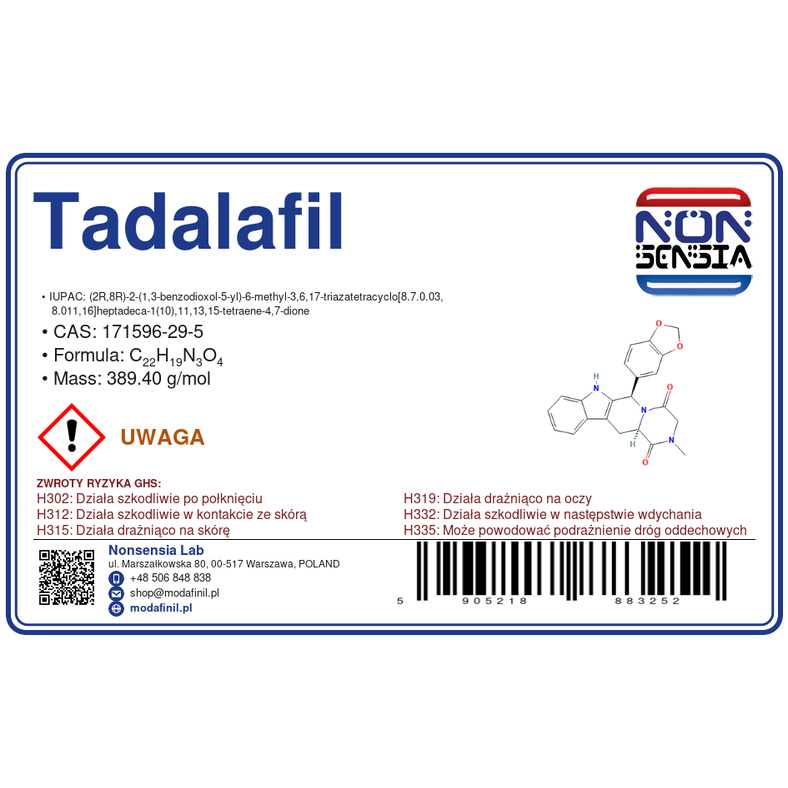
(2R,8R)-2-(1,3-benzodioxol-5-yl)-6-methyl-3,6,17-triazatetracyclo[8.7.0.0³,⁸.0¹¹,¹⁶]heptadeca-1(10),11,13,15-tetraene-4,7-dione, more widely known by its common name tadalafil, crystalline powder, 1000 mg pack. Material intended exclusively for laboratory and analytical in vitro research. This product is not intended for human or animal consumption; it is not a medicinal product, food supplement, foodstuff or cosmetic.
Three distinct entities that must not be confused
For this molecule, separating the layers is just as important as for any other substance in our catalogue that is at the same time the active substance of prescription-only medicines. Three contexts, three entirely different legal statuses:
| Entity | What it is | What it concerns |
|---|---|---|
| Chemical substance tadalafil, CAS 171596-29-5 |
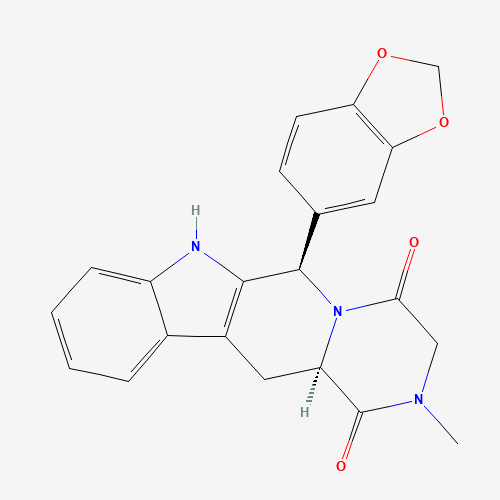
A chemical concept — a molecule of defined structure, with two configured stereogenic centres (2R,8R). In itself it is neither a medicine nor a reagent; its status is conferred only by the form in which it has been manufactured and authorised. | chemistry, substance registers |
| Medicinal product e.g. Cialis, Adcirca, Entadfi, Opsynvi |
Pharmaceutical preparations with various registered indications (erectile dysfunction, pulmonary arterial hypertension, benign prostatic hyperplasia). A defined pharmaceutical form and strength, manufacture under GMP, registration dossier, safety monitoring. In Poland dispensed only on prescription. | it is this entity that the clinical studies involving humans concern |
| Chemical reagent the material offered here |
Material for laboratory and analytical work. It does not have, and cannot have, any authorisation for use in humans or animals — it has no pharmaceutical form and no medicinal product documentation. | analytics, chemistry, reference standards |
The consequence is unambiguous. The research results referred to later on this page were obtained exclusively with the registered medicinal product, in clinical and pharmacokinetic studies involving humans. None of these studies was conducted with an analytical reagent, and none of these results transfers to the material offered. The reagent is not a form in which the substance has ever been administered to humans, and it cannot be used in that way.
Reagent identification sheet
| Systematic name (IUPAC) | (2R,8R)-2-(1,3-benzodioxol-5-yl)-6-methyl-3,6,17-triazatetracyclo[8.7.0.0³,⁸.0¹¹,¹⁶]heptadeca-1(10),11,13,15-tetraene-4,7-dione |
|---|---|
| Common name | tadalafil |
| Development codes | IC-351 (ICOS Corporation), LY-450190 (Eli Lilly) |
| CAS number | 171596-29-5 |
| Molecular formula | C22H19N3O4 |
| Molar mass | 389.4 g·mol−1 |
| Monoisotopic mass | 389.1376 Da |
| Melting point | 301.5°C |
| InChIKey | WOXKDUGGOYFFRN-IIBYNOLFSA-N |
| SMILES | CN1CC(=O)N2C(C1=O)CC3=C(C2C4=CC5=C(C=C4)OCO5)NC6=CC=CC=C36 |
| PubChem CID | 110635 |
| ChEMBL | CHEMBL3665030 |
| UNII (FDA) | 742SXX0ICT |
| ChEBI | CHEBI:71940 |
| Form | crystalline powder, white to off-white |
| Purity | ≥ 99% |
| Intended use | research reagent — not for human or animal consumption |
Origins of the molecule: a different route to the same enzyme
Tadalafil is not a modification of a molecule that was already on the market — it is a structurally distinct route to inhibiting the same enzyme that other research teams had already been working on. The core of the molecule is a tetracyclic pyrazinopyridoindole system — a distant relative of the β-carboline scaffold, additionally closed by a diketopiperazine ring bearing a 1,3-benzodioxole substituent. This is an entirely different scaffold from that of the first registered inhibitor of this enzyme class, which is based on a pyrazolopyrimidinone core — Sildenafil (CAS 171599-83-0) is a good reference point here: the same enzymatic target, a completely different ring architecture.
The family of tetracyclic pyridoindole derivatives
The same core — a tetrahydro-β-carboline system fused with a diketopiperazine ring — was studied independently by various teams designing inhibitors of the same enzyme. Liu et al. described a series of substituted acetates based on a related imidazo-pyrido-indole system as a new class of vasodilating compounds [5], and Ahmed et al. designed and synthesised functionalised tetrahydro-β-carboline derivatives as new inhibitors of the same enzymatic target [7]. The most recent of these papers, Mieczkowski et al. (2021), extended the same family with flexible analogues based on a diketopiperazine moiety, with solved crystal structures and a biological activity profile [10].
From a biotechnology laboratory to a joint venture
The molecule was isolated in the laboratories of the biotechnology company ICOS Corporation (Bothell, Washington State, USA) — hence the first development code, IC-351. In 1998 ICOS entered into a joint venture with Eli Lilly and Company (Lilly ICOS LLC) for the further development and commercialisation of the compound — from that point on, a second code, LY-450190, reflecting Lilly’s internal designation, appears in pharmacokinetic publications. In 2007 Eli Lilly acquired ICOS Corporation in full, consolidating the rights to the molecule in a single owner.
After patent expiry: a shift towards analytics
Patent protection expired in the major jurisdictions in 2017–2018. Since then the centre of gravity of new literature has clearly shifted from clinical pharmacology towards analytics and quality control — HPLC, NMR and GC-MS methods for confirming identity and purity and for detecting this substance in unregistered preparations. For a laboratory working with this reagent this is of practical importance: the most recent, best-documented analytical methods now come mainly from this stream, not from the original registration work of twenty years ago.
Timeline
| 1998 | formation of the Lilly ICOS LLC joint venture to develop the compound discovered in the laboratories of ICOS Corporation |
|---|---|
| 2002–2003 | registration as a medicinal product in Europe and then in the United States; first large clinical studies of efficacy and tolerability [2] and cross-sectional pharmacological profiles of the substance [1][3] |
| 2006 | clinical pharmacokinetic studies of the registered medicinal product in healthy volunteers [4] |
| 2007 | Eli Lilly acquires ICOS Corporation in full |
| 2009 | extension of the medicinal product registrations to further indications: pulmonary arterial hypertension and symptoms of benign prostatic hyperplasia |
| 2010 | identification of the trans-diastereomer of tadalafil in counterfeit products and assessment of the optical purity of the stereoisomers by chromatographic methods [6] |
| 2014–2015 | stability-indicating RP-HPLC method for combination preparations [9] and a quantitative 1H-NMR method for determining tadalafil in bulk material and tablets [8] |
| 2017–2018 | expiry of patent protection in the major jurisdictions; availability of generic equivalents |
| 2020 | GC-MS method for the screening detection of inhibitors of this enzyme class in unregistered preparations [11] |
| 2024 | most recent indexed stability-indicating RP-HPLC-DAD method for the simultaneous determination of tadalafil in a synthetic mixture [12] |
Chemistry: two stereogenic centres and the trans diastereomer
Cis versus trans — why this is not a pair of enantiomers
The molecule has two stereogenic centres, designated in the systematic name as (2R,8R) — one at the carbon linking the benzodioxole ring to the tetracyclic core, the other at the ring junction with the indole. The registered configuration is the cis junction of these two centres. The counterpart with a trans junction — i.e. a diastereomer, not an enantiomer — is a separate compound with different physicochemical properties and a different chromatographic retention profile. Venhuis et al. identified (–)-trans-tadalafil alongside tadalafil and sildenafil in counterfeit commercial preparations and assessed the optical purity of the tadalafil stereoisomers by chromatographic methods [6] — the presence of the trans diastereomer is one of the markers distinguishing a synthesis with poorer stereochemical control.
For the laboratory this has a practical consequence: a total determination alone (e.g. LC-UV without separation of stereoisomers) does not confirm which diastereomer is present in the sample. Confirmation of configurational identity requires a stereochemistry-sensitive method — chiral-phase chromatography, NMR spectroscopy or comparison with a reference material of confirmed (2R,8R) configuration.
Physicochemical characteristics
| Parameter | Value | What follows from it |
|---|---|---|
| Partition coefficient (XLogP) | ≈ 2.3 | moderate lipophilicity — elutes in the middle-to-late part of the RP-HPLC gradient |
| Topological polar surface area | 74.9 Å2 | two amide carbonyl groups and the methylenedioxy ring raise the number of hydrogen bond acceptors |
| Hydrogen bond donors | 1 | N–H in the indole ring |
| Hydrogen bond acceptors | 4 | two amide carbonyl groups and the two oxygen atoms of the benzodioxole ring |
| Rotatable bonds | 1 | rigid tetracyclic system — little conformational freedom despite the high molecular mass |
| Melting point | 301.5°C | high for an organic compound of this size — a consequence of the rigid, highly fused ring scaffold |
| Solubility | good in DMSO; limited in water | prepare stock solutions in an organic solvent |
Why one molecule has several names and codes
In the literature and databases, several designations are used for the same molecule with CAS number 171596-29-5, apart from the trade names of the registered medicinal preparations (listed only in the table above):
- Tadalafil — the International Nonproprietary Name (INN), the form used in the Polish and English literature;
- IC-351 / IC 351 — the original development code from the period of work at ICOS Corporation, found in most early pre-registration publications;
- LY-450190 — Eli Lilly’s internal designation, appearing in publications after the Lilly ICOS joint venture was formed;
- Tadalafilo — the form of the name used in the Spanish- and Italian-language literature;
- trans-tadalafil — not a synonym, but the name of a different diastereomer of the same molecule (see the chemistry section above) — a common error when searching, worth pointing out separately;
- the IUPAC systematic name — the only unambiguous one, independent of commercial and legal context.
When searching the literature it is worth combining the variants IC-351 and IC351 (with and without the hyphen) — some indexes treat them as separate entries.
Laboratory applications of the reagent
- reference material for confirming identity and purity by HPLC-UV/DAD, including stability-indicating methods [9][12];
- standard in quantitative 1H-NMR spectroscopy as an alternative to chromatographic methods for determination in bulk material and solid forms [8];
- comparison material in GC-MS methods for the screening detection of inhibitors of this enzyme class in unregistered preparations [11];
- (2R,8R) configuration standard for distinguishing cis/trans diastereomers by chiral chromatography [6];
- model compound in chemical research on tetracyclic pyridoindole derivatives and their analogues [5][7][10].
Storage, handling and safety at work
Store in the original, tightly closed packaging, in a dry and cool place, protected from light, away from food and feed and out of the reach of children. Work only under laboratory conditions, using personal protective equipment: gloves, safety glasses and laboratory clothing; weigh the powder under conditions that minimise dusting. Avoid inhaling dust and contact with skin and eyes. Waste handling — in accordance with the regulations applicable to chemical waste at the place where the research is carried out.
Hazard classification. The available classification data (GHS) indicate pictogram GHS07 (signal word: Warning) and the hazard statements H315 (causes skin irritation), H319 (causes serious eye irritation) and H335 (may cause respiratory irritation), together with the precautionary statement P261 (avoid breathing dust). Full data in the safety data sheet (SDS), available on request.
Regulatory status
The substance is the active substance of medicinal products dispensed in Poland on prescription, registered for several therapeutic indications. Trade in medicinal preparations is governed by separate pharmaceutical legislation, and this offer does not concern it. The material offered is a chemical reagent and has no authorisation for any use in humans or animals. The purchaser is responsible for ensuring that the intended use complies with the law in force in the country of destination.
Frequently Asked Questions
How does tadalafil differ chemically from sildenafil?
In its core — these are two completely different ring scaffolds reaching the same enzymatic target. Sildenafil is based on a pyrazolopyrimidinone system, tadalafil on a tetracyclic pyrazinopyridoindole system with a benzodioxole ring. The analytical consequence: the difference in molecular mass and an entirely different chromatographic retention profile make it easy to distinguish the two compounds.
What are IC-351 and LY-450190?
They are two historical development codes for the same molecule — IC-351 from the period of work at ICOS Corporation, LY-450190 from the period of the joint venture with Eli Lilly. Both denote the compound with CAS number 171596-29-5, not separate substances.
What is trans-tadalafil and why does it matter analytically?
It is a diastereomer of tadalafil — a molecule with the same molecular formula but inverted relative configuration at one of the two stereogenic centres (trans ring junction instead of cis). It can be a marker in preparations made by a synthesis with poorer stereochemical control; its identification in counterfeit products has been described in the analytical literature [6].
What are the chemical formula and molar mass of tadalafil?
C22H19N3O4; molar mass 389.4 g·mol−1, monoisotopic mass 389.1376 Da. CAS number 171596-29-5, InChIKey WOXKDUGGOYFFRN-IIBYNOLFSA-N.
How many stereogenic centres does the tadalafil molecule have?
Two, designated in the systematic name as (2R,8R). This pair of stereogenic centres gives rise to diastereomers (cis/trans), not enantiomers — unlike the single stereogenic centre on the sulfur atom in modafinil (CAS 68693-11-8), where only a pair of R/S enantiomers is involved.
Is the reagent suitable for applications other than laboratory ones?
No. The material is intended exclusively for laboratory and analytical research. It is not intended for human or animal consumption; it is not a medicine, food supplement, food or cosmetic and may not be used for medical, diagnostic or consumption purposes.
How should tadalafil be stored as a laboratory reagent?
In the original, tightly closed packaging, in a dry and cool place, protected from light, away from food and feed and out of the reach of children.
What should tadalafil be dissolved in to prepare a stock solution?
It dissolves well in DMSO, and in water only to a limited extent. Given XLogP ≈ 2.3 and the high melting point (301.5°C), stock solutions are prepared in an organic solvent.
How is the purity of tadalafil confirmed in the laboratory?
By HPLC-UV/DAD against a reference material, including stability-indicating methods that detect degradation products [9][12], and as an alternative method — by quantitative 1H-NMR [8]. Distinguishing the cis/trans diastereomer requires a stereochemistry-sensitive method, not a total determination alone.
Is a safety data sheet supplied with tadalafil?
We make the safety data sheet available on request to recipients conducting research or analytical activities. The basic hazard classification (GHS07, H315/H319/H335) is given in the section on safety at work above.
Is tadalafil legal in Poland?
Tadalafil is the active substance of medicinal products dispensed in Poland on prescription; trade in medicines is governed by separate regulations and this offer does not concern it. The material offered is a chemical reagent without authorisation for use in humans. The purchaser is responsible for ensuring that the intended use complies with the law of the country of destination.
What is a tadalafil standard used for in an analytical laboratory?
For confirming identity and purity by HPLC-UV/DAD and 1H-NMR, as a standard in GC-MS methods for the screening detection of inhibitors of this enzyme class in unregistered preparations, and as a reference material for the (2R,8R) configuration when distinguishing cis/trans diastereomers.
References
The entries come from the PubMed database (queries run on 2026-09-06/07) and concern the chemistry, analytics and registration history of this molecule. Entries [5], [7], [10] are papers on the synthesis and structure–activity relationships of related tetracyclic systems. Entries [6], [8], [9], [11], [12] are analytical papers (HPLC, NMR, GC-MS). Entries [1], [2], [3], [4] concern the clinical pharmacology and pharmacokinetics of the registered medicinal product, involving humans — not the analytical reagent. None of these papers describes the use of the material offered — they are cited as scientific context and bibliographic guidance, not as information about the properties of the material offered or as an encouragement to any use. An anti-collision filter against the nonsensia.pl website (status as of 2026-09-07) excluded from the results considered two papers with overlapping DOI identifiers before this list was compiled.
- Curran M, Keating G (2003). “Tadalafil.” Drugs. PMID 14498756. doi:10.2165/00003495-200363200-00004.
- Padma-Nathan H (2003). “Efficacy and tolerability of tadalafil, a novel phosphodiesterase 5 inhibitor, in treatment of erectile dysfunction.” Am J Cardiol. PMID 14609620. doi:10.1016/s0002-9149(03)00828-2.
- Carrier S (2003). “Pharmacology of phosphodiesterase 5 inhibitors.” Can J Urol. PMID 12625845.
- Forgue ST, Patterson BE, Bedding AW et al. (2006). “Tadalafil pharmacokinetics in healthy subjects.” Br J Clin Pharmacol. PMID 16487221. doi:10.1111/j.1365-2125.2005.02553.x.
- Liu J, Zhao M, Cui G et al. (2008). “Methyl (11aS)-hexahydro-3,3-dimethyl-1-oxo-imidazo-pyridin-indol-2-substituted acetates: synthesis and 3D-QSAR investigation as a class of novel vasodilators.” J Med Chem. PMID 18616237. doi:10.1021/jm800249j.
- Venhuis BJ, Zomer G, Vredenbregt MJ et al. (2010). “The identification of (-)-trans-tadalafil, tadalafil, and sildenafil in counterfeit Cialis and the optical purity of tadalafil stereoisomers.” J Pharm Biomed Anal. PMID 19782492. doi:10.1016/j.jpba.2009.08.010.
- Ahmed NS, Gary BD, Tinsley HN et al. (2011). “Design, synthesis and structure-activity relationship of functionalized tetrahydro-β-carboline derivatives as novel PDE5 inhibitors.” Arch Pharm (Weinheim). PMID 21384413. doi:10.1002/ardp.201000236.
- Yang Q, Qiu H, Guo W et al. (2015). “Quantitative 1H-NMR Method for the Determination of Tadalafil in Bulk Drugs and its Tablets.” Molecules. PMID 26147583. doi:10.3390/molecules200712114.
- Patel JK, Patel NK (2014). “Stability-Indicating RP-HPLC Method for the Determination of Ambrisentan and Tadalafil in Pharmaceutical Dosage Form.” Sci Pharm. PMID 26279975. doi:10.3797/scipharm.1403-22.
- Mieczkowski A, Speina E, Trzybiński D et al. (2021). “Diketopiperazine-Based, Flexible Tadalafil Analogues: Synthesis, Crystal Structures and Biological Activity Profile.” Molecules. PMID 33546456. doi:10.3390/molecules26040794.
- Lee W, Kim HJ, Lee ME et al. (2020). “Reliable screening and classification of phosphodiesterase type 5 inhibitors using gas chromatography / mass spectrometry combined with specific common ions.” J Chromatogr A. PMID 32505294. doi:10.1016/j.chroma.2020.461210.
- Gol D, Vyas A, Visana N et al. (2024). “Stability Indicating RP-HPLC-DAD method for simultaneous estimation of tadalafil and macitentan in synthetic mixture.” Ann Pharm Fr. PMID 37866638. doi:10.1016/j.pharma.2023.10.006.
Identification data and computed descriptors from PubChem (CID 110635) and the UNII, ChEBI and ChEMBL registers.
Related reagents in our catalogue
- Sildenafil (CAS 171599-83-0) — another inhibitor of the same enzyme on an entirely different ring core: a pyrazolopyrimidinone instead of the tetracyclic pyrazinopyridoindole system
- Forskolin (CAS 66575-29-9) — biochemical pathway contrast: it activates adenylate cyclase and raises cAMP levels, whereas tadalafil inhibits the enzyme that breaks down cGMP — two different cyclic nucleotides in the regulation of vascular smooth muscle tone
- Modafinil (CAS 68693-11-8) — stereochemical contrast: a single stereogenic centre on the sulfur atom (R/S enantiomers) versus the two stereogenic centres of tadalafil (cis/trans diastereomers)
Statement of intended use
The material offered is a chemical reagent intended exclusively for research, analytical and laboratory purposes. It is not intended for human or animal consumption. It is not a medicinal product, food supplement, foodstuff, medical device or cosmetic. It may not be used for medical, diagnostic, therapeutic, prophylactic or consumption purposes, administered to humans or animals, applied to the skin, or added to food, beverages or feed. Sale exclusively to recipients conducting research, scientific or analytical activities, with laboratory facilities and the knowledge required for the safe handling of chemical reagents. The purchaser bears sole responsibility for the lawful and safe use of the reagent and for compliance with the regulations in force in the country of destination.