
Description
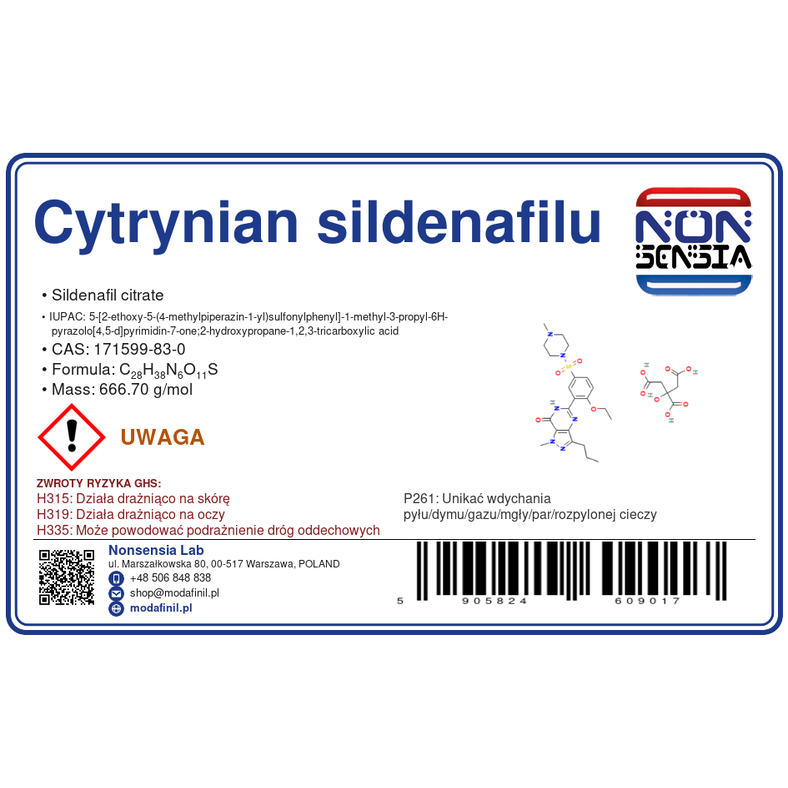
Sildenafil citrate (a salt of citric acid and sildenafil), crystalline powder, 1000 mg package in a sealed aluminum zip-lock bag. The material is intended exclusively for in vitro laboratory and analytical research. The product is not intended for human or animal consumption, and is not a medicinal product, dietary supplement, foodstuff, or cosmetic.
Three Different Entities That Must Not Be Confused
Sildenafil is one of the most frequently confused entries in catalogs of this type, because the same chemical name simultaneously functions as the active ingredient of widely known medicinal products distributed through pharmaceutical channels. Three contexts, three entirely different legal statuses:
| Entity | What it is | What it concerns |
|---|---|---|
| Chemical substance sildenafil citrate, CAS 171599-83-0 |
A chemical concept — the salt of the sildenafil molecule with citric acid. On its own it is neither a drug nor a reagent; its status is conferred by the form in which it was manufactured and approved. | chemistry, substance registries |
| Medicinal product including Viagra, Revatio, Caverta |
Pharmaceutical preparations: a defined pharmaceutical form and strength (active ingredient concentration), manufacturing under GMP, registration documentation, and safety oversight. Registered in various countries for two separate indications (erectile dysfunction and pulmonary arterial hypertension, under separate trade names). It is these preparations that the clinical trials involving human subjects cited in the literature concern. | therapeutics, pharmaceutical trade |
| Chemical reagent the material offered here |
A material for laboratory and analytical work. It does not have, and cannot have, approval for use in humans or animals — it has no pharmaceutical form or medicinal product documentation. | analytics, chemistry, reference standards |
The consequence is unambiguous. The research results cited later on this page were obtained either using a registered medicinal product (clinical trials involving human subjects), or under conditions of an analytical or environmental experiment, in which the substance was treated as an object of determination, not as a drug administered to an organism. None of these studies was conducted using the offered analytical reagent as a substance for consumption, and none of these results carries over to the way the offered material may be used. The reagent is not the form in which the substance was ever administered to humans, and it cannot be used in that way.
Reagent Identification Card
| Systematic name (IUPAC) | 5-[2-ethoxy-5-(4-methylpiperazin-1-yl)sulfonylphenyl]-1-methyl-3-propyl-6H-pyrazolo[4,5-d]pyrimidin-7-one; 2-hydroxypropane-1,2,3-tricarboxylic acid (salt) |
|---|---|
| Common name | sildenafil citrate |
| CAS Number (salt, offered material) | 171599-83-0 |
| Molecular formula (salt) | C28H38N6O11S |
| Molar mass (salt) | 666.7 g·mol−1 |
| Monoisotopic mass | 666.2319 Da |
| InChIKey | DEIYFTQMQPDXOT-UHFFFAOYSA-N |
| SMILES | CCCC1=NN(C2=C1N=C(NC2=O)C3=C(C=CC(=C3)S(=O)(=O)N4CCN(CC4)C)OCC)C.C(C(=O)O)C(CC(=O)O)(C(=O)O)O |
| PubChem CID | 135413523 |
| ChEMBL | CHEMBL3650565 |
| Form | crystalline powder, white to off-white |
| Packaging | sealed aluminum zip-lock bag |
| Purity | ≥ 99% |
| Intended use | research reagent — not for human or animal consumption |
The Molecule’s Origin: An Angina Drug That Never Reached Cardiology
The history of this molecule is among the most frequently cited examples of an accidental pharmacological discovery. The parent compound was synthesized in the late 1980s at Pfizer’s laboratories in Sandwich, United Kingdom, under the development code UK-92,480, as part of a program searching for phosphodiesterase type 5 (PDE5) inhibitors intended for the treatment of angina pectoris and arterial hypertension — the mechanism was meant to dilate coronary vessels by intensifying the nitric oxide–cGMP pathway.
The Side Effect That Changed the Direction of Research
In early phase I clinical trials, the compound did not confirm the original cardiological hypothesis — it did not show sufficient efficacy in angina pectoris. Trial participants instead reported an atypical side effect that redirected further work toward erectile dysfunction. The PDE5-inhibition mechanism and early pharmacological characterization of the compound were described by Boolell and colleagues in 1996 [1]; the history of the research pivot itself — from cardiology to urology — is presented in a 2019 review by Goldstein et al. [2].
In March 1998, the compound was registered as a medicinal product for the treatment of erectile dysfunction — the first PDE5 inhibitor registered worldwide for this indication (trade names are listed in the table above). The same substance was later also registered under a separate trade name for a different indication — pulmonary arterial hypertension. Two different preparations, two different indications, one molecule.
Why the Offered Material Is a Salt, Not the Free Base
Sildenafil as the free base (CAS 139755-83-2, formula C22H30N6O4S, molar mass 474.6 g·mol−1) and the sildenafil citrate offered on this page (CAS 171599-83-0) are two different registry records of the same active molecule, differing solely in salt form. The addition of citric acid increases the number of groups capable of forming hydrogen bonds and raises water solubility compared with the free base — a standard pharmaceutical technique used to facilitate oral formulation. The material offered in this catalog is the salt (citrate), consistent with the CAS number given in the title and the identification card above.
| Parameter | Sildenafil (free base) | Sildenafil citrate (offered material) |
|---|---|---|
| CAS Number | 139755-83-2 | 171599-83-0 |
| Molecular formula | C22H30N6O4S | C28H38N6O11S |
| Molar mass | 474.6 g·mol−1 | 666.7 g·mol−1 |
| InChIKey | BNRNXUUZRGQAQC-UHFFFAOYSA-N | DEIYFTQMQPDXOT-UHFFFAOYSA-N |
| PubChem CID | 135398744 | 135413523 |
Data for the free base were verified directly in PubChem (query by compound name) — included solely to distinguish it from the offered salt; the material in this catalog is exclusively the citrate with CAS number 171599-83-0.
Timeline
| late 1980s | synthesis of the parent compound (code UK-92,480) at Pfizer’s laboratories in Sandwich, as part of an angina pectoris research program |
|---|---|
| early 1990s | phase I trials do not confirm cardiological efficacy; observation of an atypical side effect changes the program’s direction |
| 1996 | publication describing the compound’s PDE5-inhibition mechanism [1] |
| March 1998 | registered as a medicinal product for the treatment of erectile dysfunction — the first PDE5 inhibitor registered for this indication |
| 2000s | registration of the same substance under a separate trade name for a different indication — pulmonary arterial hypertension |
| 2003–2013 | development of bioanalytical methods: HPLC-MS in biological fluids [3], RP-HPLC in laboratory animal plasma [4], fragmentation studies in mass spectrometry [5] |
| 2009–2014 | a series of studies on detecting new sildenafil analogs as adulterants in dietary supplements [6][7][8][9][10] |
| 2015–2021 | solid-state chemistry and analogs: improved synthesis [11], isosteres [12], cocrystals [13] |
| 2021 | forensic characterization using nuclear methods (IBA, INAA) [14] |
Three Strands of Literature, Not One Center
Unlike molecules with a narrow, geographically concentrated body of literature, the literature on this substance is internationally dispersed and organized more around research method than around a single laboratory. For a reader searching databases, this has practical significance — it is worth combining a topical query, not just the compound name.
Chemistry of the Drug and Its Derivatives
A strand covering synthesis, structural analogs, and solid-state chemistry: improved synthetic routes [11], isosteres of the parent molecule [12], and cocrystals that alter the substance’s physicochemical properties without changing the molecular structure [13].
Analytics and Adulterant Detection
The strand most characteristic of this molecule: sildenafil and its synthetic analogs are among the most frequently detected adulterants in dietary supplements and herbal preparations advertised as potency aids. This has given rise to a distinct area of analytical chemistry devoted to the structural identification of new analogs — by LC-UV/LC-MS [7], high-resolution Orbitrap mass spectrometry [9], combined MS/MS and NMR [10], and a decade-long review of such detections [8].
Forensic Toxicology, Biopharmaceutics, and the Environment
The third strand covers determinations in biological fluids and environmental material: bioanalytical methods in saliva and plasma [3][4], forensic characterization using nuclear analysis methods [14], and studies on the ecotoxicity of chlorination products in water [15] — an area rarely associated with this molecule, yet genuinely present in the literature.
Disclaimer for the entire section above. This describes the history of scientific research and the development of analytical methods. The studies involving human subjects cited in this section concerned exclusively the registered medicinal product, not the chemical reagent. This is not a description of the properties of the offered material and it cannot form the basis for any use of it outside the laboratory.
Chemistry: A Salt Without a Stereogenic Center
A Molecule With No Enantiomers
Unlike some other entries in this catalog, the sildenafil core does not contain a stereogenic center. The sulfonamide group (S(=O)2N) is symmetric with respect to both oxygen atoms and does not generate chirality — unlike a sulfoxide, in which the sulfur atom bears four different substituents. The piperazine ring is symmetric, and the propyl chain on the pyrazole ring does not form a carbon with four different substituents. The practical consequence: the material does not require enantiomer separation or enantioselective methods when confirming identity — this simplifies standard qualification compared with compounds having a sulfoxide stereogenic center.
Physicochemical Characterization of the Salt and Its Implications
| Parameter | Value | What this means |
|---|---|---|
| Partition coefficient (XLogP) | no computed value available in the source used | we do not extrapolate from the free base — data are given only where verified for the salt itself |
| Topological polar surface area (TPSA) | 250 Å2 | very high — an effect of adding the citric acid moiety; indicates good water solubility |
| Hydrogen bond donors | 5 | the sum of groups from the sildenafil molecule and from citric acid — the free base alone has fewer |
| Hydrogen bond acceptors | 15 | a high number typical of polycarboxylic acid salts |
| Rotatable bonds | 12 | a flexible structure — several possible conformations in solution |
| Heavy atoms | 46 | a large molecule for an analytical standard — relevant when interpreting high-resolution MS spectra |
| Solubility | good in water and DMSO, poorer in nonpolar solvents | the salt form was chosen partly for this reason — the opposite of many lipophilic reagents in this catalog |
Fragmentation in Mass Spectrometry
This molecule’s behavior under electrospray ionization is atypical: direct intramolecular gas-phase transfer reactions are observed during fragmentation, described in detail for sildenafil and its thio-analogs [5]. For a laboratory implementing LC-MS/MS methods, this has practical significance — the fragmentation spectrum cannot always be predicted by the simple additive rule known from other compound classes, as was also described in the structural identification of new sildenafil analogs by high-resolution Orbitrap spectrometry [9].
Nomenclature and Identifiers
- Sildenafil citrate — the common name of the material offered in this catalog;
- UK-92,480 — the development code of the parent compound from the period of Pfizer’s laboratory work;
- NSC-744009, NSC-758669 — registry numbers in the National Service Center catalog;
- UNII (FDA) — BW9B0ZE037;
- CHEBI:58987 — identifier in the ChEBI ontology;
- 5-[2-ethoxy-5-(4-methylpiperazin-1-yl)sulfonylphenyl]-1-methyl-3-propyl-6H-pyrazolo[4,5-d]pyrimidin-7-one — the systematic IUPAC name of the core (excluding the citrate portion), the only unambiguous one.
Trade names of medicinal products containing this substance are listed solely in the “Three Different Entities” table at the start of the page — they refer to pharmaceutical preparations, not to the offered reagent, and for this reason we do not repeat them elsewhere in this description.
Laboratory Applications of the Reagent
- a reference material for confirming identity and purity by HPLC-UV;
- a standard in LC-MS/MS and GC-MS methods, including determinations from biological fluids [3];
- a comparison material for the structural identification of new analogs detected as adulterants in dietary supplements [7][9];
- an object for NMR analysis, including two-dimensional DOSY methods used to distinguish mixtures [6];
- a comparison material in forensic toxicology and nuclear analysis of the authenticity of preparations [14];
- a model compound in solid-state chemistry studies — polymorphism and cocrystals [13];
- a standard in environmental analytics studies — stability and degradation products under water treatment conditions [15].
Storage, Handling, and Work Safety
Store in the original, tightly closed packaging, in a dry and cool place, protected from light, separately from food and feed and out of the reach of children. Work exclusively under laboratory conditions, using personal protective equipment: gloves, safety goggles, and laboratory clothing; weigh the powder under conditions that limit dust generation. Avoid inhaling dust and contact with skin and eyes. Waste handling — in accordance with the regulations applicable to chemical waste at the site where the research is conducted.
According to the hazard classification registered for this substance in the PubChem database, the material is labeled with the pictogram GHS07, the signal word “Warning”, and the precautionary statement P261 (avoid breathing dust). This is not a safety data sheet and does not replace the SDS supplied with the material — full safety data are provided to research customers upon request.
Regulatory Status
The substance is the active ingredient of registered medicinal products used in the treatment of erectile dysfunction and, under a separate trade name, pulmonary arterial hypertension (trade names are listed in the table at the start of the page). The rules governing the dispensing of such preparations vary by country and by specific pharmaceutical preparation. Trade in medicinal products is subject to separate pharmaceutical law regulations, and this offer does not concern it. The offered material is a chemical reagent and does not have approval for any use in humans or animals. The buyer is responsible for ensuring that the intended use complies with the law applicable in the country of destination.
Frequently Asked Questions
How does sildenafil citrate differ from sildenafil (the free base)?
These are two different registry records of the same active molecule, differing in salt form. The free base has CAS number 139755-83-2, formula C22H30N6O4S, and molar mass 474.6 g·mol−1. The citrate, offered in this catalog, has CAS number 171599-83-0, formula C28H38N6O11S, and molar mass 666.7 g·mol−1.
What is the chemical formula and molar mass of sildenafil citrate?
C28H38N6O11S; molar mass 666.7 g·mol−1, monoisotopic mass 666.2319 Da. CAS number 171599-83-0, InChIKey DEIYFTQMQPDXOT-UHFFFAOYSA-N.
Does sildenafil have a stereogenic center and enantiomers?
No. The sulfonamide group is symmetric and does not generate chirality — unlike the sulfoxide found in some other reagents in this catalog. The material does not require enantiomer separation when confirming identity.
How does a registered drug containing sildenafil differ from the offered reagent?
A drug is a pharmaceutical preparation — a defined pharmaceutical form and strength (active ingredient concentration), manufacturing under GMP, registration documentation, and safety oversight. The offered reagent is a material for laboratory work, with no pharmaceutical form and no approval for use in humans or animals. Details are in the “Three Different Entities” table at the start of the page.
Where do the identification data for sildenafil citrate come from?
The formula, molar mass, InChIKey, and SMILES come from the PubChem database (CID 135413523) and from the local chemical data registry used by our store. Data for the comparison free base were verified independently, directly in PubChem.
How should sildenafil citrate be stored as a laboratory reagent?
In the original, tightly closed packaging, in a dry and cool place, protected from light, separately from food and feed, and out of the reach of children.
What solvent should be used to prepare a stock solution of sildenafil citrate?
The salt dissolves well in water and DMSO — the high topological polar surface area (TPSA ≈ 250 Å2) of this salt, resulting from the attached citric acid moiety, favors aqueous solubility, unlike many other lipophilic reagents in this catalog.
How is the purity of sildenafil citrate confirmed in the laboratory?
By the HPLC-UV method against a reference material, supplemented with mass spectrometry (LC-MS/MS, GC-MS) and, when full structural characterization is needed, NMR spectroscopy.
Is a safety data sheet included with sildenafil citrate?
The safety data sheet is provided upon request to customers engaged in research or analytical activity.
Is the reagent suitable for uses other than laboratory applications?
No. The material is intended exclusively for laboratory and analytical research. It is not intended for human or animal consumption, is not a drug, dietary supplement, food, or cosmetic, and may not be used for medical, diagnostic, or consumption purposes.
Why is sildenafil sometimes detected in dietary supplements and herbal preparations?
Sildenafil and its synthetic analogs are among the most frequently detected adulterants in products advertised as natural potency aids — for this reason, a distinct strand of analytical chemistry is devoted to identifying such analogs [8][7]. The reagent offered here serves as an authentic reference material in such research, not as an ingredient of a consumer product.
What is the sildenafil citrate standard used for in an analytical laboratory?
For confirming identity and purity by HPLC-UV, as a standard in LC-MS/MS and GC-MS, a comparison material for identifying new structural analogs, an object for NMR studies, and a model compound in solid-state chemistry and environmental analytics.
References
The entries come from the PubMed database (queries performed 2026-09-06/07) and concern the chemistry, analytics, research history, and preclinical and clinical pharmacology associated with this molecule. Items [1]–[2] concern history and mechanism of action; [3]–[15] are analytical, methodological, and environmental works. None of them describes the use of the offered analytical reagent as a substance for consumption — they are cited as scientific context and a bibliographic reference, not as information on a method of use or an encouragement for any use outside the laboratory. Registered trade names appearing in the original publications have been removed from the titles while preserving the substantive content; full original titles are available at the indicated PMIDs.
- Boolell M et al. (1996). “Sildenafil: an orally active type 5 cyclic GMP-specific phosphodiesterase inhibitor for the treatment of penile erectile dysfunction.” Int J Impot Res. PMID 8858389.
- Goldstein I et al. (2019). “The Serendipitous Story of Sildenafil: An Unexpected Oral Therapy for Erectile Dysfunction.” Sex Med Rev. PMID 30301707. doi:10.1016/j.sxmr.2018.06.005.
- Tracqui A et al. (2003). “HPLC-MS for the determination of sildenafil citrate in biological fluids. Application to the salivary excretion of sildenafil after oral intake.” J Anal Toxicol. PMID 12670002.
- Tripathi AS et al. (2013). “Development and validation of RP-HPLC method for sildenafil citrate in rat plasma — application to pharmacokinetic studies.” Saudi Pharm J. PMID 23960848. doi:10.1016/j.jsps.2012.09.003.
- Reepmeyer JC et al. (2009). “Direct intramolecular gas-phase transfer reactions during fragmentation of sildenafil and thiosildenafil analogs in electrospray ionization mass spectrometry.” Rapid Commun Mass Spectrom. PMID 19222058.
- Trefi S et al. (2009). “The usefulness of 2D DOSY and 3D DOSY-COSY 1H NMR for mixture analysis: application to genuine and fake formulations of sildenafil.” Magn Reson Chem. PMID 19655367.
- Sakamoto M et al. (2012). “Structure elucidation of a novel analog of sildenafil detected as an adulterant in a dietary supplement using LC-UV and LC/MS.” J AOAC Int. PMID 22970570.
- Venhuis BJ et al. (2012). “Towards a decade of detecting new analogues of sildenafil, tadalafil and vardenafil in food supplements: a history, analytical aspects and health risks.” J Pharm Biomed Anal. PMID 22464558. doi:10.1016/j.jpba.2012.02.014.
- Kee CL et al. (2013). “Structural elucidation of a new sildenafil analogue using high-resolution Orbitrap mass spectrometry.” Rapid Commun Mass Spectrom. PMID 23681816.
- Mustazza C et al. (2014). “Characterization of Sildenafil analogs by MS/MS and NMR: a guidance for detection and structure elucidation of phosphodiesterase-5 inhibitors.” J Pharm Biomed Anal. PMID 24747148. doi:10.1016/j.jpba.2014.03.038.
- Raghava Reddy AV et al. (2015). “A Facile, Improved Synthesis of Sildenafil and Its Analogues.” Sci Pharm. PMID 28117311. doi:10.3390/scipharm84030447.
- Su Z et al. (2021). “Synthesis and properties of sildenafil isostere.” Arch Pharm (Weinheim). PMID 34131943. doi:10.1002/ardp.202100145.
- Sawatdee S et al. (2021). “Preparation and physicochemical characterization of sildenafil cocrystals.” J Adv Pharm Technol Res. PMID 34820318. doi:10.4103/japtr.japtr_72_21.
- Romolo FS et al. (2021). “Ion beam analysis (IBA) and instrumental neutron activation analysis (INAA) for forensic characterisation of authentic and illegal sildenafil-based products.” Talanta. PMID 33379047. doi:10.1016/j.talanta.2020.121829.
- Temussi F et al. (2013). “Sildenafil and tadalafil in simulated chlorination conditions: ecotoxicity of drugs and their derivatives.” Sci Total Environ. PMID 23820010. doi:10.1016/j.scitotenv.2013.05.081.
Identification data and computed descriptors for the salt are from the local chemical data registry (PubChem CID 135413523); comparison data for the free base were verified directly in PubChem (CID 135398744).
Related Reagents in Our Catalog
- Tadalafil — another phosphodiesterase type 5 inhibitor with a different structural core (diketopiperazine instead of pyrazolopyrimidinone); some analytical methods determine both compounds in parallel in the same sample (e.g., GC-MS methods covering sildenafil, vardenafil, and tadalafil simultaneously)
- Modafinil (CAS 68693-11-8) — a contrast in chirality: modafinil has a stereogenic center on the sulfur atom (sulfoxide), while sildenafil citrate is an achiral molecule
Statement of Intended Use
The offered material is a chemical reagent intended exclusively for research, analytical, and laboratory purposes. It is not intended for human or animal consumption. It is not a medicinal product, dietary supplement, foodstuff, medical device, or cosmetic. It may not be used for medical, diagnostic, therapeutic, prophylactic, or consumption purposes, administered to humans or animals, applied to the skin, or added to food, beverages, or feed. Sold exclusively to customers engaged in research, scientific, or analytical activity, possessing laboratory facilities and the knowledge required to safely handle chemical reagents. The buyer bears sole responsibility for the lawful and safe use of the reagent and for compliance with the regulations applicable in the country of destination.

