
Description
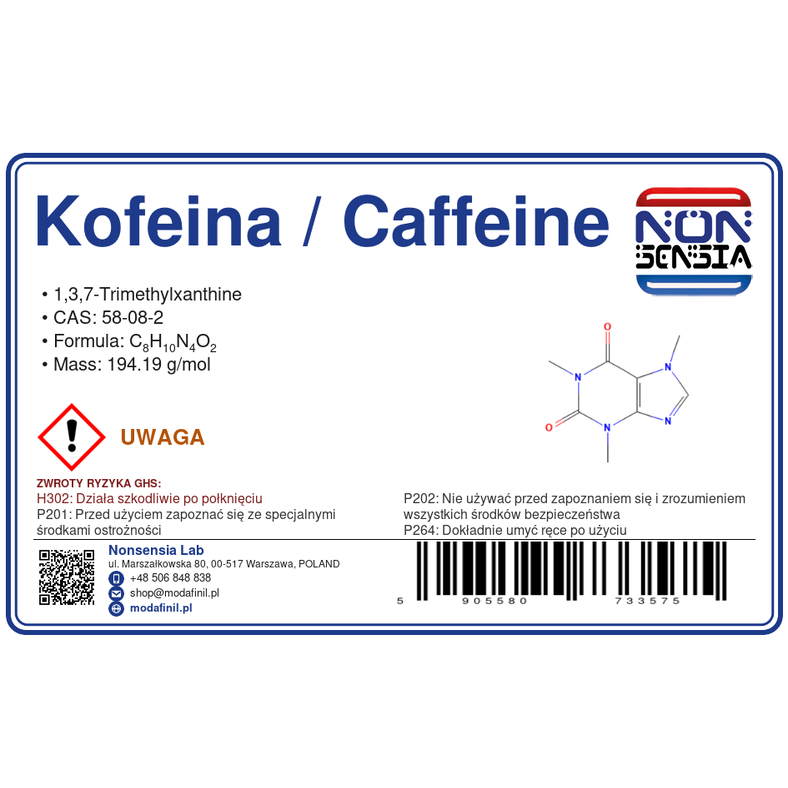
1,3,7-trimethylpurine-2,6-dione (1,3,7-trimethylxanthine), a white, fluffy crystalline powder, 1000 mg package. Material intended exclusively for in vitro laboratory and analytical research. The product is not intended for consumption by humans or animals, is not a medicinal product, dietary supplement, food, or cosmetic.
The thing that needs to be said up front
Caffeine is the opposite case to flmodafinil, for which the lack of literature was the problem. Here the problem is its abundance: the PubMed database returns tens of thousands of papers on caffeine, including a vast corpus of clinical studies in humans on its effects on the body. This description deliberately does not draw on that corpus.
The reason is the same as for every other item in this catalog: clinical studies on caffeine were conducted in the context of food or a registered medicinal product — never using unlabeled analytical material of laboratory purity, sold without pharmaceutical oversight or food safety standards. Transferring conclusions from those studies to the reagent offered here would be an error of the same kind, regardless of how extensive the source literature is.
This description is therefore limited to what can reliably be said about the molecule as a chemical object: its structure, its origin in the plant world, the history of its isolation and synthesis, its analytical behavior, and its regulatory status. The literature cited below concerns only these areas — plant biochemistry, analytical methods, and the forensic/anti-doping context — not clinical pharmacology.
Three different entities that must not be confused
With caffeine, separating the layers is more complex than for the other items in our catalog, because the same molecule functions simultaneously as a legal food ingredient, an active substance of registered medicines, and a chemical reagent. Four contexts, four different legal regimes:
| Entity | What it is | Legal regime |
|---|---|---|
| Chemical substance caffeine, CAS 58-08-2 |
A chemical concept — a purine alkaloid of defined structure. On its own it is not subject to any regime; status is conferred only by the form and context in which it occurs. | — |
| Food and beverage products coffee, tea, guarana drinks, chocolate products |
A natural plant constituent, present in coffee beans, tea leaves, guarana seeds, and cocoa beans. Consumed in this form for centuries. | food law provisions (labeling, maximum levels in energy drinks) — not provisions on chemical reagents |
| Medicinal product including Coffeinum, combination preparations with ergotamine or paracetamol |
Active substance of registered medicines: a defined pharmaceutical form, manufacturing under pharmaceutical GMP, registration documentation. | the pharmacological and clinical literature concerns this entity — deliberately omitted from this description (see section above) |
| Chemical reagent the material offered here |
Material for laboratory and analytical work, with a declared purity of ≥ 99.97%. It has no approval for use in humans or animals, nor food status — it is not subject to food safety standards or pharmaceutical GMP. | analytics, chemistry, reference standards |
The consequence is unambiguous. The widespread availability of caffeine in coffee or tea does not mean that the analytical reagent offered here has any food or pharmaceutical status. It is a raw material of declared chemical purity, without food labeling, without stability studies for food applications, and without medicinal product registration documentation. The material is not the form in which the substance is customarily consumed or administered to humans, and cannot be used in that way.
Reagent identification card
| Systematic name (IUPAC) | 1,3,7-trimethylpurine-2,6-dione |
|---|---|
| Common name | caffeine |
| CAS number | 58-08-2 |
| Molecular formula | C8H10N4O2 |
| Molar mass | 194.19 g·mol−1 |
| InChIKey | RYYVLZVUVIJVGH-UHFFFAOYSA-N |
| SMILES | Cn1cnc2c1c(=O)n(c(=O)n2C)C |
| PubChem CID | 2519 |
| Melting point | 235–238 °C |
| Form | white, fluffy crystalline powder |
| Packaging | 1000 mg, sealed aluminum sachet |
| Purity | ≥ 99.97% |
| Intended use | research reagent — not for consumption by humans or animals |
Pedigree of the molecule: a purine alkaloid from leaves, beans, and nuts
Caffeine, unlike the other items in our catalog, is not the product of laboratory synthesis designed from scratch. It is a natural secondary metabolite, produced independently by several dozen plant species from distant evolutionary lineages — from coffee beans (Coffea arabica, Coffea canephora), through tea leaves (Camellia sinensis), to cocoa seeds, guarana seeds (Paullinia cupana), and kola nuts. This convergence is chemically interesting in itself: these plants independently evolved the same trimethyl derivative of xanthine as a natural defense against pests.
From purine to three methyl groups
The backbone of caffeine is purine — a bicyclic heterocyclic system built from fused pyrimidine and imidazole rings, the same system that forms the nitrogenous bases adenine and guanine in nucleic acids. Biosynthesis proceeds from xanthosine through successive methylations and one deglycosylation: xanthosine → 7-methylxanthine → theobromine → caffeine. This pathway was enzymatically described by Suzuki and Takahashi using tea-leaf extracts, directly demonstrating the formation of theobromine from 7-methylxanthine and of caffeine from theobromine [1]. Later work by Ashihara’s team extended this picture to catabolism, defensive function, and attempts at genetic engineering of plants with reduced alkaloid content [2][3].
Guarana, tea, cocoa — the same molecule from different plants
The common name guaranine, one of the historical names for caffeine, derives directly from guarana nuts, in which the alkaloid’s concentration is exceptionally high. Studies on caffeine synthase in guarana fruit [5] and comparative work on coffee species with naturally low caffeine content [4] show that the capacity for biosynthesis of this alkaloid is regulated very precisely in the plant world — some Coffea species produce it only in trace amounts, others in amounts many times higher.
It entered European chemical awareness in 1819–1820, when the German chemist Friedlieb Ferdinand Runge isolated it from coffee beans — according to an anecdote well established in the history of chemistry, at the suggestion of Johann Wolfgang von Goethe. The full structure and the first total synthesis were established at the end of the 19th century by Emil Fischer, whose work on purine derivatives, alongside his research on sugars, was honored with the Nobel Prize in Chemistry in 1902. These facts concern the history of chemistry only and are not a reference to the use of the offered material.
Timeline
| 1819–1820 | isolation of caffeine from coffee beans by Friedlieb Ferdinand Runge |
|---|---|
| end of the 19th c. | structure elucidation and first total synthesis (Emil Fischer); work on purine derivatives honored with the Nobel Prize in 1902 |
| 1975 | enzymatic demonstration of the biosynthetic pathway: 7-methylxanthine → theobromine → caffeine in tea-leaf extracts [1] |
| 1999 | studies of biosynthesis and catabolism in low-caffeine Coffea species [4] |
| until 2004 | caffeine on the World Anti-Doping Agency (WADA) list of banned substances |
| 2004 | removal of caffeine from the WADA banned list and transfer to the monitoring program; ESI-MS method for quantitative determination of methylxanthines in equine doping control [11] |
| 2008–2017 | Ashihara’s review work on the biosynthesis and function of purine alkaloids in plants [2][3] |
| 2011 | assessment of the prevalence of caffeine use among athletes after the WADA ban was lifted [10] |
| 2014 | characterization of caffeine synthase in guarana fruit [5] |
| 2016 | certification of caffeine reference material purity by two independent methods [7]; structure–activity review of methylxanthines [9] |
| 2018 | validation of an HPLC method for determining caffeine in Coffea arabica [6] |
| 2019 | caffeine as one of the markers in the analysis of “cutting” agents in seized cocaine samples by GC-MS/LC-MS/MS [12] |
| 2025 | validation of a “green” HPLC-DAD method for methylxanthine analysis [8] |
Two strands of the literature: plant biochemistry and forensic analytics
The literature cited in this description falls into two clearly distinct strands. The first is plant biochemistry — a long-running research program, largely associated with the work of Hiroshi Ashihara and collaborators, describing the biosynthetic pathway of purine alkaloids in tea, coffee, guarana, and related species [1]–[5]. The second is forensic and anti-doping analytics, in which caffeine is treated not as the subject of study but as an analytical marker for identification and quantitative determination in a complex matrix — whether in equine doping control [11], or as a typical “cutting” agent in seized drug samples [12][13]. It is this second strand that gives the practical justification for why analytical and forensic laboratories need a reference material of confirmed, high purity.
Chemistry: a purine alkaloid, no chirality, and three methyl groups
Why caffeine has no stereogenic center
Unlike modafinil, where the stereogenic center lies on the sulfoxide sulfur atom, the caffeine skeleton is flat and fully symmetric with respect to chirality — it is a fused purine system with three methyl substituents at nitrogens N1, N3, and N7, with no atom bearing four different substituents. Caffeine therefore does not occur as enantiomers and does not require chiral separation, unlike many other items in our catalog, where a chiral column is a necessary condition for full characterization of the material.
Three methyl groups, three different molecules
Caffeine (1,3,7-trimethylxanthine) belongs to the methylxanthine family together with theobromine (3,7-dimethylxanthine, the main alkaloid of cocoa beans) and theophylline (1,3-dimethylxanthine, independently registered as the active substance of bronchodilator drugs). The difference between these three molecules comes down solely to the number and position of the methyl substituents on the same purine skeleton — yet each has a distinct CAS number, distinct applications, and a distinct analytical profile. Distinguishing them in a complex matrix, for example in an equine urine sample collected for doping control, requires methods that differentiate mass or retention time, not mere detection of a “purine alkaloid” signal — precisely this issue was described by Thevis and collaborators using an ESI-MS method with isotopically labeled analogues [11], and a review of the structure–activity relationships of the entire methylxanthine family was presented by Monteiro and collaborators [9].
Physicochemical characterization
| Parameter | Value | What it means |
|---|---|---|
| Partition coefficient (XLogP) | −0.07 | a practically hydrophilic substance — elutes early in RP-HPLC relative to most other items in the catalog |
| Topological polar surface area | 58.44 Å2 | moderate; arises from the three carbonyl-amide groups of the purine system |
| Hydrogen bond donors | 0 | no N–H or O–H groups capable of donation — all nitrogens are substituted or participate in the ring |
| Hydrogen bond acceptors | 6 | two carbonyl oxygens and four nitrogens of the purine ring |
| Solubility | good in water and methanol, markedly better at elevated temperature; weaker in nonpolar solvents | unlike most items in the catalog — stock solutions can be prepared in water |
Nomenclature and synonyms
Caffeine is one of the few items in our catalog for which the names in circulation are not accidental transliteration variants, but reflect different historical contexts and different source plants:
- Kofeina — the Polish-language name, from the Latin genus name of coffee (Coffea);
- Caffeine — the English form, dominant in international databases and in commercial designations;
- 1,3,7-Trimethylxanthine — a descriptive name, indicating directly the number and position of the methyl substituents;
- Guaranine — a historical name derived from guarana nuts, in which the same molecule was isolated independently of the work on coffee [5];
- Theine — a name historically assigned to the active constituent of tea, before it was shown chemically to be exactly the same molecule as caffeine from coffee beans;
- 1,3,7-trimethylpurine-2,6-dione — the systematic IUPAC name, the only unambiguous one.
This divergence of names has a practical consequence for literature searches: older botanical papers on tea are sometimes indexed under the term theine, papers on guarana — under guaranine, even though all of them concern the same CAS number, 58-08-2.
Laboratory use of the reagent
- reference material for confirming identity and purity by HPLC-UV/DAD — including in methods certified by two independent analytical techniques [7];
- standard in HPLC-DAD methods for determining caffeine in plant matrices, including Coffea arabica beans [6], and in validated “green” methods for determining methylxanthines [8];
- differentiating material in LC-MS/MS and GC-MS methods separating caffeine from theobromine and theophylline in doping control [11];
- comparison material in forensic toxicology — in identifying caffeine as a “cutting” agent in seized drug samples [12][13];
- model compound in studies of purine alkaloid biosynthesis in plants.
Storage, handling, and work safety
The material is supplied in a sealed aluminum sachet. Store in the original, tightly closed packaging, in a dry and cool place, protected from light, separately from food and feed and out of the reach of children. Work only under laboratory conditions, using personal protective equipment: gloves, safety goggles, and laboratory clothing; weigh the powder under conditions that limit dust generation. Avoid inhaling dust and contact with skin and eyes. Waste handling — in accordance with the regulations applicable to chemical waste at the site where research is conducted.
| Pictogram | GHS07 (exclamation mark) |
|---|---|
| Signal word | Warning |
| Hazard statement | H302 — harmful if swallowed |
| Precautionary statement | P264 — wash [hands] thoroughly after handling |
Toxicological data (for information only). Oral LD50: rat 192 mg/kg, mouse 137 mg/kg (PubChem data, CID 2519) — parameters of experimental animal toxicology, an element of the material’s safety data sheet, not information about use in humans. Data for information purposes only.
Regulatory status
Caffeine is not a controlled substance within the meaning of drug-prevention legislation. As a natural constituent of coffee, tea, and cocoa, it is subject to food law provisions, among others, regulations on labeling and maximum levels in energy drinks — these provisions do not apply to the chemical reagent offered here, which is not produced or labeled as a food item. Caffeine is furthermore the active substance of registered medicinal products, including preparations containing pure caffeine and combination preparations with ergotamine or paracetamol — the registration of these medicines concerns specific pharmaceutical forms, manufactured under GMP, and does not apply to any degree to the material offered here.
In sport, caffeine appeared on the World Anti-Doping Agency’s list of banned substances until 2004; since then it has been covered by the monitoring program, not a ban [10]. The material offered is a chemical reagent and has no approval for any use in humans or animals, nor food status. The buyer is responsible for ensuring that the intended use complies with the law applicable in the country of destination.
Frequently Asked Questions
How does caffeine differ from theine?
In no way, chemically speaking. Theine is a historical name assigned to the active constituent of tea, before it was established that it is exactly the same molecule as caffeine from coffee beans — the same CAS number, 58-08-2.
How does caffeine differ from theobromine and theophylline?
All three are methylxanthines with an identical purine skeleton, differing in the number and position of the methyl groups: caffeine is substituted at positions 1, 3, and 7, theobromine at 3 and 7, theophylline at 1 and 3. Despite the seemingly minor difference, each has a distinct CAS number and a distinct regulatory status — theophylline is independently registered as the active substance of bronchodilator drugs.
What is the chemical formula and molar mass of caffeine?
C8H10N4O2; molar mass 194.19 g·mol−1. CAS number 58-08-2, InChIKey RYYVLZVUVIJVGH-UHFFFAOYSA-N.
Does caffeine have a stereogenic center?
No. The purine skeleton of caffeine is flat and symmetric — it contains no atom bearing four different substituents. Unlike modafinil, where the stereogenic center lies on the sulfur atom, caffeine does not occur as enantiomers and does not require chiral separation.
Where does the offered caffeine come from?
The material is obtained by extraction from coffee beans, not by chemical synthesis from scratch — consistent with the natural origin of this alkaloid in the plant. Regardless of the natural origin of the raw material, the product offered is a laboratory reagent with a declared purity of ≥ 99.97%, without food status.
Is the offered reagent the same as the caffeine in registered medicinal products?
Not in the commercial sense. Caffeine as an active substance is a component of registered medicinal products, manufactured in a specific pharmaceutical form and under GMP (see the “Three different entities” table). The material offered here is a chemical reagent of declared analytical purity and is not a medicinal product or a substitute for one.
Is the reagent suitable for uses other than laboratory ones?
No. The material is intended exclusively for laboratory and analytical research. It is not intended for consumption by humans or animals, it is not a drug, dietary supplement, food, or cosmetic, and it may not be used for medical, diagnostic, or consumption purposes.
How should caffeine be stored as a laboratory reagent?
In the original, tightly closed aluminum sachet, in a dry and cool place, protected from light, separately from food and feed and out of the reach of children.
What does caffeine dissolve in?
It dissolves well in water and methanol, especially at elevated temperature — in this respect it differs from most other items in our catalog, for which stock solutions require an organic solvent.
How is the purity of caffeine confirmed?
By the HPLC-UV/DAD method against a reference material; the literature describes certification of the reference material by two independent analytical techniques simultaneously [7].
Is a safety data sheet provided with the caffeine?
We provide the safety data sheet on request to recipients conducting research or analytical activity.
Why is caffeine sometimes detected in seized drug samples?
Because of its low price, availability, and solubility similar to cocaine, it is sometimes used as a “cutting” agent (bulking/cutting agent) in illegal trafficking. For this reason, forensic toxicology laboratories need a reference material of confirmed purity to distinguish caffeine from the controlled substance in the same sample [12][13].
Is caffeine legal in Poland?
Yes, as a substance it does not appear on the list of controlled substances. As a food ingredient it is subject to separate food law provisions, which do not apply to the chemical reagent offered here. The buyer is responsible for ensuring that the intended use complies with the law of the country of destination.
References
The entries are drawn from the PubMed database and concern exclusively the plant biochemistry, analytical methods, and forensic/anti-doping context of this molecule — in accordance with the reservation described in the “The thing that needs to be said up front” section. Entries [1]–[5] concern biosynthesis and plant origin, [6]–[9] analytical methods and reference materials, [10]–[11] the anti-doping context, [12]–[13] forensic toxicology. None of them describes clinical pharmacology or the use of the analytical reagent in humans — they are cited as scientific context and a bibliographic pointer.
- Suzuki T, Takahashi E (1975). “Biosynthesis of caffeine by tea-leaf extracts. Enzymic formation of theobromine from 7-methylxanthine and of caffeine from theobromine.” Biochem J. PMID 238504.
- Ashihara H et al. (2008). “Caffeine and related purine alkaloids: biosynthesis, catabolism, function and genetic engineering.” Phytochemistry. PMID 18068204. doi:10.1016/j.phytochem.2007.10.029.
- Ashihara H et al. (2017). “Xanthine Alkaloids: Occurrence, Biosynthesis, and Function in Plants.” Prog Chem Org Nat Prod. PMID 28194561. doi:10.1007/978-3-319-49712-9_1.
- Ashihara H, Crozier A (1999). “Biosynthesis and catabolism of caffeine in low-caffeine-containing species of Coffea.” J Agric Food Chem. PMID 10552667. doi:10.1021/jf981209n.
- Schimpl FC et al. (2014). “Molecular and biochemical characterization of caffeine synthase and purine alkaloid concentration in guarana fruit.” Phytochemistry. PMID 24856135. doi:10.1016/j.phytochem.2014.04.018.
- Naveen P et al. (2018). “Method Development and Validation for the Determination of Caffeine: An Alkaloid from Coffea arabica by High-performance Liquid Chromatography Method.” Pharmacognosy Res. PMID 29568193. doi:10.4103/pr.pr_79_17.
- Shehata AB et al. (2016). “Certification of caffeine reference material purity by ultraviolet/visible spectrophotometry and high-performance liquid chromatography with diode-array detection as two independent analytical methods.” J Food Drug Anal. PMID 28911607. doi:10.1016/j.jfda.2016.06.009.
- Portillo-Castillo OJ et al. (2025). “Analytical validation and greenness assessment of HPLC-DAD method for methylxanthines analysis.” Acta Chim Slov. PMID 40109056. doi:10.17344/acsi.2024.8971.
- Monteiro JP et al. (2016). “Structure-Bioactivity Relationships of Methylxanthines: Trying to Make Sense of All the Promises and the Drawbacks.” Molecules. PMID 27472311. doi:10.3390/molecules21080974.
- Del Coso J et al. (2011). “Prevalence of caffeine use in elite athletes following its removal from the World Anti-Doping Agency list of banned substances.” Appl Physiol Nutr Metab. PMID 21854160. doi:10.1139/h11-052.
- Thevis M et al. (2004). “Electrospray ionization mass spectrometric characterization and quantitation of xanthine derivatives using isotopically labelled analogues: an application for equine doping control analysis.” Rapid Commun Mass Spectrom. PMID 15282779. doi:10.1002/rcm.1518.
- Fiorentin TR et al. (2019). “Determination of cutting agents in seized cocaine samples using GC-MS, GC-TMS and LC-MS/MS.” Forensic Sci Int. PMID 30634141. doi:10.1016/j.forsciint.2018.12.016.
- Floriani G et al. (2014). “Development and validation of an HPLC-DAD method for simultaneous determination of cocaine, benzoic acid, benzoylecgonine and the main adulterants found in products based on cocaine.” Forensic Sci Int. PMID 24447449. doi:10.1016/j.forsciint.2013.11.013.
Identification data and computed descriptors from the local CAS registry (mol-god) and PubChem (CID 2519).
Related reagents in our catalog
- Modafinil (CAS 68693-11-8) — a contrast in chirality: a stereogenic center on the sulfur atom versus the flat, achiral purine skeleton of caffeine
- Paracetamol — a frequent partner of caffeine in combination OTC preparations and a common subject of HPLC-DAD methods for the simultaneous determination of both compounds in the same sample
Statement of intended use
The material offered is a chemical reagent intended exclusively for research, analytical, and laboratory purposes. It is not intended for consumption by humans or animals. It is not a medicinal product, dietary supplement, food, medical device, or cosmetic. It may not be used for medical, diagnostic, therapeutic, prophylactic, or consumption purposes, administered to humans or animals, applied to the skin, or added to food, beverages, or feed. Sale is exclusively to recipients conducting research, scientific, or analytical activity, with laboratory facilities and the knowledge needed for the safe handling of chemical reagents. The buyer bears sole responsibility for the lawful and safe use of the reagent and for compliance with the regulations applicable in the country of destination.