
Description
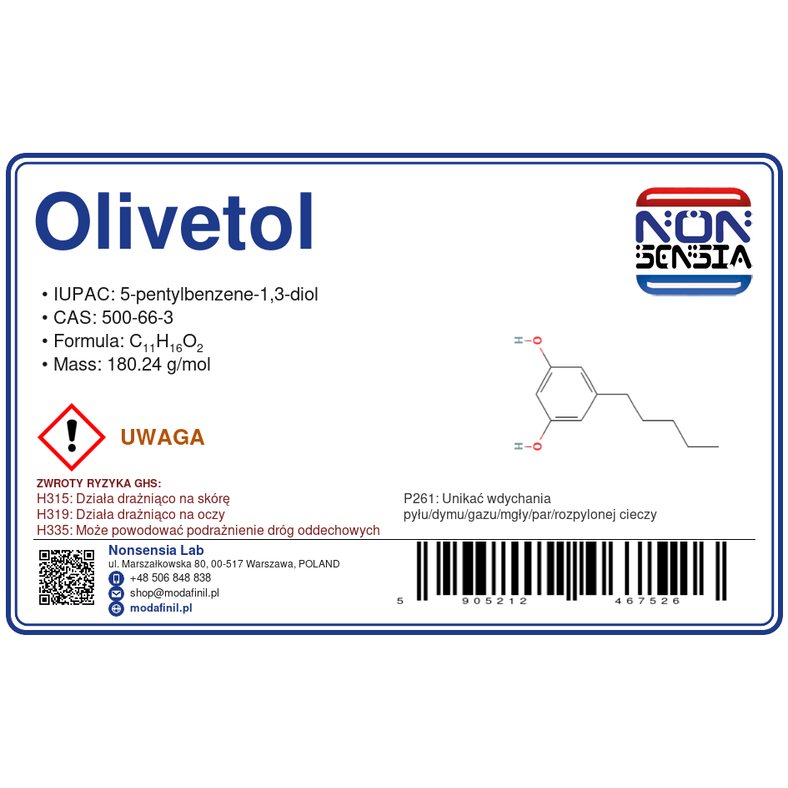
5-pentylbenzene-1,3-diol (5-pentylresorcinol), gray powder, 1000 mg package, purity ≥ 99%, in a sealed aluminum zip-lock bag. Reagent intended exclusively for laboratory, analytical and in vitro chemical synthesis research, not for human or animal consumption. It is not a medicinal product, dietary supplement, food, or cosmetic.
Something that needs to be said up front
Olivetol has sometimes been described online as an alleged “antidote” to the effects of THC, CBD, HHC, or HHC-O — supposedly the only scientifically confirmed way to neutralize cannabinoid effects. This claim has no support in any of the papers indexed in the PubMed database, and a search of that database for “olivetol” returns more than 170 entries. It is worth checking this before going further, because the actual picture is nearly the opposite of this claim.
Olivetol is a simple resorcinol — a molecule that, chemically and biosynthetically, is a starting point for producing cannabinoids, not an agent that neutralizes their effects. In classical organic chemistry, it was precisely the condensation of olivetol with a terpene derivative that gave one of the first described syntheses of THC [1], and in the Cannabis sativa plant a structurally related enzymatic pathway leads to olivetol or its acidic analog as a precursor of natural cannabinoid biosynthesis [2][3]. A building block and an end product are not the same thing — and none of the papers cited below describes olivetol as an agent that cancels the effects of cannabinoids in humans. The material offered on this page is a laboratory reagent, not a pharmacological agent.
We state this directly because it is one of the few situations in our catalog where the real problem is not a lack of literature but its misrepresentation. The description below concerns a chemical reagent and is based solely on data verified in the PubChem and PubMed databases on the day this page was prepared.
Three different entities that must not be confused
Three completely different contexts for the same chemical name, including the status of the reagent offered here:
| Entity | What it is | Status of olivetol |
|---|---|---|
| Chemical substance olivetol, CAS 500-66-3 |
A chemical concept — a molecule with a defined structure, registered in identifier databases (PubChem, ChEBI, ChEMBL). | yes — this is the only status this molecule actually has |
| Medicinal product | A pharmaceutical preparation: pharmaceutical form, GMP regime, registration documentation, safety oversight. | NO — in any country. Olivetol has never been registered as a medicine, dietary supplement, or food |
| Chemical reagent material offered here |
Material for laboratory, analytical, and synthetic work — including as a substrate in organic synthesis. | yes — and it is offered solely in this capacity |
As with flmodafinil, there is nothing here to confuse with a medicine, because there is no medicine — no registered form of olivetol intended for human use exists in any jurisdiction. A separate issue, described above, is confusing olivetol with the cannabinoids it is sometimes used as a reagent to produce. These are two different chemical compounds with different structures, different CAS numbers, and different legal status — olivetol is not a cannabinoid, does not act like a cannabinoid, and does not cancel the effects of cannabinoids.
The biological studies cited further on this page — in zebrafish, mice, or bacteria — were conducted under preclinical experimental conditions, never using the analytical reagent in its commercial form, and never involving humans. None of these results extends to the material offered here, and none provides a basis for any claim about its effects.
Reagent identification card
| Systematic name (IUPAC) | 5-pentylbenzene-1,3-diol |
|---|---|
| Common name | olivetol |
| CAS number | 500-66-3 |
| Molecular formula | C11H16O2 |
| Molar mass | 180.24 g·mol−1 |
| Monoisotopic mass | 180.1150 Da |
| InChIKey | IRMPFYJSHJGOPE-UHFFFAOYSA-N |
| SMILES | CCCCCC1=CC(=CC(=C1)O)O |
| PubChem CID | 10377 |
| ChEBI | CHEBI:66960 |
| ChEMBL | CHEMBL3656202 |
| Form | gray powder |
| Purity | ≥ 99% |
| Packaging | sealed aluminum zip-lock bag |
| Intended use | research and synthetic reagent — not for human or animal consumption |
Molecular lineage: from a simple resorcinol to a cannabinoid building block
Olivetol is not an exotic molecule. It is a resorcinol — a dihydroxybenzene — substituted at position 5 with a simple, unbranched pentyl chain. The resorcinol core itself is one of the simplest and best-understood phenolic motifs in organic chemistry. What makes olivetol interesting is not the structure itself but the role it plays as a starting reagent in organic synthesis and as a product of a natural plant biosynthetic pathway. For a chemistry laboratory, olivetol is above all a synthetic reagent.
Classical synthesis: one step from resorcinol to the cannabinoid scaffold
Acid-catalyzed condensation of resorcinol with a terpene derivative is one of the classical routes for building the benzopyran ring shared by THC and related cannabinoids. Razdan and co-workers described in 1974 a one-step synthesis of (−)-Δ1-tetrahydrocannabinol from p-mentha-2,8-dien-1-ol and olivetol [1] — a paper that, for decades, established olivetol as the standard reagent and starting substrate for synthesizing this family of compounds. Half a century later, the same reagent-based approach is still the subject of process optimization: Braga and co-workers described in 2024 a synthesis of cannabidiol carried out in both batch and continuous-flow mode [5], and a 2022 review by Nguyen and co-workers summarizes the synthetic strategies used today to obtain rare cannabinoids from Cannabis sativa [4].
Natural biosynthesis: a plant enzyme with a matching name
Independently of synthetic chemistry, olivetol is also formed enzymatically within the plant itself. Taura and co-workers characterized in 2009 a polyketide synthase capable of producing olivetol in vitro, describing it as putatively involved in the cannabinoid biosynthetic pathway [2]. Kearsey and co-workers described in 2020 the crystal structure of this enzyme, pointing to the cyclization plasticity characteristic of type III polyketide synthases [3]. This line of research — plant pathway biochemistry — runs parallel to classical synthetic chemistry and is today the basis for the metabolic engineering described further on this page. This has no bearing on the origin of the reagent offered here, which is a synthetic material of confirmed analytical purity.
Timeline
| 1974 | one-step synthesis of THC from olivetol and p-mentha-2,8-dien-1-ol [1] |
|---|---|
| 1982 | development of an HPLC method for determining olivetol in serum [11] |
| 1984 | description of olivetol biotransformation by the fungus Syncephalastrum racemosum [13] |
| 2006 | pharmacology of synthetic cannabinoid receptor ligands based on the olivetol and resorcinol core [12] |
| 2009 | characterization of the plant enzyme (“olivetol synthase”) in the cannabinoid biosynthetic pathway [2] |
| 2017 | first work on engineering yeast as a platform for cannabinoid biosynthesis [6] |
| 2020 | crystal structure of the olivetol-producing enzyme [3]; bioengineering of the THCA pathway in yeast [7]; synthetic biology of cannabinoids in tobacco and yeast [8] |
| 2022 | electrochemical method for detecting olivetol [14]; review of synthetic strategies for rare cannabinoids [4] |
| 2023 | review of fungal biotechnological platforms for cannabinoid production [9]; assessment of cross-reactivity of cannabinoid analogs in urine immunoassays [15] |
| 2024 | synthesis of cannabidiol in batch and continuous-flow mode [5]; engineering of cannabinoid production in Saccharomyces cerevisiae [10] |
| 2026 | latest work on olivetol’s activity against the bacterial SOS response [18] and nucleolar cell stress signaling [19] |
Research directions: from classical synthesis to metabolic engineering
The literature on olivetol as a reagent clearly divides into several distinct strands, which are worth distinguishing when looking for specific information.
- Classical synthetic chemistry — reagent in the organic synthesis of cannabinoids (references [1][5] in the bibliography).
- Plant pathway biochemistry — the plant enzyme that produces olivetol (references [2][3]).
- Metabolic engineering and biotechnology — cannabinoid production in yeast, tobacco, and fungi (references [6][7][8][9][10]) — the youngest and currently fastest-growing strand.
- Analytical and forensic toxicology — HPLC, electrochemistry, immunoassay cross-reactivity (references [11][14][15]).
- Preclinical pharmacology — studies in animals and bacterial models (references [12][16][17][18][19]), discussed separately in the bibliography section, with a caveat regarding the research model.
Caveat for the entire section above. The papers listed are the history of scientific research, not a description of the effects of the material offered here. The pharmacological and toxicological studies cited above were conducted in laboratory animals (zebrafish, mice), bacteria (E. coli), or cell lines — never involving humans and never using the analytical reagent in its commercial form. None of these results extends to the material offered here, provides information about its effects, or can serve as grounds for any use outside the laboratory.
Chemistry: a simple resorcinol, complex possibilities
Why the lack of chirality simplifies working with this reference standard
Unlike modafinil, whose stereogenic center lies on the sulfur atom, olivetol is an achiral molecule — it contains no atom with four different substituents. The resorcinol ring with two hydroxyl groups at positions 1 and 3 and a simple, unbranched pentyl chain at position 5 form no center of chirality. For a laboratory, this means a practical simplification: qualifying the reference standard does not require enantiomer separation or an enantioselective method — standard confirmation of identity and purity is sufficient, which simplifies working with this reagent in an analytical laboratory.
The two hydroxyl groups of resorcinol are a site of chemical reactivity used in synthesis: they can undergo O-alkylation, and the aromatic ring — strongly activated by both oxygen substituents — is susceptible to electrophilic substitution and condensation with terpene electrophiles, which is precisely the mechanism of the classical cannabinoid synthesis described above.
Physicochemical characterization
| Parameter | Value | What this means |
|---|---|---|
| Partition coefficient (XLogP, computational) | ≈ 3.6 | moderately high lipophilicity — higher than modafinil (≈ 1.3), lower than bromantane (≈ 5); elutes later in the RP-HPLC gradient |
| Topological polar surface area (TPSA) | 40.5 Å2 | arises from the two hydroxyl groups of resorcinol; moderate hydrogen-bonding capacity |
| Hydrogen bond donors | 2 | the two –OH groups of resorcinol — the O–H infrared band, a site for derivatization |
| Hydrogen bond acceptors | 2 | the same oxygen atoms |
| Rotatable bonds | 4 | conformational freedom of the pentyl chain |
| Heavy atoms | 13 | a small molecule for a reference material in cannabinoid synthesis |
| Melting point | 48.9 °C | low — the material already softens at room warmth in summer; store in a cool place |
| Boiling point | 163.9 °C | computational value (source: NIST WebBook), useful when planning distillation or vacuum drying |
| Solubility | good in methanol, ethanol, and DMSO; poor in water | with XLogP ≈ 3.6, stock solutions are prepared in an organic solvent |
Nomenclature and synonyms
- Olivetol — the most common name in international use and in the chemical literature;
- Oliwetol — the Polish-adapted spelling;
- 5-pentylresorcinol (5-Pentylresorcinol) — a descriptive name indicating the substituent and the resorcinol core;
- 5-pentylbenzene-1,3-diol (5-Pentylbenzene-1,3-diol / 5-Pentyl-1,3-benzenediol) — the systematic IUPAC name, the only unambiguous one;
- 3,5-dihydroxyamylbenzene (3,5-Dihydroxyamylbenzene) — an older common name found in 20th-century literature;
- 5-n-amylresorcinol (5-n-Amylresorcinol) — a variant using “amyl” instead of “pentyl,” both denoting the same five-carbon chain;
- CCRIS 6084, MFCD00002293 — registry numbers in chemical databases;
- CHEBI:66960 — identifier in the ChEBI database.
When running a bibliographic search, it is worth combining the variants “olivetol,” “pentylresorcinol,” and “resorcinol, 5-pentyl-” — searching under only one term misses some records indexed under the systematic name. All variants refer to the same reagent with CAS number 500-66-3.
Laboratory applications of the reagent
Below are the most important applications of this reagent in laboratory practice:
- substrate in the organic synthesis of cannabinoids — the classical reagent in condensation with terpene derivatives leading to the THC [1] and CBD [5] scaffold;
- reference material for confirming identity and purity by HPLC [11];
- reference standard in electrochemical and GC-MS methods — a sensitive electrochemical detection technique for olivetol was described by You et al. [14];
- comparison material when assessing immunoassay cross-reactivity for detecting cannabinoid analogs in urine [15];
- substrate in studies of enzymatic and microbial biotransformation of the resorcinol core [13];
- model compound in studies of metabolic engineering of cannabinoid biosynthetic pathways in yeast and fungi [6][9].
Storage, handling, and work safety
The material is a chemical reagent — not for consumption — and must be handled in accordance with laboratory work practices. Store in the original, tightly closed packaging, in a dry and cool place, protected from light, separately from food and feed and out of the reach of children. Due to its low melting point (48.9 °C), avoid storing it in sunny locations or near heat sources — the material can already soften at summer room temperature. Work only under laboratory conditions, using personal protective equipment: gloves, safety goggles, and laboratory clothing; weigh the powder under conditions that limit dust generation. Avoid inhaling dust and contact with skin and eyes. Dispose of waste in accordance with the regulations applicable to chemical waste at the research site.
Hazard classification. According to registry data (PubChem, Safety and Hazards section) for this reagent, the substance is subject to the signal word classification Warning, GHS07 pictogram, with the hazard statements: H315 — causes skin irritation, H319 — causes serious eye irritation, H335 — may cause respiratory irritation; precautionary statement P261 — avoid breathing dust. LD50 toxicological data are not compiled in the registry source — the absence of a documented value does not mean the absence of hazard. A safety data sheet is available on request.
Regulatory status
Olivetol is not registered as a medicinal product, dietary supplement, or food in any country known to us and has no pharmacopoeial monograph. It is also not a cannabinoid and does not appear on the lists of controlled substances applicable to THC or other cannabinoids — it is a separate chemical compound, although it is sometimes used as a reagent in their synthesis. The legal status of chemical reagents used as synthetic precursors can be subject to separate national regulations, independent of the status of the molecule itself — the buyer is responsible for checking the legal status in the country of destination before ordering. The material offered is a chemical reagent and has no approval for any use in humans or animals.
Frequently Asked Questions
Is olivetol an antidote to THC, CBD, HHC, or HHC-O?
No. This claim, circulating on some online shops, has no confirmation in any of the more than 170 papers indexed in PubMed under “olivetol.” The actual role of this molecule is the opposite: olivetol is a starting reagent used for producing cannabinoids in organic synthesis, not an agent that cancels their effects.
Is olivetol a cannabinoid?
No. Olivetol is a simple resorcinol — a dihydroxybenzene with a pentyl chain. Cannabinoids (THC, CBD, and related compounds) have a much more complex structure that additionally includes a terpene ring. Olivetol is sometimes their synthetic and biosynthetic precursor, but it is not a cannabinoid itself.
What is olivetol used for in cannabinoid synthesis?
As a starting reagent in the acid-catalyzed condensation with terpene derivatives that builds the benzopyran ring shared by THC and CBD. The first one-step synthesis of THC from olivetol was described in 1974; this approach continues to be developed today, including a continuous-flow version described in 2024.
Does olivetol also form naturally in the plant?
Yes, enzymatically. In 2009, a plant enzyme capable of producing olivetol in vitro was characterized, putatively involved in the cannabinoid biosynthetic pathway in Cannabis sativa; in 2020, the crystal structure of this enzyme was described.
What is the chemical formula and molar mass of olivetol?
C11H16O2; molar mass 180.24 g·mol−1, monoisotopic mass 180.1150 Da. CAS number 500-66-3, InChIKey IRMPFYJSHJGOPE-UHFFFAOYSA-N.
Does olivetol have a stereogenic center?
No. Unlike modafinil, whose center of chirality lies on the sulfur atom, olivetol is an achiral molecule — the simple resorcinol ring with a pentyl chain forms no stereogenic center. Qualifying the reference standard therefore does not require enantiomer separation.
Is the reagent suitable for uses other than laboratory applications?
No. The material is intended exclusively for laboratory, analytical, and chemical synthesis research — not for human or animal consumption, it is not a medicine, dietary supplement, food, or cosmetic, and it must not be used for medical, diagnostic, or consumption purposes.
How should olivetol be stored as a laboratory reagent?
In the original, tightly closed packaging, in a dry and cool place, protected from light, separately from food and feed and out of the reach of children. Due to its low melting point (48.9 °C), avoid heat and direct sunlight.
What solvent should be used to prepare an olivetol stock solution?
It dissolves well in methanol, ethanol, and DMSO, and poorly in water. With XLogP ≈ 3.6, stock solutions are prepared in an organic solvent.
Is a safety data sheet provided with olivetol?
A safety data sheet is provided on request to recipients conducting research, scientific, or analytical activities. The substance is subject to the signal word classification Warning (GHS07) with the hazard statements H315, H319, and H335.
Is olivetol legal in Poland?
Olivetol is not registered as a medicinal product, dietary supplement, or food, and it does not appear on the lists of controlled substances applicable to cannabinoids. However, the legal status of reagents used as synthetic precursors can be subject to separate national regulations — the buyer is responsible for checking the legal status in the country of destination before ordering. The reagent offered has no approval for use in humans.
How is olivetol identified in chromatographic or electrochemical analysis?
By HPLC against a reference material, or by an electrochemical method using a modified electrode — a sensitive electrochemical detection technique was described in 2022. With XLogP ≈ 3.6, the compound elutes later in the gradient in reversed-phase chromatography.
What is the olivetol reference standard used for in the laboratory?
As a starting reagent in the organic synthesis of cannabinoids, a reference material for confirming identity by HPLC, a reference standard in electrochemical and GC-MS methods, and a comparison material when assessing the cross-reactivity of immunoassays detecting cannabinoid analogs. This reference standard is a reagent, not a product for consumption.
References
Entries are drawn from the PubMed database (query from the day this page was prepared, result: 172 records for “olivetol”). Entries [1], [5] concern chemical synthesis; [2][3] plant pathway biochemistry; [4][6][7][8][9][10] metabolic engineering and biotechnology; [11][14][15] analytical methods; [12][13][16][17][18][19] are preclinical studies in animals, fungi, or bacteria. None of these papers describes use of the analytical reagent in humans, and none confirms the alleged “antidote” effect on cannabinoids — they are cited as scientific context and a bibliographic reference, not as information about the properties of the material offered here or as encouragement for any use.
- Razdan RK, Dalzell HC, Handrick GR (1974). Hashish. A simple one-step synthesis of (−)-Δ1-tetrahydrocannabinol (THC) from p-mentha-2,8-dien-1-ol and olivetol. J Am Chem Soc. PMID 4413630.
- Taura F et al. (2009). Characterization of olivetol synthase, a polyketide synthase putatively involved in cannabinoid biosynthetic pathway. FEBS Lett. PMID 19454282. doi:10.1016/j.febslet.2009.05.024.
- Kearsey LJ et al. (2020). Structure of the Cannabis sativa olivetol-producing enzyme reveals cyclization plasticity in type III polyketide synthases. FEBS J. PMID 31605668. doi:10.1111/febs.15089.
- Nguyen GN et al. (2022). Synthetic Strategies for Rare Cannabinoids Derived from Cannabis sativa. J Nat Prod. PMID 35648593. doi:10.1021/acs.jnatprod.2c00155.
- Braga FC et al. (2024). Batch and Continuous Flow Total Synthesis of Cannabidiol. Chem Asian J. PMID 39039021. doi:10.1002/asia.202400689.
- Zirpel B et al. (2017). Engineering yeasts as platform organisms for cannabinoid biosynthesis. J Biotechnol. PMID 28694184. doi:10.1016/j.jbiotec.2017.07.008.
- Thomas F et al. (2020). Bioengineering studies and pathway modeling of the heterologous biosynthesis of tetrahydrocannabinolic acid in yeast. Appl Microbiol Biotechnol. PMID 33043390. doi:10.1007/s00253-020-10798-3.
- Gülck T et al. (2020). Synthetic Biology of Cannabinoids and Cannabinoid Glucosides in Nicotiana benthamiana and Saccharomyces cerevisiae. J Nat Prod. PMID 33000946. doi:10.1021/acs.jnatprod.0c00241.
- Kosalkóva K et al. (2023). Biotechnological Fungal Platforms for the Production of Biosynthetic Cannabinoids. J Fungi. PMID 36836348. doi:10.3390/jof9020234.
- Schmidt C et al. (2024). Engineering cannabinoid production in Saccharomyces cerevisiae. Biotechnol J. PMID 38403455. doi:10.1002/biot.202300507.
- Rauls D, Penney LL (1982). Analysis of olivetol in rabbit serum by high-performance liquid chromatography. J Chromatogr. PMID 7056834.
- Cascio MG et al. (2006). In vitro and in vivo pharmacology of synthetic olivetol- or resorcinol-derived cannabinoid receptor ligands. Br J Pharmacol. PMID 16953186. This paper concerns synthetic olivetol derivatives used as the starting material, not the starting molecule itself.
- McClanahan RH, Robertson LW (1984). Biotransformation of olivetol by Syncephalastrum racemosum. J Nat Prod. PMID 6512535.
- You Z et al. (2022). Electrochemical Detection of Olivetol Based on Poly(L-Serine) Film Layered Copper Oxide Modified Carbon Paste Electrode. Nanomaterials (Basel). PMID 36615980. doi:10.3390/nano13010070.
- Wolf CE et al. (2023). The cross-reactivity of cannabinoid analogs (delta-8-THC, delta-10-THC and CBD), their metabolites and chiral carboxy HHC metabolites in urine of six commercially available homogeneous immunoassays. J Anal Toxicol. PMID 37602947. doi:10.1093/jat/bkad059.
- Reshma A et al. (2023). Anti-obesity effects of olivetol in adult zebrafish model induced by short-term high-fat diet. Sci Rep. PMID 37891223. doi:10.1038/s41598-023-44462-3. Study in zebrafish, not in humans.
- Zabolotneva AA et al. (2025). Olivetol’s Effects on Metabolic State and Gut Microbiota Functionality in Mouse Models of Alimentary Obesity, Diabetes Mellitus Type 1 and 2, and Hypercholesterolemia. Biomedicines. PMID 39857767. doi:10.3390/biomedicines13010183. Study in mice, not in humans.
- Şener B, Gökalsın B (2026). Inhibition of the SOS response by olivetol improves the efficacy of DNA-damaging antibiotics in Escherichia coli. J Antibiot (Tokyo). PMID 42243332. doi:10.1038/s41429-026-00935-x. Study in bacteria, not in humans.
- Deriglazov DA et al. (2026). Olivetol induces a non-genotoxic nucleolar DNA damage response via membrane-dependent stress signaling. Nucleus (Austin). PMID 42148588. doi:10.1080/19491034.2026.2672818. Study in a cellular model, not in humans.
Identification data and computational descriptors from PubChem (CID 10377); melting and boiling points from NIST Chemistry WebBook.
Related reagents in our catalog
- Cannabidiol / CBD — a compound whose synthesis olivetol is sometimes used as a starting reagent for; substantive contrast: olivetol is a simple resorcinol, while CBD is a far more complex terpenophenolic molecule formed with its involvement
- Palmitoylethanolamide (PEA) — a different chemical route to the endocannabinoid system: PEA is a lipid signaling amide, while olivetol is a precursor of classical cannabinoid receptor ligands studied through synthetic methods
- Modafinil (CAS 68693-11-8) — structural contrast: modafinil has a stereogenic center on the sulfur atom, while olivetol is an achiral molecule
Statement on the intended use of the product
The material offered is a chemical reagent intended exclusively for research, analytical, synthetic, and laboratory purposes. It is not intended for human or animal consumption. It is not a medicinal product, dietary supplement, food, medical device, or cosmetic. It is also not a cannabinoid or an “antidote” to the effects of cannabinoids — such a description has no support in the scientific literature. It must not be used for medical, diagnostic, therapeutic, preventive, or consumption purposes, administered to humans or animals, applied to the skin, or added to food, beverages, or feed. Sold exclusively to recipients engaged in research, scientific, or analytical activities, with laboratory facilities and the knowledge needed to safely handle chemical reagents. The buyer bears sole responsibility for the lawful and safe use of the reagent and for compliance with the regulations applicable in the country of destination.