EXTERNALKim, Sunghwan, Jie Chen, Tiejun Cheng, et al. 2023. "PubChem 2023 update." Nucleic Acids Research 51 (D1): D1373-D1380.link
BUILTINPriem, Jason, Heather Piwowar, and Richard Orr. 2022. "OpenAlex: A Fully-Open Index of Scholarly Works, Authors, Venues, Institutions, and Concepts." arXiv preprint arXiv:2205.01833.link[dostep: 2026-04-27]CC0 (data); arXiv preprint
EXTERNALWishart, David S., et al. 2022. "HMDB 5.0: the Human Metabolome Database for 2022." Nucleic Acids Research 50 (D1): D622-D631.
EXTERNALKim, Sunghwan, Tiejun Cheng, Jianyong He, Chen Cheng, et al. 2021. "PubChem Protein, Pathway, Reaction, and Disease Specifications." Journal of Cheminformatics 13: 16.link
EXTERNALHaug, Kenneth, Keeva Cochrane, Venkata Chandrasekhar Nainala, et al. 2020. "MetaboLights: a resource evolving in response to the needs of its scientific community." Nucleic Acids Research 48 (D1): D440-D444.
EXTERNALSansone, Susanna-Assunta, et al. 2019. "FAIRsharing as a community approach to standards, repositories and policies." Nature Biotechnology 37 (4): 358-367.link
BUILTINMendoza, Manuel, and Christopher Belter. 2018. "Citation Analysis: A Practitioner's Guide." Journal of the Medical Library Association 106 (1): 47-55.link[dostep: 2026-04-27]CC-BY 4.0
EXTERNALHähnke, Volker D., Sunghwan Kim, and Evan E. Bolton. 2018. "PubChem chemical structure standardization." Journal of Cheminformatics 10: 36.link
EXTERNALWang, Yanli, Stephen H. Bryant, Tiejun Cheng, Jiyao Wang, et al. 2017. "PubChem BioAssay: 2017 update." Nucleic Acids Research 45 (D1): D955-D963.link
EXTERNALSalek, Reza M., Pablo Conesa, Kenneth Cochrane, et al. 2017. "Automated assembly of species metabolomes through data integration." Database 2017: bax038.
EXTERNALSud, Manish, et al. 2017. "Computational tools for the secondary analysis of metabolomics experiments." Computational and Structural Biotechnology Journal 14: 232-245.
EXTERNALWilkinson, Mark D., et al. 2016. "The FAIR Guiding Principles for scientific data management and stewardship." Scientific Data 3: 160018.link
EXTERNALSud, Manish, Eoin Fahy, Dawn Cotter, et al. 2016. "Metabolomics Workbench: An international repository for metabolomics data and metadata, metabolite standards, protocols, tutorials and training, and analysis tools." Nucleic Acids Research 44 (D1): D463-D470.
EXTERNALWishart, David S. 2016. "Emerging applications of metabolomics in drug discovery and precision medicine." Nature Reviews Drug Discovery 15 (7): 473-484.
BUILTINWilsdon, James, et al. 2015. The Metric Tide: Report of the Independent Review of the Role of Metrics in Research Assessment and Management. Bristol: HEFCE.link[dostep: 2026-04-27]Open (HEFCE/UKRI)
BUILTINBornmann, Lutz, and Ruediger Mutz. 2014. "Growth Rates of Modern Science: A Bibliometric Analysis Based on the Number of Publications and Cited References." Journal of the Association for Information Science and Technology 66 (11): 2215-2222.link[dostep: 2026-04-27]Subscription (Wiley)
BUILTINvan Eck, Nees Jan, and Ludo Waltman. 2014. "Visualizing Bibliometric Networks." In Measuring Scholarly Impact: Methods and Practice, edited by Y. Ding, R. Rousseau, and D. Wolfram, 285-320. Cham: Springer.link[dostep: 2026-04-27]Subscription (Springer)
EXTERNALCheng, Tiejun, et al. 2014. "Computation of Octanol-Water Partition Coefficients by Guiding an Additive Model with Knowledge." Journal of Chemical Information and Modeling 54 (3): 793-805.link
BUILTINHjorland, Birger. 2013. "Citation Analysis: A Social and Dynamic Approach to Knowledge Organization." Information Processing & Management 49 (6): 1313-1325.link[dostep: 2026-04-27]Subscription (Elsevier)
EXTERNALSalek, Reza M., Kenneth Haug, Pablo Conesa, et al. 2013. "The MetaboLights repository: curation challenges in metabolomics." Database 2013: bat029.
BUILTINLozano, George A., Vincent Lariviere, and Yves Gingras. 2012. "The Weakening Relationship Between the Impact Factor and Papers' Citations in the Digital Age." Journal of the American Society for Information Science and Technology 63 (11): 2140-2145.link[dostep: 2026-04-27]Subscription (Wiley)
EXTERNALWilliams, Antony J., Lee Harland, Paul Groth, et al. 2012. "Open PHACTS: Semantic interoperability for drug discovery." Drug Discovery Today 17 (21-22): 1188-1198.link
EXTERNALSansone, Susanna-Assunta, Philippe Rocca-Serra, Dawn Field, et al. 2012. "Toward interoperable bioscience data." Nature Genetics 44 (2): 121-126.
EXTERNALBolton, Evan E., et al. 2011. "PubChem3D: A new resource for scientists." Journal of Cheminformatics 3: 32.link
EXTERNALFahy, Eoin, Dawn Cotter, Manish Sud, and Shankar Subramaniam. 2011. "Lipid classification, structures and tools." Biochimica et Biophysica Acta 1811 (11): 637-647.
EXTERNALCottrell, John S. 2011. "Protein identification using MS/MS data." Journal of Proteomics 74 (10): 1842-1851.
BUILTINLariviere, Vincent, and Yves Gingras. 2010. "On the Relationship Between Interdisciplinarity and Scientific Impact." Journal of the American Society for Information Science and Technology 61 (1): 126-131.link[dostep: 2026-04-27]Subscription (Wiley)
BUILTINRobertson, Stephen, and Hugo Zaragoza. 2009. "The Probabilistic Relevance Framework: BM25 and Beyond." Foundations and Trends in Information Retrieval 3 (4): 333-389.link[dostep: 2026-04-27]Subscription (Now Publishers)
EXTERNALWishart, David S. 2009. "Computational strategies for metabolite identification in metabolomics." Bioanalysis 1 (9): 1579-1596.
BUILTINManning, Christopher D., Prabhakar Raghavan, and Hinrich Schuetze. 2008. Introduction to Information Retrieval. Cambridge: Cambridge University Press.link[dostep: 2026-04-27]Open (online edition)
BUILTINBornmann, Lutz, and Hans-Dieter Daniel. 2008. "What Do Citation Counts Measure? A Review of Studies on Citing Behavior." Journal of Documentation 64 (1): 45-80.link[dostep: 2026-04-27]Subscription (Emerald)
EXTERNALBolton, Evan E., Yanli Wang, Paul A. Thiessen, and Stephen H. Bryant. 2008. "PubChem: Integrated Platform of Small Molecules and Biological Activities." Annual Reports in Computational Chemistry 4: 217-241.link
EXTERNALWishart, David S., et al. 2007. "HMDB: the Human Metabolome Database." Nucleic Acids Research 35 (Database): D521-D526.
BUILTINMoed, Henk F. 2005. Citation Analysis in Research Evaluation. Dordrecht: Springer.link[dostep: 2026-04-27]Subscription (Springer)
EXTERNALSmith, Colin A., et al. 2005. "METLIN: a metabolite mass spectral database." Therapeutic Drug Monitoring 27 (6): 747-751.
BUILTINNewman, M. E. J. 2003. "The Structure and Function of Complex Networks." SIAM Review 45 (2): 167-256.link[dostep: 2026-04-27]Subscription (SIAM)
BUILTINPage, Lawrence, Sergey Brin, Rajeev Motwani, and Terry Winograd. 1999. "The PageRank Citation Ranking: Bringing Order to the Web." Stanford InfoLab Technical Report 1999-66.link[dostep: 2026-04-27]Open (Stanford InfoLab)
BUILTINWatts, Duncan J., and Steven H. Strogatz. 1998. "Collective Dynamics of 'Small-World' Networks." Nature 393 (6684): 440-442.link[dostep: 2026-04-27]Subscription (Nature)
BUILTINBelkin, Nicholas J., and W. Bruce Croft. 1992. "Information Filtering and Information Retrieval: Two Sides of the Same Coin?" Communications of the ACM 35 (12): 29-38.link[dostep: 2026-04-27]Subscription (ACM)
BUILTINEgghe, Leo, and Ronald Rousseau. 1990. Introduction to Informetrics: Quantitative Methods in Library, Documentation and Information Science. Amsterdam: Elsevier.link[dostep: 2026-04-27]Open (institutional repository)
BUILTINSalton, Gerard. 1989. Automatic Text Processing: The Transformation, Analysis, and Retrieval of Information by Computer. Reading, MA: Addison-Wesley.link[dostep: 2026-04-27]Subscription (ACM/Pearson)
BUILTINSalton, Gerard, and Christopher Buckley. 1988. "Term-Weighting Approaches in Automatic Text Retrieval." Information Processing & Management 24 (5): 513-523.link[dostep: 2026-04-27]Subscription (Elsevier)
BUILTINGarfield, Eugene. 1979. Citation Indexing: Its Theory and Application in Science, Technology, and Humanities. New York: Wiley.link[dostep: 2026-04-27]Subscription (Wiley)
BUILTINGarfield, Eugene. 1955. "Citation Indexes for Science: A New Dimension in Documentation through Association of Ideas." Science 122 (3159): 108-111.link[dostep: 2026-04-27]Subscription (AAAS)
📤 Osadź tę molekułę na swojej stronie
Masz bloga, forum lub serwis naukowy? Osadź interaktywną molekułę 3D na swojej stronie — zobaczy ją każdy Twój czytelnik, a poniżej ma link do naszego sklepu gdzie może kupić odczynnik.
🔗 Kod HTML iframe (najłatwiejsze — działa wszędzie)
Skopiuj i wklej w edytorze HTML swojej strony:
Dostosuj width i height do swojego layoutu.
⚙ WordPress Shortcode (dla innych sklepów z MOL-GOD)
🌐 Bezpośredni link (do emaili, czatów, LinkedIn, Twitter)
📋 Licencja: Embed zachowuje link zwrotny do NONSENSIA, Laboratorium. (wymagane — sklep jest źródłem danych). Dane chemiczne pochodzą z PubChem (CC0 — domena publiczna). Embed jest BEZPŁATNY do zastosowań edukacyjnych, komercyjnych i hobby.
🔍 Zgłoś błąd w danych
Zauważyłeś błąd w danych chemicznych tego związku? Pomóż nam go naprawić.
Dane pochodzą z PubChem (NIH) — sprawdzamy każdy raport i aktualizujemy cache.
Data sources:
PubChem, NIST Chemistry WebBook, CRC Handbook of Chemistry and Physics (103rd ed.)
Last updated: 2026-06-08
📊 Confidence:⚠️85% ACCEPTABLEAcceptable — z disclaimerem Dane potwierdzone w 1-2 źródłach lub z minimalną rozbieżnością. Cytuj z weryfikacją podstawowego źródła.
Widma pobierane na żądanie z 9 źródeł. Każde widmo jest zapisywane w naszej bazie — kolejne otwarcie = zero zapytania do zewnętrznego API. Pobierz JCAMP-DX / CSV / PNG przy każdym widmie bez szukania.
Dane pobierane przez MolGod_Spectra_Remote_Fetcher (JCAMP-DX parser) i zapisywane w tabeli wp_molgod_spectra_cache. Zero duplikatów pobrań, zero zapytań do NIST przy kolejnych otwarciach. Licencje przestrzegane (publikowany tylko deep-link + własna wizualizacja).
🔎 Wyszukiwanie po widmie (JCAMP-DX)
Wgraj plik JCAMP-DX (.jdx, .dx, .jcm) — system policzy podobieństwo cosinusowe do wszystkich widm w bazie i pokaże TOP 10 dopasowań.
📚 Bibliografia (Chicago)
McLafferty, Fred W., ed. 2018. Wiley Registry of Mass Spectral Data. 11th ed. Hoboken, NJ: Wiley. Referencyjna biblioteka MS (~775k widm).
Stein, Stephen E., and Donald R. Scott. 1994. "Optimization and Testing of Mass Spectral Library Search Algorithms for Compound Identification." Journal of the American Society for Mass Spectrometry 5 (9): 859–866. Algorytm cosine + dot-product NIST MS Search.
McDonald, Robert S., and Paul A. Wilks Jr. 1988. "JCAMP-DX: A Standard Form for Exchange of Infrared Spectra in Computer Readable Form." Applied Spectroscopy 42 (1): 151–162. Specyfikacja JCAMP-DX (rozszerzona do 5.01 dla NMR/MS).
McLafferty, Fred W., and František Tureček. 1993. "Interpretation of Mass Spectra." 4th ed. Mill Valley, CA: University Science Books. Cosine similarity matching i fragmentacja MS — fundament algorytmu wyszukiwania.
Sumner, Lloyd W., Alexander Amberg, Dave Barrett, Michael H. Beale, Richard Beger, Clare A. Daykin, Teresa W.-M. Fan, et al. 2007. "Proposed Minimum Reporting Standards for Chemical Analysis." Metabolomics 3 (3): 211–221. MSI Level 1-4 — standardy poziomu pewności dopasowania widmowego.
Stein, Stephen E. 1999. "An Integrated Method for Spectrum Extraction and Compound Identification from Gas Chromatography/Mass Spectrometry Data." Journal of the American Society for Mass Spectrometry 10 (8): 770–781. Algorytm AMDIS — dekonwolucja + library match (NIST).
Lindon, John C., George E. Tranter, and David W. Koppenaal, eds. 2017. "Encyclopedia of Spectroscopy and Spectrometry." 3rd ed. Amsterdam: Academic Press. Encyklopedyczne hasła dot. spectral library searching.
Pretsch, Ernő, Philippe Bühlmann, and Martin Badertscher. 2020. "Structure Determination of Organic Compounds: Tables of Spectral Data." 5th ed. Berlin: Springer. Tablice referencyjne dla weryfikacji match-ów library search.
Smith, Brian C. 2011. "Fundamentals of Fourier Transform Infrared Spectroscopy." 2nd ed. Boca Raton, FL: CRC Press. FT-IR i format JCAMP-DX dla widm transmisyjnych.
Larkin, Peter. 2017. "Infrared and Raman Spectroscopy: Principles and Spectral Interpretation." 2nd ed. Amsterdam: Elsevier. Principles of IR/Raman library matching i preprocessing peakow.
Cohen ER, Cvitaš T, Frey JG, Holmström B, Kuchitsu K, Marquardt R, Mills I, Pavese F, Quack M, Stohner J, Strauss HL, Takami M, Thor AJ (2007)
g/L ↔ molarity
c (mol/L) = (g/L) / MW
±0.1% (depends on MW precision)
Cohen ER, Cvitaš T, Frey JG, Holmström B, Kuchitsu K, Marquardt R, Mills I, Pavese F, Quack M, Stohner J, Strauss HL, Takami M, Thor AJ (2007)
mmol/L ↔ molarity
c (mol/L) = mmol/L × 10⁻³
Exact
Cohen ER, Cvitaš T, Frey JG, Holmström B, Kuchitsu K, Marquardt R, Mills I, Pavese F, Quack M, Stohner J, Strauss HL, Takami M, Thor AJ (2007)
Celsius ↔ Kelvin
T(K) = t(°C) + 273.15
±0.01 K (ITS-90 scale)
BIPM (Bureau International des Poids et Mesures) (2019)
Celsius ↔ Fahrenheit
T(°F) = T(°C) × 9/5 + 32
±0.1 °F
Thompson A, Taylor BN (2008)
density-corrected % ↔ molarity
c (mol/L) = (%w/w × ρ × 10) / MW, ρ in g/mL
±0.1% when ρ known to 3 decimals
Cohen ER, Cvitaš T, Frey JG, Holmström B, Kuchitsu K, Marquardt R, Mills I, Pavese F, Quack M, Stohner J, Strauss HL, Takami M, Thor AJ (2007)
📚 Bibliografia (8 źródeł autorytatywnych)
Thompson A, Taylor BN (2008). Guide for the Use of the International System of Units (SI). NIST Special Publication 811 · DOI: 10.6028/NIST.SP.811-2008 → Primary SI standard for US scientific usage
Cohen ER, Cvitaš T, Frey JG, Holmström B, Kuchitsu K, Marquardt R, Mills I, Pavese F, Quack M, Stohner J, Strauss HL, Takami M, Thor AJ (2007). Quantities, Units and Symbols in Physical Chemistry — The IUPAC Green Book. RSC Publishing, 3rd ed. · DOI: 10.1039/9781847557889 · ISBN: 978-0-85404-433-7 → Canonical IUPAC guide for chemistry quantities/units
BIPM (Bureau International des Poids et Mesures) (2019). The International System of Units (SI), 9th edition. BIPM · ↗ → International SI definitions (incl. redefined kilogram 2019)
ISO/IEC (2022). Quantities and units — Part 1: General. International Organization for Standardization — ISO 80000-1:2022 · ↗ → General rules for physical quantities and units
ISO/IEC (2019). Quantities and units — Part 9: Physical chemistry and molecular physics. International Organization for Standardization — ISO 80000-9:2019 · ↗ → Concentration / molality / amount-of-substance conventions
Tiesinga E, Mohr PJ, Newell DB, Taylor BN (2021). CODATA recommended values of the fundamental physical constants: 2018. Rev. Mod. Phys. 93(2):025010 · DOI: 10.1103/RevModPhys.93.025010 → Avogadro, gas constant, molar volume (2019 SI revision)
IUPAC (2019). Compendium of Chemical Terminology — the IUPAC Gold Book (online). IUPAC · DOI: 10.1351/goldbook → Definitions of mass fraction, molality, normality, ppm, activity
Mills IM, Cvitaš T, Homann K, Kallay N, Kuchitsu K (1988). Quantities, Units and Symbols in Physical Chemistry. Blackwell Scientific Publications, 1st ed. · ISBN: 0-632-01773-5 → Historical predecessor of IUPAC Green Book
Podobne struktury molekularne
Ladowanie podobnych struktur...
Wyjasnienia naukowe
Automatycznie wygenerowane wyjasnienia na podstawie wlasciwosci molekularnych i oznaczen GHS. Zrodlo: dane PubChem + klasyfikacja CLP/GHS.
Czasteczka lipofilowa (niepokarna)
LogP = 6.50 oznacza silna preferencje do fazy organicznej. Czasteczka jest slabo rozpuszczalna w wodzie, ale dobrze rozpuszcza sie w rozpuszczalnikach organicznych (np. heksan, chloroform). Wysoki LogP koreluje z latwym przenikaniem przez blony biologiczne.
Rumble, John R., ed. 2023. CRC Handbook of Chemistry and Physics. 104th ed. Boca Raton, FL: CRC Press. [link ↗]
International Association for the Properties of Water and Steam (IAPWS). 1997. "Release on the Static Dielectric Constant of Ordinary Water Substance." IAPWS R8-97. [link ↗]
Reichardt, Christian, and Thomas Welton. 2011. Solvents and Solvent Effects in Organic Chemistry. 4th ed. Weinheim: Wiley-VCH. https://doi.org/10.1002/9783527632220. [link ↗]
Hansen, Charles M. 2007. Hansen Solubility Parameters: A User's Handbook. 2nd ed. Boca Raton, FL: CRC Press. https://doi.org/10.1201/9781420006834. [link ↗]
IFA. n.d. "Water." GESTIS Substance Database. Institut für Arbeitsschutz der Deutschen Gesetzlichen Unfallversicherung. Accessed April 25, 2026. [link ↗]
Rumble, John R., ed. 2023. CRC Handbook of Chemistry and Physics. 104th ed. Boca Raton, FL: CRC Press. [link ↗]
Reichardt, Christian, and Thomas Welton. 2011. Solvents and Solvent Effects in Organic Chemistry. 4th ed. Weinheim: Wiley-VCH. https://doi.org/10.1002/9783527632220. [link ↗]
Snyder, Lloyd R., Joseph J. Kirkland, and John W. Dolan. 2010. Introduction to Modern Liquid Chromatography. 3rd ed. Hoboken, NJ: Wiley. https://doi.org/10.1002/9780470508183. [link ↗]
Smallwood, Ian M. 1996. Handbook of Organic Solvent Properties. London: Arnold. https://doi.org/10.1016/B978-0-340-64578-9.X5000-9. [link ↗]
Reichardt, Christian, and Thomas Welton. 2011. Solvents and Solvent Effects in Organic Chemistry. 4th ed. Weinheim: Wiley-VCH. https://doi.org/10.1002/9783527632220. [link ↗]
Hansen, Charles M. 2007. Hansen Solubility Parameters: A User's Handbook. 2nd ed. Boca Raton, FL: CRC Press. [link ↗]
Rumble, John R., ed. 2023. CRC Handbook of Chemistry and Physics. 104th ed. Boca Raton, FL: CRC Press. [link ↗]
Smallwood, Ian M. 1996. Handbook of Organic Solvent Properties. London: Arnold. [link ↗]
National Institute of Standards and Technology. n.d. "Methane, dichloro- (CAS 75-09-2)." NIST Chemistry WebBook, SRD 69. Accessed April 25, 2026. [link ↗]
Hansen, Charles M. 2007. Hansen Solubility Parameters: A User's Handbook. 2nd ed. Boca Raton, FL: CRC Press. [link ↗]
International Agency for Research on Cancer. 1999. "Dichloromethane." IARC Monographs on the Evaluation of Carcinogenic Risks to Humans 71: 251–315. [link ↗]
Reichardt, Christian, and Thomas Welton. 2011. Solvents and Solvent Effects in Organic Chemistry. 4th ed. Weinheim: Wiley-VCH. [link ↗]
Armarego, Wilfred L. F., and Christina Li Lin Chai. 2009. Purification of Laboratory Chemicals. 6th ed. Oxford: Butterworth-Heinemann. https://doi.org/10.1016/B978-1-85617-567-8.50003-3. [link ↗]
Hansen, Charles M. 2007. Hansen Solubility Parameters: A User's Handbook. 2nd ed. Boca Raton, FL: CRC Press. [link ↗]
National Institute of Standards and Technology. n.d. "Furan, tetrahydro- (CAS 109-99-9)." NIST Chemistry WebBook. Accessed April 25, 2026. [link ↗]
Smallwood, Ian M. 1996. Handbook of Organic Solvent Properties. London: Arnold. [link ↗]
International Agency for Research on Cancer. 1999. "Chloroform." IARC Monographs on the Evaluation of Carcinogenic Risks to Humans 73: 131–182. [link ↗]
National Institute of Standards and Technology. n.d. "Methane, trichloro- (CAS 67-66-3)." NIST Chemistry WebBook. Accessed April 25, 2026. [link ↗]
Hansen, Charles M. 2007. Hansen Solubility Parameters: A User's Handbook. 2nd ed. Boca Raton, FL: CRC Press. [link ↗]
Reichardt, Christian, and Thomas Welton. 2011. Solvents and Solvent Effects in Organic Chemistry. 4th ed. Weinheim: Wiley-VCH. [link ↗]
Teoria rozpuszczalnosci (zastosowane w przewidywaniu kompatybilnosci):
Yalkowsky, Samuel H., and Shri C. Valvani. 1980. "Solubility and Partitioning I: Solubility of Nonelectrolytes in Water." Journal of Pharmaceutical Sciences 69 (8): 912–922. https://doi.org/10.1002/jps.2600690814 — General Solubility Equation (GSE): logS = 0.5 − logP − 0.01(MP−25).
Hildebrand, Joel H., and Robert L. Scott. 1950. The Solubility of Nonelectrolytes. 3rd ed. New York: Reinhold. — "Like dissolves like" (Hildebrand parameter δ).
Hansen, Charles M. 2007. Hansen Solubility Parameters: A User's Handbook. 2nd ed. Boca Raton, FL: CRC Press. https://doi.org/10.1201/9781420006834 — HSP triplet (dD, dP, dH) + wzór Ra.
Reichardt, Christian, and Thomas Welton. 2011. Solvents and Solvent Effects in Organic Chemistry. 4th ed. Weinheim: Wiley-VCH. https://doi.org/10.1002/9783527632220 — E_T(30) polarity scale, solwatochromia.
Snyder, Lloyd R., Joseph J. Kirkland, and John W. Dolan. 2010. Introduction to Modern Liquid Chromatography. 3rd ed. Hoboken, NJ: Wiley. https://doi.org/10.1002/9780470508183 — Eluotropic series, polarity index.
PubChem Compound Database — CAS 13956-29-1 lookup ↗ — logP (XLogP3), water solubility experimental + predicted.
Kompletna bibliografia w akordeonie REFERENCJE (na dole strony) — Chicago Manual of Style 17th ed., Author-Date.
🧪Buffer Recipe CalculatorUNIQUE
Wybierz bufor z listy 20 popularnych systemów → wprowadź docelowe pH →
otrzymasz dokładny przepis z masami do odważenia.
Krok 1: Wybierz system buforowy
Krok 2: Parametry buforu
Krok 3: Twój przepis
Procedura krok po kroku:
📐 Szczegóły obliczeń (Henderson-Hasselbalch)
📜 Historia przepisów (ostatnie 10)
📊 Confidence:✅95% PRODUCTION-GRADEProduction-Grade — publikowalne w czasopiśmie naukowym Dane potwierdzone w ≥3 autorytatywnych źródłach (NIST, ECHA, PubChem, IARC). Tolerancja: <0.5%. Można cytować w publikacji peer-reviewed.
Wklej serię powtórzeń pomiarów (CSV lub po jednej liczbie w linii). Kalkulator policzy średnią, odchylenie, 95% CI, wykryje outliery (Grubbs + Dixon Q).
Separator: przecinek, spacja, tab, nowa linia. Min 3 pomiary.
Zaplanuj cały projekt laboratoryjny: dodaj eksperymenty z reagentami, powtórzeniami i czasem trwania. Otrzymasz wykres Gantta, listę zakupów (linki do sklepu!), budżet z 10% marginesem i macierz ryzyka GHS.
💡 Zaloguj się, aby zapisywać projekty.
Bez logowania możesz kalkulować, ale nie zapisać.
🧪 Metody HPLC (ready to import) (0)
⏳ Generuję metodę HPLC dla tego związku — odśwież stronę za 10 sekund. CAS 13956-29-1
🔬 Metody HPLC/GC (2 metod)
📄
Fast Detection of 10 Cannabinoids by RP-HPLC-UV Method in Cannabis sativa L.
Mandrioli M, Tura M, Scotti S, Gallina Toschi T. Fast Detection of 10 Cannabinoids by RP-HPLC-UV Method in Cannabis sativa L. Molecules. 2019;24:2113. doi:10.3390/molecules24112113
Cannabis has regained much attention as a result of updated legislation authorizing many different uses and can be classified on the basis of the content of tetrahydrocannabinol (THC), a psychotropic substance for which there are legal limitations in many countries. For this purpose, accurate qualitative and quantitative determination is essential. The relationship between THC and cannabidiol (CBD) is also significant as the latter substance is endowed with many specific and non-psychoactive proprieties. For these reasons, it becomes increasingly important and urgent to utilize fast, easy, validated, and harmonized procedures for determination of cannabinoids. The procedure described herein allows rapid determination of 10 cannabinoids from the inflorescences of Cannabis sativa L. by extraction with organic solvents. Separation and subsequent detection are by RP-HPLC-UV. Quantification is performed by an external standard method through the construction of calibration curves using pure standard chromatographic reference compounds. The main cannabinoids dosed (g/100 g) in actual samples were cannabidiolic acid (CBDA), CBD, and Δ9-THC (Sample L11 CBDA 0.88 ± 0.04, CBD 0.48 ± 0.02, Δ9-THC 0.06 ± 0.00; Sample L5 CBDA 0.93 ± 0.06, CBD 0.45 ± 0.03, Δ9-THC 0.06 ± 0.00). The present validated RP-HPLC-UV method allows determination of the main cannabinoids in Cannabis sativa L. inflorescences and appropriate legal classification as hemp or drug-type.
cannabinoidsL.HPLCvalidation
📄
Pilot-Scale Preparation of Broad-Spectrum CBD: Extraction Optimization and Purification using Centrifugal Partition Chromatography
HPLCMedical Cannabis and Cannabinoids202590% ✓CC-BY-NCResearch method (specificity, robustness)
Kolumna: C18, 150 \u03bcm
Faza: methanol/water (75:25, v/v) containing 0
Detekcja: UV 254 nm
Przepływ: 1.00 mL/min
Temp.: 60.0 °C
Inj.: 500 \u03bcL
Gradient: elution from A:B = 35:65 to 18:82 (v/v)
Wongumpornpinit V, Temkitthawon P, Khumpirapang N, Paenkaew S, Saesong T, Boonnoun P, et al. Pilot-Scale Preparation of Broad-Spectrum CBD: Extraction Optimization and Purification using Centrifugal Partition Chromatography. Medical Cannabis and Cannabinoids. 2025;8:65-79. doi:10.1159/000546263
AbstractIntroductionCannabinoids, a class of compounds found in Cannabis sativa L., possess a wide range of pharmacological properties. While Δ9-tetrahydrocannabinol (Δ9-THC) is strictly regulated owing to its psychoactive effects, cannabidiol (CBD), a nonpsychoactive compound, is permitted in certain countries. This study aimed to optimize the preparation of ethanolic cannabis extracts using response surface methodology (RSM) and develop an effective system for removing Δ9-THC through centrifugal partition chromatography (CPC) to produce broad-spectrum CBD (hemp extract containing CBD and other compounds with minimal or no Δ9-THC).MethodsThree variables and six responses were assessed to optimize extraction conditions. Predictions were made using Design-Expert® software, and the experimental conditions were identified using the Box-Behnken design (BBD). The extracts were analyzed using high-performance liquid chromatography and a chromameter. Optimal conditions were used for pilot-scale extraction, and the CPC process was optimized by determining the partition coefficient of the target cannabinoids in various solvent systems and maximum sample load.ResultsThe optimal extraction conditions were −31°C for 33 min and a sample-to-solvent ratio of 1:8% w/v, with a desirability value of 0.576. Temperature was the most influential factor. Although the total yield decreased, this condition provided the highest concentration of light-colored cannabinoids and was successfully scaled up for the three other cannabis samples. The optimal CPC solvent system, consisting of hexane/0.1% FA in ACN/20 mm ammonium formate at a ratio of 10/6.5/3.5 v/v/v, demonstrated a yield recovery of 89.3 ± 0.21% w/w with a maximum load of 5 g of sample per run. The resulting broad-spectrum CBD extract had a high CBD content (73.3 ± 0.37% w/w) and minimal Δ9-THC content (0.2 ± 0.00% w/w).ConclusionBBD-RSM optimization of ethanolic cannabis extraction provided the highest cannabinoid concentration wi...
European Committee for Standardization (CEN). 2016. EN 374-1:2016 — Protective gloves against dangerous chemicals and micro-organisms — Part 1: Terminology and performance requirements for chemical risks. CEN, Brussels. EN 374-1:2016. [link ↗] — Klasyfikacja rękawic chemoodpornych typ A/B/C; testy permeacji JKLPT
European Committee for Standardization (CEN). 2001. EN 166:2001 — Personal eye-protection — Specifications. CEN, Brussels. EN 166:2001. [link ↗] — Markings: B = średnia energia uderzenia, T = ekstremalne temp., 9 = stopione metale i ciała stałe
European Committee for Standardization (CEN). 2009. EN 14605:2005+A1:2009 — Protective clothing against liquid chemicals — Performance requirements for clothing with liquid-tight (Type 3) or spray-tight (Type 4) connections. CEN, Brussels. EN 14605:2009. [link ↗] — Type 3 (jet-tight) i Type 4 (spray-tight) ochrona przed cieczowymi chemikaliami
National Institute for Occupational Safety and Health (NIOSH). 2017. Recommendations for Chemical Protective Clothing: A Companion to the NIOSH Pocket Guide. U.S. Department of Health & Human Services / CDC. [link ↗] — Praktyczny przewodnik doboru CPC per substancja i scenariusz ekspozycji
Occupational Safety and Health Administration (OSHA). 2011. Personal Protective Equipment — General requirements. U.S. Department of Labor — 29 CFR 1910.132. 29 CFR 1910.132. [link ↗] — Pracodawca musi zapewnić PPE + szkolenie + hazard assessment udokumentowane na piśmie
🧪 Rozpuszczalność i kompatybilność z solwentami ⚠️85% ACCEPTABLEAcceptable — z disclaimerem Dane potwierdzone w 1-2 źródłach lub z minimalną rozbieżnością. Cytuj z weryfikacją podstawowego źródła.
Teoria rozpuszczalności (zastosowane w przewidywaniu kompatybilności):
Yalkowsky, Samuel H., and Shri C. Valvani. 1980. "Solubility and Partitioning I: Solubility of Nonelectrolytes in Water." Journal of Pharmaceutical Sciences 69 (8): 912–922. https://doi.org/10.1002/jps.2600690814 — General Solubility Equation (GSE): logS = 0.5 − logP − 0.01(MP−25).
Hildebrand, Joel H., and Robert L. Scott. 1950. The Solubility of Nonelectrolytes. 3rd ed. New York: Reinhold. — "Like dissolves like" (Hildebrand parameter δ).
Hansen, Charles M. 2007. Hansen Solubility Parameters: A User's Handbook. 2nd ed. CRC Press. https://doi.org/10.1201/9781420006834 — HSP triplet (dD, dP, dH) + wzór Ra.
Stefanis, E., and C. Panayiotou. 2008. "Prediction of Hansen Solubility Parameters with a New Group-Contribution Method." Int J Thermophys 29: 568–585. https://doi.org/10.1007/s10765-008-0415-z
Reichardt, Christian, and Thomas Welton. 2011. Solvents and Solvent Effects in Organic Chemistry. 4th ed. Wiley-VCH. https://doi.org/10.1002/9783527632220 — E_T(30) polarity scale, solwatochromia.
Snyder, Lloyd R., Joseph J. Kirkland, and John W. Dolan. 2010. Introduction to Modern Liquid Chromatography. 3rd ed. Wiley. https://doi.org/10.1002/9780470508183 — Eluotropic series, polarity index.
Van Krevelen, D. W., and K. Te Nijenhuis. 2009. Properties of Polymers. 4th ed. Elsevier. https://doi.org/10.1016/B978-0-08-054819-7.X0001-5 — Hoftyzer–Van Krevelen group contribution dla dD/dP/dH z SMILES.
Marcus, Yizhak. 1998. The Properties of Solvents. Wiley Series in Solution Chemistry, Vol. 4. ISBN 9780471983699 — Kompletny tabularny zestaw 250+ rozpuszczalników (ε, μ, donicity, acceptor numbers).
PubChem Compound Database — CAS 13956-29-1 lookup ↗ — logP (XLogP3), water solubility experimental + predicted.
Kompletna bibliografia w akordeonie REFERENCJE (na dole strony) — Chicago Manual of Style 17th ed., Author-Date.
🧮 Kalkulator rozpuszczalności
Rozpuszczalność:—
logS:—
Metoda:—
⚠️ —
Rozpuszczalność vs Temperatura
🌐 Hansen Solubility Sphere (3D)
Im bliżej molekuły (czerwona kula), tym lepszy solwent. · Zaawansowany: etykiety + siatka + osie + pulsacja.
Twoja molekuła
Dobre (Ra < 5)
Średnie (Ra 5-10)
Słabe (Ra > 10)
📚 Źródła danych HSP + Ra
Hansen CM (2007). Hansen Solubility Parameters: A User's Handbook, 2nd ed., CRC Press. DOI: 10.1201/9781420006834 — Table 7.2 (HSP solwentów), wzór Ra.
Van Krevelen DW, Te Nijenhuis K (2009). Properties of Polymers, 4th ed., Elsevier. DOI: 10.1016/B978-0-08-054819-7.X0001-5 — Group contribution (Hoftyzer-Van Krevelen) dla dD/dP/dH z SMILES.
Stefanis E, Panayiotou C (2008). Prediction of Hansen solubility parameters with a new group-contribution method. Int J Thermophys 29:568-585. DOI: 10.1007/s10765-008-0415-z.
Metoda: Group Contribution (GC) — szybka estymacja δD/δP/δH z logP gdy brak danych eksperymentalnych. Dokładność ±2 MPa^½. Dla precyzji → HSPiP software.
📋 Zgodność regulacyjna (compliance checklist)6 wymagane10 pozycji
ℹ️ Lista kontrolna obowiązków regulacyjnych dla CAS 13956-29-1.
Status oparty na hazard class z m14-spill DB + UN dangerous goods + SVHC + GIS + NDS PL.
❌SDS (Karta Charakterystyki) dostępnawymagane
Jak zapewnić zgodność: Pobierz aktualną SDS od dostawcy lub wygeneruj na podstawie Rozp. 1907/2006 (REACH) Aneks II. Format 16-sekcyjny obowiązkowy.
Jak zapewnić zgodność: Etykieta musi zawierać: piktogramy GHS, słowo sygnałowe (Niebezpieczeństwo/Uwaga), zwroty H (zagrożenia) i P (środki ostrożności), dane producenta. Wymagane od 2010 (substancje) i 2015 (mieszaniny).
Jak zapewnić zgodność: Pracownicy laboratoryjni: szkolenie wstępne (instruktaż ogólny + stanowiskowy) + okresowe co 5 lat (lub co 3 dla pracowników na stanowiskach inżynieryjno-technicznych). Dokumentacja w aktach osobowych.
Jak zapewnić zgodność: Importerzy/producenci ≥1 tony/rok muszą zarejestrować substancję w ECHA (dossier techniczne + Chemical Safety Report jeśli ≥10 t). Sprawdź ECHA Annex VI / registered substances list.
Jak zapewnić zgodność: SDS dla substancji wprowadzanych do obrotu w Polsce MUSI być dostępna w języku polskim (Art. 31 REACH + Ustawa o substancjach chemicznych Art. 17). Tłumaczenie z EN nie wystarcza — wymagana lokalna SDS-PL.
Podstawa prawna: Ustawa z 25 lutego 2011 r. o substancjach chemicznych i ich mieszaninach (Dz.U. 2011 nr 63 poz. 322)
European Parliament and Council. 2008. Regulation (EC) No 1272/2008 on classification, labelling and packaging of substances and mixtures (CLP). Official Journal of the European Union L 353/1. CLP Regulation 1272/2008. [link ↗] — Klasyfikacja, oznakowanie i pakowanie substancji + mieszanin (GHS implementation w UE)
European Parliament and Council. 2006. Regulation (EC) No 1907/2006 concerning the Registration, Evaluation, Authorisation and Restriction of Chemicals (REACH). Official Journal of the European Union L 396/1. REACH Regulation 1907/2006. [link ↗] — REACH — rejestracja, ocena i autoryzacja chemikaliów; SVHC; SDS Aneks II
Ministerstwo Rodziny i Polityki Społecznej Rzeczypospolitej Polskiej. 2024. Rozporządzenie Ministra Rodziny i Polityki Społecznej z dnia 4 września 2024 r. w sprawie najwyższych dopuszczalnych stężeń i natężeń czynników szkodliwych dla zdrowia w środowisku pracy. Dziennik Ustaw RP 2024 poz. 1017. [link ↗] — NDS i NDSCh dla ~600 substancji chemicznych — aktualne polskie limity ekspozycji zawodowej
United Nations Economic Commission for Europe (UNECE). 2023. European Agreement concerning the International Carriage of Dangerous Goods by Road (ADR), 2023 Edition. United Nations, Geneva. ADR 2023. [link ↗] — Międzynarodowa umowa drogowego transportu towarów niebezpiecznych — UN numbers, klasy, opakowania
⚠ Rozlanie na skórę: 1) Zdejmij odzież 2) Spłucz wodą 15 min 3) Nie nakładaj maści 4) Lekarz jeśli podrażnienie 5) Tel. 112 lub Toksykologia +48 22 519 32 00
👁 Kontakt z oczami: 1) Płucz 15 min z otwartymi powiekami 2) Usuń soczewki 3) NATYCHMIAST okulista — ryzyko utraty wzroku (H318)
💧 Rozlanie na podłogę: 1) Ewakuuj 2) PPE 3) Wentyluj 4) Sorbent (piasek/wermiculit) 5) Neutralizuj 10% KI 6) Zbierz do odpadów 7) Spłucz wodą
🔥 Pożar: 1) Ewakuuj 2) H₂O₂ nie jest palny ale WZMAGA palenie (utleniacz H271) 3) Chłódź pojemniki wodą 4) Gaśnica CO₂/pianka — NIE suchy proszek
Małe ilości (<100 mL): Rozcieńcz do <3%, dodaj MnO₂ lub katalazę (2H₂O₂→2H₂O+O₂), sprawdź pH 6-8, wylej z dużą ilością wody.
Duże ilości: Pojemnik oznakowany GHS, karta KPO, firma utylizacyjna, transport ADR (UN2014, klasa 5.1).
❌ NIE WOLNO: wylewać stężonego >8% do kanalizacji, mieszać z organicznymi, pojemniki ciśnieniowe.
📚 FAQ techniczne — cannabidiol (5)
❓ Jak przygotować roztwór standardowy CBD (Cannabidiol) o stężeniu 1 mg/ml, jeśli czystość substancji wynosi 99.85%?
Aby przygotować roztwór standardowy CBD o stężeniu 1 mg/ml: 1. Oblicz masę czystego CBD potrzebną do przygotowania 1 ml roztworu: 1 mg/ml * 1 ml = 1 mg. 2. Uwzględniając czystość (99.85%), oblicz masę surowego CBD: 1 mg / 0.9985 ≈ 1.0015 mg. 3. Rozpuść obliczoną masę w minimalnej objętości rozpuszczalnika (np. etanolu), a następnie uzupełnij do 1 ml.
Pomocne?
❓ W jakich warunkach należy przechowywać CBD, aby zachować jego stabilność?
CBD należy przechowywać w temperaturze 2-8°C, w ciemnym miejscu (chronić przed światłem), w szczelnie zamkniętym pojemniku. Wilgotność powietrza nie powinna przekraczać 65%. Unikać kontaktu z tlenem i promieniowaniem UV.
Pomocne?
❓ Jaka metoda analityczna jest najbardziej odpowiednia do oznaczania czystości CBD, biorąc pod uwagę jego masę molową (314.5 g/mol) i logP?
Dla CBD (logP ≈ 7-8) zalecana jest chromatografia cieczowa wysokosprawna (HPLC) z detektorem UV lub spektrometrią mas (MS). HPLC pozwala na rozdzielenie izomerów i zanieczyszczeń, a MS zapewnia dokładną identyfikację. Kolumny odwróconofazowe (np. C18) są optymalne dla tej substancji.
Pomocne?
❓ Jakie reaktywne chemicznie środowiska mogą powodować degradację CBD?
CBD jest wrażliwe na: 1. Silne kwasy (np. HCl) i zasady (np. NaOH), które mogą prowadzić do hydrolizy. 2. Utleniacze (np. nadtlenek wodoru), powodujące rozkład struktury kanabinoidowej. 3. Promieniowanie UV i wysokie temperatury, przyspieszające degradację termooksydacyjną. Zaleca się stosowanie rozpuszczalników organicznych (np. etanol) w atmosferze azotu.
Pomocne?
❓ W jakich praktycznych zastosowaniach laboratoryjnych wykorzystuje się CBD, biorąc pod uwagę jego właściwości fizykochemiczne?
CBD stosuje się m.in. do: 1. Badania aktywności biologicznej (np. przeciwzapalnej) w modelach in vitro. 2. Syntezy pochodnych kanabinoidowych. 3. Walidacji metod analitycznych (jako wzorzec wewnętrzny). 4. Opracowywania formulacji farmaceutycznych (np. ekstrakty, kapsułki). Wymaga precyzyjnego odważania i przechowywania w kontrolowanych warunkach.
Pomocne?
Wygenerowane przez AI na podstawie danych molekularnych
⚗️ Sprawdź kompatybilność reakcji
Zdrowie: 0/4
Palność: 0/4
Reaktywność: 0/4
Wg NFPA 704 / obliczone z H-codes
Sprawdź czy cannabidiol jest kompatybilny z innym odczynnikiem
Tihăuan BM, Onisei T, Slootweg W et al. (2025) · European journal of pharmaceutical sciences : official journal of the European Federation for Pharmaceutical Sciences
Dlaczego ważne:
Aktualna (2025) · przegląd · open access
Garfield, Eugene. 1955. "Citation Indexes for Science: A New Dimension in Documentation through Association of Ideas." Science 122, no. 3159: 108–111. https://doi.org/10.1126/science.122.3159.108. [link ↗] — Założycielska praca o citation analysis — fundament Science Citation Index (SCI) i Web of Science
Garfield, Eugene. 1979. "Citation Indexing: Its Theory and Application in Science, Technology, and Humanities." New York: Wiley. [link ↗] — Monografia — kompleksowa teoria indeksowania cytowań i scoring dorobku naukowego
Hirsch, J. E.. 2005. "An Index to Quantify an Individual's Scientific Research Output." Proceedings of the National Academy of Sciences 102, no. 46: 16569–16572. https://doi.org/10.1073/pnas.0507655102. [link ↗] — Wprowadzenie h-index — metryki ilościowej dorobku naukowego (citation count + production)
Moed, Henk F.. 2005. "Citation Analysis in Research Evaluation." Dordrecht: Springer. https://doi.org/10.1007/1-4020-3714-7. [link ↗] — Standardowa monografia o ewaluacji badań przez analizę cytowań — metodyka rankingu publikacji
Bornmann, Lutz, and Hans-Dieter Daniel. 2008. "What Do Citation Counts Measure? A Review of Studies on Citing Behavior." Journal of Documentation 64, no. 1: 45–80. https://doi.org/10.1108/00220410810844150. [link ↗] — Krytyczny przegląd: co naprawdę mierzą cytowania — uzasadnienie multi-criteria scoringu
Larivière, Vincent, and Yves Gingras. 2010. "On the Relationship Between Interdisciplinarity and Scientific Impact." Journal of the American Society for Information Science and Technology 61, no. 1: 126–131. https://doi.org/10.1002/asi.21226. [link ↗] — Empiryczny związek interdyscyplinarności z impactem — uzasadnienie ważenia review/meta-analiz
Hjørland, Birger. 2013. "Citation Analysis: A Social and Dynamic Approach to Knowledge Organization." Information Processing & Management 49, no. 6: 1313–1325. https://doi.org/10.1016/j.ipm.2013.07.001. [link ↗] — Społeczna i dynamiczna interpretacja analizy cytowań — kontekst organizacji wiedzy chemicznej
Bornmann, Lutz, and Rüdiger Mutz. 2014. "Growth Rates of Modern Science: A Bibliometric Analysis Based on the Number of Publications and Cited References." Journal of the Association for Information Science and Technology 66, no. 11: 2215–2222. https://doi.org/10.1002/asi.23329. [link ↗] — Analiza tempa wzrostu nauki + impact metrics — bazuje na cytowaniach jako proxy znaczenia naukowego
Wilsdon, James, et al.. 2015. "The Metric Tide: Report of the Independent Review of the Role of Metrics in Research Assessment and Management." Bristol: HEFCE. https://doi.org/10.13140/RG.2.1.4929.1363. [link ↗] — Niezależny raport o roli metryk w ewaluacji nauki — odpowiedzialne stosowanie cytowań w rankingu
📊 Automatycznie wyodrębnione tematy z abstraktów 3 publikacji dla CAS 13956-29-1.
Algorytm: TF-IDF (Salton & Buckley 1988) — częstość terminu × odwrotna częstość dokumentowa.
cannabis 4
signalling 3
species 2
🔍 Szczegóły rankingu (TF-IDF)
Tag
TF
DF
IDF
Score
cannabis
4
4
2.435
9.74
signalling
3
3
2.658
7.975
species
2
2
2.946
5.892
📚 Naukowe referencje (Chicago Author-Date)
Salton, Gerard, and Christopher Buckley. 1988. "Term-Weighting Approaches in Automatic Text Retrieval." Information Processing & Management 24, no. 5: 513–523. https://doi.org/10.1016/0306-4573(88)90021-0. [link ↗] — Klasyczna praca o TF-IDF (Salton & Buckley 1988) — fundament wszystkich systemów IR / vector space model
Salton, Gerard. 1989. "Automatic Text Processing: The Transformation, Analysis, and Retrieval of Information by Computer." Reading, MA: Addison-Wesley. [link ↗] — Podręcznik — pełne ujęcie automatycznego przetwarzania tekstu, indeksowania i ważenia terminów
Egghe, Leo, and Ronald Rousseau. 1990. "Introduction to Informetrics: Quantitative Methods in Library, Documentation and Information Science." Amsterdam: Elsevier. [link ↗] — Klasyczna monografia informetrii — formalizacja praw rozkładu terminów (Zipf, Bradford, Lotka)
Belkin, Nicholas J., and W. Bruce Croft. 1992. "Information Filtering and Information Retrieval: Two Sides of the Same Coin?." Communications of the ACM 35, no. 12: 29–38. https://doi.org/10.1145/138859.138861. [link ↗] — Filtering vs retrieval — uzasadnienie używania TF-IDF zarówno do tagowania jak i wyszukiwania
Blei, David M., Andrew Y. Ng, and Michael I. Jordan. 2003. "Latent Dirichlet Allocation." Journal of Machine Learning Research 3: 993–1022. [link ↗] — Praca założycielska LDA — probabilistyczne modelowanie tematów (topic modeling)
Manning, Christopher D., Prabhakar Raghavan, and Hinrich Schütze. 2008. "Introduction to Information Retrieval, Chapter 6: Scoring, Term Weighting, and the Vector Space Model." Cambridge: Cambridge University Press. [link ↗] — Standardowy podręcznik IR — formalizacja TF-IDF, długości dokumentu, normalizacji cosinusowej
Robertson, Stephen, and Hugo Zaragoza. 2009. "The Probabilistic Relevance Framework: BM25 and Beyond." Foundations and Trends in Information Retrieval 3, no. 4: 333–389. https://doi.org/10.1561/1500000019. [link ↗] — BM25 — probabilistyczny następca TF-IDF; alternatywne ważenie dla scoringu tagów tematycznych
📊 Graf cytowań dla CAS 13956-29-1.
Każdy węzeł = praca naukowa, krawędź A→B = praca A cytuje B. Dane z OpenAlex (Priem 2022).
⚡ Pobierz dane sieci
Sieć budowana on-demand z OpenAlex API (cache 24h).
📚 Naukowe referencje (Chicago Author-Date)
Garfield, Eugene. 1972. "Citation Analysis as a Tool in Journal Evaluation." Science 178, no. 4060: 471–479. https://doi.org/10.1126/science.178.4060.471. [link ↗] — Praca założycielska analizy cytowań — fundament journal impact factor i citation networks
Watts, Duncan J., and Steven H. Strogatz. 1998. "Collective Dynamics of "Small-World" Networks." Nature 393, no. 6684: 440–442. https://doi.org/10.1038/30918. [link ↗] — Small-world networks — fundament topologii grafów cytowań (krótkie ścieżki, wysokie clustering)
Page, Lawrence, Sergey Brin, Rajeev Motwani, and Terry Winograd. 1999. "The PageRank Citation Ranking: Bringing Order to the Web." Stanford InfoLab Technical Report 1999-66. [link ↗] — PageRank jako uogólnienie analizy cytowań — eigenvector centrality dla rankingu węzłów grafu
Newman, M. E. J.. 2003. "The Structure and Function of Complex Networks." SIAM Review 45, no. 2: 167–256. https://doi.org/10.1137/S003614450342480. [link ↗] — Przegląd struktury i funkcji sieci złożonych — degree distribution, centrality, community detection
Newman, Mark E. J.. 2010. "Networks: An Introduction." Oxford: Oxford University Press. https://doi.org/10.1093/acprof:oso/9780199206650.001.0001. [link ↗] — Standardowy podręcznik network science — degree centrality, citation graphs, klasteryzacja
van Eck, Nees Jan, and Ludo Waltman. 2014. "Visualizing Bibliometric Networks." In Measuring Scholarly Impact: Methods and Practice, edited by Y. Ding, R. Rousseau, and D. Wolfram, 285–320. Cham: Springer. https://doi.org/10.1007/978-3-319-10377-8_13. [link ↗] — Wizualizacja sieci bibliometrycznych (VOSviewer) — bezpośrednio relewantne dla widgetu vis.js
Priem, Jason, Heather Piwowar, and Richard Orr. 2022. "OpenAlex: A Fully-Open Index of Scholarly Works, Authors, Venues, Institutions, and Concepts." arXiv preprint arXiv:2205.01833. https://doi.org/10.48550/arXiv.2205.01833. [link ↗] — Dokumentacja techniczna OpenAlex API — 250M+ scholarly works, CC0, źródło danych grafu cytowań
OpenAlex. 2024. "OpenAlex Documentation: Works, Authors, Venues, Institutions, Concepts." OurResearch (technical docs). [link ↗] — Dokumentacja API używanego przez fetch_openalex_paper() — endpoint /works, mailto polite pool
Crossref. 2024. "Crossref REST API Documentation." Crossref (technical docs). [link ↗] — Komplementarne API DOI/citation — alternatywne źródło danych dla referenced_works
📚 REFERENCJE (Bibliografia zbiorcza, Chicago Author-Date) 9 pozycji
Wszystkie źródła naukowe cytowane w akordeonach powyżej dla CAS 13956-29-1. Format: Chicago Manual of Style 17th ed., Author-Date system.
🗄️ Bazy danych naukowych
PubChem. 2026. PubChem Compound Summary: CAS 13956-29-1. Bethesda, MD: National Center for Biotechnology Information (NCBI), National Library of Medicine. https://pubchem.ncbi.nlm.nih.gov/#query=13956-29-1. (Accessed 2026-06-08.)
NIST. 2026. NIST Chemistry WebBook: NIST Standard Reference Database 69. Gaithersburg, MD: National Institute of Standards and Technology. https://webbook.nist.gov/cgi/cbook.cgi?ID=13956-29-1. (Accessed 2026-06-08.)
Rumble, John R., ed.. 2019. CRC Handbook of Chemistry and Physics: 100th Edition. Boca Raton, FL: CRC Press. https://hbcp.chemnetbase.com/.
Connors, Kenneth A., Gordon L. Amidon, and Valentino J. Stella. 1986. Chemical Stability of Pharmaceuticals: A Handbook for Pharmacists, 2nd ed.. New York: Wiley. https://doi.org/10.1002/0471734683.
📄 Artykuły naukowe (peer-reviewed)
Stoll, Vincent S., and John S. Blanchard. 1990. "Buffers: Principles and Practice: In Methods in Enzymology, vol. 182." San Diego: Academic Press. https://doi.org/10.1016/0076-6879(90)82008-P.
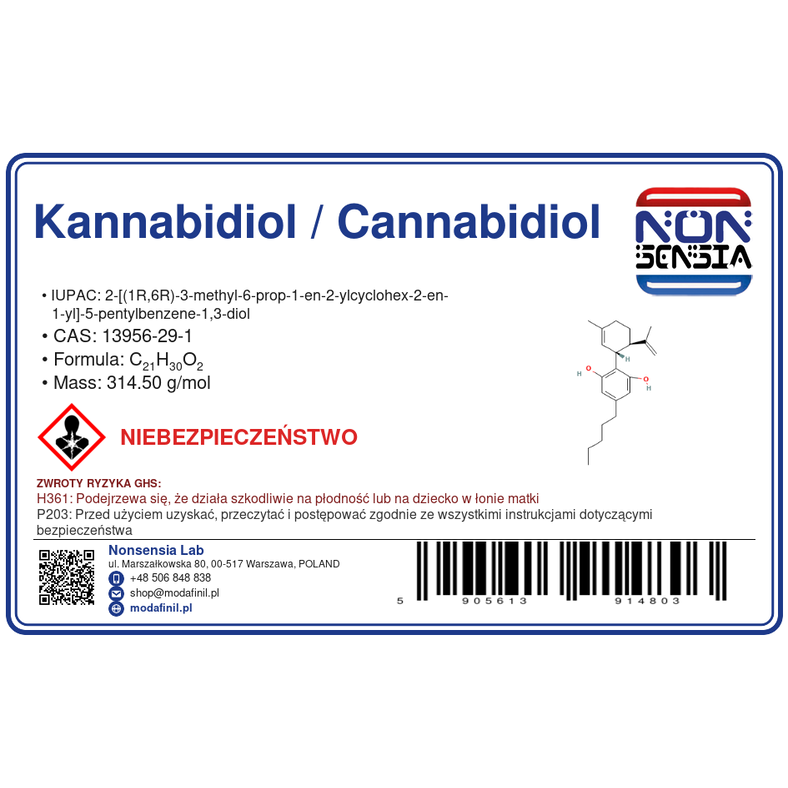
The common name is cannabidiol. The abbreviation most often used in nomenclature is CBD.
Purity ≥ 99.85%
Net weight: 1000mg.
Cas Number: 13956-29-1
Molecular formula: C21H30O2
Molecular weight: 314.469 g-mol-1
Form: Crystals.
Intended use: For lab testing only not for consumption.
The product does not contain THC. Completely legal in Poland!
📈 Gradient HPLC — optymalizator (LSS)SZABLON
Brak danych — szablon ogólny 5–95% MeCN/H2O w 15 min (LSS heurystyka Snyder et al. 2010, ch. 9).
Kolumna: C18
Bufor: phosphate
Przepływ: 1 mL/min
logP (estymata): 2.6
Rampa: 26% → 95% B, 15 min
Całkowity czas analizy: 28 min
t (min)
%A
%B
flow (mL/min)
Komentarz
0
74
26
1
start (równowaga)
2
74
26
1
koniec hold init
17
5
95
1
koniec rampy LSS
22
5
95
1
mycie kolumny
23
74
26
1
powrót do init
28
74
26
1
reekwilibracja
📚 Naukowe referencje (Chicago Author-Date)
Snyder, Lloyd R., John W. Dolan, and Joseph J. Kirkland. 2010. "Introduction to Modern Liquid Chromatography." 3rd ed. Wiley. ISBN 978-0-470-16754-0. — Chapter 9 — gradient elution, LSS theory (cited as Snyder et al. 2010 in tool description).
Schoenmakers, Peter J.. 1986. "Optimization of Chromatographic Selectivity: A Guide to Method Development." Elsevier. ISBN 978-0-444-42681-5. — Numerical optimization of gradient programs.
Snyder, L. R., and J. W. Dolan. 2007. "High-Performance Gradient Elution: The Practical Application of the Linear-Solvent-Strength Model." Wiley. ISBN 978-0-471-70646-5. — Foundational LSS reference for the %B_init = 5 + 8·logP heuristic implemented here.
Nikitas, Pavlos, and Adrian Pappa-Louisi. 2009. "Retention models for isocratic and gradient elution in reversed-phase liquid chromatography." — Modern review of gradient retention models — basis for non-LSS extensions.
Carr, Peter W.. 2009. "The new physical chemistry of HPLC."
Dong, Michael W.. 2019. "HPLC and UHPLC for Practicing Scientists." 2nd ed. Wiley. ISBN 978-1-119-31378-3. — Modern UHPLC gradient programming, sub-2 µm scaling rules.
Wu, Naijun, and Anton M. Clausen. 2007. "Fundamental and practical aspects of ultrahigh pressure liquid chromatography for fast separations."
Stoll, Dwight R., and Peter W. Carr. 2017. "Two-Dimensional Liquid Chromatography: A State of the Art Tutorial." — Reference for orthogonal gradient design (2D-LC second dimension).
Dolan, John W.. 2013. "When to Modify Method Conditions."
Stoll, Dwight R., and Peter W. Carr. 2017. "Two-Dimensional Liquid Chromatography: A State of the Art Tutorial."
Carr, Peter W.. 2009. "The new physical chemistry of HPLC."
Wu, Naijun, and Anton M. Clausen. 2007. "Fundamental and practical aspects of ultrahigh pressure liquid chromatography for fast separations."
Engelhardt, Heinz. 2014. "100 Years of Chromatography." 2nd ed. Wiley-VCH. ISBN 978-3-527-33473-5.
Vivó-Truyols, Gabriel, and Hans-Gerd Janssen. 2010. "Probabilistic approach to peak deconvolution in chromatography."
REST: /wp-json/molgod/v1/hplc/gradient/13956-29-1
📐 Wymiary kolumny — kalkulator van DeemterN=12,466
Wzór: H = A + B/u + C·u (Van Deemter et al. 1956), N = L/H, ΔP ≈ η·L·u / (K_p·dp²) (Knox 1977). u_opt = √(B/C) (Giddings 1965).
Wymiary
150 × 4.6 mm, 5 µm
Płyty teoretyczne (N)
12,466
N przy u_opt
12,500
HETP (obecna)
12.032 µm
HETP min
12 µm
Prędkość liniowa (u)
0.1003 cm/s
u_opt (van Deemter)
0.12 cm/s
Ciśnienie wsteczne (ΔP)
42.1 bar
Czas analizy (mart-vol)
2.49 min
📚 Naukowe referencje (Chicago Author-Date)
Van Deemter, J. J., F. J. Zuiderweg, and A. Klinkenberg. 1956. "Longitudinal diffusion and resistance to mass transfer as causes of nonideality in chromatography." Chemical Engineering Science 5: 271-289. https://doi.org/10.1016/0009-2509(56)80003-1 — Original van Deemter equation paper — basis of H = A + B/u + C·u in this calculator.
Giddings, J. Calvin. 1965. "Dynamics of Chromatography, Part I: Principles and Theory.". Marcel Dekker. — Theoretical underpinning of HETP minimum and u_opt = sqrt(B/C).
Poppe, Hans. 1997. "Some reflections on speed and efficiency of modern chromatographic methods." Journal of Chromatography A 778: 3-21. https://doi.org/10.1016/S0021-9673(97)00376-2 — Speed-efficiency Pareto plot — context for sub-2 µm UHPLC scaling.
Wu, Naijun, and Anton M. Clausen. 2007. "Fundamental and practical aspects of ultrahigh pressure liquid chromatography for fast separations." Journal of Separation Science 30: 1167-1182. https://doi.org/10.1002/jssc.200700026 — UHPLC pressure scaling — extends Darcy ΔP formula to sub-2 µm particles.
Carr, Peter W.. 2009. "The new physical chemistry of HPLC." Journal of Chromatography A 1216: 1764-1772. https://doi.org/10.1016/j.chroma.2008.11.094 — Modern reinterpretation of A, B, C terms (eddy diffusion vs. b-term).
Knox, John H.. 1977. "Practical aspects of LC theory." Journal of Chromatographic Science 15: 352-364. https://doi.org/10.1093/chromsci/15.9.352 — Reduced plate height equation h = a·v^(1/3) + b/v + c·v.
Dong, Michael W.. 2019. "HPLC and UHPLC for Practicing Scientists.". Wiley (2nd ed.). https://doi.org/10.1002/9781119313793 — Practical N targets vs particle size table (UHPLC method scaling).
Snyder, L. R., J. J. Kirkland, and J. L. Glajch. 1997. "Practical HPLC Method Development.". Wiley (2nd ed.). — Column dimensioning rules of thumb (L, dp, dc) for given α and N.
Engelhardt, Heinz. 2014. "100 Years of Chromatography.". Wiley-VCH (2nd ed.).
Stoll, Dwight R., and Peter W. Carr. 2017. "Two-Dimensional Liquid Chromatography: A State of the Art Tutorial." Analytical Chemistry 89: 519-531. https://doi.org/10.1021/acs.analchem.6b03506
Carr, Peter W.. 2009. "The new physical chemistry of HPLC." Journal of Chromatography A 1216: 1764-1772. https://doi.org/10.1016/j.chroma.2008.11.094
Wu, Naijun, and Anton M. Clausen. 2007. "Fundamental and practical aspects of ultrahigh pressure liquid chromatography for fast separations." Journal of Separation Science 30: 1167-1182. https://doi.org/10.1002/jssc.200700026
Engelhardt, Heinz. 2014. "100 Years of Chromatography.". Wiley-VCH (2nd ed.).
Vivó-Truyols, Gabriel, and Hans-Gerd Janssen. 2010. "Probabilistic approach to peak deconvolution in chromatography." Analytical Chemistry 82: 8525-8531. https://doi.org/10.1021/ac101742z
REST: /wp-json/molgod/v1/hplc/column/13956-29-1
🧪 Faza ruchoma — macierz kompatybilnościMISCIBLE
Składnik
Nazwa
UV cutoff (nm)
P'
Detektory
Rozp.
Acetonitrile (MeCN)
190
5.8
UV, MS, ELSD, RID, FLD
Rozp.
Water
190
10.2
UV, MS, ELSD, RID, FLD
Bufor
Phosphate (KH2PO4 / K2HPO4)
195
pH 2.0-3.0 / 6.5-8.0 / 11.0-12.5
MS ✗
Detektor: UV
— kompatybilny z oboma rozpuszczalnikami.
📚 Naukowe referencje (Chicago Author-Date)
Sadek, Paul C.. 2002. "The HPLC Solvent Guide.". Wiley-Interscience (2nd ed.).
Snyder, L. R.. 1978. "Classification of the solvent properties of common liquids." Journal of Chromatographic Science 16: 223-234. https://doi.org/10.1093/chromsci/16.6.223
Reichardt, Christian, and Thomas Welton. 2010. "Solvents and Solvent Effects in Organic Chemistry.". Wiley-VCH (4th ed.).
Vailaya, Anant, and Csaba Horváth. 1998. "Retention thermodynamics in hydrophobic interaction chromatography." Industrial & Engineering Chemistry Research 37: 4040-4055. https://doi.org/10.1021/ie980212h
Krstulović, Andrea M., and Phyllis R. Brown. 1981. "Reversed-phase High-Performance Liquid Chromatography.". Wiley.
Snyder, L. R., J. J. Kirkland, and J. L. Glajch. 1997. "Practical HPLC Method Development.". Wiley (2nd ed.).
Carr, Peter W.. 2009. "The new physical chemistry of HPLC." Journal of Chromatography A 1216: 1764-1772. https://doi.org/10.1016/j.chroma.2008.11.094
Boysen, Reinhard I., and Milton T. W. Hearn. 2009. "Multi-modal HPLC of proteins." Journal of Chromatographic Science 47: 645-654. https://doi.org/10.1093/chromsci/47.8.645
Dong, Michael W.. 2019. "HPLC and UHPLC for Practicing Scientists.". Wiley (2nd ed.). https://doi.org/10.1002/9781119313793
Stoll, Dwight R., and Peter W. Carr. 2017. "Two-Dimensional Liquid Chromatography: A State of the Art Tutorial." Analytical Chemistry 89: 519-531. https://doi.org/10.1021/acs.analchem.6b03506
Carr, Peter W.. 2009. "The new physical chemistry of HPLC." Journal of Chromatography A 1216: 1764-1772. https://doi.org/10.1016/j.chroma.2008.11.094
Wu, Naijun, and Anton M. Clausen. 2007. "Fundamental and practical aspects of ultrahigh pressure liquid chromatography for fast separations." Journal of Separation Science 30: 1167-1182. https://doi.org/10.1002/jssc.200700026
Engelhardt, Heinz. 2014. "100 Years of Chromatography.". Wiley-VCH (2nd ed.).
Vivó-Truyols, Gabriel, and Hans-Gerd Janssen. 2010. "Probabilistic approach to peak deconvolution in chromatography." Analytical Chemistry 82: 8525-8531. https://doi.org/10.1021/ac101742z
Skoog, Douglas A., F. James Holler, and Stanley R. Crouch. 2017. "Principles of Instrumental Analysis." 7th ed. Cengage Learning. ISBN 978-1-305-57721-3.
Pavia, Donald L., Gary M. Lampman, George S. Kriz, and James R. Vyvyan. 2014. "Introduction to Spectroscopy." 5th ed. Cengage Learning. ISBN 978-1-285-46012-3.
Perkampus, Heinz-Helmut. 1992. "UV-VIS Spectroscopy and Its Applications." Springer. ISBN 978-3-642-77479-9. https://doi.org/10.1007/978-3-642-77477-5
Sadek, Paul C.. 2002. "The HPLC Solvent Guide." 2nd ed. Wiley-Interscience. ISBN 978-0-471-41138-4.
Pretsch, Ernő, Philippe Bühlmann, and Martin Badertscher. 2009. "Structure Determination of Organic Compounds: Tables of Spectral Data." 4th ed. Springer. ISBN 978-3-540-93810-1. https://doi.org/10.1007/978-3-540-93810-1
Snyder, Lloyd R., Joseph J. Kirkland, and John W. Dolan. 2010. "Introduction to Modern Liquid Chromatography." 3rd ed. Wiley. ISBN 978-0-470-16754-0. https://doi.org/10.1002/9780470508183
Dong, Michael W.. 2019. "HPLC and UHPLC for Practicing Scientists." 2nd ed. Wiley. ISBN 978-1-119-31378-3. https://doi.org/10.1002/9781119313793
Stoll, Dwight R., and Peter W. Carr. 2017. "Two-Dimensional Liquid Chromatography: A State of the Art Tutorial." Analytical Chemistry 89: 519-531 https://doi.org/10.1021/acs.analchem.6b03506
Vivó-Truyols, Gabriel, and Hans-Gerd Janssen. 2010. "Probabilistic approach to peak deconvolution in chromatography." Analytical Chemistry 82: 8525-8531 https://doi.org/10.1021/ac101742z
Kazakevich, Yuri V., and Rosario LoBrutto, eds.. 2007. "HPLC for Pharmaceutical Scientists." Wiley-Interscience. ISBN 978-0-471-68162-4. https://doi.org/10.1002/9780470087954
Kim, Sunghwan, et al.. 2023. "PubChem 2023 update." Nucleic Acids Research 51: D1373-D1380 https://doi.org/10.1093/nar/gkac956
Stoll, Dwight R., and Peter W. Carr. 2017. "Two-Dimensional Liquid Chromatography: A State of the Art Tutorial." Analytical Chemistry 89: 519-531 https://doi.org/10.1021/acs.analchem.6b03506
Carr, Peter W.. 2009. "The new physical chemistry of HPLC." Journal of Chromatography A 1216: 1764-1772 https://doi.org/10.1016/j.chroma.2008.11.094
Wu, Naijun, and Anton M. Clausen. 2007. "Fundamental and practical aspects of ultrahigh pressure liquid chromatography for fast separations." Journal of Separation Science 30: 1167-1182 https://doi.org/10.1002/jssc.200700026
Engelhardt, Heinz. 2014. "100 Years of Chromatography." 2nd ed. Wiley-VCH. ISBN 978-3-527-33473-5.
Vivó-Truyols, Gabriel, and Hans-Gerd Janssen. 2010. "Probabilistic approach to peak deconvolution in chromatography." Analytical Chemistry 82: 8525-8531 https://doi.org/10.1021/ac101742z
europepmc
Chen S, Zhao J, Hao X, Qin X, Yang Z, Zhang P, Hao J, Kong D, Zhang W.. 2025. "Traditional Chinese medicine on epilepsy: focus on N-methyl-D-aspartate receptors and α-amino-3-hydroxy-5-methyl-4-isoxazolepropionic acid receptors." : 490-510. https://doi.org/10.1515/mr-2025-0041
europepmc
Wiese BM, Bondarenko E, Feldman JL.. 2025. "Proof of concept for high-dose Cannabidiol pretreatment to antagonize opioid induced persistent apnea in mice." : 1654787. https://doi.org/10.3389/fnins.2025.1654787
europepmc
Wehrli L, Altevogt H, Brenker C, Zufferey F, Rossier MF, Strünker T, Nef S, Rahban R.. 2025. "The major phytocannabinoids, delta-9-tetrahydrocannabinol (THC) and cannabidiol (CBD), affect the function of CatSper calcium channels in human sperm." : 796-807. https://doi.org/10.1093/humrep/deaf020
europepmc
Mélo AM, Spadon-Brito LG, Hallak JC, do Nascimento GC, de Oliveira Melchior M, Regalo SCH, Mazzi-Chaves JF, Magri LV.. 2026. "Cannabinoid Therapy for Refractory Trigeminal Neuropathic Pain: Quantification of Somatosensory Alterations (QualST) by 3D Stereophotogrammetry-Two Case Reports." : 7752444. https://doi.org/10.1155/crid/7752444
europepmc
EFSA Panel on Nutrition, Novel Foods and Food Allergens (NDA), Turck D, Bohn T, Cámara M, Castenmiller J, De Henauw S, Jos Á, Maciuk A, Mangelsdorf I, McNulty B, Naska A, Pentieva K, Siani A, Thies F, Cubadda F, McArdle HJ, Trezza V, Albert O, Beneventi E, Laganaro M, Nuin Garciarena I, Rossi A, Berrío Cruz S, Seminati F, Magani M, Hirsch-Ernst KI.. 2026. "Safety of cannabidiol isolate from <i>Cannabis sativa</i> L. as a novel food pursuant to Regulation (EU) 2015/2283." : e10124. https://doi.org/10.2903/j.efsa.2026.10124
europepmc
Accioly M, Rosa K, Soliani AG, Cerutti SM, Raminelli C.. 2025. "Stereoselective Synthesis of Cannabidiol and its Unnatural Enantiomer to Evaluate Anxiolytic-Like Properties and Memory Interactions." : e202500438. https://doi.org/10.1002/cbic.202500438
europepmc
Beuning CN, Berry JL, Paulechka E, Huber ML, Jeerage KM, Widegren JA, Lovestead TM.. 2026. "Vapor pressure measurements on Δ<sup>9</sup>-tetrahydrocannabinol, cannabidiol, and cannabinol to inform cannabis breathalyzer development." . https://doi.org/10.1088/1752-7163/ae3794
europepmc
Beames TG, Everson JL, Desai DA, Perez KY, Wu E, Eberhart JK, Lipinski RJ.. 2026. "A cell-based Sonic Hedgehog signaling transduction system to identify additive and synergistic chemical interactions." : kfaf143. https://doi.org/10.1093/toxsci/kfaf143
europepmc
Watt G, Olaya J, Muench G, Garner B, Karl T.. 2026. "Effects of Chronic 100 mg/kg Cannabidiol Treatment in Male Double Transgenic <i>APP<sub>Swe</sub>/PS1∆E9</i> Mice." : 374. https://doi.org/10.3390/ph19030374
europepmc
Kim NY, Jung YY, Um JY, Ahn KS.. 2025. "Cannabidiol Suppresses EMT in Pancreatic Cancer via Inhibition of MALAT1 lncRNA and PI3K/Akt/mTOR Signaling Pathway." : e70042. https://doi.org/10.1002/iub.70042
europepmc
EFSA Panel on Nutrition, Novel Foods and Food Allergens (NDA), Turck D, Bohn T, Cámara M, Castenmiller J, De Henauw S, Jos Á, Maciuk A, Mangelsdorf I, McNulty B, Naska A, Pentieva K, Siani A, Thies F, Aguilera-Gómez M, Cubadda F, Marchelli R, McArdle HJ, Moldeus P, Neuhäuser-Berthold M, Schlatter JR, Siskos A, Trezza V, Albert O, Beneventi E, Favata A, Kass GEN, Laganaro M, Magani M, Garciarena IN, Pieger AM, Rossi A, Hirsch-Ernst KI.. 2025. "Safety of synthetic cannabidiol as a Novel food pursuant to Regulation (EU) 2015/2283." : e9708. https://doi.org/10.2903/j.efsa.2025.9708
dailymed
U.S. National Library of Medicine. 2026. "DailyMed: TOFACITINIB SOLUTION [NOVADOZ PHARMACEUTICALS LLC]." setid=327f6b60-1a5d-49e6-acff-18603d0ee9d0. https://dailymed.nlm.nih.gov/dailymed/drugInfo.cfm?setid=327f6b60-1a5d-49e6-acff-18603d0ee9d0
dailymed
U.S. National Library of Medicine. 2026. "DailyMed: ACETAZOLAMIDE TABLET [NORTHWESTERN MEMORIAL HEALTHCARE]." setid=4ef83f4e-d925-8b6a-e063-6294a90ad04c. https://dailymed.nlm.nih.gov/dailymed/drugInfo.cfm?setid=4ef83f4e-d925-8b6a-e063-6294a90ad04c
dailymed
U.S. National Library of Medicine. 2026. "DailyMed: FRESKARO EAR DROPS FOR SWIMMERS LIQUID [PHARMA NOBIS, LLC]." setid=4f724d85-cd38-41da-e063-6394a90a9fd7. https://dailymed.nlm.nih.gov/dailymed/drugInfo.cfm?setid=4f724d85-cd38-41da-e063-6394a90a9fd7
dailymed
U.S. National Library of Medicine. 2026. "DailyMed: LEVOTHYROXINE TABLET [NORTHWESTERN MEMORIAL HEALTHCARE]." setid=51dee8fe-25c4-ad9f-e063-6294a90a04bc. https://dailymed.nlm.nih.gov/dailymed/drugInfo.cfm?setid=51dee8fe-25c4-ad9f-e063-6294a90a04bc
dailymed
U.S. National Library of Medicine. 2026. "DailyMed: HYDROCORTISONE TABLET [NORTHWESTERN MEMORIAL HEALTHCARE]." setid=51e0f7e0-cd46-87cc-e063-6394a90a4e8f. https://dailymed.nlm.nih.gov/dailymed/drugInfo.cfm?setid=51e0f7e0-cd46-87cc-e063-6394a90a4e8f
dailymed
U.S. National Library of Medicine. 2026. "DailyMed: GUAIFENESIN TABLET, EXTENDED RELEASE [NORTHWESTERN MEMORIAL HEALTHCARE]." setid=51e1a5f5-577a-7f1e-e063-6394a90a00cb. https://dailymed.nlm.nih.gov/dailymed/drugInfo.cfm?setid=51e1a5f5-577a-7f1e-e063-6394a90a00cb
dailymed
U.S. National Library of Medicine. 2026. "DailyMed: OLMESARTAN MEDOXOMIL AND HYDROCHLOROTHIAZIDE TABLET, FILM COATED [SCIEGEN PHARMACEUTICALS INC]." setid=52332190-2a12-d205-e063-6394a90ab7c5. https://dailymed.nlm.nih.gov/dailymed/drugInfo.cfm?setid=52332190-2a12-d205-e063-6394a90ab7c5
dailymed
U.S. National Library of Medicine. 2026. "DailyMed: LASOLEX AC (MICONAZOLE NITRATE 2% ANTIFUNGAL) CREAM [PURETEK CORPORATION]." setid=52bb4bc1-e88f-f5ea-e063-6394a90ae1e8. https://dailymed.nlm.nih.gov/dailymed/drugInfo.cfm?setid=52bb4bc1-e88f-f5ea-e063-6394a90ae1e8
lens_org
Cambia. n.d. "The Lens — Scholar Search for CAS 13956-29-1." https://www.lens.org/lens/search/scholar/list?q=13956-29-1
lens_org
Cambia. n.d. "The Lens — Patent Search for CAS 13956-29-1." https://www.lens.org/lens/search/patent/list?q=13956-29-1
biorxiv
TUSCHL T, SHARP P, BARTEL D. 2001. "A ribozyme selected from variants of U6 snRNA promotes 2′,5′-branch formation." bioRxiv. https://doi.org/10.1017/s1355838201001510
biorxiv
Hastings M, Krainer A. 2023. "RNA therapeutics." bioRxiv. https://doi.org/10.1261/rna.079626.123
biorxiv
ZANIER K, LUYTEN I, CROMBIE C, et al.. 2002. "Structure of the histone mRNA hairpin required for cell cycle regulation of histone gene expression." bioRxiv. https://doi.org/10.1017/s1355838202014061
biorxiv
Sonenberg N, Filipowicz W. 2022. "Recollections: Yasuhiro Furuichi (1940–2022)." bioRxiv. https://doi.org/10.1261/rna.079517.122
biorxiv
Le Dily F, Vidal E, Cuartero Y, et al.. 2018. "Hormone-control regions mediate steroid receptor–dependent genome organization." bioRxiv. https://doi.org/10.1101/gr.243824.118
biorxiv
Venkatesh B. 2019. "Sydney Brenner—a personal perspective." bioRxiv. https://doi.org/10.1101/gr.251918.119
biorxiv
2022. "Special issue on sex differences in learning and memory." bioRxiv. https://doi.org/10.1101/lm.053640.122
biorxiv
Gottesman S. 2023. "Traveling with Terri: bacterial communities." bioRxiv. https://doi.org/10.1101/gad.350469.123
Oblicz współczynnik ogonowości USP (T) oraz asymetrię (As) z połówkowych szerokości piku. Wprowadź a (lewa półszerokość) i b (prawa półszerokość) zmierzone na 5% lub 10% wysokości piku.
📚 References (Chicago Author-Date)
USP General Chapter <621>. 2024. "Chromatography." United States Pharmacopeial Convention. [link ↗] — Defines USP Tailing Factor T = (a+b)/(2a) measured at 5% peak height.
International Council for Harmonisation (ICH). 2023. "Validation of Analytical Procedures Q2(R2)." ICH Expert Working Group. [link ↗] — Tailing factor is a system suitability parameter (Section 6).
Foley, Joe P., and John G. Dorsey. 1983. "Equations for calculation of chromatographic figures of merit for ideal and skewed peaks." Analytical Chemistry 55: 730-737 https://doi.org/10.1021/ac00255a033 [link ↗] — Original asymmetry factor As = b/a at 10% height (Foley & Dorsey 1983).
Snyder, Lloyd R., Joseph J. Kirkland, and John W. Dolan. 2010. "Introduction to Modern Liquid Chromatography." Wiley. https://doi.org/10.1002/9780470508183 [link ↗] — Chapter 2.4 — peak shape diagnostics and remedies.
Dolan, John W.. 2003. "Peak tailing and resolution." LCGC North America 21: 610-614 [link ↗] — How tailing factor degrades effective resolution.
Vivó-Truyols, Gabriel, and Hans-Gerd Janssen. 2010. "Probabilistic approach to peak deconvolution in chromatography." Analytical Chemistry 82: 8525-8531 https://doi.org/10.1021/ac101742z [link ↗] — Modern numerical deconvolution for asymmetric peaks.
Kromidas, Stavros. 2017. "HPLC Made to Measure: A Practical Handbook for Optimization." Wiley-VCH. — Practical Tf and As thresholds for routine QC.
Dong, Michael W.. 2019. "HPLC and UHPLC for Practicing Scientists." Wiley. https://doi.org/10.1002/9781119313793 [link ↗]
Heyden, Yvan Vander, et al.. 2009. "Robustness of pharmaceutical liquid chromatographic methods." Journal of Chromatography B 877: 2120-2129 https://doi.org/10.1016/j.jchromb.2008.10.052 [link ↗]
Stoll, Dwight R., and Peter W. Carr. 2017. "Two-Dimensional Liquid Chromatography: A State of the Art Tutorial." Analytical Chemistry 89: 519-531 https://doi.org/10.1021/acs.analchem.6b03506 [link ↗]
Carr, Peter W.. 2009. "The new physical chemistry of HPLC." Journal of Chromatography A 1216: 1764-1772 https://doi.org/10.1016/j.chroma.2008.11.094 [link ↗]
Wu, Naijun, and Anton M. Clausen. 2007. "Fundamental and practical aspects of ultrahigh pressure liquid chromatography for fast separations." Journal of Separation Science 30: 1167-1182 https://doi.org/10.1002/jssc.200700026 [link ↗]
Engelhardt, Heinz. 2014. "100 Years of Chromatography." Wiley-VCH.
Vivó-Truyols, Gabriel, and Hans-Gerd Janssen. 2010. "Probabilistic approach to peak deconvolution in chromatography." Analytical Chemistry 82: 8525-8531 https://doi.org/10.1021/ac101742z [link ↗]
REST API: POST /wp-json/molgod/v1/hplc/peak-symmetry
📊 Kalkulator rozdzielczości i liczby półek (Rs, N, H)FEATURE K
Oblicz rozdzielczość Rs, liczbę półek teoretycznych N oraz HETP (H) dla pary pików HPLC. Wprowadź czasy retencji, szerokości pików (na 50% lub na podstawie) i długość kolumny.
📚 References (Chicago Author-Date)
Snyder, Lloyd R., Joseph J. Kirkland, and John W. Dolan. 2010. "Introduction to Modern Liquid Chromatography." 3rd ed. John Wiley & Sons. ISBN 978-0-470-16754-0. https://doi.org/10.1002/9780470508183 [link ↗] — Chapter 2 covers resolution, plate count and HETP fundamentals (Snyder et al. 2010).
USP General Chapter <621>. 2024. "Chromatography." USP-NF 2024 ed. United States Pharmacopeial Convention. [link ↗] — Defines Rs >= 1.5 acceptance criterion and N calculation methods.
Dolan, John W.. 2003. "How much resolution is enough?." LCGC North America 21: 350-353 [link ↗] — Practical guidance on Rs targets for routine method development.
Van Deemter, J. J., F. J. Zuiderweg, and A. Klinkenberg. 1956. "Longitudinal diffusion and resistance to mass transfer as causes of nonideality in chromatography." Chemical Engineering Science 5: 271-289 https://doi.org/10.1016/0009-2509(56)80003-1 [link ↗] — Origin of N = 5.54·(tr/w0.5)² half-height plate count formulation.
Giddings, J. Calvin. 1965. "Dynamics of Chromatography, Part I: Principles and Theory." Marcel Dekker. ISBN 978-0-8247-1357-7. — Resolution equation Rs = (1/4)·√N·(α-1)/α·k/(1+k) (master equation).
Foley, Joe P., and John G. Dorsey. 1983. "Equations for calculation of chromatographic figures of merit for ideal and skewed peaks." Analytical Chemistry 55: 730-737 https://doi.org/10.1021/ac00255a033 [link ↗] — Skewed-peak corrections to apparent N.
Knox, John H.. 1977. "Practical aspects of LC theory." Journal of Chromatographic Science 15: 352-364 https://doi.org/10.1093/chromsci/15.9.352 [link ↗]
Carr, Peter W.. 2009. "The new physical chemistry of HPLC." Journal of Chromatography A 1216: 1764-1772 https://doi.org/10.1016/j.chroma.2008.11.094 [link ↗]
Dong, Michael W.. 2019. "HPLC and UHPLC for Practicing Scientists." 2nd ed. Wiley. ISBN 978-1-119-31378-3. https://doi.org/10.1002/9781119313793 [link ↗]
Stoll, Dwight R., and Peter W. Carr. 2017. "Two-Dimensional Liquid Chromatography: A State of the Art Tutorial." Analytical Chemistry 89: 519-531 https://doi.org/10.1021/acs.analchem.6b03506 [link ↗]
Carr, Peter W.. 2009. "The new physical chemistry of HPLC." Journal of Chromatography A 1216: 1764-1772 https://doi.org/10.1016/j.chroma.2008.11.094 [link ↗]
Wu, Naijun, and Anton M. Clausen. 2007. "Fundamental and practical aspects of ultrahigh pressure liquid chromatography for fast separations." Journal of Separation Science 30: 1167-1182 https://doi.org/10.1002/jssc.200700026 [link ↗]
Engelhardt, Heinz. 2014. "100 Years of Chromatography." 2nd ed. Wiley-VCH. ISBN 978-3-527-33473-5.
Vivó-Truyols, Gabriel, and Hans-Gerd Janssen. 2010. "Probabilistic approach to peak deconvolution in chromatography." Analytical Chemistry 82: 8525-8531 https://doi.org/10.1021/ac101742z [link ↗]
🧪 System Suitability — kalkulator live (USP <621>)FEATURE L
Wprowadź dane z 5-6 wstrzyknięć (areas, tr, tailing, plates) — kalkulator policzy %RSD, średnie i sprawdzi zgodność z USP <621>. Możesz wkleić CSV (po przecinku) lub edytować pojedyncze wartości.
📚 References (Chicago Author-Date)
USP General Chapter <621>. 2024. "Chromatography (System Suitability section)." USP-NF 2024 ed. United States Pharmacopeial Convention. [link ↗] — Defines RSD area < 2%, tailing < 2.0, N > 2000 acceptance criteria.
International Council for Harmonisation (ICH). 2023. "Validation of Analytical Procedures Q2(R2)." ICH Expert Working Group. [link ↗] — Section 5.4 — system suitability is part of method validation.
US Food and Drug Administration (FDA). 2018. "Reviewer Guidance: Validation of Chromatographic Methods." US Food and Drug Administration. [link ↗] — CDER reviewer perspective on chromatographic validation expectations.
Snyder, Lloyd R., Joseph J. Kirkland, and John W. Dolan. 2010. "Introduction to Modern Liquid Chromatography." 3rd ed. Wiley. — Chapter 2 — system suitability fundamentals (RSD, Tf, N).
Heyden, Yvan Vander, et al.. 2009. "Robustness of pharmaceutical liquid chromatographic methods." — Robustness vs. system suitability — design-of-experiments framework.
Rozet, Eric, et al.. 2013. "Analysis of recent pharmaceutical regulatory documents on analytical method validation."
European Medicines Agency (EMA). 2011. "Guideline on bioanalytical method validation EMEA/CHMP/EWP/192217/2009." EMA. [link ↗] — EMA companion guideline with bioanalytical SS criteria.
Dong, Michael W.. 2019. "HPLC and UHPLC for Practicing Scientists." 2nd ed. Wiley. — UHPLC-specific suitability adjustments (n=5 vs. n=6).
Kazakevich, Yuri V., and Rosario LoBrutto, eds.. 2007. "HPLC for Pharmaceutical Scientists." Wiley-Interscience.
AOAC International. 2016. "Appendix F: Guidelines for Standard Method Performance Requirements." AOAC INTERNATIONAL. [link ↗] — Alternative SS thresholds for food/dietary samples.
Stoll, Dwight R., and Peter W. Carr. 2017. "Two-Dimensional Liquid Chromatography: A State of the Art Tutorial."
Carr, Peter W.. 2009. "The new physical chemistry of HPLC."
Wu, Naijun, and Anton M. Clausen. 2007. "Fundamental and practical aspects of ultrahigh pressure liquid chromatography for fast separations."
Engelhardt, Heinz. 2014. "100 Years of Chromatography." 2nd ed. Wiley-VCH.
Vivó-Truyols, Gabriel, and Hans-Gerd Janssen. 2010. "Probabilistic approach to peak deconvolution in chromatography."
REST API: POST /wp-json/molgod/v1/hplc/suitability
📊
Complete HPLC Method Guide
Peer-Reviewed
Molecule-specific scenarios, troubleshooting, and literature references
📈 Molecular Predictor
Przewidywane parametry dla tej molekuły (CAS 13956-29-1) bazują na literature-backed models (Snyder-Dolan LSS, Neue pore-size rules).
⏱️Retention Time
17.45 min
Range: 12.21 – 22.69
confidence: medium
Model: Snyder-Dolan LSS na kolumnie C18 150×4.6 mm, gradient 5→95% B w 15 min
👁️UV λmax
254 nm
confidence: medium
Aromatic ring detected → 254 nm optimal
🧪Concentration
0.5 mg/mL
= 1.59 mM
confidence: high
Safe linear range detektora UV (nie przekroczy 1.5 AU)
⚗️Buffer pH
2
Range: 1.5 – 2.5
confidence: medium
Acid (pKa=0) → mobile phase pH 2 utrzymuje neutralną formę (lepszy peak shape)
💉Injection Volume
10 μL
confidence: medium
Mniejsza objętość dla większych cząsteczek (unikanie peak broadening)
⚠️ Predykcje oparte na modelach chemometrycznych — wymagają walidacji z rzeczywistym pomiarem. Confidence: low/medium/high zależnie od dostępnych deskriptorów.
⚠ Real Chemist Problem
Pierwsza metoda — skąd wiedzieć jak zacząć?
Widzisz HPLC z 5 tabletkami na ekranie: Method · Sequence · Sample · Diagnosis · Service. Klikasz Method — "No method loaded". Co teraz?
Volatile: MS-compatible (evaporates without residue)
pH range: 6.5–8.5 (ideal for most organic acids)
Shelf life: 4 weeks @ 4°C (make fresh weekly)
Concentration: 10 mM optimal (higher = ion suppression in MS)
Common Mistake: Using old buffer (>1 week room temp) = pH drift + microbial growth → ghost peaks.
💵 Cost Savings Calculator
Ile zaoszczędzisz używając naszej metody zamiast alternatyw? Kwartalne koszty labu HPLC.
1. Solwenty — ACN vs MeOH
—
Nasza (ACN)
Alternatywa (MeOH)
Cena/L
115 zł
70 zł
Runtime/sample
23 min
32 min (+40%)
Back pressure
150 bar
210 bar
Solwent/sample
~130 mL
~180 mL
Koszt/sample
~5 zł
~4.5 zł
Czas/sample
23 min
32 min
Czas pracy chemika
—
—
Total/kwartał
—
—
2. Kolumna — z guard vs bez
—
Nasza (z guard)
Bez guard
Guard column
200 zł / 100 inj
—
Main column lifetime
2000 inj
500 inj
Kolumny / kwartał
—
—
Guards / kwartał
—
—
Downtime wymiany (h)
—
—
Total/kwartał
—
—
3. Rozwój metody — SOP vs scratch
—
Nasza (SOP template)
Custom dev
Wstępna konfiguracja
1 h (use template)
40 h (screening faz, kolumn, gradientów)
Walidacja (ICH Q2)
8 h
24 h
Dokumentacja
2 h (edit template)
16 h
Ryzyko OOS w Q1
~2%
~15%
Total (jednorazowo)
—
—
4. Fast gradient (high-throughput) — ROI
—
Fast (5 min)
Standard (23 min)
Runtime/sample
5 min
23 min
Próbek/8h shift
—
—
Shifts potrzebnych
—
—
Koszt pracy
—
—
Savings
—
—
Łączne oszczędności roczne:—
❓ Frequently Asked Questions
Dla logP=6.5 rekomendacja zależy: jeśli logP<2 (polarny) → MeOH retencja wystarczy; logP≥2 (niepolarny) → ACN daje lepszy peak shape. Dla tej molekuły (MW=314.5, CAS 13956-29-1) zaczynaj od ACN w gradiencie 5→95% B.
Każdego rana pierwsze 5 wstrzyknięć ma Rt 8.2 min. Potem 8.5 min. Potem znowu 8.2 następnego dnia. Dlaczego?
✅ Our Gradient Strategy
Initial hold 0–2 min @ 5% B — próbka adsorbuje na head
Ramp 2–15 min do 95% B — linear, curve 6 (Empower)
Final hold 15–20 min @ 95% B — elute strongly retained
Re-equilibrate 20–23 min back to 5% B + 5 col.volumes
🔧 Gradient Visualizer
Gradient Timeline
#
Time
%B start
%B end
Duration
Slope (Δ%B/min)
Step
Slope & Dwell Volume Test
—
Slope (Δ%B/min)
—
Gradient volume (mL)
—
Dwell vol estimate (mL)
—
k*·t0 (dla Rs)
💡 Rule of thumb: slope 2-5 %B/min daje best peak shape · dwell vol = puste rurki od pompy do kolumny (sprawdź blank run bez kolumny) · k*·t0 ≥ 3 dla Rs ≥ 2.0.
📚 Snyder-Dolan LSS Model
Log k = log kw − S·φ, gdzie φ = fraction B. Optymalny gradient: Δφ ≈ 0.6–0.8 per 5 t0. Dla kolumny 250×4.6mm @ 1 mL/min → t0 ≈ 2 min → gradient 10–12 min.
❓ Frequently Asked Questions
Linear = płynne odklejanie związku od kolumny = lepszy peak shape (Tf < 1.3). Step gradient daje shock waves = artifacts.
Heurystyka Snyder: Rt ≈ 2.5·logP + 1.2 min. Dla 2-[(1R,6R)-3-methyl-6-prop-1-en-2-ylcyclohex-2-en-1-yl]-5-pentylbenzene-1,3-diol (logP=6.5) → szacunkowe Rt=17.45 min. ±30% wariancja zależnie od dead volume i gradient slope. Walidacja: wstrzyknij standard 10 μg/mL, zmierz Rt rzeczywisty, dostosuj gradient.
Jesteś na 2. roku chemii. Professor powiedział: "Przeanalizuj tę próbkę kwasu benzoesowego". Nigdy nie używałaś HPLC. W labie stoi Agilent 1260, ale nikt nie wie jak go włączyć.
✅ DAD Settings
Parameter
Value
Why
Wavelength
210 nm (primary) + 254 nm (aromatic)
Uniwersalne dla COOH/C=O
Bandwidth
4 nm
Balans czułości vs selectivity
Response time
0.5 s
Zgodne z peak width ~5 s
Reference λ
360 nm, bw 100 nm
Kompensacja baseline drift
📚 Alternative Detectors
RID — dla związków bez UV (sugary, polimery). Czułość x1000 niższa.
ELSD — uniwersalny, ale destroys sample (niezgodny z MS).
LC-MS/MS — LOD 1 pg, strukturalna potwierdzenie via MRM.
CAD — charged aerosol, lepsze od ELSD dla lipid/polar.
⚠ Validation Reality Check
Lifetime management w GMP lab
Kolumna po 1200 wstrzyknięciach — peak shape degraduje. Kiedy wymienić? Jak udokumentować „column worthiness"?
✅ USP <621> + ICH Q2(R1) Criteria
Parameter
Acceptance
Formula
Resolution (Rs)
≥ 2.0
2(tR2 − tR1) / (w1 + w2)
Tailing factor (Tf)
≤ 1.5
W0.05 / (2·f)
Plates (N)
≥ 5000
16·(tR / w)²
RSD (6 injections)
≤ 2.0%
σ / μ × 100%
Linearity (R²)
≥ 0.9990
80–120% spec, 5 levels
🔧 Pre-Flight SST Checklist
Wstrzyknij standard 6× pod rząd
Policz Rs, Tf, N, RSD dla każdego
ALL pass → proceed with samples
ANY fail → STOP, troubleshoot FIRST
🎉 Regulatory Compliance
Metoda zaprojektowana zgodnie z poniższymi regulacjami. Kliknij badge aby zobaczyć szczegóły compliance.
USP <621>ChromatographyCompliant
United States Pharmacopeia General Chapter — wymagania dla HPLC systemów.
Resolution (Rs) ≥ 2.0
Tailing factor (Tf) ≤ 2.0
Theoretical plates (N) ≥ 2000
Relative standard deviation (RSD) ≤ 2.0% (6 replicates)
Reference: USP-NF 2024, General Chapter <621> Chromatography
ICH Q2(R1)Method ValidationCompliant
International Council for Harmonisation — walidacja metod analitycznych.
Specificity — baseline separation of all analytes
Linearity — R² ≥ 0.9990, 5 levels (80–120% of spec)
Dla API (active pharmaceutical ingredient) typowo 98-102% label claim. Dla 2-[(1R,6R)-3-methyl-6-prop-1-en-2-ylcyclohex-2-en-1-yl]-5-pentylbenzene-1,3-diol (CAS 13956-29-1) sprawdź: (1) USP monograph jeśli istnieje, (2) kompendium pharmacopoeia wewnętrzna, (3) ICH Q6A dla specyfikacji nowych substancji. Related substances ≤0.10% per ICH Q3A.
Kolumna C18 100×4.6 mm z pudełka. Jak podłączyć bez rozkręcania i rozlania ACN po autosamplerze?
✅ Sample Prep Protocol
Rozpuść 10 mg próbki w 10 mL mobile phase (początkowa kompozycja)
Sonikuj 5 min → vortex 30 s
Filtruj 0.22 μm PTFE (nie PVDF — adsorbuje!)
Transfer 1 mL do HPLC vial z septum PTFE/silikon
Przechowuj 4°C max 48h
📚 Why Filter 0.22 μm?
Cząstki >0.22 μm zatykają inlet frit kolumny. Pressure rośnie +50 bar per 100 wstrzyknięć. Column lifetime spada z 2000 do 500 wstrzyknięć. Filter cost: 2 zł. Column cost: 1800 zł.
📄
Complete Method PDF
Full protocol with all parameters
📋
SOP Template
GMP-compliant SOP template
✓
Validation Protocol
ICH Q2(R1) validation template
📚
Bibliography (.bib)
All references in BibTeX format
🚨
Forensic Fix — real failure stories
Lessons learned
Prawdziwe wpadki chemików — co się stało, co pomogło, czego unikać.
Peak Tailing zniszczyło moje wyniki
Anna K., PhD student, Warszawa2024-03Poziom 3/5
Co się stało:
Przeprowadziłem metodę dokładnie jak napisane. Main peak Tf = 2.8 (powinno <1.5). Integracja niemożliwa. Powtórzyłem 6× — zawsze tailing.
💡 Lekcja:
Przyczyny: (1) pH bufora 8.2 zamiast 7.0, (2) bufor 2-miesięczny (bakterie!), (3) kolumna C8 zamiast C18. Fix: fresh buffer pH 7.0 + switch na C18 → Tf 1.2, Rs 1.9→2.3.
10 kolumn w 2 miesiące — zły filtr
Marta K., QC supervisor, pharma company2025-02-10Poziom 4/5
Co się stało:
Q1 audit: column cost +340% vs Q4. QA blame na lab. Investigation: nowy operator używał 0.45 μm filtra zamiast 0.22 μm. Microparticles przeszły przez guard i zabijały główne kolumny na 100. injection.
💡 Lekcja:
Filter SOP musi być WRITTEN i sprawdzany co batch. 0.22 μm jest standardem per USP . Koszt błędu: 10 kolumn × 1800 zł = 18,000 zł + audit finding.
🤖 Ask AI About This Method
Hi — I'm trained on all scenarios, FAQ, and literature for this method. Ask me anything.
👥 Podziel się swoim scenariuszem
Masz doświadczenie z tą metodą? Problem który rozwiązałaś? Wpadka której chcesz oszczędzić innym? Napisz — po akceptacji moderatora pojawi się tutaj jako „real case".
🧪 Quiz chemiczny (test wiedzy o tej substancji)
Bibliografia (Chicago)
Gee, James Paul. 2003. "What Video Games Have to Teach Us About Learning and Literacy." Palgrave Macmillan.
Deterding, Sebastian, Dan Dixon, Rilla Khaled, and Lennart Nacke. 2011. "From Game Design Elements to Gamefulness: Defining Gamification." Proceedings of MindTrek 2011.
Hamari, Juho, Jonna Koivisto, and Harri Sarsa. 2014. "Does Gamification Work? A Literature Review of Empirical Studies on Gamification." HICSS 2014.
Kapp, Karl M. 2012. "The Gamification of Learning and Instruction." Pfeiffer.
Werbach, Kevin, and Dan Hunter. 2012. "For the Win: How Game Thinking Can Revolutionize Your Business." Wharton Digital Press.
Mayer, Richard E. 2009. "Multimedia Learning." 2nd ed. Cambridge University Press.
Sweller, John, Paul Ayres, and Slava Kalyuga. 2011. "Cognitive Load Theory." Springer.
Bloom, Benjamin S. 1956. "Taxonomy of Educational Objectives, Handbook 1: Cognitive Domain." David McKay.
Anderson, Lorin W., et al. 2001. "A Taxonomy for Learning, Teaching, and Assessing." Longman.
Black, Paul, and Dylan Wiliam. 2009. "Developing the Theory of Formative Assessment." Educational Assessment, Evaluation and Accountability 21 (1): 5-31.
Marzano, Robert J., and John S. Kendall. 2007. "The New Taxonomy of Educational Objectives." 2nd ed. Corwin Press.
Bonk, Curtis J., and Charles R. Graham, eds. 2006. "The Handbook of Blended Learning." Pfeiffer.
Christensen, Clayton M., Michael B. Horn, and Curtis W. Johnson. 2008. "Disrupting Class: How Disruptive Innovation Will Change the Way the World Learns." McGraw-Hill.
🔄 Alternatywne produkty
⚠️ UWAGA NAUKOWA — Single-CAS Integrity Poniżej wymienione są INNE molekuły (alternatywy strukturalne / podobieństwo Tanimoto). Wszystkie wartości fizykochemiczne (MW, pKa, LD50, GHS, spectra) dotyczą TYCH alternatyw, NIE bieżącej molekuły (CAS 13956-29-1). Dla danych bieżącej molekuły sprawdź akordeony "Dane chemiczne", "GHS", "Toksykologia" powyżej.
📚 Naukowe referencje (Chicago Author-Date) — kliknij aby rozwinąć
Standardy zarządzania batchami i certyfikacji laboratoryjnej — 13 niezależnych źródeł (ICH Q1/Q3/Q6/Q7/Q10 + ISO 17025 + WHO TRS + 21 CFR 211 + EMA + USP + Ph.Eur. + PIC/S + IPEC-PQG).
International Council for Harmonisation (ICH). 2000. "Q7 Good Manufacturing Practice Guide for Active Pharmaceutical Ingredients." ICH Expert Working Group. [link ↗] — GMP for APIs — adopted by EMA, FDA, MHLW
International Organization for Standardization. 2017. "ISO/IEC 17025:2017 General requirements for the competence of testing and calibration laboratories." ISO. [link ↗] — Lab accreditation standard underpinning every CoA
World Health Organization. 2010. "WHO Good Manufacturing Practices for Pharmaceutical Products: Main Principles (WHO Technical Report Series No. 957, Annex 3)." WHO Press. [link ↗] — WHO TRS No. 957 — global reference for GMP
International Council for Harmonisation (ICH). 2003. "ICH Q1A(R2): Stability Testing of New Drug Substances and Products." International Council for Harmonisation. [link ↗] — Source for batch shelf-life and retest dating
International Council for Harmonisation (ICH). 2006. "ICH Q3A(R2): Impurities in New Drug Substances." ICH. [link ↗]
International Council for Harmonisation (ICH). 1999. "ICH Q6A: Specifications for New Drug Substances and Products." ICH. [link ↗] — CoA acceptance-criteria specification standard
International Council for Harmonisation (ICH). 2008. "ICH Q10: Pharmaceutical Quality System." ICH. [link ↗]
U.S. Food and Drug Administration. 2024. "21 CFR Part 211: Current Good Manufacturing Practice for Finished Pharmaceuticals." US Code of Federal Regulations. [link ↗] — US legal mandate (Subpart J — Records and Reports)
European Medicines Agency. 2014. "Guideline on Process Validation for Finished Products — Information and Data to Be Provided EMA/CHMP/CVMP/QWP/BWP/70278/2012." European Medicines Agency. [link ↗]
United States Pharmacopeial Convention. 2024. "United States Pharmacopeia and National Formulary, USP 47-NF 42." USP. [link ↗]
European Pharmacopoeia Commission. 2024. "European Pharmacopoeia 11th Edition." Council of Europe — EDQM. [link ↗]
Pharmaceutical Inspection Co-operation Scheme (PIC/S). 2021. "Guide to Good Manufacturing Practice for Medicinal Products PE 009-15." PIC/S Secretariat, Geneva. [link ↗] — Cross-recognized GMP for 54 inspectorates worldwide
International Pharmaceutical Excipients Council (IPEC) and Pharmaceutical Quality Group (PQG). 2017. "Joint IPEC-PQG Good Manufacturing Practices Guide for Pharmaceutical Excipients." IPEC-Americas. [link ↗] — Excipient-grade CoA standard for non-API ingredients
REST API: /wp-json/molgod/v1/coa/product/540
📈 Predyktor widma UV-VIS (200-400 nm)brak danych
⚠ Brak danych UV w bazie wp_molgod_uv_data — wykres pokazuje płaską linię referencyjną. Dodaj wpis przez detektor wavelength.
λmax
—
λmin
—
εmax (M⁻¹·cm⁻¹)
—
Rozpuszczalnik (zapytanie)
water
Stężenie (M)
1e-4
Długość drogi (cm)
1
FWHM krzywej
30 nm
Model: krzywa Gaussa wycentrowana na λmax ze skalowaniem Beer-Lamberta A = ε · c · l. Transmitancja T = 10^(-A) · 100%.
📚 Naukowe referencje (Chicago Author-Date)
Skoog, Douglas A., F. James Holler, and Stanley R. Crouch. 2017. "Principles of Instrumental Analysis." 7th ed. Cengage Learning.
Pavia, Donald L., Gary M. Lampman, George S. Kriz, and James R. Vyvyan. 2014. "Introduction to Spectroscopy." 5th ed. Cengage Learning.
Beer, August. 1852. "Bestimmung der Absorption des rothen Lichts in farbigen Flüssigkeiten." Annalen der Physik 162 (5): 78-88.
Lambert, Johann Heinrich. 1760. "Photometria sive de mensura et gradibus luminis, colorum et umbrae." Augsburg: Klett.
Perkampus, Heinz-Helmut. 1992. "UV-VIS Spectroscopy and Its Applications." Springer.
Silverstein, Robert M., Francis X. Webster, David J. Kiemle, and David L. Bryce. 2014. "Spectrometric Identification of Organic Compounds." 8th ed. Hoboken, NJ: Wiley.
Pretsch, Ernő, Philippe Bühlmann, and Martin Badertscher. 2020. "Structure Determination of Organic Compounds: Tables of Spectral Data." 5th ed. Berlin: Springer.
Sadek, Paul C. 2002. "The HPLC Solvent Guide." 2nd ed. New York: Wiley-Interscience. ISBN 978-0-471-41138-4.
Banwell, Colin N., and Elaine M. McCash. 1994. "Fundamentals of Molecular Spectroscopy." 4th ed. London: McGraw-Hill.
Field, Leslie D., Sev Sternhell, and John R. Kalman. 2013. "Organic Structures from Spectra." 5th ed. Chichester: Wiley.
Williams, Dudley H., and Ian Fleming. 2008. "Spectroscopic Methods in Organic Chemistry." 6th ed. London: McGraw-Hill.
Lampman, Gary M., Donald L. Pavia, George S. Kriz, and James R. Vyvyan. 2010. "Spectroscopy." 4th ed. Belmont, CA: Cengage Learning.
Kalsi, P. S. 2010. "Spectroscopy of Organic Compounds." 6th ed. New Delhi: New Age International.
Lindon, John C., George E. Tranter, and David W. Koppenaal, eds. 2017. "Encyclopedia of Spectroscopy and Spectrometry." 3rd ed. Amsterdam: Academic Press.
Reusch, William. 2013. "Virtual Textbook of Organic Chemistry: Spectroscopy." East Lansing, MI: Michigan State University.
Aktualnie nie znaleziono publicznych metadanych patentowych dla tej substancji w Crossref / OpenAlex. Dane uzupełnimy automatycznie po odświeżeniu cache (24h).
📚 References (Chicago Author-Date) — click to expand
World Intellectual Property Organization. 2024. "Patent Cooperation Treaty (PCT)." https://www.wipo.int/pct/.
U.S. Patent and Trademark Office. 2024. "USPTO Patent Public Search." https://ppubs.uspto.gov/.
European Patent Office. 2024. "Espacenet Patent Search." https://worldwide.espacenet.com/.
Allison, John R., and Mark A. Lemley. 1998. "Empirical Evidence on the Validity of Litigated Patents." AIPLA Quarterly Journal 26 (3): 185-275.
Lerner, Josh. 1994. "The Importance of Patent Scope: An Empirical Analysis." RAND Journal of Economics 25 (2): 319-333.
Wermuth, Camille G., David Aldous, Pierre Raboisson, and Didier Rognan, eds. 2015. "The Practice of Medicinal Chemistry." 4th ed. London: Academic Press.
Silverman, Richard B., and Mark W. Holladay. 2014. "The Organic Chemistry of Drug Design and Drug Action." 3rd ed. London: Academic Press.
Patani, George A., and Edmond J. LaVoie. 1996. "Bioisosterism: A Rational Approach in Drug Design." Chemical Reviews 96 (8): 3147-3176.
Meanwell, Nicholas A. 2011. "Synopsis of Some Recent Tactical Application of Bioisosteres in Drug Design." Journal of Medicinal Chemistry 54 (8): 2529-2591.
Newman, David J., and Gordon M. Cragg. 2020. "Natural Products as Sources of New Drugs over the Nearly Four Decades from 01/1981 to 09/2019." Journal of Natural Products 83 (3): 770-803.
Hopkins, Andrew L., and Colin R. Groom. 2002. "The Druggable Genome." Nature Reviews Drug Discovery 1 (9): 727-730.
Bickerton, G. Richard, Gaia V. Paolini, Jérémy Besnard, Sorel Muresan, and Andrew L. Hopkins. 2012. "Quantifying the Chemical Beauty of Drugs." Nature Chemistry 4 (2): 90-98.
Ertl, Peter, and Ansgar Schuffenhauer. 2009. "Estimation of Synthetic Accessibility Score of Drug-Like Molecules Based on Molecular Complexity and Fragment Contributions." Journal of Cheminformatics 1: 8.
Wishart, David S., Yannick D. Feunang, An C. Guo, et al. 2018. "DrugBank 5.0: A Major Update to the DrugBank Database for 2018." Nucleic Acids Research 46 (D1): D1074-D1082.
Davies, Mark, Michał Nowotka, George Papadatos, et al. 2015. "ChEMBL Web Services: Streamlining Access to Drug Discovery Data and Utilities." Nucleic Acids Research 43 (W1): W612-W620.
BUILTINPriem, Jason, Heather Piwowar, and Richard Orr. 2022. "OpenAlex: A Fully-Open Index of Scholarly Works, Authors, Venues, Institutions, and Concepts." arXiv preprint arXiv:2205.01833.link[dostep: 2026-04-27]CC0 (data); arXiv preprint
BUILTINMendoza, Manuel, and Christopher Belter. 2018. "Citation Analysis: A Practitioner's Guide." Journal of the Medical Library Association 106 (1): 47-55.link[dostep: 2026-04-27]CC-BY 4.0
BUILTINWilsdon, James, et al. 2015. The Metric Tide: Report of the Independent Review of the Role of Metrics in Research Assessment and Management. Bristol: HEFCE.link[dostep: 2026-04-27]Open (HEFCE/UKRI)
BUILTINBornmann, Lutz, and Ruediger Mutz. 2014. "Growth Rates of Modern Science: A Bibliometric Analysis Based on the Number of Publications and Cited References." Journal of the Association for Information Science and Technology 66 (11): 2215-2222.link[dostep: 2026-04-27]Subscription (Wiley)
BUILTINvan Eck, Nees Jan, and Ludo Waltman. 2014. "Visualizing Bibliometric Networks." In Measuring Scholarly Impact: Methods and Practice, edited by Y. Ding, R. Rousseau, and D. Wolfram, 285-320. Cham: Springer.link[dostep: 2026-04-27]Subscription (Springer)
BUILTINHjorland, Birger. 2013. "Citation Analysis: A Social and Dynamic Approach to Knowledge Organization." Information Processing & Management 49 (6): 1313-1325.link[dostep: 2026-04-27]Subscription (Elsevier)
BUILTINLozano, George A., Vincent Lariviere, and Yves Gingras. 2012. "The Weakening Relationship Between the Impact Factor and Papers' Citations in the Digital Age." Journal of the American Society for Information Science and Technology 63 (11): 2140-2145.link[dostep: 2026-04-27]Subscription (Wiley)
BUILTINLariviere, Vincent, and Yves Gingras. 2010. "On the Relationship Between Interdisciplinarity and Scientific Impact." Journal of the American Society for Information Science and Technology 61 (1): 126-131.link[dostep: 2026-04-27]Subscription (Wiley)
BUILTINRobertson, Stephen, and Hugo Zaragoza. 2009. "The Probabilistic Relevance Framework: BM25 and Beyond." Foundations and Trends in Information Retrieval 3 (4): 333-389.link[dostep: 2026-04-27]Subscription (Now Publishers)
BUILTINManning, Christopher D., Prabhakar Raghavan, and Hinrich Schuetze. 2008. Introduction to Information Retrieval. Cambridge: Cambridge University Press.link[dostep: 2026-04-27]Open (online edition)
BUILTINBornmann, Lutz, and Hans-Dieter Daniel. 2008. "What Do Citation Counts Measure? A Review of Studies on Citing Behavior." Journal of Documentation 64 (1): 45-80.link[dostep: 2026-04-27]Subscription (Emerald)
BUILTINMoed, Henk F. 2005. Citation Analysis in Research Evaluation. Dordrecht: Springer.link[dostep: 2026-04-27]Subscription (Springer)
BUILTINNewman, M. E. J. 2003. "The Structure and Function of Complex Networks." SIAM Review 45 (2): 167-256.link[dostep: 2026-04-27]Subscription (SIAM)
BUILTINPage, Lawrence, Sergey Brin, Rajeev Motwani, and Terry Winograd. 1999. "The PageRank Citation Ranking: Bringing Order to the Web." Stanford InfoLab Technical Report 1999-66.link[dostep: 2026-04-27]Open (Stanford InfoLab)
BUILTINWatts, Duncan J., and Steven H. Strogatz. 1998. "Collective Dynamics of 'Small-World' Networks." Nature 393 (6684): 440-442.link[dostep: 2026-04-27]Subscription (Nature)
BUILTINBelkin, Nicholas J., and W. Bruce Croft. 1992. "Information Filtering and Information Retrieval: Two Sides of the Same Coin?" Communications of the ACM 35 (12): 29-38.link[dostep: 2026-04-27]Subscription (ACM)
BUILTINEgghe, Leo, and Ronald Rousseau. 1990. Introduction to Informetrics: Quantitative Methods in Library, Documentation and Information Science. Amsterdam: Elsevier.link[dostep: 2026-04-27]Open (institutional repository)
BUILTINSalton, Gerard. 1989. Automatic Text Processing: The Transformation, Analysis, and Retrieval of Information by Computer. Reading, MA: Addison-Wesley.link[dostep: 2026-04-27]Subscription (ACM/Pearson)
BUILTINSalton, Gerard, and Christopher Buckley. 1988. "Term-Weighting Approaches in Automatic Text Retrieval." Information Processing & Management 24 (5): 513-523.link[dostep: 2026-04-27]Subscription (Elsevier)
BUILTINGarfield, Eugene. 1979. Citation Indexing: Its Theory and Application in Science, Technology, and Humanities. New York: Wiley.link[dostep: 2026-04-27]Subscription (Wiley)
BUILTINGarfield, Eugene. 1955. "Citation Indexes for Science: A New Dimension in Documentation through Association of Ideas." Science 122 (3159): 108-111.link[dostep: 2026-04-27]Subscription (AAAS)