
Description
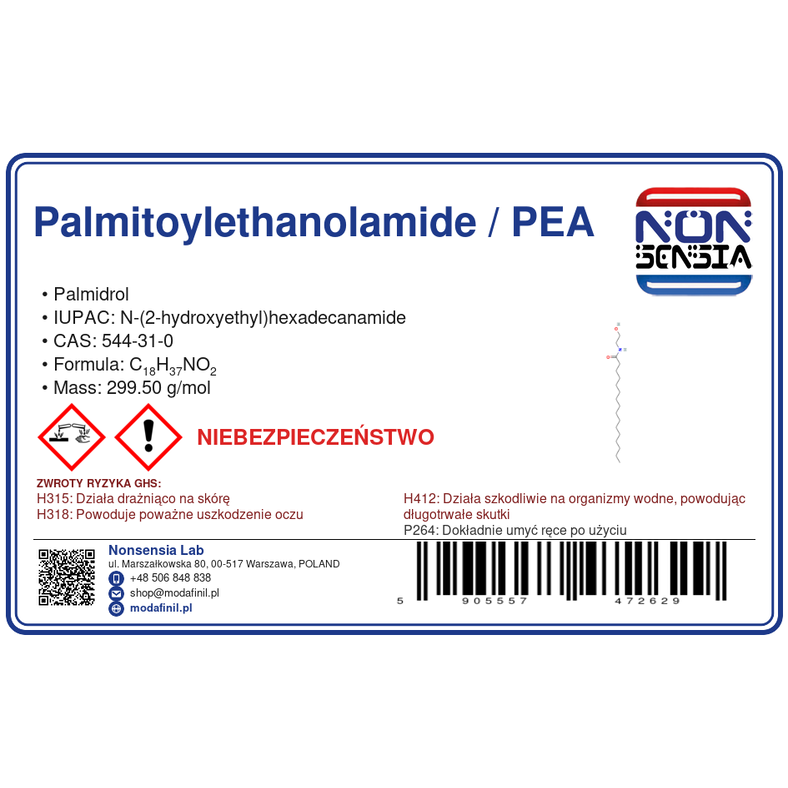
N-(2-hydroxyethyl)hexadecanamide (palmitoylethanolamide, PEA), crystalline powder, 1000 mg pack. Material intended exclusively for laboratory and analytical in vitro research. This product is not intended for human or animal consumption; it is not a medicinal product, food supplement, foodstuff or cosmetic.
Three different entities that must not be confused
For this molecule, separating the layers calls for a different approach than for substances registered as medicines. Palmitoylethanolamide has never obtained registration as a medicinal product in any country — it is, however, marketed under a different regulatory regime, as a food for special medical purposes or a food supplement. This difference is a source of misunderstanding as often as with medicinal substances, which is why we separate the layers just as carefully:
| Entity | What it is | Status |
|---|---|---|
| Chemical substance palmitoylethanolamide (PEA), CAS 544-31-0 |
A chemical concept — an N-acylethanolamine of defined structure, originally identified as a natural constituent of dietary fats. In itself it is neither a food product nor a reagent — its status is conferred only by the form in which it has been manufactured. | — |
| Commercial product food for special medical purposes / food supplement |
Micronised or ultramicronised PEA preparations with a defined particle size, manufactured under the producer’s supervision, with product documentation. In Italy classified explicitly as a “food for special medical purposes” [14], in other countries offered as a food supplement or functional ingredient under trade names (including Levagen). PEA has never obtained the status of a medicinal product. | this entity was the subject of the clinical studies and human safety studies cited below |
| Chemical reagent material offered here |
Material for laboratory and analytical work — raw crystalline powder, not micronised, without food-product or supplement documentation. It does not have, and cannot have, authorisation for use in humans or animals. | analytics, chemistry, reference standards |
The consequence is unambiguous. The study results cited further on this page were obtained either using finished commercial preparations (micronised or ultramicronised PEA, in clinical and observational studies involving humans) or using the substance administered to laboratory animals or cell cultures under controlled experimental conditions (preclinical studies). None of these studies was conducted using the analytical reagent, and none of their results transfers to the material offered. The reagent is not a form in which the substance has ever been studied in humans, and it cannot be used in such a way.
Reagent identification sheet
| Systematic name (IUPAC) | N-(2-hydroxyethyl)hexadecanamide |
|---|---|
| Common name | palmitoylethanolamide (PEA, Palmidrol) |
| CAS number | 544-31-0 |
| Molecular formula | C18H37NO2 |
| Molar mass | 299.5 g·mol−1 |
| Monoisotopic mass | 299.2824 Da |
| Melting point | 98.5 °C |
| InChIKey | HXYVTAGFYLMHSO-UHFFFAOYSA-N |
| SMILES | CCCCCCCCCCCCCCCC(=O)NCCO |
| PubChem CID | 4671 |
| ChEMBL | CHEMBL3986110 |
| Form | crystalline powder, white to off-white |
| Packaging | sealed aluminium zip-lock bag |
| Purity | ≥ 99% |
| Intended use | research reagent — not for human or animal consumption |
Lineage of the molecule: from egg-yolk fat to a nuclear receptor ligand
Palmitoylethanolamide has an unusual lineage for a molecule with such an extensive modern literature — it did not originate in a medicinal chemistry laboratory, but was isolated from natural dietary fats long before any model of its action existed.
Discovery in dietary fats
The compound was identified in the mid-1950s as a naturally occurring factor with anti-inflammatory activity, present among other sources in hen’s egg yolk. For the following decades it remained a biochemical curiosity: an effect was observed, but there was no method allowing it to be linked to a specific molecular target — mass spectrometry and molecular receptor pharmacology, which make this possible today, did not yet exist in laboratory practice.
From an “anti-inflammatory factor” to a nuclear receptor ligand
The breakthrough came in the 1990s, when it was shown that the compound limits oedema and inflammatory hypersensitivity after oral administration in laboratory animals, by inhibiting mast cell activation [1]. The natural question was whether the mechanism had anything in common with the cannabinoid system being discovered in the same period and its endogenous ligand, anandamide. The answer proved complex: PEA does not bind directly to CB1 or CB2 receptors [2], but enhances the action of anandamide by a separate mechanism, described as the “entourage effect” [3][4]. Only in 2005 was the nuclear receptor PPAR-α identified as the actual molecular target mediating the compound’s anti-inflammatory action [5][6], which shifted the whole line of research from cannabinoid pharmacology to nuclear receptor pharmacology.
Timeline
| 1950s | identification of N-(2-hydroxyethyl)hexadecanamide as a naturally occurring anti-inflammatory factor, isolated among other sources from hen’s egg yolk |
|---|---|
| 1960s–1980s | a period of limited interest — no identified mechanism of action |
| 1993–1996 | demonstration of the compound’s inhibitory effect on mast cell activation and of its anti-inflammatory activity after oral administration in laboratory animals [1] |
| 1999 | the question of a cannabimimetic mechanism of PEA raised in view of the absence of CB1/CB2 receptor binding [2] |
| 2001–2002 | description of the “entourage effect” — enhancement of anandamide’s action by PEA without direct cannabinoid receptor binding [3][4] |
| 2005 | identification of the nuclear receptor PPAR-α as the molecular target mediating the anti-inflammatory action [5][6] |
| 2006 | description of two distinct polymorphic crystal forms of PEA [8] |
| 2014 | demonstration of the higher oral efficacy of the micronised form over the non-micronised form in an animal model of inflammatory pain [13] |
| 2016 | first pooled meta-analysis of clinical data classifying micronised PEA as a food for special medical purposes [14] |
| 2017 | toxicological study of micronised PEA — mutagenicity, cytotoxicity, acute and subchronic toxicity in animals [15] |
| 2023 | meta-analysis of double-blind randomised trials of PEA in chronic pain [18] and a review comparing the mechanism of PEA with cannabidiol [17] |
Research centres and context
The literature on PEA is more geographically dispersed than for substances with a single originating centre, but three recurring clusters can be identified in it:
- Naples — nuclear receptor pharmacology. Identification of PPAR-α as the receptor mediating the anti-inflammatory action of PEA [5] and extension of this line towards CNS neuroinflammation [7].
- Messina — formulation pharmacology. Comparison of micronised and non-micronised forms in animal models of inflammatory pain, and the effect of particle size on oral efficacy [13].
- Padua and L’Aquila — clinical research. Multicentre studies and pooled meta-analyses of micronised PEA in chronic pain, including formalisation of its status as a food for special medical purposes [14].
Caveat applying to this entire section. Preclinical studies were conducted on laboratory animals or cell cultures, and studies involving humans — exclusively using finished commercial preparations (micronised/ultramicronised PEA), not the chemical reagent. This is not a description of the properties of the material offered and cannot be the basis for any use of it outside the laboratory.
Chemistry and its implications for the laboratory
The N-acylethanolamine family and the place of PEA
PEA belongs to the family of N-acylethanolamines (NAEs) — amides of fatty acids linked to ethanolamine. The best-known member of this family is anandamide, the amide of arachidonic acid (20:4), which binds the cannabinoid receptors CB1/CB2; PEA is its structural counterpart based on the fully saturated palmitic acid (16:0) — hence one of the synonyms found in chemical databases, “Anandamide (16:0)”. The same skeleton — an aliphatic chain terminating in an amide group linked to ethanolamine — recurs throughout the NAE family, and the length and degree of saturation of the chain determine affinity for individual molecular targets. Unlike anandamide, PEA does not bind CB1/CB2 receptors directly [2] and is metabolised mainly by a separate enzyme — N-acylethanolamine-hydrolysing acid amidase (NAAA), expressed mainly in macrophages — rather than by fatty acid amide hydrolase (FAAH), which is responsible for the breakdown of anandamide [9]. For the laboratory this means that analytical panels covering both PEA and anandamide must take the separate degradation pathways into account when designing sample stability studies.
Achirality and crystal polymorphism
Unlike modafinil, whose sulfur atom is a stereogenic centre, the PEA molecule contains no stereogenic centre — a simple aliphatic chain terminating in an amide group does not give rise to chirality. Qualification of the standard therefore does not require enantiomer separation. The compound does, however, crystallise in two distinct polymorphic forms, differing in the packing of molecules in the crystal lattice [8] — a fact relevant to the interpretation of the melting point and the X-ray diffraction profile, as the two forms may give slightly different values.
| Parameter | Value | Implication |
|---|---|---|
| Partition coefficient (XLogP) | ≈ 6.2 | strongly lipophilic — the highest value among comparable reagents in the catalogue; elutes very late in RP-HPLC |
| Topological polar surface area (TPSA) | 49.3 Å2 | moderate — a single amide group and a hydroxyl group |
| Hydrogen bond donors | 2 | amide N–H group and OH group |
| Hydrogen bond acceptors | 2 | carbonyl and hydroxyl oxygen |
| Rotatable bonds | 16 | the most conformationally flexible molecule in the catalogue — long aliphatic chain |
| Melting point | 98.5 °C | NIST data; the two known polymorphic forms may give slightly different measured values |
| Solubility | good in chloroform, DMSO and ethanol; practically insoluble in water | the high XLogP requires stock solutions to be prepared in an organic solvent or lipid carrier |
Nomenclature and synonyms
- Palmitoylethanolamide (PEA) — the most common name, also in the Polish literature;
- Palmidrol — an older name, still found in chemical databases and identifier registries;
- N-palmitoylethanolamine — a descriptive variant emphasising the amine group of the chain;
- Hexadecanoylethanolamide — a name based on the systematic name of palmitic acid (hexadecanoic acid);
- Anandamide (16:0) — a name describing the structural relationship with anandamide within the N-acylethanolamine family, not identity of action;
- Levagen — the trade name of a form of PEA used in preparations available as food supplements in some countries — does not apply to the reagent offered here;
- N-(2-hydroxyethyl)hexadecanamide — the IUPAC systematic name, the only unambiguous one.
The divergence of names has a bibliographic consequence: searching databases solely under “palmitoylethanolamide” misses some records indexed under “palmidrol” or under the full systematic name. It is worth combining the variants when building a query.
Laboratory applications of the reagent
- reference material for confirming identity and purity by HPLC-UV;
- standard in LC-MS/MS methods for the simultaneous determination of panels of N-acylethanolamines and endocannabinoids in biological matrices — plasma [12], hair and nails [10][11], brain tissue [19];
- calibration material for distinguishing accurate masses in lipidomic panels covering anandamide and other NAE homologues;
- reference material in crystallographic and polymorphism studies [8][16];
- model compound in the chemistry of fatty acid amides and ethanolamine derivatives.
Storage, handling and occupational safety
Store in the original, tightly closed container in a dry, cool place protected from light, separately from food and animal feed and out of the reach of children. Work only under laboratory conditions, using personal protective equipment: gloves, safety glasses and laboratory clothing; weigh the powder under conditions that limit dust formation. Avoid inhaling the dust and contact with skin and eyes. Dispose of waste in accordance with the regulations applicable to chemical waste at the place where the research is conducted.
Hazard classification. According to data registered in the PubChem database, the material carries the pictograms GHS05, GHS07 and GHS09 and hazard statements indicating skin irritation (H315) and serious eye damage (H318), with the signal word “Danger”. Numerical LD50 data are not catalogued in this record — the current Safety Data Sheet (SDS), available on request to the recipient, applies.
Regulatory status
The substance has never obtained registration as a medicinal product in any country — in the ChEMBL database it is listed with preclinical phase status, despite numerous clinical studies conducted outside the formal medicine registration pathway. Finished commercial PEA preparations (micronised, ultramicronised) are classified in some countries as food for special medical purposes and in others as food supplements — regulatory categories distinct from a medicinal product, and this offer does not concern them. The material offered is a chemical reagent: it is neither a food for special medical purposes, nor a food supplement, nor a foodstuff, and has no authorisation for any use in humans or animals. The buyer is responsible for ensuring that the intended use complies with the law in force in the country of destination.
Frequently Asked Questions
How does palmitoylethanolamide differ from anandamide?
Both molecules belong to the N-acylethanolamine family, but they differ in the length and saturation of the fatty acid chain — PEA is the amide of palmitic acid (16:0), anandamide the amide of arachidonic acid (20:4). In chemical databases PEA is therefore sometimes designated “Anandamide (16:0)”. Unlike anandamide, PEA does not bind the cannabinoid receptors CB1/CB2 directly.
What are the chemical formula and molar mass of PEA?
C18H37NO2; molar mass 299.5 g·mol−1, monoisotopic mass 299.2824 Da. CAS number 544-31-0, InChIKey HXYVTAGFYLMHSO-UHFFFAOYSA-N.
Is PEA a medicine?
No. The substance has never obtained registration as a medicinal product in any country — in the ChEMBL database it is listed only with preclinical phase status. The material offered is a chemical reagent.
Are Levagen and palmitoylethanolamide the same thing?
Chemically, yes — Levagen is the trade name of a PEA preparation used in food supplements in some countries. That name does not apply to the reagent offered here, which has no supplement status or any food-product documentation.
Why is PEA sometimes called “Anandamide (16:0)”?
Because it corresponds structurally to anandamide, only with a shorter, fully saturated palmitic acid chain instead of the polyunsaturated arachidonic acid. The name describes a structural relationship within the N-acylethanolamine family, not identity of action.
Does PEA require enantiomer separation?
No. The molecule contains no stereogenic centre — a simple aliphatic chain terminating in an amide group does not give rise to chirality, unlike, for example, modafinil.
How many crystal forms does PEA have?
Two distinct polymorphic forms have been described, differing in the packing of molecules in the crystal lattice. This matters when interpreting the melting point and the X-ray diffraction profile.
What should PEA be dissolved in to prepare a stock solution?
It dissolves well in chloroform, DMSO and ethanol; it is practically insoluble in water. With an XLogP ≈ 6.2, stock solutions are prepared in an organic solvent or lipid carrier.
How should PEA be stored as a laboratory reagent?
In the original, tightly closed container (sealed aluminium zip-lock bag), in a dry, cool place protected from light, separately from food and animal feed and out of the reach of children.
Is a safety data sheet supplied with PEA?
We provide the safety data sheet on request to recipients engaged in research or analytical activities.
Which analytical methods are used to determine PEA?
HPLC-UV for confirming identity and purity, and LC-MS/MS for the simultaneous determination of panels of N-acylethanolamines and endocannabinoids in biological matrices, including plasma, hair and brain tissue.
Is the reagent suitable for uses other than laboratory ones?
No. The material is intended exclusively for laboratory and analytical research. It is not intended for human or animal consumption; it is not a medicine, food supplement, food for special medical purposes, foodstuff or cosmetic.
References
The entries come from the PubMed database. Entries [1]–[9], [16] are chemical, analytical and mechanistic papers — in vitro studies, studies in cell models or in laboratory animals. Entries [10]–[12], [19] are LC-MS/MS analytical methods for determining PEA and related N-acylethanolamines in biological matrices. Entries [13]–[15], [17]–[18] concern finished commercial preparations (micronised/ultramicronised PEA) studied clinically or toxicologically as a food for special medical purposes or a food supplement — not the chemical reagent. None of these papers describes the use of the analytical material offered — they are cited as scientific context and a bibliographic pointer, not as information about the properties of the material offered nor as encouragement of any use.
- Mazzari S, Canella R, Petrelli L et al. (1996). “N-(2-hydroxyethyl)hexadecanamide is orally active in reducing edema formation and inflammatory hyperalgesia by down-modulating mast cell activation.” Eur J Pharmacol. PMID 8739213.
- Lambert DM, Di Marzo V (1999). “The palmitoylethanolamide and oleamide enigmas: are these two fatty acid amides cannabimimetic?” Curr Med Chem. PMID 10469890.
- Jonsson KO, Vandevoorde S, Lambert DM et al. (2001). “Effects of homologues and analogues of palmitoylethanolamide upon the inactivation of the endocannabinoid anandamide.” Br J Pharmacol. PMID 11498512.
- Smart D, Jonsson KO, Vandevoorde S et al. (2002). “’Entourage’ effects of N-acyl ethanolamines at human vanilloid receptors. Comparison of effects upon anandamide-induced vanilloid receptor activation and upon anandamide metabolism.” Br J Pharmacol. PMID 12023948.
- Lo Verme J, Fu J, Astarita G et al. (2005). “The nuclear receptor peroxisome proliferator-activated receptor-alpha mediates the anti-inflammatory actions of palmitoylethanolamide.” Mol Pharmacol. PMID 15465922.
- LoVerme J, La Rana G, Russo R et al. (2005). “The search for the palmitoylethanolamide receptor.” Life Sci. PMID 15963531.
- Mattace Raso G, Russo R, Calignano A et al. (2014). “Palmitoylethanolamide in CNS health and disease.” Pharmacol Res. PMID 24844438.
- Kamlekar RK, Swamy MJ (2006). “Molecular packing and intermolecular interactions in two structural polymorphs of N-palmitoylethanolamine, a type 2 cannabinoid receptor agonist.” J Lipid Res. PMID 16609146.
- Tsuboi K, Zhao LY, Okamoto Y et al. (2007). “Predominant expression of lysosomal N-acylethanolamine-hydrolyzing acid amidase in macrophages revealed by immunochemical studies.” Biochim Biophys Acta. PMID 17462942.
- Restin T, Byland N, Voegel CD et al. (2022). “Endocannabinoid and steroid analysis in infant and adult nails by LC-MS/MS.” Anal Bioanal Chem. PMID 35781588.
- Voegel CD, Baumgartner MR, Kraemer T et al. (2021). “Simultaneous quantification of steroid hormones and endocannabinoids (ECs) in human hair using an automated supported liquid extraction (SLE) and LC-MS/MS – Insights into EC baseline values and correlation to steroid concentrations.” Talanta. PMID 33167212.
- Gachet MS, Rhyn P, Bosch OG et al. (2015). “A quantitative LC-MS/MS method for the measurement of arachidonic acid, prostanoids, endocannabinoids, N-acylethanolamines and steroids in human plasma.” J Chromatogr B. PMID 25436483.
- Impellizzeri D, Bruschetta G, Cordaro M et al. (2014). “Micronized/ultramicronized palmitoylethanolamide displays superior oral efficacy compared to nonmicronized palmitoylethanolamide in a rat model of inflammatory pain.” J Neuroinflammation. PMID 25164769.
- Paladini A, Fusco M, Cenacchi T et al. (2016). “Palmitoylethanolamide, a Special Food for Medical Purposes, in the Treatment of Chronic Pain: A Pooled Data Meta-analysis.” Pain Physician. PMID 26815246.
- Nestmann ER (2017). “Safety of micronized palmitoylethanolamide (microPEA): lack of toxicity and genotoxic potential.” Food Sci Nutr. PMID 28265364.
- Saturnino C, Popolo A, Ramunno A et al. (2017). “Anti-Inflammatory, Antioxidant and Crystallographic Studies of N-Palmitoyl-ethanol Amine (PEA) Derivatives.” Molecules. PMID 28398240.
- Clayton P, Subah S, Venkatesh R et al. (2023). “Palmitoylethanolamide: A Potential Alternative to Cannabidiol.” J Diet Suppl. PMID 34842030.
- Lang-Illievich K, Klivinyi C, Lasser C et al. (2023). “Palmitoylethanolamide in the Treatment of Chronic Pain: A Systematic Review and Meta-Analysis of Double-Blind Randomized Controlled Trials.” Nutrients. PMID 36986081.
- Bystrowska B, Smaga I, Tyszka-Czochara M et al. (2014). “Troubleshooting in LC-MS/MS method for determining endocannabinoid and endocannabinoid-like molecules in rat brain structures applied to assessing the brain endocannabinoid/endovanilloid system significance.” Toxicol Mech Methods. PMID 24576199.
Identification data and computed descriptors from PubChem (CID 4671) and the ChEMBL registry; melting point from the NIST WebBook.
Related reagents in our catalogue
- Modafinil (CAS 68693-11-8) — a different structural class in the catalogue: there, a stereogenic centre at the sulfur atom and two aromatic rings; here, a simple, achiral aliphatic fatty acid chain — the opposite pole of analytical difficulty among the standards offered.
- Cannabidiol (CBD) — a compound with a separate but related context in the endocannabinoid system: PEA enhances the action of anandamide via the “entourage effect” without binding CB1/CB2 receptors, whereas CBD acts on the same system through multiple routes — a contrast of mechanism within a shared field of research.
Statement of intended use
The material offered is a chemical reagent intended exclusively for research, analytical and laboratory purposes. It is not intended for human or animal consumption. It is not a medicinal product, food supplement, food for special medical purposes, foodstuff, medical device or cosmetic. It must not be used for medical, diagnostic, therapeutic, prophylactic or consumption purposes, administered to humans or animals, applied to the skin, or added to food, beverages or animal feed. Sold exclusively to recipients engaged in research, scientific or analytical activities who have laboratory facilities and the knowledge required to handle chemical reagents safely. The buyer bears sole responsibility for the lawful and safe use of the reagent and for compliance with the regulations in force in the country of destination.