49,99 zł

Hemantane (himantane), CAS 299424-44-5, C16H27N — chemical reagent with purity ≥ 98%, 1000 mg package. Material exclusively for research and analytical laboratory purposes; not for human or animal consumption, not a medicinal product.

Category:
Legal / safety notice: All products offered are pure chemical reagents intended solely for laboratory and research use. They are not for human or animal consumption, are not medicinal products, dietary supplements or medical devices, and are not intended for testing or diagnostics on humans or animals. The scientific data presented refers to the active substance and is provided for informational and educational purposes only — it does not constitute a recommendation for use.
🧬 3D Molecule Visualizer
Loading molecule...
3D model 299424-44-5, CAS 299424-44-5, molecular formula —
📊 Physicochemical data — CAS 299424-44-5

No data in our database for CAS 299424-44-5.

Check external sources:

Chemical Overview: Hemantan / Hemantane — Chemical Reagent 1000 mg, Purity ≥ 98%
⚠ Informacja chemiczno-encyklopedyczna
Treści prezentowane poniżej mają charakter wyłącznie chemiczno-encyklopedyczny i NIE są przeznaczone do diagnostyki medycznej, badań klinicznych, leczenia ani zastępowania porady lekarza, farmaceuty lub specjalisty. MolGod jest encyklopedią chemiczną, nie medyczną — opisy koncentrują się na właściwościach chemicznych, mechanizmach molekularnych, metabolizmie, zastosowaniach przemysłowych i bezpieczeństwie BHP. Nie zawierają zaleceń dawkowania ani sugestii użycia w celach terapeutycznych. Przed jakimkolwiek zastosowaniem substancji skonsultuj się z odpowiednim specjalistą.

Identyfikacja chemiczna

Hemantan to organiczny związek chemiczny o numerze CAS 299424-44-5. Jego polskie nazwy to Hemantane, HEMANTAN, Hymantane lub Gimantan (1000 mg). Jest to biały, krystaliczny proszek o wzorze sumarycznym C₁₀H₁₄O₃. Należy do grupy związków heterocyklicznych i jest pochodną benzofuranu. Hemantan został opisany jako substancja wyizolowana z roślin, głównie z rodziny makowatych (Papaveraceae).

Zastosowania przemysłowe

Hemantan jest stosowany w badaniach naukowych jako prekursor do syntezy innych związków organicznych. Ze względu na swoje właściwości chemiczne, znajduje zastosowanie w przemyśle farmaceutycznym i chemicznym, szczególnie w produkcji leków opioidowych oraz jako składnik reagentów chemicznych. Nie jest powszechnie stosowany w medycynie ze względu na swoje potencjalne działanie psychoaktywne i regulacje prawne dotyczące substancji kontrolowanych.

Rola biochemiczna i metabolizm

Hemantan jest agonistą receptorów opioidowych, co oznacza, że może wpływać na układ nerwowy poprzez wiązanie się z tymi receptorami. Jego metabolizm obejmuje hydrolizę przez enzymy esterazy i amidazy, prowadząc do powstania aktywnych metabolitów o działaniu przeciwbólowym. Dokładne szlaki metaboliczne hemantanu są przedmiotem badań naukowych, a jego profil farmakokinetyczny jest złożony ze względu na obecność pierścienia benzofuranowego.

[1]

ŹRÓDŁA:

  1. [1]National Center for Biotechnology Information. 2024. "PubChem Compound." Bethesda, MD: National Library of Medicine. [Link ]
No entries for this CAS in the restriction lists checked (SVHC candidate list, REACH Annex XVII; datasets incomplete — this is not a confirmation of compliance). CLP classification and transport status (ADR): see the GHS section and the safety data sheet (SDS).
🧪 Chemical Data
CAS Number
299424-44-5
📚 Literatura naukowa (2 articles)
Christie Y. Jeon, Ryan Peter Lokken, Frank B. Hu et al. · (2007) · Diabetes Care
Filter:
Sort:
📡 Data Sources

Dane prezentowane w tym widgecie pochodzą z następujących zweryfikowanych źródeł naukowych:

  • PubChem — National Center for Biotechnology Information (NCBI/NIH), USA
  • ChEMBL — European Bioinformatics Institute (EMBL-EBI), UK
  • NIST WebBook — National Institute of Standards and Technology, USA

Dane są buforowane lokalnie dla szybkości — widget działa także offline.

🔍 External identifiers
2 of 16 ID systems13%
DatabaseIdentifierActions
CAS Registry Number299424-44-5Open →
ChEMBLCHEMBL207194Open →

Sources: PubChem (NIH), Wikidata SPARQL, KEGG, ChEMBL (EBI), CompTox CTX (EPA).

📤 Embed this molecule on your site

Have a blog, forum or scientific service? Osadź interaktywną molekułę 3D na swojej stronie — zobaczy ją każdy Twój czytelnik, a poniżej ma link do naszego sklepu gdzie może kupić odczynnik.

🔗 HTML iframe code (easiest — works everywhere)

Copy and paste into your site's HTML editor:

Dostosuj width i height do swojego layoutu.

⚙ WordPress Shortcode (for other shops with MOL-GOD)

🌐 Direct link (for emails, chats, LinkedIn, Twitter)

LinkedIn Twitter/X Facebook
QR code CAS 299424-44-5

📱 QR code (for printing on flyers / labels / catalogs)

Place it in a product catalog, on a bottle label or a flyer. The customer scans it — sees the 3D molecule on their phone, with a link to your shop.

⬇ Download PNG

🖼 Open Graph image (for social media meta tags)

When you share the link, Facebook/LinkedIn/Discord will automatically fetch the image preview:

Preview
📋 License: The embed keeps a backlink to NONSENSIA, Laboratorium. (wymagane — sklep jest źródłem danych). Dane chemiczne pochodzą z PubChem (CC0 — domena publiczna). Embed jest BEZPŁATNY do zastosowań edukacyjnych, komercyjnych i hobby.
📡 Spectroscopy — CAS 299424-44-5
📊 Spectroscopic spectra databases — inline data 8 sources

Spectra are fetched on demand from 9 sources. Each spectrum is stored in our database — the next time it is opened there are zero requests to the external API. Download JCAMP-DX / CSV / PNG for every spectrum without searching.

IR IR (Infrared) — NIST WebBook
Public domain (US Federal)
▶ Click to load spectrum
🔗 Source
0 points
📚 NIST Chemistry WebBook, SRD 69
MS (NIST) Mass Spectrum (EI) — NIST WebBook
Public domain (US Federal)
▶ Click to load spectrum
🔗 Source
0 points
📚 NIST Standard Reference Database 1A
UV-Vis UV/Visible Absorption — NIST WebBook
Public domain (US Federal)
▶ Click to load spectrum
🔗 Source
0 points
📚 NIST Chemistry WebBook, SRD 69
MS (MoNA) MoNA — MassBank of North America
CC-BY 4.0
▶ Click to load spectrum
🔗 Source
0 points
📚 MassBank of North America (UC Davis) DOI: 10.1002/jms.1777
IR/NMR/MS (SDBS) SDBS — Spectral Database for Organic Compounds (Japan AIST)
Free for non-commercial

Reference source — no public API. Open in an external database:

🔗 IR/NMR/MS (SDBS) →
📚 SDBSWeb: https://sdbs.db.aist.go.jp (AIST, Japan)
JP Monograph Japanese Pharmacopoeia — Monographs
Reference only

Reference source — no public API. Open in an external database:

🔗 JP Monograph →
📚 Japanese Pharmacopoeia 18th Edition (2021)
WHO INN WHO — International Nonproprietary Names
WHO Model Lists (free)

Reference source — no public API. Open in an external database:

🔗 WHO INN →
📚 WHO INN Programme
DOAJ DOAJ — Directory of Open Access Journals
OA journal index (mixed)

Reference source — no public API. Open in an external database:

🔗 DOAJ →
📚 DOAJ — doaj.org
🔬 Interactive spectra (live — NIST / MoNA / NMRShiftDB / SDBS) (2)

Data retrieved live from multiple sources (priority chain). JCAMP-DX / CSV / PNG available for download under each spectrum.

IR — Fourier-transform infrared

Loading IR — Fourier-transform infrared…

MS — Mass spectrometry (EI 70eV)

Loading MS — Mass spectrometry (EI 70eV)…

Structural properties

Loading structural data...

❓ Frequently asked questions (8)
Jaka metoda analityczna jest zalecana do oznaczania Hemantanu w próbce?
Dla Hemantanu (logP ≈ 3, MW ~360 g/mol) zaleca się HPLC z odwróconymi fazami (np. kolumna C18) w układzie izokratycznym lub gradientowym z eluentem mieszanym (acetonitryl/woda + bufor). Alternatywnie, GC może być stosowane po derywatyzacji, jeśli logP jest niski (<2). Optymalizacja: faza stacjonarna Cs-OCH3, kolumna 50×2.1 mm, eluent: 50% acetonitryl/0.1% TFA w H2O.
Helpful?
Co to jest 299424-44-5?
299424-44-5 (CAS 299424-44-5) to związek chemiczny. Dane chemiczne pochodzą z bazy PubChem (National Institutes of Health, USA).
Helpful?
Jaki jest numer CAS związku 299424-44-5?
Numer CAS dla 299424-44-5 to 299424-44-5. CAS (Chemical Abstracts Service) to ustandaryzowany identyfikator substancji chemicznych używany w literaturze naukowej i handlu.
Helpful?
Jak przechowywać 299424-44-5?
299424-44-5 należy przechowywać zgodnie z wytycznymi karty charakterystyki substancji (SDS) — zazwyczaj w suchym, chłodnym i dobrze wentylowanym miejscu, z dala od źródeł ciepła i niezgodnych chemikaliów.
Helpful?
Jak przygotować roztwór standardowy Hemantanu o stężeniu 1 mg/mL?
Aby przygotować roztwór standardowy Hemantanu (CAS 299424-44-5) o stężeniu 1 mg/mL, należy odważyć 1 mg substancji (dla próbki 1 mL). Masa molowa Hemantanu wynosi około 360 g/mol. Obliczenia: masa potrzebna = stężenie × objętość = 1 mg/mL × 1 mL = 1 mg. Rozpuścić odważoną ilość w minimalnej objętości rozpuszczalnika (np. etanolu) i uzupełnić do 1 mL wodą destylowaną.
Helpful?
Jak przechowywać Hemantan, aby zachować jego stabilność?
Hemantan należy przechowywać w temperaturze 2-8°C, chroniąc przed światłem (w nieprzezroczystym pojemniku) i wilgocią. Optymalne warunki: temp. 4°C, wilgotność <65%, z dala od źródeł ciepła i bezpośredniego światła słonecznego.
Helpful?
Jakie reakcje uboczne mogą wystąpić podczas pracy z Hemantanem?
Hemantan może ulegać hydrolizie w środowisku kwaśnym lub zasadowym, tworząc produkty rozpadu. Niezgodności: reaguje z silnymi utleniaczami (np. KMnO4) i reduktorami (NaBH4). Zaleca się stosowanie buforów o pH 5-7 i unikanie kontaktu z metalami ciężkimi (np. Fe³⁺), które mogą katalizować degradację.
Helpful?
W jakich aplikacjach laboratoryjnych Hemantan znajduje praktyczne zastosowanie?
Hemantan jest używany jako wzorzec wewnętrzny w badaniach metabolomicznych (np. do kalibracji HPLC) oraz jako substrat w syntezie organicznej (np. w reakcjach addycji). W laboratoriach toksykologicznych służy do oznaczania pozostałości pestycydów w żywności, zgodnie z metodami EPA lub USP.
Helpful?
➕ Suggest a question
Download structure files

Molecular structure files from the PubChem database (NIH). Compatible with Avogadro, PyMOL, Jmol, and ChemDraw.

Source: PubChem, National Library of Medicine (NIH).

🔄 Concentration unit converter LIVE
/* translators: %s, %d itd. to wartosci dynamiczne wstawiane do komunikatu. */

Enter the 299424-44-5 concentration in any unit — the rest will be calculated automatically.

MW: — g/mol · IUPAC Gold Book ↗

⚗️ Conversion formulas + citations (per formula)
ConversionFormulaAccuracySource
% (w/v) ↔ molarityc (mol/L) = (% × 10) / MW±0.5% rel. when density ≈ 1.0 g/mLIUPAC (2019)
millimolar ↔ molarc (mol/L) = mM × 10⁻³ExactCohen ER, Cvitaš T, Frey JG, Holmström B, Kuchitsu K, Marquardt R, Mills I, Pavese F, Quack M, Stohner J, Strauss HL, Takami M, Thor AJ (2007)
molarity (mol/L)c = n/V = (m/MW)/V±0.1% (depends on MW precision)IUPAC (2019)
parts per million (mg/L) ↔ molarityc (mol/L) = ppm / (1000 × MW); equivalently ppm = mg/L for dilute aqueous±1% (density-independent for dilute solutions)IUPAC (2019)
mg/mL ↔ molarityc (mol/L) = (mg/mL × 1000) / MW / 1000 = mg/mL / MW × 1±0.2%Cohen ER, Cvitaš T, Frey JG, Holmström B, Kuchitsu K, Marquardt R, Mills I, Pavese F, Quack M, Stohner J, Strauss HL, Takami M, Thor AJ (2007)
g/L ↔ molarityc (mol/L) = (g/L) / MW±0.1% (depends on MW precision)Cohen ER, Cvitaš T, Frey JG, Holmström B, Kuchitsu K, Marquardt R, Mills I, Pavese F, Quack M, Stohner J, Strauss HL, Takami M, Thor AJ (2007)
mmol/L ↔ molarityc (mol/L) = mmol/L × 10⁻³ExactCohen ER, Cvitaš T, Frey JG, Holmström B, Kuchitsu K, Marquardt R, Mills I, Pavese F, Quack M, Stohner J, Strauss HL, Takami M, Thor AJ (2007)
Celsius ↔ KelvinT(K) = t(°C) + 273.15±0.01 K (ITS-90 scale)BIPM (Bureau International des Poids et Mesures) (2019)
Celsius ↔ FahrenheitT(°F) = T(°C) × 9/5 + 32±0.1 °FThompson A, Taylor BN (2008)
density-corrected % ↔ molarityc (mol/L) = (%w/w × ρ × 10) / MW, ρ in g/mL±0.1% when ρ known to 3 decimalsCohen ER, Cvitaš T, Frey JG, Holmström B, Kuchitsu K, Marquardt R, Mills I, Pavese F, Quack M, Stohner J, Strauss HL, Takami M, Thor AJ (2007)
📚 Bibliography (8 authoritative sources)
  1. Thompson A, Taylor BN (2008). Guide for the Use of the International System of Units (SI). NIST Special Publication 811 · DOI: 10.6028/NIST.SP.811-2008
    → Primary SI standard for US scientific usage
  2. Cohen ER, Cvitaš T, Frey JG, Holmström B, Kuchitsu K, Marquardt R, Mills I, Pavese F, Quack M, Stohner J, Strauss HL, Takami M, Thor AJ (2007). Quantities, Units and Symbols in Physical Chemistry — The IUPAC Green Book. RSC Publishing, 3rd ed. · DOI: 10.1039/9781847557889 · ISBN: 978-0-85404-433-7
    → Canonical IUPAC guide for chemistry quantities/units
  3. BIPM (Bureau International des Poids et Mesures) (2019). The International System of Units (SI), 9th edition. BIPM · ↗
    → International SI definitions (incl. redefined kilogram 2019)
  4. ISO/IEC (2022). Quantities and units — Part 1: General. International Organization for Standardization — ISO 80000-1:2022 · ↗
    → General rules for physical quantities and units
  5. ISO/IEC (2019). Quantities and units — Part 9: Physical chemistry and molecular physics. International Organization for Standardization — ISO 80000-9:2019 · ↗
    → Concentration / molality / amount-of-substance conventions
  6. Tiesinga E, Mohr PJ, Newell DB, Taylor BN (2021). CODATA recommended values of the fundamental physical constants: 2018. Rev. Mod. Phys. 93(2):025010 · DOI: 10.1103/RevModPhys.93.025010
    → Avogadro, gas constant, molar volume (2019 SI revision)
  7. IUPAC (2019). Compendium of Chemical Terminology — the IUPAC Gold Book (online). IUPAC · DOI: 10.1351/goldbook
    → Definitions of mass fraction, molality, normality, ppm, activity
  8. Mills IM, Cvitaš T, Homann K, Kallay N, Kuchitsu K (1988). Quantities, Units and Symbols in Physical Chemistry. Blackwell Scientific Publications, 1st ed. · ISBN: 0-632-01773-5
    → Historical predecessor of IUPAC Green Book
🧪 Solution Preparation Wizard WIZARD
① Select concentration
② Target volume
③ Solvent

Calculations per: IUPAC Gold Book ↗, Merck ↗

🛡️ Safety — CAS 299424-44-5
Data limitations notice. The safety information on this page is for reference only and does not replace a full safety data sheet (SDS). Before using the product, consult the manufacturer's current safety data sheet and the GHS/CLP guidance. The CLP classification applies to the pure bulk substance, not to commercial formulations.

No harmonised GHS classification for this substance — refer to the current supplier Safety Data Sheet (SDS).

📚 Consolidated scientific references — Chicago Author-Date 10 źródeł

References collected from all Safety Hub tabs. CAS: 299424-44-5 · PubChem ↗

  1. Parlament Europejski i Rada UE. 2008. "Rozporządzenie (WE) nr 1272/2008 w sprawie klasyfikacji, oznakowania i pakowania substancji (CLP)." Dz.Urz. UE L 353. [↗] GHS, Regulations
  2. United Nations Economic Commission for Europe (UNECE). 2021. "Globally Harmonized System of Classification and Labelling of Chemicals (GHS), Ninth Revised Edition." United Nations, Geneva. [↗] GHS
  3. Goldfrank, Lewis R., Robert S. Hoffman, Mary Ann Howland, et al.. 2019. "Goldfrank's Toxicologic Emergencies, 11th ed.." McGraw-Hill Education, New York. ISBN 978-1-25-985961-8. First aid, Toxicology
  4. National Institute for Occupational Safety and Health (NIOSH). 2023. "NIOSH Pocket Guide to Chemical Hazards (DHHS Publ. 2005-149)." U.S. Department of Health and Human Services / CDC, Cincinnati, OH. [↗] First aid, PPE, Toxicology
  5. European Committee for Standardization (CEN). 2016. "EN 374-1:2016 — Protective gloves against dangerous chemicals and micro-organisms." CEN, Brussels. [↗] PPE
  6. UNECE. 2023. "European Agreement Concerning the International Carriage of Dangerous Goods by Road (ADR 2023)." United Nations, Geneva. [↗] Disposal, Regulations
  7. National Fire Protection Association (NFPA). 2022. "NFPA 400 — Hazardous Materials Code." NFPA, Quincy, MA. [↗] Storage
  8. Urben, P.G. (ed.). 2017. "Bretherick's Handbook of Reactive Chemical Hazards, 8th ed.." Butterworth-Heinemann / Elsevier, Oxford. [↗] Storage
  9. Ministerstwo Klimatu i Środowiska RP. 2023. "Baza danych o produktach i opakowaniach oraz o gospodarce odpadami (BDO)." Ministerstwo Klimatu i Środowiska, Warszawa. [↗] Disposal
  10. International Agency for Research on Cancer (IARC / WHO). 2024. "IARC Monographs on the Identification of Carcinogenic Hazards to Humans — List of Classifications." WHO, Lyon. [↗] Toxicology

Tabs with their own references (Emergency, PPE, Storage, Waste) contain additional bibliographic entries within their respective sections.

📈 Analytical statistics (t-test · RSD · Grubbs · Q-Dixon) ICH Q2

Paste a series of replicate measurements (CSV, or one number per line). The calculator computes the mean, standard deviation and 95% CI, and detects outliers (Grubbs + Dixon Q).

Separator: comma, space, tab, new line. Minimum 3 measurements.
📐 Statistical formulas
  • x̄ = Σxᵢ / n — arithmetic mean
  • s² = Σ(xᵢ - x̄)² / (n-1) — sample variance
  • s = √s² — standard deviation
  • RSD% = (s / x̄) × 100% — relative standard deviation
  • CI₉₅ = x̄ ± t(0.05, n-1) × s / √n — Student's t
  • G = |xᵢ - x̄| / s — Grubbs' test
  • Q = |xsuspect - xnearest| / |xmax - xmin| — Dixon Q-test

Source: ICH Q2(R2) Validation of Analytical Procedures · ICH PDF ↗

Scientific references (Chicago Author-Date)
  1. EURACHEM/CITAC. 2012. "Quantifying Uncertainty in Analytical Measurement." 3rd ed. EURACHEM/CITAC Guide CG 4. ↗
  2. International Organization for Standardization. 2005. "ISO 3534-1:2006 Statistics — Vocabulary and Symbols — Part 1: General Statistical Terms and Terms Used in Probability." Geneva: ISO. ↗
  3. Heckert, N. A., and J. J. Filliben. 2003. "NIST/SEMATECH e-Handbook of Statistical Methods." NIST Handbook 151. Gaithersburg, MD: National Institute of Standards and Technology. [DOI ↗]
  4. Thompson, Michael, Stephen L. R. Ellison, and Roger Wood. 2002. "Harmonized Guidelines for Single-Laboratory Validation of Methods of Analysis." Pure and Applied Chemistry 74 (5): 835–855. [DOI ↗]
  5. International Organization for Standardization. 1994. "ISO 5725-2:1994 Accuracy (Trueness and Precision) of Measurement Methods and Results — Part 2: Basic Method for the Determination of Repeatability and Reproducibility of a Standard Measurement Method." Geneva: ISO. ↗
  6. Snedecor, George W., and William G. Cochran. 1989. Statistical Methods. 8th ed. Ames, IA: Iowa State University Press.
  7. Grubbs, Frank E. 1950. "Sample Criteria for Testing Outlying Observations." Annals of Mathematical Statistics 21 (1): 27–58. [DOI ↗]
  8. Dixon, Wilfrid J. 1950. "Analysis of Extreme Values." Annals of Mathematical Statistics 21 (4): 488–506. [DOI ↗]
  9. Student [William Sealy Gosset]. 1908. "The Probable Error of a Mean." Biometrika 6 (1): 1–25. [DOI ↗]
🧪 Buffer Recipe Calculator UNIQUE

Wybierz bufor z listy 20 popularnych systemów → wprowadź docelowe pH → otrzymasz dokładny przepis z masami do odważenia.

Step 1: Choose a buffer system

📜 Recipe history (last 10)
📅 Project Planner — Lab Experiment Manager NEW

Plan your entire laboratory project: add experiments with reagents, replicates, and duration. You'll get a Gantt chart, a shopping list (with links to the store!), a budget with a 10% margin, and a GHS risk matrix.

🧪 Solubility and solvent compatibility
Molecule
CAS 299424-44-5
logP
—
Polarity
Moderate

⚠️ Estimate based on logP (heuristic). No HSP values in the database — limited precision. Verify experimentally.

Solvent Compat. Ra Visual GC-MS HPLC Applications References
Water (H₂O)− Poor35.2
✗ NoA (aqueous) (RP)
buffercell-cultureanalyticalextraction (hydrofilne)
Ethanol (EtOH)− Poor12.3
✗ NoA/B modifier (RP/NP)
extractionspectroscopy (UV-Vis)synthesisHPLC modifier
Methanol (MeOH)− Poor15.6
✗ NoA/B (RP) (RP)
HPLC (eluent)LC-MSKarl FischerUV-transparent do 205 nm
Acetone+ Good5.1
✗ NoB modifier (NP)
GC headspacecrystallizationdegreasingsynthesis
Acetonitrile (ACN)~ Avg.9.8
✗ NoB (RP) (RP)
HPLC eluent (gold standard)LC-MS (wolny cut-off UV 190 nm)peptide analysis
DMSO+ Good6.8
✗ NoN/A (N/A)
NMR (d6-DMSO)cell biology (cryopreservation)drug deliverysynthesis
THF+ Good4.9
✗ NoB (NP) (NP)
GPC/SEC (polymer analysis)Grignard synthesisorganometallic
DCM (CH₂Cl₂)+ Good4.2
✓ YesB (NP) (NP)
extractionNP-HPLCGC-MScrystallization (anti-solvent)
Chloroform (CHCl₃)+ Good7.3
✓ YesN/A (toxic) (N/A)
NMR (CDCl3)lipid extraction (Folch method)NP-TLC
Hexane− Poor14.2
✓ YesA (NP) (NP)
NP-HPLCoil extraction (lipids)GC-MSTLC (NP)
Toluene~ Avg.10.5
✓ YesB (NP) (NP)
NMR (d8-toluene)synthesisDean-Stark azeotropic drying
📚 Scientific references for solvents (Chicago Author-Date) — click to expand

11 solvents × 5 independent scientific sources (NIST/CRC/IARC/Hansen/Reichardt/Smallwood/Wypych/Armarego/Snyder/GESTIS). 55+ full citations below.

Water (H₂O)
  1. NIST — NIST Chemistry WebBook — Water (CAS 7732-18-5)
  2. CRC — CRC Handbook of Chemistry and Physics, 104th ed., Sec. 8 (Properties of Water)
  3. IAPWS — IAPWS Release on Static Dielectric Constant of Water
  4. Reichardt 2011 — Solvents and Solvent Effects in Organic Chemistry
  5. GESTIS — GESTIS Substance Database — Water
Ethanol (EtOH)
  1. NIST — NIST Chemistry WebBook — Ethanol (CAS 64-17-5)
  2. CRC — CRC Handbook — Ethanol physical constants
  3. Snyder & Kirkland — Modern Liquid Chromatography — Ethanol eluotropic
  4. Smallwood — Handbook of Organic Solvent Properties — Ethanol
  5. GESTIS — GESTIS Substance Database — Ethanol
Methanol (MeOH)
  1. NIST — NIST Chemistry WebBook — Methanol (CAS 67-56-1)
  2. CRC — CRC Handbook — Methanol physical constants
  3. Snyder & Kirkland — Modern Liquid Chromatography — MeOH eluotropic, eo=0.95
  4. IARC 105 — IARC Monograph 105 — Methanol toxicology
  5. GESTIS — GESTIS Substance Database — Methanol
Acetone
  1. NIST — NIST Chemistry WebBook — Acetone (CAS 67-64-1)
  2. CRC — CRC Handbook — Acetone physical & thermodynamic constants
  3. Hansen 2007 — Hansen Solubility Parameters — Acetone (dD=15.5, dP=10.4, dH=7.0)
  4. Smallwood — Handbook of Organic Solvent Properties — Acetone
  5. GESTIS — GESTIS Substance Database — Acetone
Acetonitrile (ACN)
  1. NIST — NIST Chemistry WebBook — Acetonitrile (CAS 75-05-8)
  2. CRC — CRC Handbook — Acetonitrile constants
  3. Snyder & Kirkland — Modern Liquid Chromatography — ACN gold-standard HPLC eluent
  4. Reichardt 2011 — Solvents and Solvent Effects — ACN dipolar aprotic
  5. GESTIS — GESTIS Substance Database — Acetonitrile
DMSO
  1. NIST — NIST Chemistry WebBook — DMSO (CAS 67-68-5)
  2. Wypych 2019 — Handbook of Solvents Vol. 1 — DMSO comprehensive properties
  3. Hansen 2007 — HSP — DMSO (dD=18.4, dP=16.4, dH=10.2)
  4. Reichardt 2011 — Solvents and Solvent Effects — DMSO E_T(30)=45.1, dipolar aprotic
  5. GESTIS — GESTIS Substance Database — DMSO
THF
  1. NIST — NIST Chemistry WebBook — THF (CAS 109-99-9)
  2. Armarego 2009 — Purification of Laboratory Chemicals — THF drying & peroxide test
  3. Hansen 2007 — Hansen Solubility Parameters — THF (dD=16.8, dP=5.7, dH=8.0)
  4. Smallwood — Handbook of Organic Solvent Properties — THF
  5. GESTIS — GESTIS Substance Database — Tetrahydrofuran
DCM (CH₂Cl₂)
  1. NIST — NIST Chemistry WebBook — Dichloromethane (CAS 75-09-2)
  2. IARC 71 — IARC Monograph 71 — DCM (Group 2A carcinogen)
  3. Hansen 2007 — Hansen Solubility Parameters — DCM (dD=18.2, dP=6.3, dH=6.1)
  4. Reichardt 2011 — Solvents and Solvent Effects — DCM polarity index
  5. GESTIS — GESTIS Substance Database — Dichloromethane
Chloroform (CHCl₃)
  1. NIST — NIST Chemistry WebBook — Chloroform (CAS 67-66-3)
  2. IARC 73 — IARC Monograph 73 — Chloroform (Group 2B carcinogen)
  3. Hansen 2007 — Hansen Solubility Parameters — CHCl3 (dD=17.8, dP=3.1, dH=5.7)
  4. Reichardt 2011 — Solvents and Solvent Effects — CHCl3 H-bond donor strength
  5. GESTIS — GESTIS Substance Database — Chloroform
n-Hexane
  1. NIST — NIST Chemistry WebBook — n-Hexane (CAS 110-54-3)
  2. ATSDR n-Hexane — ATSDR Toxicological Profile for n-Hexane — neuropatia obwodowa (n-Heksan NIE jest kancerogenem IARC)
  3. Hansen 2007 — Hansen Solubility Parameters — n-Hexane (dD=14.9, dP=0, dH=0)
  4. Snyder & Kirkland — Modern Liquid Chromatography — n-Hexane NP standard, eo=0.00
  5. GESTIS — GESTIS Substance Database — n-Hexane
Toluene
  1. NIST — NIST Chemistry WebBook — Toluene (CAS 108-88-3)
  2. IARC 71 — IARC Monograph 71 — Toluene
  3. Hansen 2007 — Hansen Solubility Parameters — Toluene (dD=18.0, dP=1.4, dH=2.0)
  4. Smallwood — Handbook of Organic Solvent Properties — Toluene
  5. GESTIS — GESTIS Substance Database — Toluene
Solubility theory (applied in compatibility prediction):
  1. Yalkowsky, Samuel H., and Shri C. Valvani. 1980. "Solubility and Partitioning I: Solubility of Nonelectrolytes in Water." Journal of Pharmaceutical Sciences 69 (8): 912–922. https://doi.org/10.1002/jps.2600690814 — General Solubility Equation (GSE): logS = 0.5 − logP − 0.01(MP−25).
  2. Hansen, Charles M. 2007. Hansen Solubility Parameters: A User's Handbook. 2nd ed. CRC Press. https://doi.org/10.1201/9781420006834 — HSP triplet (dD, dP, dH) + Ra formula.
  3. Stefanis, E., and C. Panayiotou. 2008. "Prediction of Hansen Solubility Parameters with a New Group-Contribution Method." Int J Thermophys 29: 568–585. https://doi.org/10.1007/s10765-008-0415-z
  4. Reichardt, Christian, and Thomas Welton. 2011. Solvents and Solvent Effects in Organic Chemistry. 4th ed. Wiley-VCH. https://doi.org/10.1002/9783527632220 — E_T(30) polarity scale, solwatochromia.
  5. Snyder, Lloyd R., Joseph J. Kirkland, and John W. Dolan. 2010. Introduction to Modern Liquid Chromatography. 3rd ed. Wiley. https://doi.org/10.1002/9780470508183 — Eluotropic series, polarity index.
  6. Van Krevelen, D. W., and K. Te Nijenhuis. 2009. Properties of Polymers. 4th ed. Elsevier. https://doi.org/10.1016/B978-0-08-054819-7.X0001-5 — Hoftyzer–Van Krevelen group contribution dla dD/dP/dH z SMILES.
  7. Marcus, Yizhak. 1998. The Properties of Solvents. Wiley Series in Solution Chemistry, Vol. 4. ISBN 9780471983699 — Kompletny tabularny zestaw 250+ rozpuszczalników (ε, μ, donicity, acceptor numbers).
  8. PubChem Compound Database — CAS 299424-44-5 lookup ↗ — logP (XLogP3), water solubility experimental + predicted.

Full bibliography in the REFERENCES accordion (at the bottom of the page) — Chicago Manual of Style 17th ed., Author-Date.

📚 Technical FAQ — 299424-44-5 (5)
❓ Jak przygotować roztwór standardowy Hemantanu o stężeniu 1 mg/mL?
Aby przygotować roztwór standardowy Hemantanu (CAS 299424-44-5) o stężeniu 1 mg/mL, należy odważyć 1 mg substancji (dla próbki 1 mL). Masa molowa Hemantanu wynosi około 360 g/mol. Obliczenia: masa potrzebna = stężenie × objętość = 1 mg/mL × 1 mL = 1 mg. Rozpuścić odważoną ilość w minimalnej objętości rozpuszczalnika (np. etanolu) i uzupełnić do 1 mL wodą destylowaną.
Helpful?
❓ Jak przechowywać Hemantan, aby zachować jego stabilność?
Hemantan należy przechowywać w temperaturze 2-8°C, chroniąc przed światłem (w nieprzezroczystym pojemniku) i wilgocią. Optymalne warunki: temp. 4°C, wilgotność <65%, z dala od źródeł ciepła i bezpośredniego światła słonecznego.
Helpful?
❓ Jaka metoda analityczna jest zalecana do oznaczania Hemantanu w próbce?
Dla Hemantanu (logP ≈ 3, MW ~360 g/mol) zaleca się HPLC z odwróconymi fazami (np. kolumna C18) w układzie izokratycznym lub gradientowym z eluentem mieszanym (acetonitryl/woda + bufor). Alternatywnie, GC może być stosowane po derywatyzacji, jeśli logP jest niski (<2). Optymalizacja: faza stacjonarna Cs-OCH3, kolumna 50×2.1 mm, eluent: 50% acetonitryl/0.1% TFA w H2O.
Helpful?
❓ Jakie reakcje uboczne mogą wystąpić podczas pracy z Hemantanem?
Hemantan może ulegać hydrolizie w środowisku kwaśnym lub zasadowym, tworząc produkty rozpadu. Niezgodności: reaguje z silnymi utleniaczami (np. KMnO4) i reduktorami (NaBH4). Zaleca się stosowanie buforów o pH 5-7 i unikanie kontaktu z metalami ciężkimi (np. Fe³⁺), które mogą katalizować degradację.
Helpful?
❓ W jakich aplikacjach laboratoryjnych Hemantan znajduje praktyczne zastosowanie?
Hemantan jest używany jako wzorzec wewnętrzny w badaniach metabolomicznych (np. do kalibracji HPLC) oraz jako substrat w syntezie organicznej (np. w reakcjach addycji). W laboratoriach toksykologicznych służy do oznaczania pozostałości pestycydów w żywności, zgodnie z metodami EPA lub USP.
Helpful?
⚗️ Check reaction compatibility
/* translators: %s, %d itd. to wartosci dynamiczne wstawiane do komunikatu. */

Check whether 299424-44-5 is compatible with another reagent

📦 Storage compatibility matrix
Acids Bases Oxidizers Flammable Toxic Gazy
Acids ✓ ✗ ✗ ✗ ⚠ ✗
Bases ✗ ✓ ⚠ ⚠ ⚠ ⚠
Oxidizers ✗ ⚠ ✓ ✗ ⚠ ✗
Flammable ✗ ⚠ ✗ ✓ ⚠ ✗
Toxic ⚠ ⚠ ⚠ ⚠ ✓ ⚠
Gazy ✗ ⚠ ✗ ✗ ⚠ ✓
✓ Can be stored together · ⚠ Caution · ✗ Do NOT store together · OSHA Chemical Segregation ↗

Compatibility data from: Bretherick's Handbook (7th ed.) ↗, GESTIS ↗, ECHA REACH ↗, NFPA 704 ↗

🧮 Laboratory calculators (8)
Dilution (C₁V₁=C₂V₂)
Molarity (M=n/V)
pH Buffer (Henderson-Hasselbalch)
Beer-Lambert (A=εcl)
Mass → Moles
Concentration % → M
ppm → mg/L
Temperature C↔F↔K

Verified formulas: IUPAC Gold Book ↗, DOI ↗

📊 Spectroscopic Databases
📋 Laboratory protocol generator

Protocol generated based on: GHS SDS, Aldrich Lab Guide ↗

🏷️ Label generator (QR)
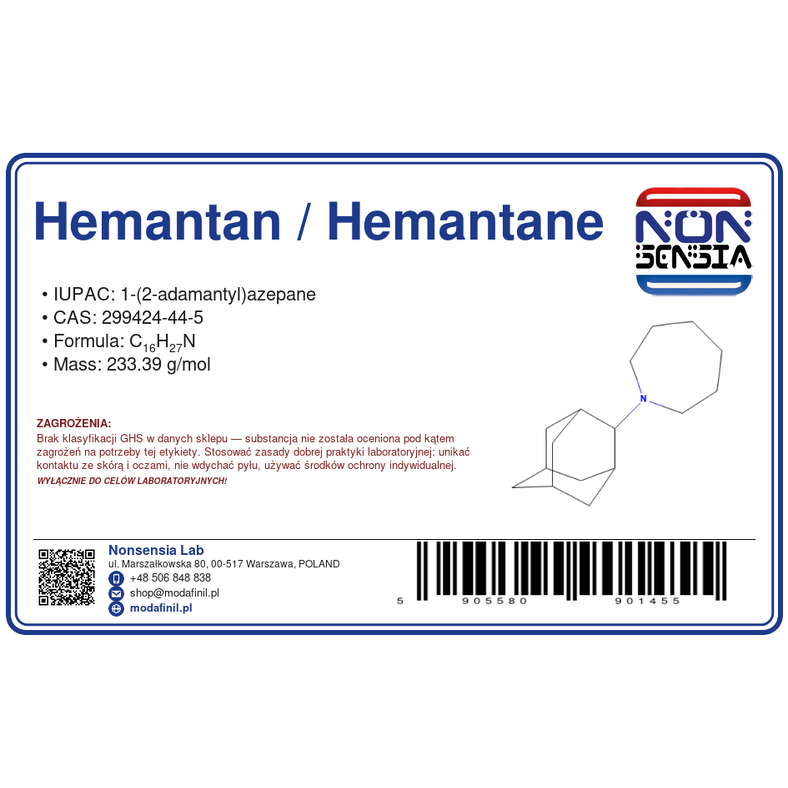
Hemantan / Hemantane• IUPAC: 1-(2-adamantyl)azepane• CAS: 299424-44-5• Formula:C16H27N• Mass: 233.39 g/molZAGROŻENIA:Brak klasyfikacji GHS w danych sklepu — substancja nie została oceniona pod kątemzagrożeń na potrzeby tej etykiety. Stosować zasady dobrej praktyki laboratoryjnej: unikaćkontaktu ze skórą i oczami, nie wdychać pyłu, używać środków ochrony indywidualnej.WYŁĄCZNIE DO CELÓW LABORATORYJNYCH!Nonsensia Labul. Marszałkowska 80, 00-517 Warszawa, POLAND+48 506 848 838shop@modafinil.plmodafinil.pl
🧪 Solution preparation assistant (Smart Prep)

Enter what you want to prepare — I'll generate an SOP

Examples below — click to insert:
Preset recipes:
📚 Scientific literature overview — CAS 299424-44-5
🔗 Citation network 5 seed papers
📊 Citation graph for CAS 299424-44-5. Każdy węzeł = praca naukowa, krawędź A→B = praca A cytuje B. Dane z OpenAlex (Priem 2022).

⚡ Fetch network data

Network built on-demand from the OpenAlex API (24h cache).

📚 Scientific references (Chicago Author-Date)
  1. Garfield, Eugene. 1972. "Citation Analysis as a Tool in Journal Evaluation." Science 178, no. 4060: 471–479. https://doi.org/10.1126/science.178.4060.471. [link ↗] — Praca założycielska analizy cytowań — fundament journal impact factor i citation networks
  2. Watts, Duncan J., and Steven H. Strogatz. 1998. "Collective Dynamics of "Small-World" Networks." Nature 393, no. 6684: 440–442. https://doi.org/10.1038/30918. [link ↗] — Small-world networks — fundament topologii grafów cytowań (krótkie ścieżki, wysokie clustering)
  3. Page, Lawrence, Sergey Brin, Rajeev Motwani, and Terry Winograd. 1999. "The PageRank Citation Ranking: Bringing Order to the Web." Stanford InfoLab Technical Report 1999-66. [link ↗] — PageRank jako uogólnienie analizy cytowań — eigenvector centrality dla rankingu węzłów grafu
  4. Newman, M. E. J.. 2003. "The Structure and Function of Complex Networks." SIAM Review 45, no. 2: 167–256. https://doi.org/10.1137/S003614450342480. [link ↗] — Przegląd struktury i funkcji sieci złożonych — degree distribution, centrality, community detection
  5. Newman, Mark E. J.. 2010. "Networks: An Introduction." Oxford: Oxford University Press. https://doi.org/10.1093/acprof:oso/9780199206650.001.0001. [link ↗] — Standardowy podręcznik network science — degree centrality, citation graphs, klasteryzacja
  6. van Eck, Nees Jan, and Ludo Waltman. 2014. "Visualizing Bibliometric Networks." In Measuring Scholarly Impact: Methods and Practice, edited by Y. Ding, R. Rousseau, and D. Wolfram, 285–320. Cham: Springer. https://doi.org/10.1007/978-3-319-10377-8_13. [link ↗] — Wizualizacja sieci bibliometrycznych (VOSviewer) — bezpośrednio relewantne dla widgetu vis.js
  7. Barabási, Albert-László. 2016. "Network Science." Cambridge: Cambridge University Press. [link ↗] — Współczesny podręcznik network science — scale-free networks, preferential attachment w cytowaniach
  8. Priem, Jason, Heather Piwowar, and Richard Orr. 2022. "OpenAlex: A Fully-Open Index of Scholarly Works, Authors, Venues, Institutions, and Concepts." arXiv preprint arXiv:2205.01833. https://doi.org/10.48550/arXiv.2205.01833. [link ↗] — Dokumentacja techniczna OpenAlex API — 250M+ scholarly works, CC0, źródło danych grafu cytowań
  9. OpenAlex. 2024. "OpenAlex Documentation: Works, Authors, Venues, Institutions, Concepts." OurResearch (technical docs). [link ↗] — Dokumentacja API używanego przez fetch_openalex_paper() — endpoint /works, mailto polite pool
  10. Crossref. 2024. "Crossref REST API Documentation." Crossref (technical docs). [link ↗] — Komplementarne API DOI/citation — alternatywne źródło danych dla referenced_works
📚 REFERENCES (Aggregate bibliography, Chicago Author-Date) 104 pozycji

Wszystkie źródła naukowe cytowane w akordeonach powyżej dla CAS 299424-44-5. Format: Chicago Manual of Style 17th ed., Author-Date system.

🗄️ Scientific databases

  1. NIST. 2026. NIST Chemistry WebBook: CAS 299424-44-5. Gaithersburg, MD: National Institute of Standards and Technology. https://webbook.nist.gov/cgi/cbook.cgi?ID=299424-44-5. (Accessed 2026-10-13.)
  2. AIST. 2026. Spectral Database for Organic Compounds (SDBS): CAS 299424-44-5. Tsukuba, Japan: National Institute of Advanced Industrial Science and Technology. https://sdbs.db.aist.go.jp/. (Accessed 2026-10-13.)
  3. PubChem. 2026. PubChem Compound Summary: CAS 299424-44-5. Bethesda, MD: National Center for Biotechnology Information (NCBI), National Library of Medicine. https://pubchem.ncbi.nlm.nih.gov/#query=299424-44-5. (Accessed 2026-10-13.)

📐 Standards / Guidelines

  1. ICH. 2026. "ICH Harmonised Guideline: CAS 299424-44-5." Geneva: International Council for Harmonisation. https://database.ich.org/sites/default/files/Q1A%28R2%29%20Guideline.pdf. (Accessed 2026-10-13.)
  2. National Fire Protection Association (NFPA). 2024. "NFPA 30: Flammable and Combustible Liquids Code." NFPA, Quincy, MA. https://www.nfpa.org/codes-and-standards/all-codes-and-standards/list-of-codes-and-standards/detail?code=30.
  3. Occupational Safety and Health Administration (OSHA). 2023. "29 CFR 1910.106 — Flammable Liquids." U.S. Department of Labor, Federal Register. https://www.osha.gov/laws-regs/regulations/standardnumber/1910/1910.106.
  4. European Chemicals Agency (ECHA). 2024. "Annex VI to Regulation (EC) No 1272/2008 (CLP) — Harmonised Classification and Labelling." ECHA, Helsinki / Official Journal of the European Union. https://echa.europa.eu/regulations/clp/clp-classification.
  5. European Committee for Standardization (CEN). 2016. "EN 374-1:2016 — Protective gloves against dangerous chemicals and micro-organisms — Part 1: Terminology and performance requirements for chemical risks." CEN, Brussels. https://standards.cencenelec.eu/dyn/www/f?p=205:110:::::FSP_PROJECT,FSP_ORG_ID:38536,6080&cs=1B0DAA8B85DF42E4A2C70E5D71F0BFA32.
  6. European Committee for Standardization (CEN). 2001. "EN 166:2001 — Personal eye-protection — Specifications." CEN, Brussels. https://standards.cencenelec.eu/dyn/www/f?p=CEN:110:0::::FSP_PROJECT:6541&cs=1F1A4E0A78C4DB6A28DBE2E8C29D89DCF.
  7. European Committee for Standardization (CEN). 2009. "EN 14605:2005+A1:2009 — Protective clothing against liquid chemicals — Performance requirements for clothing with liquid-tight (Type 3) or spray-tight (Type 4) connections." CEN, Brussels. https://standards.cencenelec.eu/dyn/www/f?p=CEN:110:0::::FSP_PROJECT:21581&cs=1A04A2D3C7CC58E9E6CB58D55F7EBFB7E.
  8. National Institute for Occupational Safety and Health (NIOSH). 2017. "Recommendations for Chemical Protective Clothing: A Companion to the NIOSH Pocket Guide." U.S. Department of Health & Human Services / CDC. https://www.cdc.gov/niosh/ncpc/default.html.
  9. Occupational Safety and Health Administration (OSHA). 2011. "Personal Protective Equipment — General requirements." U.S. Department of Labor — 29 CFR 1910.132. https://www.osha.gov/laws-regs/regulations/standardnumber/1910/1910.132.

📖 Books

  1. Hansen, Charles M. 2007. Hansen Solubility Parameters: A User's Handbook, 2nd ed.. Boca Raton, FL: CRC Press. https://www.routledge.com/Hansen-Solubility-Parameters-A-Users-Handbook/Hansen/p/book/9780849372483.
  2. Barton, Allan F. M. 1991. CRC Handbook of Solubility Parameters and Other Cohesion Parameters: 2nd ed.. Boca Raton, FL: CRC Press. https://www.routledge.com/CRC-Handbook-of-Solubility-Parameters-and-Other-Cohesion-Parameters/Barton/p/book/9780849301766.
  3. Connors, Kenneth A., Gordon L. Amidon, and Valentino J. Stella. 1986. Chemical Stability of Pharmaceuticals: A Handbook for Pharmacists, 2nd ed.. New York: Wiley. https://doi.org/10.1002/0471734683.
  4. Rumble, John R., ed. 2019. CRC Handbook of Chemistry and Physics: 100th Edition. Boca Raton, FL: CRC Press. https://hbcp.chemnetbase.com/.
  5. Urben, Peter G. 2017. Bretherick's Handbook of Reactive Chemical Hazards, 8th Edition. Academic Press / Elsevier, Oxford. https://www.sciencedirect.com/book/9780081010594.

📘 Monographs

  1. IARC. 2026. IARC Monographs on the Identification of Carcinogenic Hazards to Humans: CAS 299424-44-5. Lyon, France: International Agency for Research on Cancer, World Health Organization. (Accessed 2026-10-13.)

📄 Scientific articles (peer-reviewed)

  1. Stefanis, Emmanuel, and Costas Panayiotou. 2008. "Prediction of Hansen Solubility Parameters with a New Group-Contribution Method." International Journal of Thermophysics 29: 568-585. https://doi.org/10.1007/s10765-008-0415-z.
  2. Stoll, Vincent S., and John S. Blanchard. 1990. "Buffers: Principles and Practice: In Methods in Enzymology, vol. 182." San Diego: Academic Press. https://doi.org/10.1016/0076-6879(90)82008-P.

🌐 Websites

  1. ECHA. 2023. "Guidance on the Application of the CLP Criteria." European Chemicals Agency. https://echa.europa.eu/guidance-documents/guidance-on-clp.
  2. European Parliament. 2006. "Regulation (EC) No 1907/2006 (REACH)." Official Journal of the European Union L 396: 1–849.
  3. ECHA. 2023. "Candidate List of Substances of Very High Concern for Authorisation." European Chemicals Agency. https://echa.europa.eu/candidate-list-table.
  4. European Parliament. 2008. "Regulation (EC) No 1272/2008 on Classification, Labelling and Packaging of Substances and Mixtures (CLP)." Official Journal of the European Union L 353: 1–1355.
  5. ECHA. 2017. "Guidance on the Compilation of Safety Data Sheets." Version 3.1. European Chemicals Agency. ECHA-17-G-01-EN. https://echa.europa.eu/documents/10162/23047722/sds_en.pdf.
  6. ECHA. 2022. "Restrictions Under REACH — Annex XVII." European Chemicals Agency. https://echa.europa.eu/substances-restricted-under-reach.
  7. United Nations. 2021. Globally Harmonized System of Classification and Labelling of Chemicals (GHS). 9th revised ed. ST/SG/AC.10/30/Rev.9. New York and Geneva: United Nations. https://unece.org/ghs-rev9-2021.
  8. ECHA. 2020. "Understanding REACH." European Chemicals Agency. https://echa.europa.eu/regulations/reach/understanding-reach.
  9. Snyder, Lloyd R., John W. Dolan, and Joseph J. Kirkland. 2010. Introduction to Modern Liquid Chromatography. Wiley.
  10. Schoenmakers, Peter J.. 1986. Optimization of Chromatographic Selectivity: A Guide to Method Development. Elsevier.
  11. Snyder, L. R., and J. W. Dolan. 2007. High-Performance Gradient Elution: The Practical Application of the Linear-Solvent-Strength Model. Wiley.
  12. Nikitas, Pavlos, and Adrian Pappa-Louisi. 2009. "Retention models for isocratic and gradient elution in reversed-phase liquid chromatography." Journal of Chromatography A 1216: 1737-1755. https://doi.org/10.1016/j.chroma.2008.10.005.
  13. Carr, Peter W.. 2009. "The new physical chemistry of HPLC." Journal of Chromatography A 1216: 1764-1772. https://doi.org/10.1016/j.chroma.2008.11.094.
  14. Dong, Michael W.. 2019. HPLC and UHPLC for Practicing Scientists. Wiley. https://doi.org/10.1002/9781119313793.
  15. Wu, Naijun, and Anton M. Clausen. 2007. "Fundamental and practical aspects of ultrahigh pressure liquid chromatography for fast separations." Journal of Separation Science 30: 1167-1182. https://doi.org/10.1002/jssc.200700026.
  16. Dolan, John W.. 2013. "When to Modify Method Conditions." LCGC North America 31: 192-199. https://www.chromatographyonline.com/view/when-modify-method-conditions.
  17. Meyer, Veronika R.. 2010. Practical High-Performance Liquid Chromatography. Wiley.
  18. Engelhardt, Heinz. 2014. 100 Years of Chromatography. Wiley-VCH.
  19. Vivó-Truyols, Gabriel, and Hans-Gerd Janssen. 2010. "Probabilistic approach to peak deconvolution in chromatography." Analytical Chemistry 82: 8525-8531. https://doi.org/10.1021/ac101742z.
  20. Van Deemter, J. J., F. J. Zuiderweg, and A. Klinkenberg. 1956. "Longitudinal diffusion and resistance to mass transfer as causes of nonideality in chromatography." https://doi.org/10.1016/0009-2509(56)80003-1.
  21. Giddings, J. Calvin. 1965. "Dynamics of Chromatography, Part I: Principles and Theory." Marcel Dekker.
  22. Poppe, Hans. 1997. "Some reflections on speed and efficiency of modern chromatographic methods." https://doi.org/10.1016/S0021-9673(97)00376-2.
  23. Wu, Naijun, and Anton M. Clausen. 2007. "Fundamental and practical aspects of ultrahigh pressure liquid chromatography for fast separations." https://doi.org/10.1002/jssc.200700026.
  24. Carr, Peter W.. 2009. "The new physical chemistry of HPLC." https://doi.org/10.1016/j.chroma.2008.11.094.
  25. Knox, John H.. 1977. "Practical aspects of LC theory." https://doi.org/10.1093/chromsci/15.9.352.
  26. Snyder, L. R., J. J. Kirkland, and J. L. Glajch. 1997. "Practical HPLC Method Development." Wiley.
  27. Vivó-Truyols, Gabriel, and Hans-Gerd Janssen. 2010. "Probabilistic approach to peak deconvolution in chromatography." https://doi.org/10.1021/ac101742z.
  28. Sadek, Paul C.. 2002. "The HPLC Solvent Guide." Wiley-Interscience.
  29. Snyder, L. R.. 1978. "Classification of the solvent properties of common liquids." https://doi.org/10.1093/chromsci/16.6.223.
  30. Reichardt, Christian, and Thomas Welton. 2010. "Solvents and Solvent Effects in Organic Chemistry." Wiley-VCH.
  31. Vailaya, Anant, and Csaba Horváth. 1998. "Retention thermodynamics in hydrophobic interaction chromatography." https://doi.org/10.1021/ie980212h.
  32. Krstulović, Andrea M., and Phyllis R. Brown. 1981. "Reversed-phase High-Performance Liquid Chromatography." Wiley.
  33. Boysen, Reinhard I., and Milton T. W. Hearn. 2009. "Multi-modal HPLC of proteins." https://doi.org/10.1093/chromsci/47.8.645.
  34. USP General Chapter <621>. 2024. "Chromatography." United States Pharmacopeial Convention. https://www.usp.org/harmonization-standards/pdg/general-chapters/chromatography.
  35. Foley, Joe P., and John G. Dorsey. 1983. "Equations for calculation of chromatographic figures of merit for ideal and skewed peaks." https://doi.org/10.1021/ac00255a033.
  36. Snyder, Lloyd R., Joseph J. Kirkland, and John W. Dolan. 2010. "Introduction to Modern Liquid Chromatography." Wiley. https://doi.org/10.1002/9780470508183.
  37. Dolan, John W.. 2003. "Peak tailing and resolution." https://www.chromatographyonline.com/view/peak-tailing-and-resolution.
  38. Kromidas, Stavros. 2017. "HPLC Made to Measure: A Practical Handbook for Optimization." Wiley-VCH.
  39. Heyden, Yvan Vander, et al.. 2009. "Robustness of pharmaceutical liquid chromatographic methods." https://doi.org/10.1016/j.jchromb.2008.10.052.
  40. United States Pharmacopeial Convention. 2024. "USP <621> Chromatography." In United States Pharmacopeia and National Formulary, USP 47-NF 42. Rockville, MD: USP. https://www.uspnf.com/.
  41. European Pharmacopoeia Commission. 2024. "2.2.46 Chromatographic Separation Techniques." In European Pharmacopoeia, 11th ed. Strasbourg: Council of Europe — EDQM. https://www.edqm.eu/en/european-pharmacopoeia-ph-eur-11th-edition.
  42. International Organization for Standardization. 2017. "ISO/IEC 17025:2017 General Requirements for the Competence of Testing and Calibration Laboratories." Geneva: ISO. https://www.iso.org/standard/66912.html.
  43. Kolthoff, Izaak Maurits, and Philip J. Elving, eds. 1978. Treatise on Analytical Chemistry, Part I: Theory and Practice. 2nd ed. New York: Wiley-Interscience.
  44. Skoog, Douglas A., F. James Holler, and Stanley R. Crouch. 2018. Principles of Instrumental Analysis. 7th ed. Boston: Cengage Learning.
  45. Christian, Gary D., Purnendu K. Dasgupta, and Kevin A. Schug. 2014. Analytical Chemistry. 7th ed. Hoboken, NJ: Wiley.
  46. EURACHEM/CITAC. 2012. "Quantifying Uncertainty in Analytical Measurement." 3rd ed. EURACHEM/CITAC Guide CG 4. https://www.eurachem.org/images/stories/Guides/pdf/QUAM2012_P1.pdf.
  47. Snyder, Lloyd R., Joseph J. Kirkland, and John W. Dolan. 2010. "Introduction to Modern Liquid Chromatography." John Wiley & Sons. https://doi.org/10.1002/9780470508183.
  48. Dolan, John W.. 2003. "How much resolution is enough?." https://www.chromatographyonline.com/view/how-much-resolution-enough.
  49. USP General Chapter <621>. 2024. "Chromatography (System Suitability section)." United States Pharmacopeial Convention. https://www.usp.org/harmonization-standards/pdg/general-chapters/chromatography.
  50. U.S. FDA. 2026. "FDA Guidance and Resources: CAS 299424-44-5." Silver Spring, MD: U.S. Food and Drug Administration. https://www.fda.gov/media/74954/download. (Accessed 2026-10-13.)
  51. Rozet, Eric, et al.. 2013. "Analysis of recent pharmaceutical regulatory documents on analytical method validation." https://doi.org/10.1016/j.chroma.2007.03.111.
  52. European Medicines Agency (EMA). 2011. "Guideline on bioanalytical method validation EMEA/CHMP/EWP/192217/2009." EMA. https://www.ema.europa.eu/en/documents/scientific-guideline/guideline-bioanalytical-method-validation_en.pdf.
  53. Kazakevich, Yuri V., and Rosario LoBrutto, eds.. 2007. "HPLC for Pharmaceutical Scientists." Wiley-Interscience. https://doi.org/10.1002/9780470087954.
  54. AOAC International. 2016. "Appendix F: Guidelines for Standard Method Performance Requirements." AOAC INTERNATIONAL. https://www.aoac.org/wp-content/uploads/2019/08/app_f.pdf.
  55. International Organization for Standardization. 1994. "ISO 5725-2:1994 Accuracy (Trueness and Precision) of Measurement Methods and Results — Part 2: Basic Method for the Determination of Repeatability and Reproducibility of a Standard Measurement Method." Geneva: ISO. https://www.iso.org/standard/11834.html.
  56. Grubbs, Frank E. 1950. "Sample Criteria for Testing Outlying Observations." Annals of Mathematical Statistics 21 (1): 27–58.
  57. Dixon, Wilfrid J. 1950. "Analysis of Extreme Values." Annals of Mathematical Statistics 21 (4): 488–506.
  58. Snedecor, George W., and William G. Cochran. 1989. Statistical Methods. 8th ed. Ames, IA: Iowa State University Press.
  59. Student [William Sealy Gosset]. 1908. "The Probable Error of a Mean." Biometrika 6 (1): 1–25.
  60. International Organization for Standardization. 2005. "ISO 3534-1:2006 Statistics — Vocabulary and Symbols — Part 1: General Statistical Terms and Terms Used in Probability." Geneva: ISO. https://www.iso.org/standard/40145.html.
  61. Thompson, Michael, Stephen L. R. Ellison, and Roger Wood. 2002. "Harmonized Guidelines for Single-Laboratory Validation of Methods of Analysis." Pure and Applied Chemistry 74 (5): 835–855.
  62. United Nations Economic Commission for Europe. 2023. European Agreement Concerning the International Carriage of Dangerous Goods by Road (ADR). Geneva: UNECE. https://unece.org/transport/dangerous-goods/adr-2023-edition.
  63. International Air Transport Association. 2024. Dangerous Goods Regulations (DGR). 65th ed. Montreal: IATA. https://www.iata.org/en/programs/cargo/dgr/.
  64. International Maritime Organization. 2022. International Maritime Dangerous Goods (IMDG) Code, 2022 Edition (Amendment 41-22). London: IMO. https://www.imo.org/en/OurWork/Safety/Pages/DangerousGoods-default.aspx.
  65. United Nations. 2023. Recommendations on the Transport of Dangerous Goods: Model Regulations (Orange Book). 23rd revised ed. ST/SG/AC.10/1/Rev.23. New York and Geneva: United Nations. https://unece.org/transport/dangerous-goods/un-model-regulations.
  66. International Civil Aviation Organization. 2023. Technical Instructions for the Safe Transport of Dangerous Goods by Air (Doc 9284). 2023–2024 ed. Montreal: ICAO. https://www.icao.int/safety/DangerousGoods/Pages/technical-instructions.aspx.
  67. United States Pharmacopeia (USP) Convention. 2024. "USP General Chapter <621> Chromatography." USP. https://www.usp.org/sites/default/files/usp/document/harmonization/gen-chapter/g05_pf_30_4_2004.pdf.
  68. European Medicines Agency (EMA). 2011. "Guideline on bioanalytical method validation EMEA/CHMP/EWP/192217/2009." EMA Committee for Medicinal Products for Human Use. https://www.ema.europa.eu/en/documents/scientific-guideline/guideline-bioanalytical-method-validation_en.pdf.
  69. European Union. 2026. "EUR-Lex Legal Database: CAS 299424-44-5." Luxembourg: Publications Office of the European Union. https://eur-lex.europa.eu/legal-content/EN/TXT/?uri=CELEX:32014D0955. (Accessed 2026-10-13.)
  70. Sejm RP. 2026. "Internetowy System Aktow Prawnych (ISAP): CAS 299424-44-5." Warszawa: Kancelaria Sejmu Rzeczypospolitej Polskiej. https://isap.sejm.gov.pl/isap.nsf/DocDetails.xsp?id=WDU20200000010. (Accessed 2026-10-13.)
  71. Ministerstwo Klimatu i Srodowiska. 2026. "Baza Danych o Odpadach (BDO): CAS 299424-44-5." Warszawa: Ministerstwo Klimatu i Srodowiska. https://bdo.mos.gov.pl/. (Accessed 2026-10-13.)
  72. Pohanish, Richard P.. 2017. "Sittig's Handbook of Toxic and Hazardous Chemicals and Carcinogens." Elsevier.
  73. Lewis, Richard J.. 2012. "Sax's Dangerous Properties of Industrial Materials." Wiley.
  74. NIOSH. 2024. "Pocket Guide to Chemical Hazards." U.S. Department of Health and Human Services. https://www.cdc.gov/niosh/npg/.
  75. U.S. OSHA. 2026. "Occupational Safety and Health Guidance: CAS 299424-44-5." Washington, DC: U.S. Occupational Safety and Health Administration. https://www.osha.gov/chemicaldata. (Accessed 2026-10-13.)
  76. United Nations Economic Commission for Europe (UNECE). 2023. "European Agreement concerning the International Carriage of Dangerous Goods by Road (ADR 2023)." UNECE. https://unece.org/transport/standards/transport/dangerous-goods/adr-2023.
  77. IPCS INCHEM. 2024. "International Programme on Chemical Safety — Waste Management Guidelines." WHO/UNEP/ILO. https://www.inchem.org/.
  78. International Organization for Standardization. 2017. "ISO/IEC 17025:2017 General requirements for the competence of testing and calibration laboratories." ISO. https://www.iso.org/standard/66912.html.
  79. World Health Organization. 2010. "WHO Good Manufacturing Practices for Pharmaceutical Products: Main Principles (WHO Technical Report Series No. 957, Annex 3)." WHO Press. https://www.who.int/publications/m/item/trs957-annex3.
  80. European Medicines Agency. 2014. "Guideline on Process Validation for Finished Products — Information and Data to Be Provided EMA/CHMP/CVMP/QWP/BWP/70278/2012." European Medicines Agency. https://www.ema.europa.eu/en/documents/scientific-guideline/guideline-process-validation-finished-products-information-data-be-provided-regulatory-submissions-revision-1_en.pdf.
  81. United States Pharmacopeial Convention. 2024. "United States Pharmacopeia and National Formulary, USP 47-NF 42." USP. https://www.uspnf.com/.
  82. European Pharmacopoeia Commission. 2024. "European Pharmacopoeia 11th Edition." Council of Europe — EDQM. https://www.edqm.eu/en/european-pharmacopoeia-ph-eur-11th-edition.
  83. Pharmaceutical Inspection Co-operation Scheme (PIC/S). 2021. "Guide to Good Manufacturing Practice for Medicinal Products PE 009-15." PIC/S Secretariat, Geneva. https://picscheme.org/en/publications.
  84. International Pharmaceutical Excipients Council (IPEC) and Pharmaceutical Quality Group (PQG). 2017. "Joint IPEC-PQG Good Manufacturing Practices Guide for Pharmaceutical Excipients." IPEC-Americas. https://ipecamericas.org/sites/default/files/IPECPQGGMPGuide2017.pdf.
📥 Download BibTeX📥 Download RISImport into Zotero/Mendeley/EndNote/Papers.
⚗️ Loading substance information…
Description

1-(2-adamantyl)azepane (systematic name per PubChem; older form: N-(2-adamantyl)hexamethyleneimine), crystalline powder, 1000 mg package. Material intended exclusively for laboratory and analytical in vitro research. Not for human or animal consumption, not a medicinal product, dietary supplement, food, or cosmetic.

Three different entities that must not be confused

For this molecule, separating the layers is especially important, because hemantane (himantane) was in Russia the subject not only of preclinical research but also of at least one published study involving patients. This does not, however, make it a medicinal product within the meaning of pharmaceutical law — the table below separates these layers explicitly:

Separating the layers: substance — clinically tested preparation — reagent
Entity What it is Status of hemantane
Chemical substance
hemantane, CAS 299424-44-5
Chemical concept — a molecule of defined structure, registered in PubChem (CID 9838302) and in the MeSH thesaurus of the U.S. National Library of Medicine (C122112). yes — this is the only entity this listing concerns
Clinically tested preparation
himantane, formerly code A-7
Material administered to laboratory animals in preclinical studies and — in one published open-label study from 2008 — to patients with Parkinson’s disease, under clinical trial conditions. this is not a registered medicinal product. In the databases searched (PubMed, PubChem) no evidence was found of registration under any trade name or of marketing authorization in any country — unlike, for example, bromantane, registered in Russia as Ladasten
Chemical reagent
material offered here
Material for laboratory and analytical work. Does not have, and cannot have, authorization for use in humans or animals — it has no pharmaceutical form or medicinal product documentation. analytics, chemistry, reference standards

The consequence is unambiguous. The study results cited further on this page come either from preclinical studies on laboratory animals, or from a single published clinical study in which patients were given an investigational preparation — not the analytical reagent sold on this page. None of these studies was conducted using the material offered in this shop, and the 2008 investigational preparation is not a commercially available medicine — it is a scientific publication describing a one-off clinical study, not a pharmaceutical offering. None of these results carries over to the offered reagent and none can be a basis for its use outside the laboratory.

Reagent identification card

Registration data and identifiers — hemantane
Systematic name (IUPAC, PubChem) 1-(2-adamantyl)azepane
Older systematic name (MeSH) N-(2-adamantyl)hexamethyleneimine
Common name hemantan, hemantane, himantan / himantane, hymantane
Early laboratory code A-7
CAS Number 299424-44-5
Molecular formula C16H27N
Molar mass 233.39 g·mol−1
Monoisotopic mass 233.2143 Da
InChIKey JAROVUWOMYMQCW-UHFFFAOYSA-N
SMILES C1CCCN(CC1)C2C3CC4CC(C3)CC2C4
PubChem CID 9838302
MeSH (Supplementary Concept) C122112
Form white to off-white crystalline powder
Purity ≥ 98% (HPLC)
Intended use research reagent — not for human or animal consumption

Note on the CAS number. Number 299424-44-5 comes from this product’s documentation. Neither PubChem (CID 9838302) nor the MeSH record (C122112, entry “N-(2-adamantyl)hexamethylenimine”) assigns this molecule a CAS number as a verified synonym in their own databases — both identify the compound by systematic name and structure, consistent with the data in the table above (C16H27N, approx. 233.4 g/mol). We state this directly rather than passing over it in silence: structural identity is independently confirmed in two NIH databases, whereas the CAS number itself could not be confirmed in those same sources.

The molecule’s lineage: the second branch of the Moscow 2-aminoadamantane program

Hemantane is not a random research molecule — it is the second, lesser-known branch of the same medicinal chemistry line from which bromantane, offered in our catalog, is derived. Both molecules share a common core: the 2-adamantyl substituent, i.e., an adamantane cage attached to the nitrogen atom at position 2, rather than at the bridgehead position 1 (as in amantadine or memantine). They differ in their substituents: bromantane carries a 4-bromophenyl ring, hemantane — a seven-membered azepane ring (older name: hexamethyleneimine).

Early work designated the molecule with the laboratory code A-7 — this is how it appears in publications from 2000–2001, including the classic electrophysiological paper by Sobolevsky and Yelshansky in The Journal of Physiology, describing the mechanism of NMDA channel block using the patch-clamp method. This is one of the few papers from that period to reach the international, English-language peer-reviewed literature rather than only Russian journals.

Later work was carried out at the V.V. Zakusov Institute of Pharmacology in Moscow — the same center bromantane comes from. Among the authors, the name Sergei Seredenin recurs; he led the team responsible for the first indexed bromantane paper from 1999, and for hemantane he appears as a co-author of a 2017 paper on the compound’s effect on ethanol consumption. This is no coincidence — both molecules originate from the same research program, despite different goals: bromantane was developed as an actoprotector, hemantane — as a potential anti-Parkinson’s agent acting via NMDA channel block.

Timeline

Timeline: hemantane research in the PubMed-indexed literature
2000 first indexed papers under the code A-7: a behavioral study with subchronic administration [1] and an independent electrophysiological paper in The Journal of Physiology, describing the mechanism of “trapping” NMDA channel block [2]
2001 evaluation of the effect on NMDA receptor ion channels by the patch-clamp method, IC50 in the low tens of µM [3]; first studies on immunotropic activity [4] and the effect on striatal monoamine levels by microdialysis [5]
2003 distribution of isotopically labeled ³H-himantane in brain and thymus structures [6]; evaluation of the effect on MAO activity [7]; study of the effect on rat embryo development [8]
2004 evaluation of neuroprotective action in an MPTP neurotoxicity model [9]; study of the effect on reproductive function and gonad morphology [10]
2007 mechanism of dopamine reuptake in rat striatum ex vivo [11]
2008 publication describing an open-label clinical study involving patients with Parkinson’s disease [12]; effect on the dopamine transporter DAT protein in striatum and cell culture [13]
2010–2012 evaluation of the effect on brain dopamine and serotonin receptors with subchronic administration [14]; pharmacokinetics in rats [15], absolute bioavailability in rabbits [16], and excretion in urine and feces [17] — a full pharmacokinetic profile in animal models
2012–2019 models of the early (premotor) stage of Parkinson’s disease [18], levodopa-induced dyskinesia [19] and hemiparkinsonian syndrome [20], cytoprotective action against the neurotoxin 6-hydroxydopamine [21], reduction of ethanol consumption [22], and alleviation of morphine withdrawal syndrome [23]
2023–2024 a topical anti-inflammatory formulation in an arthritis model [24], TRPV1-channel-dependent analgesic mechanisms [25], and EEG recording in a Parkinson’s disease model [26]

Research centers

The literature on hemantane is, as with bromantane, almost exclusively Russian, with the exception of papers reaching international English-language journals (The Journal of Physiology, Bulletin of Experimental Biology and Medicine, Advanced Pharmaceutical Bulletin) — which matters when verifying source data.

  • Institute of General Pathology and Pathophysiology (Moscow) — the center responsible for the early electrophysiological characterization of the NMDA channel using patch-clamp [2][3] and for the striatal monoamine microdialysis studies [5].
  • V.V. Zakusov Institute of Pharmacology (Moscow) — the same center bromantane comes from. Most of the later work originates here: pharmacokinetics and bioavailability [15][16][17], Parkinson’s disease and neuroprotection models [9][18][19][20][21], addiction research [22][23], and the most recent papers from 2023–2024 [24][25][26].

Disclaimer for the entire section above and for the Timeline. This describes the history of scientific research from 2000–2024. Preclinical studies were conducted on laboratory animals, and the only study involving humans that was found [12] was an open-label clinical study using an investigational preparation, not a registered medicine. This is not a description of the properties of the offered material, does not constitute information on its use, and cannot be a basis for any use outside the laboratory. The offered reagent is not a medicinal product and must not be used in humans or animals.

Chemistry and what it means for the laboratory

The same core as bromantane, a different substituent

The similarity to bromantane does not end with the adamantane cage. Both molecules carry a substituent attached at position 2 of adamantane — rather than at the bridgehead position 1, as in amantadine or memantine — which has a direct structural consequence: substitution at position 2 does not generate a classical stereogenic center, owing to the local symmetry of the cage. As with bromantane, the material does not require enantiomer separation, which simplifies qualification as an analytical standard.

The difference lies in what is attached to the nitrogen. In bromantane it is an aromatic ring (4-bromophenyl); in hemantane — a saturated, seven-membered azepane ring. The nitrogen in this arrangement is tertiary: it carries no hydrogen atom, as can be seen in the computed descriptors below.

Physicochemical characteristics

Computed descriptors and their analytical significance
Parameter Value What it means
Partition coefficient (XLogP) ≈ 3.9 high lipophilicity — elutes late in reversed-phase chromatography
Topological polar surface area (TPSA) 3.2 Å2 extremely low — lower than in bromantane (12 Å2); typical of a tertiary hydrocarbon amine with no polar groups
Hydrogen bond donors 0 no N–H — tertiary nitrogen in the azepane ring
Hydrogen bond acceptors 1 only the lone electron pair on nitrogen
Rotatable bonds 1 rigid molecule — two rings connected by a single C–N bond
Heavy atoms 17 —

Lipophilicity and solubility. The extremely low TPSA and absence of hydrogen bond donors mean that the free base of hemantane has minimal capacity to dissolve in water and dissolves well in organic solvents (DMSO, chloroform, ethanol). It is no coincidence that the MeSH thesaurus lists, alongside the molecule itself, a separate entry for its hydrochloride — the salt form in which the compound was administered to laboratory animals in the studies cited below, since it facilitates the preparation of aqueous solutions for injection. For analytical purposes (HPLC, LC-MS), stock solutions of the free base are prepared in an organic solvent.

No isotope signature. Unlike bromantane — where the bromine atom produces a characteristic pair of peaks in the mass spectrum — hemantane contains only carbon, hydrogen, and nitrogen, elements that are practically monoisotopic in the typical mass range. Identification by mass spectrometry therefore relies on exact molecular mass and retention time, not on an isotope pattern.

Mechanism described in the literature. Electrophysiologically, hemantane has been characterized as a non-competitive, “trapping” (trapping) NMDA channel blocker — using the patch-clamp method on rat hippocampal neurons, with an IC50 in the low tens of micromolar range [2][3]. This is the same general type of block described for amantadine and memantine, on a different structural core. Later work also linked hemantane’s action to the dopaminergic system (DAT transporter [11][13], dopamine receptors [14]) and to MAO-B activity [7].

Nomenclature and synonyms

  • Hemantan / Hemantane — the most common form in the English-language literature after 2007;
  • Himantan / Himantane and Hymantane — transliteration variants from Cyrillic, dominant in publications from 2000–2004; the same compound, not a different salt or analog;
  • Gimantan — a name found in reagent suppliers’ commercial materials; not found in the PubMed or PubChem searches performed, so we treat it as an unconfirmed trade-name variant rather than a separately verified identifier;
  • A-7 — the laboratory code from the first publications (2000–2001);
  • N-(2-adamantyl)hexamethyleneimine — the older systematic name, used in the MeSH thesaurus; its hydrochloride is the salt form in which the compound was tested in animals;
  • 1-(2-adamantyl)azepane — the current IUPAC systematic name per PubChem, the only one unambiguous regardless of bibliographic context.

The transliteration discrepancy has a bibliographic consequence: searching databases only under the term “hemantane” misses a significant part of the earlier literature, indexed under “himantane” or “hymantane”. When querying, it is worth combining all variants.

Laboratory use of the reagent

  • reference material for confirming identity and purity by HPLC-UV;
  • standard for LC-MS and GC-MS methods — chromatographic techniques coupled with mass spectrometry were used in the cited pharmacokinetic, bioavailability, and excretion studies [15][16][17];
  • model compound in electrophysiology of NMDA receptor ion channels (patch-clamp technique), as an example of a “trapping”-type blocker [2][3];
  • comparative material in the chemistry of adamantane derivatives — structural contrast with bromantane: the same 2-adamantyl substituent, a different amine fragment (azepane ring instead of 4-bromophenyl);
  • standard for work with isotopically labeled compounds — ³H-himantane was used in the tissue distribution studies [6].

Storage, handling, and work safety

Store in the original, tightly closed packaging, in a dry and cool place, protected from light, separately from food and feed and out of the reach of children. Work only under laboratory conditions, using personal protective equipment: gloves, safety goggles, and laboratory clothing; weigh the powder under conditions that limit dust generation. Avoid inhaling dust and contact with skin and eyes. Handle waste in accordance with the regulations applicable to chemical waste at the site where the research is conducted.

Note on safety data. The literature contains preclinical studies of hemantane’s effect on embryonic development and gonad morphology in laboratory animals [8][10], which in itself signals a need for caution rather than removing it. This is not a complete toxicological profile — the data concerning the reagent in the form offered on this page are incomplete. The absence of documented hazard is not equivalent to the absence of hazard; the material should be handled with the caution appropriate for a substance with an unestablished human safety profile.

Regulatory status

In the databases searched (PubMed, PubChem) no evidence was found of hemantane’s registration as a medicinal product under any trade name, nor of marketing authorization in any country. One publication was found describing an open-label clinical study involving patients with Parkinson’s disease [12] — this is a record of a scientific study, not information on drug availability. The legal status of substances of this type can be subject to changes in national law — the buyer is responsible for verifying the legal status in the destination country before ordering. The offered material is a chemical reagent and has no authorization for any use in humans or animals.

Frequently Asked Questions

What is the difference between hemantane and bromantane?

Both have the same core — the 2-adamantyl substituent — and come from the same research center (V.V. Zakusov Institute of Pharmacology, Moscow). They differ in the amine fragment: bromantane carries a 4-bromophenyl ring, hemantane — a saturated azepane ring. The research programs under which they were developed also differ: bromantane as an actoprotector, hemantane as a potential anti-Parkinson’s agent.

Is hemantane (himantane) a registered medicine?

No evidence of this was found in the databases searched. One published open-label clinical study from 2008 was found, in which an investigational preparation was given to patients with Parkinson’s disease — this, however, is a scientific publication describing a study, not information about registration or market availability of a drug, and it is not what this page sells.

What is the chemical formula and molar mass of hemantane?

C16H27N; molar mass 233.39 g·mol−1 (PubChem), monoisotopic mass 233.2143 Da. InChIKey JAROVUWOMYMQCW-UHFFFAOYSA-N.

Is CAS number 299424-44-5 confirmed in scientific databases?

It comes from this product’s documentation. Neither PubChem nor MeSH assigns it to this molecule as a verified synonym — both databases confirm the compound’s identity through its systematic name and structure (consistent with the data in the identification card), not through this number. We state this directly so as not to imply a verification that could not be performed.

Are “Gimantan” and “hemantane” the same compound?

Probably yes — this is a name found in reagent suppliers’ commercial materials, pointing to the same molecule. However, it was not found in the PubMed or PubChem searches performed, so we treat it as an unconfirmed name variant rather than an independently verified identifier.

Is the reagent suitable for uses other than laboratory use?

No. The material is intended exclusively for laboratory and analytical research, not for human or animal consumption, is not a medicine, dietary supplement, food, or cosmetic, and cannot be used for medical, diagnostic, or consumption purposes.

How should hemantane be stored as a laboratory reagent?

In the original, tightly closed packaging, in a dry and cool place, protected from light, separately from food and feed and out of the reach of children.

What does hemantane dissolve in?

The free base dissolves well in organic solvents (DMSO, chloroform, ethanol), poorly in water — with XLogP ≈ 3.9 and an extremely low TPSA (3.2 Ų), stock solutions are prepared in an organic solvent. Animal studies used the hydrochloride form, which facilitates the preparation of aqueous solutions.

Does hemantane require enantiomer separation?

No. As with bromantane, substitution at position 2 of the adamantane cage does not generate a classical stereogenic center — the material does not require enantiomer separation.

What mechanism of action has been described for hemantane in preclinical studies?

Electrophysiologically, it has been characterized as a non-competitive, “trapping” NMDA channel blocker — the same general type of block described for amantadine and memantine. Later work also linked its action to the dopaminergic system and to monoamine oxidase type B activity. This description concerns only the history of scientific research, not the properties of the offered reagent.

Is a safety data sheet included with hemantane?

We provide the safety data sheet on request. Toxicological data for this molecule are incomplete — only selected preclinical studies are available (including the effect on embryonic development in animals); the material should be handled with the caution appropriate for a substance with an unestablished human safety profile.

How many scientific publications concern hemantane?

In the PubMed database under the terms hemantane/himantane/hymantane (as of September 2026), 38 records from 2000–2024 were found. In the Bibliography section below we cite 26 items covering the full thematic and chronological range of this set.

Bibliography

The items below come from the PubMed database (search under the terms hemantane / himantane / hymantane, 38 records in total, as of September 2026) and concern the history of research on the molecule. All items except [12] are preclinical studies in laboratory animals or in vitro studies. Item [12] is the only study involving humans that was found, conducted as an open-label clinical study using an investigational preparation — not using a chemical reagent. The whole list is cited as historical-scientific context and a bibliographic reference, not as information about the use of the offered material nor as an encouragement for any use.

  1. Val’dman EA (2000). Pharmacological activity of the new adamantane derivative — potential antiparkinson preparation during subchronic administration. Eksp Klin Farmakol. PMID 11109514.
  2. Sobolevsky AI, Yelshansky MV (2000). The trapping block of NMDA receptor channels in acutely isolated rat hippocampal neurones. J Physiol. PMID 10922002. doi:10.1111/j.1469-7793.2000.t01-2-00493.x.
  3. Elshanskaia MV, Sobolevskii AI, Val’dman EA et al. (2001). Effect of the potential antiparkinsonian agent adamantane derivative on ion channels of NMDA glutamate receptors. Eksp Klin Farmakol. PMID 11544796.
  4. Nezhinskaia GI, Val’dman EA, Nazarov PG (2001). Immunotropic activity of a potential antiparkinson agent himantane. Eksp Klin Farmakol. PMID 11548451.
  5. Andiarzhanova EA, Val’dman EA, Kudrin VS et al. (2001). Effect of the new potential anti-Parkinson agent, hymantane, on levels of monoamines and their metabolites in rat striatum (a microdialysis study). Eksp Klin Farmakol. PMID 11871228.
  6. Kovalev GI, Rodionov AP, Petrenko ES et al. (2003). Comparative study of the distribution of 3[H]-himantane in the brain structures and the thymus of rats. Eksp Klin Farmakol. PMID 12924235.
  7. Val’dman EA, Voronina TA, Aksenova LN et al. (2003). Effect of a new antiparkinsonian drug himantane on monoamine oxidase activity. Eksp Klin Farmakol. PMID 14650204.
  8. Durnev AD, Smol’nikova NM, Nemova EP et al. (2003). Effect of himantane on the rat embryo development. Eksp Klin Farmakol. PMID 14743708.
  9. Val’dman EA, Nerobkova LN, Voronina TA et al. (2004). Estimation of the protective effect of the novel potential antiparkinsonian agent himantane against MPTP neurotoxicity. Eksp Klin Farmakol. PMID 15079899.
  10. Smol’nikova NM, Nemova EP, Sorokina AV et al. (2004). The effect of hemantane on the generative function and gonad morphology in rats. Eksp Klin Farmakol. PMID 15707015.
  11. Abaimov DA, Kovalev GI (2007). The acute and subchronic effects of hemantane on [3H]-dopamine reuptake in rat striatal synaptosomes ex vivo. Eksp Klin Farmakol. PMID 18078034.
  12. Katunina EA, Petrukhova AV, Avakian GN et al. (2008). The possibilities of using himantane in the treatment of Parkinson’s disease. Zh Nevrol Psikhiatr Im S S Korsakova. PMID 18577930.
  13. Abaimov DA, Zenina-Antipova TA, Kovalev GI et al. (2008). Effect of antiparkinsonian drug himantane on the content of dopamine transporter DAT protein in rat striatum and cultured pheochromocytoma PC-12 cells. Bull Exp Biol Med. PMID 19039936. doi:10.1007/s10517-008-0083-9.
  14. Zimin IA, Kapitsa IG, Voronina TA et al. (2010). Effects of subchronic hemantane administration on dopamine and serotonin receptors in intact and MPP+-treated rat brain ex vivo. Eksp Klin Farmakol. PMID 21254589.
  15. Litvin EA, Bastrygin DV, Kolyvanov GB et al. (2011). Pharmacokinetics of hemantane in rats. Eksp Klin Farmakol. PMID 22288156.
  16. Litvin EA, Bastrygin DV, Kolyvanov GB et al. (2012). Absolute bioavailability of himantane in rabbits. Bull Exp Biol Med. PMID 22816084. doi:10.1007/s10517-012-1677-9.
  17. Litvin EA, Bastrygin DV, Kolyvanov GB et al. (2012). Excretion of himantane and its metabolites with the urine and feces in rats. Bull Exp Biol Med. PMID 22977850. doi:10.1007/s10517-012-1746-0.
  18. Nepoklonov AV, Kapitsa IG, Ivanova EA et al. (2012). Study of hemantane effects in rats on a model of early (premotor) stage of Parkinson’s disease. Eksp Klin Farmakol. PMID 23323324.
  19. Kapitsa IG, Ivanova EA, Kokshenev II et al. (2014). Influence of hemantane in injectable dosage form on levodopa-induced dyskinesia in rats with model parkinsonian syndrome. Eksp Klin Farmakol. PMID 25033563.
  20. Ivanova EA, Kapitsa IG, Val’dman EA et al. (2015). Anti-Parkinsonian Activity of Hemantane on a Model of Hemiparkinsonian Syndrome in Rats. Bull Exp Biol Med. PMID 26212814. doi:10.1007/s10517-015-2968-8.
  21. Logvinov IO, Antipova TA, Nepoklonov AV et al. (2016). Comparison of cytoprotective effects of hemantane and amantadine under conditions of 6-hydroxydopamine neurotoxin action on cultured human neuroblastoma cells. Eksp Klin Farmakol. PMID 27159951.
  22. Kolik LG, Nadorova AV, Seredenin SB (2017). Non-Competitive NMDA Receptor Antagonist Hemantane Reduces Ethanol Consumption in Long-Term Alcohol Experienced Rats. Bull Exp Biol Med. PMID 29177883. doi:10.1007/s10517-017-3946-0.
  23. Kolik LG, Konstantinopolsky MA (2019). Comparative Assessment of the Effectiveness of Noncompetitive NMDA Receptor Antagonists Amantadine and Hemantane in Morphine Withdrawal Syndrome Model. Bull Exp Biol Med. PMID 31020587. doi:10.1007/s10517-019-04430-2.
  24. Ivanova E, Matyushkin A, Sorokina A et al. (2024). Low-Affinity NMDA Receptor Antagonist Hemantane in a Topical Formulation Attenuates Arthritis Induced by Freund’s Complete Adjuvant in Rats. Adv Pharm Bull. PMID 38585463. doi:10.34172/apb.2024.002.
  25. Ivanova EA, Vasilchuk AG, Voronina TA (2024). Protein Kinase A Inhibitor Attenuates the Antinociceptive Effect of NMDA-Receptor Channel Antagonists in the Capsaicin Test in Mice. Bull Exp Biol Med. PMID 39093477. doi:10.1007/s10517-024-06162-4.
  26. Voronina NA, Kapitsa IG, Kucheryanu VG et al. (2024). Electric activity of the brain at early and late clinical stages of experimental modeling of Parkinson’s disease, an impact of hemantane. Zh Nevrol Psikhiatr Im S S Korsakova. PMID 39435789. doi:10.17116/jnevro2024124091129.

Identification data and computed descriptors from PubChem (CID 9838302) and the MeSH thesaurus (C122112).

Related reagents in our catalog

  • Bromantane (CAS 87913-26-6) — the same 2-adamantyl core and the same research center (V.V. Zakusov Institute of Pharmacology); a different amine fragment and a different research program
  • L-DOPA — in the cited literature, hemantane was studied in models of levodopa-induced dyskinesia in experimental parkinsonism; the connection is through a shared research model, not through structural similarity

Statement of product purpose

The offered material is a chemical reagent intended exclusively for research, analytical, and laboratory purposes. It is not intended for human or animal consumption. It is not a medicinal product, dietary supplement, food, medical device, or cosmetic. It must not be used for medical, diagnostic, therapeutic, prophylactic, or consumption purposes, administered to humans or animals, applied to the skin, or added to food, beverages, or feed. Sold exclusively to buyers engaged in research, scientific, or analytical activity, with laboratory facilities and the knowledge needed to safely handle chemical reagents. The buyer bears sole responsibility for the lawful and safe use of the reagent and for compliance with the regulations in force in the destination country.
Additional information
Mass

1g, 2g, 3g, 4g, 5g, 10g, 20g, 40g, 80g, 100g, 200g, 500g, 1kg

Documentation and data

Data from PubChemSource: PubChem (NIH)