
Description
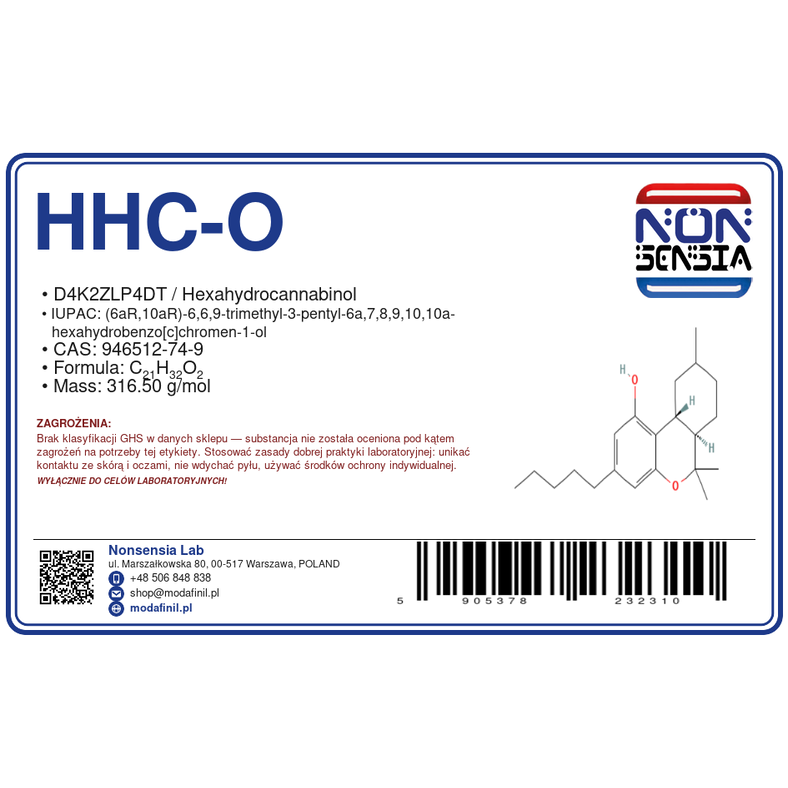
(6aR,10aR)-6,6,9-Trimethyl-3-pentyl-6a,7,8,9,10,10a-hexahydrobenzo[c]chromen-1-yl acetate (hexahydrocannabinol acetate ester), a material with a declared HHC-O content of ≥ 85%, 1000 mg package. Material intended exclusively for laboratory and analytical in vitro research. The product is not intended for consumption by humans or animals, and is not a medicinal product, a dietary supplement, a foodstuff, or a cosmetic.
A thing that needs to be said at the start
HHC-O is a molecule with a very short and turbulent market history. Unlike other items in our catalogue, this page concerns a material whose synthesis and sale within the Republic of Poland have been discontinued by us following a change in national legislation on new psychoactive substances (Journal of Laws 2022, item 763). We are not fulfilling new orders for this material for the Polish market. We maintain the page for informational and analytical purposes — as a source of verified identification and bibliographic data for laboratories that encounter this substance in secured samples.
The reason is not a local peculiarity — HHC-O belongs to a wave of semi-synthetic cannabinoids that, since 2021, have appeared one after another on the market as not-yet-classified THC substitutes, and are regularly placed on lists of controlled substances at a pace faster than analytical laboratories can keep up with [1]. We describe this mechanism in the “Molecular lineage” section, and its current status in the “Regulatory status” section.
Three distinct entities that must not be confused
| Entity | What it is | HHC-O status |
|---|---|---|
| Chemical substance hexahydrocannabinol acetate ester, PubChem CID 165412103 |
A chemical concept — a molecule with a defined structure, registered in chemical databases. It does not have a separate CAS number. | yes — this is the only fully documented status of this molecule |
| Consumer-market product dried material, resins, e-liquids and gummies marketed as a “legal THC substitute” |
A good of the unregulated “legal high” market: unknown formulation, uncontrolled content, a frequent subject of poisoning cases and toxicological studies. It is this entity that the clinical reports cited below concern [13] [15]. | DOES NOT apply to the offered reagent |
| Chemical reagent the material described on this page |
A material for analytical and laboratory work — a reference standard for GC-MS/LC-MS methods. It does not have, and cannot have, approval for use in humans or animals. | currently unavailable to order for the Polish market — see “Regulatory status” |
The consequence is unambiguous. The study results cited further on this page come either from chemical analysis of material seized in consumer-market circulation (products of the “legal high” market), or from case reports of poisoning in persons who consumed such a market product, or from administration of the substance to laboratory animals in a controlled experiment [14]. None of these studies were conducted using an analytical reagent of controlled, declared purity, and none of these results transfer to the material offered as a laboratory standard.
Reagent identification card
| Systematic name (IUPAC) | [(6aR,10aR)-6,6,9-trimethyl-3-pentyl-6a,7,8,9,10,10a-hexahydrobenzo[c]chromen-1-yl] acetate |
|---|---|
| Common names | HHC-O, HHC acetate, HHC-O-acetate, HHCO, hexahydrocannabinol acetate |
| CAS number | not assigned — the compound is not listed in the CAS registry under a separate number |
| Parent compound | hexahydrocannabinol (HHC), CAS 946512-74-9, PubChem CID 16050328 |
| PubChem CID | 165412103 |
| UNII (FDA) | FA3U4A4VSR |
| DTXSID (EPA CompTox) | DTXSID801358864 |
| Molecular formula | C23H34O3 |
| Molar mass | 358.5 g·mol−1 |
| Monoisotopic mass | 358.2508 Da |
| InChIKey | ZAZIHGFBNRVMAI-JCNKGUCWSA-N |
| SMILES | CCCCCC1=CC2=C([C@@H]3CC(CC[C@H]3C(O2)(C)C)C)C(=C1)OC(=O)C |
| Declared HHC-O content | ≥ 85% |
| Intended use | reference material for analytical purposes — not for consumption by humans or animals |
Experimental physicochemical data (melting point, numerical solubility) are not yet available in public chemical databases for this compound — below we provide only the computed descriptors per PubChem (CID 165412103).
Molecular lineage: from a forgotten experiment to the 2021 market breakthrough
The synthesis and cannabimimetic activity of hexahydrocannabinol were first described eight decades ago, during the search for the psychoactive substances of marijuana and hashish [1]. For the following decades the compound remained a laboratory curiosity — with no market, no application, virtually absent from the literature.
The cannabis legislative loophole as a turning point
The situation changed with legislative amendments in the United States that enabled the renewed, legal cultivation of industrial hemp. Hemp-derived cannabidiol (CBD) became a bulk raw material, and with it — a starting material for simple chemical transformations. The industrial route to HHC involves cyclization of CBD to a mixture of Δ8/Δ9-THC, followed by catalytic hydrogenation to a mixture of the (9R)-HHC and (9S)-HHC epimers [1]. HHC appeared on the market in 2021, sold as a “legal” product — not yet classified as a narcotic in most jurisdictions [3].
A chemical arms race: where the acetate ester came from
HHC-O is not an independent invention — it is a direct market response to regulation. When Sweden classified HHC and the related HHC-P as narcotics on 11 July 2023, both compounds immediately disappeared from legal online and retail circulation, and their place was taken by variants not yet covered by the regulations — among them precisely HHC-O and THC-P [2]. This same mechanism — a minor chemical modification staying one step ahead of the letter of the law — has been observed for years across the entire family of new psychoactive substances, and the hexahydrocannabinol family (HHC, HHC-O, HHC-P, HHC-H) is its latest chapter.
Timeline
| 1940s | first reports of the synthesis and cannabimimetic activity of hexahydrocannabinol [1] |
|---|---|
| 2021 | HHC appears on the market as a semi-synthetic product derived from hemp CBD [1] |
| May 2022 | first documented cases of HHC poisoning in Europe — France [13] |
| 2022 | HHC appears on the Swedish market [2]; in Poland, an amendment to the legislation on new psychoactive substances is published (Journal of Laws 2022, item 763) |
| spring 2023 | a sharp rise in interest in HHC recorded on internet forums in Sweden [2] |
| 11 July 2023 | HHC and HHC-P classified as narcotics in Sweden; the market replaces them with, among others, HHC-O [2] |
| 2024 | the Czech Republic becomes the next country to introduce a ban on HHC [18]; publication of the first methods for determining HHC-O epimers in three matrices [6] |
| 2024–2025 | characterization of HHC-O receptor activity in vitro [5], HPLC methods with electrochemical detection [8] |
The network of centres that built the literature
Unlike molecules with a single centre of origin, the literature on HHC-O arose almost simultaneously in several European forensic toxicology and forensic medicine laboratories — a result of the substance appearing on many national markets nearly in parallel.
- France. Bordeaux — HHC poisoning registry [13]; Bron (LATLUMTOX) — determination of epimers in three matrices [6]; Nancy — immunochemical detection in oral fluid [10].
- Sweden. Linköping (National Board of Forensic Medicine) — HHC-O receptor activity in vitro [5]; Karolinska — cross-reactivity of screening tests after the delegalization of HHC [2].
- Italy. Milan (Tossicologia Forense) — first report of HHC in commercialized cannabis products [4]; Rome (Istituto Superiore di Sanità) — first review of HHC pharmacology and toxicology [3].
- Czech Republic. Prague (National Institute of Mental Health) — pharmacokinetics, toxicity and behavioral effects of HHC in rats [14].
Caveat for the entire section above. The clinical studies concern persons who consumed a consumer-market product; the preclinical studies concern laboratory animals. This is not a description of the properties of the offered material and cannot form the basis for any use of it outside the laboratory.
Chemistry: the acetate ester and the uncertainty at carbon C9
What the acetate group does
HHC-O is formed by esterification of the phenolic group of hexahydrocannabinol at position 1 of the chromene ring. Masking the free OH group has direct, quantifiable consequences:
| Parameter | HHC (parent compound) | HHC-O | Significance |
|---|---|---|---|
| Molecular formula | C21H32O2 | C23H34O3 | difference: an acetyl group (+C2H2O) |
| Molar mass | 316.5 | 358.5 | +42 — easy distinction in MS |
| Hydrogen bond donors | 1 | 0 | OH group masked by the ester |
| Hydrogen bond acceptors | 2 | 3 | additional carbonyl oxygen of the ester |
| Rotatable bonds | 4 | 6 | the acetyl group contributes additional conformational freedom |
| Partition coefficient (XLogP, computed) | 7.8 | 6.8 | change in RP-HPLC retention direction — to be verified empirically for the specific method |
Why carbon C9 remains “undefined” — and what follows from it
The PubChem registry describes the molecule as having two defined stereogenic centres (carbons 6a and 10a, which determine the ring fusion) and one undefined centre — carbon C9, bearing the methyl group. It is precisely this atom that is responsible for the division into epimers known from the literature, (9R)-HHC-O and (9S)-HHC-O. The difference is not cosmetic: in an in vitro CB1 receptor activation study, the (9R) epimer activated the receptor to a minimal extent, while the (9S) epimer showed no activation at all — suggesting that cannabinoid acetates most likely act in the body as precursors, requiring hydrolysis to the free phenol to activate the receptor [5]. Methods for separating the two epimers have been validated in three matrices — seized material, whole blood, and oral fluid [6].
For a laboratory, this has a practical consequence: a summary assay of “HHC-O ≥ 85%” does not determine the ratio of epimers. Material obtained via catalytic hydrogenation is typically a mixture of (9R) and (9S), unless the manufacturer declares otherwise.
Nomenclature and synonyms
- HHC-O — the most common name in commercial circulation and in the analytical literature;
- HHC acetate / HHC-O-acetate / hexahydrocannabinol-O-acetate — full English names;
- HHCO — a hyphen-free spelling, found in chemical publications [11];
- hexahydrocannabinol acetate — the descriptive English equivalent;
- (9R)-HHC-O / (9S)-HHC-O — notation indicating the specific epimer at carbon C9;
- [(6aR,10aR)-6,6,9-trimethyl-3-pentyl-6a,7,8,9,10,10a-hexahydrobenzo[c]chromen-1-yl] acetate — the systematic IUPAC name, the only unambiguous one.
A frequent source of confusion is treating the abbreviations of this family as synonyms. HHC-P (hexahydrocannabiphorol) is a homolog with an extended side chain, not an ester; HHC-H (hexahydrocannabihexol) is another chain homolog; THC-O is the acetate of an entirely different parent compound — Δ9-THC, not HHC. All four are often mentioned together in the same publication as a family that cross-reacts in screening tests [7], which, when searching the literature, requires distinguishing the names rather than merging them.
Laboratory application of the reagent
Where availability of the reagent is legally permitted, the HHC-O reference material finds application in the following areas of analysis:
- reference material for confirming identity and purity by HPLC, including with electrochemical detection on a boron-doped diamond electrode [8];
- standard in GC-MS and LC-MS/MS methods for detecting HHC-O in seized plant material and physiological fluids — blood, urine, oral fluid [6] [9];
- material for assessing the cross-reactivity of immunochemical tests (strip and ELISA) used routinely in THC screening [7] [10];
- comparison material for the identification of unknown cannabinoids in consumer-market products — the first report of HHC present in a commercialized product was based on standards obtained via semi-synthesis [4];
- model compound in studies of the chemistry of pyrolysis of cannabinoid acetates during vaporization — a source of toxic ketene [11].
Storage, handling and work safety
Store in the original, tightly closed packaging, in a dry, cool place, protected from light, separately from food and feed and out of the reach of children. Work only under laboratory conditions, using personal protective equipment: gloves, safety goggles and laboratory clothing. Avoid contact with skin and eyes. Waste handling — in accordance with the regulations applicable to chemical waste at the site where the research is conducted.
Note regarding heating the reagent and safety data. The acetate group of this family of compounds decomposes almost quantitatively on heating into ketene — a strongly irritating compound with documented pulmonary toxicity [11] [12], so procedures requiring heating of the sample (e.g. GC injection) should be carried out with adequate ventilation and extraction. Beyond this, the toxicological data for a compound with such a short analytical history remain incomplete — the absence of documented hazard is not equivalent to the absence of hazard, and the reagent should be handled with the caution appropriate for a substance with an unestablished profile.
Regulatory status
HHC-O is an example of a molecule whose legal status changes faster than the scientific literature is able to describe it. The sequence of delegalization of the parent compound in Sweden and its immediate replacement by HHC-O, described above in the “Molecular lineage” section [2], was repeated in subsequent countries — in 2024 the Czech Republic introduced a ban on HHC [18]. Clinical reports from this period describe cases of severe poisoning [17] and psychotic episodes requiring hospitalization in persons using products of this family [15] [16] — these, as explained in the “Three distinct entities” section, concern consumer-market products, not the analytical reagent.
In Poland, under the amendment to the legislation on new psychoactive substances published in 2022 (Journal of Laws 2022, item 763), trade in this substance is subject to restrictions. As a consequence we have discontinued further synthesis of HHC-O for the Polish market and are not fulfilling new orders for this material. Persons interested in the current legal status in other jurisdictions should verify it independently beforehand — the legal status of substances of this type is frequently subject to change. The material described on this page, where its availability is legally permitted, remains a chemical reagent without approval for any use in humans or animals.
Frequently Asked Questions
How does HHC-O differ from HHC?
HHC-O is the acetate ester of hexahydrocannabinol — the hydroxyl (OH) group of the parent compound is masked by an acetate group. The mass difference is 42 units (358.5 versus 316.5 g/mol), which makes the distinction in mass spectrometry trivial.
Is HHC-O the same thing as THC?
No. HHC-O is an ester of hexahydrocannabinol — a compound different from tetrahydrocannabinol (THC), although structurally related (HHC is a hydrogenated derivative of the cannabinoid skeleton). THC-O — the acetate of Δ9-THC, not of HHC — is also a separate compound.
Why doesn’t HHC-O have a CAS number?
The compound is too new and too narrowly distributed in formal chemical registries to have been assigned a CAS number. It does, however, have identifiers in other databases: PubChem CID 165412103, UNII FA3U4A4VSR, DTXSID801358864.
Is HHC-O legal in Poland?
Under the amendment to the legislation on new psychoactive substances (Journal of Laws 2022, item 763), trade in this substance within Poland is subject to restrictions. For this reason we have discontinued the synthesis and sale of this material for the Polish market.
Why can’t HHC-O currently be ordered on this page?
Following the change in national legislation we have discontinued further synthesis of HHC-O and are not fulfilling new orders for this material for the Polish market. We maintain the page for informational purposes and as a source of identification data.
Is HHC-O detectable in drug tests?
Yes — contrary to widespread claims. Cross-reactivity studies have shown that HHC-O gives a positive result in standard immunochemical THC screening tests, which has translated into an increase in the rate of false-positive results in routine cannabinoid testing [2] [7].
How does (9R)-HHC-O differ from (9S)-HHC-O?
The two epimers differ in configuration at carbon C9. In an in vitro study, the (9R) epimer activated the CB1 receptor to a minimal extent, while the (9S) epimer showed no activation at all — suggesting that both act in the body as precursors requiring hydrolysis to free HHC [5].
Is HHC-O the same thing as HHC-P or HHC-H?
No. HHC-P (hexahydrocannabiphorol) and HHC-H (hexahydrocannabihexol) are homologs with a different side chain, not acetate esters. All three are often mentioned together as a “new generation” family of semi-synthetic cannabinoids, but they are distinct molecules.
What is the chemical formula and molecular mass of HHC-O?
C23H34O3; molar mass 358.5 g·mol−1, monoisotopic mass 358.2508 Da, InChIKey ZAZIHGFBNRVMAI-JCNKGUCWSA-N.
How should HHC-O be stored as a laboratory reagent?
In the original, tightly closed packaging, in a dry, cool place, protected from light, separately from food and feed and out of the reach of children. Procedures requiring heating of the sample should be carried out with adequate ventilation due to the decomposition of the acetate group into ketene.
Is a safety data sheet provided with HHC-O?
We provide the sheet on request to recipients conducting research or analytical activity, to the extent permitted by applicable regulations. We note that the toxicological data for this compound remain incomplete.
What is the HHC-O standard used for in an analytical laboratory?
For confirming identity and purity by HPLC, as a standard in GC-MS and LC-MS/MS for detecting HHC-O in seized material and biological samples, for assessing the cross-reactivity of immunochemical tests, and as a model material in studies of the pyrolysis chemistry of cannabinoid acetates.
Literature
The entries come from the PubMed database and concern the chemistry, analysis, market epidemiology and clinical toxicology of this family of compounds. Entries [1]–[12] are analytical, chemical and review papers; [13], [15]–[17] are case reports and clinical series concerning persons who consumed a consumer-market product; [14] is a preclinical study in laboratory animals; [18] is a press report on a regulatory decision. None of these entries describes the use of the analytical reagent — they are cited as scientific and regulatory context, not as information about the properties of the offered material nor as encouragement for any use.
- Ujváry I (2024). “Hexahydrocannabinol and closely related semi-synthetic cannabinoids: A comprehensive review.” Drug Test Anal. PMID 37269160. doi:10.1002/dta.3519.
- Helander A, Johansson M, Villén T, Andersson A (2024). “Appearance of hexahydrocannabinols as recreational drugs and implications for cannabis drug testing – focus on HHC, HHC-P, HHC-O and HHC-H.” Scand J Clin Lab Invest. PMID 38619215. doi:10.1080/00365513.2024.2340039.
- Graziano S, Varì MR, Pichini S et al. (2023). “Hexahydrocannabinol Pharmacology, Toxicology, and Analysis: The First Evidence for a Recent New Psychoactive Substance.” Curr Neuropharmacol. PMID 37357519. doi:10.2174/1570159X21666230623104624.
- Casati S, Rota P, Bergamaschi RF et al. (2024). “Hexahydrocannabinol on the Light Cannabis Market: The Latest ‘New’ Entry.” Cannabis Cannabinoid Res. PMID 36445181. doi:10.1089/can.2022.0253.
- Persson M, Kronstrand R, Evans-Brown M, Green H (2025). “In vitro activation of the CB(1) receptor by the semi-synthetic cannabinoids hexahydrocannabinol (HHC), hexahydrocannabinol acetate (HHC-O) and hexahydrocannabiphorol (HHC-P).” Drug Test Anal. PMID 38894658. doi:10.1002/dta.3750.
- Bottinelli C, Baradian P, Poly A et al. (2024). “Identification and quantification of both isomers of hexahydrocannabinol, (9R)-hexahydrocannabinol and (9S)-hexahydrocannabinol, in three different matrices by mass spectrometry.” Rapid Commun Mass Spectrom. PMID 38342829. doi:10.1002/rcm.9711.
- Höfert L, Becker S, Dreßler J, Baumann S (2024). “Quantification of (9R)- and (9S)-hexahydrocannabinol (HHC) via GC-MS in serum/plasma samples from drivers suspected of cannabis consumption and immunological detection of HHC and related substances in serum, urine, and saliva.” Drug Test Anal. PMID 37652872. doi:10.1002/dta.3570.
- Belbasi Z, Petr J, Hrbac J, Jirovsky D (2025). “HPLC method for novel cannabinoid separation with electrochemical detection on boron-doped diamond electrode.” J Pharm Biomed Anal. PMID 40220634. doi:10.1016/j.jpba.2025.116875.
- Schirmer W, Auwärter V, Kaudewitz J et al. (2023). “Identification of human hexahydrocannabinol metabolites in urine.” Eur J Mass Spectrom. PMID 37709263.
- Derne AS, Pape E, Jouzeau JY et al. (2024). “Immunological detection of hexahydrocannabinol (HHC) in oral fluid.” Drug Test Anal. PMID 37916294. doi:10.1002/dta.3595.
- Evans RL, Corley CN, Hunsaker HC et al. (2026). “Effect of O-acetylation on ketene and carbonyl yields from conventional and emerging cannabinoids.” Analyst. PMID 42029062. doi:10.1039/d6an00190d.
- Meehan-Atrash J, Rahman I (2021). “Cannabis Vaping: Existing and Emerging Modalities, Chemistry, and Pulmonary Toxicology.” Chem Res Toxicol. PMID 34622654. doi:10.1021/acs.chemrestox.1c00290.
- Labadie M, Nardon A, Castaing N et al. (2024). “Hexahydrocannabinol poisoning reported to French poison centres.” Clin Toxicol (Phila). PMID 38426845. doi:10.1080/15563650.2024.2318409.
- Šíchová K, Mallarino B, Janečková L et al. (2025). “Hexahydrocannabinol: pharmacokinetics, systemic toxicity, and acute behavioral effects in Wistar rats.” Int J Neuropsychopharmacol. PMID 40643195. doi:10.1093/ijnp/pyaf041.
- O’Mahony B, Lanigan S, Lally N et al. (2025). “Novel substance, same old problems: admissions of psychosis precipitated by hexahydrocannabinol, a widely available semi-synthetic cannabinoid.” BJPsych Bull. PMID 40637199. doi:10.1192/bjb.2025.85.
- Naughton S, Clarke M (2024). “Hexahydrocannabinol (HHC): a potentially potent challenge for Ireland’s early intervention in psychosis network.” Ir J Psychol Med. PMID 39327819. doi:10.1017/ipm.2024.33.
- Reiter N, Linnet K, Andersen NØ et al. (2024). “Severe poisoning with semi-synthetic cannabinoids.” Ugeskr Laeger (Danish). PMID 39323250. doi:10.61409/V04240241.
- Holt E (2024). “Czech Republic latest country to ban hexahydrocannabinol.” Lancet. PMID 38368884. doi:10.1016/S0140-6736(24)00307-6.
Identification data and computed descriptors per PubChem (CID 165412103); parent compound HHC — PubChem CID 16050328.
Related reagents in our catalogue
- Cannabidiol / CBD — the parent raw material for the industrial synthesis of HHC: hemp-derived CBD undergoes cyclization to a mixture of Δ8/Δ9-THC, followed by catalytic hydrogenation to HHC, from which HHC-O is obtained via esterification
- Olivetol — the resorcinol building block common to the entire cannabinoid family; structural contrast: a simple resorcinol ring without a fused chromene system and without stereogenic centres
Product intended-use statement
The offered material is a chemical reagent intended exclusively for research, analytical and laboratory purposes. It is not intended for consumption by humans or animals. It is not a medicinal product, a dietary supplement, a foodstuff, a medical device, or a cosmetic. It may not be used for medical, diagnostic, therapeutic, prophylactic or consumption purposes, administered to humans or animals, applied to the skin, or added to food, beverages or feed. Sale is restricted to recipients conducting research, scientific or analytical activity, possessing laboratory facilities and the knowledge required for the safe handling of chemical reagents, within the scope and in the territories where trade in the material is legally permitted. The buyer bears sole responsibility for the lawful and safe use of the reagent and for compliance with the regulations applicable in the country of destination.