



Description
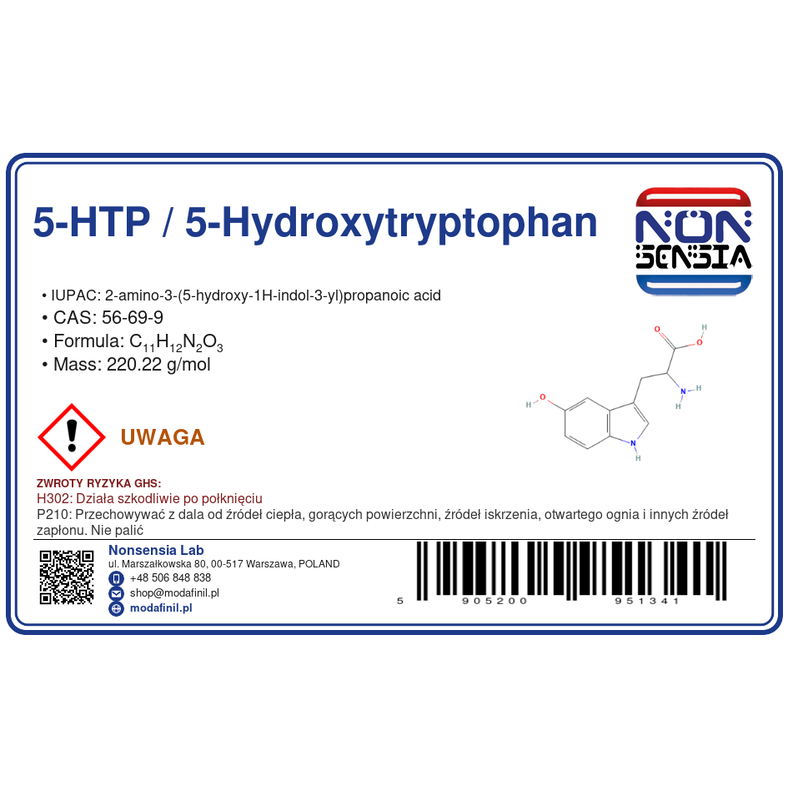
2-Amino-3-(5-hydroxy-1H-indol-3-yl)propanoic acid, a white-to-off-white crystalline powder, purity ≥ 99.00%, 1000 mg package. Material intended solely for in vitro laboratory and analytical research. The product is not intended for consumption by humans or animals, is not a medicinal product, dietary supplement, food, or cosmetic.
Three Different Entities That Must Not Be Confused
The same name “5-HTP” functions simultaneously in three independent contexts — chemical, pharmaceutical, and laboratory — and only separating them from the outset avoids drawing mistaken conclusions from one context to another:
| Entity | What it is | What it concerns |
|---|---|---|
| Chemical substance 5-hydroxytryptophan, CAS 56-69-9 |
A chemical concept — a molecule with a defined structure. On its own it is neither a drug nor a reagent; its status is conferred by the form in which it was manufactured and authorized. | chemistry, substance registries |
| Medicinal product INN: oxitriptan |
Under the international nonproprietary name oxitriptan, the compound has been and still is registered as a pharmaceutical preparation in some European countries: a defined pharmaceutical form, manufacture under a pharmaceutical regime, registration dossier, and safety surveillance of use. | published clinical studies in humans concerned this entity |
| Chemical reagent the material offered here |
Material for laboratory and analytical work. It does not and cannot hold authorization for use in humans or animals — it has no pharmaceutical form and no medicinal-product documentation. | analytics, chemistry, reference standards |
The consequence is unambiguous. The publications cited later on this page concern either the pharmaceutical preparation oxitriptan administered to patients under clinical conditions [6][16][17], or analytical methods and studies in animals or microbiological strains under laboratory conditions. None of these works was carried out using the analytical reagent, and none of these results transfers to the material offered here. The reagent is not the form in which the substance was studied clinically, and it cannot be used that way.
Reagent Identification Card
| Systematic name (IUPAC) | 2-amino-3-(5-hydroxy-1H-indol-3-yl)propanoic acid |
|---|---|
| Common name | 5-hydroxytryptophan (5-HTP) |
| CAS number | 56-69-9 |
| Molecular formula | C11H12N2O3 |
| Molar mass | 220.22 g·mol−1 |
| Monoisotopic mass | 220.0848 Da |
| InChIKey | LDCYZAJDBXYCGN-UHFFFAOYSA-N |
| SMILES | C1=CC2=C(C=C1O)C(=CN2)CC(C(=O)O)N |
| PubChem CID | 144 |
| Melting point | 286 °C |
| Form | crystalline powder, white to off-white |
| Purity | ≥ 99.00% |
| Intended use | research reagent — not for consumption by humans or animals |
Molecular Lineage: From the Tryptophan Scaffold to a Neurotransmitter
5-Hydroxytryptophan is not a molecule designed in a medicinal chemistry laboratory — it is a natural biosynthetic intermediate, part of the same pathway by which living organisms convert the exogenous amino acid L-tryptophan into serotonin. The enzyme tryptophan hydroxylase introduces a hydroxyl group at position 5 of tryptophan’s indole ring — it is precisely this step that defines 5-HTP as an intermediate compound, not the starting point or the final product of the pathway. This biochemical lineage, however, does not translate into the status of the reagent offered here: the route by which the material sold for laboratory use is obtained is separate from the endogenous pathway and is discussed below.
Commercial Plant Source: Griffonia simplicifolia
Although 5-HTP occurs in trace amounts in select foodstuffs, the main commercial source remains the seeds of Griffonia simplicifolia — a West African vine of the legume family. The chemical composition and seed-extraction methods of this plant have been the subject of separate analytical work: the chemical characterization and DNA fingerprinting of the plant material were described by Vigliante et al. [14], and a comparison of different seed-extraction methodologies was carried out by Mannino et al. [18]. The absorption kinetics of 5-HTP from Griffonia extract following oral administration have also been studied clinically [12] — this work, however, concerns a plant-derived preparation given to study participants, not the analytical reagent, and is cited here solely as part of the molecule’s raw-material lineage.
Alternative Route: Microbial Synthesis
Alongside plant extraction, a second, considerably younger route to obtaining 5-HTP has developed: biosynthesis in engineered microorganisms. Zeng and coworkers developed synthetic pathways leading to 5-HTP and serotonin from glucose in the bacterium Escherichia coli [13], using metabolic engineering instead of extraction from plant material. These are two entirely different routes to the same molecule — agricultural (seed extraction) and biotechnological (microbial fermentation) — which lead to an identical chemical product but differ in their profile of process-related impurities.
Racemic Form versus Naturally Occurring Form
CAS number 56-69-9, assigned to this reagent in the PubChem registry (CID 144), refers to the racemic form, designated as (±)-5-hydroxytryptophan or DL-5-HTP — a mixture of both enantiomers at the stereogenic center on the α-carbon. This is an important distinction: the form biosynthesized endogenously in living organisms, and the one predominant in plant extracts, is the L-enantiomer, designated by a separate CAS number. The reagent offered here, CAS number 56-69-9, is the racemic form — it should not be equated without qualification with the single L-enantiomer, even though in commercial circulation the two terms are sometimes used interchangeably.
Timeline
| 1962 | one of the first described methods for determining 5-hydroxytryptophan alongside serotonin [1] |
|---|---|
| 1964 | a paper in Nature on the regulation of 5-hydroxytryptophan decarboxylase in the rat pineal gland — one of the foundations of knowledge on the enzymatic conversion of 5-HTP to serotonin [2] |
| 1976 | a method for determining 5-HTP and its metabolites in human plasma following administration [3] |
| 1980–1981 | development of sensitive HPLC methods with electrochemical and voltammetric detection for determining 5-HTP and its conversion products [4][5] |
| 1988 | clinical publications on combining the oxitriptan preparation with classical antidepressants in European medical practice [6] |
| 1989–1996 | the eosinophilia-myalgia syndrome (EMS) epidemic linked to L-tryptophan preparations; pathogenesis research also covers related 5-HTP preparations [8][9] |
| 2003 | structural characterization of a process-related impurity designated “Peak X” in commercial 5-HTP preparations linked to EMS cases [10] |
| 2006 | a review of the pharmacology of serotonin-precursor administration [11] |
| 2018–2019 | development of a microbial synthesis route to 5-HTP in E. coli [13] and chemical characterization of the plant source Griffonia simplicifolia [14] |
| 2020 | a comprehensive review of the natural occurrence, analytics, biosynthesis, biotechnology, physiology, and toxicology of 5-HTP [15] and a meta-analysis of clinical studies on distinct types of depression [16] |
Research Centers and Context
The literature on 5-HTP is considerably more geographically dispersed than for molecules with a single parent research center — this reflects the fact that the substance itself is simultaneously the subject of clinical pharmacology, phytochemistry, and microbial biotechnology, pursued independently of one another. For a laboratory using this reagent, this means having to combine literature from several distinct disciplines.
- Phytochemistry of Griffonia simplicifolia (Italy, University of Turin). The team around Massimo E. Maffei conducts systematic work on the chemical profile and seed-extraction methods of this plant [14][18], and has also published one of the most comprehensive reviews covering the whole molecule [15].
- Analytical toxicology of process-related impurities (United States). Klarskov’s group worked on the structural identification of impurities in commercial 5-HTP preparations linked to cases of eosinophilia-myalgia syndrome [9][10], while Sternberg described the pathogenesis of this syndrome in a broader context [8].
- Clinical pharmacology of oxitriptan (Europe, 1980s and 1990s). A Swiss publication from this period documents the use of the pharmaceutical preparation oxitriptan in medical practice, including in combination with classical antidepressants [6].
- Metabolic engineering and microbial biotechnology (Germany). Zeng’s team at the Hamburg University of Technology developed synthetic pathways for producing 5-HTP and serotonin in the bacterium Escherichia coli, opening an alternative to plant extraction [13].
Chemistry and Implications for the Laboratory
An Aromatic Amino Acid with a Hydroxyl Substituent
5-HTP is a derivative of tryptophan — it differs from it only by a single hydroxyl group attached at position 5 of the indole ring. It retains the α-amino acid backbone: an amino group and a carboxyl group on the same carbon atom, which makes the α-carbon a stereogenic center — hence the existence of the two enantiomers described above. The molecule of the reagent offered here carries this same backbone, regardless of the form in which it ultimately reaches the package.
Polarity Instead of Lipophilicity
Unlike the benzhydrylsulfinyl cores or adamantane cages described for other reagents in our catalog, 5-HTP is a strongly polar molecule, which directly affects how this reagent is handled in the laboratory:
| Parameter | Value | What this means |
|---|---|---|
| Partition coefficient (XLogP) | ≈ −1.2 | a negative value — a hydrophilic compound, elutes early in a standard RP-HPLC gradient |
| Topological polar surface area | 99.3 Å2 | a high value typical of free amino acids; limits retention on C18 columns without modifiers |
| Hydrogen bond donors | 4 | amino, carboxyl, and hydroxyl groups — an extensive hydrogen-bond network |
| Hydrogen bond acceptors | 4 | carboxyl oxygen, hydroxyl oxygen, and the indole-ring nitrogen |
| Solubility | good in water and methanol; poor in nonpolar solvents | stock solutions are readily prepared in the aqueous phase — the reverse situation compared with most other reagents in our catalog |
Electrochemical Detection
The indole ring bearing a hydroxyl substituent at position 5 is electroactive — it oxidizes at a relatively low potential, which makes this reagent a convenient analyte for high-performance liquid chromatography with electrochemical detection (HPLC-ECD). This method, for the simultaneous determination of 5-HTP, serotonin, and 5-hydroxyindoleacetic acid in brain tissue and biological fluids, was described by Semerdjian-Rouquier, Bossi, and Scatton [5]. The same electrochemical property underlies the HPLC-coupled voltammetric method described earlier by Rahman and coworkers for determining the activity of the enzyme that decarboxylates 5-HTP [4].
Complexation with Metal Ions
The amino acid moiety of 5-HTP forms complexes with transition metal ions — Milovanović and Kapetanović used polarographic and potentiometric methods to describe complexes of this reagent with cobalt(II) ions [7], which shows that the molecule is at times a subject of inorganic analytics alongside pharmacology and organic chromatography.
Nomenclature and Synonyms
- 5-HTP — the abbreviation most commonly used internationally;
- 5-hydroxytryptophan — the common chemical name;
- DL-5-HTP / (±)-5-hydroxytryptophan — names unambiguously indicating the racemic form, consistent with the CAS number of this listing;
- oxitriptan — the international nonproprietary name (INN) used in a pharmaceutical context; PubMed treats this term as a synonym of the same substance at the MeSH indexing level;
- oxytryptophan — a variant found in older chemical registries;
- 2-amino-3-(5-hydroxy-1H-indol-3-yl)propanoic acid — the systematic IUPAC name, the only unambiguous one.
This divergence of names has a bibliographic consequence: a search limited to “5-HTP” alone misses part of the clinical literature indexed under the name oxitriptan. When searching for materials on this reagent, it is worth combining both variants.
Laboratory Use of the Reagent
The uses below pertain solely to analytical and research work with the reagent — they are not a recommendation for any other use.
- a reference material for confirming identity and purity by HPLC-UV or HPLC-ECD, utilizing the electroactivity of the indole ring [5];
- a standard in methods for determining the enzymatic activity of aromatic L-amino acid decarboxylase — the enzyme that converts 5-HTP into serotonin [4][2];
- a model material in studies of the serotonin biosynthesis pathway from L-tryptophan, including comparisons of the plant and microbial routes to the compound [13];
- a comparison standard in quality analytics of commercial preparations — identification of process-related impurities by spectroscopic and chromatographic methods [10];
- a model compound in the analytical chemistry of amino acid–metal ion complexes [7];
- a reference reagent for distinguishing 5-HTP from tryptophan and serotonin in the same analytical matrix by RP-HPLC methods.
In all of the uses above, the reagent functions as a comparison material or analytical standard — never as a substance administered to test organisms by the ordering laboratory.
Storage, Handling, and Work Safety
Store in the original, tightly closed package, in a dry and cool place, protected from light, separately from food and feed and out of the reach of children. Work only under laboratory conditions, using personal protective equipment: gloves, safety goggles, and laboratory clothing; weigh the powder under conditions that limit dust generation. Avoid inhaling dust and contact with skin and eyes. Waste handling must comply with the regulations applicable to chemical waste at the site where the research is conducted. The reagent is not for consumption at any stage of laboratory work.
Hazard classification. According to the PubChem registry (CID 144), this substance has been assigned the pictograms GHS02, GHS06, and GHS07 with the signal word “Danger,” and the precautionary statement P210 (keep away from heat, hot surfaces, sparks, open flames, and other ignition sources; no smoking). The registry does not list hazard statements (H) for this entry — this data should be treated as incomplete and always supplemented with a current safety data sheet (SDS).
Regulatory Status
The substance under the international nonproprietary name oxitriptan is or has been the active substance of pharmaceutical preparations registered in some European countries [6][16][17]. The trade in pharmaceutical preparations is subject to separate pharmaceutical law, and this offer does not concern it. A separate, historical regulatory thread — process-related impurities in commercial 5-HTP preparations linked to eosinophilia-myalgia syndrome — is discussed above in the timeline and the research-centers section [8][9][10]; that episode concerned the quality of specific commercial batches, not the molecule itself. The material offered here is a chemical reagent and holds no authorization for any use in humans or animals. The buyer is responsible for ensuring that the intended use complies with the law applicable in the country of destination.
Frequently Asked Questions
What is the difference between the DL (racemic) form and the naturally occurring L form?
The L form is biosynthesized endogenously from L-tryptophan and predominates in Griffonia simplicifolia extracts. CAS number 56-69-9, assigned to this reagent, refers to the racemic mixture (DL) — both enantiomers at once, consistent with the PubChem registry (CID 144).
Are 5-HTP and oxitriptan the same compound?
Yes, at the chemical level it is the same molecule. Oxitriptan is the international nonproprietary name (INN) used in a pharmaceutical context — preparations under this name have been the subject of clinical studies. The material offered here is not a pharmaceutical preparation or its substitute, only a chemical reagent.
What is the chemical formula and molar mass of 5-HTP?
The molecular formula of this reagent is C11H12N2O3; the molar mass is 220.22 g·mol−1, and the monoisotopic mass is 220.0848 Da. CAS number 56-69-9, InChIKey LDCYZAJDBXYCGN-UHFFFAOYSA-N.
Where does commercially available 5-HTP come from?
The main commercial source is the seeds of the West African vine Griffonia simplicifolia [14][18]. An alternative route is microbial biosynthesis in engineered strains of Escherichia coli [13].
What is “Peak X” and why is it analytically significant?
This is the designation of a process-related impurity detected in some commercial 5-HTP preparations from the 1980s and 1990s, linked to cases of eosinophilia-myalgia syndrome. Its structure was characterized by spectroscopic methods [10]. For a laboratory, this is an example of why purity control of the reagent and verification of raw-material provenance are an integral part of working with this material.
Is the reagent suitable for uses other than laboratory work?
No. The material is intended solely for laboratory and analytical research — it is not for consumption by humans or animals, is not a medicine, dietary supplement, food, or cosmetic, and may not be used for medical, diagnostic, or consumption purposes.
How should 5-HTP be stored as a laboratory reagent?
In the original, tightly closed package, in a dry and cool place, protected from light, separately from food and feed, and out of the reach of children.
What solvent should be used to prepare a stock solution of 5-HTP?
Unlike many other reagents in our catalog, 5-HTP dissolves well in water and in methanol — with an XLogP of ≈ −1.2, stock solutions are most conveniently prepared in the aqueous phase.
How are the identity and purity of 5-HTP confirmed?
By the HPLC-UV or HPLC-ECD method against a reference material, utilizing the electroactivity of the indole ring [5]. An additional identification parameter is the melting point (286 °C).
Is a safety data sheet included with the 5-HTP?
We provide the safety data sheet on request to recipients engaged in research or analytical activity.
Is 5-HTP legal in Poland?
5-Hydroxytryptophan, under the name oxitriptan, has at times been the active substance of pharmaceutical preparations registered in some European countries; the trade in such preparations is subject to separate pharmaceutical law, and this offer does not concern it. The material offered here is a chemical reagent with no authorization for use in humans. The buyer is responsible for ensuring that the intended use complies with the law of the country of destination.
What is the 5-HTP standard used for in an analytical laboratory?
For confirming identity and purity by the HPLC-UV/ECD method, as a standard for determining the enzymatic activity of aromatic L-amino acid decarboxylase, as a model material in studies of the serotonin biosynthesis pathway, and as a comparison standard in quality analytics of commercial preparations.
References
The items below document the state of knowledge on this reagent and are drawn from the PubMed database; they concern the chemistry, analytics, and regulatory history of this molecule. Items [1], [2], [3], [4], [5], [7], [9], [10], [13], [14], [15], [18] are methodological, analytical, and phytochemical papers; [6], [16], and [17] concern the pharmaceutical preparation oxitriptan studied clinically in humans; [8] and [9] discuss the pathogenesis of the syndrome associated with contamination of commercial preparations; [12] concerns a plant extract, not the analytical reagent. None of these works describes a use of the analytical reagent offered here — they are cited as scientific context and a bibliographic pointer, not as information about the properties of the material or an encouragement toward any use.
- Wiegand RG, Scherfling E (1962). “Determination of 5-hydroxytryptophan and serotonin.” J Neurochem. PMID 14006781. doi:10.1111/j.1471-4159.1962.tb11851.x
- Snyder SH, Axelrod J, Fischer JE et al. (1964). “Neural and photic regulation of 5-hydroxytryptophan decarboxylase in the rat pineal gland.” Nature. PMID 14203521. doi:10.1038/203981a0
- Joseph MH, Baker HF (1976). “The determination of 5-hydroxytryptophan and its metabolites in plasma following administration to man.” Clin Chim Acta. PMID 1086173. doi:10.1016/0009-8981(76)90043-7
- Rahman MK, Nagatsu T, Kato T (1980). “New and highly sensitive assay for L-5-hydroxytryptophan decarboxylase activity by high-performance liquid chromatography-voltammetry.” J Chromatogr. PMID 6971297. doi:10.1016/s0378-4347(00)84311-x
- Semerdjian-Rouquier L, Bossi L, Scatton B (1981). “Determination of 5-hydroxytryptophan, serotonin and 5-hydroxyindoleacetic acid in rat and human brain and biological fluids by reversed-phase high-performance liquid chromatography with electrochemical detection.” J Chromatogr. PMID 6172438. doi:10.1016/s0021-9673(00)82092-0
- Calanca A (1988). “Hydroxytryptophan (oxitriptan) associated with classical antidepressants: an additional therapeutic possibility.” Schweiz Rundsch Med Prax. PMID 3263678.
- Milovanović L, Kapetanović V (1993). “Polarographic and potentiometric investigation of Co(II) complexes with 5-hydroxytryptophan.” J Pharm Belg. PMID 8492290.
- Sternberg EM (1996). “Pathogenesis of L-tryptophan eosinophilia myalgia syndrome.” Adv Exp Med Biol. PMID 8906284. doi:10.1007/978-1-4613-0381-7_50
- Klarskov K, Johnson KL, Benson LM et al. (1999). “Eosinophilia-myalgia syndrome case-associated contaminants in commercially available 5-hydroxytryptophan.” Adv Exp Med Biol. PMID 10721089. doi:10.1007/978-1-4615-4709-9_58
- Klarskov K, Johnson KL, Benson LM et al. (2003). “Structural characterization of a case-implicated contaminant, ‘Peak X,’ in commercial preparations of 5-hydroxytryptophan.” J Rheumatol. PMID 12508395.
- Turner EH, Loftis JM, Blackwell AD (2006). “Serotonin a la carte: supplementation with the serotonin precursor 5-hydroxytryptophan.” Pharmacol Ther. PMID 16023217. doi:10.1016/j.pharmthera.2005.06.004
- Rondanelli M, Opizzi A, Faliva M et al. (2012). “Relationship between the absorption of 5-hydroxytryptophan from an integrated diet, by means of Griffonia simplicifolia extract, and the effect on satiety in overweight females after oral spray administration.” Eat Weight Disord. PMID 22142813. doi:10.3275/8165
- Mora-Villalobos JA, Zeng AP (2018). “Synthetic pathways and processes for effective production of 5-hydroxytryptophan and serotonin from glucose in Escherichia coli.” J Biol Eng. PMID 29568327. doi:10.1186/s13036-018-0094-7
- Vigliante I, Mannino G, Maffei ME (2019). “Chemical Characterization and DNA Fingerprinting of Griffonia simplicifolia Baill.” Molecules. PMID 30875930. doi:10.3390/molecules24061032
- Maffei ME (2020). “5-Hydroxytryptophan (5-HTP): Natural Occurrence, Analysis, Biosynthesis, Biotechnology, Physiology and Toxicology.” Int J Mol Sci. PMID 33375373. doi:10.3390/ijms22010181
- Javelle F, Lampit A, Bloch W et al. (2020). “Effects of 5-hydroxytryptophan on distinct types of depression: a systematic review and meta-analysis.” Nutr Rev. PMID 31504850. doi:10.1093/nutrit/nuz039
- Shaw K, Turner J, Del Mar C (2002). “Tryptophan and 5-hydroxytryptophan for depression.” Cochrane Database Syst Rev. PMID 11869656. doi:10.1002/14651858.CD003198
- Mannino G, Serio G, Gaglio R et al. (2023). “Biological Activity and Metabolomics of Griffonia simplicifolia Seeds Extracted with Different Methodologies.” Antioxidants (Basel). PMID 37760012. doi:10.3390/antiox12091709
Identification data and computed descriptors from PubChem (CID 144).
Related Reagents in Our Catalog
- Melatonin — another link in the same metabolic pathway: the serotonin formed from 5-HTP is the direct precursor of melatonin
- L-Tyrosine — an analogous aromatic amino acid, precursor of a separate catecholamine pathway (dopamine, noradrenaline); a contrast of pathways: indole versus phenolic
Statement of Intended Use
The material offered here is a chemical reagent intended solely for research, analytical, and laboratory purposes. It is not intended for consumption by humans or animals. It is not a medicinal product, dietary supplement, food, medical device, or cosmetic. It may not be used for medical, diagnostic, therapeutic, preventive, or consumption purposes, administered to humans or animals, applied to the skin, or added to food, beverages, or feed. Sold only to recipients engaged in research, scientific, or analytical activity, who have laboratory facilities and the knowledge needed to safely handle chemical reagents. The buyer bears sole responsibility for the lawful and safe use of the reagent and for compliance with the regulations applicable in the country of destination.