
Description
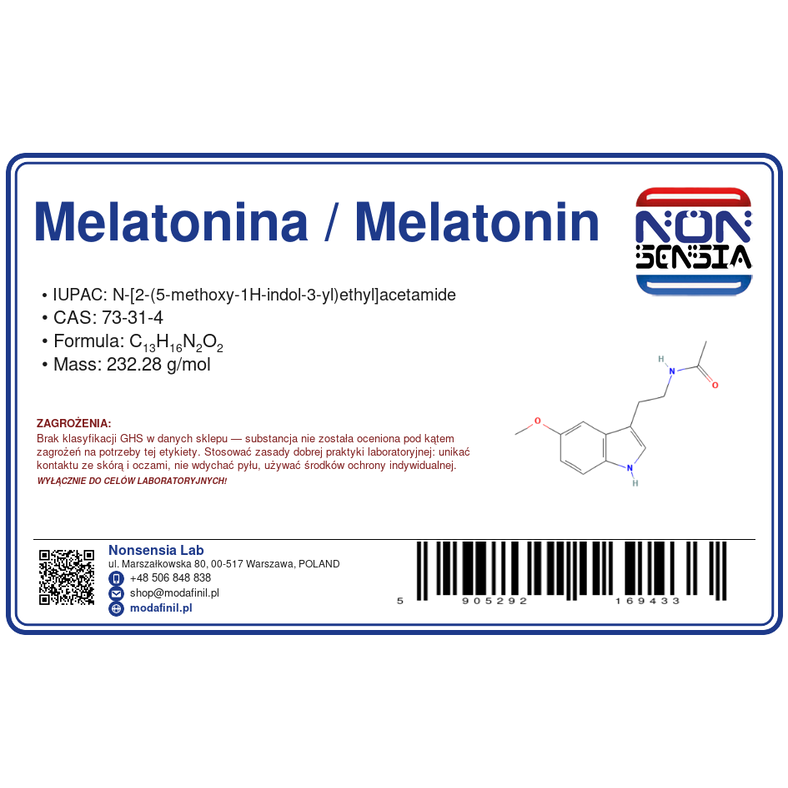
N-[2-(5-methoxy-1H-indol-3-yl)ethyl]acetamide, crystalline powder, 1000 mg package. Material intended exclusively for in vitro laboratory and analytical research. The product is not intended for consumption by humans or animals, and is not a medicinal product, dietary supplement, food, or cosmetic.
Three Different Entities That Must Not Be Confused
For this molecule, separating the layers is especially important, because unlike most of our catalog, melatonin is an endogenous compound — produced naturally by the organism — while also being sold commercially under two entirely different legal regimes at once. Three contexts, three completely different statuses:
| Entity | What it is | What it concerns |
|---|---|---|
| Chemical substance melatonin, CAS 73-31-4 |
A chemical concept — a molecule with a defined structure, produced endogenously by many living organisms. On its own it is neither a supplement, nor a drug, nor a reagent; its status is conferred by the form in which it has been manufactured, purified, and placed on the market. | chemistry, biochemistry, substance registries |
| Dietary supplement / medicinal product commercially available preparations |
In many countries, including Poland, melatonin is authorized for sale as a dietary supplement without a prescription. In the European Union, a controlled-release medicinal product has also been authorized, manufactured under pharmaceutical-grade regulation, with its own registration dossier and safety oversight. It is these forms — not the reagent — that human studies concern, including a clinical trial of a prolonged-release product in patients within a defined age range [17]. | supplementation, pharmacy, retail trade |
| Chemical reagent the material offered here |
Material for laboratory and analytical work. It does not have, and cannot have, authorization for use in humans or animals — it has no pharmaceutical form, is not manufactured or labeled as a dietary supplement, and is not accompanied by documentation appropriate to either of those products. | analytics, chemistry, reference standards |
The consequence is unambiguous. Information on effects circulating publicly concerns the dietary supplement or the registered medicinal product — never the analytical reagent offered here. The basic research cited further on this page concerns the chemistry and biosynthesis of the molecule, carried out on model organisms (laboratory animals, plants, yeast) under experimental conditions — not on the material in the form sold here, and it does not carry over to its use.
Reagent Identification Card
| Systematic name (IUPAC) | N-[2-(5-methoxy-1H-indol-3-yl)ethyl]acetamide |
|---|---|
| Common name | melatonin |
| CAS number | 73-31-4 |
| Molecular formula | C13H16N2O2 |
| Molar mass | 232.28 g·mol−1 |
| Monoisotopic mass | 232.1212 Da |
| InChIKey | DRLFMBDRBRZALE-UHFFFAOYSA-N |
| SMILES | CC(=O)NCCC1=CNC2=C1C=C(C=C2)OC |
| PubChem CID | 896 |
| UNII (FDA) | JL5DK93RCL |
| ChEMBL | CHEMBL3942629 |
| Melting point | 117°C (NIST) |
| Form | crystalline powder, white to slightly yellowish |
| Purity | ≥ 98% (HPLC) |
| Intended use | research reagent — not for consumption by humans or animals |
Lineage of the Molecule: an Indole Hormone Found Throughout the Tree of Life
Unlike the synthetic molecules in our catalog, melatonin is an endogenous compound — its lineage is not the history of a single laboratory and a single synthetic route, but the history of a biochemical pathway present in parallel in animals, plants, fungi, and some microorganisms. This makes it an atypical item: it was not “invented” in the chemical sense, but rather isolated and identified as a pre-existing product of metabolism.
Discovery and Isolation
The substance was isolated and identified from the bovine pineal gland in 1958 — this date can be reconstructed directly from the title of a later review, published exactly fifty years afterward and referring to this discovery [1]. The next milestone was the elucidation of its formation outside the pineal gland: melatonin was also identified in the gastrointestinal tract, as documented in a 2008 review referring to a discovery made thirty-four years earlier [2].
The Enzymatic Biosynthesis Pathway
The pathway of melatonin formation was elucidated in two stages of research spanning the 1950s to the 1970s. In 1960, the enzymatic O-methylation of N-acetylserotonin to melatonin was described — the final step of the serotonin → N-acetylserotonin → melatonin pathway [3]. In 1971, the neural regulation of the enzyme responsible for an earlier step of this pathway, serotonin acetyltransferase, was characterized [4]. The same pathway, at the chemical level, was later also described in gastrointestinal tissue — using an HPLC method allowing the simultaneous separation of six tryptophan metabolites along the route to melatonin [5].
Beyond Vertebrates: Plants, Yeast, Bacteria
The same enzymatic pathway — with local variations — functions in organisms that are not phylogenetically related to animals. Genome-wide analysis of serotonin and melatonin biosynthesis genes in plants showed their conserved role in stress response and development [6]. In the yeast Saccharomyces cerevisiae, the PAA1 gene was identified as a candidate for a new arylalkylamine N-acetyltransferase involved in this pathway [7]. This fact also has a practical application: in 2024, the metabolic engineering of an Escherichia coli strain was described, constructed to synthesize melatonin from L-tryptophan in submerged culture — a proof-of-concept study, presented by its authors as a fast and economical synthesis strategy, potentially an alternative to purely chemical synthesis [8].
Timeline
| 1958 | isolation and identification of the substance from the bovine pineal gland [1] |
|---|---|
| 1960 | description of the enzymatic biosynthesis step — O-methylation of N-acetylserotonin [3] |
| 1971 | characterization of the neural regulation of serotonin acetyltransferase [4] |
| 1974 | identification of melatonin outside the pineal gland, in the gastrointestinal tract [2] |
| 1988 | documented methodological difficulties of GC-MS determination with SPE extraction [9] |
| 2004 | sensitive HPLC method with precolumn oxidation for determinations in mammalian tissues [10] |
| 2006 | improved photostability through encapsulation in lipospheres [11] |
| 2020–2023 | extension of biosynthesis knowledge to plants and yeast [6][7] |
| 2024 | microbial biosynthesis from L-tryptophan in an engineered bacterial cell [8] |
| 2026 | studies of melatonin coordination in magnesium porphyrins and its photostability [12]; review of analytical determination methods [16] |
Chemistry: an Indole Ring Without a Stereogenic Center
Why Melatonin Has No Optical Isomers
This is a significant difference compared with other items in our catalog. In modafinil, the stereogenic center lies on the sulfur atom, which necessitates the existence of a pair of enantiomers. Melatonin has no such center — its skeleton is a flat indole ring with an ethylamide side chain, without a carbon atom (or any other atom) bonded to four different substituents. The molecule is achiral. For the laboratory, this has a practical consequence: confirming identity and purity does not require an enantioselective method or a chiral column — unlike modafinil or its analogs.
Physicochemical Characteristics
| Parameter | Value | What this means |
|---|---|---|
| Partition coefficient (XLogP) | 0.8 | the lowest lipophilicity among the benzhydryl/adamantane molecules in our catalog — elutes early in RP-HPLC |
| Topological polar surface area (TPSA) | 54.1 Å2 | moderate; presence of the indole NH and the amide group |
| Hydrogen bond donors | 2 | the NH of the indole ring and the NH of the amide group |
| Hydrogen bond acceptors | 2 | the methoxy oxygen and the carbonyl oxygen of the amide |
| Rotatable bonds | 4 | flexible side chain — several conformers of similar energy |
| Heavy atoms | 17 | a small molecule by the analytical standard of this group |
| Solubility | good in DMSO, methanol, and ethanol; poor in water | prepare stock solutions in an organic solvent |
Stability and Light Sensitivity
The indole ring makes melatonin susceptible to photochemical degradation and oxidation — which is why storage in the dark is a chemical requirement, not merely a precautionary recommendation. Encapsulation in lipid carriers was the subject of a study aimed at improving the molecule’s photostability [11], and the most recent work in inorganic chemistry analyzes the excited-state dynamics and photostability of melatonin coordinated in magnesium porphyrins [12]. The material in solid form, protected from light and moisture, is considerably more stable than in solution.
Nomenclature and Synonyms
- Melatonina — the common name in Polish-language literature;
- Melatonin / Melatonine — the English form and a variant found in older sources;
- N-acetyl-5-methoxytryptamine — a descriptive name, indicating its derivation from tryptamine;
- 5-methoxy-N-acetyltryptamine — an alternative rendering of the same descriptive name;
- N-[2-(5-methoxy-1H-indol-3-yl)ethyl]acetamide — the systematic IUPAC name, the only unambiguous one.
The unambiguous identifiers, independent of commercial or legal context, remain the systematic IUPAC name and CAS number 73-31-4.
Laboratory Use of the Reagent
- reference material for confirming identity and purity by the HPLC-UV/FLD method — without the need for enantiomer separation;
- standard in GC-MS methods, including during SPE extraction validation, where methodological pitfalls of this technique have been documented [9];
- standard in HPLC with precolumn oxidation for trace determinations in tissues [10];
- calibration standard in LC-MS/MS determinations in biological matrices, e.g. urine [15];
- standard in food and beverage analysis — determination of naturally occurring melatonin in wine [13] and in tea [14];
- model material in studies of indole ring chemistry and its biosynthesis pathways.
Storage, Handling, and Work Safety
Store in the original, tightly closed packaging, at a temperature of 2–8°C, protected from light, separately from food and feed and out of the reach of children. Stock solutions in an organic solvent remain stable for a shorter time than the material in solid form — store the prepared solution at a low temperature and for as short a time as possible before use. Work only under laboratory conditions, using personal protective equipment: gloves, protective eyewear, and laboratory clothing; weigh the powder under conditions that limit dust generation. Avoid inhaling dust and contact with skin and eyes. Waste disposal should follow the regulations applicable to chemical waste at the site where the research is conducted.
Regulatory Status
Melatonin as an active substance is marketed in two different ways: as a dietary supplement available without a prescription in many countries (including Poland), and as a registered controlled-release medicinal product in the European Union, manufactured under pharmaceutical-grade regulation, with a separate registration dossier. Neither of these legal regimes applies to the material offered here. The chemical reagent is not a dietary supplement, does not meet the requirements set for food products or medicinal products, and has no authorization for any use in humans or animals. The buyer is responsible for ensuring that the intended use complies with the law applicable in the country of destination.
Frequently Asked Questions
How does this reagent differ from melatonin sold as a sleep-aid supplement?
In form, documentation, and intended use. A dietary supplement is a ready-to-consume product, manufactured and labeled in accordance with food regulations. The material offered here is a chemical reagent for laboratory and analytical applications — it is not intended for consumption by humans or animals.
What is the chemical formula and molar mass of melatonin?
C13H16N2O2; molar mass 232.28 g·mol−1, monoisotopic mass 232.1212 Da. CAS number 73-31-4, InChIKey DRLFMBDRBRZALE-UHFFFAOYSA-N.
Does melatonin have optical isomers?
No. Unlike modafinil, which has a stereogenic center on the sulfur atom, melatonin is an achiral molecule — it contains no atom bonded to four different substituents. Confirming its identity does not require an enantioselective method or a chiral column.
Where does melatonin come from as a chemical compound — only from animal organisms?
No. The same biosynthesis pathway, with local variations, has been described in animals, plants, and yeast [6][7]. Work is also underway on producing melatonin by biotechnological means — in 2024, an engineered bacterial strain (E. coli) synthesizing it from L-tryptophan under laboratory conditions was described, as a proof-of-concept study [8].
How does melatonin differ from serotonin and tryptophan?
These are successive stages of the same biosynthesis pathway: tryptophan → 5-hydroxytryptophan → serotonin → N-acetylserotonin → melatonin. The final step, enzymatic O-methylation, was first described in 1960 [3]. We offer the direct precursor of this pathway, 5-HTP, separately.
How should melatonin be stored as a laboratory reagent?
In the original, tightly closed packaging, at a temperature of 2–8°C, protected from light, separately from food and feed and out of the reach of children. The indole ring is susceptible to photochemical degradation, so protection from light applies to both the solid material and solutions [11][12].
What solvent should be used to prepare a melatonin stock solution?
It dissolves well in DMSO, methanol, and ethanol; poorly in water. Stock solutions are prepared in an organic solvent and stored for as short a time as possible, at a low temperature.
How is the purity of melatonin confirmed in the laboratory?
By the HPLC-UV or HPLC-FLD method against a reference material. Unlike modafinil or flmodafinil, the molecule does not require an enantioselective method — there are no enantiomer pairs to separate.
Is a safety data sheet included with melatonin?
We provide the safety data sheet on request to recipients conducting research or analytical activity.
Is melatonin legal in Poland?
The substance is authorized for sale in Poland as an ingredient of dietary supplements — however, this concerns the ready-to-consume food product, not the reagent offered here. The material sold on this page is a chemical reagent with no authorization for use in humans or animals; the buyer is responsible for ensuring that the intended use complies with the law applicable in the country of destination.
What is a melatonin reference standard used for in an analytical laboratory?
For confirming identity and purity by the HPLC-UV/FLD method, as a standard in GC-MS and LC-MS/MS, including in the determination of naturally occurring melatonin in food matrices such as wine or tea [13][14].
References
The entries come from the PubMed database. Entries [1]–[8] concern the history of the molecule’s identification and its enzymatic biosynthesis — basic research, partly carried out on laboratory animals and on model organisms (plants, yeast, bacteria). Entries [9]–[16] are methodological and analytical works: chromatography, mass spectrometry, photostability — concerning techniques for determining melatonin in various matrices, not the use of the reagent offered here. Entry [17] is a clinical trial carried out using a registered controlled-release medicinal product, not an analytical reagent. None of these works describes a use of the material offered here, nor do they constitute an encouragement for any use outside the laboratory.
- Chowdhury I et al. (2008). “Melatonin: fifty years of scientific journey from the discovery in bovine pineal gland to delineation of functions in human.” Indian J Biochem Biophys. PMID 19069840.
- Bubenik GA (2008). “Thirty four years since the discovery of gastrointestinal melatonin.” J Physiol Pharmacol. PMID 18812627.
- Axelrod J, Weissbach H (1960). “Enzymatic O-methylation of N-acetylserotonin to melatonin.” Science. PMID 13795316.
- Klein DC et al. (1971). “Melatonin metabolism: neural regulation of pineal serotonin: acetyl coenzyme A N-acetyltransferase activity.” Proc Natl Acad Sci U S A. PMID 4332009.
- Zagajewski J et al. (2012). “Conversion L-tryptophan to melatonin in the gastrointestinal tract: the new high performance liquid chromatography method enabling simultaneous determination of six metabolites of L-tryptophan by native fluorescence and UV-VIS detection.” J Physiol Pharmacol. PMID 23388477.
- Bhowal B et al. (2021). “Serotonin and Melatonin Biosynthesis in Plants: Genome-Wide Identification of the Genes and Their Expression Reveal a Conserved Role in Stress and Development.” Int J Mol Sci. PMID 34681693. doi:10.3390/ijms222011034.
- Bisquert R et al. (2023). “The Role of the PAA1 Gene on Melatonin Biosynthesis in Saccharomyces cerevisiae: A Search of New Arylalkylamine N-Acetyltransferases.” Microorganisms. PMID 37317089. doi:10.3390/microorganisms11051115.
- Wang L et al. (2024). “Biosynthesis of melatonin from L-tryptophan by an engineered microbial cell factory.” Biotechnol Biofuels Bioprod. PMID 38369525. doi:10.1186/s13068-024-02476-7.
- Lee CR et al. (1988). “Determination of melatonin by GC-MS: problems with solid phase extraction (SPE) columns.” Biomed Environ Mass Spectrom. PMID 3416091.
- Hamase K et al. (2004). “A sensitive internal standard method for the determination of melatonin in mammals using precolumn oxidation reversed-phase high-performance liquid chromatography.” J Chromatogr B. PMID 15522726.
- Tursilli R et al. (2006). “Enhancement of melatonin photostability by encapsulation in lipospheres.” J Pharm Biomed Anal. PMID 16242283.
- Choudhury AK et al. (2026). “Axial Coordination of Melatonin in Magnesium Porphyrin: Structural Insights, Excited-State Dynamics, and Photostability.” Inorg Chem. PMID 42281461. doi:10.1021/acs.inorgchem.6c00370.
- Albu C et al. (2020). “Assessment of Melatonin and Its Precursors Content by a HPLC-MS/MS Method from Different Romanian Wines.” ACS Omega. PMID 33134687. doi:10.1021/acsomega.0c03463.
- Gutiérrez-Fernández L et al. (2024). “Combining method validation data with additional information for measurement uncertainty evaluation – determination of melatonin content in tea.” Anal Methods. PMID 39466022. doi:10.1039/d4ay01468e.
- Magliocco G et al. (2021). “Simultaneous determination of melatonin and 6-hydroxymelatonin in human overnight urine by LC-MS/MS.” J Chromatogr B. PMID 34521018. doi:10.1016/j.jchromb.2021.122938.
- Butiulca M et al. (2026). “Analytical Methods for Melatonin Quantification: Advances, Challenges, and Clinical Applications.” Pharmaceuticals (Basel). PMID 41901286. doi:10.3390/ph19030439.
- Wade AG et al. (2007). “Efficacy of prolonged release melatonin in insomnia patients aged 55-80 years: quality of sleep and next-day alertness outcomes.” Curr Med Res Opin. PMID 17875243.
Identification data and computed descriptors from PubChem (CID 896); melting point from NIST WebBook.
Related Reagents in Our Catalog
- 5-HTP — a direct precursor in the same biosynthesis pathway: 5-hydroxytryptophan → serotonin → melatonin
- Modafinil (CAS 68693-11-8) — a structural contrast: a stereogenic center on the sulfur atom versus melatonin’s achiral indole ring
Statement of Intended Use
The material offered is a chemical reagent intended exclusively for research, analytical, and laboratory purposes. It is not intended for consumption by humans or animals. It is not a medicinal product, dietary supplement, food, medical device, or cosmetic. It must not be used for medical, diagnostic, therapeutic, preventive, or consumption purposes, administered to humans or animals, applied to the skin, or added to food, beverages, or feed. Sold exclusively to buyers engaged in research, scientific, or analytical activity, possessing laboratory facilities and the knowledge required for the safe handling of chemical reagents. The buyer bears sole responsibility for the lawful and safe use of the reagent and for compliance with the regulations applicable in the country of destination.

