
Description
(2S)-2-Amino-3-(4-hydroxyphenyl)propanoic acid, crystalline powder, 1000 mg pack (sachet). Material intended exclusively for laboratory and analytical in vitro research. This product is not intended for human or animal consumption; it is not a medicinal product, food supplement, foodstuff or cosmetic.
Three different entities that must not be confused
With proteinogenic amino acids, separating the layers is skipped more often than with controlled substances — yet it is just as important. The same chemical name functions simultaneously as a natural constituent of proteins, as a component of food products sold for oral use and as a laboratory material. Three contexts, three different quality regimes and different intended uses:
| Entity | What it is | Status |
|---|---|---|
| Chemical substance L-tyrosine, CAS 60-18-4 |
A chemical concept — one of the twenty standard proteinogenic amino acids, a molecule with a defined structure and L spatial configuration. In itself it is neither a foodstuff nor a reagent; its status is conferred only by the form in which it has been manufactured, purified and described. | — |
| Food supplement / food product commercial preparations containing tyrosine |
A form intended for consumption: a defined presentation (tablets, capsules, powder for dissolving in water), labelling compliant with food law, serving information on the pack. It is precisely such preparations — or a controlled dietary intake of tyrosine in study participants — that the studies on metabolism and biosynthesis cited further on this page concern. | the material offered here is not one |
| Chemical reagent material offered on this page |
Material for laboratory and analytical work. It does not have, and cannot have, authorisation as a foodstuff — it is not accompanied by food labelling, serving information or documentation intended for products for consumption. | analytics, chemistry, reference standards |
The consequence is unambiguous. The data on metabolism and biosynthesis cited further on this page come from biochemical studies conducted in cell models and laboratory animals, or from controlled human nutritional physiology studies in which tyrosine was a dietary component or the compound under investigation — never using the analytical reagent described on this page. The material offered here has not been and is not studied as a food ingredient or as a substance for consumption, and none of the results cited transfers to this reagent.
Reagent identification sheet
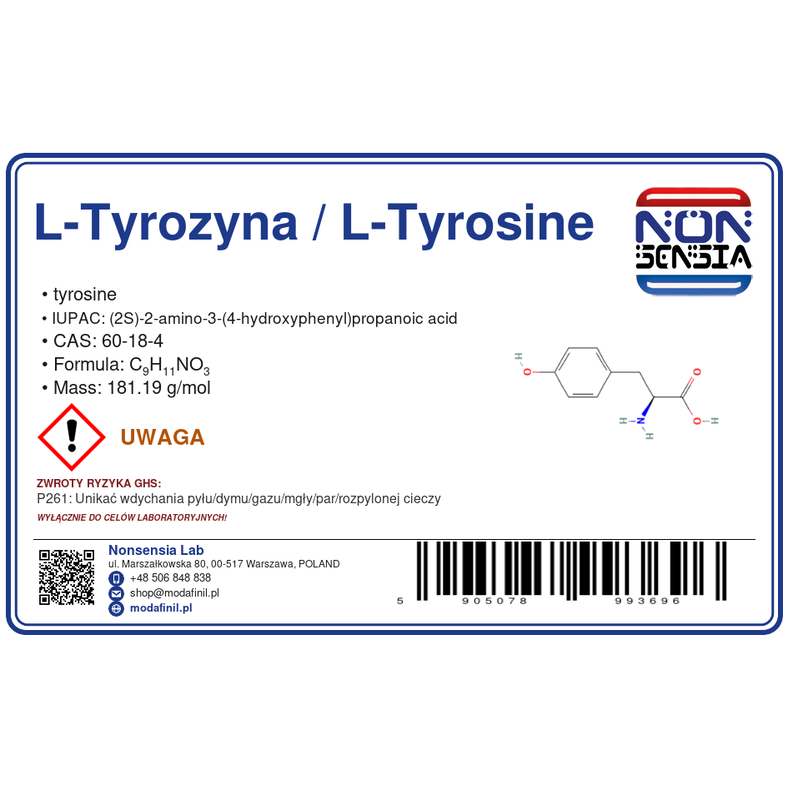
| Systematic name (IUPAC) | (2S)-2-amino-3-(4-hydroxyphenyl)propanoic acid |
|---|---|
| Common name | L-tyrosine (tyrosyl — name of the residue in a peptide chain) |
| CAS number | 60-18-4 |
| Molecular formula | C9H11NO3 |
| Molar mass | 181.19 g·mol−1 |
| Monoisotopic mass | 181.0739 Da |
| InChIKey | OUYCCCASQSFEME-QMMMGPOBSA-N |
| SMILES | C1=CC(=CC=C1C[C@@H](C(=O)O)N)O |
| PubChem CID | 6057 |
| ChEMBL | CHEMBL3659228 |
| Form | crystalline powder, white to off-white |
| Purity | ≥ 99% |
| Intended use | research reagent — not for human or animal consumption |
Lineage of the molecule: from cheese casein to a standard proteinogenic amino acid
The name “tyrosine” derives from the Greek tyros — cheese. The etymology is no accident: the compound was first isolated in 1846 by the German chemist Justus von Liebig from casein, the principal protein of cheese, in the course of work on the hydrolysis products of proteins. This was a period of intensive research into the breakdown of proteins into their constituent “building blocks” — by the same route of acidic or alkaline hydrolysis, most of the remaining standard amino acids were isolated over the following decades.
Phenylalanine as precursor: the enzyme that adds a hydroxyl group
In mammals, tyrosine is not obtained solely from food — it is also formed from L-phenylalanine in a reaction catalysed by the enzyme phenylalanine hydroxylase, which attaches a hydroxyl group to the aromatic ring. A disturbance of this pathway — deficiency or absence of enzyme activity — underlies phenylketonuria, a disease first described by the Norwegian physician Ivar Asbjørn Følling in 1934. A biochemical characterisation of the recombinant human enzyme was given by Ledley et al. [6], and Müller and co-workers showed, in a paper published in PNAS, that in adult humans the kidney is an important site of this conversion [5]. For this reason tyrosine is classified as a conditionally essential amino acid — the organism can produce it, but only provided there is a sufficient supply of phenylalanine and a functional enzyme.
The further pathway: starting point for catecholamines and thyroid hormones
This is solely a description of a biochemical pathway occurring in the organism, not information about the action of the reagent offered. Tyrosine is the substrate for the enzyme tyrosine hydroxylase, which catalyses the step regarded as rate-limiting for the entire catecholamine biosynthesis pathway — leading via L-DOPA to dopamine, noradrenaline and adrenaline. The regulation of this enzyme in the central nervous system was reviewed by Masserano and Weiner [7]. A separate pathway, unrelated to tyrosine hydroxylase, is the use of tyrosine as a structural core in the biosynthesis of thyroid hormones — Edward C. Kendall isolated thyroxine, built on the tyrosine skeleton, in 1914. None of these pathways is a property conferred by the analytical reagent — they are processes occurring in the living organism using endogenous or dietary tyrosine, not the material offered here for laboratory purposes.
Timeline
| 1846 | Justus von Liebig isolates tyrosine from cheese casein; hence the name from the Greek tyros |
|---|---|
| 2nd half of the 19th c. | tyrosine counted among the standard proteinogenic amino acids; development of methods for the hydrolysis and identification of amino acids |
| 1914 | Edward C. Kendall isolates thyroxine — a thyroid hormone built on the tyrosine skeleton |
| 1934 | Ivar Asbjørn Følling describes phenylketonuria — a disease associated with impaired conversion of phenylalanine to tyrosine |
| 1983 | review of tyrosine hydroxylase regulation in the central nervous system [7] |
| 1987 | biochemical characterisation of recombinant phenylalanine hydroxylase [6] |
| 1994 | description of tyrosine racemisation in the proteins of the ageing eye lens as a model of racemisation chemistry [4] |
| 1997 | method for trace determination of the positional isomers meta- and ortho-tyrosine by GC-MS [8] |
| 2000 | demonstration of the kidney as a site of phenylalanine-to-tyrosine conversion in adult humans [5] |
| 2009 | synthetic method limiting racemisation in Suzuki couplings of tyrosine derivatives [3] and an HPLC method with fluorescence detection for determining tyrosine in plasma and dried blood [1] |
| 2011 | trace analysis of D-tyrosine by microchip electrophoresis with fluorescence detection [2] |
Chemistry: why the L configuration and not D, and why the para position matters
The stereogenic centre at the alpha carbon
As in every chiral proteinogenic amino acid, the stereogenic centre of tyrosine is the alpha carbon — it bears four different substituents: an amino group, a carboxyl group, a hydrogen atom and a side chain with a 4-hydroxyphenyl ring. The naturally occurring form incorporated into proteins has the L configuration (corresponding to S in the R/S nomenclature for this molecule); its mirror image, D-tyrosine, is not used in mammalian protein synthesis, but appears as a biochemical marker and is the subject of separate analytical methods — trace analysis of D-tyrosine in biological samples by microchip electrophoresis with fluorescence detection was described by Huang et al. [2].
Racemisation: why control of chirality matters in practice
The alpha carbon of amino acids, including tyrosine, can undergo racemisation — slow conversion to the D form, spontaneous or catalysed — under conditions of high temperature, a strongly alkaline environment or in the presence of certain synthetic catalysts. The phenomenon has been described both as a marker of ageing of structural proteins — racemisation of tyrosine in the insoluble protein fraction of the ageing eye lens [4] — and as a practical synthetic problem: in Suzuki couplings of aryl derivatives of tyrosine, an appropriate choice of ligand (SPhos) made it possible to limit undesired racemisation of the product [3]. For a laboratory using this reagent the conclusion is practical: declared chemical purity is not the same as enantiomeric purity — confirming the L/D ratio requires a chiral method, not merely a total assay.
Why the position of the substituent matters: para-, not meta- or ortho-tyrosine
The hydroxyl group in tyrosine is located at the para position of the phenyl ring. This is not the only chemically possible position: oxidation of phenylalanine by hydroxyl radicals can lead to the formation of positional isomers — meta-tyrosine and ortho-tyrosine — regarded as markers of oxidative protein damage, distinct from the normal, para-substituted protein tyrosine. A method for trace determination of both isomers by gas chromatography–mass spectrometry with electron-capture ionisation was described by Blount and Duncan [8]. For analytics this means that merely detecting “tyrosine” in a mass spectrum does not settle the position of the substituent at the same molecular mass — distinguishing positional isomers requires chromatographic separation before detection.
Physicochemical characteristics
| Parameter | Value | Implication |
|---|---|---|
| Partition coefficient (logP) | −2.3 | strongly hydrophilic molecule — short retention time in classical RP-HPLC without derivatisation or ion-pairing |
| Topological polar surface area | 83.6 Å2 | high — reflects the simultaneous presence of phenolic, amino and carboxyl groups |
| Hydrogen bond donors | 3 | phenolic OH group, NH2 group and carboxyl group |
| Hydrogen bond acceptors | 4 | phenolic oxygen, amino nitrogen, two carboxyl oxygens |
| Melting point (with decomposition) | 343.5 °C | typical of amino acids — thermal decomposition precedes true melting |
| Solubility | poor in water and in common organic solvents; good in dilute solutions of acids and bases | prepare stock solutions by acidification or alkalinisation, not in pure water |
Nomenclature and synonyms
One molecule, many forms of notation in chemical databases and catalogues — useful when building a bibliographic query or checking that a batch matches an order:
- L-Tyrozyna / L-Tyrosine — the name most common in commercial circulation and in the Polish literature;
- Tyrosyl — the name used when referring to a tyrosine residue incorporated into a peptide chain rather than to the free amino acid;
- (S)-Tyrosine — designation of the absolute configuration in R/S nomenclature, equivalent to L for this molecule;
- p-Tyrosine / L-p-Tyrosine — notation emphasising the para position of the hydroxyl substituent, distinguishing it from the meta and ortho isomers;
- 4-Hydroxy-L-phenylalanine — systematic name deriving from phenylalanine as the parent compound;
- Tyrosinum — Latin pharmacopoeial form, found in older and Central European sources;
- (2S)-2-amino-3-(4-hydroxyphenyl)propanoic acid — the IUPAC systematic name, the only unambiguous one.
The divergence of names has a bibliographic consequence: when building a query it is worth combining the Latin, English and systematic variants — otherwise some records, especially older and pharmacopoeial ones, will remain invisible.
Laboratory applications of the reagent
- reference material for confirming identity and purity by HPLC-UV or HPLC with fluorescence detection — a technique for determining tyrosine alongside other amino acids in plasma and dried blood was described by Kand’ár et al. [1];
- standard for distinguishing positional isomers (para- versus meta-/ortho-tyrosine) by GC-MS [8];
- material for chiral methods distinguishing the L and D forms [2];
- internal or external standard in amino acid analysis panels, including pre-column derivatisation methods;
- model substrate in research on the synthetic chemistry of phenolic amino acid derivatives, including coupling reactions with racemisation control [3];
- model compound in teaching and research on the chemistry of aromatic amino acids.
Storage, handling and occupational safety
Store in the original, tightly closed container in a dry, cool place protected from light, separately from food and animal feed and out of the reach of children. Work only under laboratory conditions, using personal protective equipment: gloves, safety glasses and laboratory clothing; weigh the powder under conditions that limit dust formation. Avoid inhaling the dust and contact with skin and eyes. Dispose of waste in accordance with the regulations applicable to chemical waste at the place where the research is conducted.
Hazard classification. According to PubChem registry data, the material carries the GHS07 pictogram (exclamation mark) with the signal word “Warning” and the precautionary statement P261 — avoid breathing dust. This classification concerns the reagent powder form and has no connection whatsoever with any assessment of safety for consumption — the material remains not for consumption regardless of the declared purity grade.
Regulatory status
L-tyrosine is not a controlled substance or a registered medicinal product — as a naturally occurring proteinogenic amino acid it is a component of food and is also marketed as a component of food products intended for oral use, which are subject to separate food-law regulations. This offer is not subject to those regulations — the material offered is a chemical reagent, sold without food labelling, without serving information and not for human or animal consumption. The buyer is responsible for ensuring that the intended use complies with the law in force in the country of destination.
Frequently Asked Questions
How does L-tyrosine differ from D-tyrosine?
In the spatial configuration at the alpha carbon — L-tyrosine is the form incorporated into proteins and naturally predominant; D-tyrosine is its mirror image, used mainly as a biochemical marker and the subject of separate analytical methods. Molecular mass alone does not distinguish the two forms — a chiral method is required [2].
What are the chemical formula and molar mass of L-tyrosine?
C9H11NO3; molar mass 181.19 g·mol−1, monoisotopic mass 181.0739 Da. CAS number 60-18-4, InChIKey OUYCCCASQSFEME-QMMMGPOBSA-N.
Where does the name “tyrosine” come from?
From the Greek tyros — cheese. Justus von Liebig isolated this amino acid in 1846 from casein, the principal protein of cheese.
Is tyrosine an essential amino acid?
Not in the strict sense — it is classified as a conditionally essential amino acid. The organism can synthesise it from phenylalanine with the participation of phenylalanine hydroxylase, provided there is a sufficient supply of the precursor and a functional enzyme [5][6].
Is the reagent suitable for uses other than laboratory ones?
No. The material is intended exclusively for laboratory and analytical research. It is not intended for human or animal consumption; it is not a medicine, foodstuff or cosmetic and must not be used for medical, diagnostic or consumption purposes.
How should L-tyrosine be stored as a laboratory reagent?
In the original, tightly closed container in a dry, cool place protected from light, separately from food and animal feed and out of the reach of children.
What should L-tyrosine be dissolved in to prepare a stock solution?
It dissolves poorly both in water and in common organic solvents; well — in dilute solutions of acids or bases, owing to ionisation of the carboxyl and phenolic groups. Stock solutions are prepared by acidification or alkalinisation, not in pure water.
How is the purity of L-tyrosine confirmed?
By HPLC-UV or HPLC with fluorescence detection against a reference material [1]; a chiral method is required to distinguish the L and D forms — a total assay alone does not settle enantiomeric purity.
Is a safety data sheet supplied with L-tyrosine?
We provide the safety data sheet on request to recipients engaged in research or analytical activities.
Is L-tyrosine legal in Poland?
Yes — it is not a controlled substance. As a natural amino acid it is also marketed as an ingredient of food products, which are subject to separate food-law regulations that do not apply to this offer. The material offered is a chemical reagent, not for consumption. The buyer is responsible for ensuring that the intended use complies with the law of the country of destination.
How is L-tyrosine identified in mass spectrometry?
By the accurate ion mass (monoisotopic mass 181.0739 Da) and the characteristic fragmentation to the 4-hydroxybenzyl radical. Mass alone, however, does not distinguish L-tyrosine from D-tyrosine (identical) or from the positional isomers meta- and ortho-tyrosine (same total mass) — separation requires chromatography preceding detection [8].
What is an L-tyrosine standard used for in an analytical laboratory?
For confirming identity and purity by HPLC, as a standard in amino acid analysis panels, as a material for distinguishing positional and configurational isomers, and as a model substrate in the synthetic chemistry of phenolic amino acid derivatives.
References
The entries come from the PubMed database and concern the chemistry, analytics and biochemistry of the biosynthetic pathway of this molecule. Entries [1], [2], [3], [8] are methodological and analytical papers; [5], [6], [7] are biochemical papers on the metabolism of phenylalanine and tyrosine in the organism; [4] is a paper describing the chemistry of racemisation in a biological model. None of them describes the use of the analytical reagent or the effect of its consumption — they are cited as scientific context and a bibliographic pointer, not as information about the properties of the material offered nor as encouragement of any use.
- Kand’ár R, Žáková P, Jirošová J, Sladká M (2009). “Determination of branched chain amino acids, methionine, phenylalanine, tyrosine and alpha-keto acids in plasma and dried blood samples using HPLC with fluorescence detection.” Clin Chem Lab Med. PMID 19290779. doi:10.1515/CCLM.2009.123.
- Huang Y, Shi M, Zhao S, Liang H (2011). “Trace analysis of D-tyrosine in biological samples by microchip electrophoresis with laser induced fluorescence detection.” J Chromatogr B. PMID 21342793. doi:10.1016/j.jchromb.2011.01.033.
- Prieto M, Mayor S, Lloyd-Williams P, Giralt E (2009). “Use of the SPhos ligand to suppress racemization in arylpinacolboronate ester Suzuki couplings involving alpha-amino acids.” J Org Chem. PMID 19863122. doi:10.1021/jo901899w.
- Luthra M, Ranganathan D, Ranganathan S, Balasubramanian D (1994). “Racemization of tyrosine in the insoluble protein fraction of brunescent aging human lenses.” J Biol Chem. PMID 8077220.
- Müller N, Meek S, Bigelow M, Andrews J, Nair KS (2000). “The kidney is an important site for in vivo phenylalanine-to-tyrosine conversion in adult humans.” Proc Natl Acad Sci U S A. PMID 10655515. doi:10.1073/pnas.97.3.1242.
- Ledley FD, Grenett HE, Woo SL (1987). “Biochemical characterization of recombinant human phenylalanine hydroxylase produced in Escherichia coli.” J Biol Chem. PMID 3546287.
- Masserano JM, Weiner N (1983). “Tyrosine hydroxylase regulation in the central nervous system.” Mol Cell Biochem. PMID 6137760. doi:10.1007/BF00225250.
- Blount BC, Duncan MW (1997). “Trace quantification of the oxidative damage products, meta- and ortho-tyrosine, in biological samples by gas chromatography-electron capture negative ionization mass spectrometry.” Anal Biochem. PMID 9025943. doi:10.1006/abio.1996.9900.
Identification data and computed descriptors from PubChem (CID 6057), the ChEMBL registry (CHEMBL3659228) and the NIST WebBook.
Related reagents in our catalogue
- L-Phenylalanine — the direct precursor in the biosynthetic pathway: phenylalanine hydroxylase converts it into tyrosine
- L-DOPA — the next step of the same pathway: tyrosine is the substrate for tyrosine hydroxylase, which produces L-DOPA as the catecholamine precursor
- 5-HTP — a contrast of pathways: a parallel but independent neurotransmitter precursor, formed from tryptophan, not from tyrosine
Statement of intended use
The material offered is a chemical reagent intended exclusively for research, analytical and laboratory purposes. It is not intended for human or animal consumption. It is not a medicinal product, food supplement, foodstuff, medical device or cosmetic. It must not be used for medical, diagnostic, therapeutic, prophylactic or consumption purposes, administered to humans or animals, applied to the skin, or added to food, beverages or animal feed. Sold exclusively to recipients engaged in research, scientific or analytical activities who have laboratory facilities and the knowledge required to handle chemical reagents safely. The buyer bears sole responsibility for the lawful and safe use of the reagent and for compliance with the regulations in force in the country of destination.