
Description
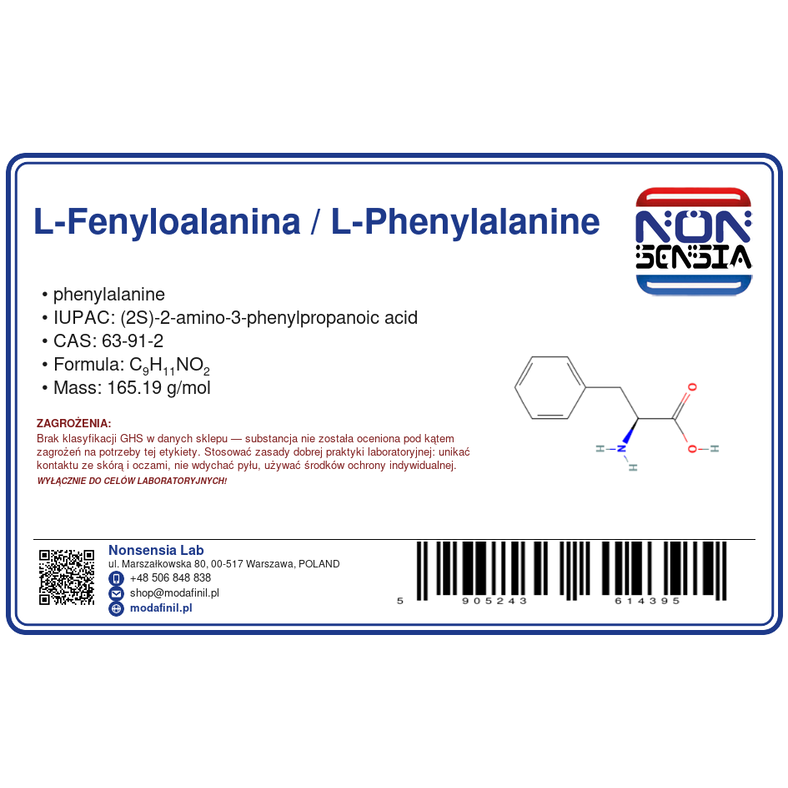
(2S)-2-amino-3-phenylpropanoic acid, crystalline powder, 1000 mg pack. Material intended exclusively for laboratory and analytical in vitro research. The product is not intended for human or animal consumption; it is not a medicinal product, food supplement, foodstuff or cosmetic.
Three distinct entities that must not be confused
The name “phenylalanine” tends to be used interchangeably in three different contexts — as a chemical concept, as a constituent of registered pharmaceutical preparations administered in hospital settings, and as a laboratory material. Separating these layers is just as important here as for the substances with a stronger regulatory profile in our catalogue:
| Entity | What it is | Status |
|---|---|---|
| Chemical substance L-phenylalanine, CAS 63-91-2 |
A chemical concept — one of the twenty proteinogenic amino acids, a building block of proteins. In itself it is neither a drug nor a reagent; its status is conferred only by the form in which it has been manufactured and authorised for marketing. | — |
| Medicinal product constituent of parenteral nutrition solutions |
L-phenylalanine is a constituent of multi-component amino acid solutions for intravenous infusion, used in the parenteral nutrition of hospital patients. These preparations are manufactured under a GMP regime, at a strictly defined concentration, as part of a complex mixture of more than a dozen amino acids — never as a single substance. | clinical data on the administration of amino acids to patients concern this entity |
| Chemical reagent the material offered here |
Material for laboratory and analytical work: standard, substrate, reference material. It does not have, and cannot have, authorisation for use in humans or animals — it has no pharmaceutical form, is not subject to a pharmaceutical manufacturing regime, and is not accompanied by medicinal product documentation. | analytics, chemistry, reference standards |
The consequence is unambiguous. Data on the role of phenylalanine in the human body — its absorption, its conversion to tyrosine or the kinetics of its plasma concentration [1] — come from physiological and clinical studies conducted either on phenylalanine contained in food or on registered pharmaceutical preparations administered under medical supervision. None of these studies was conducted using an analytical reagent, and none of these findings carries over to the material offered. The reagent is not a form in which the substance has ever been administered to humans for therapeutic or nutritional purposes, and it must not be used in such a way.
Reagent identification sheet
| Systematic name (IUPAC) | (2S)-2-amino-3-phenylpropanoic acid |
|---|---|
| Common name | L-phenylalanine (L-Fenyloalanina) |
| CAS number | 63-91-2 |
| Molecular formula | C9H11NO2 |
| Molar mass | 165.19 g·mol−1 |
| Monoisotopic mass | 165.0790 Da |
| InChIKey | COLNVLDHVKWLRT-QMMMGPOBSA-N |
| SMILES | C1=CC=C(C=C1)C[C@@H](C(=O)O)N |
| PubChem CID | 6140 |
| ChEMBL | CHEMBL373882 |
| Form | crystalline powder, white to off-white |
| Purity | ≥ 99% |
| Intended use | research reagent — not for human or animal consumption |
Lineage of the molecule: from a green urine sample to newborn screening worldwide
Phenylalanine as a chemical compound was already known to chemists in the 19th century, as one of the amino acids that make up proteins. Its actual lineage as a substance of distinct medical significance, however, begins only in 1934, in Oslo — and not in a chemistry laboratory, but with the observation of two children.
A mother, two children and an unusual urine odour
A Norwegian physician drew the attention of the chemist Asbjørn Følling to the unusual odour of the urine of her two children with intellectual disability. Følling examined the samples chemically using a simple reaction with iron(III) chloride — a test that typically gives a violet colour with ketone bodies. Instead, he obtained a persistent green colour, the signal of a compound he could not immediately identify. Further analysis led him to phenylpyruvic acid — a product of phenylalanine metabolism that accumulates in the body when the enzyme converting this amino acid into tyrosine is lacking. The history of this discovery and the circumstances in which it came about were reconstructed by Centerwall [2] and by Følling himself in a memoir published sixty years later [3].
In 1934 Følling described this disease entity as “imbecillitas phenylpyruvica” — a name later replaced by the term phenylketonuria. A detailed historical analysis of the discovery, including Følling’s role and the context of Norwegian medicine in the 1930s, was presented by Christ [4], and a synthesis of a hundred years of screening research by Woolf [5].
From symptom to population screening
For three decades after the discovery, phenylketonuria was diagnosed only after irreversible damage to the central nervous system had occurred. This was changed by the introduction of the Guthrie test — a microbiological bacterial growth inhibition assay performed on a drop of blood taken from a newborn, making it possible to detect an elevated phenylalanine concentration before any symptoms appear. Early descriptions of the method and experience with its implementation in population screening programmes were published by Partington [6] and Blumenfeld [7]. Phenylketonuria thus became one of the first diseases covered by universal newborn screening worldwide — a model later extended to dozens of other metabolic disorders.
Timeline
| 1934 | Asbjørn Følling identifies phenylpyruvic acid in the urine of two children with intellectual disability; describes “imbecillitas phenylpyruvica” [2][4] |
|---|---|
| 1950s | introduction of a diet with controlled phenylalanine content as the first effective intervention |
| 1960s | implementation of the Guthrie test in population newborn screening [6][7] |
| 1997 | systematic comparison of four methods for determining phenylalanine in screening samples [8] |
| 2014 | American guideline for the diagnosis and management of phenylalanine hydroxylase deficiency [9] |
| 2017 | complete European guidelines for the diagnosis and treatment of phenylketonuria [10] |
| 2023–2024 | development of tandem mass spectrometry (LC-MS/MS) in newborn screening, displacing the Guthrie test [11][12] |
The 2014 and 2017 guidelines [9][10] were developed independently on both sides of the Atlantic and reached convergent conclusions — for the laboratory, this signals that the phenylalanine determination methods described below are validated on an international scale, not in a single centre.
Chemistry: the stereogenic centre at the α-carbon and what follows from it
Why S, not R, is the biologically relevant form
The α-carbon atom (C2) of phenylalanine bears four different substituents — an amino group, a carboxyl group, a hydrogen atom and a benzyl group — which makes it a stereogenic centre. The natural enantiomer incorporated into proteins has the S configuration and is designated L-phenylalanine; the enantiomer with the R configuration, D-phenylalanine, has the same molecular formula and the same mass but is not a substrate of ribosomal protein synthesis in mammals. The two forms cannot be distinguished by achiral methods — this requires a chiral column or derivatisation with a chiral reagent. Methods for separating phenylalanine enantiomers were described by Lomenova et al., using achiral-chiral two-dimensional chromatography in a dietary supplement matrix [13], and by Hsiao et al., determining phenylalanine enantiomers in mammalian plasma and urine by two-dimensional HPLC [14].
For the laboratory this has a practical consequence analogous to the one we describe for modafinil: a total determination by an achiral method does not settle the enantiomeric purity of the material. The declaration “L-phenylalanine ≥ 99%” refers to chemical purity, not to the enantiomer ratio, unless the manufacturer states this separately.
Isotopic labels and mass spectrometry
Phenylalanine labelled with stable isotopes (2H, 13C, 15N) is a standard tool of quantitative mass spectrometry — it serves as an internal standard in GC-MS and LC-MS/MS methods, allowing the analyte signal to be distinguished from the biological matrix background by the mass difference. The methodology for determining isotopic ratios of L-leucine and L-phenylalanine by gas chromatography/triple-stage quadrupole mass spectrometry was described by Schweer et al. [15].
Physicochemical characteristics
| Parameter | Value | What follows from it |
|---|---|---|
| Partition coefficient (logP, computed) | ≈ −1.5 | a distinctly hydrophilic compound — short retention time in standard RP-HPLC without derivatisation |
| Topological polar surface area | 63.3 Å2 | moderate, dominated by the amino and carboxyl groups |
| Hydrogen bond donors | 2 | amino group |
| Hydrogen bond acceptors | 3 | carboxyl oxygen and amino nitrogen |
| Melting point | ≈ 283 °C (with decomposition) | typical of free amino acids — the compound decomposes before classical boiling could be spoken of |
| Solubility | good in water (zwitterionic form); negligible in non-polar solvents | prepare stock solutions in water or aqueous buffer |
Nomenclature and synonyms
A single CAS number, 63-91-2, covers more than a dozen naming variants, some of which are confused with related but distinct substances:
- L-fenyloalanina / L-Phenylalanine — the name most common in scientific and commercial circulation;
- Phe (three-letter code) and F (one-letter code) — standard designations used in protein biochemistry and bioinformatics;
- (S)-phenylalanine, (2S)-2-amino-3-phenylpropanoic acid — systematic names unambiguously indicating the absolute configuration;
- 3-phenyl-L-alanine, beta-phenyl-L-alanine — descriptive names emphasising the position of the phenyl ring relative to the alanine skeleton;
- Phenylalaninum — the Latin pharmacopoeial form;
- fenilalanina — the spelling found in Spanish- and Portuguese-language sources.
An important note for orders and bibliographic queries. The name “phenylalanine” without a configurational prefix is often used by default for the L form, but this is not a universal rule. D-phenylalanine (the R enantiomer) and DL-phenylalanine (the racemic mixture) have the same molecular formula but separate CAS numbers and different behaviour in biological systems and chiral analytical methods. The material offered here is exclusively the L form, CAS 63-91-2 — when ordering and searching the literature, it is always worth confirming which enantiomer the query concerns.
Laboratory applications of the reagent
- reference material for confirmation of identity and purity by HPLC-UV;
- calibration standard in amino acid analysers based on ion-exchange chromatography with post-column derivatisation;
- starting material for enantiomer separation methods (L/D) by chiral HPLC [13][14];
- standard in LC-MS/MS methods used in newborn screening and metabolic diagnostics [8][12];
- substrate and model compound in solid-phase peptide synthesis, after appropriate protection of the functional groups;
- model compound in studies of the shikimate pathway and aromatic amino acid biosynthesis in plants and microorganisms [16].
Storage, handling and occupational safety
Store in the original, tightly closed container, in a dry and cool place, protected from light, separately from food and feed and out of the reach of children. Work only under laboratory conditions, using personal protective equipment: gloves, safety glasses and laboratory clothing; weigh the powder under conditions that limit dust formation. Avoid inhaling dust and contact with skin and eyes. Dispose of waste in accordance with the regulations applicable to chemical waste at the place where the research is conducted.
Regulatory status
L-phenylalanine is not a controlled substance nor a substance covered by the international drug control conventions. Its regulatory status is, however, unusual among the reagents in our catalogue: it is not the risk of misuse but the need for a specific group of patients to avoid it that forms the axis of the regulations concerning it.
People with phenylketonuria and related disorders of phenylalanine metabolism must limit its dietary supply throughout their lives. This has a direct bearing on food law: foodstuffs containing aspartame — a sweetener whose molecule releases phenylalanine on hydrolysis — must carry a warning about its presence on the label in the European Union. This relationship, together with a quantitative characterisation of the phenylalanine content of aspartame, was described by Bickel as early as 1986 [17].
The substance is moreover a constituent of registered medicinal products — multi-component amino acid solutions for parenteral nutrition, authorised for marketing and used exclusively in hospital settings. The registration of these preparations in no way concerns the chemical reagent offered here and confers no medicinal product status on it. The material offered is a chemical reagent and has no approval for any use in humans or animals. The purchaser is responsible for ensuring that the intended use complies with the law in force in the country of destination.
Frequently Asked Questions
How does L-phenylalanine differ from D-phenylalanine?
In the configuration at the stereogenic α-carbon centre: L-phenylalanine has the S configuration and is the form incorporated into proteins, D-phenylalanine has the R configuration and is not a substrate of ribosomal protein synthesis in mammals. Both have the same molecular formula and the same mass — only chiral analysis distinguishes them.
What are the chemical formula and molar mass of L-phenylalanine?
C9H11NO2; molar mass 165.19 g·mol−1, monoisotopic mass 165.0790 Da. CAS number 63-91-2, InChIKey COLNVLDHVKWLRT-QMMMGPOBSA-N.
What is phenylketonuria and how is it related to this amino acid?
It is a rare genetic disease in which the enzyme (phenylalanine hydroxylase) that converts phenylalanine into tyrosine is lacking. Untreated, it leads to the accumulation of phenylalanine and its metabolites and to irreversible damage to the central nervous system. It was described by Asbjørn Følling in 1934, and its detection initiated universal newborn screening [2].
Why do products containing aspartame carry a phenylalanine warning on the label?
Because aspartame, on hydrolysis in the digestive tract, releases phenylalanine among other products. For people with phenylketonuria this has direct clinical significance, which is why EU food law requires an appropriate warning on the label [17].
Is the reagent suitable for applications other than laboratory use?
No. The material is intended exclusively for laboratory and analytical research. It is not intended for human or animal consumption, it is not a drug, food supplement, food or cosmetic, and it must not be used for medical, diagnostic or consumption purposes.
How can L- and D-phenylalanine be distinguished in chromatographic analysis?
They cannot be distinguished by achiral methods — both forms have an identical mass and an identical molecular formula. Separation requires a chiral column or derivatisation with a chiral reagent; this has been described, among others, in achiral-chiral two-dimensional chromatography [13] and in determinations of the enantiomers in biological matrices [14].
How should L-phenylalanine be stored as a laboratory reagent?
In the original, tightly closed container, in a dry and cool place, protected from light, separately from food and feed and out of the reach of children.
What should L-phenylalanine be dissolved in to prepare a stock solution?
With logP ≈ −1.5, the compound is distinctly hydrophilic and dissolves well in water in its zwitterionic form; it dissolves poorly in non-polar solvents. Stock solutions are therefore prepared in water or aqueous buffer — unlike the distinctly lipophilic materials in our catalogue, such as bromantane.
How are the purity and identity of L-phenylalanine confirmed?
By HPLC-UV against a reference material; to confirm enantiomeric purity, and not only chemical purity, a chiral method is additionally required — the declaration “≥ 99%” alone does not settle the proportion of enantiomers.
Is a safety data sheet supplied with L-phenylalanine?
We make the safety data sheet available on request to recipients engaged in research or analytical activity.
Is L-phenylalanine legal in Poland?
The substance is not subject to legal control as a narcotic or psychotropic substance. It is, however, a constituent of registered pharmaceutical preparations used in parenteral nutrition and is subject to separate food-law provisions on the labelling of products containing aspartame — this offer concerns exclusively the chemical reagent. The purchaser is responsible for ensuring that the intended use complies with the law in force in the country of destination.
Why is phenylalanine an essential amino acid?
Because mammals, including humans, lack the shikimate pathway — the metabolic route for biosynthesis of the aromatic ring present in plants, fungi and bacteria. Phenylalanine must therefore be supplied from outside, in the form of dietary protein [16].
What is an L-phenylalanine standard used for in an analytical laboratory?
For confirmation of identity and purity by HPLC-UV, as a calibration standard in amino acid analysers and LC-MS/MS methods, as material for enantiomer separation, and as a substrate in solid-phase peptide synthesis.
References
The entries come from the PubMed database and concern the history of the discovery, analytical methods and chemistry of this amino acid. [2]–[5] cover the history of the discovery of phenylketonuria; [6]–[8], [11]–[12] the development of methods for its detection; [9]–[10] are clinical guidelines; [13]–[15] are analytical papers on chirality and isotopic labelling. None of them describes the use of an analytical reagent — they are cited as scientific context and as a bibliographic pointer, not as information about the properties of the material offered nor as an encouragement to any use.
- Matthews DE (2007). “An overview of phenylalanine and tyrosine kinetics in humans.” J Nutr. PMID 17513423.
- Centerwall SA, Centerwall WR (2000). “The discovery of phenylketonuria: the story of a young couple, two retarded children, and a scientist.” Pediatrics. PMID 10617710.
- Følling I (1994). “The discovery of phenylketonuria.” Acta Paediatr Suppl. PMID 7766954.
- Christ SE (2003). “Asbjørn Følling and the discovery of phenylketonuria.” J Hist Neurosci. PMID 12785112.
- Woolf LI (2020). “The Early History of PKU.” Int J Neonatal Screen. PMID 33239585.
- Partington MW (1964). “Case finding in phenylketonuria. II. The Guthrie test.” Can Med Assoc J. PMID 14174526.
- Blumenfeld CM (1966). “Phenylketonuria — the Guthrie screening test — a method of quantitation, observations on reliability and suggestions for improvement.” Calif Med. PMID 18730038.
- Fingerhut R et al. (1997). “Comparison of four different phenylalanine determination methods.” Clin Chim Acta. PMID 9267704.
- Vockley J et al. (2014). “Phenylalanine hydroxylase deficiency: diagnosis and management guideline.” Genet Med. PMID 24385074.
- van Wegberg AMJ et al. (2017). “The complete European guidelines on phenylketonuria: diagnosis and treatment.” Orphanet J Rare Dis. PMID 29025426.
- Janzen N et al. (2023). “[Development of analytics in newborn screening — from the Guthrie card to genetics].” Bundesgesundheitsblatt Gesundheitsforschung Gesundheitsschutz. PMID 37828293.
- Duh TH et al. (2024). “Quantification of derivatized phenylalanine and tyrosine in dried blood spots using liquid chromatography with tandem spectrometry for newborn screening of phenylketonuria.” Eur J Mass Spectrom. PMID 38321764.
- Lomenova A et al. (2021). “Application of achiral-chiral two-dimensional HPLC for separation of phenylalanine and tryptophan enantiomers in dietary supplement.” Biomed Chromatogr. PMID 32840880.
- Hsiao SW et al. (2021). “Determination of phenylalanine enantiomers in the plasma and urine of mammals and D-amino acid oxidase deficient rodents using two-dimensional high-performance liquid chromatography.” Biochim Biophys Acta Proteins Proteom. PMID 32971287.
- Schweer H et al. (1996). “Determination of isotopic ratios of L-leucine and L-phenylalanine and their stable isotope labeled analogues in biological samples by gas chromatography/triple-stage quadrupole mass spectrometry.” J Mass Spectrom. PMID 8799305.
- Maeda H, Dudareva N (2012). “The shikimate pathway and aromatic amino acid biosynthesis in plants.” Annu Rev Plant Biol. PMID 22554242.
- Bickel H (1986). “[Aspartame: a sweetening agent with a high phenylalanine content].” Monatsschr Kinderheilkd. PMID 3748044.
Identification data and computed descriptors from PubChem (CID 6140) and the ChEMBL registry (CHEMBL373882); melting point from the NIST WebBook.
Related reagents in our catalogue
- L-Tyrosine — the direct product of the reaction catalysed by phenylalanine hydroxylase; the same metabolic pathway, the next step
- L-DOPA — two enzymatic steps further along the same aromatic amino acid pathway leading to the catecholamines
- 5-HTP — analogous biochemical logic: decarboxylation of an aromatic amino acid to a monoamine precursor, in the tryptophan pathway instead of the phenylalanine/tyrosine pathway
Statement of intended use
The material offered is a chemical reagent intended exclusively for research, analytical and laboratory purposes. Not intended for human or animal consumption. It is not a medicinal product, food supplement, foodstuff, medical device or cosmetic. It must not be used for medical, diagnostic, therapeutic, prophylactic or consumption purposes, administered to humans or animals, applied to the skin, or added to food, beverages or feed. Sold exclusively to recipients engaged in research, scientific or analytical activity who have laboratory facilities and the knowledge required to handle chemical reagents safely. The purchaser bears sole responsibility for the lawful and safe use of the reagent and for compliance with the regulations in force in the country of destination.