
Description
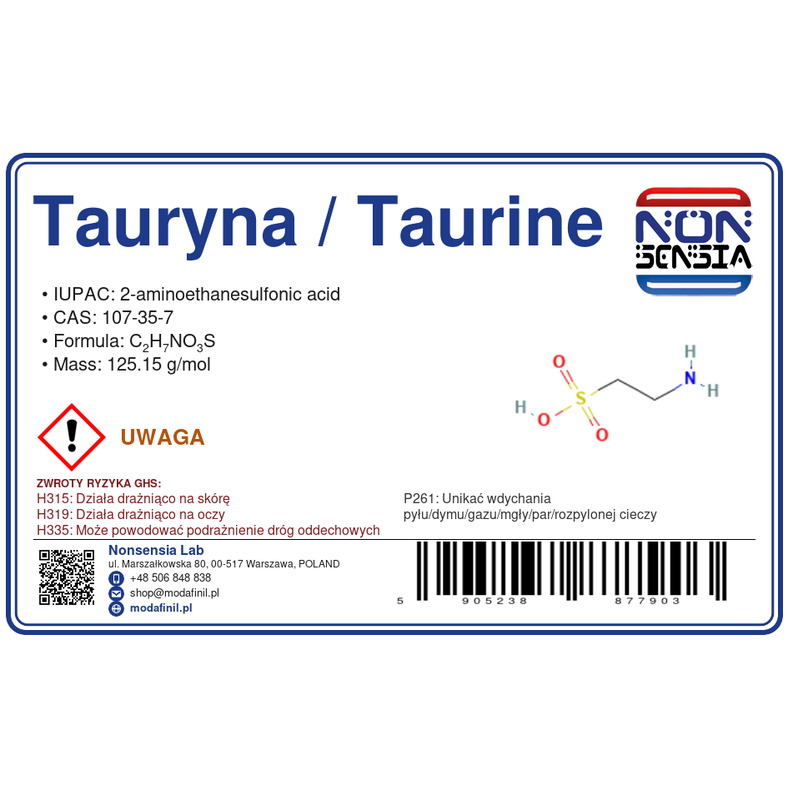
2-Aminoethanesulfonic acid, a white crystalline powder, 1000 mg package. The material is intended exclusively for laboratory and analytical in vitro research. The product is not intended for consumption by humans or animals, nor is it a medicinal product, a dietary supplement, a foodstuff, or a cosmetic.
Three different entities that must not be confused
For this molecule, separating the layers is especially important, because taurine simultaneously occupies more legal contexts than most substances in our catalog: it is a natural metabolite, a permitted food ingredient within strictly defined limits, an active substance of registered medicinal products in certain countries — and a chemical reagent, which is the only context this page addresses.
| Entity | What it is | What it concerns |
|---|---|---|
| Chemical substance taurine, CAS 107-35-7 |
A chemical concept — a β-amino acid with a defined structure. On its own it is neither a drug, nor a reagent, nor a food ingredient; its status is conferred by the form in which it has been manufactured and approved. | chemistry, substance registries (PubChem CID 1123, ChEMBL CHEMBL4297772) |
| Medicinal product including preparations under the trade names Taufon, Taukard |
Pharmaceutical preparations in a defined pharmaceutical form (e.g., eye drops), manufactured under pharmaceutical regulatory regimes, with registration documentation and safety oversight, approved in certain countries. These names appear as synonyms of the substance in chemical registries (PubChem) alongside the common name. | when a clinical study involving humans exists, its results concern this entity — never the reagent |
| Chemical reagent the material offered here |
Material for laboratory and analytical work. It does not and cannot hold approval for use in humans or animals — it has no pharmaceutical form or medicinal product documentation, nor is it an approved food or feed ingredient. | analytics, chemistry, reference standards |
The consequence is unambiguous. The study results cited further on this page come either from purely analytical and chemical work (determination of the substance in various matrices), or from studies in laboratory animals conducted under controlled experimental conditions, and wherever the compound’s administration to animals or humans under clinical conditions is mentioned — this concerns the pharmaceutical or supplemental form used in that particular study, never the analytical reagent. The reagent is not the form in which the substance has ever been administered to humans or animals for purposes other than analytical ones, and it must not be used in such a way.
A separate layer, unusual for our catalog, is taurine’s status as a permitted food ingredient in some jurisdictions (energy drinks, infant formula) — discussed in the “Regulatory status” section. This status likewise does not extend to the reagent offered here: approval as a food ingredient applies to a specific food product manufactured in accordance with food law, not to a chemical raw material sold as laboratory material.
Reagent identification card
| Systematic name (IUPAC) | 2-aminoethanesulfonic acid |
|---|---|
| Common name | taurine |
| CAS number | 107-35-7 |
| Molecular formula | C2H7NO3S |
| Molar mass | 125.15 g·mol−1 |
| Monoisotopic mass | 125.0147 Da |
| InChIKey | XOAAWQZATWQOTB-UHFFFAOYSA-N |
| SMILES | C(CS(=O)(=O)O)N |
| PubChem CID | 1123 |
| Form | crystalline powder, white to off-white |
| Purity | ≥ 99.0% |
| Intended use | research reagent — not for consumption by humans or animals |
The molecule’s lineage: from ox bile to an analytical standard
Taurine is one of the few molecules in our catalog whose history reaches back to nineteenth-century organic chemistry, long before the emergence of modern pharmacology. The name comes from the Latin taurus — ox — because the compound was first isolated from ox bile. This discovery is tied to early work by German chemists on the composition of animal bile in the first half of the nineteenth century, a period when organic chemistry was only just establishing basic methods for separating and identifying organosulfur compounds.
A beta-amino acid, not a protein building block
Structurally, taurine belongs to the β-amino acids — the amino group is located on the second carbon atom, not the first, counting from the acid group, unlike the classical α-amino acids that build proteins. More importantly, taurine has no carboxyl group (-COOH) but rather a sulfonic group (-SO₃H) — for this reason it does not form peptide bonds and is never incorporated into protein chains. It is therefore an amino acid in the functional sense (it contains an amino group and an acid group), but falls outside the main biochemical classification of proteinogenic amino acids. For the laboratory this has a specific analytical consequence: standard protein sequencing and analysis methods do not cover it, and its determination requires separate methods suited to free amino acids and sulfur derivatives — see the “Chemistry” section below.
The 1975 discovery that shaped feed industry standards
A pivotal moment in the history of research on this molecule was the 1975 paper by Hayes and colleagues, published in the journal Science, describing retinal degeneration in cats fed a taurine-deficient diet [13]. The study was carried out on laboratory animals under controlled experimental conditions. This finding, further developed in subsequent years by studies on dilated cardiomyopathy in cats fed low-taurine diets [14], became one of the reasons why taurine is today mandatorily added to industrial feline feed formulations — a regulatory fact concerning the feed industry, cited here solely as historical context for research on the molecule, not as information about the use of the reagent offered here.
Timeline
| 1827 | isolation of the compound from ox bile as part of early German work on the composition of animal bile; the name derives from Lat. taurus |
|---|---|
| 1975 | description of retinal degeneration associated with a taurine-deficient diet in cats — a preclinical study in animals [13] |
| 1978–1992 | a series of studies on the role of taurine in the physiology of mammals and felids, conducted in laboratory animals and in veterinary diagnostics [14] |
| 1989 | development of a rapid method for determining taurine in biological tissue [5] |
| 2001 | first application of 33S NMR spectroscopy to detect taurine in biological tissues [1] |
| 2004–2005 | development of LC-MS/MS and HILIC-MS methods for determining taurine in marine invertebrates and carbohydrate-rich matrices [10][3] |
| 2014 | validation of a quantitative 1H NMR method for determining taurine in energy drinks [9] |
| 2020–2025 | formalization of reference methods: AOAC International validations and new LC-MS/MS methods for companion animals and sports nutrition products [8][6][11][12] |
Standardization of determination methods — why it matters for the laboratory
Taurine is one of the few molecules in our catalog for which a formally validated reference method, published by a standardization organization, exists. AOAC International — the organization responsible for validating analytical methods used in food and related product quality control — granted the method for determining taurine by UHPLC with MS/MS detection in multiple reaction monitoring mode the status of First Action 2022.08, following a single-laboratory validation carried out on infant formula and pediatric/adult nutritional products [6]. In parallel, the same organization validated a method based on proton NMR for the simultaneous determination of L-arginine, L-citrulline, and taurine [8].
For laboratory work, this means that the taurine reference material is used in three distinct, well-documented areas of analytics — veterinary diagnostics, quality control of food and nutritional products, and natural product chemistry — listed in detail in the “Laboratory use” section below. Physicochemical reference data (melting point) are additionally drawn from the NIST WebBook database.
Chemistry: a zwitterion without a chromophore, and what that means for the laboratory
Why taurine gives no signal in standard UV detection
The taurine molecule contains no aromatic ring or other extended conjugated system — its structure is a short ethylene chain terminated by an amino group on one side and a sulfonic group on the other. The absence of a chromophore means no native UV absorbance in the range typical for HPLC-UV detection. For this reason, most chromatographic methods require derivatization prior to analysis — the most commonly used reagent is o-phthalaldehyde combined with a thiol (e.g., ethanethiol), which reacts with the amino group and yields a fluorescent or electroactive product [7]. An alternative that bypasses the derivatization step is the use of mass spectrometry- or NMR-based methods.
Extreme hydrophilicity — why an ordinary C18 column fails
Taurine’s octanol/water partition coefficient is negative and clearly differs from that of other compounds in our catalog — the molecule exists as a zwitterion (a simultaneously protonated amino group and a dissociated sulfonic group), strongly polar and highly soluble in water. In classical reversed-phase chromatography on a C18 column, a compound with such a low logP elutes with practically no retention, together with the solvent front, which makes separation from other polar matrix components impossible. A solution used in the literature is hydrophilic interaction chromatography (HILIC), validated for determining taurine and methionine in carbohydrate-rich matrices [3], or ion-exchange/ion-pair chromatography.
Physicochemical characteristics
| Parameter | Value | What this means |
|---|---|---|
| Partition coefficient (XLogP) | ≈ −4.1 | an extremely hydrophilic zwitterion — no retention on a standard C18 column without derivatization or ion-pairing |
| Topological polar surface area | 88.8 Å2 | high polarity consistent with the zwitterionic form (-NH₂ and -SO₃H groups) |
| Hydrogen bond donors | 2 | the amino group |
| Hydrogen bond acceptors | 4 | three oxygen atoms of the sulfonic group and the nitrogen atom |
| Rotatable bonds | 2 | a short, flexible ethylene chain between the functional groups |
| Melting point | approx. 300°C, with decomposition (NIST data) | no sharp melting point typical of inner salts — DSC/TGA is better suited than a Thiele tube for identity confirmation |
| Solubility | very good in water; poor in ethanol and non-polar solvents | prepare stock solutions in water or aqueous buffer |
The stereogenic center that isn’t there
Unlike many other entries in our catalog, taurine has no stereogenic center at all. Both carbon atoms of the chain carry two hydrogen atoms each and do not meet the requirement of four different substituents needed for chirality; the sulfur atom of the sulfonic group is fully and symmetrically surrounded by three equivalent oxygen atoms. The molecule is therefore achiral — no enantiomers exist, and the material requires neither optical resolution nor a declaration of absolute configuration, which simplifies standard qualification compared with compounds containing a stereogenic center on carbon or sulfur.
A rare isotope that provides a unique tool: 33S NMR
Sulfur has three stable isotopes, of which 33S (nuclear spin 3/2) occurs in natural abundance at only about 0.76%. Despite its low natural abundance and the measurement difficulties associated with the quadrupolar character of the nucleus, methods have been developed for the direct detection of taurine by 33S NMR in biological tissues [1], later extended to studies of isotopically labeled material in the solid state and in solution [2]. This is one of the few techniques allowing direct observation of the sulfur atom within the molecule, without the mediation of protons or carbon.
Nomenclature and synonyms
Taurine appears under more than a dozen names in various registries — chemical, pharmaceutical, and industrial. The terms below all refer to the same compound, CAS number 107-35-7:
- Taurine — the common name, the most widely used internationally;
- 2-Aminoethanesulfonic acid — the systematic IUPAC name, the only unambiguous one;
- 2-Aminoethylsulfonic acid / aminoethylsulfonic acid — descriptive variants found in older chemical literature;
- 2-Sulfoethylamine — a name emphasizing the sulfonic group as the substituent;
- “L-Taurine” — a label found on commercial materials that is chemically misleading: the molecule is achiral (see the “Chemistry” section above), so the L- prefix does not correspond to any real absolute configuration;
- Taurinum — the Latin pharmacopeial form;
- FEMA No. 3813 — the registry number of the Flavor and Extract Manufacturers Association, used in the context of food ingredient regulations;
- NCI-C60606 — the registry number of the National Cancer Institute.
The divergence in names has a bibliographic consequence: a search limited solely to the term “taurine” misses some older records indexed under descriptive or pharmacopeial names.
Laboratory use of the reagent
- a reference material for determination by HPLC with fluorescence detection after derivatization (e.g., with o-phthalaldehyde) in plant and biological matrices [4];
- a standard in HILIC-MS methods for separating strongly polar compounds in carbohydrate-rich matrices [3];
- a standard in voltammetry after o-phthalaldehyde-ethanethiol derivatization, used among other things for beverage composition control [7];
- a standard in validated UHPLC-MS/MS and LC-MS methods used in nutritional product quality control and veterinary diagnostics [6][11][12];
- a subject and standard in NMR spectroscopy, including quantitative 1H NMR [9] and the less commonly used 33S NMR [1][2];
- a comparative material in natural product chemistry — determination in marine invertebrates by LC-MS/MS [10];
- a model compound in methodology for determining free, non-proteinogenic β-amino acids.
Storage, handling, and work safety
Store in the original, tightly closed packaging, at room temperature, in a dry place, separately from food and feed and out of reach of children. Work exclusively under laboratory conditions, using personal protective equipment: gloves, safety glasses, and laboratory clothing; weigh the powder under conditions that limit dust generation. Avoid inhaling dust and contact with skin and eyes. Handle waste in accordance with the regulations applicable to chemical waste at the site where the research is conducted.
Hazard classification (GHS). GHS07 pictogram, signal word “Warning”. Hazard statements: H315 — causes skin irritation; H319 — causes serious eye irritation; H335 — may cause respiratory irritation. Precautionary statement: P261 — avoid breathing dust. The data are provided for informational purposes — consult the current Safety Data Sheet (SDS) before beginning work.
Regulatory status
Taurine is a substance with an unusually wide spread of regulatory statuses depending on its form and context of use. In some countries it is a permitted food ingredient — in the European Union, its addition to energy drinks is subject to a concentration limit (up to 4000 mg/l), and it is added to infant feeding formulas in amounts regulated by separate rules on foods for special purposes. The ChEMBL database records a clinical development status of “Phase 2” for this molecule (record CHEMBL4297772), without specifying a particular indication. In certain countries the substance is also an ingredient of registered medicinal products — their trade names are listed solely in the “Three different entities” table above, together with an explicit clause stating that the offer does not concern them. None of the above statuses applies to the chemical reagent offered here. This material does not hold approval for any use in humans or animals, is not an approved food or feed ingredient, and must not be treated as a substitute for any of the forms mentioned. The buyer is responsible for ensuring that the intended use complies with the law applicable in the country of destination.
Frequently Asked Questions
How does taurine differ from protein amino acids?
Taurine has a sulfonic group (-SO₃H) instead of a carboxyl group (-COOH), so it does not form peptide bonds and is never incorporated into protein chains. It is classified as a non-proteinogenic β-amino acid — the amino group is located on the second carbon atom, not the first as in proteinogenic amino acids.
What is the chemical formula and molar mass of taurine?
C2H7NO3S; molar mass 125.15 g·mol−1, monoisotopic mass 125.0147 Da. CAS number 107-35-7, InChIKey XOAAWQZATWQOTB-UHFFFAOYSA-N.
Is taurine a chiral compound?
No. The molecule has no stereogenic center at all — both carbon atoms carry two hydrogen atoms each, and the sulfur in the sulfonic group is symmetrically surrounded by three equivalent oxygen atoms. The “L-Taurine” label found on commercial materials is chemically misleading, since there is no absolute configuration to which the L- prefix could refer.
Why does taurine give no signal in standard HPLC UV detection?
The molecule contains no aromatic ring or conjugated system, so it has no native UV absorbance in the typical detection range. Determination by HPLC requires derivatization, most often with o-phthalaldehyde and a thiol, yielding a fluorescent or electroactive product.
How is taurine determined in an analytical laboratory?
Most often by HPLC with derivatization and fluorescence detection, by HILIC-MS chromatography without derivatization (useful for a compound with an extremely low logP), by quantitative 1H NMR spectroscopy, or by validated UHPLC-MS/MS methods used in food quality control and veterinary diagnostics.
What is 33S NMR and what is it used for with taurine?
It is a nuclear magnetic resonance spectroscopy technique using the rare sulfur isotope 33S (approx. 0.76% of natural abundance), allowing direct observation of the sulfur atom within the molecule. It has been applied to detect taurine in biological tissues and to study isotopically labeled material.
What does taurine dissolve in?
Very well in water; poorly in ethanol and non-polar solvents. With an XLogP of approximately −4.1, stock solutions are prepared in water or an aqueous buffer, not in organic solvents.
How should taurine be stored as a laboratory reagent?
In the original, tightly closed packaging, at room temperature, in a dry place, separately from food and feed and out of reach of children.
Is a safety data sheet provided with taurine?
We provide the Safety Data Sheet upon request to recipients engaged in research or analytical activity.
Is taurine legal in Poland?
As a chemical substance, it is not subject to a separate ban. Its various forms, however, have different statuses: as a permitted food ingredient it is subject to food law regulations, and as an active substance of medicinal products — to pharmaceutical law in the countries where they are registered. The material offered here is a chemical reagent without approval for use in humans or animals. The buyer is responsible for ensuring that the intended use complies with the law of the country of destination.
Do the trade names of registered drugs containing taurine apply to this reagent?
No. In certain countries there are registered medicinal products containing taurine as an active substance, sold under their own trade names — the full list, together with the clause stating that the offer does not concern them, is given solely in the “Three different entities” table above. The material offered on this page is a chemical reagent unrelated to any of those preparations.
What is the taurine standard used for in an analytical laboratory?
For determination by HPLC after derivatization, as a standard in HILIC-MS and UHPLC-MS/MS, as a subject in NMR spectroscopy (including 1H and 33S), and as a comparative material in food quality control, veterinary diagnostics, and natural product chemistry.
Is the reagent suitable for uses other than laboratory ones?
No. The material is intended exclusively for laboratory and analytical research. It is not intended for consumption by humans or animals, it is not a drug, a dietary supplement, a food, or a cosmetic, and it must not be used for medical, diagnostic, nutritional, or consumption purposes.
References
These items come from the PubMed database (search conducted 2026-09-06/08) and concern the chemistry, analytics, and research history of this molecule. Items [1]–[12] are methodological and analytical papers — they concern the determination of taurine in various matrices, not its effects. Items [13]–[14] are preclinical studies in laboratory animals, cited as historical context for the discovery. None of them describes the use of the analytical reagent in humans or animals — they are cited as scientific context and a bibliographic reference, not as information about the properties of the material offered here, nor as an encouragement for any use.
- Musio R, Sciacovelli O (2001). “Detection of taurine in biological tissues by (33)S NMR spectroscopy.” J Magn Reson 153(2):259-61. PMID 11740903. doi:10.1006/jmre.2001.2437.
- Masuda Y, Ohki S, Mogami Y et al. (2023). “Solution and solid-state (33)S NMR studies of (33)S-labeled taurine.” Magn Reson Chem 61(11):589-594. PMID 37612854. doi:10.1002/mrc.5387.
- de Person M, Hazotte A, Elfakir C et al. (2005). “Development and validation of a hydrophilic interaction chromatography-mass spectrometry assay for taurine and methionine in matrices rich in carbohydrates.” J Chromatogr A 1081(2):174-81. PMID 16038207. doi:10.1016/j.chroma.2005.05.052.
- Chen X, You J, Suo Y et al. (2015). “Sensitive determination of taurine, γ-aminobutyric acid and ornithine in wolfberry fruit and cortex lycii by HPLC with fluorescence detection and online mass spectrometry identification.” J Chromatogr Sci 53(4):492-7. PMID 24996656. doi:10.1093/chromsci/bmu072.
- Hopkins PC, Kay IS, Davies WE (1989). “A rapid method for the determination of taurine in biological tissue.” Neurochem Int 15(4):429-32. PMID 20504516. doi:10.1016/0197-0186(89)90160-5.
- Ten Kate GA, Popma B, van der Pruik G et al. (2024). “Determination of Taurine in Infant Formula and Adult/Pediatric Nutritionals by Ultra High-Performance Liquid Chromatography with Multiple Reaction Monitoring-Mass Spectrometry: Single-Laboratory Validation, First Action 2022.08.” J AOAC Int 107(6):971-978. PMID 39180718. doi:10.1093/jaoacint/qsae068.
- Farag AS, Klikarová J, Česlová L et al. (2019). “Voltammetric determination of taurine in energy drinks after o-phthalaldehyde-ethanethiol derivatization.” Talanta 202:486-493. PMID 31171211. doi:10.1016/j.talanta.2019.04.083.
- Lee I, Vo J, Gao Q et al. (2020). “Single-Laboratory Validation Study of a Proton NMR Method for the Determination of L-Arginine, L-Citrulline, and Taurine Contents in Dietary Supplements.” J AOAC Int 103(4):1140-1147. PMID 33241353. doi:10.1093/jaoacint/qsaa002.
- Hohmann M, Felbinger C, Christoph N et al. (2014). “Quantification of taurine in energy drinks using ¹H NMR.” J Pharm Biomed Anal 93:156-60. PMID 24094700. doi:10.1016/j.jpba.2013.08.046.
- Chaimbault P, Alberic P, Elfakir C et al. (2004). “Development of an LC-MS-MS method for the quantification of taurine derivatives in marine invertebrates.” Anal Biochem 332(2):215-25. PMID 15325288. doi:10.1016/j.ab.2004.06.014.
- Furlanello T, Masti R, Bertolini FM et al. (2024). “Development and Validation of a Robust and Straightforward LC-MS Method for Measuring Taurine in Whole Blood and Plasma of Dogs and Reference Intervals Calculation.” Animals (Basel) 15(1). PMID 39794945. doi:10.3390/ani15010003.
- van der Merwe R, Liebenberg W, Lemmer HJR et al. (2025). “Development and validation of a fast LC-MS/MS method for the quantitation of creatine and taurine in sports supplements.” Pharmazie 80(1):2-6. PMID 40205672. doi:10.1691/ph.2025.4059.
- Hayes KC, Carey RE, Schmidt SY (1975). “Retinal degeneration associated with taurine deficiency in the cat.” Science 188(4191):949-51. PMID 1138364. doi:10.1126/science.1138364.
- Pion PD, Kittleson MD, Thomas WP et al. (1992). “Response of cats with dilated cardiomyopathy to taurine supplementation.” J Am Vet Med Assoc 201(2):275-84. PMID 1500324.
Identification data and computed descriptors from PubChem (CID 1123); melting point from the NIST WebBook; clinical development status from ChEMBL (CHEMBL4297772).
Related reagents in our catalog
- L-Tyrosine — another free amino acid requiring derivatization for HPLC-UV detection; methodological contrast: tyrosine has an aromatic ring and native UV absorbance, taurine does not
- Acetyl-L-carnitine — another strongly polar zwitterionic compound, a candidate for HILIC-MS analysis; structural contrast: a quaternary ammonium nitrogen instead of a sulfonic group
Statement of intended use
The material offered is a chemical reagent intended solely for research, analytical, and laboratory purposes. It is not intended for consumption by humans or animals. It is not a medicinal product, a dietary supplement, a foodstuff, a medical device, or a cosmetic. It must not be used for medical, diagnostic, therapeutic, prophylactic, or consumption purposes, administered to humans or animals, applied to the skin, or added to food, beverages, or feed. Sold exclusively to recipients engaged in research, scientific, or analytical activity, with laboratory facilities and the knowledge required to safely handle chemical reagents. The buyer bears sole responsibility for the lawful and safe use of the reagent and for compliance with the regulations applicable in the country of destination.