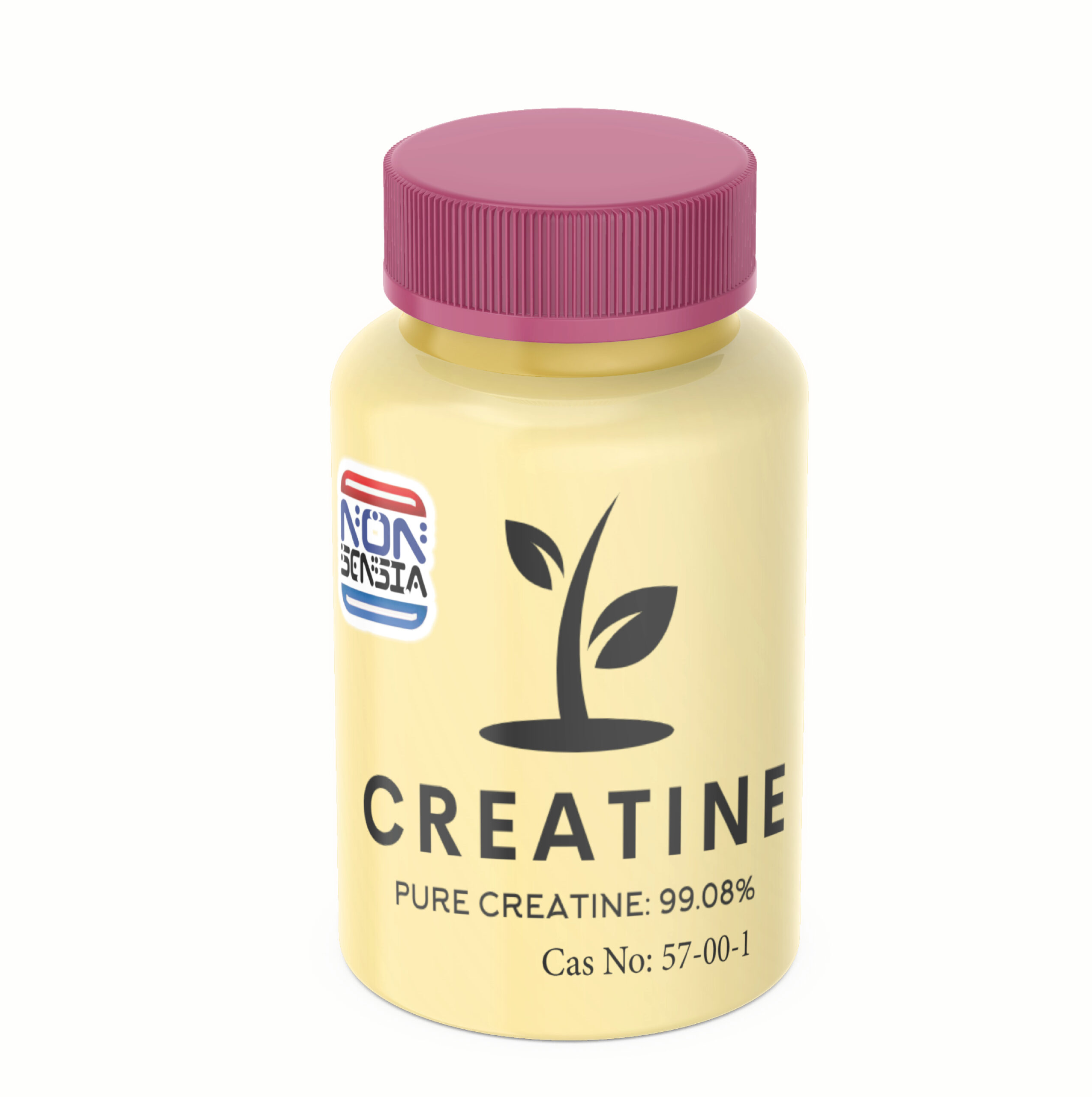

Description
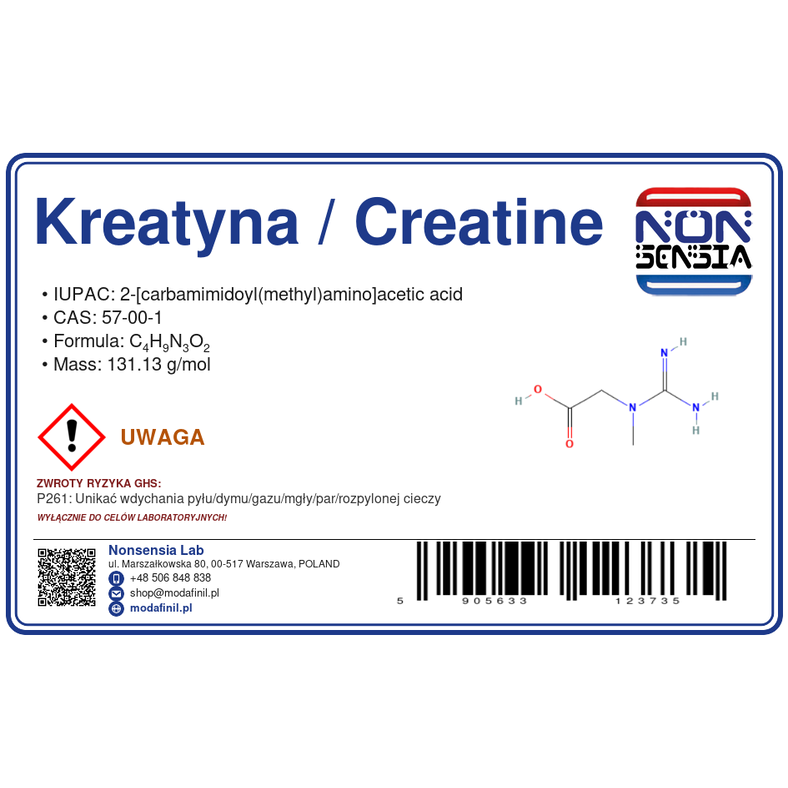
2-[carbamimidoyl(methyl)amino]acetic acid (creatine), white crystalline powder, 100 g package, purity ≥ 99.9%. Material intended exclusively for in vitro laboratory and analytical research. The product is not intended for consumption by humans or animals, is not a medicinal product, a food product, or a cosmetic.
Three different entities that must not be confused
Creatine is a common example of a chemical name that functions in three different contexts. Unlike other entries in our catalog, the middle entity here is not a registered drug but a product intended for human consumption — which does not change the final conclusion: the material offered here does not fall into any of these categories.
| Entity | What it is | What it concerns |
|---|---|---|
| Chemical substance creatine, CAS 57-00-1 |
A chemical concept — a molecule with a defined structure. Its status is determined only by the form in which it was produced. | chemistry, substance registries |
| Product for human consumption food products containing creatine |
A product placed on the market as a food product: a defined form, manufacturing compliant with food law, sanitary oversight. Studies involving human participants concern this entity [12][13][14]. | food market, food law |
| Chemical reagent the material offered here |
Material for laboratory and analytical work. It does not hold and cannot hold approval for consumption — it lacks a form intended for consumption, a food-manufacturing regime, and food-product documentation. | analytics, reference standards |
The consequence is unambiguous. The study results cited below were obtained using a product intended for consumption (studies involving human participants) or in laboratory animals under experimental conditions. None of them were conducted using the analytical reagent, and no result transfers to the material offered here.
Reagent identification sheet
| Systematic name (IUPAC) | 2-[carbamimidoyl(methyl)amino]acetic acid |
|---|---|
| Common name | creatine |
| CAS Number | 57-00-1 |
| Molecular formula | C4H9N3O2 |
| Molar mass | 131.13 g·mol−1 |
| Monoisotopic mass | 131.0695 Da |
| InChIKey | CVSVTCORWBXHQV-UHFFFAOYSA-N |
| SMILES | CN(CC(=O)O)C(=N)N |
| PubChem CID | 586 |
| Form | crystalline powder, white, odorless |
| Purity | ≥ 99.9% |
| Intended use | research reagent — not for consumption by humans or animals |
The molecule’s origin: how the body synthesizes creatine on its own
Unlike most entries in our catalog, creatine is not a molecule designed in a laboratory — it is a metabolite that vertebrate organisms synthesize on their own, via a two-step pathway split across two organs. The first step occurs mainly in the kidney (the pancreas also participates [4]): the enzyme AGAT transfers an amidino group from arginine to glycine, yielding guanidinoacetic acid (GAA) and ornithine. The second step occurs in the liver: the enzyme GAMT methylates GAA using S-adenosylmethionine, yielding creatine [3]. Hence the three precursor amino acids of the entire pathway: glycine, arginine, and methionine. The consumption of the methyl-group pool by this pathway is significant enough to be a separate research topic — the metabolic cost of creatine biosynthesis was described by Brosnan and colleagues [2], and a comprehensive review of biosynthesis and transport by the team from Lille [5].
The purpose of this costly synthesis lies in the phosphagen system: creatine kinase catalyzes the reversible transfer of a phosphate group between phosphocreatine and ADP, and creatine and ATP, which makes phosphocreatine an energy buffer for tissues with rapidly fluctuating ATP demand — mainly muscle, but also brain. A review of this system and its pleiotropic functions was published by Wallimann and colleagues [6], and the metabolism of creatine and creatinine together was described by Wyss and Kaddurah-Daouk in Physiological Reviews [1].
Timeline
| 19th century | isolation of creatine from muscle tissue; the name derives from the Greek kreas (flesh) |
|---|---|
| 2nd half of 20th century | establishment of the two-step biosynthesis pathway (AGAT in the kidney, GAMT in the liver) and the role of the phosphocreatine system |
| 2003 | validation of a chromatographic method for pharmacokinetic applications [10]; a controlled study in human participants on cognitive function [13] |
| 2007-2009 | GC-MS and LC-MS/MS methods for the diagnosis of deficiency syndromes [9]; characterization of the hepatic biosynthesis step [3] |
| 2008-2013 | reviews of AGAT/GAMT/SLC6A8 distribution in the CNS and creatine deficiency syndromes in pediatric neurology [7][8] |
| 2011-2017 | review of the metabolic cost of biosynthesis [2] and the creatine kinase system [6]; a scientific society position stand on food products [12] |
| 2022 | 31P-MRS spectroscopy for measuring phosphocreatine in the human brain [11] |
The literature on creatine is distributed across three distinct research centers: the biochemistry of the biosynthesis pathway (Memorial University of Newfoundland, Canada [2][3][4]), the metabolic genetics of deficiency syndromes (Lausanne, Toronto, Lille [5][7][8]), and analytical methods and imaging (Duke University [9], University of Florida [10], Medical University of Innsbruck [11]).
Chemistry: a zwitterion with no stereogenic center
The creatine skeleton is N-methylated glycine linked to a guanidino group. The carboxyl group and the strongly basic guanidino group mean that, at pH close to physiological, the molecule exists predominantly in its zwitterionic (dipolar ion) form — the same mechanism accounts for its good solubility in water.
Why creatine does not require enantiomer separation
Unlike modafinil, in which the stereogenic center lies on the sulfoxide sulfur atom, creatine contains no stereogenic center at all — no carbon atom carries four different substituents, and the guanidino group is planar. Qualification of the reference standard does not require an enantioselective method or a chiral column.
Cyclization to creatinine
In aqueous solutions, creatine slowly and irreversibly undergoes intramolecular cyclization to creatinine — this is accelerated by elevated temperature and an acidic environment [1]. Stock solutions should therefore be prepared shortly before use, and quantitative determination by a chromatographic method should distinguish between the two compounds [9][10].
Physicochemical characterization
| Parameter | Value | What this means |
|---|---|---|
| Partition coefficient (XLogP) | ≈ -1.2 | strongly hydrophilic — readily soluble in water, poorly soluble in nonpolar solvents |
| Topological polar surface area | 90.4 Å2 | high value consistent with the carboxyl and guanidino groups; early elution in RP-HPLC |
| Hydrogen bond donors / acceptors | 3 / 3 | strong hydrogen-bonding network with water |
| Density | 1.33 g/cm3 | typical of finely crystalline solids of this class |
| Melting point | 303 °C (with decomposition) | high decomposition temperature typical of inner salts |
Note. The data above come from a local registry verified against PubChem CID 586. Extended experimental parameters (numerical solubility, pKa, flash point) were not confirmed in this session due to a PubChem service overload error (code 503) and were deliberately omitted rather than reproducing unconfirmed figures from an earlier version of the description.
Why one molecule has so many names
In chemical registries and older literature, creatine appears under more than a dozen names. All of them denote the same compound with CAS number 57-00-1:
- Creatine — the most common name in modern usage;
- Kreatin, Creatinum — older localized and Latin variants;
- N-amidinosarcosine — a descriptive name indicating substitution of sarcosine with an amidino group;
- Methylglycocyamine — an older common name from the biochemical literature;
- alpha-methylguanidinoacetic acid — a descriptive name equivalent to the systematic name;
- Krebiozen — a historical name from the mid-20th century, today present only as a synonym entry in registries, not a separate compound;
- 2-[carbamimidoyl(methyl)amino]acetic acid — the systematic IUPAC name, the only unambiguous one.
Older biochemical papers, especially those predating the 1970s, are sometimes indexed under common names different from today’s — when performing a retrospective search, it is worth accounting for historical variants.
Laboratory applications of the reagent
- reference material for confirming identity and purity by HPLC — a validated method for pharmacokinetic applications was described by Persky and colleagues [10];
- a standard in GC-MS and LC-MS/MS methods for the differential determination of creatine, creatinine, and guanidinoacetic acid, including in the diagnosis of biosynthesis disorders [9];
- comparative material in 31P-MRS studies, where the phosphocreatine signal serves as a marker of tissue energy metabolism [11];
- a model compound in studies of the biosynthesis pathway in vivo and ex vivo (liver, kidney, pancreas) [3][4];
- comparative material in the biochemistry of the creatine kinase and phosphagen system [6].
Storage, handling, and work safety
Store in the original, tightly closed packaging, in a dry and cool place, protected from light, separately from food and feed and out of the reach of children. Work only under laboratory conditions, using personal protective equipment: gloves, safety goggles, and laboratory clothing; weigh the powder under conditions that limit dust formation. Avoid inhaling dust and contact with skin and eyes. Waste handling — in accordance with the regulations for chemical waste at the research site. According to the PubChem classification, the material is marked with the GHS07 pictogram, the signal word Warning, and the hazard statement P261 (avoid breathing dust).
Regulatory status
Creatine is not a substance whose trade in the form of a chemical reagent is subject to separate regulation. Its most widespread commercial form is products intended for human consumption, placed on the market as food products and subject to food law and sanitary oversight — this regime does not apply to the reagent offered here. The material offered does not hold approval for any use in humans or animals. The buyer is responsible for ensuring that the intended use complies with the law of the country of destination.
Frequently Asked Questions
How does this reagent differ from creatine products sold for consumption?
In form, intended use, and manufacturing regime. Products for consumption are food products manufactured in accordance with food law and subject to sanitary oversight. The material offered here is a chemical reagent for laboratory applications — it is not intended for consumption by humans or animals and does not have food-product documentation.
What is the chemical formula and molar mass of creatine?
C4H9N3O2; molar mass 131.13 g·mol−1, monoisotopic mass 131.0695 Da. CAS number 57-00-1, InChIKey CVSVTCORWBXHQV-UHFFFAOYSA-N.
Why does creatine not require separation into enantiomers?
Because it contains no stereogenic center — no carbon atom carries four different substituents. This distinguishes it, for example, from modafinil, where the stereogenic center lies on the sulfoxide sulfur atom.
What is creatinine and how does it form from creatine?
Creatinine forms as a result of the slow, irreversible intramolecular cyclization of creatine, accelerated by elevated temperature and an acidic environment [1].
Is the reagent suitable for uses other than laboratory applications?
No. The material is intended exclusively for laboratory and analytical research. It is not intended for consumption by humans or animals, it is not a drug, a food product, or a cosmetic.
How should creatine be stored as a laboratory reagent?
In the original, tightly closed packaging, in a dry and cool place, protected from light, separately from food and feed and out of the reach of children. Aqueous solutions should be prepared shortly before use because of the slow cyclization to creatinine.
What does creatine dissolve in?
With a negative partition coefficient (XLogP ≈ -1.2), creatine is a strongly hydrophilic molecule — readily soluble in water, much less so in nonpolar solvents.
How is the identity and purity of creatine confirmed in the laboratory?
By a chromatographic method (HPLC or LC-MS/MS) against a reference material, distinguishing it from creatinine and guanidinoacetic acid [9][10].
Is a safety data sheet provided with the creatine?
We provide the safety data sheet upon request to recipients engaged in research or analytical activity.
Where do the many names of creatine, such as N-amidinosarcosine or methylglycocyamine, come from?
These are older common names from the biochemical literature predating the standardization of IUPAC nomenclature, still present in chemical registries as synonyms of the compound with CAS number 57-00-1.
What is the creatine standard used for in research on disorders of its biosynthesis?
As a reference material in GC-MS and LC-MS/MS methods detecting creatine deficiency syndromes (AGAT, GAMT, or SLC6A8 transporter deficiency) based on the concentration of creatine and guanidinoacetic acid in body fluids [7][9].
Is creatine, as a substance, illegal or controlled in Poland?
No. The substance is not subject to separate regulation. Its most popular commercial form is food products subject to food law — this regime does not apply to the reagent offered here, which does not hold approval for use in humans or animals.
References
The entries are drawn from the PubMed database. Entries [1]-[11] concern biochemistry, analytical methods, and metabolic genetics — preclinical, ex vivo, or methodological studies, including the validation of analytical methods on biological samples. Entries [12], [13], and [14] are works in which studies involving human participants were conducted using products intended for consumption, not the chemical reagent. The whole serves as scientific context and a bibliographic reference, not information about the properties of the material offered here. The list is complete with respect to the queries performed in this session as of 2026-09-08.
- Wyss M, Kaddurah-Daouk R (2000). “Creatine and creatinine metabolism.” Physiol Rev. PMID 10893433. doi:10.1152/physrev.2000.80.3.1107.
- Brosnan JT, da Silva RP, Brosnan ME (2011). “The metabolic burden of creatine synthesis.” Amino Acids. PMID 21387089. doi:10.1007/s00726-011-0853-y.
- da Silva RP, Nissim I, Brosnan ME, Brosnan JT (2009). “Creatine synthesis: hepatic metabolism of guanidinoacetate and creatine in the rat in vitro and in vivo.” Am J Physiol Endocrinol Metab. PMID 19017728. doi:10.1152/ajpendo.90547.2008.
- da Silva RP, Clow K, Brosnan JT, Brosnan ME (2014). “Synthesis of guanidinoacetate and creatine from amino acids by rat pancreas.” Br J Nutr. PMID 24103317. doi:10.1017/S0007114513003012.
- Joncquel-Chevalier Curt M, Voicu PM, Fontaine M et al. (2015). “Creatine biosynthesis and transport in health and disease.” Biochimie. PMID 26542286. doi:10.1016/j.biochi.2015.10.022.
- Wallimann T, Tokarska-Schlattner M, Schlattner U (2011). “The creatine kinase system and pleiotropic effects of creatine.” Amino Acids. PMID 21448658. doi:10.1007/s00726-011-0877-3.
- Braissant O, Henry H (2008). “AGAT, GAMT and SLC6A8 distribution in the central nervous system, in relation to creatine deficiency syndromes: a review.” J Inherit Metab Dis. PMID 18392746. doi:10.1007/s10545-008-0826-9.
- Schulze A (2013). “Creatine deficiency syndromes.” Handb Clin Neurol. PMID 23622406. doi:10.1016/B978-0-444-59565-2.00053-8.
- Young S, Struys E, Wood T (2007). “Quantification of creatine and guanidinoacetate using GC-MS and LC-MS/MS for the detection of cerebral creatine deficiency syndromes.” Curr Protoc Hum Genet. PMID 18428409. doi:10.1002/0471142905.hg1703s54.
- Persky AM, Hochhaus G, Brazeau GA et al. (2003). “Validation of a simple liquid chromatography assay for creatine suitable for pharmacokinetic applications, determination of plasma protein binding and verification of percent labeled claim of various creatine products.” J Chromatogr B. PMID 12888208. doi:10.1016/s1570-0232(03)00452-5.
- Rietzler A et al. (2022). “Energy metabolism measured by 31P magnetic resonance spectroscopy in the healthy human brain.” J Neuroradiol. PMID 34871672. doi:10.1016/j.neurad.2021.11.006.
- Kreider RB, Kalman DS, Antonio J et al. (2017). “International Society of Sports Nutrition position stand: safety and efficacy of creatine supplementation in exercise, sport, and medicine.” J Int Soc Sports Nutr. PMID 28615996. doi:10.1186/s12970-017-0173-z.
- Rae C, Digney AL, McEwan SR et al. (2003). “Oral creatine monohydrate supplementation improves brain performance: a double-blind, placebo-controlled, cross-over trial.” Proc Biol Sci. PMID 14561278. doi:10.1098/rspb.2003.2492.
- Gualano B, Roschel H, Lancha AH Jr et al. (2012). “In sickness and in health: the widespread application of creatine supplementation.” Amino Acids. PMID 22101980. doi:10.1007/s00726-011-1132-7.
Identification data and computed descriptors from PubChem (CID 586).
Related reagents in our catalog
- Taurine — another small nitrogen-containing metabolite important for muscle physiology, often determined alongside creatine in LC-MS/MS panels of biological fluids
- Acetyl-L-carnitine — a metabolic contrast: carnitine transports fatty acids into mitochondria, while creatine buffers ATP through the phosphocreatine system — two different cellular energy mechanisms
- Modafinil (CAS 68693-11-8) — a structural contrast: a molecule with a stereogenic center on the sulfur atom, unlike achiral creatine
Statement on the intended use of the product
The material offered is a chemical reagent intended exclusively for research, analytical, and laboratory purposes. It is not intended for consumption by humans or animals. It is not a medicinal product, a food product, a medical device, or a cosmetic. It must not be used for medical, diagnostic, therapeutic, prophylactic, or consumption purposes, administered to humans or animals, applied to the skin, or added to food, beverages, or feed. Sold only to recipients engaged in research, scientific, or analytical activity, with laboratory facilities and the knowledge necessary for the safe handling of chemical reagents. The buyer bears sole responsibility for the lawful and safe use of the reagent and for compliance with the regulations in force in the country of destination.