
Description
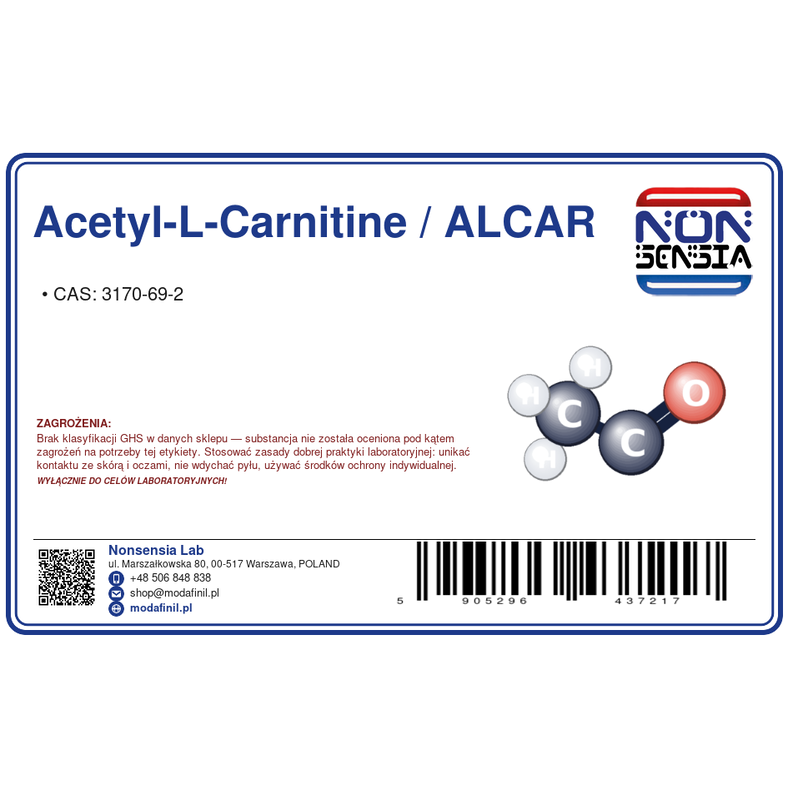
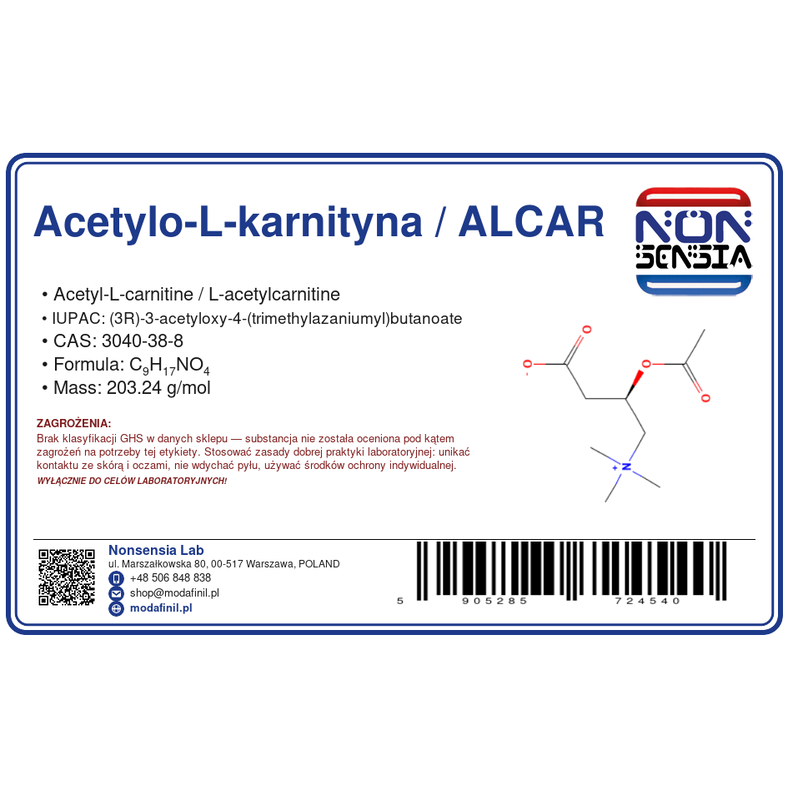
(3R)-3-acetyloxy-4-(trimethylazaniumyl)butanoate (the zwitterion of acetyl-L-carnitine), crystalline powder, white to off-white, 1000 mg pack. Material intended exclusively for laboratory and analytical in vitro research. The product is not intended for human or animal consumption; it is not a medicinal product, food supplement, foodstuff or cosmetic.
Three distinct entities that must not be confused
With this molecule a fourth element comes into play that is absent from the other items in our catalogue: acetyl-L-carnitine is an endogenous compound — the body produces it itself, in the mitochondria, through the enzymatic acetylation of carnitine. This does not remove the separation of layers; it only complicates it: the mere fact that the molecule is naturally present in the body confers no regulatory status on material sold as a reagent.
| Entity | What it is | Status |
|---|---|---|
| Chemical substance acetyl-L-carnitine, CAS 3040-38-8 |
A chemical concept — a molecule of defined structure, registered in databases (PubChem, ChEBI, ChEMBL). At the same time a physiological compound: it is formed naturally in the mitochondria as the product of carnitine acetyltransferase activity. | an overarching concept, covering both the endogenous compound and the synthetic material |
| Medicinal product pharmaceutical preparations, including under the trade name Nicetile |
A pharmaceutical preparation: defined form and strength, manufacture under a GMP regime, registration dossier, safety surveillance. It is precisely this entity that the clinical studies concerned — including the Cochrane systematic review [12] as well as a pharmacological-clinical review and a randomised trial on peripheral neuropathy [20][21]. | clinical studies in humans concern this entity |
| Chemical reagent the material offered here |
Material for laboratory and analytical work. It does not have, and cannot have, authorisation for use in humans or animals — it has no pharmaceutical form and no medicinal product documentation, regardless of the fact that the molecule itself occurs naturally in the body. | analytics, chemistry, reference standards |
The consequence is unambiguous. The research findings cited further on this page were obtained either using the registered medicinal product (clinical studies in humans), or using the substance administered to laboratory animals under controlled experimental conditions, or by measuring endogenous concentrations — that is, by studying the state the molecule naturally has in the body, without any administration of the reagent. None of these studies was conducted using the material offered on this page, and the fact that the body produces this molecule itself is no basis for administering it in the form of a chemical reagent.
Reagent identification sheet
| Systematic name (IUPAC) | (3R)-3-acetyloxy-4-(trimethylazaniumyl)butanoate |
|---|---|
| Common name | acetyl-L-carnitine (ALCAR) |
| CAS number | 3040-38-8 |
| Molecular formula | C9H17NO4 |
| Molar mass | 203.24 g·mol−1 |
| Monoisotopic mass | 203.1158 Da |
| InChIKey | RDHQFKQIGNGIED-MRVPVSSYSA-N |
| SMILES | CC(=O)O[C@H](CC(=O)[O-])C[N+](C)(C)C |
| PubChem CID | 7045767 |
| ChEBI | CHEBI:57589 |
| ChEMBL | CHEMBL582267 |
| UNII (FDA) | 6DH1W9VH8Q |
| Melting point | approx. 145 °C (computed data) |
| Form | crystalline powder, white to off-white |
| Purity | ≥ 99% |
| Intended use | research reagent — not for human or animal consumption |
Lineage of the molecule: from the discovery of carnitine’s function to the enzyme that adds the acetyl group
Carnitine was isolated from meat extract as early as the beginning of the 20th century — hence the name, from the Latin caro, carnis (meat). For half a century it remained a biochemical curiosity: a compound present in muscle tissue, of unknown function. The turning point came only in 1959, when Fritz demonstrated experimentally that carnitine accelerates the oxidation of long-chain fatty acids — first in muscle [1], then in the liver, and shortly afterwards, in 1962, he confirmed the specificity of this action in heart muscle [2]. This discovery established carnitine as an element of the mechanism transporting fatty acids into the mitochondria — the mechanism known today as the carnitine shuttle.
The mediating enzyme: carnitine acetyltransferase
Acetyl-L-carnitine is formed in the body in a reaction catalysed by carnitine acetyltransferase (CRAT) — an enzyme that transfers the acetyl group from acetyl coenzyme A to carnitine. The first kinetic studies of the mechanism of this reaction were published in 1966 [3], and twenty years later structural analogues of the substrate were used as probes of the enzyme’s active site [4]. The definitive explanation of the catalytic mechanism came only with the crystal structure of the enzyme, solved in 2003 by Jogl and Tong [5] — a paper published in Cell, showing the active-site geometry responsible for transferring the acetyl group.
Where carnitine comes from: the biosynthetic pathway
Carnitine, the precursor of acetyl-L-carnitine, is formed in the body from the amino acid lysine in a multi-step biosynthetic pathway. The key step — the enzymatic conversion of lysine to ε-N-trimethyllysine — was described as early as 1976 in the fungal model Neurospora crassa [6], before the analogous pathway in mammals was fully understood. A non-obvious element of this pathway is the involvement of ascorbic acid (vitamin C) as a cofactor of two biosynthetic enzymes — a link that partly explains the muscle fatigue observed in scurvy [7]. A contemporary review of this pathway, also covering its links to the epigenetic biology of trimethyllysine, was published in 2020 [8].
Timeline
| early 20th c. | isolation of carnitine from meat extract; name from the Latin caro, carnis (meat) |
|---|---|
| 1959 | discovery of the role of carnitine in fatty acid oxidation in muscle [1] |
| 1976 | elucidation of the biosynthetic pathway: conversion of lysine to trimethyllysine [6] |
| 1991 | demonstration of the role of vitamin C as a cofactor of carnitine biosynthesis [7] |
| 1999 | RP-HPLC method for determining the enantiomeric purity of acetyl-L-carnitine [9] |
| 2003 | crystal structure of carnitine acetyltransferase [5] |
| 2005 | NMR method with chiral shift reagents for optical purity control [10] |
| 2018 | linking of endogenous acetyl-L-carnitine deficiency with clinical depression, PNAS [11] |
| 2019 | Cochrane systematic review on use in diabetic neuropathy [12] |
| 2025 | sex differences in mitochondrial free-carnitine concentration in Alzheimer’s disease, Molecular Psychiatry [13] |
Two separate literatures: basic biochemistry and clinical research
The literature on this molecule divides clearly into two lines — for a reader checking the sources, this division is more important than the geography of research centres. The biochemical line deals with mechanism: how carnitine and its acetyl derivative participate in the transport and conversion of fatty acids at the level of the enzyme and the mitochondrion — Fritz’s work in Toronto [1][2], kinetic studies of the enzymatic mechanism [3][4] and the crystal structure of carnitine acetyltransferase [5]. The endpoints of these studies are enzyme activity and active-site geometry, not an effect in humans.
The clinical line tested the registered pharmaceutical preparation in peripheral neuropathy of various aetiologies (diabetic, drug-induced, associated with carpal tunnel syndrome), gathered systematically in the Cochrane review [12]. A separate, third category of evidence consists of studies of endogenous concentrations — measurement of how much acetyl-L-carnitine the body has naturally, without administering anything: the paper linking a low endogenous level with clinical depression [11] and the most recent study of sex differences in Alzheimer’s disease [13]. This is observational evidence describing a physiological state, not the effect of administering a reagent.
Chemistry: a zwitterion and a stereogenic centre
Why this is not an ordinary salt
Acetyl-L-carnitine is a zwitterion: the molecule simultaneously carries a quaternary nitrogen atom with a permanent positive charge (trimethylammonium group) and a deprotonated carboxyl group with a negative charge. Unlike modafinil, bromantane or flmodafinil — neutral compounds, poorly soluble in water — acetyl-L-carnitine is polar and readily soluble in water precisely because it consists entirely of separated charges rather than a non-polar hydrocarbon skeleton.
The stereogenic centre and the L/R naming convention
The carbon atom bearing the acetyloxy group is a stereogenic centre. The naturally occurring, biologically active form has the (R) configuration according to the CIP rules — which can be confusing, because the historical designation “L” comes from the separate Fischer convention (referencing L-serine), not from the CIP rules. “L-carnitine” and “(R)-carnitine” are in practice the same molecule, but using both systems at once can be a source of errors when working with literature older than the 1970s. For the laboratory this has a practical consequence: the name “acetyl-L-carnitine” alone says nothing about the method of confirming the configuration — chiral methods serve this purpose, such as RP-HPLC with chiral derivatisation [9] or NMR with chiral shift reagents [10], both developed specifically for this molecule.
Physicochemical characteristics
| Parameter | Value | What follows from it |
|---|---|---|
| Partition coefficient (XLogP) | ≈ 0.4 | a hydrophilic compound — the opposite of the lipophilic reagents of the benzhydryl sulfoxide family in our catalogue |
| Topological polar surface area | 66.4 Å2 | moderate — consistent with an ionic structure concentrated on two functional groups |
| Hydrogen bond donors | 0 | despite the carboxyl group — in the zwitterionic form it is deprotonated (-COO−), and the nitrogen is quaternary and bears no hydrogen atom |
| Hydrogen bond acceptors | 4 | all four oxygen atoms of the molecule (ester and carboxylate groups); the positively charged quaternary nitrogen does not count as an acceptor |
| Solubility | very good in water; poor in non-polar solvents | prepare stock solutions in water or aqueous buffer, not in DMSO |
Nomenclature and synonyms
- Acetylo-L-karnityna — the name most common in the Polish literature and reagent trade;
- ALCAR — abbreviation of the English “Acetyl-L-Carnitine”, widespread in the English-language literature;
- Acetyl-L-carnitine, L-Acetylcarnitine — English forms, used in international databases;
- (R)-Acetylcarnitine, (−)-Acetylcarnitine — designations referring directly to the absolute configuration rather than to the historical L/D convention;
- L-Carnitine acetyl ester — a descriptive name indicating the ester structure;
- (3R)-3-acetyloxy-4-(trimethylazaniumyl)butanoate — the systematic IUPAC name, the only unambiguous one.
The discrepancy between the L/D convention and the R/S designation (see the chemistry section) has a bibliographic consequence: some older Russian- and German-language papers use only the “L” designation, while the newer analytical literature more often gives “R” — both variants are worth including in a query.
Laboratory applications of the reagent
- reference material for confirmation of identity and purity by HPLC-UV;
- standard in LC-MS/MS methods for determining acetylcarnitine and related acylcarnitines in biological fluids [15][16];
- standard in the bioanalysis of cerebrospinal fluid by HILIC-MS [14];
- comparison material in metabolomic panels simultaneously determining several amino acid and acylcarnitine biomarkers by LC-MS/MS [17];
- subject of mass spectrometry imaging — a technique showing the tissue distribution of the compound in skeletal muscle [18];
- material for chiral methods confirming the R configuration (RP-HPLC with derivatisation [9] or NMR with shift reagents [10]);
- model compound in studies of the chemistry of zwitterions and carboxylic esters of quaternary amines.
Storage, handling and occupational safety
Store in the original, tightly closed container, in a dry and cool place, protected from light, separately from food and feed and out of the reach of children. Owing to the ionic, highly polar structure of the molecule, the material may be sensitive to atmospheric moisture — after each opening, close the container tightly and as quickly as possible. Work only under laboratory conditions, using personal protective equipment: gloves, safety glasses and laboratory clothing; weigh the powder under conditions that limit dust formation. Avoid inhaling dust and contact with skin and eyes. Aqueous solutions show limited stability over time — a stability study by HPLC-MS/MS documented a decrease in substance content in dextrose solutions under long-term storage conditions [19], which justifies preparing fresh stock solutions immediately before use. Dispose of waste in accordance with the regulations applicable to chemical waste at the place where the research is conducted.
Regulatory status
Acetyl-L-carnitine is an endogenous compound, naturally present in the human and animal body. It is at the same time the active substance of registered medicinal products evaluated in numerous clinical studies, including the Cochrane systematic review on diabetic neuropathy [12] and pharmacological and clinical reviews in the field of peripheral neuropathy [20][21]. Trade in medicinal preparations is subject to separate pharmaceutical legislation and this offer does not concern it. The material offered is a chemical reagent and has no approval for any use in humans or animals — the natural presence of the molecule in the body does not change this status. The purchaser is responsible for ensuring that the intended use complies with the law in force in the country of destination.
Frequently Asked Questions
What is acetyl-L-carnitine and where does the abbreviation ALCAR come from?
It is the acetate ester of L-carnitine, an endogenous compound formed in the mitochondria with the participation of carnitine acetyltransferase. The abbreviation ALCAR comes from the English name “Acetyl-L-Carnitine” and is widely used in the analytical and biochemical literature.
How does acetyl-L-carnitine differ from L-carnitine?
Acetyl-L-carnitine is L-carnitine with an acetyl group attached at position 3 (an acetyloxy group instead of a hydroxyl group). This modification is formed enzymatically in the body and is reversible — the same carnitine acetyltransferase catalyses the reaction in both directions.
Why is the molecule a zwitterion rather than an ordinary salt?
Because the positive charge (quaternary nitrogen) and the negative charge (deprotonated carboxyl group) are located in the same molecule, permanently, regardless of the pH of the solution — this distinguishes a zwitterion from a salt, in which the counterion is a separate molecule.
What are the chemical formula and molar mass of acetyl-L-carnitine?
C9H17NO4; molar mass 203.24 g·mol−1, monoisotopic mass 203.1158 Da. CAS number 3040-38-8, InChIKey RDHQFKQIGNGIED-MRVPVSSYSA-N.
Is the reagent suitable for applications other than laboratory use?
No. The material is intended exclusively for laboratory and analytical research. It is not intended for human or animal consumption, it is not a drug, food supplement, food or cosmetic, and it must not be used for medical, diagnostic or consumption purposes — also because the body produces this molecule itself.
How should acetyl-L-carnitine be stored as a laboratory reagent?
In the original, tightly closed container, in a dry and cool place, protected from light, separately from food and feed and out of the reach of children. Owing to its ionic structure, the material may be sensitive to moisture — close the container tightly after each use.
What does acetyl-L-carnitine dissolve in?
Very well in water, poorly in non-polar solvents — unlike most of our reagents of the sulfoxide family, which require DMSO or methanol. Aqueous solutions have limited stability and are best prepared fresh before use.
How are the purity and R configuration of acetyl-L-carnitine confirmed?
Identity and chemical purity by HPLC-UV; the absolute (R) configuration by chiral methods developed specifically for this molecule: RP-HPLC with chiral derivatisation or NMR with chiral shift reagents. Achiral analysis alone does not confirm the configuration.
Is a safety data sheet supplied with the reagent?
We make the safety data sheet available on request to recipients engaged in research or analytical activity.
Is acetyl-L-carnitine legal in Poland?
The substance is a constituent of registered medicinal products; trade in medicines is subject to separate regulations and this offer does not concern it. The material offered is a chemical reagent without approval for use in humans. The purchaser is responsible for ensuring that the intended use complies with the law of the country of destination.
What is an acetyl-L-carnitine standard used for in an analytical laboratory?
For confirmation of identity and purity by HPLC-UV, as a standard in LC-MS/MS for the determination of acylcarnitines in biological fluids, in metabolomic panels, and in chiral methods confirming the R configuration.
Does the fact that the body produces this molecule naturally change the status of the reagent offered?
No. The endogenous origin of the molecule confers no authorisation for use in humans or animals on material sold as a chemical reagent — the reagent has no pharmaceutical form, strength or medicinal product registration dossier.
References
The entries come from the PubMed database. [1]–[8] are papers in basic biochemistry (enzymatic mechanism, biosynthesis) — they concern the molecule as an element of metabolism, not its administration. [9][10] are analytical methods for confirming enantiomeric purity. [11][13] are studies of endogenous concentrations — measurement, not administration. [12][20][21] are clinical studies and reviews conducted using the registered medicinal product, not the analytical reagent. [14]–[19] are methodological papers in analytics and stability. None of these entries describes the use of the material offered on this page — they are cited as scientific context and as a bibliographic pointer, not as information about effects nor as an encouragement to any use.
- Fritz IB, McEwen B (1959). “Effects of carnitine on fatty-acid oxidation by muscle.” Science. PMID 13624727.
- Fritz IB, Kaplan E, Yue KT (1962). “Specificity of carnitine action on fatty acid oxidation by heart muscle.” Am J Physiol. PMID 13895427.
- Chase JF, Tubbs PK (1966). “Some kinetic studies on the mechanism of action of carnitine acetyltransferase.” Biochem J. PMID 5965344.
- Gandour RD et al. (1986). “Active-site probes of carnitine acyltransferases. Inhibition of carnitine acetyltransferase by hemiacetylcarnitinium, a reaction intermediate analogue.” Biochem Biophys Res Commun. PMID 3741430.
- Jogl G, Tong L (2003). “Crystal structure of carnitine acetyltransferase and implications for the catalytic mechanism and fatty acid transport.” Cell. PMID 12526798.
- Rebouche CJ, Broquist HP (1976). “Carnitine biosynthesis in Neurospora crassa: enzymatic conversion of lysine to epsilon-N-trimethyllysine.” J Bacteriol. PMID 133101.
- Rebouche CJ (1991). “Ascorbic acid and carnitine biosynthesis.” Am J Clin Nutr. PMID 1962562.
- Maas MN et al. (2020). “Trimethyllysine: From Carnitine Biosynthesis to Epigenetics.” Int J Mol Sci. PMID 33322546.
- Kagawa M et al. (1999). “Enantiomeric purity determination of acetyl-L-carnitine by reversed-phase high-performance liquid chromatography using chiral derivatization.” J Chromatogr A. PMID 10536831.
- Kagawa M et al. (2005). “Enantiomeric purity determination of acetyl-L-carnitine by NMR with chiral lanthanide shift reagents.” J Pharm Biomed Anal. PMID 16024206.
- Nasca C et al. (2018). “Acetyl-l-carnitine deficiency in patients with major depressive disorder.” Proc Natl Acad Sci U S A. PMID 30061399.
- Rolim LC et al. (2019). “Acetyl-L-carnitine for the treatment of diabetic peripheral neuropathy.” Cochrane Database Syst Rev. PMID 31201734.
- Bigio B et al. (2025). “Sex differences in mitochondrial free-carnitine levels in subjects at-risk and with Alzheimer’s disease in two independent study cohorts.” Mol Psychiatry. PMID 39774493.
- Holder BR et al. (2015). “Bioanalysis of acetylcarnitine in cerebrospinal fluid by HILIC-mass spectrometry.” Biomed Chromatogr. PMID 25712252.
- Heinig K, Henion J (1999). “Determination of carnitine and acylcarnitines in biological samples by capillary electrophoresis-mass spectrometry.” J Chromatogr B. PMID 10670733.
- Vernez L et al. (2004). “Determination of carnitine and acylcarnitines in plasma by high-performance liquid chromatography/electrospray ionization ion trap tandem mass spectrometry.” Rapid Commun Mass Spectrom. PMID 15164354.
- Shin S et al. (2019). “Simultaneous analysis of acetylcarnitine, proline, hydroxyproline, citrulline, and arginine as potential plasma biomarkers to evaluate NSAIDs-induced gastric injury by liquid chromatography-tandem mass spectrometry.” J Pharm Biomed Anal. PMID 30522064.
- Furuichi Y et al. (2014). “Imaging mass spectrometry reveals fiber-specific distribution of acetylcarnitine and contraction-induced carnitine dynamics in rat skeletal muscles.” Biochim Biophys Acta. PMID 24882639.
- Zhang Y et al. (2012). “Stability of acetyl-1-carnitine in 5% dextrose using a high-performance liquid chromatography-mass spectrometry times 2 method.” Int J Pharm Compd. PMID 23050330.
- Sima AA (2007). “Acetyl-L-carnitine in diabetic polyneuropathy: experimental and clinical data.” CNS Drugs. PMID 17696589.
- Li S et al. (2016). “Effects of acetyl-L-carnitine and methylcobalamin for diabetic peripheral neuropathy: A multicenter, randomized, double-blind, controlled trial.” J Diabetes Investig. PMID 27180954.
Identification data and computed descriptors from PubChem (CID 7045767) and the ChEBI, ChEMBL and UNII registries.
Related reagents in our catalogue
- Alpha-GPC (CAS 28319-77-9) — a contrast in carrier chemistry: the glycerophosphate ester of choline versus the acetate ester of carnitine; both are endogenous carrier molecules involved in mitochondrial metabolism
- L-Tyrosine (CAS 60-18-4) — a structural contrast: a classical α-amino acid versus a betaine-type quaternary compound; both molecules are precursors of endogenous metabolic pathways
Statement of intended use
The material offered is a chemical reagent intended exclusively for research, analytical and laboratory purposes. Not intended for human or animal consumption. It is not a medicinal product, food supplement, foodstuff, medical device or cosmetic. It must not be used for medical, diagnostic, therapeutic, prophylactic or consumption purposes, administered to humans or animals, applied to the skin, or added to food, beverages or feed. Sold exclusively to recipients engaged in research, scientific or analytical activity who have laboratory facilities and the knowledge required to handle chemical reagents safely. The purchaser bears sole responsibility for the lawful and safe use of the reagent and for compliance with the regulations in force in the country of destination.