
Description
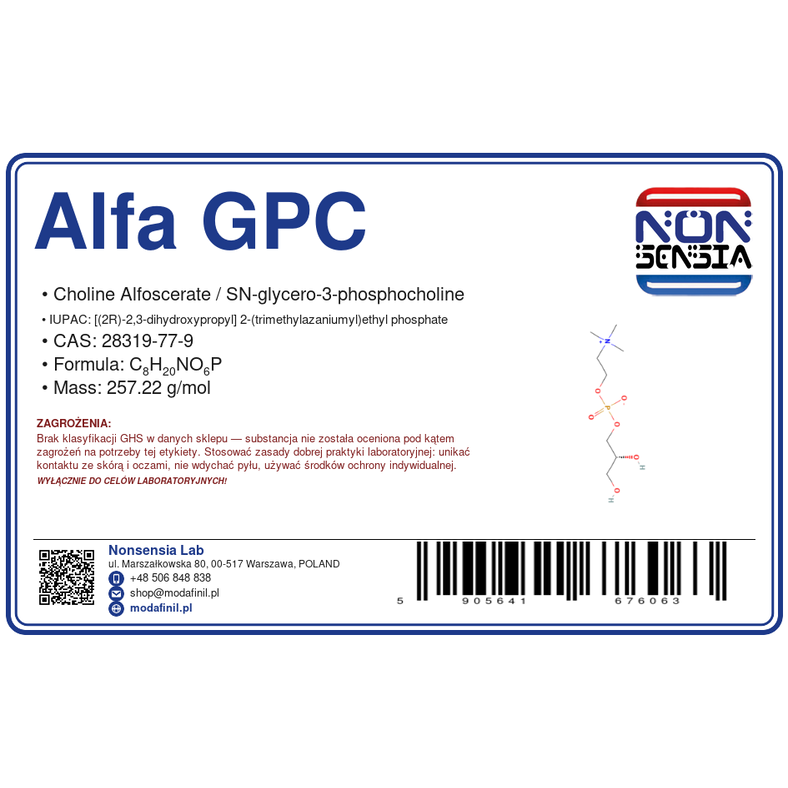
(2R)-2,3-dihydroxypropyl 2-(trimethylazaniumyl)ethyl phosphate (alpha-glycerylphosphorylcholine), hygroscopic powder, 1000 mg pack. Material intended exclusively for laboratory and analytical in vitro research. The product is not intended for human or animal consumption; it is not a medicinal product, foodstuff or cosmetic.
Three distinct entities that must not be confused
For this molecule, separating the layers requires an additional caveat that the other items in our catalogue do not need: alpha-GPC is a compound occurring physiologically in the human body — as an intermediate in the breakdown of phosphatidylcholine in cell membranes. This invites the reasoning “since the body produces it itself, consuming the pure powder must be safe”. This reasoning is wrong for two independent reasons: the endogenous presence of trace amounts of an intracellular metabolite is not the same as oral administration of a purified compound in chemical form, and the material offered on this page has not undergone any procedure of authorisation for use in humans. The three contexts below have different legal statuses:
| Entity | What it is | What it concerns |
|---|---|---|
| Chemical substance alpha-GPC, CAS 28319-77-9 |
A chemical concept — a molecule of defined structure, occurring endogenously as a metabolite of phosphatidylcholine. In itself it is neither a medicine nor a reagent; its status is conferred by the form in which it has been manufactured and authorised. | chemistry, biochemistry, substance registries |
| Medicinal product e.g. Gliatilin |
A pharmaceutical preparation: a defined pharmaceutical form and strength, manufacture under a pharmaceutical regime, registration dossier, safety surveillance. Registered in, among other countries, Italy and Russia, and prescribed in some countries in the therapy of cognitive disorders and post-stroke rehabilitation. It is not registered as a medicinal product in Poland. | clinical studies involving humans concern this entity |
| Chemical reagent material offered here |
Material for laboratory and analytical work. It does not and cannot hold any authorisation for use in humans or animals — it has no pharmaceutical form and no medicinal product documentation, regardless of the fact that the molecule itself occurs naturally in the body. | analytics, chemistry, reference standards |
The consequence is unambiguous. The research results cited further on this page were obtained either with the registered medicinal product (clinical studies involving humans), or in animal and cell models under controlled experimental conditions (preclinical studies), or by an observational method using insurance data from a population already treated with the registered preparation (pharmacoepidemiology). None of these studies was conducted with an analytical reagent, and none of these results transfers to the material offered.
Reagent identification sheet
| Systematic name (IUPAC) | (2R)-2,3-dihydroxypropyl 2-(trimethylazaniumyl)ethyl phosphate |
|---|---|
| Common name | alpha-GPC (alpha-glycerylphosphorylcholine, choline alfoscerate) |
| CAS number | 28319-77-9 |
| Molecular formula | C8H20NO6P |
| Molar mass | 257.22 g·mol−1 |
| Monoisotopic mass | 257.1028 Da |
| InChIKey | SUHOQUVVVLNYQR-MRVPVSSYSA-N |
| SMILES | C[N+](C)(C)CCOP(=O)([O-])OC[C@@H](CO)O |
| PubChem CID | 657272 |
| ChEMBL | CHEMBL5739928 |
| Form | powder, white to pale yellow, strongly hygroscopic |
| Purity | ≥ 99% |
| Intended use | research reagent — not for human or animal consumption |
Lineage of the molecule: from renal osmolyte to neurological medicine in three countries
Alpha-GPC differs from the other items in our catalogue in one fundamental respect: it was not synthesised from scratch as a new pharmacological molecule. It is a natural intermediate in the breakdown of phosphatidylcholine — the main phospholipid of cell membranes — formed by the action of phospholipases and further converted by a specific phosphodiesterase into glycerophosphate and free choline. Early biochemical work from the 1970s described the distribution of this phosphodiesterase in the rat brain [1] and the pathway by which choline formed from ethanolamine in the brain is incorporated into phospholipid metabolism [2], and the work of Jope and Jenden linked this metabolism directly to the synthesis of acetylcholine [3].
An osmolyte before it became a medicine
Before the molecule reached clinical pharmacology, renal physiologists described it as one of the main organic osmolytes of the renal medulla — a compound that renal tubular cells accumulate to protect themselves against osmotic damage under conditions of highly concentrated urine. The review by Garcia-Perez and Burg in Physiological Reviews summarised this mechanism [4], and earlier work confirmed accumulation of the compound in animals subjected to salt loading [5]. Independently, it was described as a natural component of rodent milk [6], and disturbances of its synthesis were described in a model of muscular dystrophy [7] — evidence that the molecule has a biochemical role extending beyond a single application.
From renal biochemistry to a pharmaceutical preparation
Pharmaceutical-grade material is obtained industrially from soy or egg lecithin by controlled deacylation of phosphatidylcholine — a review of preparation techniques and applications was published in 2025 [8]. On this basis a pharmaceutical preparation was developed and registered in, among other countries, Italy and Russia under a trade name reserved for the registered medicinal product (see the table “Three distinct entities” above), tested clinically since the early 1990s — the first multicentre comparative study in patients with vascular dementia was published in 1991 [9].
Timeline
| 1970s | description of the phosphodiesterase that breaks down alpha-GPC in the brain and of the pathway of choline synthesis from ethanolamine [1][2] |
|---|---|
| 1985 | description of impaired synthesis of the compound in a mouse model of muscular dystrophy [7] |
| late 1980s/1991 | identification as a major organic osmolyte of the renal medulla [4] |
| 1991 | first multicentre clinical study with the registered medicinal product in patients with vascular dementia [9] |
| 1990s | registration of the pharmaceutical preparation in Italy and Russia under a proprietary trade name (see the table “Three distinct entities” above); a series of studies by the Camerino group on structural brain changes in ageing animals [10] |
| 2001 | comprehensive review of published clinical data [11] |
| 2003 | multicentre RCT in mild to moderate Alzheimer’s disease [12] |
| 2013 | Russian clinical publication on the use of the registered preparation (see the table “Three distinct entities” above) in patients after ischaemic stroke [13] |
| 2021 | 10-year Korean epidemiological study linking use of the preparation with stroke risk, based on insurance data [14] |
| 2023 | systematic review and meta-analysis of choline-containing phospholipids in stroke therapy [15] |
| 2024–2025 | further Korean observational studies using national health insurance data [16][17] |
Three lines of research that built the literature
The literature on alpha-GPC has an unusual, three-layered character — different from the other items in our catalogue, where research clustered around a single centre. Here there are three separate disciplines, pursued independently of one another:
- Membrane biochemistry and renal physiology (1970s–1990s, international centres). Work on brain phospholipid metabolism [1][3] and on the role of the compound as a protective osmolyte of the renal tubules [4][5] — the discipline that answers the question of why the molecule occurs in the body at all.
- Italian-Russian clinical pharmacology (1990s–2010s). Amenta’s group at the University of Camerino described structural brain changes in ageing animals under treatment with the preparation [10], and clinical studies with the registered medicinal product covered vascular dementia [9], Alzheimer’s disease [12] and post-stroke rehabilitation in Russia [13].
- Korean pharmacoepidemiology (2020s, insurance data). The youngest and methodologically most distinct group: instead of interventional studies, it analyses national health insurance data covering populations already treated with the preparation — including in the context of adverse risk, as in the 10-year study of stroke risk [14].
Caveat applying to the whole section above. It describes the history of scientific research. Preclinical studies were conducted in animals or cell models, clinical studies exclusively with the registered medicinal product, and pharmacoepidemiological studies are based on administrative data from a population treated with that product. None of them is a description of the properties of the material offered, and none can serve as a basis for any application of it outside the laboratory.
Chemistry: a zwitterion without a chromophore and what this means for the laboratory
Why this molecule is charged at every pH
Unlike the other reagents in our catalogue, alpha-GPC contains no aromatic ring. The molecule is a zwitterion: a permanent positive charge is carried by the quaternary nitrogen atom of the trimethylammonium group, a permanent negative charge by one of the oxygens of the phosphate group. This charge arrangement persists regardless of the pH of the solution, which distinguishes the compound from molecules with reversibly ionisable groups. The computational consequence is clear: XLogP ≈ −2.3, an extremely hydrophilic value compared with the other items in the catalogue.
A stereogenic centre at the glycerol
The molecule has one defined stereogenic centre — carbon atom C2 of the glycerol backbone, with R configuration. This distinguishes the source of chirality from modafinil (centre on the sulfur atom) or bromantane (no stereogenic centre owing to the symmetry of the adamantane cage) — here chirality comes from the retained glycerol fragment, the same one found in natural phospholipids.
Why the absence of a chromophore complicates standard UV detection
The absence of an aromatic ring and of conjugated double bonds means that the compound has no strong chromophore in the UV range routinely used in HPLC-UV for the other reagents in our catalogue. In practice, confirmation of identity and purity requires evaporative light scattering detection (ELSD), mass spectrometry or pre-column derivatisation. An HPLC method coupled with tandem mass spectrometry for profiling phosphorylcholine-containing lipids, including glycerophosphocholine derivatives, in a biological matrix was described by Tang and co-workers [18].
Physicochemical characteristics
| Parameter | Value | What follows from it |
|---|---|---|
| Partition coefficient (XLogP) | ≈ −2.3 | extreme hydrophilicity — no retention in classical RP-HPLC without phase modification |
| Topological polar surface area | 99.1 Å2 | one of the highest in the catalogue — a consequence of the phosphate group and two OH groups |
| Hydrogen bond donors | 2 | two hydroxyl groups of glycerol |
| Hydrogen bond acceptors | 6 | oxygens of the phosphate and hydroxyl groups |
| Rotatable bonds | 8 | flexible glycerol-phosphocholine chain |
| Melting point | 142.5°C | data from the NIST WebBook (CAS 28319-77-9) — value for crystalline material; given the strong hygroscopicity of the sample, it must be determined under controlled humidity |
| Solubility | very good in water; poor in non-polar solvents | prepare stock solutions in water or aqueous buffer, not in DMSO |
Why one molecule has a dozen or so names
More than ten names for the same compound with CAS number 28319-77-9 are in chemical and pharmaceutical use. Recognising all of them matters in practice when searching the literature and supplier databases:
- Alpha-GPC / α-GPC — the abbreviation most common in commercial use;
- Choline Alfoscerate / Choline Alphoscerate — the INN, present in most international registries;
- L-alpha-glycerylphosphorylcholine — full common name, source of the abbreviation GPC;
- sn-glycero-3-phosphocholine (sn-3-GPC) — name used in lipid biochemistry, emphasising the stereochemical configuration of the natural isomer;
- Glycerophosphorylcholine / GPCho — variants found in the older biochemical literature;
- Trade name of the registered medicinal product — see the table “Three distinct entities” above; it does not apply to the reagent offered, and the trade name is deliberately not repeated here;
- (2R)-2,3-dihydroxypropyl 2-(trimethylazaniumyl)ethyl phosphate — systematic IUPAC name, the only unambiguous one.
The divergence of names has a bibliographic consequence: the older biochemical literature indexes the compound almost exclusively under “glycerophosphorylcholine”, the newer clinical literature under “choline alfoscerate”, and the pharmacoepidemiological literature under the full name “L-α glycerylphosphorylcholine”. When searching, it is worth combining all variants.
Laboratory applications of the reagent
- reference material for confirming identity and purity by LC-MS/MS — given the absence of a UV chromophore, mass spectrometry is more practical here than classical HPLC-UV [18];
- standard in studies of phospholipid and choline metabolism as an analogue of a natural cellular metabolite;
- model substrate in studies of phosphodiesterase enzymes that break down glycerophosphocholine;
- comparative material in the validation of methods for determining organic osmolytes in biological samples;
- reference compound in research on industrial methods of obtaining choline-containing phospholipids from lecithin [8].
Storage, handling and occupational safety
The material is strongly hygroscopic — it absorbs moisture from the air faster than most other reagents in our catalogue, which calls for particularly tight packaging. Store in the original, tightly closed container in a dry, cool place protected from light, separately from food and animal feed and out of the reach of children. Work only under laboratory conditions using personal protective equipment: gloves, safety glasses and laboratory clothing; weigh the powder under conditions that limit dust formation and contact with atmospheric moisture. Avoid inhaling dust and contact with skin and eyes. Dispose of waste in accordance with the regulations applicable to chemical waste at the place where the research is carried out.
Regulatory status
The substance is the active ingredient of medicinal products registered in some countries (including Italy and Russia) and — as the insurance-data studies cited above show — a widely prescribed and reimbursed preparation in South Korea. In Poland the substance is not registered as a medicinal product, and this offer does not concern any of the pharmaceutical preparations mentioned. Outside the pharmaceutical market, the molecule is also sometimes an ingredient used in the food industry in certain jurisdictions outside the European Union [19] — this context likewise does not apply to the material offered here. The reagent offered is a chemical material and holds no authorisation for any use in humans or animals, regardless of the fact that the parent molecule occurs endogenously in the body. The purchaser is responsible for ensuring that the intended use complies with the law in force in the country of destination.
Frequently Asked Questions
How does the alpha-GPC reagent differ from the registered medicinal product in the table above?
The registered medicinal product (see the table “Three distinct entities” above) is a defined pharmaceutical form, strength and registration dossier, manufactured under a pharmaceutical regime. The material offered here is a chemical reagent for laboratory applications, without any authorisation for use in humans. Both share the same base molecule (CAS 28319-77-9) but have a different legal status.
Is alpha-GPC the same as ordinary choline?
No. Alpha-GPC is a different, more complex molecule — a phospholipid metabolite containing choline ester-linked to glycerophosphate. Choline itself and alpha-GPC have different molecular formulae, different CAS numbers and different physicochemical properties (including solubility and polarity).
How does alpha-GPC differ from CDP-choline?
Both molecules are choline carriers, but of different structure: CDP-choline contains a cytidine ring linked to choline by a diphosphate bond, whereas alpha-GPC has a glycerol backbone derived from phosphatidylcholine. They also differ in molar mass, number of stereogenic centres and chromatographic behaviour.
What are the chemical formula and molar mass of alpha-GPC?
C8H20NO6P; molar mass 257.22 g·mol−1, monoisotopic mass 257.1028 Da. CAS number 28319-77-9, InChIKey SUHOQUVVVLNYQR-MRVPVSSYSA-N.
Why is the material not intended for consumption if the body produces it itself?
The endogenous presence of trace amounts of an intracellular metabolite is not the same as oral administration of a purified chemical compound in commercial form. The material offered has not undergone any safety assessment or authorisation procedure for use in humans — it is a laboratory reagent, not a product for consumption.
How should alpha-GPC be stored as a laboratory reagent?
In the original, tightly closed container, in a dry, cool place protected from light. The material is strongly hygroscopic, so the tightness of the container matters more here than for most other reagents — store separately from food and animal feed and out of the reach of children.
What should alpha-GPC be dissolved in to prepare a stock solution?
The compound is very readily soluble in water and poorly soluble in non-polar solvents — the opposite of most other reagents in our catalogue. Stock solutions are prepared in water or aqueous buffer, not in DMSO.
How is the identity of alpha-GPC confirmed in the laboratory, given that it has no UV chromophore?
Standard HPLC-UV, used for the other reagents in the catalogue, is not suitable here owing to the absence of an aromatic ring. In practice, evaporative light scattering detection (ELSD), mass spectrometry (LC-MS/MS) or pre-column derivatisation is used.
Is a safety data sheet supplied with alpha-GPC?
We provide the safety data sheet on request to recipients engaged in research or analytical activity.
Is alpha-GPC legal in Poland?
The substance is not registered as a medicinal product in Poland; trade in pharmaceutical preparations registered abroad is subject to separate regulations and this offer does not concern it. The material offered is a chemical reagent with no authorisation for use in humans. The purchaser is responsible for ensuring that the intended use complies with the law of the country of destination.
What is an alpha-GPC standard used for in the analytical laboratory?
For confirming identity and purity by LC-MS/MS, as a standard in studies of phospholipid and choline metabolism, as a model substrate in studies of phosphodiesterase enzymes, and as comparative material in the determination of organic osmolytes in biological samples.
References
The entries come from the PubMed database and concern the biochemistry, physiology, history of clinical research and pharmacoepidemiology of this molecule. Entries [1]–[3], [5]–[8] are biochemical and review papers on the natural metabolism of the compound; [10] is a preclinical (animal) study of the pharmaceutical preparation; [18] is a methodological paper in analytical chemistry; [9], [11]–[13], [15] are clinical studies and reviews with the registered medicinal product; [14], [16]–[17] are pharmacoepidemiological studies using administrative data; [4] is a physiological review; [19] concerns non-pharmaceutical applications. None of them describes the use of an analytical reagent — they are cited as scientific context and bibliographic guidance, not as information on the properties of the material offered.
- Mann SP (1975). “Distribution of glycerophosphorylcholine diesterase in rat brain.” Experientia. PMID 173572. doi:10.1007/BF01945764.
- Kewitz H, Pleul O (1976). “Synthesis of choline from ethanolamine in rat brain.” Proc Natl Acad Sci U S A. PMID 1065868. doi:10.1073/pnas.73.7.2181.
- Jope RS, Jenden DJ (1979). “Choline and phospholipid metabolism and the synthesis of acetylcholine in rat brain.” J Neurosci Res. PMID 423317. doi:10.1002/jnr.490040110.
- Garcia-Perez A, Burg MB (1991). “Renal medullary organic osmolytes.” Physiol Rev. PMID 1924548. doi:10.1152/physrev.1991.71.4.1081.
- Heilig CW et al. (1989). “Characterization of the major brain osmolytes that accumulate in salt-loaded rats.” Am J Physiol. PMID 2603957. doi:10.1152/ajprenal.1989.257.6.F1108.
- Rohlfs EM et al. (1993). “Glycerophosphocholine and phosphocholine are the major choline metabolites in rat milk.” J Nutr. PMID 8410369. doi:10.1093/jn/123.10.1762.
- Infante JP (1985). “Impaired glycerophosphorylcholine synthesis in murine muscular dystrophy.” Med Biol. PMID 4068770.
- Li J et al. (2025). “L-Alpha-Glycerylphosphorylcholine (L-α-GPC): A Comprehensive Review of Its Preparation Techniques and Versatile Biological Effects.” J Food Sci. PMID 40556032. doi:10.1111/1750-3841.70338.
- Di Perri R et al. (1991). “A multicentre trial to evaluate the efficacy and tolerability of alpha-glycerylphosphorylcholine versus cytosine diphosphocholine in patients with vascular dementia.” J Int Med Res. PMID 1916007. doi:10.1177/030006059101900406.
- Amenta F et al. (1991). “Age-related structural changes in the rat cerebellar cortex: effect of choline alfoscerate treatment.” Mech Ageing Dev. PMID 1824122. doi:10.1016/0047-6374(91)90015-r.
- Parnetti L, Amenta F, Gallai V (2001). “Choline alphoscerate in cognitive decline and in acute cerebrovascular disease: an analysis of published clinical data.” Mech Ageing Dev. PMID 11589921. doi:10.1016/s0047-6374(01)00312-8.
- De Jesus Moreno Moreno M (2003). “Cognitive improvement in mild to moderate Alzheimer’s dementia after treatment with the acetylcholine precursor choline alfoscerate: a multicenter, double-blind, randomized, placebo-controlled trial.” Clin Ther. PMID 12637119. doi:10.1016/s0149-2918(03)90023-3.
- Vinogradov OI et al. (2013). “[The use of choline alfoscerate (gliatiline) in patients with ischemic stroke].” Zh Nevrol Psikhiatr Im S S Korsakova. PMID 23528493.
- Lee G et al. (2021). “Association of L-α Glycerylphosphorylcholine With Subsequent Stroke Risk After 10 Years.” JAMA Netw Open. PMID 34817582. doi:10.1001/jamanetworkopen.2021.36008.
- Sagaro GG, Amenta F (2023). “Choline-Containing Phospholipids in Stroke Treatment: A Systematic Review and Meta-Analysis.” J Clin Med. PMID 37109211. doi:10.3390/jcm12082875.
- Duong KL et al. (2024). “Effect of choline alfoscerate in older adult patients with dementia: an observational study from the claims data of national health insurance.” BMC Geriatr. PMID 39548376. doi:10.1186/s12877-024-05531-y.
- Kim HK et al. (2025). “Association between L-α glycerylphosphorylcholine use and delayed dementia conversion: A nationwide longitudinal study in South Korea.” J Prev Alzheimers Dis. PMID 40155153. doi:10.1016/j.tjpad.2025.100059.
- Tang CH et al. (2012). “Phosphorylcholine-containing lipid molecular species profiling in biological tissue using a fast HPLC/QqQ-MS method.” Anal Bioanal Chem. PMID 23001309. doi:10.1007/s00216-012-6414-8.
- Cao J, Su E (2025). “Unlocking the potential of l-α-glycerylphosphorylcholine in the food industry: From safety approvals to market prospects.” Compr Rev Food Sci Food Saf. PMID 39898924. doi:10.1111/1541-4337.70117.
Identification data and computed descriptors from PubChem (CID 657272) and the ChEMBL registry.
Related reagents in our catalogue
- CDP-choline — the second form of choline in our range; structural contrast: a cytidine ring and a diphosphate bond instead of a glycerol backbone
- Acetyl-L-carnitine — another natural acyl group carrier linked to the metabolism of cell membranes and mitochondria, often considered in the same biochemical context as choline derivatives
Statement of intended use
The material offered is a chemical reagent intended exclusively for research, analytical and laboratory purposes. It is not intended for human or animal consumption, regardless of the fact that the parent molecule occurs endogenously in the human body. It is not a medicinal product, foodstuff, medical device or cosmetic. It must not be used for medical, diagnostic, therapeutic, prophylactic or consumption purposes, administered to humans or animals, applied to the skin, or added to food, beverages or animal feed. Sold exclusively to recipients engaged in research, scientific or analytical activity who have laboratory facilities and the knowledge required to handle chemical reagents safely. The purchaser bears sole responsibility for the lawful and safe use of the reagent and for compliance with the regulations in force in the country of destination.