
Description
Cytidine 5′-diphosphocholine (CDP-choline), crystalline powder, 1000 mg pack. Material intended exclusively for laboratory and analytical in vitro research. This product is not intended for human or animal consumption; it is not a medicinal product, food supplement, foodstuff or cosmetic.
Three different entities that must not be confused
The same chemical name circulates in three entirely different contexts, with a different legal status, different quality control and a different intended use. Separating them is as important here as for every other item in our catalogue:
| Entity | What it is | What it concerns |
|---|---|---|
| Chemical substance citicoline, CAS 987-78-0 |
A chemical concept — a nucleotide coenzyme of defined structure. In itself it is neither a medicine nor a reagent; its status is conferred by the form in which it has been manufactured and authorised. | chemistry, biochemistry, substance registries |
| Medicinal product a preparation with a trade name such as Nicholin (other trade names depend on the country of registration) |
A pharmaceutical preparation: a defined pharmaceutical form and strength, GMP manufacturing, registration documentation, pharmacovigilance. It is precisely this entity that the clinical studies involving humans cited in the literature concern. | the clinical studies concerned this entity |
| Chemical reagent material offered here |
Material for laboratory and analytical work. It does not have, and cannot have, authorisation for use in humans or animals — it has no pharmaceutical form or medicinal-product documentation. | analytics, chemistry, reference standards |
The consequence is unambiguous. The study results cited further on this page were obtained either using a registered medicinal product or a preparation given to volunteers in a clinical study (human data), or using the substance administered to laboratory animals under controlled experimental conditions (preclinical studies), or they concern solely the chemistry and biochemistry of the molecule (synthesis, crystallisation, enzymatic mechanism) without it being administered to anyone. None of these studies was conducted using the analytical reagent, and none of their results transfers to the material offered.
Reagent identification sheet
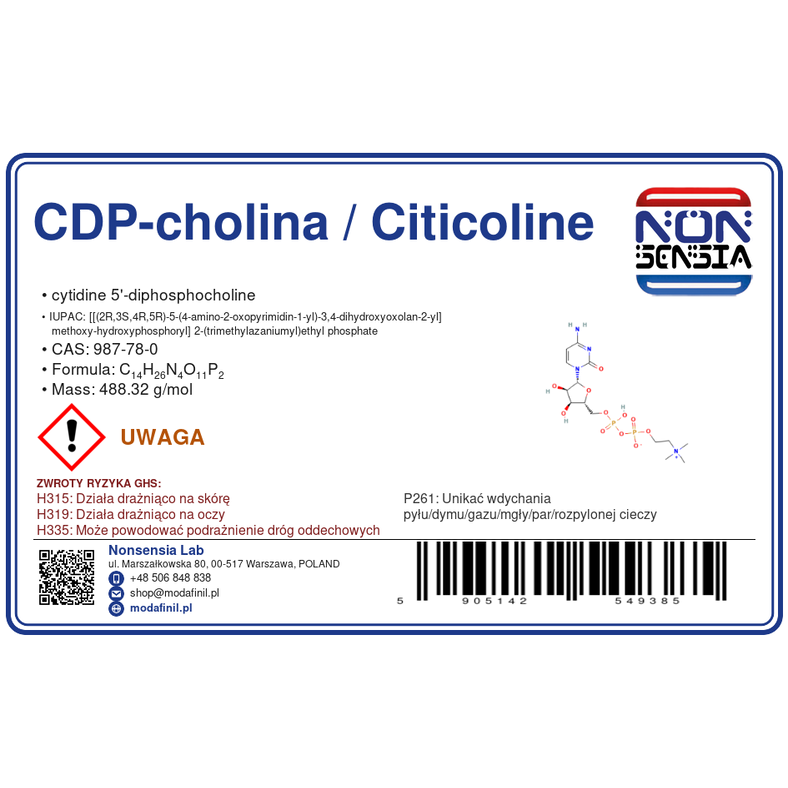
| Systematic name (IUPAC) | [[(2R,3S,4R,5R)-5-(4-amino-2-oxopyrimidin-1-yl)-3,4-dihydroxyoxolan-2-yl]methoxy-hydroxyphosphoryl] 2-(trimethylazaniumyl)ethyl phosphate |
|---|---|
| Common name / INN | citicoline (cytykolina, CDP-choline) |
| CAS number | 987-78-0 |
| Molecular formula | C14H26N4O11P2 |
| Molar mass | 488.32 g·mol−1 |
| Monoisotopic mass | 488.1073 Da |
| InChIKey | RZZPDXZPRHQOCG-OJAKKHQRSA-N |
| SMILES (isomeric) | C[N+](C)(C)CCOP(=O)([O-])OP(=O)(O)OC[C@@H]1[C@H]([C@H]([C@@H](O1)N2C=CC(=NC2=O)N)O)O |
| PubChem CID | 13804 |
| ChEMBL | CHEMBL5903940 |
| Form | crystalline powder, white to off-white |
| Purity | ≥ 99% |
| Intended use | research reagent — not for human or animal consumption |
Lineage of the molecule: a coenzyme, not a drug candidate
CDP-choline is an exception in our catalogue in one respect: it did not originate as a product of medicinal synthesis designed for a specific therapeutic target. It is a natural nucleotide coenzyme, present in every living cell, which only later became a subject of interest for pharmacology.
From coenzyme chemistry to a molecule on the laboratory shelf
The starting point was the work of Eugene P. Kennedy, who in the mid-1950s described the chemical synthesis of cytidine 5′-diphosphocholine and the related cytidine 5′-diphosphoethanolamine, showing that the cell “activates” choline for incorporation into membrane phospholipids via a cytidine nucleotide — a mechanism analogous to the activation of glucose by UDP in other metabolic pathways [1]. This phosphatidylcholine biosynthetic pathway now bears his name — the Kennedy pathway (CDP-choline pathway).
Confirmation in nature: crystallisation from yeast
In the same year a paper appeared confirming that the structure proposed by Kennedy was not merely a theoretical construct: Berger and Gimenez crystallised cytidine 5′-diphosphocholine directly from yeast, proving that it is a compound genuinely produced by the cell and not merely a product of chemical synthesis [2].
A chemical curiosity: could such a coenzyme have formed without enzymes?
Because CDP-choline belongs to the family of nucleotide-diphosphate coenzymes (alongside, for example, UDP-glucose), it has also become an object of interest in prebiotic chemistry. A 1987 paper by Mar, Dworkin and Oró showed that compounds of this type can form non-enzymatically under conditions resembling the early Earth — an argument in the discussion on the origin of cellular metabolism, which, however, has no connection whatsoever with the use of the reagent offered [3].
Where the registered medicinal product came from
Pharmacological interest in this molecule stems directly from its biochemical role: since CDP-choline is an obligatory intermediate in phosphatidylcholine synthesis, and the rate-limiting step of this synthesis responds to the cell’s demand for membrane phospholipids, its exogenous administration became a subject of research as a means of supporting the rebuilding of cell membranes after nerve tissue injury. On this basis, over the following decades, medicinal products were registered under various trade names in selected countries — it was these, and not the analytical reagent, that were the subject of the clinical studies involving humans cited below.
Timeline
| 1956 | chemical synthesis of CDP-choline and CDP-ethanolamine by Kennedy — description of the choline activation pathway [1] |
|---|---|
| 1956 | crystallisation of CDP-choline from yeast — confirmation of its natural occurrence [2] |
| 1970s–1980s | development of pharmaceutical preparations based on this molecule; registrations as a medicinal product in selected European and Asian countries |
| 1987 | demonstration of the non-enzymatic (prebiotic) synthesis of nucleotide-diphosphate coenzymes, including CDP-choline [3] |
| 1996 | study of histological and behavioural efficacy in an animal model of focal ischaemia [4] |
| 1999 | development of a method for separating choline metabolites without HPLC — two-dimensional electrophoresis and TLC [5] |
| 2001 | description of the role of the CDP-choline pathway in phosphatidylcholine turnover in a yeast model [6] |
| 2002 | in vivo phosphorus magnetic resonance spectroscopy (31P-MRS) study in healthy older volunteers [7] |
| 2004 | description of elevated erythrocyte CDP-choline levels in a rare transfusion-independent anaemia [8] |
| 2005 | study of the neuroprotection mechanism in an animal model of cerebral ischaemia — glutamate transport [9] |
| 2011 | pharmacological and clinical review concerning the medicinal product [10] |
| 2012 | multicentre phase III clinical trial (COBRIT) published in JAMA [11] |
| 2013 | description of the mechanism of the enzyme CTP:phosphocholine cytidylyltransferase — the key enzyme of the Kennedy pathway [12] |
| 2018 | development of a one-pot enzymatic synthesis of CDP-choline under industrial conditions [13] |
| 2020 | review of genetic diseases associated with disorders of the Kennedy pathway [14] |
| 2024 | the most recent neuroprotection study in an animal model of acute cerebral ischaemia [15] |
| 2025 | structural basis of catalysis by eukaryotic choline-phosphotransferase — the enzyme of the final step of the pathway [16] |
Chemistry: a nucleotide coenzyme and extreme polarity
CDP-choline belongs to an entirely different chemical family from most reagents in our catalogue. Instead of a lipophilic aromatic skeleton, here we have a diphosphate nucleotide: a cytosine ring linked to ribofuranose, which in turn is linked — via a diphosphate bridge — to choline.
Four stereogenic centres of the ribose ring
Unlike our reagents based on a single stereogenic centre (sulfur in modafinil) or lacking one altogether (the adamantane cage of bromantan), CDP-choline has four defined stereogenic centres — the (2R,3S,4R,5R) configuration of the oxolane ring, inherited from the natural D-ribose that forms part of cytidine. This is not a mixture that needs to be separated — it is a single, unambiguously defined stereoisomer, as found in natural cellular metabolism.
An inner salt: positive nitrogen, negative phosphate
The molecule is an inner salt (zwitterion): the quaternary nitrogen atom of choline carries a permanent positive charge, and one of the oxygens of the diphosphate bridge carries a negative charge. Both charges are present simultaneously, irrespective of the pH of the solution, which distinguishes this molecule from the other reagents in the catalogue, which are electrically neutral under physiological conditions.
What the two phosphorus atoms reveal
The diphosphate bridge means the presence of two non-equivalent phosphorus atoms. Phosphorus-31 is an isotope of 100% natural abundance with a nuclear spin of ½, which makes it a convenient nucleus for NMR spectroscopy. In the 31P NMR spectrum such a structure gives two distinct signals, coupled to each other through the P–O–P linkage — a signature analogous to that used in in vivo studies by 31P-MRS, which was applied in healthy volunteers to observe brain phospholipid metabolism after administration of the pharmaceutical preparation [7].
| Parameter | Value | Implication |
|---|---|---|
| Partition coefficient (XLogP) | ≈ −4 | extremely hydrophilic — the opposite of the lipophilic stimulants in this catalogue |
| Topological polar surface area (TPSA) | 214 Å2 | one of the highest in the catalogue — a consequence of the two phosphate groups |
| Hydrogen bond donors | 4 | ribose hydroxyl groups and phosphate groups |
| Hydrogen bond acceptors | 11 | phosphate, hydroxyl and ring oxygens |
| Rotatable bonds | 10 | flexible phosphate–choline chain |
| Solubility | very good in water; negligible in non-polar solvents | stock solutions are prepared in water, not in DMSO or methanol |
The extreme polarity has a direct methodological consequence: classical reversed-phase chromatography (RP-HPLC) in a standard set-up retains this molecule poorly — it elutes close to the column dead volume. In practice, ion-pair chromatography, HILIC or non-chromatographic methods are used — hence the analytical literature on this molecule features electrophoresis, thin-layer chromatography and spectroscopic methods side by side, not only a classical RP-HPLC gradient [5].
Nomenclature and synonyms
- Citicoline — the international non-proprietary name (INN, WHO), the most common in the English-language literature;
- Citicolinum — the Latin form of the INN, used in pharmacopoeial nomenclature;
- Cytykolina / Citicolina — forms found in the Polish- and Spanish-language literature;
- CDP-cholina / CDP-choline — abbreviation of cytidine 5′-diphosphocholine, the most widespread in the chemical reagent trade;
- Cytidine 5′-diphosphocholine (Polish: cytydyno-5′-difosfocholina) — the full descriptive name indicating the structure: cytidine linked by a diphosphate bridge to choline;
- Trade name of the medicinal product — we give an example only in the table “Three different entities” above, together with the clause that the offer does not concern it; we deliberately do not repeat it here so as not to suggest any connection with the reagent offer.
The unambiguous designation, independent of commercial and legal context, remains CAS number 987-78-0 and the IUPAC systematic name.
Laboratory applications of the reagent
- reference material for confirming identity and purity by ion-pair chromatography or HILIC;
- standard in the development and validation of methods for separating highly polar choline metabolites — electrophoresis, TLC, ion chromatography [5];
- substrate and model compound in studies of Kennedy pathway enzymes — choline kinase and phosphocholine cytidylyltransferase [6][12];
- subject for 31P NMR — the two non-equivalent phosphorus atoms give a characteristic coupled spectrum, useful for method calibration and control;
- model material in research on prebiotic chemistry and the origin of nucleotide coenzymes [3];
- comparator compound in the development of biotechnological enzymatic synthesis methods for nucleotide-diphosphate coenzymes [13].
Storage, handling and occupational safety
Store in the original, tightly closed container in a dry, cool place protected from light, separately from food and animal feed and out of the reach of children. Like most nucleotide salts, the material is hygroscopic — excessive air humidity promotes caking. Work only under laboratory conditions, using personal protective equipment: gloves, safety glasses and laboratory clothing; weigh the powder under conditions that limit dust formation. Avoid inhaling the dust and contact with skin and eyes. Dispose of waste in accordance with the regulations applicable to chemical waste at the place where the research is conducted.
Hazard classification. According to registry data, the material carries the GHS07 pictogram (exclamation mark), the hazard statements H315 (causes skin irritation), H319 (causes serious eye irritation) and H335 (may cause respiratory irritation), the signal word “Warning” and the precautionary statement P261 (avoid breathing dust). Full data should be verified in the current Safety Data Sheet.
Regulatory status
The substance is an ingredient of medicinal products registered in selected countries under various trade names (section “Nomenclature and synonyms”). Trade in medicinal preparations is subject to separate pharmaceutical-law regulations and this offer does not concern it. The legal status and regulatory category of products containing this substance differ between jurisdictions. The material offered is a chemical reagent and has no authorisation for any use in humans or animals. The buyer is responsible for ensuring that the intended use complies with the law in force in the country of destination.
Frequently Asked Questions
How does CDP-choline differ from alpha-GPC?
Both molecules are choline carriers, but they differ in the “activating group”. In CDP-choline, choline is linked to the rest of the molecule by a diphosphate bridge to cytidine; in alpha-GPC, choline is ester-linked to glycerophosphate, without a nucleotide. This means different chemistry and a different mass spectrum, despite the common element — the trimethylammonium group of choline.
What are the chemical formula and molar mass of CDP-choline?
C14H26N4O11P2; molar mass 488.32 g·mol−1, monoisotopic mass 488.1073 Da. CAS number 987-78-0, InChIKey RZZPDXZPRHQOCG-OJAKKHQRSA-N.
Are citicoline and CDP-choline the same compound?
Yes. Citicoline is the international non-proprietary name (INN); CDP-choline is the descriptive abbreviation of cytidine 5′-diphosphocholine. Both terms refer to the same compound with CAS number 987-78-0.
Is a medicinal product containing this substance the same as CDP-choline?
Not in the legal sense. A trade name denotes a medicinal product — a defined pharmaceutical form, strength and registration documentation (example in the table “Three different entities” above). CDP-choline is the name of the chemical substance. The material offered here is neither a medicinal product nor a substitute for one.
Is the reagent suitable for uses other than laboratory ones?
No. The material is intended exclusively for laboratory and analytical research. It is not intended for human or animal consumption; it is not a medicine, food supplement, food or cosmetic and must not be used for medical, diagnostic or consumption purposes.
How should CDP-choline be stored as a laboratory reagent?
In the original, tightly closed container in a dry, cool place protected from light, separately from food and animal feed and out of the reach of children. The material is hygroscopic — limit contact with humid air.
What should CDP-choline be dissolved in to prepare a stock solution?
Unlike the other reagents in our catalogue, CDP-choline is strongly hydrophilic (XLogP ≈ −4) — stock solutions are prepared in water, not in DMSO or methanol.
How is the purity of CDP-choline confirmed?
Classical reversed-phase chromatography retains this molecule poorly because of its extreme polarity — ion-pair chromatography or HILIC is used. An additional tool for confirming identity is 31P NMR, which exploits the presence of two phosphorus atoms in the diphosphate bridge.
Is a safety data sheet supplied with CDP-choline?
We provide the safety data sheet on request to recipients engaged in research or analytical activities.
Is CDP-choline legal in Poland?
The substance is an ingredient of medicinal products registered in selected countries; trade in medicines is subject to separate regulations and this offer does not concern it. The material offered is a chemical reagent without authorisation for use in humans. The buyer is responsible for ensuring that the intended use complies with the law of the country of destination.
What is a CDP-choline standard used for in an analytical laboratory?
For confirming identity and purity by ion-pair or HILIC methods, as a substrate in studies of Kennedy pathway enzymes, as a subject for 31P NMR and as a model material in research on the chemistry of nucleotide coenzymes.
Why does CDP-choline have four stereogenic centres?
Because it contains a ribofuranose ring inherited from cytidine — a natural nucleoside built from D-ribose. The (2R,3S,4R,5R) configuration of this ring is unambiguously defined, unlike the racemic mixtures encountered with other reagents in the catalogue.
What does the 31P NMR spectrum of CDP-choline show?
Two distinct signals, coupled to each other, arising from the two non-equivalent phosphorus atoms of the diphosphate bridge. Phosphorus-31 has a natural abundance of 100%, which makes this technique a convenient identification tool without the need for isotopic labelling.
References
The entries come from the PubMed database. Entries [1][2][3][5][6][12][13][14][16] concern solely chemistry, biochemistry and analytical methods — synthesis, crystallisation, enzymatic mechanism, structural biology — and do not describe administration of the molecule to any organism. Entries [4][9][15] are preclinical studies in laboratory animals. Entries [7][11] are studies involving humans, conducted using a registered medicinal product or a clinically investigated preparation — not using the chemical reagent. Entry [8] is a clinical observation concerning a naturally elevated level of this compound in the blood of patients with a rare anaemia, unrelated to its administration. Entry [10] is a review of the pharmacological and clinical literature. None of these entries describes the use of the analytical reagent — they are cited as scientific context and a bibliographic pointer, not as information about the properties of the material offered nor as encouragement of any use.
- Kennedy EP (1956). “The synthesis of cytidine diphosphate choline, cytidine diphosphate ethanolamine, and related compounds.” J Biol Chem. PMID 13366992.
- Berger L, Gimenez WT (1956). “Crystallization of cytidine diphosphate choline from yeast.” Science. PMID 13337357.
- Mar A, Dworkin J, Oró J (1987). “Non-enzymatic synthesis of the coenzymes, uridine diphosphate glucose and cytidine diphosphate choline, and other phosphorylated metabolic intermediates.” Orig Life Evol Biosph. PMID 2819807.
- Aronowski J, Strong R, Grotta JC (1996). “Citicoline for treatment of experimental focal ischemia: histologic and behavioral outcome.” Neurol Res. PMID 8985961.
- Utal AK, Coleman PD (1999). “Non-HPLC separation of water-soluble choline metabolites by two-dimensional high voltage electrophoresis and thin layer chromatography.” J Neurosci Methods. PMID 10517269.
- Dowd SR, Bier ME, Patton-Vogt JL (2001). “Turnover of phosphatidylcholine in Saccharomyces cerevisiae. The role of the CDP-choline pathway.” J Biol Chem. PMID 11078727.
- Babb SM et al. (2002). “Chronic citicoline increases phosphodiesters in the brains of healthy older subjects: an in vivo phosphorus magnetic resonance spectroscopy study.” Psychopharmacology. PMID 12021827.
- Laurence AD, Layton M, Duley JA, Simmonds HA (2004). “Elevated erythrocyte CDP-choline levels associated with beta-thalassaemia in patients with transfusion independent anaemia.” Nucleosides Nucleotides Nucleic Acids. PMID 15571243.
- Hurtado O et al. (2005). “Neuroprotection afforded by prior citicoline administration in experimental brain ischemia: effects on glutamate transport.” Neurobiol Dis. PMID 15686962.
- Secades JJ (2011). “Citicoline: pharmacological and clinical review, 2010 update.” Rev Neurol. PMID 21432836.
- Zafonte RD et al. (2012). “Effect of citicoline on functional and cognitive status among patients with traumatic brain injury: Citicoline Brain Injury Treatment Trial (COBRIT).” JAMA. PMID 23168823. doi:10.1001/jama.2012.13256.
- Nagy GN et al. (2013). “Evolutionary and mechanistic insights into substrate and product accommodation of CTP:phosphocholine cytidylyltransferase from Plasmodium falciparum.” FEBS J. PMID 23578277. doi:10.1111/febs.12282.
- Wang J et al. (2018). “Rational Design of an Efficient Halotolerant Enzymatic System for In Vitro One-Pot Synthesis of Cytidine Diphosphate Choline.” Biotechnol J. PMID 29388751. doi:10.1002/biot.201700577.
- Tavasoli M et al. (2020). “Genetic diseases of the Kennedy pathways for membrane synthesis.” J Biol Chem. PMID 33454021.
- Zhao G et al. (2024). “Efficacy of Citicoline Delivered via Brain Extracellular Space against Experimental Acute Ischemic Stroke in Rats.” Int J Med Sci. PMID 38818467. doi:10.7150/ijms.93482.
- Roberts JR et al. (2025). “Structural basis for catalysis and selectivity of phospholipid synthesis by eukaryotic choline-phosphotransferase.” Nat Commun. PMID 39747155.
Identification data and computed descriptors from PubChem (CID 13804) and the ChEMBL registry. List complete as of 2026-09-08.
Related reagents in our catalogue
- Alpha-GPC — another form of choline; a chemical contrast: there a glycerophosphate ester, here a diphosphate nucleotide with cytidine
- Acetyl-L-carnitine — another endogenous metabolic carrier; like CDP-choline it contains a quaternary nitrogen atom and requires a similar analytical approach because of its high polarity
Statement of intended use
The material offered is a chemical reagent intended exclusively for research, analytical and laboratory purposes. It is not intended for human or animal consumption. It is not a medicinal product, food supplement, foodstuff, medical device or cosmetic. It must not be used for medical, diagnostic, therapeutic, prophylactic or consumption purposes, administered to humans or animals, applied to the skin, or added to food, beverages or animal feed. Sold exclusively to recipients engaged in research, scientific or analytical activities who have laboratory facilities and the knowledge required to handle chemical reagents safely. The buyer bears sole responsibility for the lawful and safe use of the reagent and for compliance with the regulations in force in the country of destination.