
Description
N-Phenylacetyl-L-prolylglycine ethyl ester (development code GVS-111), crystalline powder, 1000 mg pack. Material intended exclusively for laboratory and analytical in vitro research. This product is not intended for human or animal consumption; it is not a medicinal product, food supplement, foodstuff or cosmetic.
Three distinct entities that must not be confused
This molecule has an unusual feature: its common name (Noopept) is also the name under which the preparation appears in the Russian clinical literature. This makes it all the more necessary to separate the layers right at the outset:
| Entity | What it is | Status of noopept |
|---|---|---|
| Chemical substance CAS 157115-85-0 |
A chemical concept — a molecule of defined structure, registered in databases (PubChem CID 180496, ChEMBL CHEMBL3663392). The INN of this substance is omberacetam. | a chemical concept; in itself neither a medicine nor a reagent |
| Medicinal product available in the Russian Federation |
The clinical publications cited in the literature [9][10][14] describe it explicitly as a “new nootropic drug” (original English wording: new nootropic drug) administered to patients in open-label studies, with EEG assessment and neuropsychological testing. It is precisely this entity — a registered pharmaceutical preparation — that the clinical studies involving humans concerned. | exists as a pharmaceutical product in Russia; according to the international ChEMBL register the substance has Preclinical status (max_phase 0), i.e. it has not gone through the Western registration pathway |
| Chemical reagent the material offered here |
Material for laboratory and analytical work. It does not have, and cannot have, any authorisation for use in humans or animals — it has no pharmaceutical form and no medicinal product documentation. | analytics, chemistry, reference standards |
The consequence is unambiguous. The research results referred to later on this page were obtained either with the pharmaceutical preparation available in Russia (clinical studies involving humans) or with the substance administered to laboratory animals or tested on cell cultures (preclinical studies). None of these studies was conducted with an analytical reagent, and none of these results transfers to the material offered.
Reagent identification sheet
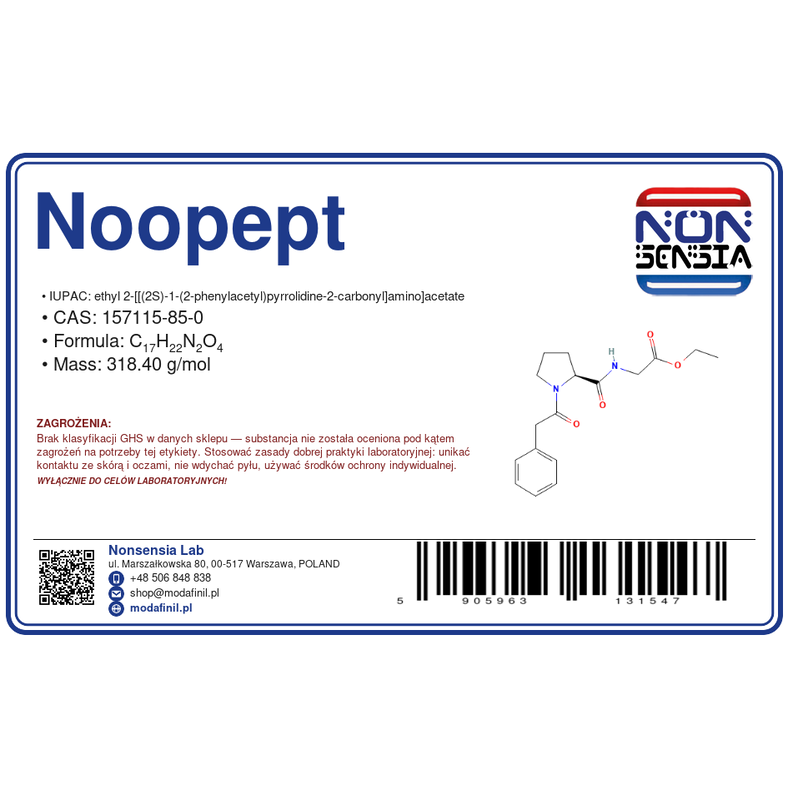
| Systematic name (IUPAC) | ethyl 2-[[(2S)-1-(2-phenylacetyl)pyrrolidine-2-carbonyl]amino]acetate (N-phenylacetyl-L-prolylglycine ethyl ester) |
|---|---|
| INN | omberacetam |
| Development code | GVS-111 |
| CAS number | 157115-85-0 |
| Molecular formula | C17H22N2O4 |
| Molar mass | 318.4 g·mol−1 |
| Monoisotopic mass | 318.1580 Da |
| InChIKey | PJNSMUBMSNAEEN-AWEZNQCLSA-N |
| SMILES | CCOC(=O)CNC(=O)[C@@H]1CCCN1C(=O)CC2=CC=CC=C2 |
| PubChem CID | 180496 |
| ChEMBL | CHEMBL3663392 |
| Form | crystalline powder, white to off-white |
| Purity | ≥ 99% |
| Intended use | research reagent — not for human or animal consumption |
Origins of the molecule: rational dipeptide design
Noopept was not the product of a chance discovery, nor of trial-and-error modification of an existing drug. It is the outcome of a deliberate strategy for designing dipeptide drugs, developed at the V. V. Zakusov Institute of Pharmacology in Moscow. This strategy — described explicitly by its authors — consisted of isolating structural fragments (amino acid residues, peptide bonds) from the molecules of non-peptide drugs with known activity and then designing topologically similar peptide analogues [6]. In the literature, Noopept is consistently described as a dipeptide analogue of piracetam [1] — not its metabolite or a chemical derivative in the synthetic sense, but a molecule designed around the same pharmacophore fragment.
A metabolite that is also a natural neuropeptide
Pharmacokinetic studies in rats showed that the compound undergoes enzymatic breakdown to three metabolites, one of which — cyclo-Pro-Gly (cyclo-L-prolylglycine, a diketopiperazine) — proved to be an active metabolite and at the same time a structure identical to an endogenous neuropeptide [1]. This relationship has an analytical consequence: cyclo-Pro-Gly is also observed as a product of intramolecular cyclisation in material of reduced purity, so an HPLC-UV method should separate it from the parent substance.
Timeline
| 1997 | first indexed pharmacokinetic studies of GVS-111 in rats; identification of the active metabolite cyclo-Pro-Gly [1] |
|---|---|
| 2000 | demonstration of neuroprotective properties in cell cultures (oxygen-glucose deprivation, glutamate toxicity) [2] |
| 2002 | chronic toxicity study in rabbits [3]; basic electrophysiological studies on molluscan neurons [4]; prefrontal cortex lesion model in the rat [5] |
| 2003 | publication of the strategy for designing dipeptide neuropsychotropic drugs — the rationale for the rational design of the molecule [6] |
| 2005–2007 | series of studies in animal models of Alzheimer’s disease (beta-amyloid administration) [7][8] |
| 2008–2011 | clinical studies involving humans, using the pharmaceutical preparation available in Russia: post-traumatic and vascular cognitive disorders [9], comparison with piracetam [10], stroke [14] |
| 2010 | description of the effect on inhibitory synaptic transmission in the hippocampus by the patch-clamp method [11]; studies of the molecular mechanism of action involving the Ufa centre [12] |
| 2011 | study conducted outside Russia (Umeå University, Sweden) on the effect on α-synuclein amyloid cytotoxicity [13] |
| 2013–2015 | extension of research to a diabetic model [15]; continuation of the 2010 electrophysiological line by the same team [16] |
| 2018 | review of twenty years of the “dipeptide drugs” project by a co-author of the original molecular design [17] |
| 2020–2022 | molecular studies involving the Ufa centre on the transcription factor HIF-1 [18]; latest publication of the electrophysiological line from the Research Center of Neurology [19] |
The centres that built the literature
As with other substances of Russian origin in our catalogue, the literature on noopept has a concentrated geography — three centres, each with its own research profile.
- V. V. Zakusov Institute of Pharmacology (Moscow). The parent centre of the project — this is where the dipeptide design strategy was developed [6][17], where the chronic toxicity study [3] and the studies of the molecular mechanism of action [12] were carried out, and where the programme was extended to a diabetic model [15]. It is the same institute whose earlier work we cite for bromantane — another compound from the same Russian research programme on psychotropic substances.
- Research Center of Neurology / Brain Science Institute (Moscow). A separate research line focused on hippocampal electrophysiology using the patch-clamp method, pursued by the same team without interruption from 2010 to 2022: the first publication on the effect on inhibitory transmission in CA1 pyramidal cells [11], a continuation five years later [16], and the most recent paper, from 2022, examining the involvement of α7 nicotinic acetylcholine receptors [19].
- Institute of Biochemistry and Genetics in Ufa. A centre analysing the molecular mechanism at the level of gene expression and transcription factors, collaborating with the Zakusov Institute [12][18]. It is exactly the same centre that carried out the DNA macroarray analysis for bromantane — in both cases the same methodological group took up a different molecule from the same research stream.
The exception to the Russian geography is a 2011 paper on the effect of the compound on α-synuclein amyloid cytotoxicity, conducted at Umeå University in Sweden [13] — evidence that the molecule attracted research interest also outside the centres that designed it.
Disclaimer covering the entire section above. It describes the history of scientific research from 1997–2022. Preclinical studies were conducted on laboratory animals or cell cultures, and studies involving humans — exclusively with the pharmaceutical preparation available in Russia, not with a chemical reagent. This is not a description of the properties of the material offered and cannot serve as a basis for any use of it outside the laboratory.
Chemistry: an ester, a dipeptide and a single stereogenic centre
Why the stereochemistry of noopept differs from that of modafinil
Unlike modafinil, where the stereogenic centre lies on the sulfur atom and the commercial material is usually a racemic mixture, in noopept the stereogenic centre derives from the natural L-proline used as the synthesis starting material. The SMILES and IUPAC notation (2S configuration) define a single, fixed enantiomer — the material does not require chiral separation, because the configuration is determined at the stage of starting-material selection rather than established post factum by an analytical method.
The ester bond as the weak point of the molecule
The structure of the molecule includes three functional groups of differing stability: two amide bonds (stable) and one ester bond (ethoxycarbonyl), susceptible to hydrolysis. It is hydrolysis and the subsequent intramolecular cyclisation that lead to the metabolite/degradation product cyclo-Pro-Gly described above [1]. For the laboratory this has a practical consequence: the material should be stored in dry, cool conditions, and when assessing purity by HPLC-UV the possible presence of this degradation product as a separate peak should be taken into account.
Physicochemical characteristics
| Parameter | Value | What follows from it |
|---|---|---|
| Partition coefficient (LogP) | 1.5 | moderate lipophilicity, close to modafinil (≈1.3) — middle part of the RP-HPLC gradient |
| Topological polar surface area | 75.7 Å2 | the presence of two amide bonds and an ester bond raises polarity relative to adamantane-type cage hydrocarbons |
| Hydrogen bond donors | 1 | the N–H group of the second amide bond |
| Hydrogen bond acceptors | 4 | two carbonyl oxygens and the ester oxygen |
| Rotatable bonds | 7 | flexible chain — the molecule is considerably less rigid than the adamantane cage of bromantane |
| Solubility | good in DMSO and methanol; limited in water | prepare stock solutions in an organic solvent |
Nomenclature and synonyms
Several names from different stages of its history refer to this compound — from the laboratory code to the INN:
- Noopept — the common name most widely used internationally;
- Ноопепт — the original Cyrillic spelling, found in the titles of most source papers;
- Omberacetam — the INN (International Nonproprietary Name); registers also contain the Latin form omberacetamum, typical of official WHO nomenclature;
- GVS-111 — the development code from the laboratory stage, found in the titles of early publications [1][2];
- SGS-111 — a variant spelling of the same code, found in some chemical registers; it does not denote a different compound;
- N-phenylacetyl-L-prolylglycine ethyl ester — a descriptive name reflecting the peptide structure of the molecule.
When searching the literature it is worth combining all variants — some older papers are indexed only under the code GVS-111, not under the name Noopept.
Laboratory applications of the reagent
- reference material for confirming identity and purity by HPLC-UV, including separation from the degradation product cyclo-Pro-Gly;
- standard in chromatographic methods (HPLC, GC) — the technique for determining the compound and its metabolites in this way was first described by Boĭko et al. [1];
- model material in research on the rational design of peptide drugs — a reference point for the strategy described by Gudasheva et al. [6][17];
- standard for NMR — a single, defined stereogenic centre (2S configuration) makes the material useful in the control of optical purity;
- model compound in basic research in the field of neuronal membrane electrophysiology [4][11][16][19].
Storage, handling and safety at work
Store in the original, tightly closed packaging, in a dry and cool place, protected from light, away from food and feed and out of the reach of children — the ester bond in the structure of the molecule is susceptible to hydrolysis, so contact with moisture should also be limited for analytical reasons, not only for safety. Work only under laboratory conditions, using personal protective equipment: gloves, safety glasses and laboratory clothing; weigh the powder under conditions that minimise dusting. Avoid inhaling dust and contact with skin and eyes. Waste handling — in accordance with the regulations applicable to chemical waste at the place where the research is carried out.
Note on safety data. A chronic toxicity study in rabbits (oral administration for 6 months) revealed no irreversible pathological changes and no allergenic, immunotoxic or mutagenic effects [3]. Nevertheless, public registers (PubChem) contain no harmonised GHS classification for this substance — the material should be handled with the caution appropriate to unclassified research reagents, and not on the basis of a single study in another species.
Regulatory status
The substance is available in the Russian Federation as a pharmaceutical preparation — the clinical publications cited in this text describe it as a “new nootropic drug” administered to patients under medical supervision [9][10][14]. This is a historical and regulatory fact concerning another country, another legal entity and another form of manufacture — the registration covered a pharmaceutical preparation manufactured under a pharmaceutical regime. It does not in any way apply to the chemical reagent offered here and confers on it no status whatsoever as a medicinal product. According to the international ChEMBL register, the substance is listed with Preclinical status (max_phase 0) — it has not gone through the Western registration pathway as a drug. The material offered is a chemical reagent and has no authorisation for any use in humans or animals. The purchaser is responsible for ensuring that the intended use complies with the law in force in the country of destination.
Frequently Asked Questions
How does noopept differ from piracetam?
In structure and design origin. Piracetam is a pyrrolidone derivative; noopept is a dipeptide designed around the same pharmacophore fragment by the method of rational dipeptide drug design [6]. In the literature, noopept is consistently described as a “dipeptide analogue of piracetam” [1], not as its metabolite or a simple chemical derivative.
What are the chemical formula and molar mass of noopept?
C17H22N2O4; molar mass 318.4 g·mol−1, monoisotopic mass 318.1580 Da. CAS number 157115-85-0, InChIKey PJNSMUBMSNAEEN-AWEZNQCLSA-N.
What does the name Omberacetam mean?
It is the International Nonproprietary Name (INN) of this substance — registers also contain the Latin form omberacetamum, typical of official WHO nomenclature. The name Noopept remains the most common in commercial circulation and in the literature.
Are GVS-111 and SGS-111 different compounds?
No. They are two variant spellings of the same development code, found in different chemical registers. The same CAS number 157115-85-0.
Is noopept a medicine?
In Poland the material offered is not a medicine or a substitute for one. In the Russian Federation the substance is available as a registered pharmaceutical preparation — a separate legal entity to which this offer does not relate. The material offered here is a chemical reagent without authorisation for use in humans.
Is the reagent suitable for applications other than laboratory ones?
No. The material is intended exclusively for laboratory and analytical research. It is not intended for human or animal consumption; it is not a medicine, food supplement, food or cosmetic and may not be used for medical, diagnostic or consumption purposes.
How should noopept be stored as a laboratory reagent?
In the original, tightly closed packaging, in a dry and cool place, protected from light, away from food and feed and out of the reach of children. Moisture promotes hydrolysis of the ester bond, so the tightness of the packaging also matters analytically.
What should noopept be dissolved in to prepare a stock solution?
It dissolves well in DMSO and methanol, and to a limited extent in water. With LogP ≈ 1.5, stock solutions are prepared in an organic solvent.
How is the purity of noopept confirmed?
By HPLC-UV against a reference material. Because the ester bond is susceptible to hydrolysis, it is worth including in the method separation from cyclo-Pro-Gly — the product of intramolecular cyclisation described in pharmacokinetic studies as an active metabolite [1].
Does noopept have a stereogenic centre requiring separation?
Yes, but unlike modafinil it does not require chiral separation by an analytical method — the (2S) configuration derives from the natural L-proline used as the synthesis starting material and is defined already at the stage of starting-material selection.
Is a safety data sheet supplied with noopept?
We make the safety data sheet available on request to recipients conducting research or analytical activities.
Is noopept legal in Poland?
The substance is not listed as a registered medicinal product in Poland; the material offered is a chemical reagent without authorisation for use in humans. The purchaser is responsible for ensuring that the intended use complies with the law of the country of destination.
What is a noopept standard used for in an analytical laboratory?
For confirming identity and purity by HPLC-UV, as a standard in LC-MS and GC-MS, as model material in peptide drug design research and in basic electrophysiological studies of neuronal membranes.
References
The entries come from the PubMed database and concern the chemistry, pharmacokinetics, molecular design and research history of this molecule. Entries [1]–[6], [11][12][13][15][16][18][19] are preclinical (laboratory animals or cell cultures) and methodological papers; [7][8] are studies in animal models of Alzheimer’s disease; [9][10][14] are studies involving humans, conducted exclusively with the pharmaceutical preparation available in Russia — not with a chemical reagent; [17] is a historical review of the project. None of these papers describes the use of an analytical reagent — they are cited as scientific context and bibliographic guidance, not as information about the properties of the material offered or as an encouragement to any use. The list was compiled on the basis of PubMed queries dated 2026-09-06/08.
- Boĭko SS, Zherdev VP, Dvorianinov AA (1997). “Pharmacokinetics of the nootropic dipeptide piracetam analogue GVS-111 and its main metabolites” [in Russian]. Eksp Klin Farmakol. PMID 9206571.
- Andreeva NA, Stel’mashuk EV, Isaev NK (2000). “Neuroprotective properties of nootropic dipeptide GVS-111 in in vitro oxygen-glucose deprivation, glutamate toxicity and oxidative stress.” Bull Exp Biol Med. PMID 11177296.
- Kovalenko LP, Smol’nikova NM, Alekseeva SV (2002). “Preclinical study of the toxicity of noopept” [in Russian]. Eksp Klin Farmakol. PMID 12025790.
- Bukanova JV, Solntseva EI, Skrebitsky VG (2002). “Selective suppression of the slow-inactivating potassium currents by nootropics in molluscan neurons.” Int J Neuropsychopharmacol. PMID 12366875.
- Romanova GA, Shakova FM, Gudasheva TA et al. (2002). “Impairment of learning and memory after photothrombosis of the prefrontal cortex in rat brain: effects of Noopept.” Bull Exp Biol Med. PMID 12660828.
- Gudasheva TA, Skoldinov AP (2003). “Design of new dipeptide neuropsychotropic drugs” [in Russian]. Eksp Klin Farmakol. PMID 12962042.
- Bobkova NV, Gruden’ MA, Samokhin AN et al. (2005). “Noopept improves spatial memory and stimulates the production of antibodies against prefibrillar beta-amyloid(25-35) in mice” [in Russian]. Eksp Klin Farmakol. PMID 16277202.
- Ostrovskaya RU, Gruden MA, Bobkova NA et al. (2007). “The nootropic and neuroprotective proline-containing dipeptide noopept restores spatial memory and increases immunoreactivity to amyloid in an Alzheimer’s disease model.” J Psychopharmacol. PMID 17092975.
- Bochkarev VK, Teleshova ES, Siuniakov SA et al. (2008). “Clinical and electroencephalographic characteristics of noopept in patients with mild post-traumatic and vascular cognitive disorders” [in Russian]. Zh Nevrol Psikhiatr Im S S Korsakova. PMID 19008801.
- Neznamov GG, Teleshova ES et al. (2009). “Comparative studies of Noopept and piracetam in the treatment of patients with mild cognitive disorders in organic brain diseases of vascular and traumatic origin.” Neurosci Behav Physiol. PMID 19234797.
- Kondratenko RV, Derevyagin VI, Skrebitsky VG (2010). “Novel nootropic dipeptide Noopept increases inhibitory synaptic transmission in CA1 pyramidal cells.” Neurosci Lett. PMID 20382202.
- Ostrovskaia RU, Vakhitova IuV, Salimgareeva MKh et al. (2010). “On the mechanism of action of noopept: decrease in the activity of stress-induced kinases and increase in neurotrophin expression” [in Russian]. Eksp Klin Farmakol. PMID 21395007.
- Jia X, Gharibyan AL, Öhman A et al. (2011). “Neuroprotective and nootropic drug noopept rescues α-synuclein amyloid cytotoxicity.” J Mol Biol. PMID 21986202.
- Amelin AV, Iliukhina AIu, Shmonin AA (2011). “Noopept in the treatment of mild cognitive impairment in patients after stroke” [in Russian]. Zh Nevrol Psikhiatr Im S S Korsakova. PMID 22500312.
- Ostrovskaya RU, Ozerova IV, Gudascheva TA et al. (2013). “Efficiency of noopept in streptozotocin-induced diabetes in rats.” Bull Exp Biol Med. PMID 23484194.
- Povarov IS, Kondratenko RV, Derevyagin VI et al. (2015). “Nootropic dipeptide noopept enhances inhibitory synaptic transmission in the hippocampus.” Bull Exp Biol Med. PMID 25573367.
- Gudasheva TA, Ostrovskaya RU, Seredenin SB (2018). “Novel Technologies for Dipeptide Drugs Design and their Implantation.” Curr Pharm Des. PMID 30295186.
- Zainullina LF, Ivanova TV, Sadovnikov SV et al. (2020). “Cognitive Enhancer Noopept Activates Transcription Factor HIF-1.” Dokl Biochem Biophys. PMID 33119829.
- Kondratenko RV, Povarov IS, Kolbaev SN et al. (2022). “Effect of nootropic dipeptide noopept on CA1 pyramidal neurons involves α7AChRs on interneurons in hippocampal slices from rat.” Neurosci Lett. PMID 36195298.
Identification data and computed descriptors from PubChem (CID 180496) and the ChEMBL register (CHEMBL3663392).
Related reagents in our catalogue
- Bromantane (CAS 87913-26-6) — another substance from the same Russian research stream; the same Institute of Biochemistry and Genetics in Ufa analysed the molecular mechanism of both compounds
- Aniracetam — often grouped with noopept as a “racetam”, but with an entirely different scaffold: a pyrrolidone derivative, not a dipeptide
Statement of intended use
The material offered is a chemical reagent intended exclusively for research, analytical and laboratory purposes. It is not intended for human or animal consumption. It is not a medicinal product, food supplement, foodstuff, medical device or cosmetic. It may not be used for medical, diagnostic, therapeutic, prophylactic or consumption purposes, administered to humans or animals, applied to the skin, or added to food, beverages or feed. Sale exclusively to recipients conducting research, scientific or analytical activities, with laboratory facilities and the knowledge required for the safe handling of chemical reagents. The purchaser bears sole responsibility for the lawful and safe use of the reagent and for compliance with the regulations in force in the country of destination.