
Description
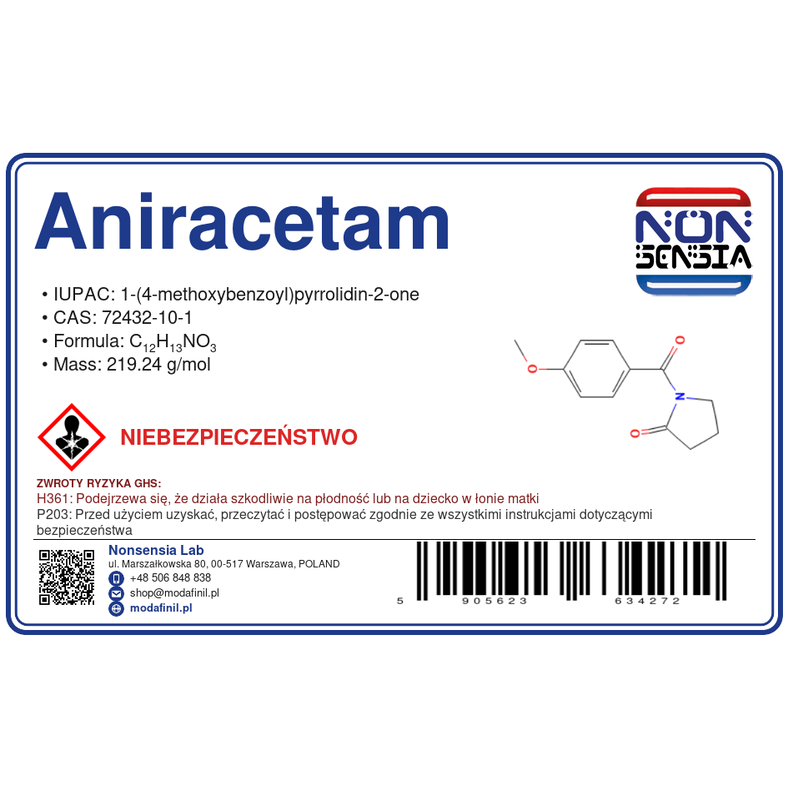
1-(4-Methoxybenzoyl)pyrrolidin-2-one, crystalline powder, 1000 mg package. Material intended solely for laboratory and analytical research in vitro. The product is not intended for consumption by humans or animals, is not a medicinal product, dietary supplement, foodstuff, or cosmetic.
Three Different Entities That Must Not Be Confused
For this molecule, separating the layers is just as important as for any other item in our catalog belonging to the racetam family, because the same chemical name is simultaneously associated with pharmaceutical preparations registered outside Poland. Three contexts, three completely different statuses:
| Entity | What it is | What it concerns |
|---|---|---|
| Chemical substance aniracetam, CAS 72432-10-1 |
A chemical concept — a molecule with a defined structure from the pyrrolidinone (racetam) family. In itself it is neither a drug nor a reagent; its status is conferred by the form in which it was manufactured and approved. | chemistry, substance registries |
| Medicinal product including Draganon, Sarpul, Ampamet, Memodrin, Referan |
Pharmaceutical preparations sold under these trade names in selected countries outside Poland and the United States: a defined pharmaceutical form, manufacturing under pharmaceutical regime, registration documentation, safety oversight. | this entity was the subject of clinical trials involving humans [5][8][13][14] |
| Chemical reagent the material offered here |
Material for laboratory and analytical work. It does not have, and cannot have, approval for use in humans or animals — it has no pharmaceutical form or medicinal product documentation. | analytics, chemistry, reference standards |
The consequence is unambiguous. The study results cited further on this page were obtained either using a registered medicinal product (clinical trials involving humans), or using the substance administered to laboratory animals or tested on in vitro preparations under controlled experimental conditions (preclinical studies). None of these studies was conducted using an analytical reagent, and none of these results transfers to the offered material. The reagent is not the form in which the substance was ever studied in humans, and cannot be used in that way.
Reagent Identification Card
| Systematic name (IUPAC) | 1-(4-methoxybenzoyl)pyrrolidin-2-one |
|---|---|
| Common name | aniracetam (aniracetamum) |
| Development code | Ro 13-5057 |
| CAS number | 72432-10-1 |
| Molecular formula | C12H13NO3 |
| Molar mass | 219.24 g·mol−1 |
| Monoisotopic mass | 219.0895 Da |
| InChIKey | ZXNRTKGTQJPIJK-UHFFFAOYSA-N |
| SMILES | COC1=CC=C(C=C1)C(=O)N2CCCC2=O |
| PubChem CID | 2196 |
| ChEMBL | CHEMBL561371 |
| ATC code (WHO) | N06BX11 |
| GHS classification (PubChem data) | GHS08 pictogram, signal word Warning |
| Physical form | crystalline powder, white to off-white |
| Purity | ≥ 99% |
| Intended use | research reagent — not for human or animal consumption |
Molecular Lineage: Second-Generation Racetams
Aniracetam is not the first representative of its family. The core from which the entire class of racetams derives is the pyrrolidin-2-one ring — the same structural fragment that first entered pharmaceutical practice in the form of piracetam, the earliest and most extensively described member of the group. Aniracetam differs from this simple scaffold by substitution at the nitrogen atom: instead of a short amide chain, it carries a 4-methoxybenzoyl (anisoyl) group — hence the older name “1-anisoyl-2-pyrrolidinone” found in some early chemical registries.
From Development Code to First Publication
The compound was developed in the Swiss laboratories of Hoffmann-La Roche under the development code Ro 13-5057 — the code itself, present in the title of the first publication, is a standard designation used by this company for compounds at the preclinical research stage. The first indexed description of pharmacological properties in rodent models with impaired memory and learning was published by Cumin and coworkers in 1982 [1]. Two years later, a paper appeared extending the observations to primates, with simultaneous EEG recording [2] — a sequence typical of this period: first rodents, then species closer to humans, and only later clinical studies.
Three Independent Research Paths
The literature on aniracetam developed in parallel along three, largely independent directions. Japanese research centers — the group around Nakamura — built an extensive body of work on aging and impaired laboratory animal models, including the mechanism of antidepressant-like action in aged rats [9]. In parallel, controlled clinical trials using a registered pharmaceutical preparation were conducted in Europe in patients with dementia [5][14], and later — already in this century — pharmacokinetic studies in healthy volunteers in China [13]. The third path is AMPA receptor electrophysiology, conducted from the early 1990s to the present on in vitro preparations and animal models [4][6][10][15][16].
Timeline
| before 1982 | development of the compound in the Hoffmann-La Roche laboratories (Switzerland) under the code Ro 13-5057 |
|---|---|
| 1982 | first indexed pharmacological paper in rodents [1] |
| 1985 | studies in primates with EEG recording [2] |
| 1986 | mechanism: enhancement of long-term potentiation (LTP) in the guinea pig hippocampus [3] |
| 1991 | AMPA receptor mechanism described by the patch-clamp method [4]; in parallel, the first controlled clinical trial in Alzheimer-type dementia using a registered preparation [5] |
| 1992 | further characterization of the link between LTP and AMPA receptor modification [6] |
| 1995 | identification of specific [3H]aniracetam binding sites in brain membranes [7] |
| 1998 | clinical study of combination therapy in geriatric patients with cerebral circulatory disorders and dementia [8] |
| 2001 | mechanism of antidepressant-like action in aged laboratory animals [9] |
| 2003 | detailed mechanism of modulation of AMPA receptor desensitization [10] |
| 2007 | development of an LC-MS/MS method for determination in human plasma [12] |
| 2008 | pharmacokinetic and bioequivalence study in healthy volunteers [13] |
| 2012 | comparative clinical study of efficacy in patients with cognitive impairment [14] |
| 2023 | studies on the neuroprotective mechanism in an experimental model of ischemic stroke [15] |
| 2026 | most recent paper on the mechanism in a mouse model of attention deficit [16] |
Chemistry: A Pyrrolidinone Ring Without a Stereogenic Center
Why This Molecule Does Not Require Enantiomer Separation
Unlike some other reagents in our catalog, where a sulfur atom or a substituted carbon forms a stereogenic center, aniracetam is an achiral molecule. The three carbons of the pyrrolidinone ring are methylene groups (CH2), and the nitrogen atom in the amide moiety is practically planar due to conjugation with the carbonyl group — it therefore does not meet the condition of four different substituents required for a stable chirality center. The practical consequence: the material does not require an enantioselective method to confirm identity, unlike compounds from the benzhydryl sulfoxide family, where the total-assay result alone does not resolve the ratio of the R and S forms.
Physicochemical Characteristics
| Parameter | Value | What this means |
|---|---|---|
| Partition coefficient (XLogP) | ≈ 1.6 | moderate lipophilicity — elutes in the middle portion of an RP-HPLC gradient |
| Topological polar surface area (TPSA) | 46.6 Å2 | moderate; lower than in molecules bearing a sulfoxide group |
| Hydrogen bond donors | 0 | no N–H or O–H group capable of donation — the amide nitrogen is substituted on both sides |
| Hydrogen bond acceptors | 3 | two carbonyl oxygens and the ether oxygen of the methoxy group |
| Rotatable bonds | 2 | limited conformational freedom — the bond to the benzoyl ring and the methoxy group |
| Heavy atoms | 16 | a small, compact molecule |
| Solubility | good in DMSO, methanol, and acetonitrile; poor in water | prepare stock solutions in an organic solvent |
The methoxy group as a reference point in mass spectrometry. The presence of the 4-methoxybenzoyl substituent gives a characteristic fragment ion at m/z 135 (the 4-methoxybenzoyl cation), useful for confirming identity by LC-MS/MS regardless of matrix — such a method for human plasma was developed by Zhang and coworkers [12].
Nomenclature and Synonyms
- Aniracetam — common name, the most frequent in international literature;
- Aniracetamum — Latin form (INN);
- Ro 13-5057 / Ro-13-5057 / Ro-135057 — Hoffmann-La Roche development code, present in the titles of early publications [1][5];
- 1-(4-Methoxybenzoyl)-2-pyrrolidinone, 1-p-Anisoyl-2-pyrrolidinone, 1-p-anisoylpyrrolidin-2-one, 1-[(4-methoxyphenyl)carbonyl]pyrrolidin-2-one — variants of the systematic name used in various chemical databases;
- NSC-758223 — National Cancer Institute database number;
- 1-(4-Methoxybenzoyl)pyrrolidin-2-one — IUPAC systematic name, the only fully unambiguous designation.
A separate group consists of the trade names of pharmaceutical preparations registered under this active substance in selected countries — listed solely in the “Three Different Entities” table above, together with an explicit clause that this offer does not concern them.
The divergence in names has a bibliographic consequence: searching databases solely under the term “aniracetam” omits part of the earlier literature indexed under the development code Ro 13-5057. When querying, it is worth combining both variants.
Laboratory Use of the Reagent
- reference material for confirming identity and purity by HPLC-UV;
- standard in the LC-MS/MS method for determination in biological matrices — the technique for human plasma was described by Zhang et al. [12];
- material in receptor binding studies using the [3H]aniracetam radioligand, used to characterize specific binding sites in brain membranes [7];
- model compound in electrophysiological studies of AMPA receptors (patch-clamp, LTP induction) [4][6][10];
- comparative material in the development and validation of new compounds from the pyrrolidinone family [11];
- fragment mass standard (m/z 135 ion) for calibrating LC-MS/MS methods for compounds bearing the 4-methoxybenzoyl group.
Storage, Handling, and Work Safety
Store in the original, tightly closed container, in a dry and cool place, protected from light, separately from food and feed and out of the reach of children. Work only under laboratory conditions, using personal protective equipment: gloves, safety goggles, and laboratory clothing; weigh the powder under conditions that limit dust generation. Avoid inhaling dust and contact with skin and eyes. Waste handling — in accordance with the regulations applicable to chemical waste at the site where the research is conducted.
Note on safety data. The available toxicological data (including LD50 values) are incomplete in publicly accessible databases. The absence of documented hazard is not equivalent to the absence of hazard — the material should be handled with the caution appropriate for a substance with an incompletely established toxicological profile.
Regulatory Status
The substance is known as the active ingredient of registered pharmaceutical preparations in selected countries outside Poland (trade names — see the “Three Different Entities” table above). In Poland and in the United States, aniracetam does not have the status of a registered medicinal product — trade in medicinal preparations in the countries where it has obtained such registration is subject to separate pharmaceutical law provisions, and this offer does not concern them. The offered material is a chemical reagent and has no approval for any use in humans or animals. The buyer is responsible for checking the legal status of the substance in the country of destination before ordering, and for the compliance of the intended use with applicable law.
Frequently Asked Questions
How does aniracetam differ from piracetam?
Both compounds share a common core — the pyrrolidin-2-one ring, which defines the entire racetam family. Aniracetam differs in the substitution at the ring nitrogen: instead of a simple amide chain, it carries a 4-methoxybenzoyl (anisoyl) group, which increases its molar mass and lipophilicity relative to the simpler scaffold.
Is aniracetam a medicine available in Poland?
No. In Poland and in the United States, aniracetam does not have the status of a registered medicinal product. The active substance of this name occurs in pharmaceutical preparations registered under other trade names in selected countries outside Poland — the material offered here is not any of those preparations.
What is the chemical formula and molar mass of aniracetam?
C12H13NO3; molar mass 219.24 g·mol−1, monoisotopic mass 219.0895 Da. CAS number 72432-10-1, InChIKey ZXNRTKGTQJPIJK-UHFFFAOYSA-N.
Does aniracetam have a stereogenic center?
No. All three carbons of the pyrrolidinone ring are methylene groups, and the amide nitrogen is practically planar. The molecule is achiral and does not occur as a pair of enantiomers — unlike compounds with a stereogenic center on a sulfur atom.
How should aniracetam be stored as a laboratory reagent?
In the original, tightly closed container, in a dry and cool place, protected from light, separately from food and feed and out of the reach of children. Details are provided in the storage section above.
What solvent should be used to prepare a stock solution of aniracetam?
It dissolves well in DMSO, methanol, and acetonitrile, and poorly in water. With XLogP ≈ 1.6, stock solutions are prepared in an organic solvent.
How is the identity and purity of aniracetam confirmed in the laboratory?
By the HPLC-UV method against a reference material, and by LC-MS/MS, including the use of the characteristic fragment ion at m/z 135 originating from the 4-methoxybenzoyl group [12].
Is a safety data sheet provided with aniracetam?
We provide the safety data sheet on request to recipients conducting research or analytical activities. We note that the available toxicological data are incomplete — the material should be handled with the caution appropriate for a substance with an incompletely established profile.
Is aniracetam legal in Poland?
Aniracetam is not listed as a registered medicinal product in Poland. The offered material is a chemical reagent with no approval for use in humans or animals. The buyer is responsible for checking the legal status of the substance in the country of destination before ordering.
What does the code Ro 13-5057 mean?
It is an internal development code assigned to the compound by Hoffmann-La Roche at the preclinical research stage, present in the titles of the earliest scientific publications [1][5]. It denotes the same molecule as aniracetam, CAS 72432-10-1.
What is the aniracetam standard used for in an analytical laboratory?
For confirming identity and purity by HPLC-UV, as a standard in LC-MS/MS for determinations in biological matrices, as material in receptor binding studies using a radioligand, and as a model compound in electrophysiological studies of AMPA receptors.
Is the reagent suitable for uses other than laboratory ones?
No. The material is intended solely for laboratory and analytical research. It is not intended for consumption by humans or animals, it is not a medicine, dietary supplement, food, or cosmetic, and it may not be used for medical, diagnostic, or consumption purposes.
References
The references are drawn from the PubMed database and concern the chemistry, mechanism of action, analytics, and research history of this molecule. References [1]–[4], [6]–[7], [9]–[10], [15]–[16] are preclinical and mechanistic studies — animal models (rat, guinea pig, mouse, primates) and in vitro preparations (hippocampal slices, synaptic membranes, electrophysiology). Reference [12] is a bioanalytical method (LC-MS/MS) validated using human plasma — a methodological paper, not a clinical study. References [5], [8], [13], [14] are studies involving humans, conducted using a registered medicinal product (a pharmaceutical preparation in a defined pharmaceutical form) — not using a chemical reagent. Reference [11] concerns a related compound from the same family of pyrrolidinone-class compounds (DM235/sunifiram), cited as a pharmacological comparison within the class. The whole set is cited as scientific context and a bibliographic pointer, not as information about the use of the offered material or an encouragement of any use.
- Cumin R et al. (1982). “Effects of the novel compound aniracetam (Ro 13-5057) upon impaired learning and memory in rodents.” Psychopharmacology. PMID 6817363. doi:10.1007/BF00432244.
- Schwam E et al. (1985). “The effects of aniracetam on primate behavior and EEG.” Annals of the New York Academy of Sciences. PMID 3860103. doi:10.1111/j.1749-6632.1985.tb37617.x.
- Satoh M et al. (1986). “Aniracetam augments, and midazolam inhibits, the long-term potentiation in guinea-pig hippocampal slices.” Neuroscience Letters. PMID 3018633. doi:10.1016/0304-3940(86)90145-x.
- Isaacson JS et al. (1991). “Aniracetam reduces glutamate receptor desensitization and slows the decay of fast excitatory synaptic currents in the hippocampus.” Proceedings of the National Academy of Sciences USA. PMID 1660156. doi:10.1073/pnas.88.23.10936.
- Senin U et al. (1991). “Aniracetam (Ro 13-5057) in the treatment of senile dementia of Alzheimer type (SDAT): results of a placebo controlled multicentre clinical study.” European Neuropsychopharmacology. PMID 1822317. doi:10.1016/0924-977x(91)90004-e.
- Staubli U et al. (1992). “Receptor changes and LTP: an analysis using aniracetam, a drug that reversibly modifies glutamate (AMPA) receptors.” Hippocampus. PMID 1339192. doi:10.1002/hipo.450020107.
- Fallarino F et al. (1995). “[3H]aniracetam binds to specific recognition sites in brain membranes.” Journal of Neurochemistry. PMID 7616253. doi:10.1046/j.1471-4159.1995.65020912.x.
- Katsunuma H et al. (1998). “Treatment of insomnia by concomitant therapy with Zopiclone and Aniracetam in patients with cerebral infarction, cerebroatrophy, Alzheimer’s disease and Parkinson’s disease.” Psychiatry and Clinical Neurosciences. PMID 9628149. doi:10.1111/j.1440-1819.1998.tb01028.x.
- Nakamura K et al. (2001). “Antidepressant-like effects of aniracetam in aged rats and its mode of action.” Psychopharmacology. PMID 11702095. doi:10.1007/s002130100849.
- Lawrence JJ et al. (2003). “The mechanism of action of aniracetam at synaptic alpha-amino-3-hydroxy-5-methyl-4-isoxazolepropionic acid (AMPA) receptors: indirect and direct effects on desensitization.” Molecular Pharmacology. PMID 12869631. doi:10.1124/mol.64.2.269.
- Ghelardini C et al. (2002). “DM235 (sunifiram): a novel nootropic with potential as a cognitive enhancer.” Naunyn-Schmiedeberg’s Archives of Pharmacology. PMID 12070754. doi:10.1007/s00210-002-0577-3.
- Zhang J et al. (2007). “Sensitive and selective liquid chromatography-tandem mass spectrometry method for the quantification of aniracetam in human plasma.” Journal of Chromatography B. PMID 17826366. doi:10.1016/j.jchromb.2007.08.010.
- Tian Y et al. (2008). “Pharmacokinetics and bioequivalence study of aniracetam after single-dose administration in healthy Chinese male volunteers.” Arzneimittel-Forschung. PMID 19025058. doi:10.1055/s-0031-1296547.
- Koliaki CC et al. (2012). “Clinical efficacy of aniracetam, either as monotherapy or combined with cholinesterase inhibitors, in patients with cognitive impairment: a comparative open study.” CNS Neuroscience & Therapeutics. PMID 22070796. doi:10.1111/j.1755-5949.2010.00244.x.
- Sharma H et al. (2023). “AMPA receptor modulation through sequential treatment with perampanel and aniracetam mitigates post-stroke damage in experimental model of ischemic stroke.” Naunyn-Schmiedeberg’s Archives of Pharmacology. PMID 37231168. doi:10.1007/s00210-023-02544-z.
- Cui J et al. (2026). “Aniracetam restores the excitation-inhibition balance of neurotransmitters in the prefrontal cortex of mice with ADHD.” Scientific Reports. PMID 41644999. doi:10.1038/s41598-026-38725-y.
Identification data and computed descriptors from PubChem (CID 2196).
Related Reagents in Our Catalog
- Oxiracetam (CAS 62613-82-5) — the same pyrrolidin-2-one core as aniracetam; a direct comparison within the racetam family
- Sunifiram (CAS 314728-85-3) — a different scaffold (piperazine instead of pyrrolidinone), cited in the literature as a pharmacological comparator for compounds of this class [11]
- Pramiracetam (CAS 68497-62-1) — another representative of the 2-pyrrolidinone family, with an extended diisopropylaminoethyl chain instead of the anisoyl group — a contrast in lipophilicity and molecular mass
Statement on Product Intended Use
The offered material is a chemical reagent intended solely for research, analytical, and laboratory purposes. It is not intended for consumption by humans or animals. It is not a medicinal product, dietary supplement, foodstuff, medical device, or cosmetic. It may not be used for medical, diagnostic, therapeutic, prophylactic, or consumption purposes, administered to humans or animals, applied to the skin, or added to food, beverages, or feed. Sales are limited to recipients conducting research, scientific, or analytical activities, who have laboratory facilities and the knowledge required for the safe handling of chemical reagents. The buyer bears sole responsibility for the lawful and safe use of the reagent and for compliance with the regulations applicable in the country of destination.