
Description
1-(4-benzoylpiperazin-1-yl)propan-1-one, crystalline powder, 1000 mg pack. Material intended exclusively for laboratory and analytical in vitro research. The product is not intended for human or animal consumption; it is not a medicinal product, food supplement, foodstuff or cosmetic.
Three distinct entities that must not be confused
For this molecule the separation of layers is often overlooked, because many imprecise descriptions of this substance circulate on the internet. Yet the same chemical name functions in three entirely different contexts:
| Entity | What it is | Status of sunifiram |
|---|---|---|
| Chemical substance sunifiram, CAS 314728-85-3 |
A chemical concept — a molecule of defined structure, registered in the PubChem and ChEMBL databases. | yes — this is the only status this molecule actually has |
| Medicinal product | A pharmaceutical preparation: a defined pharmaceutical form and strength, manufacture under GMP, registration dossier, safety surveillance. | NO — in any country. The ChEMBL registry (CHEMBL3663392) records clinical development phase 0 — “Preclinical” for sunifiram: the compound never entered clinical studies involving humans and was never registered as a medicine |
| Chemical reagent material offered here |
Material for laboratory and analytical work. It does not and cannot hold any authorisation for use in humans or animals. | yes — and it is offered exclusively in this capacity |
As with flmodafinil, there is nothing here to confuse with a medicine, because no medicine exists — no form of sunifiram has been authorised anywhere for use in humans. Unlike flmodafinil, however, sunifiram has a noticeably larger body of literature: a dozen or so chemical and pharmacological papers, almost exclusively preclinical — concerning the synthesis of analogues and studies in laboratory animals, not in humans. None of the papers cited below was conducted with an analytical reagent such as the material offered here, and the results of rodent studies do not transfer to the product sold in this shop.
Reagent identification sheet
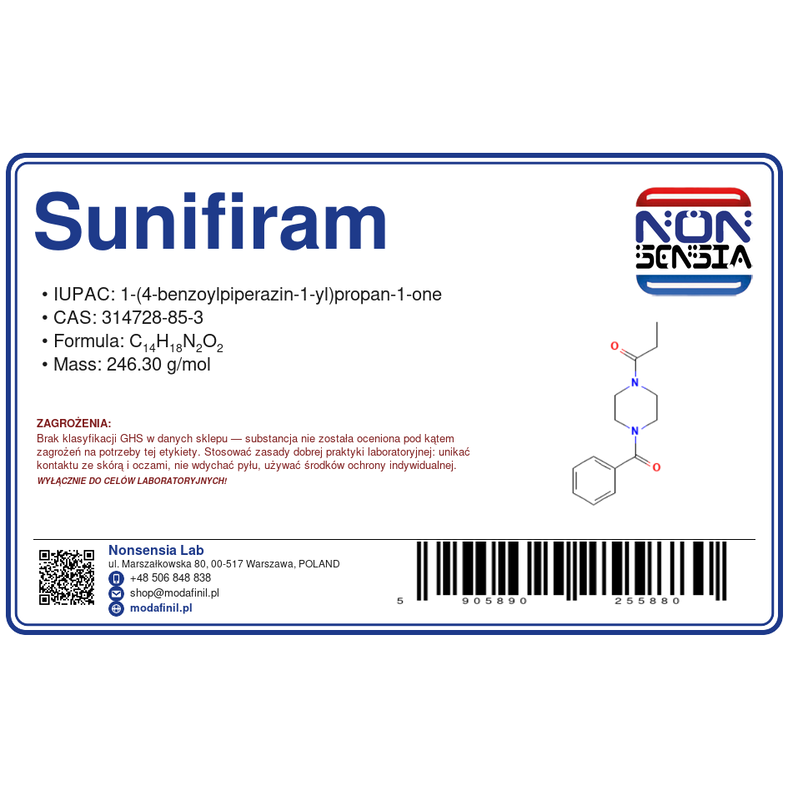
| Systematic name (IUPAC) | 1-(4-benzoylpiperazin-1-yl)propan-1-one |
|---|---|
| Common name | sunifiram |
| Development code | DM-235 (DM235) |
| CAS number | 314728-85-3 |
| Molecular formula | C14H18N2O2 |
| Molar mass | 246.30 g·mol−1 |
| Monoisotopic mass | 246.1368 Da |
| InChIKey | DGOWDUFJCINDGI-UHFFFAOYSA-N |
| SMILES | CCC(=O)N1CCN(CC1)C(=O)C2=CC=CC=C2 |
| PubChem CID | 4223812 |
| UNII (FDA) | 66924E735K |
| ChEMBL | CHEMBL3663392 |
| MDL number | MFCD04112755 |
| Form | crystalline powder, white to off-white |
| Purity | ≥ 99% |
| Intended use | research reagent — not for human or animal consumption |
Lineage of the molecule: simplifying a bicyclic skeleton to piperazine
Sunifiram is not a derivative of the classical racetams, even though it is sometimes confused with them in informal compilations. Piracetam and the whole racetam family are substituted 2-pyrrolidone rings; sunifiram has an entirely different core — a substituted piperazine, a six-membered ring with two nitrogen atoms, one of which carries a propanoyl group and the other a benzoyl group.
Where the piperazine came from in place of the bicyclic skeleton
Work on this family of compounds was carried out at the University of Florence, in a team including, among others, the researchers Ghelardini, Gualtieri, Manetti and Romanelli — engaged since the 1990s in the synthesis and pharmacology of compounds referred to in the paper titles as “cognition-enhancers”. The starting point was bicyclic diazabicyclo[4.3.0]nonanones; systematic simplification of this skeleton to a single piperazine ring led to two closely related molecules — DM-232 (unifiram) and DM-235 (sunifiram) — differing in the length of the acyl chain on one of the nitrogen atoms.
The piperazine family: a decade of work on analogues
Since the first publications devoted to the simplified piperazine derivatives, a series of papers has designed and tested successive analogues: new piperidine and piperazine derivatives with altered acyl chain length [1], analogues derived directly from DM-232 and DM-235 [2], analogues of sunifiram and the related compound sapunifiram [3], the influence of ring size compared with the analogue designated MN19 [4], and substituted phenylpiperazines structurally related to DM-235 [6]. The common denominator of these papers is sunifiram itself — not as the subject of study, but as the reference compound against which the activity of newly designed analogues was compared.
Caveat applying to the whole section above. It describes the history of chemical and pharmacological work conducted in laboratory animals and in vitro. This is not a description of the properties of the material offered, it does not constitute information on its use and cannot serve as a basis for any use outside the laboratory. The reagent offered is not a medicinal product and must not be used in humans or animals.
Research context: sunifiram in its own right, not only as a reference point for analogues
Of the papers indexed in PubMed under the terms sunifiram/DM-235 that do not overlap with the bibliography cited for the same substance by another shop, only one concerns sunifiram itself administered to animals, rather than its analogues. In 2013 Moriguchi et al. described the effect of sunifiram administration on cognitive deficits in mice after olfactory bulbectomy — a procedure used as an animal model of mood disorders — linking the observed effect to activation of CaM kinase II and protein kinase C [5]. This is a preclinical study conducted in laboratory mice, not a clinical study involving humans, and it was not conducted with an analytical reagent. It does not transfer to the reagent offered here and does not constitute information on its action.
Timeline
| turn of the 1990s/2000s | simplification of bicyclic diazabicyclononanones to piperazine derivatives at the University of Florence; DM-232 (unifiram) and DM-235 (sunifiram) are created |
|---|---|
| 2008 (February) | new piperidine and piperazine derivatives as cognition-enhancers [1] |
| 2008 (December) | analogues of DM-232/DM-235 as cognition modulators [2] |
| 2009 | analogues of sunifiram and sapunifiram [3] |
| 2012 | influence of ring size — DM-235 versus MN19 [4] |
| 2013 | the only animal study using sunifiram itself — mouse olfactory bulbectomy model [5] |
| 2015 | substituted phenylpiperazines related to DM-235 [6] |
Chemistry: a substituted piperazine without a stereogenic centre
Why sunifiram has no enantiomers
Unlike modafinil, where the sulfur atom of the sulfoxide group forms a stereogenic centre and necessitates the existence of two enantiomers, sunifiram has no atom bearing four different substituents. The piperazine core is symmetrical, and both nitrogen atoms are fully substituted with acyl groups — propanoyl on one side, benzoyl on the other — with no free N–H bond. The reagent therefore requires neither enantiomer separation nor a declaration of the R/S ratio, which simplifies reference standard qualification compared with modafinil or flmodafinil.
Physicochemical characteristics
| Parameter | Value | What follows from it |
|---|---|---|
| Partition coefficient (XLogP) | ≈ 1.1 | moderate lipophilicity — elutes in the middle part of an RP-HPLC gradient, close to the profile of modafinil (≈ 1.3) |
| Topological polar surface area | 40.6 Å2 | both carbonyl groups counted as acceptors; lower than for modafinil (71.7 Å2) |
| Hydrogen bond donors | 0 | both nitrogen atoms are fully substituted (tertiary amides) — no N–H bond |
| Hydrogen bond acceptors | 2 | two carbonyl oxygens of the amide groups |
| Rotatable bonds | 2 | conformational freedom limited to the exocyclic bonds of the propanoyl chain and the phenyl ring |
| Solubility | good in DMSO, methanol and other organic solvents; poor in water | prepare stock solutions in an organic solvent |
The LOPAC1280 library as confirmation of research-material status
Sunifiram appears in chemical registries under additional catalogue identifiers — Lopac0_000340 and Lopac-D-5689 — indicating its presence in the LOPAC1280 library (Library of Pharmacologically Active Compounds), a collection of reference compounds used in in vitro pharmacological screening assays. This fact alone confirms the nature of the material: the compound circulates in science as a reagent for screening assays, not as a product intended for consumption.
Nomenclature and synonyms
Several names are in use for the same molecule with CAS number 314728-85-3:
- Sunifiram — common name, the most frequent in commercial use and in the later literature;
- DM-235 (DM235, DM 235) — development code from the period of work at the University of Florence, used in most titles of chemical papers;
- 1-(4-benzoylpiperazin-1-yl)propan-1-one — systematic IUPAC name, the only unambiguous one;
- 1-(4-benzoyl-1-piperazinyl)-1-propanone — English equivalent of the systematic name, found in chemical registries;
- Piperazine, 1-benzoyl-4-(1-oxopropyl)- — index name in the Chemical Abstracts style.
When searching the literature it is worth combining all variants — searching only under the term “sunifiram” misses some records indexed under the code DM-235.
Laboratory applications of the reagent
- reference material for confirming identity and purity by HPLC-UV;
- standard in LC-MS and GC-MS methods for determining sunifiram and its piperazine analogues in reaction mixtures;
- reference compound in the synthesis and structure–activity studies of new piperazine derivatives [1][2][3][4][6];
- component of screening libraries such as LOPAC1280 in in vitro pharmacological assays;
- comparative material for calibrating methods that separate small, achiral amide molecules.
Storage, handling and occupational safety
Store in the original, tightly closed container in a dry, cool place protected from light, separately from food and animal feed and out of the reach of children. Work only under laboratory conditions using personal protective equipment: gloves, safety glasses and laboratory clothing; weigh the powder under conditions that limit dust formation. Avoid inhaling dust and contact with skin and eyes. Dispose of waste in accordance with the regulations applicable to chemical waste at the place where the research is carried out.
Note on safety data. Public chemical registries (PubChem) record no GHS classification and no LD50 values for sunifiram. The absence of a documented hazard is not the same as the absence of a hazard — the material should be handled with the caution appropriate to a substance with an unestablished toxicological profile.
Regulatory status
Sunifiram is not registered as a medicinal product in any country known to us and has no pharmacopoeial monograph. The ChEMBL registry records clinical development phase 0 for the compound — preclinical status, with no history of clinical studies involving humans. The legal status of substances of this type may be subject to changes in national law — the purchaser is responsible for checking the legal position in the country of destination before ordering. The material offered is a chemical reagent and holds no authorisation for any use in humans or animals.
Frequently Asked Questions
How does sunifiram differ from unifiram (DM-232)?
Both compounds arose from the same process of simplifying the diazabicyclononanone skeleton to piperazine. They differ in the length of the acyl chain on one of the piperazine nitrogen atoms — a small structural modification, but sufficient to give the two molecules separate CAS numbers and separate development codes.
Is sunifiram a medicine or a registered medicinal product?
No. Sunifiram has never been registered as a medicinal product in any country. The ChEMBL registry records clinical development phase 0 (“Preclinical”) for the compound — no registered pharmaceutical form of this substance exists.
What does the development code DM-235 mean?
It is a designation from the period of chemical work carried out at the University of Florence, preceding the common name “sunifiram”. In the titles of most scientific papers both forms — DM-235/DM235 and sunifiram — appear interchangeably or side by side.
What are the chemical formula and molar mass of sunifiram?
C14H18N2O2; molar mass 246.30 g·mol−1, monoisotopic mass 246.1368 Da. CAS number 314728-85-3, InChIKey DGOWDUFJCINDGI-UHFFFAOYSA-N.
Does sunifiram have a stereogenic centre and require enantiomer separation?
No. The piperazine core is symmetrical and both nitrogen atoms are fully substituted with acyl groups — the molecule has no atom bearing four different substituents, so it does not exist as enantiomers.
How does sunifiram differ from piracetam and other racetams?
In the structure of the core. Piracetam and the other racetams are substituted 2-pyrrolidone rings; sunifiram has a piperazine core with two acyl groups (benzoyl and propanoyl) and does not belong chemically to the racetam family, even though it is sometimes grouped with them in informal sources.
Is the reagent suitable for anything other than laboratory use?
No. The reagent is intended exclusively for laboratory and analytical research. It is not intended for human or animal consumption; it is not a medicine, food supplement, food or cosmetic, and must not be used for medical, diagnostic or consumption purposes.
How should sunifiram be stored as a laboratory reagent?
In the original, tightly closed container, in a dry, cool place protected from light, separately from food and animal feed and out of the reach of children.
What should sunifiram be dissolved in to prepare a stock solution?
It dissolves well in DMSO, methanol and other organic solvents, and poorly in water. With an XLogP of ≈ 1.1, stock solutions are prepared in an organic solvent.
Is a safety data sheet supplied with sunifiram?
We provide the safety data sheet on request to recipients engaged in research or analytical activity. Please note that public chemical registries record no GHS classification and no LD50 data for this substance — the material should be handled with the caution appropriate to a substance with an unestablished toxicological profile.
Is sunifiram legal in Poland?
Sunifiram is not registered as a medicinal product in any country known to us and has no pharmacopoeial monograph. The legal status of substances of this type may be subject to changes in national law — the purchaser is responsible for checking the legal position in the country of destination before ordering.
What is a sunifiram standard used for in the analytical laboratory?
For confirming identity and purity by HPLC-UV, as a standard in LC-MS and GC-MS, as reference material in the synthesis and structure–activity studies of new piperazine derivatives, and as a component of screening libraries such as LOPAC1280.
References
The PubMed database lists a total of 16 entries under the terms “sunifiram” and “DM-235” (as of 2026-09-06). Some of them overlap with the bibliography cited for the same substance by another shop offering the same reagent — we omit these entries in order to keep the sources of this page independent; a retracted paper from 2022 is also omitted, together with its retraction notice from 2026. The six entries below constitute the complete list of sources free from this overlap as of 2026-09-06. Entries [1]–[4] and [6] are chemical and pharmacological papers on the synthesis and structure–activity studies of sunifiram analogues, conducted in laboratory animals and in vitro. Entry [5] is the only behavioural study in animals using sunifiram itself. None of them describes the use of an analytical reagent — they are cited as scientific context and bibliographic guidance, not as information on the properties of the material offered, nor as an encouragement to any use.
- Martini E et al. (2008). “Design, synthesis and preliminary pharmacological evaluation of new piperidine and piperazine derivatives as cognition-enhancers.” Bioorg Med Chem. PMID 17981042. doi:10.1016/j.bmc.2007.10.050.
- Martini E et al. (2008). “Design, synthesis and preliminary pharmacological evaluation of new analogues of DM232 (unifiram) and DM235 (sunifiram) as cognition modulators.” Bioorg Med Chem. PMID 18954993. doi:10.1016/j.bmc.2008.10.017.
- Martini E et al. (2009). “Design, synthesis and nootropic activity of new analogues of sunifiram and sapunifiram, two potent cognition-enhancers.” Bioorg Med Chem. PMID 19786353. doi:10.1016/j.bmc.2009.08.055.
- Guandalini L et al. (2012). “Influence of ring size on the cognition-enhancing activity of DM235 and MN19, two potent nootropic drugs.” Bioorg Med Chem Lett. PMID 22325944. doi:10.1016/j.bmcl.2012.01.045.
- Moriguchi S et al. (2013). “Novel nootropic drug sunifiram improves cognitive deficits via CaM kinase II and protein kinase C activation in olfactory bulbectomized mice.” Behav Brain Res. PMID 23295391. doi:10.1016/j.bbr.2012.12.054.
- Guandalini L et al. (2015). “Substituted piperazines as nootropic agents: 2- or 3-phenyl derivatives structurally related to the cognition-enhancer DM235.” Bioorg Med Chem Lett. PMID 25813160. doi:10.1016/j.bmcl.2015.03.009.
Identification data and computed descriptors from PubChem (CID 4223812) and the UNII and ChEMBL registries (CHEMBL3663392).
Related reagents in our catalogue
- Modafinil (CAS 68693-11-8) — structural contrast: a stereogenic centre on the sulfur atom, which sunifiram lacks
- Flmodafinil (CAS 90280-13-0) — shared regulatory feature: neither substance has ever been registered as a medicine in any country
Statement of intended use
The material offered is a chemical reagent intended exclusively for research, analytical and laboratory purposes. It is not intended for human or animal consumption. It is not a medicinal product, food supplement, foodstuff, medical device or cosmetic. It must not be used for medical, diagnostic, therapeutic, prophylactic or consumption purposes, administered to humans or animals, applied to the skin, or added to food, beverages or animal feed. Sold exclusively to recipients engaged in research, scientific or analytical activity who have laboratory facilities and the knowledge required to handle chemical reagents safely. The purchaser bears sole responsibility for the lawful and safe use of the reagent and for compliance with the regulations in force in the country of destination.