
Description
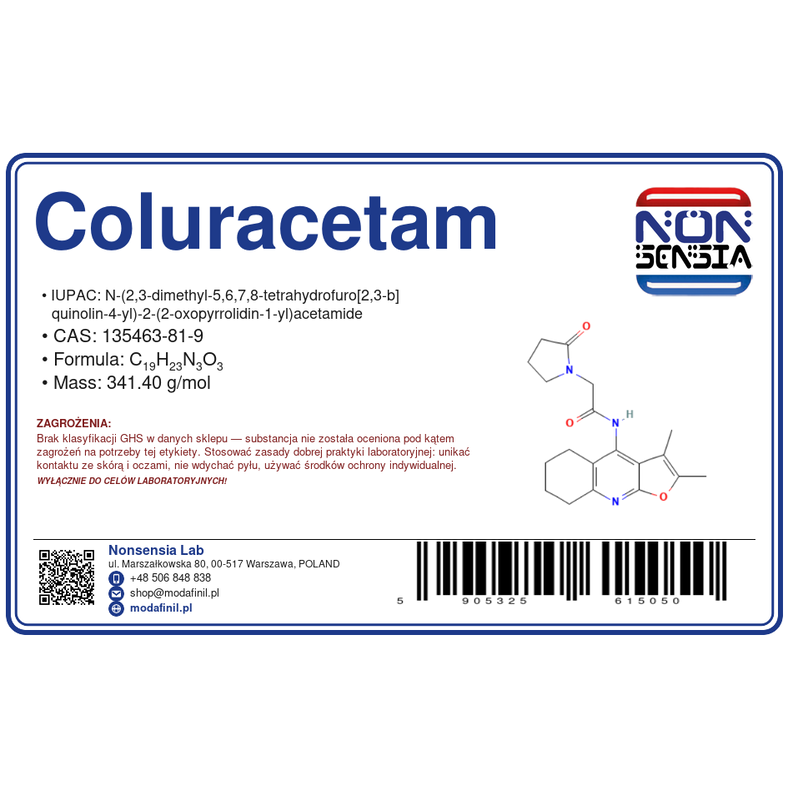
N-(2,3-dimethyl-5,6,7,8-tetrahydrofuro[2,3-b]quinolin-4-yl)-2-(2-oxopyrrolidin-1-yl)acetamide, crystalline powder, 1000 mg package. Material intended exclusively for laboratory and analytical in vitro research. The product is not intended for consumption by humans or animals, it is not a medicinal product, a dietary supplement, a foodstuff, or a cosmetic.
A thing that needs to be said up front
The literature on this molecule has an unusual shape worth knowing before reading further. Coluracetam is a compound chemically well-defined and with a real, though narrow, body of preclinical research — the problem is that most of it is indexed in databases not under the current common name, but under the development code from the period of laboratory work, MKC-231. A PubMed query for just the term “coluracetam” returns in practice a single record; only extending the query with the development code reveals the proper set of papers.
The second caveat is more important: this entire body of work consists of mechanistic and behavioral studies in laboratory animals, conducted mainly between 1994 and 2008. None of it includes a published clinical study involving humans. The ChEMBL database classifies the compound’s development status as preclinical (development phase: 0) — meaning the compound formally never entered a documented clinical research program as understood by that database. The description below sticks to what can be reliably supported: chemistry, the cellular mechanism studied in animals, and registry data. We do not attribute any effect in humans to this molecule in the present tense — we have no source basis for that.
Three different entities that must not be confused
| Entity | What it is | Status of coluracetam |
|---|---|---|
| Chemical substance CAS 135463-81-9 |
A chemical concept — a molecule with a defined structure, registered in registry databases (PubChem, ChEMBL). | yes — this is the only status this molecule actually has |
| Medicinal product | Pharmaceutical preparation: pharmaceutical form, GMP regime, registration documentation, safety oversight. | NO — in any country. The compound was the subject of development work under the code MKC-231, but it never achieved registration as a drug; ChEMBL records its status as preclinical |
| Chemical reagent the material offered here |
Material for laboratory and analytical work. | yes — and it is offered exclusively in this capacity |
The situation is closer to flmodafinil than to modafinil: there is no registered drug here from which the reagent would need to be distinguished — no approved form of this substance intended for humans exists in any jurisdiction. The research results cited below come exclusively from experiments in laboratory animals — none of them were conducted using the analytical reagent, and none of them transfer to the material offered here.
Reagent identification card
| Systematic name (IUPAC) | N-(2,3-dimethyl-5,6,7,8-tetrahydrofuro[2,3-b]quinolin-4-yl)-2-(2-oxopyrrolidin-1-yl)acetamide |
|---|---|
| Common name | coluracetam (coluracetamum) |
| Development codes | MKC-231, BCI-540 |
| CAS number | 135463-81-9 |
| Molecular formula | C19H23N3O3 |
| Molar mass | 341.4 g·mol−1 |
| Monoisotopic mass | 341.17394 Da |
| InChIKey | PSPGQHXMUKWNDI-UHFFFAOYSA-N |
| SMILES | CC1=C(OC2=NC3=C(CCCC3)C(=C12)NC(=O)CN4CCCC4=O)C |
| PubChem CID | 214346 |
| ChEMBL ID | CHEMBL535678 |
| Form | crystalline powder, white to off-white |
| Purity | ≥ 99% |
| Intended use | research reagent — not for consumption by humans or animals |
Origin of the molecule: a Japanese “choline uptake enhancer”
Coluracetam did not arise as a derivative of piracetam in the sense of a strict modification of an existing drug. It is a separate research line developed in Japan, where the starting point was not the structure of a specific compound but function: a molecule was sought that would enhance high-affinity choline uptake (HACU, high-affinity choline uptake) — the rate-limiting step in acetylcholine synthesis in cholinergic neurons. The compound received the development code MKC-231, under which the entire early literature from 1994–2008 is listed. The current common name “coluracetam” and the second development code, BCI-540, appear only in later chemical registries (ChEMBL) — earlier papers do not use them, which is itself a bibliographic clue, not just a curiosity.
The cholinergic lesion model as the axis of research
The first indexed papers date from the mid-1990s and describe the compound’s behavior in a working memory deficit model induced by ethylcholine aziridinium ion (AF64A) in rodents — a standard pharmacological method for mimicking the cholinergic loss seen in dementias. In subsequent years, the same model was used to systematically describe the mechanism: effects on acetylcholine synthesis and release, long-term improvement in memory test results after repeated administration and — separately — the molecular mechanism of choline uptake enhancement itself. Three papers on this topic appeared together in 2008 in the Journal of Neural Transmission and constitute the most systematic set of mechanistic data on this molecule that exists.
The cytoprotective thread and the schizophrenia model
In parallel, cytoprotective studies were conducted in cortical neuron cultures (protection against glutamate cytotoxicity), along with studies on the compound’s effect on carbohydrate metabolism in animals. A separate branch of the literature concerns a pharmacological model resembling schizophrenia: administration of phencyclidine (PCP) to rodents causes loss of septal cholinergic neurons and behavioral deficits, and prior exposure to the compound antagonized part of these changes in an animal study. This is a study in an animal model, not a clinical observation — we cite it as part of the history of mechanistic research, not as evidence of effects in humans.
Separately, in a review paper on the pharmacology of compounds modulating glutamatergic transmission in the context of the search for new antidepressant drugs, coluracetam was listed alongside ketamine, riluzole, memantine, and several experimental compounds as one of the candidates considered in this area [1]. This is a mention in a review paper, not a standalone clinical study — we flag it because it is the only place where the molecule appears in literature indexed under its current common name, rather than under the code MKC-231.
Timeline
| 1994 | first indexed papers on the compound under the code MKC-231 — AF64A working memory deficit model in rodents |
|---|---|
| 1998 | cytoprotective studies: protection against glutamate cytotoxicity in cortical neuron culture |
| 1999 | studies on the compound’s central effect on carbohydrate metabolism in rats |
| 2007 | study in a pharmacological model resembling schizophrenia — antagonizing phencyclidine (PCP)-induced deficits in animals |
| 2008 | three-part series of papers in Journal of Neural Transmission: mechanism, acetylcholine synthesis/release, cognitive effects after repeated administration in the AF64A model |
| 2015 | compound listed in a review of the pharmacology of glutamatergic antidepressant candidates [1] |
Chemistry: the pyrrolidinone core and the furoquinoline system
Why the structure is classified in the racetam family
The molecule contains a 2-oxopyrrolidine ring (γ-butyrolactam) connected by an acetamide group to the rest of the skeleton — exactly the same pharmacophoric motif that defines the entire racetam family, starting with piracetam. It is this that qualifies coluracetam for this structural category, not resemblance to any specific other molecule from this family.
What the furoquinoline system adds
The second part of the molecule distinguishes it from simpler racetams: instead of a single aromatic ring (as in aniracetam), coluracetam carries a fused tricyclic system — a furan fused to a quinoline ring, partially hydrogenated at positions 5,6,7,8, and substituted with two methyl groups at positions 2 and 3. Three nitrogen atoms in the molecule (pyrrolidinone, quinoline, amide) and three oxygen atoms give the molecular formula C19H23N3O3 — significantly larger and more complex than in piracetam or aniracetam.
| Parameter | Value | What this implies |
|---|---|---|
| Partition coefficient (XLogP) | 2.4 | moderate lipophilicity — elutes later in an RP-HPLC gradient than simple racetams |
| Topological polar surface area (TPSA) | 75.4 Å2 | similar to modafinil (79.4 Å2); three nitrogen heteroatoms and three oxygen atoms give a multi-point hydrogen-bonding profile |
| Hydrogen bond donors | 1 | the amide N–H group |
| Hydrogen bond acceptors | 4 | amide oxygen, lactam oxygen, furan oxygen, quinoline nitrogen |
| Rotatable bonds | 3 | a relatively rigid molecule — most of the skeleton is locked within the fused ring system |
| Heavy atoms | 25 | the molecule’s mass is distributed across an extensive, polycyclic core |
A stereogenic center — which is absent here
Unlike modafinil, where a stereogenic center on the sulfur atom necessitates distinguishing between enantiomers, coluracetam has no defined stereogenic center — the canonical InChI representation of this molecule contains no stereochemical layer. The carbon at position 4 of the furoquinoline system, to which the amide substituent is attached, lies in the plane of the conjugated ring system (a C=C double bond at this position), rather than in an sp3 center bearing four different substituents. The practical consequence for the laboratory: the material does not require chiral separation when confirming identity.
Nomenclature: the common name is younger than the development codes
- Coluracetam — the current INN name (coluracetamum), present in chemical registries, but not used in the early mechanistic literature;
- MKC-231 — the original development code, under which the vast majority of the mechanistic literature from 1994–2008 is indexed;
- BCI-540 — a later development code, used in registry documentation (ChEMBL) alongside the current name;
- N-(2,3-dimethyl-5,6,7,8-tetrahydrofuro[2,3-b]quinolin-4-yl)-2-(2-oxopyrrolidin-1-yl)acetamide — the systematic IUPAC name, the only unambiguous one.
The bibliographic consequence is measurable: searching databases solely under the term “coluracetam” misses nearly the entire body of mechanistic papers, because at the time of their publication this name did not yet exist. It is worth combining the query with the code MKC-231.
Laboratory applications of the reagent
- reference material for confirming identity and purity by HPLC-UV;
- a standard in LC-MS and GC-MS methods — the three nitrogen atoms in the molecule give a characteristic fragmentation pattern, useful in building quantitative methods;
- a comparison material in structure-property (SAR) studies within the racetam family — a contrast between the simple pyrrolidinone ring and the extensive furoquinoline system;
- an object for 1H and 13C NMR characterization — two non-equivalent methyl groups on the furan ring give distinct, easily distinguishable signals;
- a model compound in the chemistry of furo[2,3-b]quinoline derivatives and fused heterocyclic systems.
Storage, handling, and work safety
Store in the original, tightly sealed packaging, in a dry and cool place, protected from light, separately from food and feed and out of reach of children. Work only under laboratory conditions, using personal protective equipment: gloves, safety goggles, and laboratory clothing; weigh the powder under conditions that limit dust generation. Avoid inhaling dust and contact with skin and eyes. Waste handling — in accordance with the regulations applicable to chemical waste at the site where the research is conducted.
Note on safety data. For compounds with a narrow literature base, such as this one, toxicological data and hazard classification (GHS) in public registries are incomplete or unestablished. The absence of a documented hazard is not equivalent to the absence of one — the material should be handled with the caution appropriate for a substance with an unestablished toxicological profile.
Regulatory status
Coluracetam is not registered as a medicinal product in any country known to us. It does not have a pharmacopoeial monograph. The legal status of substances of this type can be subject to changes in national law — the buyer is responsible for checking the legal status in the destination country before ordering. The material offered is a chemical reagent and has no approval for any use in humans or animals.
Frequently Asked Questions
What is coluracetam and where did the code MKC-231 come from?
Coluracetam is the current common name (INN) for a molecule originally developed in Japan under the development code MKC-231, as a compound enhancing high-affinity choline uptake in neurons. The entire mechanistic literature from 1994–2008 uses only the code MKC-231; the INN name and the second development code (BCI-540) appear only in later chemical registries.
Is coluracetam a drug?
No. It is not registered as a medicinal product in any country. The compound has been the subject of preclinical studies in animals, but the ChEMBL database classifies its development status as preclinical. The material offered is a chemical reagent.
How does coluracetam differ structurally from other racetams in the catalog?
All racetams share a 2-oxopyrrolidine ring connected by an acetamide group. Coluracetam stands out with an extensive tricyclic furo[2,3-b]quinoline system in the place where simpler racetams have a single substituent or ring — hence the greater molecular mass and three nitrogen atoms instead of one.
What is the chemical formula and molar mass of coluracetam?
C19H23N3O3; molar mass 341.4 g·mol−1, monoisotopic mass 341.17394 Da. CAS number 135463-81-9, InChIKey PSPGQHXMUKWNDI-UHFFFAOYSA-N.
Are MKC-231, BCI-540, and coluracetamum different compounds?
No — these are three designations for the same compound with CAS number 135463-81-9: MKC-231 is the original development code, BCI-540 is the later code, and coluracetamum is the Latin form of the current INN name.
Does coluracetam have a stereogenic center?
No. Unlike modafinil or flmodafinil, where the stereogenic center lies on the sulfur atom, coluracetam has no defined stereogenic center — the canonical InChI contains no stereochemical layer. The material does not require chiral separation when confirming identity.
Why doesn’t the description include information about effects in humans?
Because there is no published clinical study involving humans for this molecule — the entire available body of work consists of mechanistic and behavioral studies in laboratory animals. Attributing effects in humans to it would be misleading. The material is a chemical reagent and is not intended for use in humans or animals.
Is the reagent suitable for applications other than laboratory use?
No. The material is intended exclusively for laboratory and analytical research. It is not intended for consumption by humans or animals, it is not a drug, a dietary supplement, a food, or a cosmetic.
How should coluracetam be stored?
In the original, tightly sealed packaging, in a dry and cool place, protected from light, separately from food and feed, and out of reach of children.
What should coluracetam be dissolved in to prepare a stock solution?
With an XLogP of 2.4 and moderate polarity (TPSA 75.4 Å2), the material dissolves well in DMSO and other organic solvents; stock solutions are prepared outside of water.
Is a safety data sheet provided with coluracetam?
We provide the sheet upon request. We note that for this molecule, toxicological data in public registries are incomplete — the material should be handled with the caution appropriate for a substance with an unestablished profile.
Is coluracetam legal in Poland?
Coluracetam is not registered as a medicinal product in any country known to us and does not have a pharmacopoeial monograph. The legal status of substances of this type can be subject to changes in national law — the buyer is responsible for checking the legal status in the destination country before ordering.
What is the coluracetam standard used for in the laboratory?
For confirming identity and purity by HPLC-UV, as a standard in LC-MS and GC-MS, as a comparison material in structure-property studies within the racetam family, and as an object for NMR characterization.
References
The literature directly concerning this molecule is narrow and has an unusual shape: the main body of mechanistic papers from 1994–2008 cannot be found under the current common name, only under the development code MKC-231 — they concern exclusively animal models and the cellular mechanism, never studies involving humans. Below we provide the entry verified in PubMed available under the current name, along with registry data from chemical databases — this is the complete list of sources indexed under the name “coluracetam” as of 2026-09-06, not the full bibliography of the compound under all its designations.
- Dutta A, McKie S, Deakin JFW (2015). “Ketamine and other potential glutamate antidepressants.” Psychiatry Res. PMID 25467702. doi:10.1016/j.psychres.2014.10.028.
Identification data and computed descriptors from PubChem (CID 214346) and the ChEMBL registry (CHEMBL535678).
Related reagents in our catalog
- Aniracetam — a simpler racetam with the same 2-oxopyrrolidine core, but a single aromatic ring instead of the furoquinoline system
- Pramiracetam — another modification of the same family, with a diisopropylamino chain instead of a fused ring system; a contrast in approaches to extending the base structure
- Modafinil (CAS 68693-11-8) — a stereochemical contrast: a stereogenic center on the sulfur atom necessitates separation of enantiomers, which coluracetam does not require
Statement on the intended use of the product
The material offered is a chemical reagent intended exclusively for research, analytical, and laboratory purposes. It is not intended for consumption by humans or animals. It is not a medicinal product, a dietary supplement, a foodstuff, a medical device, or a cosmetic. It must not be used for medical, diagnostic, therapeutic, prophylactic, or consumption purposes, administered to humans or animals, applied to the skin, or added to food, beverages, or feed. Sold exclusively to buyers engaged in research, scientific, or analytical activity, with laboratory facilities and the knowledge needed to safely handle chemical reagents. The buyer bears sole responsibility for the lawful and safe use of the reagent and for compliance with the regulations applicable in the destination country.