
Description
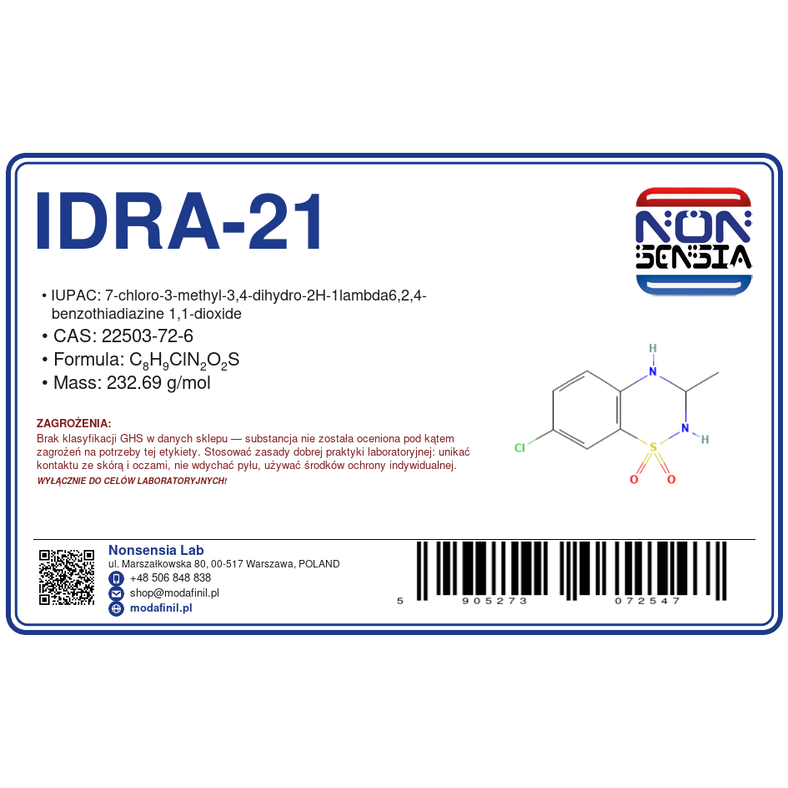
7-chloro-3-methyl-3,4-dihydro-2H-1,2,4-benzothiadiazine 1,1-dioxide, 1000 mg pack, purity ≥ 99%. Material intended exclusively for laboratory and analytical in vitro research. Not for human or animal consumption — it is not a medicinal product, food supplement, foodstuff or cosmetic.
Three distinct entities that must not be confused
For this molecule, separating the layers matters all the more because the IDRA-21 research programme never led to a registered medicine — yet more than a dozen preclinical papers exist for it, which are easily misread as a description of the effects of a finished product. Three contexts, three different statuses:
| Entity | What it is | IDRA-21 status |
|---|---|---|
| Chemical substance IDRA-21, CAS 22503-72-6 |
A chemical concept — a molecule of defined structure, registered in databases (PubChem CID 3688, ChEMBL CHEMBL3649035). | yes — this is the only status the molecule actually has |
| Medicinal product | A pharmaceutical preparation: pharmaceutical form, strength, GMP regime, registration dossier, safety surveillance. | NO — in no country. According to the ChEMBL registry, the compound never progressed beyond the preclinical phase (status: Preclinical, max_phase = 0); further work on this class of AMPA modulators concentrated on newer, more potent benzothiadiazine derivatives |
| Chemical reagent the material offered here |
Material for laboratory and analytical work. | yes — and it is offered solely in this capacity |
The consequence is unambiguous. The research findings cited further on this page come exclusively from experiments on laboratory animals (rats, monkeys) and from in vitro studies on cell cultures and brain tissue slices — never from clinical trials in humans, because no such trials have been conducted for this molecule. None of these experiments was carried out using an analytical reagent within the meaning of this offer, and none of these findings carries over to the material sold on this page.
Reagent identification sheet
| Systematic name (IUPAC) | 7-chloro-3-methyl-3,4-dihydro-2H-1,2,4-benzothiadiazine 1,1-dioxide |
|---|---|
| Common name | IDRA-21 (IDRA 21, IDRA21) |
| CAS number | 22503-72-6 |
| Molecular formula | C8H9ClN2O2S |
| Molar mass | 232.69 g·mol−1 |
| Monoisotopic mass | 232.0073 Da |
| InChIKey | VZRNTCHTJRLTMU-UHFFFAOYSA-N |
| SMILES | CC1NC2=C(C=C(C=C2)Cl)S(=O)(=O)N1 |
| PubChem CID | 3688 |
| UNII (FDA) | 689UW7PT68 |
| ChEMBL | CHEMBL3649035 |
| MDL number | MFCD00270874 |
| Form | solid material, sold in weighed portions |
| Purity | ≥ 99% |
| Intended use | research reagent — not for human or animal consumption |
Lineage of the molecule: from diazoxide to benzothiadiazine AMPA modulators
IDRA-21 derives from the chemistry of diazoxide — a compound of the benzothiadiazine family long used in entirely different indications. At the turn of the 1980s and 1990s, the team of Erminio Costa and Alessandro Guidotti at the Nathan S. Kline Institute for Psychiatric Research (Orangeburg, New York State) investigated whether derivatives of diazoxide and of the related cyclothiazide — a compound of the same structural family, known as a pharmacological tool in electrophysiology — could modulate AMPA receptors by inhibiting their rapid desensitisation. The earliest paper in this line, describing the effect of diazoxide and cyclothiazide analogues on AMPA/kainate receptors in rat hippocampal slices, dates from 1993 [1].
From this line of work, the compound designated IDRA-21 — the 7-chloro-3-methyl derivative of benzothiadiazine 1,1-dioxide — was singled out. The first paper characterising it behaviourally in rats (water maze and passive avoidance tests) described it as 20–30 times more potent than aniracetam in attenuating pharmacologically induced memory impairment [2] — and it is precisely this figure that circulates in parts of the secondary literature as a universal index of potency. It is worth knowing, however, that in a study on patas monkeys from the same period, the advantage over aniracetam was approximately 10-fold, not 20–30 [4] — the value depends on the species and the test used; it is not a fixed property of the molecule.
The term “diazoxide derivative” appears explicitly in the titles of some papers [7] and refers to structural lineage, not to the mechanism of action of diazoxide as a drug used clinically in entirely different indications — neither diazoxide nor cyclothiazide is the subject of this offer.
Timeline
| 1993 | first paper on modulation of AMPA/kainate receptors by diazoxide and cyclothiazide analogues in rat hippocampal slices [1] |
|---|---|
| 1995 (January) | first behavioural characterisation of IDRA-21 in rats — water maze and passive avoidance tests [2] |
| 1995 (August) | first resolution of the enantiomers on a dedicated chiral phase — only the (+) enantiomer proved active [3]; in parallel, a study on patas monkeys [4] |
| 1996 | electrophysiological mechanism: enhancement of synaptic transmission and facilitation of long-term potentiation (LTP) induction in hippocampal slices [5] |
| 1997 | in vitro study in cell culture: no neurotoxicity under conditions in which the structurally related cyclothiazide was already strongly neurotoxic [6] |
| 1998 | in vivo study: aggravation of hippocampal neuron injury after ischaemia in animals given the compound orally [7] |
| 2000 | chiral HPLC method on a cellulose phase, confirmed by circular dichroism spectroscopy [8]; review of diazoxide and cyclothiazide analogues [9] |
| 2002 | development of newer, more potent 5′-alkyl-benzothiadiazide derivatives with IDRA-21 as the lead compound [10][11] |
| 2004 | study in rhesus monkeys (young and ageing), oral administration — effect persisting up to 48 hours after a single administration of the compound [12] |
| 2005 | preclinical review of the class of positive AMPA modulators [13] |
| 2011 | study of visual recognition memory in young macaques [14] |
| to date | no registered medicinal product in any country; ChEMBL records an exclusively preclinical status (max_phase = 0) |
Research centres and why development stalled
The IDRA-21 literature has a clear institutional geography — different from that of bromantane, where three centres of the former USSR dominated. Here, the main work was carried out by three independent American teams, each with a different research question.
- Nathan S. Kline Institute for Psychiatric Research (Orangeburg, New York). The parent centre — the source of the first behavioural characterisation [2], the study on patas monkeys [4] and the first resolution of the enantiomers [3].
- University of California, Irvine (the Lynch and Chamberlin team). Focused on potency optimisation — it was here, with IDRA-21 as the lead compound, that a newer generation of 5′-alkyl-benzothiadiazides with markedly higher receptor affinity was developed [10][11], which in practice shifted the attention of further development work to these derivatives.
- Washington University in St. Louis / St. Louis Children’s Hospital (the Yamada team). Independently examined the safety profile under conditions of cerebral ischaemia — this is the source of the finding that IDRA-21 aggravates hippocampal neuron injury after ischaemia in animals [7], an important counterpoint to the earlier report of no neurotoxicity under physiological conditions [6].
Caveat applying to the whole of the section above and to the “Lineage of the molecule” section above. All the findings cited come from preclinical studies on laboratory animals or from in vitro experiments on cell cultures and tissue slices. The substance has never been studied clinically in humans and has never been registered as a medicinal product in any country. This is not a description of the properties of the material offered, it does not constitute information about its effects and cannot be the basis for any use outside the laboratory. The reagent offered is not a medicinal product and must not be used in humans or animals.
Chemistry: the benzothiadiazine ring and the stereogenic centre at carbon C3
Why this molecule has only one stereogenic atom
Unlike flmodafinil, where the stereogenic centre lies on the sulfur atom, in IDRA-21 chirality arises from carbon C3 of the thiadiazine ring — the atom bearing a methyl group, a hydrogen and two different ring substituents. The first resolution of the enantiomers on a dedicated chiral phase of the “mixed” type (π-donor/π-acceptor) was described by Uzunov and co-workers in 1995 [3]; five years later an alternative method on a cellulose phase (Chiralcel OD/OD-R) was developed, with the identity of the enantiomers confirmed by circular dichroism spectroscopy [8]. In both studies, behavioural activity in animal tests was shown only by the (+)-IDRA-21 enantiomer; the (−) form was described as devoid of activity under comparable conditions [3]. The material offered as a reagent is the racemic form unless stated otherwise on the product sheet.
The S=O double bond and where the name “dioxide” comes from
The core of the molecule is a fused benzo-1,2,4-thiadiazine system with a sulfonyl group — two oxygen atoms double-bonded to the sulfur at position 1. Hence the older naming convention found in some 1990s papers, “S,S-dioxide”, equivalent to the name “1,1-dioxide” used today (in Polish translation: 1,1-ditlenek). Both forms denote the same molecule, and both must be taken into account when searching the older literature.
Physicochemical characteristics
| Parameter | Value | What follows from it |
|---|---|---|
| Partition coefficient (logP) | 1.5 | moderate lipophilicity — elutes in the middle part of an RP-HPLC gradient |
| Topological polar surface area | 66.6 Å2 | the sulfonyl group and two nitrogen atoms substantially raise polarity relative to pure hydrocarbons |
| Hydrogen bond donors | 2 | two N–H groups of the thiadiazine ring |
| Hydrogen bond acceptors | 4 | two sulfonyl oxygens and two ring nitrogens |
| Rotatable bonds | 0 | compact, bicyclic structure — no freely rotating side chains |
| Solubility | good in DMSO and methanol; limited in water | prepare stock solutions in an organic solvent |
Chlorine isotope signature — contrast with bromine and fluorine
The chlorine atom at position 7 gives a characteristic isotope cluster in a ratio of approximately 3:1 in mass spectrometry (35Cl to 37Cl, peaks 2 Da apart) — a different pattern from bromantane, where the two bromine isotopes give a ratio close to 1:1, and different from flmodafinil, where fluorine is practically monoisotopic and forms no cluster at all. For a laboratory calibrating isotope-cluster recognition in GC-MS or LC-MS, these three reagents together provide a complete set of patterns: 3:1, 1:1 and no cluster.
Nomenclature and synonyms
- IDRA-21 — the name most commonly in circulation, derived from the development code of the research programme;
- IDRA 21 / IDRA21 — spelling variants without the hyphen, common in bibliographic indexes;
- (+)-IDRA-21 and (−)-IDRA-21 — designations of the individual enantiomers, each with a separate CAS number in registry databases (the material offered is the racemic form unless indicated otherwise);
- 7-Chloro-3-methyl-3,4-dihydro-2H-1,2,4-benzothiadiazine S,S-dioxide — an older naming convention from 1990s papers, equivalent to today’s “1,1-dioxide”;
- 7-chloro-3-metylo-3,4-dihydro-2H-1,2,4-benzotiadiazyno-1,1-ditlenek — the systematic IUPAC name in Polish translation, the only unambiguous one.
CAS number 22503-72-6 remains the only identifier independent of naming convention. For bibliographic queries it is worth combining all hyphen and space variants — older databases index some papers under the unhyphenated spelling.
Laboratory applications of the reagent
- reference material for confirmation of identity and purity by HPLC-UV;
- substrate for chiral enantiomer separation methods — on “mixed”-type phases [3] or on cellulose phases [8];
- standard in GC-MS and LC-MS methods, including calibration of chlorine isotope-cluster recognition (ratio approx. 3:1);
- model compound (lead compound) in structure–activity studies of benzothiadiazine derivatives modulating AMPA receptors [10][11];
- comparison material for distinguishing it from the structurally related diazoxide and cyclothiazide in chromatographic analysis.
Storage, handling and occupational safety
Store in the original, tightly closed container, in a dry and cool place, protected from light, separately from food and feed and out of the reach of children. Work only under laboratory conditions, using personal protective equipment: gloves, safety glasses and laboratory clothing; weigh the material under conditions that limit dust formation. Avoid inhaling dust and contact with skin and eyes. Dispose of waste in accordance with the regulations applicable to chemical waste at the place where the research is conducted.
Note on safety data. In publicly available databases (including the PubChem registry) no harmonised GHS classification or LD50 value was found for this substance — the toxicological data field remains empty. The absence of a classified hazard is not equivalent to the absence of a hazard; one preclinical study showed that the substance aggravates neuronal injury in an animal model of cerebral ischaemia [7] — the material should be handled with the caution appropriate to a compound with an incomplete toxicological profile.
Regulatory status
IDRA-21 is not registered as a medicinal product in any country known to us. The ChEMBL registry (CHEMBL3649035) records an exclusively preclinical status for this substance (max_phase = 0) — development work did not reach the stage of clinical trials in humans. The substance has no pharmacopoeial monograph. The legal status of substances of this type may be subject to changes in national law — the purchaser is responsible for checking the legal position in the country of destination before ordering. The material offered is a chemical reagent and has no approval for any use in humans or animals.
Frequently Asked Questions
What is IDRA-21?
It is a benzothiadiazine derivative (CAS 22503-72-6), studied since the 1990s as a positive allosteric modulator of the AMPA receptor. The substance never entered the phase of clinical trials in humans and was never registered as a drug. The material offered here is a chemical reagent for laboratory applications.
Is IDRA-21 a drug?
No. According to the ChEMBL registry, the substance never progressed beyond the preclinical phase (max_phase = 0) — no registered medicinal product containing IDRA-21 exists in any country. Further development work on this class of AMPA modulators concentrated on newer, more potent benzothiadiazine derivatives.
What are the chemical formula and molar mass of IDRA-21?
C8H9ClN2O2S; molar mass 232.69 g·mol−1, monoisotopic mass 232.0073 Da. CAS number 22503-72-6, InChIKey VZRNTCHTJRLTMU-UHFFFAOYSA-N.
How do the (+)-IDRA-21 and (−)-IDRA-21 enantiomers differ?
The molecule has one stereogenic centre at carbon C3 of the thiadiazine ring. In animal studies, behavioural activity was shown only by the (+) enantiomer; the (−) form was described as devoid of activity under comparable conditions. Both enantiomers have separate CAS numbers in registry databases.
Why is IDRA-21 sometimes called a “diazoxide derivative”?
Because of its structural lineage — the compound derives from benzothiadiazine chemistry, to which diazoxide and cyclothiazide also belong, long used in other indications and as pharmacological tools. The term refers to the structure of the molecule, not to the mechanism of action of diazoxide as a drug.
Is the reagent suitable for applications other than laboratory use?
No. The material is intended exclusively for laboratory and analytical research. It is not intended for human or animal consumption, it is not a drug, food supplement, food or cosmetic, and it must not be used for medical, diagnostic or consumption purposes.
How should IDRA-21 be stored?
In the original, tightly closed container, in a dry and cool place, protected from light, separately from food and feed and out of the reach of children.
What should IDRA-21 be dissolved in to prepare a stock solution?
It dissolves well in DMSO and methanol, less well in water. Given logP ≈ 1.5 and the absence of freely rotating side chains, stock solutions are usually prepared in an organic solvent.
How can IDRA-21 be recognised in mass spectrometry?
By the chlorine isotope cluster — 35Cl and 37Cl give a pair of peaks 2 Da apart in a ratio of approx. 3:1. This is a different pattern from bromantane (bromine, approx. 1:1) and flmodafinil (fluorine, practically monoisotopic, no cluster).
Is a safety data sheet supplied with IDRA-21?
We make the sheet available on request to recipients engaged in research or analytical activity. Please note that no harmonised GHS classification or LD50 data were found for this substance in publicly available databases — the material should be handled with the caution appropriate to a compound with an incomplete toxicological profile.
Is IDRA-21 legal in Poland?
IDRA-21 is not registered as a medicinal product in any country known to us and has no pharmacopoeial monograph. The legal status of substances of this type may be subject to changes in national law — the purchaser is responsible for checking the legal position in the country of destination before ordering.
What is an IDRA-21 standard used for in an analytical laboratory?
For confirmation of identity and purity by HPLC-UV, as a substrate for chiral enantiomer separation methods, as a standard in GC-MS and LC-MS, and as a model compound in structure–activity studies of benzothiadiazine derivatives.
References
The entries come from the PubMed database and concern the chemistry, preclinical pharmacology and analytics of this molecule. All the studies described were carried out on laboratory animals, on cell cultures or in vitro — none of them involved humans and none was carried out using an analytical reagent. They are cited as scientific context and as a bibliographic pointer, not as information about the properties of the material offered nor as an encouragement to any use. List based on queries to the PubMed database dated 2026-09-08.
- Bertolino M et al. (1993). “Modulation of AMPA/kainate receptors by analogues of diazoxide and cyclothiazide in thin slices of rat hippocampus.” Receptors Channels. PMID 7915948.
- Zivkovic I, Thompson DM, Bertolino M et al. (1995). “7-Chloro-3-methyl-3,4-dihydro-2H-1,2,4-benzothiadiazine S,S-dioxide (IDRA 21): a benzothiadiazine derivative that enhances cognition by attenuating AMPA receptor desensitization.” J Pharmacol Exp Ther. PMID 7815345.
- Uzunov DP, Zivkovich I, Pirkle WH et al. (1995). “Enantiomeric resolution with a new chiral stationary phase of 7-chloro-3-methyl-3,4-dihydro-2H-1,2,4-benzothiadiazine S,S-dioxide.” J Pharm Sci. PMID 7500277. doi:10.1002/jps.2600840807.
- Thompson DM, Guidotti A, DiBella M, Costa E (1995). “7-Chloro-3-methyl-3,4-dihydro-2H-1,2,4-benzothiadiazine S,S-dioxide (IDRA 21), a congener of aniracetam, potently abates pharmacologically induced cognitive impairments in patas monkeys.” Proc Natl Acad Sci USA. PMID 7644474. doi:10.1073/pnas.92.17.7667.
- Arai A, Guidotti A, Costa E, Lynch G (1996). “Effect of the AMPA receptor modulator IDRA 21 on LTP in hippocampal slices.” Neuroreport. PMID 8930991. doi:10.1097/00001756-199609020-00031.
- Impagnatiello F, Oberto A, Longone P et al. (1997). “7-Chloro-3-methyl-3,4-dihydro-2H-1,2,4-benzothiadiazine S,S-dioxide: a partial modulator of AMPA receptor desensitization devoid of neurotoxicity.” Proc Natl Acad Sci USA. PMID 9192690. doi:10.1073/pnas.94.13.7053.
- Yamada KA, Covey DF, Hsu CY et al. (1998). “The diazoxide derivative IDRA 21 enhances ischemic hippocampal neuron injury.” Ann Neurol. PMID 9585363. doi:10.1002/ana.410430517.
- Cannazza G, Braghiroli D, Baraldi M, Parenti C (2000). “Chiral resolution of the enantiomers of 7-chloro-3-methyl-3,4-dihydro-2H-1,2,4-benzothiadiazine 1,1-dioxide using HPLC on cellulose-based chiral stationary phases.” J Pharm Biomed Anal. PMID 10898161. doi:10.1016/s0731-7085(00)00281-8.
- Puia G et al. (2000). “Modulation of kainate-activated currents by diazoxide and cyclothiazide analogues (IDRA) in cerebellar granule neurons.” Prog Neuropsychopharmacol Biol Psychiatry. PMID 11041540. doi:10.1016/s0278-5846(00)00120-2.
- Phillips D, Sonnenberg J, Arai AC et al. (2002). “5′-alkyl-benzothiadiazides: a new subgroup of AMPA receptor modulators with improved affinity.” Bioorg Med Chem. PMID 11886787. doi:10.1016/s0968-0896(01)00405-9.
- Arai AC, Xia YF, Kessler M et al. (2002). “Effects of 5′-alkyl-benzothiadiazides on AMPA receptor biophysics and synaptic responses.” Mol Pharmacol. PMID 12181433. doi:10.1124/mol.62.3.566.
- Buccafusco JJ, Weiser T, Winter K et al. (2004). “The effects of IDRA 21, a positive modulator of the AMPA receptor, on delayed matching performance by young and aged rhesus monkeys.” Neuropharmacology. PMID 14654093. doi:10.1016/j.neuropharm.2003.07.002.
- Black MD (2005). “Therapeutic potential of positive AMPA modulators and their relationship to AMPA receptor subunits. A review of preclinical data.” Psychopharmacology. PMID 15672275. doi:10.1007/s00213-004-2065-6.
- Malkova L, Kozikowski AP, Gale K (2011). “The effects of huperzine A and IDRA 21 on visual recognition memory in young macaques.” Neuropharmacology. PMID 21185313. doi:10.1016/j.neuropharm.2010.12.018.
Identification data and computed descriptors from PubChem (CID 3688) and the UNII and ChEMBL (CHEMBL3649035) registries.
Related reagents in our catalogue
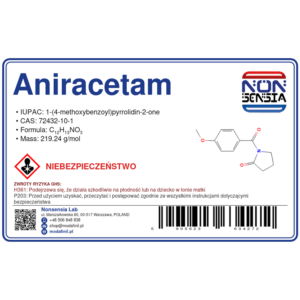
- Aniracetam — the direct reference point in the primary literature: it was against aniracetam that the potency of IDRA-21 was measured in the first animal studies
- Bromantane (CAS 87913-26-6) — isotopic contrast: chlorine in IDRA-21 gives a mass cluster in a ratio of approx. 3:1, bromine in bromantane approx. 1:1
- Flmodafinil (CAS 90280-13-0) — completing the isotopic contrast: fluorine is practically monoisotopic and forms no cluster at all
Statement of intended use
The material offered is a chemical reagent intended exclusively for research, analytical and laboratory purposes. Not for human or animal consumption. It is not a medicinal product, food supplement, foodstuff, medical device or cosmetic. It must not be used for medical, diagnostic, therapeutic, prophylactic or consumption purposes, administered to humans or animals, applied to the skin, or added to food, beverages or feed. Sold exclusively to recipients engaged in research, scientific or analytical activity who have laboratory facilities and the knowledge required to handle chemical reagents safely. The purchaser bears sole responsibility for the lawful and safe use of the reagent and for compliance with the regulations in force in the country of destination.