
Description
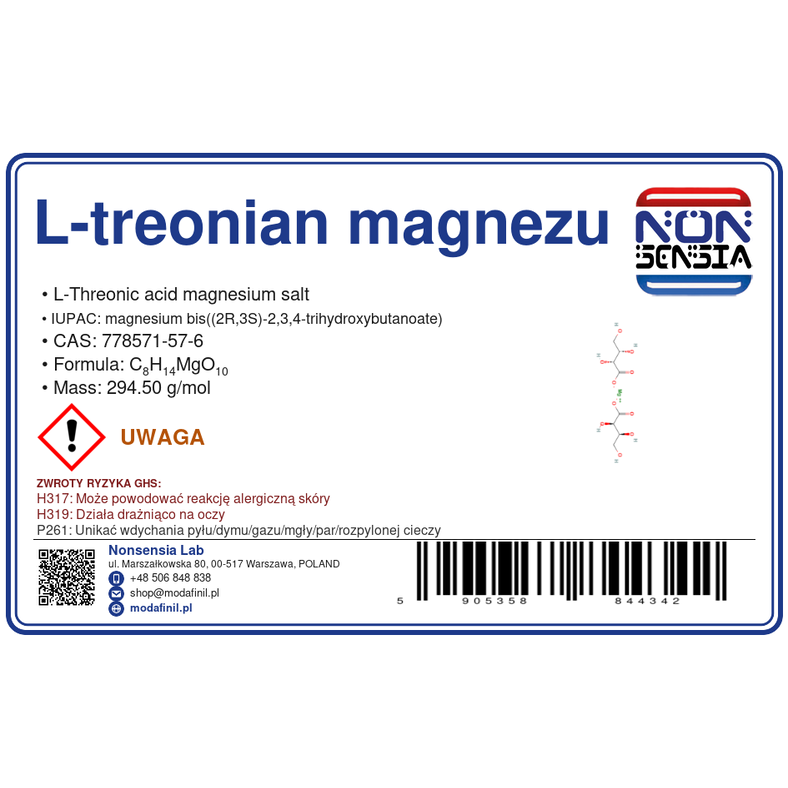
Magnesium L-threonate (magnesium bis[(2R,3S)-2,3,4-trihydroxybutanoate]), 1000 mg package, purity ≥ 99.5%. Material intended exclusively for in vitro laboratory and analytical research. The product is not intended for consumption by humans or animals, it is not a medicinal product, a food, a medical device, or a cosmetic.
Three Different Entities That Must Not Be Confused
For this salt, the separation of layers looks different than for the other items in our catalog, because the intermediate entity here is not a registered medicinal product, but a food authorized under the novel food procedure. These are still three separate legal contexts that are easy to confuse:
| Entity | What It Is | Status |
|---|---|---|
| Chemical substance Magnesium L-threonate, CAS 778571-57-6 |
A chemical concept — a salt of L-threonic acid and magnesium with a defined structure. On its own it is neither a food nor a reagent; status is conferred only by the form in which it was manufactured and authorized. | chemistry, substance registries |
| Food (novel food) formulation under code MMFS-01, trade name Magtein |
A specific, registered product: a defined quality specification, safety documentation, and a positive EFSA opinion (2024) under Regulation (EU) 2015/2283 on novel foods. | this is the formulation covered by clinical trials in humans |
| Chemical reagent the material offered here |
Material for laboratory and analytical work. It does not have, and cannot have, the status of a food or novel food — it is not accompanied by food documentation or compliance with Regulation 2015/2283. | analytics, chemistry, reference standards |
The consequence is unambiguous. The study results cited later on this page were obtained either using a specific, registered food formulation (clinical trials in humans), or using the substance administered to laboratory animals under controlled experimental conditions (preclinical studies). None of these studies were conducted using the analytical reagent, and none of these results carry over to the offered material. The reagent is not the form in which the substance was ever studied in humans, and it cannot be used in that way.
Reagent Identification Card
| Systematic (IUPAC) Name | magnesium bis[(2R,3S)-2,3,4-trihydroxybutanoate] |
|---|---|
| Common Name | Magnesium L-threonate |
| Formulation Code / Trade Name | MMFS-01 / Magtein — refers to the food formulation, not the offered reagent, see section above |
| CAS Number | 778571-57-6 (databases also list a related number, 2088918-94-7, assigned to a separate registration form of the same salt) |
| Molecular Formula | C8H14MgO10 |
| Molar Mass | 294.50 g·mol−1 |
| Monoisotopic Mass | 294.0437 Da |
| InChIKey | YVJOHOWNFPQSPP-BALCVSAKSA-L |
| SMILES | C([C@@H]([C@H](C(=O)[O-])O)O)O.C([C@@H]([C@H](C(=O)[O-])O)O)O.[Mg+2] |
| PubChem CID | 45489777 |
| UNII (FDA) | 1Y26ZZ0OTM |
| ChEMBL | CHEMBL2104851 |
| MDL Number | MFCD16621117 |
| Purity | ≥ 99.5% |
| Intended Use | research reagent — not for consumption by humans or animals |
The Molecule’s Lineage: From Ascorbic Acid to a Synapse Density Enhancer
L-Threonic Acid as a Natural Metabolite of Vitamin C
The anion of this salt is not an exotic chemical novelty. L-threonic acid is formed in the body as a product of the oxidative degradation of ascorbic acid (vitamin C) — this relationship was experimentally documented as early as 1983 in a guinea pig model [21], and the enzyme responsible for its further metabolism, L-threonic acid dehydrogenase, was purified and characterized even earlier, in 1964 [20]. More recent work on the catabolic pathways of L-threonate and D-erythronate confirms that this is a metabolism routinely present in mammals and microorganisms, not an artificial synthetic construct [22].
2010: Elevating Brain Magnesium and the Birth of Contemporary Interest
For decades, threonic acid remained a curiosity of vitamin C metabolism biochemistry. This changed with the work of the Inna Slutsky and Guosong Liu team, published in Neuron in 2010: it was shown that administering a magnesium salt with the L-threonate anion to rats raises magnesium concentration in the cerebrospinal fluid more effectively than comparator salts, and that this is accompanied by improved results in learning and spatial memory tests in the animals [1]. The key question — whether the effect is produced by the Mg2+ cation alone, or whether the anion also plays a role — was settled six years later by work from the same group: L-threonate itself, independent of the magnesium source, regulates the density of structural and functional synapses by modulating intraneuronal Mg2+ ion concentration [2]. This finding explains why the literature on this molecule has received separate attention — unlike magnesium citrate, oxide, or sulfate, which supply only the cation.
From the Code MMFS-01 to the Trade Name Magtein
The 2010 study result went on to commercialization: the developed formulation was designated with the research code MMFS-01, under which the first randomized clinical trial in humans was conducted, involving older adults with cognitive impairment [3]. The same preparation is marketed under the trade name Magtein, used directly in the title of a later clinical trial in healthy adults in China [4]. In 2024, this specific formulation received a positive opinion from the European Food Safety Authority under the novel food procedure [5] — which we describe in more detail in the regulatory status section. It is worth emphasizing: the code MMFS-01 and the name Magtein denote a specific commercial product with a defined specification, not every chemical batch of magnesium L-threonate — the reagent offered here is not that product and is not regulatorily identical to it.
Timeline
| 1964 | purification and characterization of L-threonic acid dehydrogenase [20] |
|---|---|
| 1983 | experimental demonstration of the relationship between ascorbic acid and threonic acid in guinea pigs [21] |
| 2003 | spectroscopic (FTIR) characterization of L-threonic acid and its metal compounds [19] |
| 2010 | Slutsky et al. paper in Neuron: elevating brain magnesium improved learning and memory test results in rats [1] |
| 2013–2021 | a series of preclinical studies: neuropathic pain [9], extinction of conditioned taste aversion [18], vincristine-induced allodynia [10], Alzheimer’s disease model [11], Parkinson’s disease model [12] |
| 2016 | mechanistic demonstration of the role of the L-threonate anion itself [2]; first clinical trial of the MMFS-01 formulation in humans [3] |
| 2019 | comparative study in rats: magnesium L-threonate versus magnesium chloride and sulfate [13] |
| 2021 | open-label pilot study in ADHD [14] |
| 2022–2023 | clinical trial of the Magtein formulation in healthy adults [4]; randomized trials in the context of cancer pain [6][7] |
| 2024 | positive EFSA opinion — novel food under Regulation (EU) 2015/2283 [5]; clinical trial on sleep quality [8] |
| 2025–2026 | further clinical trials (cognitive function and sleep) and comparative preclinical studies of various magnesium salts [15]; cellular neuroprotection model in the SH-SY5Y line [24] |
Research Centers and the Geography of the Literature
Unlike bromantane, whose literature originated almost exclusively from three research centers in the former USSR, research on magnesium L-threonate is spread across several independent strands: the parent center (MIT/Tsinghua — the founding paper [1] and the mechanistic paper [2]), the manufacturer of the commercial formulation (subsequent clinical trials on the patented Magtein/MMFS-01 formulation [4][8][16]), Chinese preclinical teams (an extensive strand using animal models: neuroinflammation and Alzheimer’s disease [11], pain [9][6], bladder function [17]), and the EFSA Panel on Nutrition (NDA), which assessed the safety and bioavailability of magnesium from this salt in the context of use in finished foods [5]. A comprehensive review of the role of magnesium in the central nervous system, organizing this scattered material, was published in 2016 [23].
Chemistry and What It Means for the Laboratory
The Opposite of Modafinil and Bromantane in Terms of Polarity
The three other items in our catalog from the family of substances with extensive literature — modafinil, flmodafinil, and bromantane — are distinctly lipophilic compounds, poorly soluble in water, requiring DMSO or methanol to prepare stock solutions. Magnesium L-threonate is their mirror image. The topological polar surface area (TPSA) here is 202 Ų — many times higher than for modafinil (71.7 Ų) or bromantane (12 Ų) — reflecting the ionic nature of the salt and the six hydroxyl groups of the two anion subunits. The practical consequence is the opposite of that for benzhydrylsulfinyl compounds: the material is readily soluble in water, and poorly soluble in organic solvents such as DMSO or methanol. XLogP values have not been determined in PubChem — typical for ionic inorganic-organic salts, for which the octanol-water partition coefficient is not a meaningful descriptor.
Two Stereogenic Centers on the Anion, Not the Cation
The Mg2+ cation is achiral, but the L-threonate anion carries two defined stereogenic centers — the (2R,3S) configuration at the C2 and C3 atoms of the butanoate chain. It is precisely this configuration that corresponds to the natural degradation product of L-ascorbic acid described in the section on the molecule’s lineage; a salt built from D-threonate or from a racemic mixture would be a material with different, undocumented characteristics. For the laboratory, this has an analytical consequence: determination of magnesium content alone, by ICP-MS or complexometric titration, does not confirm the identity of the anion — a method sensitive to configuration is needed for that, e.g., HPLC with polarimetric detection or comparison of the FTIR spectrum with reference data [19].
Physicochemical Characteristics
| Parameter | Value | What It Means |
|---|---|---|
| Topological Polar Surface Area (TPSA) | 202 Å2 | highly polar salt — good solubility in water, poor in organic solvents |
| Hydrogen Bond Donors | 6 | six hydroxyl groups (three on each anion subunit) |
| Hydrogen Bond Acceptors | 10 | carboxyl and hydroxyl oxygens of both anions |
| Rotatable Bonds | 4 | moderate conformational freedom of the butanoate chain |
| Heavy Atoms | 19 | — |
| Solubility | good in water; poor in DMSO and methanol | prepare stock solutions in water or aqueous buffer |
Nomenclature and Synonyms
- L-treonian magnezu — the Polish form, most common in domestic literature and trade;
- Magnesium L-Threonate / Magnesium L-threonate — the English form, dominant in international databases and paper titles;
- L-Threonic acid magnesium salt — the preferred name in PubChem;
- MgT — an abbreviation used directly in the titles of some scientific papers [13];
- MMFS-01 — the research code of the patented food formulation used in the first clinical trials [3] — does not refer to the offered reagent;
- Magtein — the trade name of the same food formulation [4] — does not refer to the offered reagent;
- magnesium bis[(2R,3S)-2,3,4-trihydroxybutanoate] — the systematic IUPAC name, the only unambiguous one.
The discrepancy in names has a bibliographic consequence: a search limited to the term “magnesium L-threonate” misses some records indexed under the abbreviation MgT or under the formulation’s trade name. When searching databases, it is worth combining all variants.
Laboratory Applications of the Reagent
- reference material for confirming identity and purity by HPLC and FTIR [19];
- standard in ICP-MS and AAS methods for determining magnesium content in biological matrices and food products;
- comparative material in validating methods differentiating forms of magnesium (L-threonate versus citrate, lactate, oxide, sulfate, and chloride) — relevant for interpreting comparative bioavailability studies [13][15];
- model compound in studies on the complex chemistry of L-threonic acid with divalent cations;
- material for calibrating methods sensitive to absolute configuration (HPLC with polarimetric detection, FTIR spectroscopy) when verifying the identity of the L-threonate anion.
Storage, Handling, and Work Safety
Store in the original, tightly closed packaging, in a dry and cool place, protected from light, separately from food and feed, and out of the reach of children. Work only under laboratory conditions, using personal protective equipment: gloves, safety goggles, and laboratory clothing; weigh out and transfer the material in a manner that limits dust generation and contact with skin and eyes. Waste handling — in accordance with the regulations applicable to chemical waste at the site where the research is conducted.
Hazard classification. Available safety data indicate a GHS07 classification (pictogram: exclamation mark), signal word “Warning”, with hazard statements H317 (may cause an allergic skin reaction) and H319 (causes serious eye irritation), and precautionary statement P261 (avoid breathing dust). Avoid breathing dust and contact with skin and eyes. Quantitative LD50 data are not recorded in PubChem — the absence of quantitative data does not equate to the absence of hazard; the material should be handled with the caution appropriate for a substance with an incomplete toxicological profile.
Regulatory Status
The food formulation designated by the code MMFS-01 and sold under the trade name Magtein received, in 2024, a positive opinion from the European Food Safety Authority (EFSA), authorizing it as a novel food under Regulation (EU) 2015/2283, together with an assessment of the bioavailability of magnesium from this source in the context of use in finished foods [5]. This authorization applies to a specific, registered food formulation — with a defined specification and safety documentation — not to the raw chemical reagent. The substance is not, and has never been, registered as a medicinal product in any country known to us. The material offered here is a chemical reagent: it is not subject to the novel food regulation, it is not a food or a food ingredient within the meaning of food law, and it has no authorization for any use in humans or animals. The buyer is responsible for ensuring that the intended use complies with the law applicable in the country of destination.
Frequently Asked Questions
How Does Magnesium L-Threonate Differ From Other Magnesium Salts, Such as Citrate or Oxide?
Chemically — by the anion. Citrate, lactate, oxide, and sulfate supply only the Mg2+ cation; a 2016 mechanistic study showed that for this salt, the L-threonate anion itself regulates synapse density independent of the magnesium source [2]. Physicochemically, it also differs in solubility and polarity profile — a comparison with other magnesium salts in an animal model is described in a 2019 study [13].
Are MMFS-01 and Magtein the Same Compound as the Offered Reagent?
Chemically it is the same molecule, but not the same product. MMFS-01 and Magtein are the research code and trade name of a specific, patented food formulation with a defined specification, authorized by an EFSA decision as a novel food. The material offered here is a chemical reagent without such authorization — see the “Three Different Entities” section.
What Is the Chemical Formula and Molar Mass of Magnesium L-Threonate?
C8H14MgO10; molar mass 294.50 g·mol−1, monoisotopic mass 294.0437 Da. CAS number 778571-57-6, InChIKey YVJOHOWNFPQSPP-BALCVSAKSA-L.
Where Does the Name “L-Threonate” Come From, and What Is Its Connection to Vitamin C?
L-threonic acid is a natural product of the oxidative degradation of ascorbic acid (vitamin C) in the body — this relationship was experimentally documented in 1983 [21], and its enzymatic metabolism was already described in 1964 [20]. The (2R,3S) configuration of the anion in this salt corresponds precisely to this natural metabolite.
Is Magnesium L-Threonate a Medicinal Product?
No. The substance is not, and has never been, registered as a medicinal product in any country known to us. The specific food formulation (MMFS-01 / Magtein) received an EFSA opinion as a novel food in 2024 [5] — this is a different regulatory category from a medicinal product, and different from the reagent offered here.
Is the Reagent Suitable for Uses Other Than Laboratory Applications?
No. The material is intended exclusively for laboratory and analytical research. It is not intended for consumption by humans or animals, it is not a medicinal product, a food, or a cosmetic, and it must not be used for medical, diagnostic, or consumption purposes.
How Should Magnesium L-Threonate Be Stored as a Laboratory Reagent?
In the original, tightly closed packaging, in a dry and cool place, protected from light, separately from food and feed, and out of the reach of children. Details of the hazard classification are given in the storage section above.
What Solvent Should Be Used to Prepare a Stock Solution of Magnesium L-Threonate?
Unlike modafinil or bromantane, this salt is readily soluble in water and poorly soluble in organic solvents. With a TPSA of 202 Ų, stock solutions are prepared in water or an aqueous buffer, not in DMSO or methanol.
How Is the Identity and Purity of This Salt Confirmed in the Laboratory?
By HPLC against a reference material, and by FTIR spectroscopy, which allows L-threonic acid and its metal salts to be distinguished by characteristic bands [19]. Determination of magnesium content alone (ICP-MS, titration) does not confirm the configuration of the anion — a method sensitive to stereogenic centers is needed for that.
Is a Safety Data Sheet Provided With Magnesium L-Threonate?
We provide the safety data sheet on request to recipients engaged in research or analytical activity. Quantitative LD50 data are not recorded in public databases — treat the material with the caution appropriate for a substance with an incomplete toxicological profile.
Is Magnesium L-Threonate Legal in Poland?
The substance does not appear on any list of controlled substances. The material offered is a chemical reagent that is not subject to the novel food regulations (these apply only to the specific, registered food formulation) and has no authorization for use in humans. The buyer is responsible for ensuring that the intended use complies with the law of the country of destination.
What Is the Magnesium L-Threonate Standard Used for in an Analytical Laboratory?
For confirming identity and purity by HPLC and FTIR, as a standard in ICP-MS and AAS for determining magnesium content, as a comparative material for differentiating forms of magnesium, and as a model compound in the complex chemistry of L-threonic acid with divalent cations.
References
The items come from the PubMed database. Items [1], [2], [9]–[13], [15], [17], [18], [24] are preclinical studies in laboratory animals or cell lines. Items [3], [4], [6]–[8], [14], [16] are clinical trials in humans, conducted using a specific, registered food formulation (code MMFS-01 / trade name Magtein) — not using the chemical reagent. Item [5] is an EFSA regulatory opinion, item [23] is a review. Items [19]–[22] concern the chemistry and biochemistry of L-threonic acid as such. None of these papers describes the use of the analytical reagent — they are cited as scientific context and a bibliographic reference, not as information about the properties of the offered material, nor as an encouragement for any use.
- Slutsky I et al. (2010). “Enhancement of learning and memory by elevating brain magnesium.” Neuron. PMID 20152124.
- Sun Q et al. (2016). “Regulation of structural and functional synapse density by L-threonate through modulation of intraneuronal magnesium concentration.” Neuropharmacology. PMID 27178134.
- Liu G et al. (2016). “Efficacy and Safety of MMFS-01, a Synapse Density Enhancer, for Treating Cognitive Impairment in Older Adults: A Randomized, Double-Blind, Placebo-Controlled Trial.” J Alzheimers Dis. PMID 26519439.
- Zhang C et al. (2022). “A Magtein, Magnesium L-Threonate, -Based Formula Improves Brain Cognitive Functions in Healthy Chinese Adults.” Nutrients. PMID 36558392.
- EFSA Panel on Nutrition, Novel Foods and Food Allergens (NDA) (2024). “Safety of magnesium l-threonate as a novel food pursuant to Regulation (EU) 2015/2283 and bioavailability of magnesium from this source in the context of Directive 2002/46/EC.” EFSA Journal. PMID 38481468.
- Wu S et al. (2023). “Oral application of magnesium-L-threonate enhances analgesia and reduces the dosage of opioids needed in advanced cancer patients-A randomized, double-blind, placebo-controlled trial.” Cancer Med. PMID 36703238.
- Ni Y et al. (2023). “A Randomized, Double-Blind, Placebo-Controlled Trial to Evaluate the Therapeutic Effect of Magnesium-L-Threonate Supplementation for Persistent Pain.” Breast Cancer (Dove Med Press). PMID 37520407.
- Hausenblas HA et al. (2024). “Magnesium-L-threonate improves sleep quality and daytime functioning in adults with self-reported sleep problems: A randomized controlled trial.” Sleep Med X. PMID 39252819; correction PMID 40567408.
- Wang J et al. (2013). “Magnesium L-threonate prevents and restores memory deficits associated with neuropathic pain by inhibition of TNF-α.” Pain Physician. PMID 24077207.
- Xu T et al. (2017). “Oral Application of Magnesium-L-Threonate Attenuates Vincristine-induced Allodynia and Hyperalgesia by Normalization of Tumor Necrosis Factor.” Anesthesiology. PMID 28306698.
- Li W et al. (2014). “Elevation of brain magnesium prevents synaptic loss and reverses cognitive deficits in Alzheimer’s disease mouse model.” Mol Brain. PMID 25213836.
- Shen Y et al. (2019). “Treatment Of Magnesium-L-Threonate Elevates The Magnesium Level In The Cerebrospinal Fluid And Attenuates Motor Deficits And Dopamine Neuron Loss.” Neuropsychiatr Dis Treat. PMID 31806980.
- Sadir S et al. (2019). “Neurobehavioral and biochemical effects of magnesium chloride (MgCl2), magnesium sulphate (MgSO4) and magnesium-L-threonate (MgT) supplementation in rats: A dose dependent comparative study.” Pak J Pharm Sci. PMID 30829204.
- Surman C et al. (2021). “L-Threonic Acid Magnesium Salt Supplementation in ADHD: An Open-Label Pilot Study.” J Diet Suppl. PMID 32162987.
- Kumar A et al. (2026). “Enhanced Neurophysiological Benefits of Magnesium-Acetyl-Taurate Over Magnesium-L-Threonate: A Comparative Pre-clinical Study on Bioavailability.” Neuromolecular Med. PMID 42084749.
- Lopresti AL et al. (2025). “The effects of magnesium L-threonate (Magtein) on cognitive performance and sleep quality in adults: a randomised, double-blind, placebo-controlled trial.” Front Nutr. PMID 41601871.
- Chen J et al. (2026). “Normalization of magnesium deficiency with magnesium-L-Threonate alleviates bladder overactivity in cyclophosphamide-induced cystitis.” Eur J Pharmacol. PMID 41985648.
- Mickley GA et al. (2013). “Chronic dietary magnesium-L-threonate speeds extinction and reduces spontaneous recovery of a conditioned taste aversion.” Pharmacol Biochem Behav. PMID 23474371.
- Gao SL et al. (2003). “[FTIR studies of L-threonic acid and its metal compounds].” Guang Pu Xue Yu Guang Pu Fen Xi. PMID 12961869.
- Aspen AJ (1964). “L-threonic acid dehydrogenase: purification and properties.” J Biol Chem. PMID 14154441.
- Thomas M (1983). “A relationship between ascorbic acid and threonic acid in guinea-pigs.” Food Chem Toxicol. PMID 6684626. doi:10.1016/0278-6915(83)90101-1.
- Guo Y et al. (2024). “In vitro characterization of alternative l-threonate and d-erythronate catabolic pathways.” Biochem Biophys Res Commun. PMID 38157628. doi:10.1016/j.bbrc.2023.149440.
- Vink R (2016). “Magnesium in the CNS: recent advances and developments.” Magnes Res. PMID 27829572.
- Sis CO et al. (2026). “Neuroprotective and therapeutic effects of magnesium L-threonate in an amyloid β(1-42) induced SH-SY5Y cell model of Alzheimer’s disease.” Brain Res. PMID 42025717.
Identification data and computed descriptors per PubChem (CID 45489777) and the UNII and ChEMBL registries. The list of references is complete as of 2026-09-07, based on PubMed database queries performed in this session.
Related Reagents in Our Catalog
- Modafinil (CAS 68693-11-8) — a contrast in polarity: a lipophilic compound soluble in DMSO, versus an ionic salt soluble in water here
- Taurine — a 2026 comparative study examined the bioavailability of magnesium from an acetyl-taurate formulation versus an L-threonate one [15]
Statement on the Intended Use of the Product
The material offered is a chemical reagent intended exclusively for research, analytical, and laboratory purposes. It is not intended for consumption by humans or animals. It is not a medicinal product, a food, a medical device, or a cosmetic, and it is not subject to the novel food regulations. It must not be used for medical, diagnostic, therapeutic, prophylactic, or consumption purposes, administered to humans or animals, applied to the skin, or added to food, beverages, or feed. Sale is restricted to recipients engaged in research, scientific, or analytical activity, with laboratory facilities and the knowledge needed to safely handle chemical reagents. The buyer bears sole responsibility for the lawful and safe use of the reagent and for compliance with the regulations applicable in the country of destination.