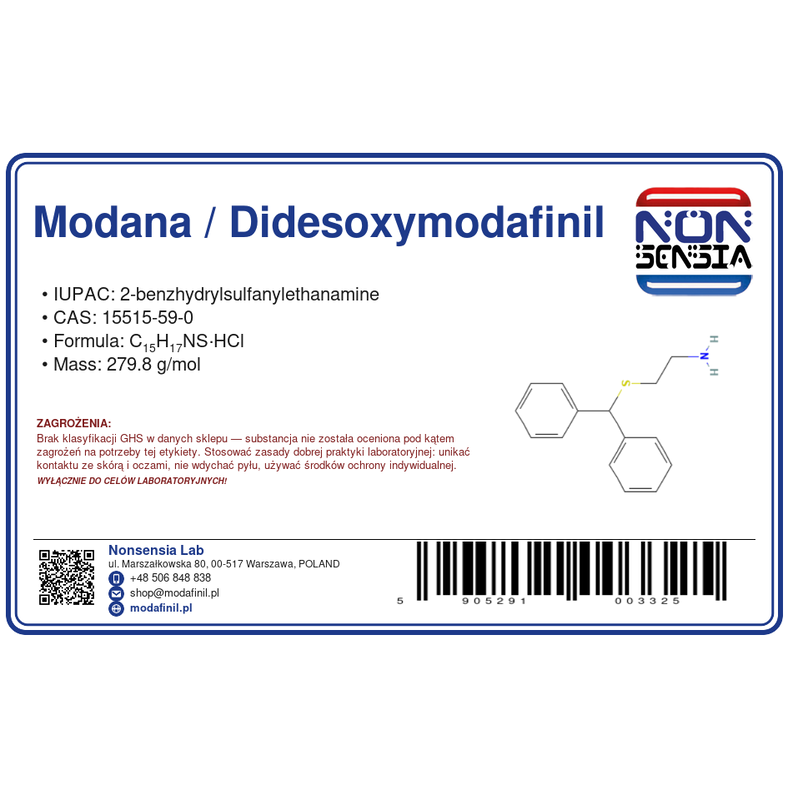
The prefix “didesoxy” in a compound’s name means exactly this: two oxygen atoms have been removed. It sounds like a detail: two atoms in a molecule that contains several dozen. In practice, removing oxygen from a specific position can change polarity, stability, and chromatographic behavior. In this case, it also changes the number of stereogenic centers in the molecule.
The most important point for evaluating this text should be stated up front: there is practically no literature devoted directly to this compound. What follows is derived from functional-group chemistry and from work on the parent molecule and on series of its analogues. For each of these sources, we indicate what it concerns. Modana, CAS number 15515-59-0, is offered by us as a chemical reagent.
Identity card
The values in the table come from the PubChem database (record CID 279413), as of 2026-09-08. We give the date because database entries are sometimes updated, and a number without information on when it was retrieved goes out of date without anyone noticing.
| CAS number | 15515-59-0 |
|---|---|
| Molecular formula | C15H17NS |
| Molar mass | 243.4 g/mol |
| Systematic name | 2-benzhydrylsulfanylethanamine |
| InChIKey | BIPNUYXEYOEPHN-UHFFFAOYSA-N |
| SMILES | C1=CC=C(C=C1)C(C2=CC=CC=C2)SCCN |
| Partition coefficient (logP) | 3.1 |
| Topological polar surface area | 51.3 Ų |
| Hydrogen bond donors / acceptors | 1 / 2 |
Sulfoxide and sulfide: what the difference is
In the parent molecule, the sulfur atom is in an oxidized form: it is double-bonded to oxygen, forming a sulfoxide group. Removing this oxygen converts the sulfoxide group into a sulfide, which is sulfur bonded only to two carbon residues.
This substitution has several consequences that are well established in organic chemistry and do not require separate studies of the specific compound.
Polarity drops markedly. The sulfoxide group is strongly polar, because the sulfur–oxygen bond has a large dipole moment. A sulfide is much less polar. The practical result is a change in solubility, and in reversed-phase chromatography the compound is retained longer.
The stereogenic center at sulfur disappears. This is the most interesting consequence. In a sulfoxide, the sulfur atom has four different substituents (two carbon residues, oxygen, and a lone electron pair) and is a stereogenic center. For this reason, the parent molecule exists as a pair of enantiomers, and one of them is sometimes studied separately; it has been described as an inhibitor with a profile that departs from the classical pattern.1 In the sulfide there is no oxygen, there are three substituents, and the stereocenter at sulfur disappears. The molecule no longer exists as a pair of enantiomers that differ in configuration at this atom.
Susceptibility to oxidation increases. Sulfides are oxidized to sulfoxides relatively easily, by atmospheric oxygen, in the presence of light, or by traces of metals or peroxides in solvents. This is the reverse of the direction in which the molecule was obtained, and it has direct implications for storage.
Why none of this says anything about activity
It is tempting to assume that because the scaffold stayed the same, the properties will be similar. The literature on this family says the opposite, and says it emphatically.
An analysis published in 2024 described the structural basis of the activity cliff in a group of dopamine transporter inhibitors based on the parent molecule. An activity cliff is a situation in which a small structural change produces a disproportionately large change in properties.2 Earlier work on series of analogues, both heterocyclic3 and thiazole-based,4 showed the same thing empirically: structure–activity relationships in this group are not smooth.
It is also worth noting that the way the parent molecule interacts with its molecular target turned out to differ from the pattern typical of its class.5 The first affinity measurement, made in 1994, gave a low value and for years undermined the whole hypothesis.6 The history of this family is therefore a history of conclusions that had to be revised several times.
In other words, here in particular, extrapolating from similarity of structural formula is especially unreliable. The parent molecule has its own extensive literature, including summaries of its pharmacokinetic and pharmacodynamic properties.7 The history of the dispute over its mechanism is instructive in itself, and we describe it in our article on what imaging studies have shown. None of this carries over automatically to the derivative lacking the oxygen.
Practical consequences for the material
Since the pharmacological literature is silent, what follows from the chemistry is what matters. Here it tells us a good deal, and the knowledge is useful.
Storage. The susceptibility of sulfides to oxidation means that the material should be kept away from oxygen and light, preferably in a tightly sealed container, in a cool place. Oxidation does not destroy the molecule. It converts it into a different compound, which is more dangerous, because the product is not an obvious “decomposition” but a different substance.
Identity control. A proton spectrum distinguishes a sulfide from a sulfoxide, because the protons adjacent to sulfur resonate at a different position depending on its oxidation state. This is one of those distinctions that are visible in the spectrum immediately. We explain why a spectrum can be stronger evidence of identity than a chromatogram in our article on the proton spectrum as evidence of identity.
Interpreting the chromatogram. If a peak with a shorter retention time than the main peak appears in the material, then in a reversed-phase system the natural suspect is the oxidation product, which is more polar and therefore less strongly retained. This hypothesis is worth checking first, before turning to more exotic explanations.
A note on nomenclature
Compounds in this family are known by many names at once: systematic, common, trade, and code names. When searching the literature, this is a real obstacle. The same compound may be described under three different terms, and searching for just one of them gives a falsely sparse picture.
For this reason, with compounds that have little literature, it is always worth starting from the CAS number rather than the name. The number identifies a specific compound unambiguously and does not depend on naming conventions. We describe separately what a CAS number identifies and what it does not guarantee, because it too has limitations worth being aware of.
For someone working with such material, the practical conclusion is this. With a compound that has no direct literature, confirming identity yourself and storing the material carefully matter more, because there is no external dataset against which observations could be compared. We describe how to read the document supplied with the material in our article on the certificate of analysis.
Sources
Each item below was retrieved from the PubMed database through the E-utilities interface and is not reproduced from memory. The PMID numbers link to the source records.
- Loland CJ, Mereu M, Okunola OM et al. R-modafinil (armodafinil): a unique dopamine uptake inhibitor and potential medication for psychostimulant abuse. Biol Psychiatry. 2012;72:405-13. PMID: 22537794. DOI: 10.1016/j.biopsych.2012.03.022.
- Lee KH, Camacho-Hernandez GA, Newman AH et al. The Structural Basis of the Activity Cliff in Modafinil-Based Dopamine Transporter Inhibitors. Biomolecules. 2024;14. PMID: 38927116. DOI: 10.3390/biom14060713.
- Kalaba P, Aher NY, Ilić M et al. Heterocyclic Analogues of Modafinil as Novel, Atypical Dopamine Transporter Inhibitors. J Med Chem. 2017;60:9330-9348. PMID: 29091428. DOI: 10.1021/acs.jmedchem.7b01313.
- Kalaba P, Ilić M, Aher NY et al. Structure-Activity Relationships of Novel Thiazole-Based Modafinil Analogues Acting at Monoamine Transporters. J Med Chem. 2020;63:391-417. PMID: 31841637. DOI: 10.1021/acs.jmedchem.9b01938.
- Schmitt KC, Reith ME. The atypical stimulant and nootropic modafinil interacts with the dopamine transporter in a different manner than classical cocaine-like inhibitors. PLoS One. 2011;6:e25790. PMID: 22043293. DOI: 10.1371/journal.pone.0025790.
- Mignot E, Nishino S, Guilleminault C et al. Modafinil binds to the dopamine uptake carrier site with low affinity. Sleep. 1994;17:436-7. PMID: 7991954. DOI: 10.1093/sleep/17.5.436.
- Sousa A, Dinis-Oliveira RJ. Pharmacokinetic and pharmacodynamic of the cognitive enhancer modafinil: Relevant clinical and forensic aspects. Subst Abus. 2020;41:155-173. PMID: 31951804. DOI: 10.1080/08897077.2019.1700584.

