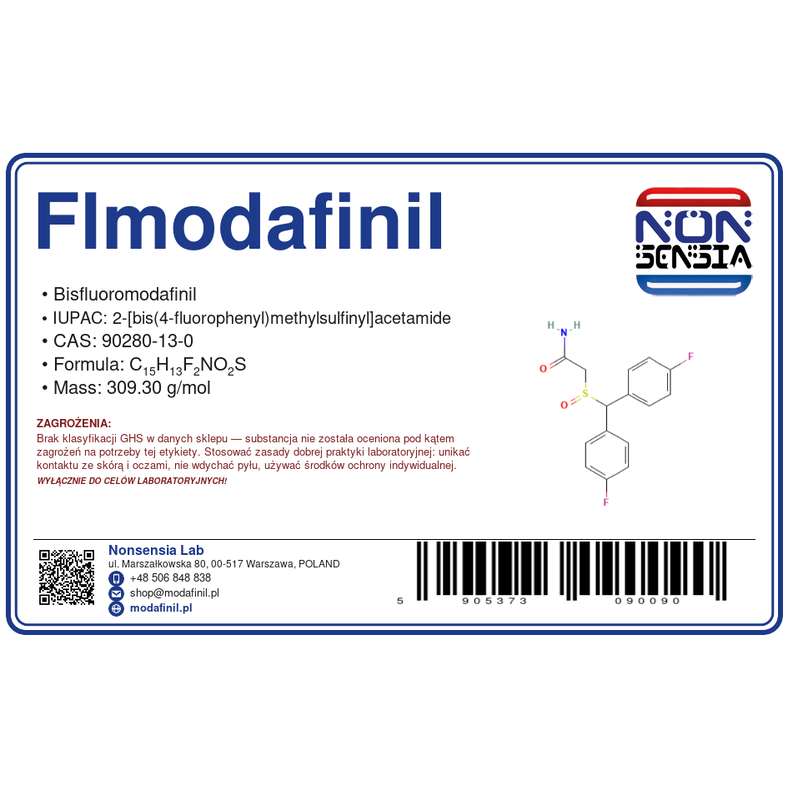
Flmodafinil differs from modafinil by two atoms. Literally: two fluorine atoms introduced at the para positions of both aromatic rings. The rest of the molecule remains the same. This is one of the clearest examples of how a small change in substitution translates into physicochemical, analytical, and metabolic properties, and of how little follows from this automatically.
Let us begin with something that has to be said plainly about this compound, because it puts everything else in order: flmodafinil has never been a drug. There is no registered preparation, no trade name, no registration dossier. So there is nothing to confuse it with, and that is an advantage, not a drawback. With a compound that exists solely as a research material, an entire layer of misunderstandings arising from confusing a substance with a medicinal product disappears. Flmodafinil, CAS number 90280-13-0, is a chemical reagent in our catalog and nothing more.
Identity card
The values in the table come from the PubChem database (record CID 13271852), as of 2026-07-03. We give the date because database entries are sometimes updated, and a number without information about when it was recorded goes out of date unnoticed.
| CAS number | 90280-13-0 |
|---|---|
| Molecular formula | C15H13F2NO2S |
| Molar mass | 309.3 g/mol |
| Systematic name | 2-[bis(4-fluorophenyl)methylsulfinyl]acetamide |
| InChIKey | YEAQNUMCWMRYMU-UHFFFAOYSA-N |
| SMILES | C1=CC(=CC=C1C(C2=CC=C(C=C2)F)S(=O)CC(=O)N)F |
| Partition coefficient (logP) | 1.9 |
| Topological polar surface area | 79.4 Ų |
| Hydrogen bond donors / acceptors | 1 / 5 |
The direct literature is sparse, and this is worth saying up front
Rigor requires starting with the limits. There are few studies devoted directly to this molecule. The most frequently cited one describes the compound under the name lauflumide (designation NLS-4) as a new potent wake-promoting compound.1 Beyond it, the literature concerns either the parent molecule or a broader series of analogues.
This means that everything below must be read within one of two frames: “measured on flmodafinil” or “measured on modafinil or other analogues, which may or may not carry over.” Mixing these frames is the most common error in texts about this compound.
What fluorine does in the ring
Substitution with a fluorine atom is so common a technique in medicinal chemistry that it has developed its own logic. Three effects are the most important.
Blocking a site of oxidation. The carbon–fluorine bond is among the strongest in organic chemistry. If metabolic oxidation occurred at a given ring position, introducing fluorine there closes off that pathway: the reaction must find another site or does not occur at all. This is the most common reason molecules are fluorinated.
Change in electron density distribution. Fluorine is strongly electronegative and withdraws electrons from the ring. This changes the basicity and reactivity of the remaining parts of the molecule and also, importantly for the analyst, shifts signals in the spectra.
Change in lipophilicity. Fluorine substitution usually increases lipophilicity, which affects solubility and chromatographic behavior. A fluorinated compound is often retained more strongly in reversed-phase systems than its non-fluorinated counterpart.
None of these effects, however, is predictable in magnitude. In a series of modafinil analogues, the existence of a so-called activity cliff was demonstrated: a situation in which a small structural change produces a disproportionately large change in properties.2 This is a hard argument against extrapolation: in this family, “similar formula” does not mean “similar behavior.”
What the analogue series teaches
The richest source of knowledge about this family is systematic series of analogues studied in a single system. Heterocyclic analogues of modafinil have been described as atypical dopamine transporter inhibitors,3 and later structure–activity relationships for a series of thiazole analogues.4 Separately, the properties of R-modafinil as an inhibitor with a profile departing from the classical pattern5 and the very manner in which the parent molecule interacts with the transporter have been characterized.6
It is also worth remembering the starting point of this entire discussion: the first measurement of modafinil’s affinity for the dopamine uptake site, performed in 1994, yielded a low value7, and for years this was precisely the argument against the whole hypothesis. We describe the history of this debate separately in the article on what imaging studies have shown.
The pharmacokinetic and pharmacodynamic properties of the parent molecule itself have been summarized in a separate review.8 No analogous review exists for flmodafinil, and that is perhaps the shortest possible description of the state of knowledge about this compound.
Fluorine as a gift to the analyst
Here we come to the most practical and, in my opinion, the most interesting part. The presence of fluorine provides an identification tool that simply does not exist for modafinil: fluorine-19 nuclear magnetic resonance spectroscopy.
Fluorine-19 is the only stable isotope of this element, has a spin of one-half, and is almost as sensitive to measure as the proton. More importantly, in a typical laboratory sample practically nothing else contains fluorine, so the spectrum is clean and the background is almost zero. Two equivalent fluorine atoms in symmetrical positions will give a single, well-defined signal.
Practical consequences:
- Confirmation of the presence of fluorine within a few minutes. The absence of a signal in the fluorine spectrum means that the material is not what it was supposed to be, regardless of what the chromatogram shows.
- Distinction from the parent molecule. Modafinil contains no fluorine, so a mix-up between the two materials is detectable immediately and unambiguously.
- Detection of partial substitution. Material containing an admixture of a monofluoro analogue will give an additional signal in the fluorine spectrum, at a different shift, whereas in chromatography it could hide under the main peak.
This is a rare case in which the structure of the molecule itself facilitates quality control: fluorine here is a built-in marker that does not need to be added or developed. We devote a separate article in this series to the magnetic resonance spectrum as proof of identity.
What follows from this
Flmodafinil is a molecule about which little is known directly and relatively much indirectly, through the chemistry of fluorine substitution and the literature on analogues. An honest approach consists of keeping these two sources separate and not attributing to the compound properties that have not been measured for it.
For laboratory work, three things are practical: fluorine is a convenient identity marker; lipophilicity is increased relative to the parent molecule, so chromatographic conditions must be selected separately; and the materials literature, covering stability and impurity profile, practically does not exist, which makes one’s own identity confirmation more important than usual. How to read the document supplied with the material is described in the article on the certificate of analysis, and the limitations of chromatography itself in the article on what this method sees and what it does not.
Sources
Each entry below was retrieved from the PubMed database via the E-utilities interface and is not reproduced from memory. PMID numbers link to the source records.
- Luca G, Bandarabadi M, Konofal E et al. Lauflumide (NLS-4) Is a New Potent Wake-Promoting Compound. Front Neurosci. 2018;12:519. PMID: 30158846. DOI: 10.3389/fnins.2018.00519.
- Lee KH, Camacho-Hernandez GA, Newman AH et al. The Structural Basis of the Activity Cliff in Modafinil-Based Dopamine Transporter Inhibitors. Biomolecules. 2024;14. PMID: 38927116. DOI: 10.3390/biom14060713.
- Kalaba P, Aher NY, Ilić M et al. Heterocyclic Analogues of Modafinil as Novel, Atypical Dopamine Transporter Inhibitors. J Med Chem. 2017;60:9330-9348. PMID: 29091428. DOI: 10.1021/acs.jmedchem.7b01313.
- Kalaba P, Ilić M, Aher NY et al. Structure-Activity Relationships of Novel Thiazole-Based Modafinil Analogues Acting at Monoamine Transporters. J Med Chem. 2020;63:391-417. PMID: 31841637. DOI: 10.1021/acs.jmedchem.9b01938.
- Loland CJ, Mereu M, Okunola OM et al. R-modafinil (armodafinil): a unique dopamine uptake inhibitor and potential medication for psychostimulant abuse. Biol Psychiatry. 2012;72:405-13. PMID: 22537794. DOI: 10.1016/j.biopsych.2012.03.022.
- Schmitt KC, Reith ME. The atypical stimulant and nootropic modafinil interacts with the dopamine transporter in a different manner than classical cocaine-like inhibitors. PLoS One. 2011;6:e25790. PMID: 22043293. DOI: 10.1371/journal.pone.0025790.
- Mignot E, Nishino S, Guilleminault C et al. Modafinil binds to the dopamine uptake carrier site with low affinity. Sleep. 1994;17:436-7. PMID: 7991954. DOI: 10.1093/sleep/17.5.436.
- Sousa A, Dinis-Oliveira RJ. Pharmacokinetic and pharmacodynamic of the cognitive enhancer modafinil: Relevant clinical and forensic aspects. Subst Abus. 2020;41:155-173. PMID: 31951804. DOI: 10.1080/08897077.2019.1700584.

