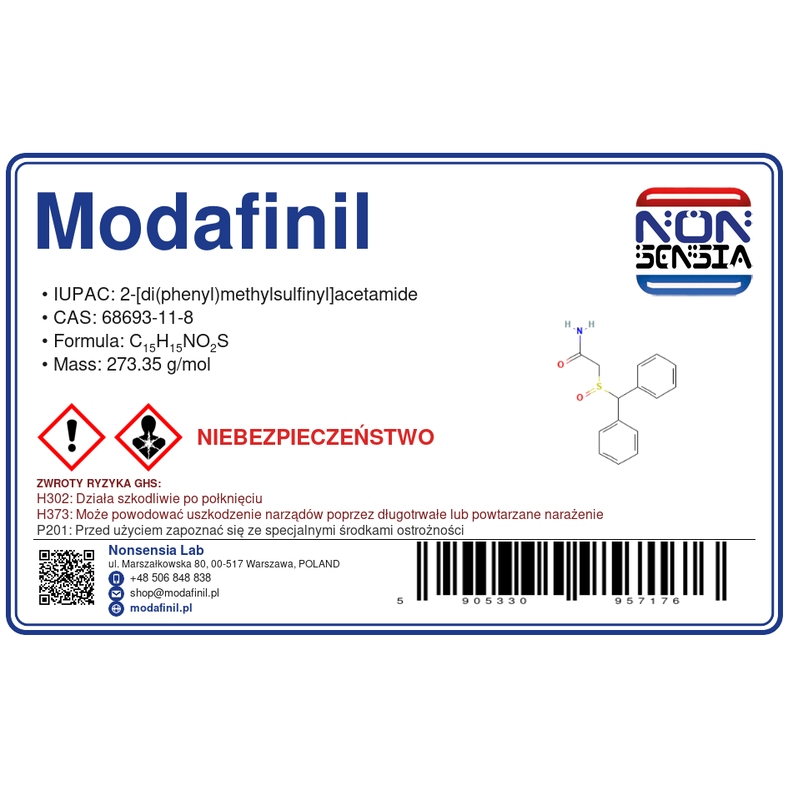
The statement “modafinil acts on the dopamine transporter” is repeated in hundreds of popular texts and almost always appears without its most interesting part — that for well over a decade this was a contested claim, and the first measurements tended to contradict it rather than confirm it. The history of this dispute is a good example of how the scientific literature arrives at a conclusion, and of what the difference looks like between “a molecule binds to a protein” and “this binding explains anything.”
Below, we reconstruct this path chronologically: from the first affinity measurement in 1994, through imaging of the brains of living humans, to the structural analyses of recent years. We do not discuss applications or methods of administration here — modafinil in our catalog is a chemical reagent with CAS number 68693-11-8, intended for laboratory use, and this entire text concerns exclusively what has been published in the literature.
Identity card
The values in the table come from the PubChem database (record CID 4236), as of 2026-07-03. We give the date because database entries are sometimes updated, and a number without information about when it was measured goes out of date imperceptibly.
| CAS number | 68693-11-8 |
|---|---|
| Molecular formula | C15H15NO2S |
| Molar mass | 273.35 g/mol |
| Systematic name | 2-[di(phenyl)methylsulfinyl]acetamide |
| InChIKey | YFGHCGITMMYXAQ-UHFFFAOYSA-N |
| SMILES | C1=CC=C(C=C1)C(C2=CC=CC=C2)S(=O)CC(=O)N |
| Partition coefficient (logP) | 1.32 |
| Topological polar surface area | 71.68 Ų |
| Hydrogen bond donors / acceptors | 1 / 3 |
| GHS pictograms | GHS07, GHS08 |
1994: a binding that looked too weak
The first paper, the one that set up the entire dispute, appeared in 1994. The team investigated what exactly modafinil attaches to in brain tissue and found that the molecule binds to the dopamine uptake site — but with low affinity.1 This phrase later had quite a career, usually being misread.
Low affinity simply means that a high concentration of the compound is needed to occupy a substantial portion of the protein. In pharmacology, this is usually an argument against regarding a given molecular target as responsible for the observed phenomena: if a molecule binds weakly, it is hard to believe that this particular contact is what matters. Over the following decade, some authors therefore treated binding to the dopamine transporter as an artifact or a side phenomenon, and the mechanism was sought elsewhere.
It is worth pausing on the method itself. Affinity measurements are performed on tissue preparations or on cell lines overexpressing the protein, under conditions that by their very nature simplify reality. The result speaks to the strength of the contact in a test tube, not to how much of the protein will be occupied in a living brain. These two questions diverged in the literature for well over a decade.
What the scanners saw
The resolution came only from imaging. In 2009, a study was published using positron emission tomography in healthy volunteers, in which dopamine transporter occupancy was measured after administration of modafinil.2 This was a breakthrough moment, because the measurement concerned the living human brain rather than a tissue homogenate. It turned out that the transporter is occupied to a clear and measurable degree — despite the low affinity found fifteen years earlier.
The apparent contradiction disappears when the two numbers are set side by side. Low affinity means that many molecules are needed; if, however, an adequate concentration is actually reached in brain tissue, the protein will be occupied regardless of the fact that a single contact is weak. The first measurement and the second measurement therefore did not say contradictory things — they spoke of two different quantities, and the dispute arose from treating them as one.
Subsequent imaging studies extended the observation to other groups of subjects; among others, an analysis of transporter occupancy in a population of cocaine-dependent individuals was published.3 Independently of imaging, electrophysiological and amperometric measurements in animal preparations showed that modafinil blocks dopamine uptake — that is, it not only occupies the protein but also disrupts its transport function.4 This is an important distinction: binding alone does not determine whether the protein stops working.
Why it is called an “atypical” inhibitor
Once the involvement of the transporter was no longer questioned, research shifted to another question: if modafinil blocks the same protein as well-known stimulants, why did its pharmacological profile in animal studies look different? The answer began to be sought not in the strength of binding but in its mode.
A 2011 paper showed that modafinil interacts with the dopamine transporter in a manner different from classical uptake inhibitors.5 A year later, the properties of R-modafinil (armodafinil) were described as those of an inhibitor with a peculiar profile, clearly departing from the pattern typical of this class.6 From these and related observations grew the concept of the “atypical dopamine transporter inhibitor” — a category later discussed collectively in review papers.7
The shape of the binding pocket
The crux of the difference lies in the protein’s conformation. The transporter is not a rigid tube but a machine that changes shape during the cycle of carrying a molecule across the membrane. Classical and atypical inhibitors stabilize different intermediate states of this machine, which translates into different functional consequences despite an identical molecular target.
An analysis published in 2024 described the structural basis of the so-called activity cliff in a group of modafinil-based dopamine transporter inhibitors — a situation in which a small change in molecular structure causes a disproportionately large change in activity.8 For a chemist, this is the most valuable piece of information in the entire set, because it states outright that in this family of compounds properties must not be extrapolated from the similarity of structural formulas.
Analogs as a test of the hypothesis
The strongest test of the hypothesis about the role of the transporter was to build analogs and check whether a change in structure translates into a change in action in a predictable way. In 2017, heterocyclic analogs of modafinil were described as novel, atypical dopamine transporter inhibitors,9 and in 2020 structure–activity relationships were published for a series of thiazole analogs.10 Separately, the behavioral and binding properties of the analog designated (S,S)-CE-158 were characterized.11
All of these studies are preclinical research — conducted in cellular and animal models. Their value for someone working with the reagent lies elsewhere than in conclusions about action: they show which fragments of the molecule proved critical, and therefore which impurities and degradation products are worth paying attention to in analysis.
In parallel, the hypothesis was tested from the negative side. In animal studies using animals lacking the transporter, it was shown that the involvement of this protein is necessary for some of the observed behavioral effects.12 The effect of modafinil on the transporter and dopamine receptors in the rat has also been described.13
What these studies did not settle
A rigorous review must also state where what is known ends. A 2013 review paper bore a title that speaks for itself — it discussed modafinil as a catecholaminergic agent, juxtaposing empirical evidence with questions that remained unanswered.14 Several of these questions remain open to this day.
- Does the dopamine transporter explain all of the observations? Occupancy of the protein has been measured, but it does not follow that other systems are not involved. Demonstrating involvement is not demonstrating exclusivity.
- How does this translate into differences between individuals? For example, sex-dependent differences in dopamine binding and in conditioned place preference in mice have been described.15 This is an observation from an animal model and does not automatically transfer to other species.
- How sensitive are the imaging results to the method? Studies using transporter tracers have shown that concomitantly administered substances can alter the imaging result.16 The measurement itself is therefore not a neutral readout.
Added to this is the most prosaic limitation: a large proportion of the studies concern analogs rather than modafinil itself, and conclusions from them do not transfer to the parent molecule without separate evidence. Given the “activity cliff” described above, this caveat is particularly strong.
What follows for work with the reagent
For the laboratory, three practical conclusions emerge from this whole history, none of them related to biological action.
First, the identity of the material is more important here than usual. Since small structural changes cause disproportionate changes in activity, working with material of unconfirmed identity makes no methodological sense. A CAS number identifies a compound, but it is not proof that this is precisely what is in the container — which we write about separately in the article on what declared purity really means.
Second, the impurity profile matters, not just the total. A declaration of “≥98%” does not say what the remaining two percent are. In a family of compounds in which analogs differ in activity by orders of magnitude, this is a significant difference. How to read such declarations is discussed in the article on the certificate of analysis.
Characteristic ions in the mass spectrum
The values below come from the same PubChem record as the data in the table above. The “abundance” column gives the intensity relative to the base peak.
| m/z | abundance | assignment |
|---|---|---|
| 167 | 100 | [Ph₂CH]⁺ base peak |
| 273 | 45 | M⁺ |
| 105 | 38 | C₈H₉⁺ |
| 77 | 32 | C₆H₅⁺ |
| 256 | 28 | M−17 (−NH₃) |
| 91 | 22 | C₇H₇⁺ tropylium |
| 179 | 20 | PhCH=S fragment |
| 152 | 18 | fragment |
Third, the assay method has its limits. Liquid chromatography with UV detection will show what absorbs at the selected wavelength and what manages to separate under the conditions used — and not necessarily everything that is in the sample. We describe these limitations in the article on what HPLC sees and what it does not.
The history of the dispute over the dopamine transporter also has a more general moral, extending beyond a single molecule. For well over a decade, two correctly performed measurements appeared contradictory because they measured different quantities — affinity in a preparation and protein occupancy in a living brain. The resolution did not consist in one of them proving wrong, but in people ceasing to confuse them. In analytical work, this trap recurs regularly and usually in the same disguise: two numbers that go by the same name but answer different questions.
Sources
Each entry below was retrieved from the PubMed database via the E-utilities interface and is not reproduced from memory. The PMID numbers link to the source records.
- Mignot E, Nishino S, Guilleminault C et al. Modafinil binds to the dopamine uptake carrier site with low affinity. Sleep. 1994;17:436-7. PMID: 7991954. DOI: 10.1093/sleep/17.5.436.
- Volkow ND, Fowler JS, Logan J et al. Effects of modafinil on dopamine and dopamine transporters in the male human brain: clinical implications. JAMA. 2009;301:1148-54. PMID: 19293415. DOI: 10.1001/jama.2009.351.
- Karila L, Leroy C, Dubol M et al. Dopamine Transporter Correlates and Occupancy by Modafinil in Cocaine-Dependent Patients: A Controlled Study With High-Resolution PET and [(11)C]-PE2I. Neuropsychopharmacology. 2016;41:2294-302. PMID: 26892922. DOI: 10.1038/npp.2016.28.
- Federici M, Latagliata EC, Rizzo FR et al. Electrophysiological and amperometric evidence that modafinil blocks the dopamine uptake transporter to induce behavioral activation. Neuroscience. 2013;252:118-24. PMID: 23933217. DOI: 10.1016/j.neuroscience.2013.07.071.
- Schmitt KC, Reith ME. The atypical stimulant and nootropic modafinil interacts with the dopamine transporter in a different manner than classical cocaine-like inhibitors. PLoS One. 2011;6:e25790. PMID: 22043293. DOI: 10.1371/journal.pone.0025790.
- Loland CJ, Mereu M, Okunola OM et al. R-modafinil (armodafinil): a unique dopamine uptake inhibitor and potential medication for psychostimulant abuse. Biol Psychiatry. 2012;72:405-13. PMID: 22537794. DOI: 10.1016/j.biopsych.2012.03.022.
- Reith ME, Blough BE, Hong WC et al. Behavioral, biological, and chemical perspectives on atypical agents targeting the dopamine transporter. Drug Alcohol Depend. 2015;147:1-19. PMID: 25548026. DOI: 10.1016/j.drugalcdep.2014.12.005.
- Lee KH, Camacho-Hernandez GA, Newman AH et al. The Structural Basis of the Activity Cliff in Modafinil-Based Dopamine Transporter Inhibitors. Biomolecules. 2024;14. PMID: 38927116. DOI: 10.3390/biom14060713.
- Kalaba P, Aher NY, Ilić M et al. Heterocyclic Analogues of Modafinil as Novel, Atypical Dopamine Transporter Inhibitors. J Med Chem. 2017;60:9330-9348. PMID: 29091428. DOI: 10.1021/acs.jmedchem.7b01313.
- Kalaba P, Ilić M, Aher NY et al. Structure-Activity Relationships of Novel Thiazole-Based Modafinil Analogues Acting at Monoamine Transporters. J Med Chem. 2020;63:391-417. PMID: 31841637. DOI: 10.1021/acs.jmedchem.9b01938.
- Rotolo RA, Kalaba P, Dragacevic V et al. Behavioral and dopamine transporter binding properties of the modafinil analog (S, S)-CE-158: reversal of the motivational effects of tetrabenazine and enhancement of progressive ratio responding. Psychopharmacology (Berl). 2020;237:3459-3470. PMID: 32770257. DOI: 10.1007/s00213-020-05625-6.
- Zolkowska D, Jain R, Rothman RB et al. Evidence for the involvement of dopamine transporters in behavioral stimulant effects of modafinil. J Pharmacol Exp Ther. 2009;329:738-46. PMID: 19197004. DOI: 10.1124/jpet.108.146142.
- Karabacak Y, Sase S, Aher YD et al. The effect of modafinil on the rat dopamine transporter and dopamine receptors D1-D3 paralleling cognitive enhancement in the radial arm maze. Front Behav Neurosci. 2015;9:215. PMID: 26347626. DOI: 10.3389/fnbeh.2015.00215.
- Wisor J. Modafinil as a catecholaminergic agent: empirical evidence and unanswered questions. Front Neurol. 2013;4:139. PMID: 24109471. DOI: 10.3389/fneur.2013.00139.
- Bernardi RE, Broccoli L, Spanagel R et al. Sex differences in dopamine binding and modafinil conditioned place preference in mice. Drug Alcohol Depend. 2015;155:37-44. PMID: 26342627. DOI: 10.1016/j.drugalcdep.2015.08.016.
- Justesen TEH, Borghammer P, Aanerud J et al. Sertraline treatment influences [(18)F]FE-PE2I PET imaging for Parkinsonism. EJNMMI Res. 2023;13:46. PMID: 37221321. DOI: 10.1186/s13550-023-01000-6.

