
Description
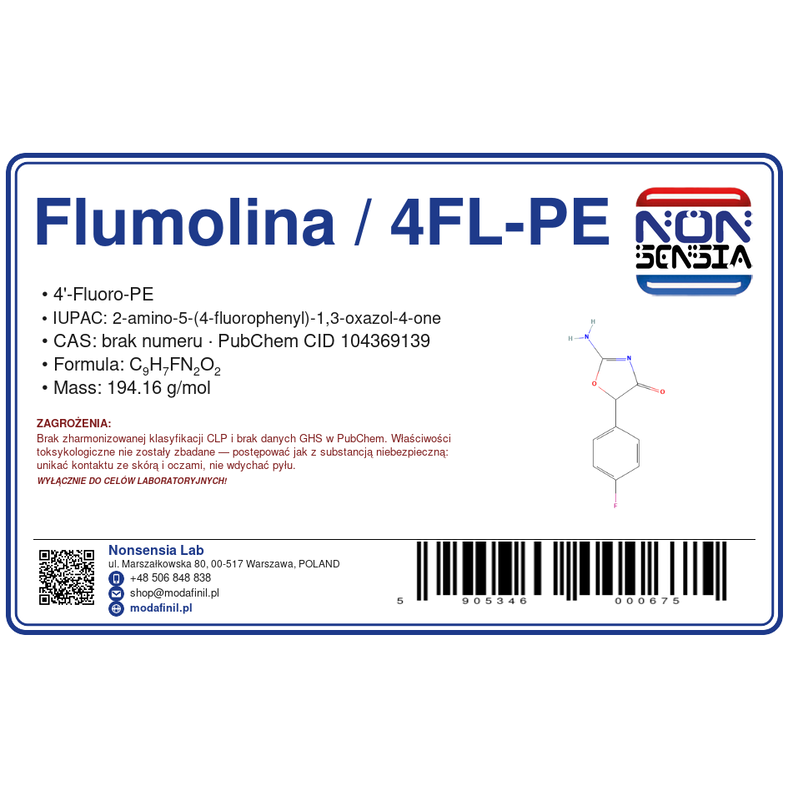
2-amino-5-(4-fluorophenyl)-1,3-oxazol-4-one, a chemical reagent, 1000 mg package. Material intended exclusively for laboratory and analytical in vitro research, not for human or animal consumption. It is not a medicinal product, dietary supplement, food, or cosmetic.
Something that needs to be said upfront
Flumolina (4FL-PE) stands in a more extreme position than any other item in our catalog described under this template: it is a compound for which a PubMed search under none of its names — flumolina, 4FL-PE, 4′-fluoro-PE, fluoropemoline — returns a single result. There are no preclinical studies, no clinical studies, not even a single analytical paper describing its detection.
In the PubChem database, the compound is registered structurally (CID 104369139) — but without a single registered synonym and without a CAS number. The only source behind this entry is the catalog of a single chemical reagent supplier (Aurora Fine Chemicals LLC). In other words: the molecule has a defined, consistent chemical structure, but beyond this one catalog entry no trace of it exists in the scientific literature or in independent chemical registries.
We state this plainly, because it is the only reliable thing that can be said about this molecule as such. Everything that can be said substantively — and there is quite a lot of it — concerns its parent compound, pemoline (a separate substance, with its own CAS number), from which 4FL-PE differs by one fluorine atom. This description consistently separates these two levels and nowhere attributes documented properties to pemoline, or undocumented ones to Flumolina.
Three different entities that must not be confused
| Entity | What it is | Status of Flumolina (4FL-PE) |
|---|---|---|
| Chemical substance 4FL-PE, PubChem CID 104369139 |
A chemical concept — a molecule of defined structure, registered structurally in PubChem, without an assigned CAS number and without its own literature. | yes — this is the only status this molecule actually has |
| Medicinal product | A pharmaceutical preparation: pharmaceutical form, GMP regime, registration documentation, safety surveillance. | NO — in any country. This derivative has never been registered as a drug and is not the subject of any clinical trial |
| Chemical reagent material offered here |
Material for laboratory and analytical work. | yes — and it is offered exclusively in this capacity |
The consequence is unambiguous. There is nothing here to confuse with a drug, because there is no drug. The literature cited further on this page — concerning hepatotoxicity, analytics, and pharmacology — refers exclusively to pemoline (CAS 2152-34-3), a compound with a different CAS number and a different — though closely related — structure than the material offered on this page. None of these studies were conducted using 4FL-PE, none of them concern the analytical reagent, and none of these results carry over to the offered material.
Reagent identification card
| Systematic name (IUPAC) | 2-amino-5-(4-fluorophenyl)-1,3-oxazol-4-one |
|---|---|
| Common names / codes | Flumolina, 4FL-PE, 4′-Fluoro-PE — names present exclusively in commercial circulation; PubChem does not register any synonym for this molecule |
| CAS number | none — the compound has no assigned CAS number in public chemical registries (as of the query date, 2026-09-08) |
| Molecular formula | C9H7FN2O2 |
| Molar mass | 194.16 g·mol−1 |
| Monoisotopic mass | 194.0492 Da |
| InChIKey | KWHHCDCDZNARQY-UHFFFAOYSA-N |
| SMILES | C1=CC(=CC=C1C2C(=O)N=C(O2)N)F |
| PubChem CID | 104369139 |
| Purity | high-purity reagent; a numerical specification is not present in the available documentation for this item — we do not state one, so as not to guess |
| Physical form | not independently documented for this derivative (see the section above on the state of the literature) — we do not guess at color or consistency |
| Intended use | research reagent — not for human or animal consumption |
Molecular lineage: pemoline and fluorine substitution
4FL-PE is not a molecule designed from scratch. It is a derivative of pemoline — a compound with a 2-amino-1,3-oxazol-4-one core, known to medicinal chemistry for decades and holding its own CAS number 2152-34-3 (PubChem CID 4723). The modification consists of introducing one fluorine atom in the para position of the phenyl ring at carbon C5 — hence the trade name “4FL-PE”: the 4 denotes the substitution position, FL stands for fluorine, and PE is short for the phenyl-oxazolone core.
Measurable effects, not assumed ones
Para-position fluorine substitution is one of the most common manipulations in medicinal chemistry and carries predictable physicochemical consequences, which can be stated only on the basis of comparing verified computed descriptors for both molecules — without reference to any biological studies:
| Parameter | Pemoline | Flumolina (4FL-PE) | Significance |
|---|---|---|---|
| Molecular formula | C9H8N2O2 | C9H7FN2O2 | difference: 1×H → 1×F |
| Molar mass | 176.17 | 194.16 | +17.99 — clear distinction in MS |
| XLogP | 0.9 | 1.0 | slightly higher lipophilicity |
| Polar surface area (TPSA) | 64.7 Å2 | 64.7 Å2 | unchanged — fluorine does not alter the core’s hydrogen-bonding profile |
| Hydrogen bond acceptors | 2 | 3 | the fluorine atom is counted as an additional acceptor |
| Hydrogen bond donors | 1 | 1 | unchanged — the core amino group |
| Rotatable bonds | 1 | 1 | unchanged |
Why this matters for the laboratory
A mass difference of just under 18 Da means that distinguishing pemoline from its fluorinated derivative by mass spectrometry does not require chromatographic separation — the ion mass alone is sufficient. Fluorine is practically monoisotopic (19F accounts for nearly 100% of the natural composition), so the presence of this atom cannot be recognized from an isotope pattern the way it could for chlorinated or brominated compounds — it must be inferred from the exact mass or confirmed by 19F NMR, where a single fluorine atom in this molecule gives a single, clean signal with no coupling to a second fluorine center (unlike difluorinated analogs from other families, such as the separately offered flmodafinil, where two equivalent fluorine atoms produce a different spectral pattern).
Timeline: what has been documented for pemoline
The timeline below concerns exclusively pemoline — the parent compound, CAS 2152-34-3 — because it is the only molecule in this family for which dated literature exists. No such timeline can be constructed for 4FL-PE.
| early 1970s | pre-registration studies found liver enzyme abnormalities in 1-3% of adolescents on maintenance pemoline treatment, confirmed on rechallenge (6/6 cases) and on biopsy (2/2) [7] |
|---|---|
| 1975-1996 | adverse event reports to the US FDA: 12 cases of jaundice and 6 deaths among adolescents reported between 1975 and 1989 [7] |
| 1976 | first indexed method for pemoline determination by HPLC [1] |
| 1984 | HPLC method for pemoline determination in plasma, saliva, and urine [2] |
| 1989 | first serious adverse event with pemoline described in the medical literature (letter to the editor) [7] |
| 1997 | another reported case of hepatotoxicity (letter to the editor) [5]; the medical community became more widely aware of the scale of the risk in December 1996, and pemoline use began to decline from that year onward [7] |
| 1998 | description of five cases of hepatotoxicity in children, one ending in liver transplantation [6] |
| 2000 | pemoline included in a GC-MS panel for identifying sympathomimetic amines in clinical toxicology [3] |
| 2012 | a review identifying pemoline as one of the strongest inducers of hepatotoxicity among psychotropic drugs [8]; in parallel, pemoline was still used as a pharmacological tool in an animal model of self-injurious behavior [9] |
| 2014 | modern LC-MS method for pemoline determination in plasma [4] |
| undated | registration of the fluorinated derivative 4FL-PE in a chemical catalog — the only source is a reagent supplier entry in PubChem (CID 104369139), with no associated publication or date |
Pemoline analytics across four decades and four countries
The analytical literature on pemoline spans from the mid-1970s to the present and originated in several independent centers — the same principles of chromatographic separation and MS detection form the starting point for methods applied to analogs, including the fluorinated derivative offered here.
- Rome, 1976 — first HPLC method for pemoline determination [1];
- Japan, 1984 — parallel HPLC determination in plasma, saliva, and urine [2];
- USA — GC-MS panel for sympathomimetic amines in emergency toxicology [3] and a Johns Hopkins University postmarketing surveillance review of hepatotoxicity [7];
- Bonn, 2014 — a modern LC-MS method used, among other things, in pharmacokinetic studies [4].
For 4FL-PE, no parallel list of centers exists — which once again brings us back to the section that opened this description.
Chemistry: the stereogenic center and ring tautomerism
Carbon C5 as a stereogenic center
Carbon C5 of the oxazolone ring — the same carbon to which the 4-fluorophenyl ring is attached — carries four different substituents: a hydrogen atom, the aromatic ring, the ring oxygen atom, and the adjacent carbonyl carbon atom. This satisfies the definition of a stereogenic center: the molecule can exist as a pair of R and S enantiomers. The structure representation registered in PubChem (SMILES, InChI) carries no stereochemical layer, which corresponds to material with an undetermined or undeclared configuration — a practice typical of early-stage catalog entries, not proof of the absence of chirality.
Why this matters analytically
As with many other molecules bearing a stereogenic center in our catalog — for example the separately offered modafinil, where the center lies on the sulfur atom — a simple non-chiral total determination does not resolve the enantiomer ratio. That would require a chiral column and an enantioselective method, which no one has yet published for this particular derivative.
Tautomerism of the 2-aminooxazolone core
The 2-amino-1,3-oxazol-4-one core, common to pemoline and its derivatives, can be written in two tautomeric forms: the amino form (2-amino-oxazol-4(5H)-one, the form registered in PubChem for both molecules on this page) and the imino form (2-imino-oxazolidin-4-one). For analytical work, this means that both naming conventions for the core are worth considering when searching the literature and databases.
Nomenclature and synonyms
- Flumolina — the trade name used in the circulation of this material;
- 4FL-PE — an abbreviation indicating the substitution position (4), the atom (fluorine), and the core (phenyl-oxazolone, “PE”);
- 4′-Fluoro-PE — an alternative notation of the same abbreviation, with the prime denoting the position on the ring;
- 2-amino-5-(4-fluorophenyl)-1,3-oxazol-4-one — the systematic IUPAC name, the only unambiguous one and the only one verified directly in PubChem (CID 104369139).
None of the first three names is registered as a synonym in PubChem — they exist solely in the commercial circulation of this type of material, not in independent chemical databases. In a bibliographic search, none of them returns any results; the only way to reach the chemical context is to search under the name of the parent compound, pemoline (CAS 2152-34-3).
Laboratory application of the reagent
- a reference material for identity confirmation by HPLC-UV against the spectrum and retention time declared for this batch;
- a differentiating standard in LC-MS and GC-MS — distinguishable from pemoline by a mass difference of just under 18 Da, without the need for full chromatographic separation;
- a subject for 19F NMR — a single fluorine atom gives a single, clear signal useful for identity and purity control;
- a model material in structure-property relationship (SAR) studies across a series of 2-aminooxazolone derivatives, with pemoline as the reference point;
- a starting point for developing screening methods for pemoline derivatives in toxicology laboratories — based on the principles described for pemoline itself [3][4], not verified for this particular molecule.
Storage, handling, and work safety
Store in the original, tightly closed packaging, in a dry and cool place, protected from light, separately from food and feed and out of the reach of children. Work only under laboratory conditions, using personal protective equipment: gloves, safety goggles, and laboratory clothing; weigh the material under conditions that limit dust generation. Avoid inhaling dust and contact with skin and eyes. Waste handling — in accordance with the regulations applicable to chemical waste at the site where the research is conducted.
Note on safety data. For this derivative, toxicological data are undetermined — no published acute or chronic toxicity study exists. Even for the parent compound, pemoline, with an extensive clinical literature, a serious risk of hepatotoxicity has been documented [6][7] — a fact that, given the complete absence of any studies for 4FL-PE, is all the more reason to treat the material with heightened caution appropriate for a substance with a completely undetermined profile.
Regulatory status
Flumolina (4FL-PE) is not registered as a medicinal product in any country known to us, has no pharmacopoeial monograph, and does not appear in any controlled substance registry we have found. This does not automatically mean the absence of restrictions, however — the legal status of chemical derivatives of this type can be subject to changes in national law, regardless of whether a given molecule has acquired its own scientific publication. The buyer is responsible for checking the legal status in the country of destination before ordering. The offered material is a chemical reagent and has no approval for any use in humans or animals.
Frequently Asked Questions
What is Flumolina (4FL-PE) and where does this name come from?
It is a chemical reagent with the formula C9H7FN2O2, a 4-fluoro derivative of pemoline. The abbreviation “4FL-PE” indicates the fluorine substitution position (4), the fluorine atom itself (FL), and the phenyl-oxazolone core (PE). The trade name “Flumolina” is not registered as a synonym in any independent chemical database.
How does Flumolina differ from pemoline?
By one fluorine atom in the para position of the phenyl ring. The measurable effect: a molar mass higher by just under 18 Da (194.16 versus 176.17), slightly higher lipophilicity (XLogP 1.0 versus 0.9), and one additional hydrogen bond acceptor.
Is Flumolina a drug or a supplement?
No. It is neither a drug nor a dietary supplement. It has never been registered as a medicinal product in any country. The offered material is a chemical reagent intended exclusively for laboratory research.
What is the chemical formula and molar mass of Flumolina?
C9H7FN2O2; molar mass 194.16 g·mol−1, monoisotopic mass 194.0492 Da, InChIKey KWHHCDCDZNARQY-UHFFFAOYSA-N. Data verified in PubChem (CID 104369139).
Does a CAS number exist for this compound?
No. We checked public chemical registries — the compound has no assigned CAS number. We therefore do not enter any number in the identification card, so as not to guess.
Why does this description not include information about mechanism of action or receptor binding affinity?
Because for this molecule not a single scientific publication exists that would allow anything to be reliably stated on this subject. Earlier versions of descriptions of this type of material sometimes circulate with numerical data on receptor binding affinity — no such data for this derivative were found in any searched source, so we do not state any here.
Is the reagent suitable for applications other than laboratory use?
No. The material is intended exclusively for laboratory and analytical research, not for human or animal consumption. It is not a drug, dietary supplement, food, or cosmetic, and may not be used for medical, diagnostic, or consumption purposes.
How should Flumolina be stored as a laboratory reagent?
In the original, tightly closed packaging, in a dry and cool place, protected from light, separately from food and feed and out of the reach of children.
What solvent should be used to prepare a stock solution of Flumolina?
No specific solubility data have been published for this derivative. Compounds of this structural family — including pemoline — have moderate lipophilicity (XLogP around 1) and low polar donor surface area, which typically favors solubility in organic solvents such as DMSO; we recommend running your own solubility test before use.
Is a safety data sheet included with Flumolina?
We provide a safety data sheet upon request. Toxicological data for this derivative are undetermined — the absence of documented hazard is not equivalent to the absence of hazard.
Is Flumolina legal in Poland?
Flumolina is not registered as a medicinal product and does not appear in any controlled substance registry we have found. The legal status of derivatives of this type can be subject to changes in national law — the buyer is responsible for checking the legal status in the country of destination before ordering.
How can Flumolina be distinguished from pemoline analytically?
Most simply by mass: a difference of just under 18 Da (194.16 versus 176.17) allows the two molecules to be distinguished by mass spectrometry without full chromatographic separation. In addition, the presence of fluorine can be confirmed by 19F NMR — a single atom gives a single, clear signal.
What is this reagent used for in an analytical laboratory?
For identity and purity confirmation by HPLC-UV, as a differentiating standard in LC-MS and GC-MS relative to pemoline, as a subject for 19F NMR, and as a model material in structure-property studies across a series of 2-aminooxazolone derivatives.
References
Due to the complete absence of scientific publications concerning Flumolina (4FL-PE) itself — confirmed by a PubMed search under all of its names and by the absence of synonyms and a CAS number in PubChem — the list below concerns exclusively the parent compound, pemoline (CAS 2152-34-3). Items [1]-[4] are methodological/analytical papers, [5]-[8] concern the hepatotoxicity of pemoline as a previously registered drug, [9] is a preclinical animal study using pemoline as a pharmacological tool. None of these papers concerns 4FL-PE or the reagent offered on this page — they are cited as chemical and historical context for the parent molecule, not as information about the properties of the offered material.
- Cartoni GP, Natalizia F (1976). “Determination of pemoline high-pressure liquid chromatography.” J Chromatogr 123(2):474-8. PMID 956318. doi:10.1016/s0021-9673(00)82224-4.
- Nishihara K, Kohda Y, Saitoh Y, Nakagawa F, Honda Y (1984). “Determination of pemoline in plasma, plasma water, mixed saliva, and urine by high-performance liquid chromatography.” Ther Drug Monit 6(2):232-7. PMID 6740743. doi:10.1097/00007691-198406000-00018.
- Valentine JL, Middleton R (2000). “GC-MS identification of sympathomimetic amine drugs in urine: rapid methodology applicable for emergency clinical toxicology.” J Anal Toxicol 24(3):211-22. PMID 10774541. doi:10.1093/jat/24.3.211.
- Hess C, Ritke N, Sydow K, Mehling LM, Ruehs H, Madea B, Musshoff F (2014). “Determination of levamisole, aminorex, and pemoline in plasma by means of liquid chromatography-mass spectrometry and application to a pharmacokinetic study of levamisole.” Drug Test Anal 6(10):1049-54. PMID 24574157. doi:10.1002/dta.1619.
- McCurry L, Cronquist S (1997). “Pemoline and hepatotoxicity.” Am J Psychiatry 154(5):713-4. PMID 9137138. doi:10.1176/ajp.154.5.713b.
- Marotta PJ, Roberts EA (1998). “Pemoline hepatotoxicity in children.” J Pediatr 132(5):894-7. PMID 9602211. doi:10.1016/s0022-3476(98)70329-4.
- Safer DJ, Zito JM, Gardner JE (2001). “Pemoline hepatotoxicity and postmarketing surveillance.” J Am Acad Child Adolesc Psychiatry 40(6):622-9. PMID 11392339. doi:10.1097/00004583-200106000-00006.
- Sedky K, Nazir R, Joshi A, Kaur G, Lippmann S (2012). “Which psychotropic medications induce hepatotoxicity?” Gen Hosp Psychiatry 34(1):53-61. PMID 22133982. doi:10.1016/j.genhosppsych.2011.10.007.
- Muehlmann AM, Kies SD, Turner CA, Wolfman S, Lewis MH, Devine DP (2012). “Self-injurious behaviour: limbic dysregulation and stress effects in an animal model.” J Intellect Disabil Res 56(5):490-500. PMID 21988194. doi:10.1111/j.1365-2788.2011.01485.x.
Identification data and computed descriptors per PubChem (CID 104369139 for Flumolina/4FL-PE, CID 4723 for pemoline); information on the entry depositor per PubChem xrefs (Aurora Fine Chemicals LLC).
Related reagents in our catalog
- Modafinil (CAS 68693-11-8) — a different structural family (a sulfinyl core instead of an oxazolone one), shared reference point: a stereogenic center requiring a chiral method for enantiomer separation
- Flmodafinil (CAS 90280-13-0) — a fluorine contrast: there, two equivalent fluorine atoms give a single type of signal in 19F NMR, here a single fluorine atom gives a signal without that symmetry
Statement of intended use
The offered material is a chemical reagent intended exclusively for research, analytical, and laboratory purposes — not for human or animal consumption. It is not a medicinal product, dietary supplement, food, medical device, or cosmetic. It may not be used for medical, diagnostic, therapeutic, preventive, or consumption purposes, administered to humans or animals, applied to skin, or added to food, beverages, or feed. Sold exclusively to buyers engaged in research, scientific, or analytical activity, equipped with laboratory facilities and the knowledge needed for the safe handling of chemical reagents. The buyer bears sole responsibility for the lawful and safe use of the reagent and for compliance with the regulations in force in the country of destination.

