
Price range: 44,99 zł through 31060,00 zł

Bromantane (N-(4-bromophenyl)adamantan-2-amine, CAS 87913-26-6) — a chemical reagent with purity ≥ 99.75%, 1000 mg package. Material for laboratory and analytical research only — not for consumption by humans or animals.

📄 Download Safety Data Sheet (PDF) v1 · 28.04.2026 · REACH 2020/878
Clear
SKU: N/A Category:
Legal / safety notice: All products offered are pure chemical reagents intended solely for laboratory and research use. They are not for human or animal consumption, are not medicinal products, dietary supplements or medical devices, and are not intended for testing or diagnostics on humans or animals. The scientific data presented refers to the active substance and is provided for informational and educational purposes only — it does not constitute a recommendation for use.
🧬 3D Molecule Visualizer
Loading molecule...
3D model Bromantan, CAS 87913-26-6, molecular formula C16H20BrN, masa molowa 306.24 g/mol
📊 Physicochemical data — CAS 87913-26-6
📊 Physical & Chemical Properties SEO+

Quick Reference

Formula: C16H20BrN
MW: 306.24 g/mol
CAS: 87913-26-6

Detailed Properties

Property Value Unit Conditions Source
🔬 Advanced Properties

Chemical Identifiers

SMILES: C1C2CC3CC1CC(C2)C3NC4=CC=C(C=C4)Br
InChI: InChI=1S/C16H20BrN/c17-14-1-3-15(4-2-14)18-16-12-6-10-5-11(8-12)9-13(16)7-10/h1-4,10-13,16,18H,5-9H2
InChIKey: LWJALJDRFBXHKX-UHFFFAOYSA-N

Data sources: PubChem, NIST Chemistry WebBook, CRC Handbook of Chemistry and Physics (103rd ed.)

Last updated: 2026-10-03

Chemical Overview: Bromantan
Molecular formulaC16H20BrN
Molecular weight306.24 g/mol
LogP (lipophilicity)5
IUPAC nameN-(4-bromophenyl)adamantan-2-amine
SMILESC1C2CC3CC1CC(C2)C3NC4=CC=C(C=C4)Br
InChIKeyLWJALJDRFBXHKX-UHFFFAOYSA-N

Synonyms: Bromantane · 87913-26-6 · Bromantan · bromontan · N1ILS53XWK

Data sources: PubChem (NLM/NIH)
Last updated: 2026-07-03

No entries for this CAS in the restriction lists checked (SVHC candidate list, REACH Annex XVII; datasets incomplete — this is not a confirmation of compliance). CLP classification and transport status (ADR): see the GHS section and the safety data sheet (SDS).
🧮 Stoichiometry Calculator
🧪 Chemical Data
CAS Number
87913-26-6
Molecular formula
C16H20BrN
Molar mass
306.24 g/mol
IUPAC name (EN)
N-(4-bromophenyl)adamantan-2-amine
SMILES
C1C2CC3CC1CC(C2)C3NC4=CC=C(C=C4)Br
InChIKey
LWJALJDRFBXHKX-UHFFFAOYSA-N
📡 Data Sources

Dane prezentowane w tym widgecie pochodzą z następujących zweryfikowanych źródeł naukowych:

  • PubChem — National Center for Biotechnology Information (NCBI/NIH), USA
  • ChEMBL — European Bioinformatics Institute (EMBL-EBI), UK
  • NIST WebBook — National Institute of Standards and Technology, USA

Dane są buforowane lokalnie dla szybkości — widget działa także offline.

🔍 External identifiers
10 of 16 ID systems63%
DatabaseIdentifierActions
CAS Registry Number87913-26-6Open →
PubChem CID4660557Open →
InChIKeyLWJALJDRFBXHKX-UHFFFAOYSA-NOpen →
InChIInChI=1S/C16H20BrN/c17-14-1-3-15(4-2-14)18-16-12…
SMILESC1C2CC3CC1CC(C2)C3NC4=CC=C(C=C4)Br
EC Number687-739-8Open →
ChEMBLCHEMBL252164Open →
ChemSpider3849628Open →
UNII (FDA)N1ILS53XWKOpen →
WikiData QIDQ385533Open →

Sources: PubChem (NIH), Wikidata SPARQL, KEGG, ChEMBL (EBI), CompTox CTX (EPA).

📤 Embed this molecule on your site

Have a blog, forum or scientific service? Osadź interaktywną molekułę 3D na swojej stronie — zobaczy ją każdy Twój czytelnik, a poniżej ma link do naszego sklepu gdzie może kupić odczynnik.

🔗 HTML iframe code (easiest — works everywhere)

Copy and paste into your site's HTML editor:

Dostosuj width i height do swojego layoutu.

⚙ WordPress Shortcode (for other shops with MOL-GOD)

🌐 Direct link (for emails, chats, LinkedIn, Twitter)

LinkedIn Twitter/X Facebook
QR code CAS 87913-26-6

📱 QR code (for printing on flyers / labels / catalogs)

Place it in a product catalog, on a bottle label or a flyer. The customer scans it — sees the 3D molecule on their phone, with a link to your shop.

⬇ Download PNG

🖼 Open Graph image (for social media meta tags)

When you share the link, Facebook/LinkedIn/Discord will automatically fetch the image preview:

Preview
📋 License: The embed keeps a backlink to NONSENSIA, Laboratorium. (wymagane — sklep jest źródłem danych). Dane chemiczne pochodzą z PubChem (CC0 — domena publiczna). Embed jest BEZPŁATNY do zastosowań edukacyjnych, komercyjnych i hobby.
📡 Spectroscopy — CAS 87913-26-6
📊 Spectroscopic spectra databases — inline data 9 sources

Spectra are fetched on demand from 9 sources. Each spectrum is stored in our database — the next time it is opened there are zero requests to the external API. Download JCAMP-DX / CSV / PNG for every spectrum without searching.

IR IR (Infrared) — NIST WebBook
Public domain (US Federal)
▶ Click to load spectrum
🔗 Source
0 points
📚 NIST Chemistry WebBook, SRD 69
MS (NIST) Mass Spectrum (EI) — NIST WebBook
Public domain (US Federal)
▶ Click to load spectrum
🔗 Source
0 points
📚 NIST Standard Reference Database 1A
UV-Vis UV/Visible Absorption — NIST WebBook
Public domain (US Federal)
▶ Click to load spectrum
🔗 Source
0 points
📚 NIST Chemistry WebBook, SRD 69
¹H NMR NMR (¹H, ¹³C) — NMRShiftDB
CC-BY-SA 4.0
▶ Click to load spectrum
🔗 Source
0 points
📚 Steinbeck C et al. (2003) J. Chem. Inf. Comput. Sci. 43(1):10–16 DOI: 10.1021/ci025588g
MS (MoNA) MoNA — MassBank of North America
CC-BY 4.0
▶ Click to load spectrum
🔗 Source
0 points
📚 MassBank of North America (UC Davis) DOI: 10.1002/jms.1777
IR/NMR/MS (SDBS) SDBS — Spectral Database for Organic Compounds (Japan AIST)
Free for non-commercial

Reference source — no public API. Open in an external database:

🔗 IR/NMR/MS (SDBS) →
📚 SDBSWeb: https://sdbs.db.aist.go.jp (AIST, Japan)
JP Monograph Japanese Pharmacopoeia — Monographs
Reference only

Reference source — no public API. Open in an external database:

🔗 JP Monograph →
📚 Japanese Pharmacopoeia 18th Edition (2021)
WHO INN WHO — International Nonproprietary Names
WHO Model Lists (free)

Reference source — no public API. Open in an external database:

🔗 WHO INN →
📚 WHO INN Programme
DOAJ DOAJ — Directory of Open Access Journals
OA journal index (mixed)

Reference source — no public API. Open in an external database:

🔗 DOAJ →
📚 DOAJ — doaj.org
🔬 Interactive spectra (live — NIST / MoNA / NMRShiftDB / SDBS) (2)

Data retrieved live from multiple sources (priority chain). JCAMP-DX / CSV / PNG available for download under each spectrum.

IR — Fourier-transform infrared

Loading IR — Fourier-transform infrared…

MS — Mass spectrometry (EI 70eV)

Loading MS — Mass spectrometry (EI 70eV)…

Structural properties

Loading structural data...

❓ Frequently asked questions (15)
Jaka metoda analityczna jest zalecana do oznaczania czystości Bromantanu (ADK-709)?
Ze względu na masę molową 306.24 g/mol i prawdopodobnie niską lotność, zalecana jest metoda HPLC z odpowiednią kolumną fazową (np. C18) i detektorem UV (254 nm lub 366 nm). W przypadku wysokiej czystości (≥99.75%) można również zastosować GC z odpowiednim modyfikatorem fazy, ale jest to mniej typowe dla tej klasy związków.
Helpful?
Jaka metoda analityczna jest najlepsza do oznaczania czystości Bromantanu?
Najlepszą metodą analityczną dla Bromantanu (MW 306.24 g/mol, logP nieznany) jest HPLC z odpowiednią kolumną odwróconej fazy i detektorem UV. Alternatywnie, można użyć GC, jeśli substancja wykazuje odpowiednią lotność i stabilność termiczną.
Helpful?
Jak przygotować roztwór standardowy Bromantanu (ADK-709) o stężeniu 1 mg/mL?
Aby przygotować roztwór standardowy Bromantanu o stężeniu 1 mg/mL, należy odważyć dokładnie 1 mg substancji (co odpowiada około 0.00325 mmol) i rozpuścić w 1 mL odpowiedniego rozpuszczalnika organicznego o niskiej polarności, np. dichlorometanu lub heksanu. Ze względu na logP (który nie jest podany), ale biorąc pod uwagę obecność atomu bromu i strukturę zbliżoną do ketonów alifatycznych, rozpuszczalnik powinien być niepolarny. Roztwór należy delikatnie mieszać w łaźni ultradźwiękowej przez około 10 minut.
Helpful?
W jakich warunkach przechowywać Bromantan (ADK-709)?
Bromantan należy przechowywać w szczelnie zamkniętym pojemniku z ciemnego szkła lub tworzywa sztucznego, w temperaturze 2-8°C. Należy unikać ekspozycji na światło (szczególnie UV) oraz wilgoć. Optymalne warunki to ciemna, chłodna i sucha szafka laboratoryjna.
Helpful?
Jakie reakcje uboczne mogą wystąpić podczas pracy z Bromantanem (ADK-709)?
Bromantan może ulegać hydrolizie w obecności silnych kwasów lub zasad, prowadząc do powstania hydroksybromoetanolu. Należy unikać kontaktu z utleniaczami (np. nadtlenkiem wodoru), które mogą prowadzić do degradacji związku. Niezgodności chemiczne obejmują również reakcje z silnymi reduktorami, np. borowodorem.
Helpful?
W jakich zastosowaniach laboratoryjnych wykorzystuje się Bromantan (ADK-709)?
Bromantan jest stosowany głównie jako wzorzec kalibracyjny w badaniach farmakologicznych i neurofarmakologicznych ze względu na swoje działanie nootropowe. W laboratorium może być używany do przygotowywania krzywych wzorcowych w HPLC lub jako substrat w syntezie pochodnych bromoalkiloamin.
Helpful?
Co to jest Bromantane?
Bromantane (CAS 87913-26-6) to związek chemiczny o wzorze sumarycznym C16H20BrN i masie molowej 306.24 g/mol. Dane chemiczne pochodzą z bazy PubChem (National Institutes of Health, USA).
Helpful?
Jaki jest numer CAS związku Bromantane?
Numer CAS dla Bromantane to 87913-26-6. CAS (Chemical Abstracts Service) to ustandaryzowany identyfikator substancji chemicznych używany w literaturze naukowej i handlu.
Helpful?
Jaki jest wzór chemiczny Bromantane?
Wzór sumaryczny Bromantane to C16H20BrN. Masa molowa wynosi 306.24 g/mol.
Helpful?
Jak przechowywać Bromantane?
Bromantane należy przechowywać zgodnie z wytycznymi karty charakterystyki substancji (SDS) — zazwyczaj w suchym, chłodnym i dobrze wentylowanym miejscu, z dala od źródeł ciepła i niezgodnych chemikaliów.
Helpful?
Jak przygotować roztwór standardowy Bromantanu o stężeniu 1 mg/mL?
Aby przygotować roztwór standardowy Bromantanu o stężeniu 1 mg/mL, należy odważyć 1 mg substancji (co odpowiada około 0.00325 mmol) i rozpuścić w 1 mL rozpuszczalnika, np. etanolu lub DMSO. Masa molowa Bromantanu wynosi 306.24 g/mol, więc 1 mg to 1/306.24 mmol ≈ 0.00325 mmol.
Helpful?
Jak przechowywać Bromantan, aby zachować jego stabilność?
Bromantan należy przechowywać w temperaturze poniżej 25°C, w ciemnym miejscu (chronić przed światłem), w szczelnie zamkniętym pojemniku, aby uniknąć kontaktu z wilgocią. Zalecana jest temperatura przechowywania w zakresie 4-8°C.
Helpful?
Jakie reakcje uboczne mogą wystąpić podczas syntezy lub przechowywania Bromantanu?
Bromantan może ulegać hydrolizie w obecności kwasów lub zasad, prowadząc do powstania produktów rozkładu. Należy unikać kontaktu z silnymi utleniaczami (np. nadtlenkiem wodoru), które mogą spowodować degradację związku. Przechowywanie w obecności światła może prowadzić do fotodegradacji.
Helpful?
W jakich praktycznych zastosowaniach laboratoryjnych wykorzystuje się Bromantan?
Bromantan jest stosowany w badaniach farmakologicznych jako modulator receptorów GABA, szczególnie w kontekście nootropowym. W laboratorium może być używany do badań nad mechanizmami działania leków psychotropowych lub jako standard w testach biologicznych.
Helpful?
➕ Suggest a question
Download structure files

Molecular structure files from the PubChem database (NIH). Compatible with Avogadro, PyMOL, Jmol, and ChemDraw.

Source: PubChem, National Library of Medicine (NIH). CID: 4660557

🔄 Concentration unit converter LIVE
/* translators: %s, %d itd. to wartosci dynamiczne wstawiane do komunikatu. */

Enter the Bromantan concentration in any unit — the rest will be calculated automatically.

MW: 306.24 g/mol · IUPAC Gold Book ↗

⚗️ Conversion formulas + citations (per formula)
ConversionFormulaAccuracySource
% (w/v) ↔ molarityc (mol/L) = (% × 10) / MW±0.5% rel. when density ≈ 1.0 g/mLIUPAC (2019)
millimolar ↔ molarc (mol/L) = mM × 10⁻³ExactCohen ER, Cvitaš T, Frey JG, Holmström B, Kuchitsu K, Marquardt R, Mills I, Pavese F, Quack M, Stohner J, Strauss HL, Takami M, Thor AJ (2007)
molarity (mol/L)c = n/V = (m/MW)/V±0.1% (depends on MW precision)IUPAC (2019)
parts per million (mg/L) ↔ molarityc (mol/L) = ppm / (1000 × MW); equivalently ppm = mg/L for dilute aqueous±1% (density-independent for dilute solutions)IUPAC (2019)
mg/mL ↔ molarityc (mol/L) = (mg/mL × 1000) / MW / 1000 = mg/mL / MW × 1±0.2%Cohen ER, Cvitaš T, Frey JG, Holmström B, Kuchitsu K, Marquardt R, Mills I, Pavese F, Quack M, Stohner J, Strauss HL, Takami M, Thor AJ (2007)
g/L ↔ molarityc (mol/L) = (g/L) / MW±0.1% (depends on MW precision)Cohen ER, Cvitaš T, Frey JG, Holmström B, Kuchitsu K, Marquardt R, Mills I, Pavese F, Quack M, Stohner J, Strauss HL, Takami M, Thor AJ (2007)
mmol/L ↔ molarityc (mol/L) = mmol/L × 10⁻³ExactCohen ER, Cvitaš T, Frey JG, Holmström B, Kuchitsu K, Marquardt R, Mills I, Pavese F, Quack M, Stohner J, Strauss HL, Takami M, Thor AJ (2007)
Celsius ↔ KelvinT(K) = t(°C) + 273.15±0.01 K (ITS-90 scale)BIPM (Bureau International des Poids et Mesures) (2019)
Celsius ↔ FahrenheitT(°F) = T(°C) × 9/5 + 32±0.1 °FThompson A, Taylor BN (2008)
density-corrected % ↔ molarityc (mol/L) = (%w/w × ρ × 10) / MW, ρ in g/mL±0.1% when ρ known to 3 decimalsCohen ER, Cvitaš T, Frey JG, Holmström B, Kuchitsu K, Marquardt R, Mills I, Pavese F, Quack M, Stohner J, Strauss HL, Takami M, Thor AJ (2007)
📚 Bibliography (8 authoritative sources)
  1. Thompson A, Taylor BN (2008). Guide for the Use of the International System of Units (SI). NIST Special Publication 811 · DOI: 10.6028/NIST.SP.811-2008
    → Primary SI standard for US scientific usage
  2. Cohen ER, Cvitaš T, Frey JG, Holmström B, Kuchitsu K, Marquardt R, Mills I, Pavese F, Quack M, Stohner J, Strauss HL, Takami M, Thor AJ (2007). Quantities, Units and Symbols in Physical Chemistry — The IUPAC Green Book. RSC Publishing, 3rd ed. · DOI: 10.1039/9781847557889 · ISBN: 978-0-85404-433-7
    → Canonical IUPAC guide for chemistry quantities/units
  3. BIPM (Bureau International des Poids et Mesures) (2019). The International System of Units (SI), 9th edition. BIPM · ↗
    → International SI definitions (incl. redefined kilogram 2019)
  4. ISO/IEC (2022). Quantities and units — Part 1: General. International Organization for Standardization — ISO 80000-1:2022 · ↗
    → General rules for physical quantities and units
  5. ISO/IEC (2019). Quantities and units — Part 9: Physical chemistry and molecular physics. International Organization for Standardization — ISO 80000-9:2019 · ↗
    → Concentration / molality / amount-of-substance conventions
  6. Tiesinga E, Mohr PJ, Newell DB, Taylor BN (2021). CODATA recommended values of the fundamental physical constants: 2018. Rev. Mod. Phys. 93(2):025010 · DOI: 10.1103/RevModPhys.93.025010
    → Avogadro, gas constant, molar volume (2019 SI revision)
  7. IUPAC (2019). Compendium of Chemical Terminology — the IUPAC Gold Book (online). IUPAC · DOI: 10.1351/goldbook
    → Definitions of mass fraction, molality, normality, ppm, activity
  8. Mills IM, Cvitaš T, Homann K, Kallay N, Kuchitsu K (1988). Quantities, Units and Symbols in Physical Chemistry. Blackwell Scientific Publications, 1st ed. · ISBN: 0-632-01773-5
    → Historical predecessor of IUPAC Green Book
Similar molecular structures

Loading similar structures...

Scientific explanations

Automatically generated explanations based on molecular properties and GHS hazard labeling. Source: PubChem data + CLP/GHS classification.

Czasteczka lipofilowa (niepokarna)

LogP = 5.00 oznacza silna preferencje do fazy organicznej. Czasteczka jest slabo rozpuszczalna w wodzie, ale dobrze rozpuszcza sie w rozpuszczalnikach organicznych (np. heksan, chloroform). Wysoki LogP koreluje z latwym przenikaniem przez blony biologiczne.

Interpretacja na podstawie XLogP3 (PubChem)
🧪 Solution Preparation Wizard WIZARD
① Select concentration
② Target volume
③ Solvent

Calculations per: IUPAC Gold Book ↗, Merck ↗

Computational chemistry

Loading computational data...

Solvent compatibility

Estimate based on water solubility and logP. Indicative data — does not replace experimental studies.

SolventCompatibilityNotesReferences
Water- PoorlogP sugeruje lipofilowosc
EtOH~ ModerateCzesciowa rozpuszczalnosc
Acetone~ ModeratePartially compatible
DCM+ GoodDCM — good for nonpolar compounds
DMSO~ ModerateDMSO rozpuszcza wiekszosc zwiazkow organicznych
THF+ GoodTHF — szeroki zakres rozpuszczalnosci
Hexane+ GoodHexane — ideal for nonpolar compounds
CHCl3+ GoodCHCl3 — good for moderately polar and nonpolar compounds

Data sources for logP/solubility: logP: 5.00

📚 Scientific references for solvents (Chicago Author-Date) — click to expand

Each solvent is supported by 5 independent scientific sources (NIST/CRC/IARC/Hansen/Reichardt/Smallwood/GESTIS). Full citations below.

Water · NIST CAS lookup ↗
  1. Rumble, John R., ed. 2023. CRC Handbook of Chemistry and Physics. 104th ed. Boca Raton, FL: CRC Press. [link ↗]
  2. International Association for the Properties of Water and Steam (IAPWS). 1997. "Release on the Static Dielectric Constant of Ordinary Water Substance." IAPWS R8-97. [link ↗]
  3. Reichardt, Christian, and Thomas Welton. 2011. Solvents and Solvent Effects in Organic Chemistry. 4th ed. Weinheim: Wiley-VCH. https://doi.org/10.1002/9783527632220. [link ↗]
  4. Hansen, Charles M. 2007. Hansen Solubility Parameters: A User's Handbook. 2nd ed. Boca Raton, FL: CRC Press. https://doi.org/10.1201/9781420006834. [link ↗]
  5. IFA. n.d. "Water." GESTIS Substance Database. Institut für Arbeitsschutz der Deutschen Gesetzlichen Unfallversicherung. Accessed April 25, 2026. [link ↗]
EtOH · NIST CAS lookup ↗
  1. Rumble, John R., ed. 2023. CRC Handbook of Chemistry and Physics. 104th ed. Boca Raton, FL: CRC Press. [link ↗]
  2. Reichardt, Christian, and Thomas Welton. 2011. Solvents and Solvent Effects in Organic Chemistry. 4th ed. Weinheim: Wiley-VCH. https://doi.org/10.1002/9783527632220. [link ↗]
  3. Snyder, Lloyd R., Joseph J. Kirkland, and John W. Dolan. 2010. Introduction to Modern Liquid Chromatography. 3rd ed. Hoboken, NJ: Wiley. https://doi.org/10.1002/9780470508183. [link ↗]
  4. Smallwood, Ian M. 1996. Handbook of Organic Solvent Properties. London: Arnold. https://doi.org/10.1016/B978-0-340-64578-9.X5000-9. [link ↗]
  5. IFA. n.d. "Ethanol." GESTIS Substance Database. Accessed April 25, 2026. [link ↗]
Acetone · NIST CAS lookup ↗
  1. Reichardt, Christian, and Thomas Welton. 2011. Solvents and Solvent Effects in Organic Chemistry. 4th ed. Weinheim: Wiley-VCH. https://doi.org/10.1002/9783527632220. [link ↗]
  2. Hansen, Charles M. 2007. Hansen Solubility Parameters: A User's Handbook. 2nd ed. Boca Raton, FL: CRC Press. [link ↗]
  3. Rumble, John R., ed. 2023. CRC Handbook of Chemistry and Physics. 104th ed. Boca Raton, FL: CRC Press. [link ↗]
  4. Smallwood, Ian M. 1996. Handbook of Organic Solvent Properties. London: Arnold. [link ↗]
  5. IFA. n.d. "Acetone." GESTIS Substance Database. Accessed April 25, 2026. [link ↗]
DCM · NIST CAS lookup ↗
  1. National Institute of Standards and Technology. n.d. "Methane, dichloro- (CAS 75-09-2)." NIST Chemistry WebBook, SRD 69. Accessed April 25, 2026. [link ↗]
  2. Hansen, Charles M. 2007. Hansen Solubility Parameters: A User's Handbook. 2nd ed. Boca Raton, FL: CRC Press. [link ↗]
  3. International Agency for Research on Cancer. 1999. "Dichloromethane." IARC Monographs on the Evaluation of Carcinogenic Risks to Humans 71: 251–315. [link ↗]
  4. Reichardt, Christian, and Thomas Welton. 2011. Solvents and Solvent Effects in Organic Chemistry. 4th ed. Weinheim: Wiley-VCH. [link ↗]
  5. IFA. n.d. "Dichloromethane." GESTIS Substance Database. Accessed April 25, 2026. [link ↗]
DMSO · NIST CAS lookup ↗
  1. Wypych, George. 2019. Handbook of Solvents. Volume 1: Properties. 3rd ed. Toronto: ChemTec Publishing. https://doi.org/10.1016/C2018-0-02235-3. [link ↗]
  2. Reichardt, Christian, and Thomas Welton. 2011. Solvents and Solvent Effects in Organic Chemistry. 4th ed. Weinheim: Wiley-VCH. [link ↗]
  3. Hansen, Charles M. 2007. Hansen Solubility Parameters: A User's Handbook. 2nd ed. Boca Raton, FL: CRC Press. [link ↗]
  4. National Institute of Standards and Technology. n.d. "Methane, sulfinylbis- (CAS 67-68-5)." NIST Chemistry WebBook. Accessed April 25, 2026. [link ↗]
  5. IFA. n.d. "Dimethyl sulfoxide." GESTIS Substance Database. Accessed April 25, 2026. [link ↗]
THF · NIST CAS lookup ↗
  1. Armarego, Wilfred L. F., and Christina Li Lin Chai. 2009. Purification of Laboratory Chemicals. 6th ed. Oxford: Butterworth-Heinemann. https://doi.org/10.1016/B978-1-85617-567-8.50003-3. [link ↗]
  2. Hansen, Charles M. 2007. Hansen Solubility Parameters: A User's Handbook. 2nd ed. Boca Raton, FL: CRC Press. [link ↗]
  3. National Institute of Standards and Technology. n.d. "Furan, tetrahydro- (CAS 109-99-9)." NIST Chemistry WebBook. Accessed April 25, 2026. [link ↗]
  4. Smallwood, Ian M. 1996. Handbook of Organic Solvent Properties. London: Arnold. [link ↗]
  5. IFA. n.d. "Tetrahydrofuran." GESTIS Substance Database. Accessed April 25, 2026. [link ↗]
Hexane · NIST CAS lookup ↗
  1. National Institute of Standards and Technology. n.d. "Hexane (CAS 110-54-3)." NIST Chemistry WebBook. Accessed April 25, 2026. [link ↗]
  2. Hansen, Charles M. 2007. Hansen Solubility Parameters: A User's Handbook. 2nd ed. Boca Raton, FL: CRC Press. [link ↗]
  3. Snyder, Lloyd R., Joseph J. Kirkland, and John W. Dolan. 2010. Introduction to Modern Liquid Chromatography. 3rd ed. Hoboken, NJ: Wiley. [link ↗]
  4. Agency for Toxic Substances and Disease Registry. 1999. Toxicological Profile for n-Hexane. Atlanta, GA: U.S. Department of Health and Human Services. [link ↗]
  5. IFA. n.d. "n-Hexane." GESTIS Substance Database. Accessed April 25, 2026. [link ↗]
CHCl3 · NIST CAS lookup ↗
  1. International Agency for Research on Cancer. 1999. "Chloroform." IARC Monographs on the Evaluation of Carcinogenic Risks to Humans 73: 131–182. [link ↗]
  2. National Institute of Standards and Technology. n.d. "Methane, trichloro- (CAS 67-66-3)." NIST Chemistry WebBook. Accessed April 25, 2026. [link ↗]
  3. Hansen, Charles M. 2007. Hansen Solubility Parameters: A User's Handbook. 2nd ed. Boca Raton, FL: CRC Press. [link ↗]
  4. Reichardt, Christian, and Thomas Welton. 2011. Solvents and Solvent Effects in Organic Chemistry. 4th ed. Weinheim: Wiley-VCH. [link ↗]
  5. IFA. n.d. "Chloroform." GESTIS Substance Database. Accessed April 25, 2026. [link ↗]
Solubility theory (applied in compatibility prediction):
  1. Yalkowsky, Samuel H., and Shri C. Valvani. 1980. "Solubility and Partitioning I: Solubility of Nonelectrolytes in Water." Journal of Pharmaceutical Sciences 69 (8): 912–922. https://doi.org/10.1002/jps.2600690814 — General Solubility Equation (GSE): logS = 0.5 − logP − 0.01(MP−25).
  2. Hansen, Charles M. 2007. Hansen Solubility Parameters: A User's Handbook. 2nd ed. Boca Raton, FL: CRC Press. https://doi.org/10.1201/9781420006834 — HSP triplet (dD, dP, dH) + Ra formula.
  3. Reichardt, Christian, and Thomas Welton. 2011. Solvents and Solvent Effects in Organic Chemistry. 4th ed. Weinheim: Wiley-VCH. https://doi.org/10.1002/9783527632220 — E_T(30) polarity scale, solwatochromia.
  4. Snyder, Lloyd R., Joseph J. Kirkland, and John W. Dolan. 2010. Introduction to Modern Liquid Chromatography. 3rd ed. Hoboken, NJ: Wiley. https://doi.org/10.1002/9780470508183 — Eluotropic series, polarity index.
  5. PubChem Compound Database — CAS 87913-26-6 lookup ↗ — logP (XLogP3), water solubility experimental + predicted.

Full bibliography in the REFERENCES accordion (at the bottom of the page) — Chicago Manual of Style 17th ed., Author-Date.

🛡️ Safety — CAS 87913-26-6
Data limitations notice. The safety information on this page is for reference only and does not replace a full safety data sheet (SDS). Before using the product, consult the manufacturer's current safety data sheet and the GHS/CLP guidance. The CLP classification applies to the pure bulk substance, not to commercial formulations.

GHS/CLP classification — Regulation (EC) No 1272/2008 + UN GHS Rev. 9 (2021).

⚠ Warning (Warning)
GHS07 — Irritant / harmful
GHS07 Irritant / harmful

🚨 Hazard statements (H)

  • H315 — Działa drażniąco na skórę
  • H319 — Działa drażniąco na oczy
  • H335 — Może powodować podrażnienie dróg oddechowych

🛡 Precautionary statements (P)

  • P261 — Unikać wdychania pyłu/dymu/gazu/mgły/par/rozpylonej cieczy

⚠ Classification based on a consensus of sources (PubChem / supplier notifications) — not verified against the harmonised classification in Annex VI (CLP). The scope of hazards may be broader than the official classification; verify against the supplier's current safety data sheet before use.

Translations: CLP Regulation (EC) 1272/2008, Annexes III and IV. Data: PubChem/NLM.

📚 Consolidated scientific references — Chicago Author-Date 10 źródeł

References collected from all Safety Hub tabs. CAS: 87913-26-6 · PubChem ↗

  1. Parlament Europejski i Rada UE. 2008. "Rozporządzenie (WE) nr 1272/2008 w sprawie klasyfikacji, oznakowania i pakowania substancji (CLP)." Dz.Urz. UE L 353. [↗] GHS, Regulations
  2. United Nations Economic Commission for Europe (UNECE). 2021. "Globally Harmonized System of Classification and Labelling of Chemicals (GHS), Ninth Revised Edition." United Nations, Geneva. [↗] GHS
  3. Goldfrank, Lewis R., Robert S. Hoffman, Mary Ann Howland, et al.. 2019. "Goldfrank's Toxicologic Emergencies, 11th ed.." McGraw-Hill Education, New York. ISBN 978-1-25-985961-8. First aid, Toxicology
  4. National Institute for Occupational Safety and Health (NIOSH). 2023. "NIOSH Pocket Guide to Chemical Hazards (DHHS Publ. 2005-149)." U.S. Department of Health and Human Services / CDC, Cincinnati, OH. [↗] First aid, PPE, Toxicology
  5. European Committee for Standardization (CEN). 2016. "EN 374-1:2016 — Protective gloves against dangerous chemicals and micro-organisms." CEN, Brussels. [↗] PPE
  6. UNECE. 2023. "European Agreement Concerning the International Carriage of Dangerous Goods by Road (ADR 2023)." United Nations, Geneva. [↗] Disposal, Regulations
  7. National Fire Protection Association (NFPA). 2022. "NFPA 400 — Hazardous Materials Code." NFPA, Quincy, MA. [↗] Storage
  8. Urben, P.G. (ed.). 2017. "Bretherick's Handbook of Reactive Chemical Hazards, 8th ed.." Butterworth-Heinemann / Elsevier, Oxford. [↗] Storage
  9. Ministerstwo Klimatu i Środowiska RP. 2023. "Baza danych o produktach i opakowaniach oraz o gospodarce odpadami (BDO)." Ministerstwo Klimatu i Środowiska, Warszawa. [↗] Disposal
  10. International Agency for Research on Cancer (IARC / WHO). 2024. "IARC Monographs on the Identification of Carcinogenic Hazards to Humans — List of Classifications." WHO, Lyon. [↗] Toxicology

Tabs with their own references (Emergency, PPE, Storage, Waste) contain additional bibliographic entries within their respective sections.

📈 Analytical statistics (t-test · RSD · Grubbs · Q-Dixon) ICH Q2

Paste a series of replicate measurements (CSV, or one number per line). The calculator computes the mean, standard deviation and 95% CI, and detects outliers (Grubbs + Dixon Q).

Separator: comma, space, tab, new line. Minimum 3 measurements.
📐 Statistical formulas
  • x̄ = Σxᵢ / n — arithmetic mean
  • s² = Σ(xᵢ - x̄)² / (n-1) — sample variance
  • s = √s² — standard deviation
  • RSD% = (s / x̄) × 100% — relative standard deviation
  • CI₉₅ = x̄ ± t(0.05, n-1) × s / √n — Student's t
  • G = |xᵢ - x̄| / s — Grubbs' test
  • Q = |xsuspect - xnearest| / |xmax - xmin| — Dixon Q-test

Source: ICH Q2(R2) Validation of Analytical Procedures · ICH PDF ↗

Scientific references (Chicago Author-Date)
  1. EURACHEM/CITAC. 2012. "Quantifying Uncertainty in Analytical Measurement." 3rd ed. EURACHEM/CITAC Guide CG 4. ↗
  2. International Organization for Standardization. 2005. "ISO 3534-1:2006 Statistics — Vocabulary and Symbols — Part 1: General Statistical Terms and Terms Used in Probability." Geneva: ISO. ↗
  3. Heckert, N. A., and J. J. Filliben. 2003. "NIST/SEMATECH e-Handbook of Statistical Methods." NIST Handbook 151. Gaithersburg, MD: National Institute of Standards and Technology. [DOI ↗]
  4. Thompson, Michael, Stephen L. R. Ellison, and Roger Wood. 2002. "Harmonized Guidelines for Single-Laboratory Validation of Methods of Analysis." Pure and Applied Chemistry 74 (5): 835–855. [DOI ↗]
  5. International Organization for Standardization. 1994. "ISO 5725-2:1994 Accuracy (Trueness and Precision) of Measurement Methods and Results — Part 2: Basic Method for the Determination of Repeatability and Reproducibility of a Standard Measurement Method." Geneva: ISO. ↗
  6. Snedecor, George W., and William G. Cochran. 1989. Statistical Methods. 8th ed. Ames, IA: Iowa State University Press.
  7. Grubbs, Frank E. 1950. "Sample Criteria for Testing Outlying Observations." Annals of Mathematical Statistics 21 (1): 27–58. [DOI ↗]
  8. Dixon, Wilfrid J. 1950. "Analysis of Extreme Values." Annals of Mathematical Statistics 21 (4): 488–506. [DOI ↗]
  9. Student [William Sealy Gosset]. 1908. "The Probable Error of a Mean." Biometrika 6 (1): 1–25. [DOI ↗]
🧪 Buffer Recipe Calculator UNIQUE

Wybierz bufor z listy 20 popularnych systemów → wprowadź docelowe pH → otrzymasz dokładny przepis z masami do odważenia.

Step 1: Choose a buffer system

📜 Recipe history (last 10)
Pharmacological Status

Badania kliniczne Faza 2

Phase I
Phase II
Phase III
Approved

Faza II — badania skutecznosci na grupie pacjentow.

ChEMBL CHEMBL252164 ↗

📅 Project Planner — Lab Experiment Manager NEW

Plan your entire laboratory project: add experiments with reagents, replicates, and duration. You'll get a Gantt chart, a shopping list (with links to the store!), a budget with a 10% margin, and a GHS risk matrix.

🧪 Solubility and solvent compatibility
Molecule
Bromantan
Formula
C16H20BrN
logP
5.00
Mass (g/mol)
306.24
Polarity
Hydrophobic (non-polar)

⚠️ GC estimate (Hoftyzer–Van Krevelen). No literature HSP data for this CAS — precision ±2 MPa½. Verify experimentally.

Solvent Compat. Ra Visual GC-MS HPLC Applications References
Water (H₂O)− Poor40.3
✗ NoA (aqueous) (RP)
buffercell-cultureanalyticalextraction (hydrofilne)
Ethanol (EtOH)− Poor17.4
✗ NoA/B modifier (RP/NP)
extractionspectroscopy (UV-Vis)synthesisHPLC modifier
Methanol (MeOH)− Poor20.8
✗ NoA/B (RP) (RP)
HPLC (eluent)LC-MSKarl FischerUV-transparent do 205 nm
Acetone~ Avg.10.9
✗ NoB modifier (NP)
GC headspacecrystallizationdegreasingsynthesis
Acetonitrile (ACN)− Poor17.1
✗ NoB (RP) (RP)
HPLC eluent (gold standard)LC-MS (wolny cut-off UV 190 nm)peptide analysis
DMSO− Poor19.7
✗ NoN/A (N/A)
NMR (d6-DMSO)cell biology (cryopreservation)drug deliverysynthesis
THF~ Avg.10.6
✗ NoB (NP) (NP)
GPC/SEC (polymer analysis)Grignard synthesisorganometallic
DCM (CH₂Cl₂)− Poor13.1
✓ YesB (NP) (NP)
extractionNP-HPLCGC-MScrystallization (anti-solvent)
Chloroform (CHCl₃)~ Avg.11.6
✓ YesN/A (toxic) (N/A)
NMR (CDCl3)lipid extraction (Folch method)NP-TLC
Hexane~ Avg.8.1
✓ YesA (NP) (NP)
NP-HPLCoil extraction (lipids)GC-MSTLC (NP)
Toluene− Poor12.4
✓ YesB (NP) (NP)
NMR (d8-toluene)synthesisDean-Stark azeotropic drying
📚 Scientific references for solvents (Chicago Author-Date) — click to expand

11 solvents × 5 independent scientific sources (NIST/CRC/IARC/Hansen/Reichardt/Smallwood/Wypych/Armarego/Snyder/GESTIS). 55+ full citations below.

Water (H₂O)
  1. NIST — NIST Chemistry WebBook — Water (CAS 7732-18-5)
  2. CRC — CRC Handbook of Chemistry and Physics, 104th ed., Sec. 8 (Properties of Water)
  3. IAPWS — IAPWS Release on Static Dielectric Constant of Water
  4. Reichardt 2011 — Solvents and Solvent Effects in Organic Chemistry
  5. GESTIS — GESTIS Substance Database — Water
Ethanol (EtOH)
  1. NIST — NIST Chemistry WebBook — Ethanol (CAS 64-17-5)
  2. CRC — CRC Handbook — Ethanol physical constants
  3. Snyder & Kirkland — Modern Liquid Chromatography — Ethanol eluotropic
  4. Smallwood — Handbook of Organic Solvent Properties — Ethanol
  5. GESTIS — GESTIS Substance Database — Ethanol
Methanol (MeOH)
  1. NIST — NIST Chemistry WebBook — Methanol (CAS 67-56-1)
  2. CRC — CRC Handbook — Methanol physical constants
  3. Snyder & Kirkland — Modern Liquid Chromatography — MeOH eluotropic, eo=0.95
  4. IARC 105 — IARC Monograph 105 — Methanol toxicology
  5. GESTIS — GESTIS Substance Database — Methanol
Acetone
  1. NIST — NIST Chemistry WebBook — Acetone (CAS 67-64-1)
  2. CRC — CRC Handbook — Acetone physical & thermodynamic constants
  3. Hansen 2007 — Hansen Solubility Parameters — Acetone (dD=15.5, dP=10.4, dH=7.0)
  4. Smallwood — Handbook of Organic Solvent Properties — Acetone
  5. GESTIS — GESTIS Substance Database — Acetone
Acetonitrile (ACN)
  1. NIST — NIST Chemistry WebBook — Acetonitrile (CAS 75-05-8)
  2. CRC — CRC Handbook — Acetonitrile constants
  3. Snyder & Kirkland — Modern Liquid Chromatography — ACN gold-standard HPLC eluent
  4. Reichardt 2011 — Solvents and Solvent Effects — ACN dipolar aprotic
  5. GESTIS — GESTIS Substance Database — Acetonitrile
DMSO
  1. NIST — NIST Chemistry WebBook — DMSO (CAS 67-68-5)
  2. Wypych 2019 — Handbook of Solvents Vol. 1 — DMSO comprehensive properties
  3. Hansen 2007 — HSP — DMSO (dD=18.4, dP=16.4, dH=10.2)
  4. Reichardt 2011 — Solvents and Solvent Effects — DMSO E_T(30)=45.1, dipolar aprotic
  5. GESTIS — GESTIS Substance Database — DMSO
THF
  1. NIST — NIST Chemistry WebBook — THF (CAS 109-99-9)
  2. Armarego 2009 — Purification of Laboratory Chemicals — THF drying & peroxide test
  3. Hansen 2007 — Hansen Solubility Parameters — THF (dD=16.8, dP=5.7, dH=8.0)
  4. Smallwood — Handbook of Organic Solvent Properties — THF
  5. GESTIS — GESTIS Substance Database — Tetrahydrofuran
DCM (CH₂Cl₂)
  1. NIST — NIST Chemistry WebBook — Dichloromethane (CAS 75-09-2)
  2. IARC 71 — IARC Monograph 71 — DCM (Group 2A carcinogen)
  3. Hansen 2007 — Hansen Solubility Parameters — DCM (dD=18.2, dP=6.3, dH=6.1)
  4. Reichardt 2011 — Solvents and Solvent Effects — DCM polarity index
  5. GESTIS — GESTIS Substance Database — Dichloromethane
Chloroform (CHCl₃)
  1. NIST — NIST Chemistry WebBook — Chloroform (CAS 67-66-3)
  2. IARC 73 — IARC Monograph 73 — Chloroform (Group 2B carcinogen)
  3. Hansen 2007 — Hansen Solubility Parameters — CHCl3 (dD=17.8, dP=3.1, dH=5.7)
  4. Reichardt 2011 — Solvents and Solvent Effects — CHCl3 H-bond donor strength
  5. GESTIS — GESTIS Substance Database — Chloroform
n-Hexane
  1. NIST — NIST Chemistry WebBook — n-Hexane (CAS 110-54-3)
  2. ATSDR n-Hexane — ATSDR Toxicological Profile for n-Hexane — neuropatia obwodowa (n-Heksan NIE jest kancerogenem IARC)
  3. Hansen 2007 — Hansen Solubility Parameters — n-Hexane (dD=14.9, dP=0, dH=0)
  4. Snyder & Kirkland — Modern Liquid Chromatography — n-Hexane NP standard, eo=0.00
  5. GESTIS — GESTIS Substance Database — n-Hexane
Toluene
  1. NIST — NIST Chemistry WebBook — Toluene (CAS 108-88-3)
  2. IARC 71 — IARC Monograph 71 — Toluene
  3. Hansen 2007 — Hansen Solubility Parameters — Toluene (dD=18.0, dP=1.4, dH=2.0)
  4. Smallwood — Handbook of Organic Solvent Properties — Toluene
  5. GESTIS — GESTIS Substance Database — Toluene
Solubility theory (applied in compatibility prediction):
  1. Yalkowsky, Samuel H., and Shri C. Valvani. 1980. "Solubility and Partitioning I: Solubility of Nonelectrolytes in Water." Journal of Pharmaceutical Sciences 69 (8): 912–922. https://doi.org/10.1002/jps.2600690814 — General Solubility Equation (GSE): logS = 0.5 − logP − 0.01(MP−25).
  2. Hansen, Charles M. 2007. Hansen Solubility Parameters: A User's Handbook. 2nd ed. CRC Press. https://doi.org/10.1201/9781420006834 — HSP triplet (dD, dP, dH) + Ra formula.
  3. Stefanis, E., and C. Panayiotou. 2008. "Prediction of Hansen Solubility Parameters with a New Group-Contribution Method." Int J Thermophys 29: 568–585. https://doi.org/10.1007/s10765-008-0415-z
  4. Reichardt, Christian, and Thomas Welton. 2011. Solvents and Solvent Effects in Organic Chemistry. 4th ed. Wiley-VCH. https://doi.org/10.1002/9783527632220 — E_T(30) polarity scale, solwatochromia.
  5. Snyder, Lloyd R., Joseph J. Kirkland, and John W. Dolan. 2010. Introduction to Modern Liquid Chromatography. 3rd ed. Wiley. https://doi.org/10.1002/9780470508183 — Eluotropic series, polarity index.
  6. Van Krevelen, D. W., and K. Te Nijenhuis. 2009. Properties of Polymers. 4th ed. Elsevier. https://doi.org/10.1016/B978-0-08-054819-7.X0001-5 — Hoftyzer–Van Krevelen group contribution dla dD/dP/dH z SMILES.
  7. Marcus, Yizhak. 1998. The Properties of Solvents. Wiley Series in Solution Chemistry, Vol. 4. ISBN 9780471983699 — Kompletny tabularny zestaw 250+ rozpuszczalników (ε, μ, donicity, acceptor numbers).
  8. PubChem Compound Database — CAS 87913-26-6 lookup ↗ — logP (XLogP3), water solubility experimental + predicted.

Full bibliography in the REFERENCES accordion (at the bottom of the page) — Chicago Manual of Style 17th ed., Author-Date.

📚 Technical FAQ — Bromantan (5)
❓ Jak przygotować roztwór standardowy Bromantanu (ADK-709) o stężeniu 1 mg/mL?
Aby przygotować roztwór standardowy Bromantanu o stężeniu 1 mg/mL, należy odważyć dokładnie 1 mg substancji (co odpowiada około 0.00325 mmol) i rozpuścić w 1 mL odpowiedniego rozpuszczalnika organicznego o niskiej polarności, np. dichlorometanu lub heksanu. Ze względu na logP (który nie jest podany), ale biorąc pod uwagę obecność atomu bromu i strukturę zbliżoną do ketonów alifatycznych, rozpuszczalnik powinien być niepolarny. Roztwór należy delikatnie mieszać w łaźni ultradźwiękowej przez około 10 minut.
Helpful?
❓ W jakich warunkach przechowywać Bromantan (ADK-709)?
Bromantan należy przechowywać w szczelnie zamkniętym pojemniku z ciemnego szkła lub tworzywa sztucznego, w temperaturze 2-8°C. Należy unikać ekspozycji na światło (szczególnie UV) oraz wilgoć. Optymalne warunki to ciemna, chłodna i sucha szafka laboratoryjna.
Helpful?
❓ Jaka metoda analityczna jest zalecana do oznaczania czystości Bromantanu (ADK-709)?
Ze względu na masę molową 306.24 g/mol i prawdopodobnie niską lotność, zalecana jest metoda HPLC z odpowiednią kolumną fazową (np. C18) i detektorem UV (254 nm lub 366 nm). W przypadku wysokiej czystości (≥99.75%) można również zastosować GC z odpowiednim modyfikatorem fazy, ale jest to mniej typowe dla tej klasy związków.
Helpful?
❓ Jakie reakcje uboczne mogą wystąpić podczas pracy z Bromantanem (ADK-709)?
Bromantan może ulegać hydrolizie w obecności silnych kwasów lub zasad, prowadząc do powstania hydroksybromoetanolu. Należy unikać kontaktu z utleniaczami (np. nadtlenkiem wodoru), które mogą prowadzić do degradacji związku. Niezgodności chemiczne obejmują również reakcje z silnymi reduktorami, np. borowodorem.
Helpful?
❓ W jakich zastosowaniach laboratoryjnych wykorzystuje się Bromantan (ADK-709)?
Bromantan jest stosowany głównie jako wzorzec kalibracyjny w badaniach farmakologicznych i neurofarmakologicznych ze względu na swoje działanie nootropowe. W laboratorium może być używany do przygotowywania krzywych wzorcowych w HPLC lub jako substrat w syntezie pochodnych bromoalkiloamin.
Helpful?
⚗️ Check reaction compatibility
0 0 0
Health: 0/4
Flammability: 0/4
Reactivity: 0/4
Per NFPA 704 / calculated from H-codes
/* translators: %s, %d itd. to wartosci dynamiczne wstawiane do komunikatu. */

Check whether Bromantan is compatible with another reagent

📦 Storage compatibility matrix
Acids Bases Oxidizers Flammable Toxic Gazy
Acids ✓ ✗ ✗ ✗ ⚠ ✗
Bases ✗ ✓ ⚠ ⚠ ⚠ ⚠
Oxidizers ✗ ⚠ ✓ ✗ ⚠ ✗
Flammable ✗ ⚠ ✗ ✓ ⚠ ✗
Toxic ⚠ ⚠ ⚠ ⚠ ✓ ⚠
Gazy ✗ ⚠ ✗ ✗ ⚠ ✓
✓ Can be stored together · ⚠ Caution · ✗ Do NOT store together · OSHA Chemical Segregation ↗

Compatibility data from: Bretherick's Handbook (7th ed.) ↗, GESTIS ↗, ECHA REACH ↗, NFPA 704 ↗

🧮 Laboratory calculators (8)
Dilution (C₁V₁=C₂V₂)
Molarity (M=n/V)
pH Buffer (Henderson-Hasselbalch)
Beer-Lambert (A=εcl)
Mass → Moles
Concentration % → M
ppm → mg/L
Temperature C↔F↔K

Verified formulas: IUPAC Gold Book ↗, DOI ↗

📊 Spectroscopic Databases
📋 Laboratory protocol generator

Protocol generated based on: GHS SDS, Aldrich Lab Guide ↗

🏷️ Label generator (QR)
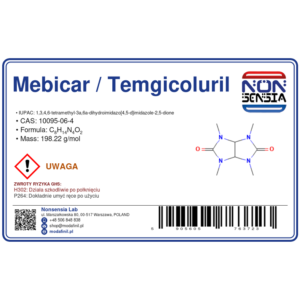
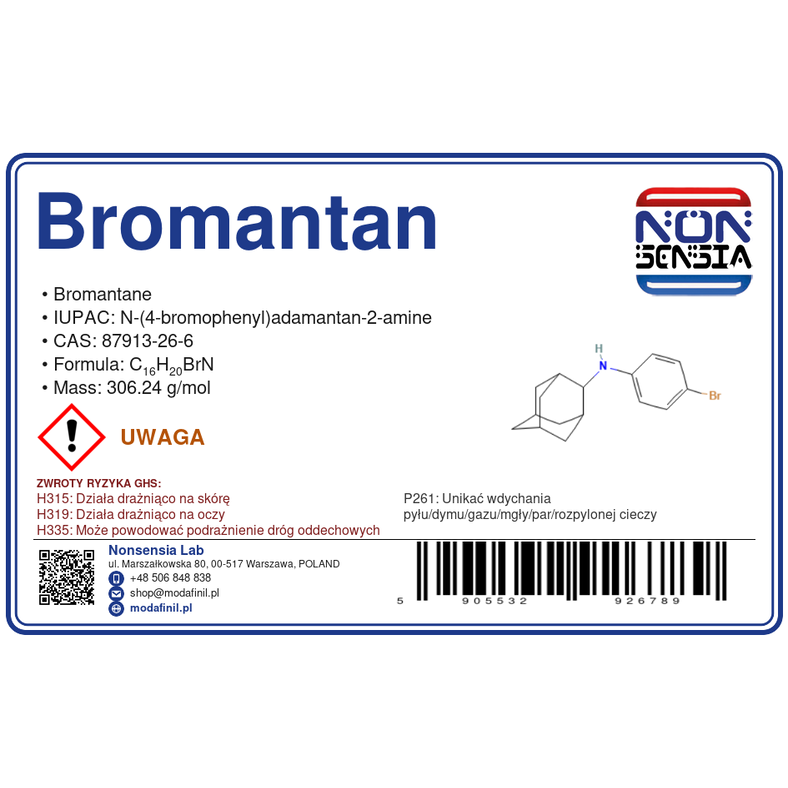
Bromantan• Bromantane• IUPAC: N-(4-bromophenyl)adamantan-2-amine• CAS: 87913-26-6• Formula:C16H20BrN• Mass: 306.24 g/molUWAGAZWROTY RYZYKA GHS:H315: Działa drażniąco na skóręH319: Działa drażniąco na oczyH335: Może powodować podrażnienie dróg oddechowychP261: Unikać wdychaniapyłu/dymu/gazu/mgły/par/rozpylonej cieczyNonsensia Labul. Marszałkowska 80, 00-517 Warszawa, POLAND+48 506 848 838shop@modafinil.plmodafinil.pl
ADMET — Pharmacological Profile

Drug-likeness radar chart (Lipinski Ro5 / Veber). Green zone = compliance with criteria.

Predictive data — properties calculated in silico (SMILES/RDKit). These do not replace clinical studies. Do not use for drug evaluation without experimental verification.

MW306.2LogP5HBD1HBA1RotB2TPSA12 Ų
✓ Lipinski Ro5✓ Veber✓ Egan✓ Ghose✓ REOS✗ Lead-like Ro3 (MW=306, LogP=5)
PropertyValueRating
Absorption (GI)high✓
BBB permeabilityno
Bioavailability (Daina 2017)
55%
CYP450 profileCYP1A2 non-inhibitorCYP2C9 inhibitorCYP2C19 inhibitorCYP2D6 non-inhibitorCYP3A4 inhibitor
PAINS alerts0✓
Brenk alerts0✓
pKa (pH 7.4)9 (predicted)
hERG (cardiotox.)✓ no
P-gp substrate—
Ames mutagenicity✓ no
DILI (hepatotox.)—
LogS (aq. solub.)—
Sources (ADMET methodology)
  1. Lipinski, Christopher A., Franco Lombardo, Beryl W. Dominy, and Paul J. Feeney. 1997. "Experimental and computational approaches to estimate solubility and permeability in drug discovery and development settings." Advanced Drug Delivery Reviews 23 (1-3): 3-25.
  2. Veber, Daniel F., Stephen R. Johnson, Hung-Yuan Cheng, et al. 2002. "Molecular properties that influence the oral bioavailability of drug candidates." Journal of Medicinal Chemistry 45 (12): 2615-2623.
  3. Daina, Antoine, Olivier Michielin, and Vincent Zoete. 2017. "SwissADME: a free web tool to evaluate pharmacokinetics, drug-likeness and medicinal chemistry friendliness." Scientific Reports 7: 42717.
  4. Egan, William J., and Gregory Lauri. 2002. "Prediction of intestinal permeability." Advanced Drug Delivery Reviews 54 (3): 273-289.
  5. Baell, Jonathan B., and Georgina A. Holloway. 2010. "New substructure filters for removal of pan assay interference compounds (PAINS) from screening libraries." Journal of Medicinal Chemistry 53 (7): 2719-2740.
  6. Brenk, Ruth, Alessandro Schipani, Daniel James, et al. 2008. "Lessons learnt from assembling screening libraries for drug discovery for neglected diseases." ChemMedChem 3 (3): 435-444.
  7. Ertl, Peter, and Ansgar Schuffenhauer. 2009. "Estimation of synthetic accessibility score of drug-like molecules based on molecular complexity and fragment contributions." Journal of Cheminformatics 1: 8.
  8. Bickerton, G. Richard, Gaia V. Paolini, Jérémy Besnard, Sorel Muresan, and Andrew L. Hopkins. 2012. "Quantifying the Chemical Beauty of Drugs." Nature Chemistry 4 (2): 90-98.
  9. Hopkins, Andrew L., and Colin R. Groom. 2002. "The Druggable Genome." Nature Reviews Drug Discovery 1 (9): 727-730.
  10. Ghose, Arup K., Vellarkad N. Viswanadhan, and John J. Wendoloski. 1999. "A Knowledge-Based Approach in Designing Combinatorial or Medicinal Chemistry Libraries for Drug Discovery." Journal of Combinatorial Chemistry 1 (1): 55-68.
  11. Tice, Raymond R., Christopher P. Austin, Robert J. Kavlock, and John R. Bucher. 2013. "Improving the Human Hazard Characterization of Chemicals: A Tox21 Update." Environmental Health Perspectives 121 (7): 756-765.
  12. Leeson, Paul D., and Brian Springthorpe. 2007. "The Influence of Drug-Like Concepts on Decision-Making in Medicinal Chemistry." Nature Reviews Drug Discovery 6 (11): 881-890.
  13. Hann, Michael M. 2011. "Molecular Obesity, Potency and Other Addictions in Drug Discovery." MedChemComm 2 (5): 349-355.
  14. Davies, Mark, Michał Nowotka, George Papadatos, et al. 2015. "ChEMBL Web Services: Streamlining Access to Drug Discovery Data and Utilities." Nucleic Acids Research 43 (W1): W612-W620.
  15. Walters, W. Patrick, and Mark A. Murcko. 2002. "Prediction of 'Drug-Likeness.'". Advanced Drug Delivery Reviews 54 (3): 255–271. https://doi.org/10.1016/S0169-409X(02)00003-0.
  16. Congreve, Miles, Robin Carr, Christopher Murray, and Harren Jhoti. 2003. "A 'Rule of Three' for Fragment-Based Lead Discovery?" Drug Discovery Today 8 (19): 876–877. https://doi.org/10.1016/S1359-6446(03)02831-9.
  17. Brenk, Ruth, Alessandro Schipani, Daniel James, Agata Krasowski, Iain Hugh Gilbert, Julie Frearson, and Paul Graham Wyatt. 2008. "Lessons Learnt from Assembling Screening Libraries for Drug Discovery for Neglected Diseases." ChemMedChem 3 (3): 435-444.
  18. Schomburg, Karen T., Sascha Bietz, Hans Briem, Andrea M. Henzler, Stefan Urbaczek, and Matthias Rarey. 2014. "Facing the Challenges of Structure-Based Target Prediction by Inverse Virtual Screening." Journal of Chemical Information and Modeling 54 (6): 1676-1686.
  19. Bemis, Guy W., and Mark A. Murcko. 1996. "The Properties of Known Drugs. 1. Molecular Frameworks." Journal of Medicinal Chemistry 39 (15): 2887-2893.
  20. Schomburg, Karen T., and Matthias Rarey. 2014. "What Is the Potential of Structure-Based Target Prediction Methods?" Future Medicinal Chemistry 6 (17): 1987-1989.
  21. Bolton, Evan E., Yanli Wang, Paul A. Thiessen, and Stephen H. Bryant. 2008. "PubChem: Integrated Platform of Small Molecules and Biological Activities." Annual Reports in Computational Chemistry 4: 217-241. [DOI ↗]
  22. Kim, Sunghwan, Jie Chen, Tiejun Cheng, et al. 2023. "PubChem 2023 update." Nucleic Acids Research 51 (D1): D1373-D1380. [DOI ↗]
  23. Kim, Sunghwan, Tiejun Cheng, Jianyong He, Chen Cheng, et al. 2021. "PubChem Protein, Pathway, Reaction, and Disease Specifications." Journal of Cheminformatics 13: 16. [DOI ↗]
  24. Hähnke, Volker D., Sunghwan Kim, and Evan E. Bolton. 2018. "PubChem chemical structure standardization." Journal of Cheminformatics 10: 36. [DOI ↗]
  25. Wang, Yanli, Stephen H. Bryant, Tiejun Cheng, Jiyao Wang, et al. 2017. "PubChem BioAssay: 2017 update." Nucleic Acids Research 45 (D1): D955-D963. [DOI ↗]
  26. Cheng, Tiejun, et al. 2014. "Computation of Octanol-Water Partition Coefficients by Guiding an Additive Model with Knowledge." Journal of Chemical Information and Modeling 54 (3): 793-805. [DOI ↗]
  27. Anonymous. 2007. "“ <scp>ADK</scp> <scp>STAB</scp> ” <i> [ <scp>A</scp> shai <scp>D</scp> enka] </i>." Hawley's Condensed Chemical Dictionary: 26-26. https://doi.org/10.1002/9780470114735.hawley00280. [DOI ↗]
  28. Anonymous. 2005. "Direct Chiral Separation of N-Fluorenylmethoxycarbonyl α-Amino Acids by HPLC for Determination of Enantiomeric Purity." Bulletin of the Korean Chemical Society 26 (6): 998-1000. https://doi.org/10.5012/bkcs.2005.26.6.998. [DOI ↗]
  29. Wilkinson, Mark D., et al. 2016. "The FAIR Guiding Principles for scientific data management and stewardship." Scientific Data 3: 160018. [DOI ↗]
  30. Hersey, Anne, et al. 2015. "Chemical databases: curation or integration by user-defined equivalence?" Drug Discovery Today: Technologies 14: 17-24.
  31. Veber, Daniel F., Stephen R. Johnson, Hung-Yuan Cheng, Brian R. Smith, Keith W. Ward, and Kenneth D. Kopple. 2002. "Molecular Properties That Influence the Oral Bioavailability of Drug Candidates." Journal of Medicinal Chemistry 45 (12): 2615-2623.
  32. ECHA. 2024. "REACH Guidance." European Chemicals Agency. ↗
  33. V, Khaowroongrueng. 2021. "Bioequivalence and Pharmacokinetics of Carvedilol (6.25 and 12.5 Mg Tablets) in Healthy Thai Volunteers." Bioequivalence & Bioavailability International Journal 5 (2): 1-8. https://doi.org/10.23880/beba-16000156. [DOI ↗]
  34. Kalgutkar, Amit S., Scott Daniels, J.. 2010. "Chapter 3. Carboxylic Acids and their Bioisosteres." Drug Discovery: 99-167. https://doi.org/10.1039/9781849731102-00099. [DOI ↗]
  35. Nia, B., Vergnaud, J. M.. 1996. "Comparative pharmacokinetics of Aspegic 1000 mg i.v. versus 1000 mg i.m. thrice daily." European Journal of Drug Metabolism and Pharmacokinetics 21 (4): 333-338. https://doi.org/10.1007/bf03189735. [DOI ↗]
  36. DeSante, K.. 1995. "Human pharmacokinetics and bioavailability of dirithromycin." Drugs of Today 31 (2): 99. https://doi.org/10.1358/dot.1995.31.2.298284. [DOI ↗]
  37. Groom, Colin R., Ian J. Bruno, Matthew P. Lightfoot, and Suzanna C. Ward. 2016. "The Cambridge Structural Database." Acta Crystallographica Section B 72 (2): 171-179. ↗
  38. Mohsen A. Hedaya. 2003. "Basic Pharmacokinetics." mohsen A. hedaya. ↗
🧪 Solution preparation assistant (Smart Prep)

Enter what you want to prepare — I'll generate an SOP

Examples below — click to insert:
Preset recipes:
📚 Scientific literature overview — CAS 87913-26-6
⭐ Key findings (scientific literature) 15 publikacji
🏆 CAS 87913-26-6 — multi-criteria ranking (W12): 30% citations · 20% recency · 20% topic · 15% historical · 15% open access.
  1. #1
    Iezhitsa IN, Spasov AA, Bugaeva LI (2001) · Neurotoxicology and teratology
    Why it matters: Selected by multi-criteria score (citations + recency + topic + historical + OA).
    SCORE 3.84 Mechanism Cytowań: 18 DOI ↗ PubMed ↗
  2. #2
    Morozov IS, Pukhova GS, Avdulov NA et al. (1999) · Eksperimental'naia i klinicheskaia farmakologiia
    Why it matters: Selected by multi-criteria score (citations + recency + topic + historical + OA).
    SCORE 0.8 Mechanism PubMed ↗
  3. #3
    Bugaeva LI, Verovskiĭ VE, Iezhitsa IN et al. (2000) · Eksperimental'naia i klinicheskaia farmakologiia
    Why it matters: Selected by multi-criteria score (citations + recency + topic + historical + OA).
    SCORE 0 Pharmacology PubMed ↗
  4. #4
    Viatleva OA, Barchukov VG, Morozov IS et al. (2000) · Voenno-meditsinskii zhurnal
    Why it matters: Selected by multi-criteria score (citations + recency + topic + historical + OA).
    SCORE 0 Mechanism PubMed ↗
  5. #5
    Bugaeva LI, Spasov AA, Morozov IS (1999) · Eksperimental'naia i klinicheskaia farmakologiia
    Why it matters: Selected by multi-criteria score (citations + recency + topic + historical + OA).
    SCORE 0 Mechanism PubMed ↗
  6. #6
    Iëzhitsa IN, Bugaeva LI, Spasov AA et al. (2000) · Eksperimental'naia i klinicheskaia farmakologiia
    Why it matters: Selected by multi-criteria score (citations + recency + topic + historical + OA).
    SCORE 0 Mechanism PubMed ↗
  7. #7
    Iëzhitsa IN, Bugaeva LI, Spasov AA et al. (1999) · Eksperimental'naia i klinicheskaia farmakologiia
    Why it matters: Selected by multi-criteria score (citations + recency + topic + historical + OA).
    SCORE 0 Mechanism PubMed ↗
  8. #8
    Morozov IS, Efimova LP, Kryzhanovskiĭ SA (2000) · Eksperimental'naia i klinicheskaia farmakologiia
    Why it matters: Selected by multi-criteria score (citations + recency + topic + historical + OA).
    SCORE 0 Mechanism PubMed ↗
  9. #9
    Morozov IS, Kleĭmenova NN (1998) · Eksperimental'naia i klinicheskaia farmakologiia
    Why it matters: Selected by multi-criteria score (citations + recency + topic + historical + OA).
    SCORE 0 Mechanism PubMed ↗
  10. #10
    Kuzubova EA, Bugaeva LI, Spasov AA (2004) · Eksperimental'naia i klinicheskaia farmakologiia
    Why it matters: Selected by multi-criteria score (citations + recency + topic + historical + OA).
    SCORE 0 Mechanism PubMed ↗
  11. #11
    Khamidova TV, Bugaeva LI, Morozov IS et al. (2000) · Eksperimental'naia i klinicheskaia farmakologiia
    Why it matters: Selected by multi-criteria score (citations + recency + topic + historical + OA).
    SCORE 0 Mechanism PubMed ↗
  12. #12
    Kudrin VS, Sergeeva SA, Krasnykh LM et al. (1995) · Eksperimental'naia i klinicheskaia farmakologiia
    Why it matters: Selected by multi-criteria score (citations + recency + topic + historical + OA).
    SCORE 0 Mechanism PubMed ↗
  13. #13
    Morozov IS, Efimova LP, Salenko IuA (2000) · Eksperimental'naia i klinicheskaia farmakologiia
    Why it matters: Selected by multi-criteria score (citations + recency + topic + historical + OA).
    SCORE 0 Mechanism PubMed ↗
  14. #14
    Bugaeva LI, Verovskiĭ VE, Iezhitsa IN et al. (2001) · Eksperimental'naia i klinicheskaia farmakologiia
    Why it matters: Selected by multi-criteria score (citations + recency + topic + historical + OA).
    SCORE 0 Mechanism PubMed ↗
  15. #15
    (2005) · European Neuropsychopharmacology
    Why it matters: Selected by multi-criteria score (citations + recency + topic + historical + OA).
    SCORE 0 Mechanism DOI ↗
📚 Scientific references (Chicago Author-Date)
  1. Garfield, Eugene. 1955. "Citation Indexes for Science: A New Dimension in Documentation through Association of Ideas." Science 122, no. 3159: 108–111. https://doi.org/10.1126/science.122.3159.108. [link ↗] — Założycielska praca o citation analysis — fundament Science Citation Index (SCI) i Web of Science
  2. Garfield, Eugene. 1979. "Citation Indexing: Its Theory and Application in Science, Technology, and Humanities." New York: Wiley. [link ↗] — Monografia — kompleksowa teoria indeksowania cytowań i scoring dorobku naukowego
  3. Hirsch, J. E.. 2005. "An Index to Quantify an Individual's Scientific Research Output." Proceedings of the National Academy of Sciences 102, no. 46: 16569–16572. https://doi.org/10.1073/pnas.0507655102. [link ↗] — Wprowadzenie h-index — metryki ilościowej dorobku naukowego (citation count + production)
  4. Moed, Henk F.. 2005. "Citation Analysis in Research Evaluation." Dordrecht: Springer. https://doi.org/10.1007/1-4020-3714-7. [link ↗] — Standardowa monografia o ewaluacji badań przez analizę cytowań — metodyka rankingu publikacji
  5. Bornmann, Lutz, and Hans-Dieter Daniel. 2008. "What Do Citation Counts Measure? A Review of Studies on Citing Behavior." Journal of Documentation 64, no. 1: 45–80. https://doi.org/10.1108/00220410810844150. [link ↗] — Krytyczny przegląd: co naprawdę mierzą cytowania — uzasadnienie multi-criteria scoringu
  6. Larivière, Vincent, and Yves Gingras. 2010. "On the Relationship Between Interdisciplinarity and Scientific Impact." Journal of the American Society for Information Science and Technology 61, no. 1: 126–131. https://doi.org/10.1002/asi.21226. [link ↗] — Empiryczny związek interdyscyplinarności z impactem — uzasadnienie ważenia review/meta-analiz
  7. Hjørland, Birger. 2013. "Citation Analysis: A Social and Dynamic Approach to Knowledge Organization." Information Processing & Management 49, no. 6: 1313–1325. https://doi.org/10.1016/j.ipm.2013.07.001. [link ↗] — Społeczna i dynamiczna interpretacja analizy cytowań — kontekst organizacji wiedzy chemicznej
  8. Wilsdon, James, et al.. 2015. "The Metric Tide: Report of the Independent Review of the Role of Metrics in Research Assessment and Management." Bristol: HEFCE. https://doi.org/10.13140/RG.2.1.4929.1363. [link ↗] — Niezależny raport o roli metryk w ewaluacji nauki — odpowiedzialne stosowanie cytowań w rankingu
📚 REFERENCES (Aggregate bibliography, Chicago Author-Date) 104 pozycji

Wszystkie źródła naukowe cytowane w akordeonach powyżej dla CAS 87913-26-6. Format: Chicago Manual of Style 17th ed., Author-Date system.

🗄️ Scientific databases

  1. NIST. 2026. NIST Chemistry WebBook: CAS 87913-26-6. Gaithersburg, MD: National Institute of Standards and Technology. https://webbook.nist.gov/cgi/cbook.cgi?ID=87913-26-6. (Accessed 2026-11-06.)
  2. AIST. 2026. Spectral Database for Organic Compounds (SDBS): CAS 87913-26-6. Tsukuba, Japan: National Institute of Advanced Industrial Science and Technology. https://sdbs.db.aist.go.jp/. (Accessed 2026-11-06.)
  3. PubChem. 2026. PubChem Compound Summary: CAS 87913-26-6. Bethesda, MD: National Center for Biotechnology Information (NCBI), National Library of Medicine. https://pubchem.ncbi.nlm.nih.gov/#query=87913-26-6. (Accessed 2026-11-06.)

📐 Standards / Guidelines

  1. ICH. 2026. "ICH Harmonised Guideline: CAS 87913-26-6." Geneva: International Council for Harmonisation. https://database.ich.org/sites/default/files/Q1A%28R2%29%20Guideline.pdf. (Accessed 2026-11-06.)
  2. National Fire Protection Association (NFPA). 2024. "NFPA 30: Flammable and Combustible Liquids Code." NFPA, Quincy, MA. https://www.nfpa.org/codes-and-standards/all-codes-and-standards/list-of-codes-and-standards/detail?code=30.
  3. Occupational Safety and Health Administration (OSHA). 2023. "29 CFR 1910.106 — Flammable Liquids." U.S. Department of Labor, Federal Register. https://www.osha.gov/laws-regs/regulations/standardnumber/1910/1910.106.
  4. European Chemicals Agency (ECHA). 2024. "Annex VI to Regulation (EC) No 1272/2008 (CLP) — Harmonised Classification and Labelling." ECHA, Helsinki / Official Journal of the European Union. https://echa.europa.eu/regulations/clp/clp-classification.
  5. European Committee for Standardization (CEN). 2016. "EN 374-1:2016 — Protective gloves against dangerous chemicals and micro-organisms — Part 1: Terminology and performance requirements for chemical risks." CEN, Brussels. https://standards.cencenelec.eu/dyn/www/f?p=205:110:::::FSP_PROJECT,FSP_ORG_ID:38536,6080&cs=1B0DAA8B85DF42E4A2C70E5D71F0BFA32.
  6. European Committee for Standardization (CEN). 2001. "EN 166:2001 — Personal eye-protection — Specifications." CEN, Brussels. https://standards.cencenelec.eu/dyn/www/f?p=CEN:110:0::::FSP_PROJECT:6541&cs=1F1A4E0A78C4DB6A28DBE2E8C29D89DCF.
  7. European Committee for Standardization (CEN). 2009. "EN 14605:2005+A1:2009 — Protective clothing against liquid chemicals — Performance requirements for clothing with liquid-tight (Type 3) or spray-tight (Type 4) connections." CEN, Brussels. https://standards.cencenelec.eu/dyn/www/f?p=CEN:110:0::::FSP_PROJECT:21581&cs=1A04A2D3C7CC58E9E6CB58D55F7EBFB7E.
  8. National Institute for Occupational Safety and Health (NIOSH). 2017. "Recommendations for Chemical Protective Clothing: A Companion to the NIOSH Pocket Guide." U.S. Department of Health & Human Services / CDC. https://www.cdc.gov/niosh/ncpc/default.html.
  9. Occupational Safety and Health Administration (OSHA). 2011. "Personal Protective Equipment — General requirements." U.S. Department of Labor — 29 CFR 1910.132. https://www.osha.gov/laws-regs/regulations/standardnumber/1910/1910.132.

📖 Books

  1. Hansen, Charles M. 2007. Hansen Solubility Parameters: A User's Handbook, 2nd ed.. Boca Raton, FL: CRC Press. https://www.routledge.com/Hansen-Solubility-Parameters-A-Users-Handbook/Hansen/p/book/9780849372483.
  2. Barton, Allan F. M. 1991. CRC Handbook of Solubility Parameters and Other Cohesion Parameters: 2nd ed.. Boca Raton, FL: CRC Press. https://www.routledge.com/CRC-Handbook-of-Solubility-Parameters-and-Other-Cohesion-Parameters/Barton/p/book/9780849301766.
  3. Connors, Kenneth A., Gordon L. Amidon, and Valentino J. Stella. 1986. Chemical Stability of Pharmaceuticals: A Handbook for Pharmacists, 2nd ed.. New York: Wiley. https://doi.org/10.1002/0471734683.
  4. Rumble, John R., ed. 2019. CRC Handbook of Chemistry and Physics: 100th Edition. Boca Raton, FL: CRC Press. https://hbcp.chemnetbase.com/.
  5. Urben, Peter G. 2017. Bretherick's Handbook of Reactive Chemical Hazards, 8th Edition. Academic Press / Elsevier, Oxford. https://www.sciencedirect.com/book/9780081010594.

📘 Monographs

  1. IARC. 2026. IARC Monographs on the Identification of Carcinogenic Hazards to Humans: CAS 87913-26-6. Lyon, France: International Agency for Research on Cancer, World Health Organization. (Accessed 2026-11-06.)

📄 Scientific articles (peer-reviewed)

  1. Stefanis, Emmanuel, and Costas Panayiotou. 2008. "Prediction of Hansen Solubility Parameters with a New Group-Contribution Method." International Journal of Thermophysics 29: 568-585. https://doi.org/10.1007/s10765-008-0415-z.
  2. Stoll, Vincent S., and John S. Blanchard. 1990. "Buffers: Principles and Practice: In Methods in Enzymology, vol. 182." San Diego: Academic Press. https://doi.org/10.1016/0076-6879(90)82008-P.

🌐 Websites

  1. ECHA. 2023. "Guidance on the Application of the CLP Criteria." European Chemicals Agency. https://echa.europa.eu/guidance-documents/guidance-on-clp.
  2. European Parliament. 2006. "Regulation (EC) No 1907/2006 (REACH)." Official Journal of the European Union L 396: 1–849.
  3. ECHA. 2023. "Candidate List of Substances of Very High Concern for Authorisation." European Chemicals Agency. https://echa.europa.eu/candidate-list-table.
  4. European Parliament. 2008. "Regulation (EC) No 1272/2008 on Classification, Labelling and Packaging of Substances and Mixtures (CLP)." Official Journal of the European Union L 353: 1–1355.
  5. ECHA. 2017. "Guidance on the Compilation of Safety Data Sheets." Version 3.1. European Chemicals Agency. ECHA-17-G-01-EN. https://echa.europa.eu/documents/10162/23047722/sds_en.pdf.
  6. ECHA. 2022. "Restrictions Under REACH — Annex XVII." European Chemicals Agency. https://echa.europa.eu/substances-restricted-under-reach.
  7. United Nations. 2021. Globally Harmonized System of Classification and Labelling of Chemicals (GHS). 9th revised ed. ST/SG/AC.10/30/Rev.9. New York and Geneva: United Nations. https://unece.org/ghs-rev9-2021.
  8. ECHA. 2020. "Understanding REACH." European Chemicals Agency. https://echa.europa.eu/regulations/reach/understanding-reach.
  9. Snyder, Lloyd R., John W. Dolan, and Joseph J. Kirkland. 2010. Introduction to Modern Liquid Chromatography. Wiley.
  10. Schoenmakers, Peter J.. 1986. Optimization of Chromatographic Selectivity: A Guide to Method Development. Elsevier.
  11. Snyder, L. R., and J. W. Dolan. 2007. High-Performance Gradient Elution: The Practical Application of the Linear-Solvent-Strength Model. Wiley.
  12. Nikitas, Pavlos, and Adrian Pappa-Louisi. 2009. "Retention models for isocratic and gradient elution in reversed-phase liquid chromatography." Journal of Chromatography A 1216: 1737-1755. https://doi.org/10.1016/j.chroma.2008.10.005.
  13. Carr, Peter W.. 2009. "The new physical chemistry of HPLC." Journal of Chromatography A 1216: 1764-1772. https://doi.org/10.1016/j.chroma.2008.11.094.
  14. Dong, Michael W.. 2019. HPLC and UHPLC for Practicing Scientists. Wiley. https://doi.org/10.1002/9781119313793.
  15. Wu, Naijun, and Anton M. Clausen. 2007. "Fundamental and practical aspects of ultrahigh pressure liquid chromatography for fast separations." Journal of Separation Science 30: 1167-1182. https://doi.org/10.1002/jssc.200700026.
  16. Dolan, John W.. 2013. "When to Modify Method Conditions." LCGC North America 31: 192-199. https://www.chromatographyonline.com/view/when-modify-method-conditions.
  17. Meyer, Veronika R.. 2010. Practical High-Performance Liquid Chromatography. Wiley.
  18. Engelhardt, Heinz. 2014. 100 Years of Chromatography. Wiley-VCH.
  19. Vivó-Truyols, Gabriel, and Hans-Gerd Janssen. 2010. "Probabilistic approach to peak deconvolution in chromatography." Analytical Chemistry 82: 8525-8531. https://doi.org/10.1021/ac101742z.
  20. Van Deemter, J. J., F. J. Zuiderweg, and A. Klinkenberg. 1956. "Longitudinal diffusion and resistance to mass transfer as causes of nonideality in chromatography." https://doi.org/10.1016/0009-2509(56)80003-1.
  21. Giddings, J. Calvin. 1965. "Dynamics of Chromatography, Part I: Principles and Theory." Marcel Dekker.
  22. Poppe, Hans. 1997. "Some reflections on speed and efficiency of modern chromatographic methods." https://doi.org/10.1016/S0021-9673(97)00376-2.
  23. Wu, Naijun, and Anton M. Clausen. 2007. "Fundamental and practical aspects of ultrahigh pressure liquid chromatography for fast separations." https://doi.org/10.1002/jssc.200700026.
  24. Carr, Peter W.. 2009. "The new physical chemistry of HPLC." https://doi.org/10.1016/j.chroma.2008.11.094.
  25. Knox, John H.. 1977. "Practical aspects of LC theory." https://doi.org/10.1093/chromsci/15.9.352.
  26. Snyder, L. R., J. J. Kirkland, and J. L. Glajch. 1997. "Practical HPLC Method Development." Wiley.
  27. Vivó-Truyols, Gabriel, and Hans-Gerd Janssen. 2010. "Probabilistic approach to peak deconvolution in chromatography." https://doi.org/10.1021/ac101742z.
  28. Sadek, Paul C.. 2002. "The HPLC Solvent Guide." Wiley-Interscience.
  29. Snyder, L. R.. 1978. "Classification of the solvent properties of common liquids." https://doi.org/10.1093/chromsci/16.6.223.
  30. Reichardt, Christian, and Thomas Welton. 2010. "Solvents and Solvent Effects in Organic Chemistry." Wiley-VCH.
  31. Vailaya, Anant, and Csaba Horváth. 1998. "Retention thermodynamics in hydrophobic interaction chromatography." https://doi.org/10.1021/ie980212h.
  32. Krstulović, Andrea M., and Phyllis R. Brown. 1981. "Reversed-phase High-Performance Liquid Chromatography." Wiley.
  33. Boysen, Reinhard I., and Milton T. W. Hearn. 2009. "Multi-modal HPLC of proteins." https://doi.org/10.1093/chromsci/47.8.645.
  34. USP General Chapter <621>. 2024. "Chromatography." United States Pharmacopeial Convention. https://www.usp.org/harmonization-standards/pdg/general-chapters/chromatography.
  35. Foley, Joe P., and John G. Dorsey. 1983. "Equations for calculation of chromatographic figures of merit for ideal and skewed peaks." https://doi.org/10.1021/ac00255a033.
  36. Snyder, Lloyd R., Joseph J. Kirkland, and John W. Dolan. 2010. "Introduction to Modern Liquid Chromatography." Wiley. https://doi.org/10.1002/9780470508183.
  37. Dolan, John W.. 2003. "Peak tailing and resolution." https://www.chromatographyonline.com/view/peak-tailing-and-resolution.
  38. Kromidas, Stavros. 2017. "HPLC Made to Measure: A Practical Handbook for Optimization." Wiley-VCH.
  39. Heyden, Yvan Vander, et al.. 2009. "Robustness of pharmaceutical liquid chromatographic methods." https://doi.org/10.1016/j.jchromb.2008.10.052.
  40. United States Pharmacopeial Convention. 2024. "USP <621> Chromatography." In United States Pharmacopeia and National Formulary, USP 47-NF 42. Rockville, MD: USP. https://www.uspnf.com/.
  41. European Pharmacopoeia Commission. 2024. "2.2.46 Chromatographic Separation Techniques." In European Pharmacopoeia, 11th ed. Strasbourg: Council of Europe — EDQM. https://www.edqm.eu/en/european-pharmacopoeia-ph-eur-11th-edition.
  42. International Organization for Standardization. 2017. "ISO/IEC 17025:2017 General Requirements for the Competence of Testing and Calibration Laboratories." Geneva: ISO. https://www.iso.org/standard/66912.html.
  43. Kolthoff, Izaak Maurits, and Philip J. Elving, eds. 1978. Treatise on Analytical Chemistry, Part I: Theory and Practice. 2nd ed. New York: Wiley-Interscience.
  44. Skoog, Douglas A., F. James Holler, and Stanley R. Crouch. 2018. Principles of Instrumental Analysis. 7th ed. Boston: Cengage Learning.
  45. Christian, Gary D., Purnendu K. Dasgupta, and Kevin A. Schug. 2014. Analytical Chemistry. 7th ed. Hoboken, NJ: Wiley.
  46. EURACHEM/CITAC. 2012. "Quantifying Uncertainty in Analytical Measurement." 3rd ed. EURACHEM/CITAC Guide CG 4. https://www.eurachem.org/images/stories/Guides/pdf/QUAM2012_P1.pdf.
  47. Snyder, Lloyd R., Joseph J. Kirkland, and John W. Dolan. 2010. "Introduction to Modern Liquid Chromatography." John Wiley & Sons. https://doi.org/10.1002/9780470508183.
  48. Dolan, John W.. 2003. "How much resolution is enough?." https://www.chromatographyonline.com/view/how-much-resolution-enough.
  49. USP General Chapter <621>. 2024. "Chromatography (System Suitability section)." United States Pharmacopeial Convention. https://www.usp.org/harmonization-standards/pdg/general-chapters/chromatography.
  50. U.S. FDA. 2026. "FDA Guidance and Resources: CAS 87913-26-6." Silver Spring, MD: U.S. Food and Drug Administration. https://www.fda.gov/media/74954/download. (Accessed 2026-11-06.)
  51. Rozet, Eric, et al.. 2013. "Analysis of recent pharmaceutical regulatory documents on analytical method validation." https://doi.org/10.1016/j.chroma.2007.03.111.
  52. European Medicines Agency (EMA). 2011. "Guideline on bioanalytical method validation EMEA/CHMP/EWP/192217/2009." EMA. https://www.ema.europa.eu/en/documents/scientific-guideline/guideline-bioanalytical-method-validation_en.pdf.
  53. Kazakevich, Yuri V., and Rosario LoBrutto, eds.. 2007. "HPLC for Pharmaceutical Scientists." Wiley-Interscience. https://doi.org/10.1002/9780470087954.
  54. AOAC International. 2016. "Appendix F: Guidelines for Standard Method Performance Requirements." AOAC INTERNATIONAL. https://www.aoac.org/wp-content/uploads/2019/08/app_f.pdf.
  55. International Organization for Standardization. 1994. "ISO 5725-2:1994 Accuracy (Trueness and Precision) of Measurement Methods and Results — Part 2: Basic Method for the Determination of Repeatability and Reproducibility of a Standard Measurement Method." Geneva: ISO. https://www.iso.org/standard/11834.html.
  56. Grubbs, Frank E. 1950. "Sample Criteria for Testing Outlying Observations." Annals of Mathematical Statistics 21 (1): 27–58.
  57. Dixon, Wilfrid J. 1950. "Analysis of Extreme Values." Annals of Mathematical Statistics 21 (4): 488–506.
  58. Snedecor, George W., and William G. Cochran. 1989. Statistical Methods. 8th ed. Ames, IA: Iowa State University Press.
  59. Student [William Sealy Gosset]. 1908. "The Probable Error of a Mean." Biometrika 6 (1): 1–25.
  60. International Organization for Standardization. 2005. "ISO 3534-1:2006 Statistics — Vocabulary and Symbols — Part 1: General Statistical Terms and Terms Used in Probability." Geneva: ISO. https://www.iso.org/standard/40145.html.
  61. Thompson, Michael, Stephen L. R. Ellison, and Roger Wood. 2002. "Harmonized Guidelines for Single-Laboratory Validation of Methods of Analysis." Pure and Applied Chemistry 74 (5): 835–855.
  62. United Nations Economic Commission for Europe. 2023. European Agreement Concerning the International Carriage of Dangerous Goods by Road (ADR). Geneva: UNECE. https://unece.org/transport/dangerous-goods/adr-2023-edition.
  63. International Air Transport Association. 2024. Dangerous Goods Regulations (DGR). 65th ed. Montreal: IATA. https://www.iata.org/en/programs/cargo/dgr/.
  64. International Maritime Organization. 2022. International Maritime Dangerous Goods (IMDG) Code, 2022 Edition (Amendment 41-22). London: IMO. https://www.imo.org/en/OurWork/Safety/Pages/DangerousGoods-default.aspx.
  65. United Nations. 2023. Recommendations on the Transport of Dangerous Goods: Model Regulations (Orange Book). 23rd revised ed. ST/SG/AC.10/1/Rev.23. New York and Geneva: United Nations. https://unece.org/transport/dangerous-goods/un-model-regulations.
  66. International Civil Aviation Organization. 2023. Technical Instructions for the Safe Transport of Dangerous Goods by Air (Doc 9284). 2023–2024 ed. Montreal: ICAO. https://www.icao.int/safety/DangerousGoods/Pages/technical-instructions.aspx.
  67. United States Pharmacopeia (USP) Convention. 2024. "USP General Chapter <621> Chromatography." USP. https://www.usp.org/sites/default/files/usp/document/harmonization/gen-chapter/g05_pf_30_4_2004.pdf.
  68. European Medicines Agency (EMA). 2011. "Guideline on bioanalytical method validation EMEA/CHMP/EWP/192217/2009." EMA Committee for Medicinal Products for Human Use. https://www.ema.europa.eu/en/documents/scientific-guideline/guideline-bioanalytical-method-validation_en.pdf.
  69. European Union. 2026. "EUR-Lex Legal Database: CAS 87913-26-6." Luxembourg: Publications Office of the European Union. https://eur-lex.europa.eu/legal-content/EN/TXT/?uri=CELEX:32014D0955. (Accessed 2026-11-06.)
  70. Sejm RP. 2026. "Internetowy System Aktow Prawnych (ISAP): CAS 87913-26-6." Warszawa: Kancelaria Sejmu Rzeczypospolitej Polskiej. https://isap.sejm.gov.pl/isap.nsf/DocDetails.xsp?id=WDU20200000010. (Accessed 2026-11-06.)
  71. Ministerstwo Klimatu i Srodowiska. 2026. "Baza Danych o Odpadach (BDO): CAS 87913-26-6." Warszawa: Ministerstwo Klimatu i Srodowiska. https://bdo.mos.gov.pl/. (Accessed 2026-11-06.)
  72. Pohanish, Richard P.. 2017. "Sittig's Handbook of Toxic and Hazardous Chemicals and Carcinogens." Elsevier.
  73. Lewis, Richard J.. 2012. "Sax's Dangerous Properties of Industrial Materials." Wiley.
  74. NIOSH. 2024. "Pocket Guide to Chemical Hazards." U.S. Department of Health and Human Services. https://www.cdc.gov/niosh/npg/.
  75. U.S. OSHA. 2026. "Occupational Safety and Health Guidance: CAS 87913-26-6." Washington, DC: U.S. Occupational Safety and Health Administration. https://www.osha.gov/chemicaldata. (Accessed 2026-11-06.)
  76. United Nations Economic Commission for Europe (UNECE). 2023. "European Agreement concerning the International Carriage of Dangerous Goods by Road (ADR 2023)." UNECE. https://unece.org/transport/standards/transport/dangerous-goods/adr-2023.
  77. IPCS INCHEM. 2024. "International Programme on Chemical Safety — Waste Management Guidelines." WHO/UNEP/ILO. https://www.inchem.org/.
  78. International Organization for Standardization. 2017. "ISO/IEC 17025:2017 General requirements for the competence of testing and calibration laboratories." ISO. https://www.iso.org/standard/66912.html.
  79. World Health Organization. 2010. "WHO Good Manufacturing Practices for Pharmaceutical Products: Main Principles (WHO Technical Report Series No. 957, Annex 3)." WHO Press. https://www.who.int/publications/m/item/trs957-annex3.
  80. European Medicines Agency. 2014. "Guideline on Process Validation for Finished Products — Information and Data to Be Provided EMA/CHMP/CVMP/QWP/BWP/70278/2012." European Medicines Agency. https://www.ema.europa.eu/en/documents/scientific-guideline/guideline-process-validation-finished-products-information-data-be-provided-regulatory-submissions-revision-1_en.pdf.
  81. United States Pharmacopeial Convention. 2024. "United States Pharmacopeia and National Formulary, USP 47-NF 42." USP. https://www.uspnf.com/.
  82. European Pharmacopoeia Commission. 2024. "European Pharmacopoeia 11th Edition." Council of Europe — EDQM. https://www.edqm.eu/en/european-pharmacopoeia-ph-eur-11th-edition.
  83. Pharmaceutical Inspection Co-operation Scheme (PIC/S). 2021. "Guide to Good Manufacturing Practice for Medicinal Products PE 009-15." PIC/S Secretariat, Geneva. https://picscheme.org/en/publications.
  84. International Pharmaceutical Excipients Council (IPEC) and Pharmaceutical Quality Group (PQG). 2017. "Joint IPEC-PQG Good Manufacturing Practices Guide for Pharmaceutical Excipients." IPEC-Americas. https://ipecamericas.org/sites/default/files/IPECPQGGMPGuide2017.pdf.
📥 Download BibTeX📥 Download RISImport into Zotero/Mendeley/EndNote/Papers.
⚗️ Loading substance information…
Description

N-(4-bromophenyl)adamantan-2-amine, purity ≥ 99.75%, 1000 mg package. Material intended exclusively for in vitro laboratory and analytical research. The product is not intended for consumption by humans or animals, is not a medicinal product, dietary supplement, foodstuff, or cosmetic.

Reagent Identification Card

Registration data and identifiers — bromantane
Systematic name (IUPAC) N-(4-bromophenyl)adamantan-2-amine
Common name bromantane (bromantan, bromontan)
Development code ADK-709
CAS number 87913-26-6
Molecular formula C16H20BrN
Molar mass 306.24 g·mol−1
Monoisotopic mass 305.0779 Da
InChIKey LWJALJDRFBXHKX-UHFFFAOYSA-N
SMILES C1C2CC3CC1CC(C2)C3NC4=CC=C(C=C4)Br
PubChem CID 4660557
UNII (FDA) N1ILS53XWK
ChEMBL CHEMBL4303520
MDL number MFCD02101627
Form crystalline powder, white to off-white
Purity ≥ 99.75%
Intended use research reagent — not for consumption by humans or animals

Three Distinct Entities That Must Not Be Confused

With this molecule, confusion is especially easy, which is why we separate the layers from the outset. The same chemical name occurs in three entirely different contexts, with different legal status, different quality control, and different intended use:

Timeline: Origin and Spread of the Molecule
Chemical substance
bromantane, CAS 87913-26-6
A chemical concept — a defined molecule with a defined structure. On its own it is neither a drug nor a reagent; its status is conferred only by the form in which it was manufactured and approved.
Medicinal product
Ladasten, registered in the Russian Federation (2009)
A pharmaceutical preparation: a defined pharmaceutical form, manufacture under pharmaceutical conditions, registration documentation, safety surveillance. It is this entity that the human clinical studies cited in the literature [14][20] concerned.
Chemical reagent
the material offered on this page
A material for laboratory and analytical work. It does not and cannot have approval for use in humans or animals: it has no pharmaceutical form, is not subject to pharmaceutical manufacturing conditions, and is not accompanied by medicinal product documentation.

The consequence is unambiguous and not open to interpretation. The study results cited later on this page were obtained either using the registered medicinal product (human clinical studies), or using the substance administered to laboratory animals under controlled experimental conditions (preclinical studies). None of these studies were conducted using the analytical reagent, and none of these results transfer to the material offered here. The reagent is not the form in which the substance was ever studied in humans, and it cannot be used in that way.

We cite the literature because a reliable description of a laboratory material requires indicating where the knowledge about the molecule came from and where to find it. This is not information about the product’s effects, does not constitute encouragement for any use outside the laboratory, and cannot be the basis for any health-related decision.

Lineage of the Molecule: Where the Adamantane Cage Came From

Bromantane cannot meaningfully be described in isolation from the family it belongs to. The core of the molecule is adamantane — a cage-structured hydrocarbon whose skeleton corresponds to the elementary unit cell of diamond. This compound was isolated from a petroleum fraction in the 1930s, and for the following two decades it remained a laboratory curiosity, since no efficient route to its production existed. The situation changed only with a synthesis developed in the late 1950s using a Lewis-acid-catalyzed rearrangement, which lowered the cost of the material enough that the adamantane cage became an accessible building block for medicinal chemistry.

The consequences were far-reaching. The rigid, strongly lipophilic cage proved to be a convenient structural handle: attaching an amino group to it gave the aminoadamantane derivatives, the best known of which is amantadine. It is this line of research — and not, as is sometimes incorrectly stated, a chance discovery in a single year — that constitutes the real context for the emergence of bromantane.

Bromantane belongs to the 2-aminoadamantanes, a subgroup in which the amino substituent is located at position 2 of the cage rather than at the bridgehead position 1. A 4-bromophenyl ring is attached to the nitrogen atom. This seemingly minor synthetic decision has two consequences relevant to the analytical laboratory: it increases the molecule’s lipophilicity (calculated XLogP ≈ 5) and introduces a bromine atom which, as discussed below, gives a characteristic signature in the mass spectrum.

Timeline: How Knowledge of Bromantane Developed

Computational Descriptors and Their Analytical Significance
1930s isolation of adamantane from petroleum
late 1950s efficient synthesis of adamantane; the cage becomes an accessible building block
1960s–1970s development of aminoadamantane derivatives in medicinal chemistry
1980s development of the compound under the code ADK-709 in the Soviet actoprotector research program
first half of the 1990s first indexed experimental papers; formation of three research centers
1996 detection of the substance in anti-doping control samples — the molecule’s international debut
1997 addition to the list of substances banned in sport
1999–2006 a series of toxicological and behavioral studies in animals [1][2][3][4][5][6][7]
2004–2005 gene expression studies using DNA macroarrays at the Ufa center [8][9][10]
2009 registration of the medicinal product under the trade name Ladasten in the Russian Federation (concerns the pharmaceutical preparation, not the reagent)
2010–2013 clinical studies using the medicinal product and reviews of the actoprotector category [14][17][20]

Three Centers That Built the Literature

The literature on bromantane has an unusual geography: it originated almost entirely in three centers of the former USSR, in the Russian language, and a significant portion of it has never been replicated outside that region. For a laboratory using this reagent, this has practical implications — when verifying literature data, one encounters records indexed only by a translated title.

  • Moscow — Institute of Pharmacology (later named after V. V. Zakusov). The parent center of the program. This is the source of the studies on the compound’s effects on the cardiovascular and sympatho-adrenal systems of animals [4] and on instrumental conditioning and its autonomic correlates [3], as well as an early analysis of pharmacological properties [1].
  • Volgograd — Volgograd Medical Academy. A team focused on toxicology and experimental safety: a comprehensive assessment of animal behavior [5], toxicity after single administration [6], neurological status after two-month administration [7], and studies on the development of rat offspring [11][12][13].
  • Ufa — Institute of Biochemistry and Genetics. The latest and methodologically most distinct group. It was here that DNA macroarrays were applied to analyze changes in gene expression in the rat brain following administration of the 2-aminoadamantane compound [8][9], and the induction of genes regulating dopamine biosynthesis was described [10].

Actoprotectors — A Category Without Which This Literature Cannot Be Understood

Bromantane was developed within a pharmacological category that has no exact equivalent in Western classification: actoprotectors. It was defined by purpose rather than by mechanism — the goal was to maintain working capacity under extreme conditions: thermal load, hypoxia, and prolonged exertion. This has a direct bearing on how the sources should be read: the studies were designed around endpoints such as the physical performance of laboratory animals or thermal protection [15][16], rather than around receptor affinity. A reader looking in these papers for modern targeted pharmacology will not find it, because that was not the question being asked. The broader historical context of the adaptogen category and compounds of a similar profile is described in a 2021 review [18], and an assessment of the actoprotective activity of heterocyclic nitrogen derivatives is given in a 2013 paper [17].

A caveat applying to the entire section above. This describes the history of scientific research from 1990–2013. Preclinical studies were conducted in laboratory animals, and studies involving humans used exclusively the registered medicinal product, not the chemical reagent. This is not a description of the properties of the material offered here, does not constitute information about its use, and cannot be the basis for any use outside the laboratory. The reagent offered is not a medicinal product and must not be used in humans or animals.

Why Does One Molecule Have Six Names?

This is one of the more frequent questions when ordering this material, and a source of real mix-ups in orders. All of the terms below refer to the same compound with CAS number 87913-26-6:

  • Bromantan — the Polish form, most common in Polish-language literature;
  • Bromantane — the English form, present in international databases;
  • Bromontan — a transliteration variant from Cyrillic, established in some early English-language publications and still present in indexes today; it is not a different compound or a different salt;
  • ADK-709 — the development code from the period of laboratory work;
  • Ladasten — the trade name of the preparation registered in the Russian Federation, appearing in the titles of most papers after 2004;
  • N-(4-bromophenyl)adamantan-2-amine — the systematic IUPAC name, the only unambiguous one.

This divergence of names has a bibliographic consequence: searching databases only under the term bromantane misses a significant portion of the literature indexed under the trade name. When querying, it is worth combining all the variants.

1996 — An Unusual International Debut

The compound entered international awareness not through pharmacology but through anti-doping control. In the mid-1990s it was detected in samples taken from athletes, and initially it could not be identified — it appeared in laboratories as a previously unknown signal. A year later the substance was added to the list of banned substances, where it remains to this day in the class of masking agents and manipulation methods. From the point of view of an analytical laboratory, this event has a lasting consequence: bromantane has since been a routine reference material in anti-doping control, and its spectra and retention times are part of the standard equipment of reference libraries.

Physicochemical Characteristics and Their Implications for Analytical Work

Separating the Layers: Substance — Medicinal Product — Reagent
Partition coefficient (XLogP, calculated) ≈ 5
Topological polar surface area (TPSA) 12 Å2
Hydrogen bond donors 1
Hydrogen bond acceptors 1
Rotatable bonds 2
Heavy atoms 18
Solubility good in DMSO and organic solvents; negligible in water

Lipophilicity. High XLogP and minimal polar surface area mean that in reversed-phase chromatography the compound elutes late. This is sometimes used practically — as a retention marker at the lipophilic end of the range when calibrating RP-HPLC methods. Negligible solubility in water requires that stock solutions be prepared in an organic solvent.

Bromine isotope signature. The most useful analytical feature of this molecule. Bromine occurs as two stable isotopes, 79Br and 81Br, at nearly equal natural abundance. In the mass spectrum this produces a pair of peaks 2 Da apart at roughly 1:1 height — a pattern distinctive enough to distinguish organobromine compounds from background even in complex matrices. For a laboratory implementing GC-MS or LC-MS methods, bromantane is therefore sometimes a convenient control material for checking the correct recognition of isotope clusters.

Cage symmetry. The structure of the adamantane skeleton means that the material does not require enantiomer separation, which simplifies standard qualification compared with many other organic standards.

Laboratory Applications of the Reagent

  • reference material for confirming identity and purity by HPLC-UV;
  • standard in GC-MS and LC-MS methods, in particular for verifying recognition of the bromine isotope signature;
  • comparison material in anti-doping analysis;
  • substrate and model compound in studies of adamantane derivative chemistry;
  • retention marker for calibrating reversed-phase chromatography methods.

Storage, Handling, and Work Safety

Store in the original, tightly closed packaging, in a dry and cool place, protected from light, separately from food and feed and out of the reach of children. Work only under laboratory conditions, using personal protective equipment: gloves, safety glasses, and laboratory clothing; weigh the powder under conditions that limit dust formation. Avoid inhaling dust and contact with skin and eyes. Waste handling — in accordance with the regulations applicable to chemical waste at the site where the research is conducted.

Regulatory Status

The substance has been on the list of substances banned in sport (category of masking agents and manipulation methods) continuously since 1997. In the Russian Federation, the preparation under the trade name Ladasten obtained registration as a medicinal product in 2009. This is a historical-regulatory fact concerning a different country, a different legal entity, and a different form of manufacture — the registration covered a pharmaceutical preparation in a defined pharmaceutical form, manufactured under pharmaceutical conditions. This registration in no way pertains to the chemical reagent offered here and does not confer upon it any status of a medicinal product. The material offered is a chemical reagent and has no approval for any use in humans or animals.

Frequently Asked Questions

How does bromantane differ from Ladasten?

Nothing, in the chemical sense — it is the same molecule with CAS number 87913-26-6. Ladasten is the trade name of the preparation registered in Russia; bromantane is the common name of the substance. The difference concerns context, not structure.

Who developed bromantane and when?

The compound was developed in the 1980s in the Soviet actoprotector research program, under the code ADK-709; the main center was the Moscow Institute of Pharmacology, later named after V. V. Zakusov. The first indexed experimental papers date from the first half of the 1990s. The date 1960, sometimes encountered, concerns the development of other adamantane derivatives, not this compound.

What is the chemical formula and molar mass of bromantane?

C16H20BrN; molar mass 306.24 g·mol−1, monoisotopic mass 305.0779 Da.

Is bromontan a different compound?

No. It is a transliteration variant from Cyrillic, present in some early English-language publications. The same CAS number.

Is the reagent suitable for uses other than laboratory ones?

No. The material is intended exclusively for laboratory and analytical research. It is not intended for consumption by humans or animals, is not a drug, dietary supplement, food, or cosmetic, and cannot be used for medical, diagnostic, or consumption purposes.

How much does bromantane cost and in what package sizes is it available?

We offer the reagent in a 1000 mg package; the current price is shown in the product card above. We sell the material only to customers conducting research or analytical activity.

How should bromantane be stored in the laboratory?

In the original, tightly closed packaging, in a dry and cool place, protected from light, separately from food and feed and out of the reach of children. Details are in the storage section above.

What does bromantane dissolve in?

Well in DMSO and organic solvents, negligibly in water — with XLogP ≈ 5, stock solutions are prepared in an organic solvent.

Is a safety data sheet included with bromantane?

We provide the safety data sheet on request. For compounds with a limited literature base, some toxicological data remain unestablished — the absence of documented hazard is not equivalent to the absence of hazard.

How can bromantane be recognized in mass spectrometry?

By the bromine isotope signature: 79Br and 81Br occur in nearly equal abundance, producing a pair of peaks 2 Da apart in a ratio of roughly 1:1. This is the most convenient identifying feature of this molecule.

Does bromantane require enantiomer separation?

No. The structure of the adamantane skeleton means that the material does not require enantiomer separation — which simplifies standard qualification compared with many other organic standards.

References

The items below are from the PubMed database and concern the history of research on the molecule. Items [1]–[13] and [15]–[17] and [19] are preclinical studies in laboratory animals. Items [14] and [20] are studies involving humans, conducted using the registered medicinal product (a pharmaceutical preparation in a defined pharmaceutical form) — not using the chemical reagent. Item [18] is a historical review of the category. The entire list is cited as historical-scientific context and a bibliographic reference, not as information about the use of the material offered, nor as encouragement for any use.

  1. Seredenin SB, Miramedova AG (1999). Analysis of the pharmacological properties of bromantane. Biull Eksp Biol Med. PMID 10640239.
  2. Viatleva OA, Barchukov VG, Morozov IS et al. (2000). Neuro- and psychophysiological effects of bromantane. Voen Med Zh. PMID 10998997.
  3. Morozov IS, Efimova LP, Salenko YuA (2000). Effect of bromantane and sydnocarb on long-term instrumental conditioning and its autonomic correlates in rats. Eksp Klin Farmakol. PMID 10934588.
  4. Morozov IS, Efimova LP, Kryzhanovskii SA (2000). Effect of bromantane on the cardiovascular and sympatho-adrenal system of animals. Eksp Klin Farmakol. PMID 10763107.
  5. Bugaeva LI, Verovskii VE, Iezhitsa IN et al. (2001). Comprehensive assessment of the effect of bromantane on animal behavior. Eksp Klin Farmakol. PMID 11764509.
  6. Iezhitsa IN, Spasov AA, Bugaeva LI et al. (2002). Toxic effect of single treatment with bromantane on neurological status of experimental animals. Bull Exp Biol Med. PMID 12124651. doi:10.1023/a:1016206306875.
  7. Iezhitsa IN, Bugaeva LI, Spasov AA et al. (2000). Effect of bromantane on the neurological status of the rat after two-month administration. Eksp Klin Farmakol. PMID 11109517.
  8. Vakhitova YV, Yamidanov RS, Vakhitov VA et al. (2005). The effect of ladasten on gene expression in the rat brain. Dokl Biochem Biophys. PMID 15999825.
  9. Vakhitova YuV, Yamidanov RS, Vakhitov VA et al. (2005). DNA macroarray analysis — changes in gene expression in the rat brain after single administration of a 2-aminoadamantane compound. Mol Biol (Mosk). PMID 15856951.
  10. Vakhitova YuV, Yamidanov RS, Seredenin SB (2004). Ladasten induces expression of genes regulating dopamine biosynthesis in various structures of the rat brain. Eksp Klin Farmakol. PMID 15500036.
  11. Khamidova TV, Bugaeva LI, Morozov IS et al. (2000). Effect of long-term administration of bromantane on reproductive function in rats. Eksp Klin Farmakol. PMID 10934594.
  12. Kuzubova EA, Bugaeva LI, Spasov AA (2004). Effect of bromantane on sexual behavior and fertilization in rats. Eksp Klin Farmakol. PMID 15341065.
  13. Iezhitsa IN, Bugaeva LI, Spasov AA et al. (1999). Effect of the actoprotector bromantane on the postnatal development of young rats. Eksp Klin Farmakol. PMID 10650526.
  14. Voznesenskaya TG, Fokina NM, Yakhno NN (2010). Treatment of asthenic disorders — a multicenter study of the efficacy and safety of ladasten. Zh Nevrol Psikhiatr Im S S Korsakova. PMID 21322821.
  15. Levina MN, Badyshtov BA, Yarkova MA (2006). Comparison of the effects of ladasten, sydnocarb, and their combination on the physical performance of laboratory animals. Eksp Klin Farmakol. PMID 16878505.
  16. Levina MN, Badyshtov BA, Ganshina TS (2006). Thermoprotective properties of the combination of sydnocarb with ladasten. Eksp Klin Farmakol. PMID 16579065.
  17. Tsublova EG, Ivanova TG, Ivanova TN et al. (2013). Experimental assessment of the actoprotective activity of nitrogen derivatives of heterocyclic compounds under extreme conditions. Voen Med Zh. PMID 24341005.
  18. Todorova V, Ivanov K, Delattre C et al. (2021). Plant Adaptogens — History and Future Perspectives. Nutrients 13(8):2861. PMID 34445021. doi:10.3390/nu13082861.
  19. Levina MN (2005). Psychotropic effects of sidnocarb and ladasten in inbred mice with different reaction to emotional stress. Bull Exp Biol Med. PMID 16027847. doi:10.1007/s10517-005-0288-0.
  20. Neznamov GG, Bochkarev VK, Reutova MA et al. (2012). Evaluation of the effect of ladasten versus placebo in patients with neurasthenia with different types of EEG alpha rhythm. Eksp Klin Farmakol. PMID 22834121.

Identification data and computational descriptors from PubChem (CID 4660557) and the UNII and ChEMBL registries.

Related Reagents in Our Catalog

  • Modafinil (CAS 68693-11-8) — a different structural family; a methodological contrast: there a stereogenic center on sulfur, here the symmetry of the adamantane cage
  • Flmodafinil (CAS 90280-13-0) — a fluorinated analog; an isotopic contrast: bromine gives a 1:1 pattern, fluorine is monoisotopic

Statement on the Intended Use of the Product
The material offered is a chemical reagent intended exclusively for research, analytical, and laboratory purposes. It is not intended for consumption by humans or animals. It is not a medicinal product, dietary supplement, foodstuff, medical device, or cosmetic. It must not be used for medical, diagnostic, therapeutic, prophylactic, or consumption purposes, administered to humans or animals, applied to the skin, or added to food, beverages, or feed. Sale is restricted to customers engaged in research, scientific, or analytical activity who have laboratory facilities and the knowledge needed to handle chemical reagents safely. The buyer bears sole responsibility for the lawful and safe use of the reagent and for compliance with the regulations applicable in the country of destination.

Additional information
Mass

1g, 2g, 3g, 4g, 5g, 10g, 20g, 40g, 80g, 100g, 200g, 500g, 1kg

Related articles

Documentation and data

Data from PubChemSource: PubChem (NIH)