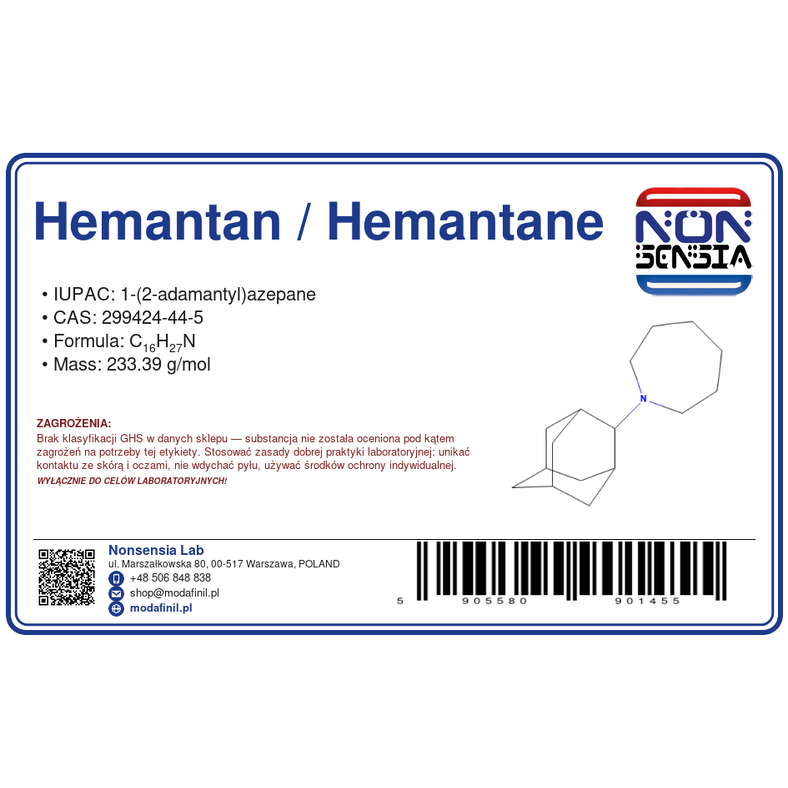
Hemantane is a good example of a molecule that goes by several names at once in the literature, and this alone can be a source of confusion. Databases contain both the spellings “hemantane” and “himantane,” and both refer to the same compound. The difference comes solely from transliteration from Cyrillic. Anyone who searches for only one form misses half of the literature.
This article organizes what has been published about this compound, places it in the context of the adamantane family, and shows where the body of evidence ends. Hemantane, CAS number 299424-44-5, is offered by us as a chemical reagent, and we discuss it in that role.
Where the family comes from
Adamantane is a hydrocarbon whose structure corresponds to the smallest fragment of the diamond lattice, hence its name. The cage is rigid, symmetrical, and strongly hydrophobic, and these three features recur in every derivative: good solubility in organic solvents, poor solubility in water, high thermal stability, and characteristic, clean proton spectra.
The chemistry of this cage turned out to be versatile enough that adamantane derivatives have found their way into very distant fields. Adamantane derivatives of cannabinoids have been described,1 as have adamantane analogues of anticancer compounds.2 The effect of adamantane derivatives on cerebral circulation has been studied separately.3 In the Soviet and Russian literature, this class also has its own extensive branch devoted to the body’s resistance to stress loads.4
For laboratory practice, the conclusion is prosaic: “adamantane derivative” tells you about the scaffold, not about the properties. Two molecules with the same cage can differ in everything other than the cage.
What has been published on hemantane itself
Research on this compound was conducted mainly within a single scientific community and published in Russian. The central theme was the dopaminergic system and the parkinsonian context.
In 2003, the compound’s effect on monoamine oxidase activity was described,5 and a year later its protective effect was assessed in an experimental model.6 Later, the effects of subchronic administration on the dopaminergic and serotonergic systems were studied,7 and in 2011 a comparison of hemantane with amantadine with respect to their effects on the dopamine transporter was published.8 This comparison is the most methodologically interesting in the whole set, because it sets the compound under study against a well-characterized compound in the same experimental system.
A more recent study from 2024 addressed the electrical activity of the brain at early and late stages of an experimental model.9 It is one of the few signs that this line of research has not been entirely abandoned.
All of the studies listed are preclinical studies in animals. None of them concerns the analytical reagent, and none of them carries over to laboratory material.
Why the comparison with amantadine matters
Amantadine is the reference point in this family. It is the best-characterized compound, with an established profile and a long history of use. Comparing against it makes it possible to answer the question that is hardest with new molecules: are we dealing with a variant of something known, or with something that behaves differently?
The 2011 comparative study suggested differences between the two compounds in their effects on the dopamine transporter.8 Similarly, earlier comparisons within the family, of adapromine, midantane, and bromantane in a single system, showed that membership in the adamantane class does not by itself determine anything.10
This conclusion comes up regularly in this family and is worth remembering outside pharmacology as well: the scaffold does not determine behavior. When evaluating material, this means that structural similarity to a known compound is not an argument for similarity of properties, whether chemical or analytical.
The limits of this literature
The body of work on hemantane has features that must be stated together with the conclusions.
- A single research community. Most publications come from the same center. Independent replications outside the Russian-speaking world are practically nonexistent.
- Availability of abstracts, not full texts. International databases usually provide only the abstracts, which makes it impossible to assess the methodology, group sizes, and method of analysis.
- Two transliterations of the name. “Hemantane” and “himantane” split the literature into two sets. Searching for only one form gives a picture sparser than the actual one.
- No studies of the substance itself as a material. There is no work on stability, impurity profile, or storage conditions, and these are the most important questions for a reagent.
The last point applies, in fact, to most compounds in this group. The pharmacological literature and the materials literature are two different sets, and for someone keeping a substance in a container, the second one is the useful one. It is usually much sparser.
What follows from the chemistry
Since the materials literature is sparse, it is worth turning to what follows from the scaffold itself. The adamantane cage is hydrophobic, so preparing aqueous solutions can be troublesome and usually requires an organic solvent. It is also rigid and symmetrical, which yields proton spectra with a small number of well-resolved signals. This is an advantage when confirming identity, because the spectrum is easy to compare and hard to mistake.
The cage itself is also chemically unreactive. This means that the stability of a derivative is usually determined not by the adamantane but by the substituents and bonds attached to it: an amino group, a bond to an aromatic ring, a halogen atom. When assessing storage conditions, one therefore looks at the substituent, not at the scaffold.
The practical consequence for evaluating material: for compounds with little literature, confirming identity carries more weight than the declared purity, because there is no broad comparative dataset against which the result could be checked. We explain why these are two separate questions in our article on what the number on the certificate really means, and how to read the document in our article on the certificate of analysis.
A close relative of hemantane is bromantane, which has a more extensive literature and a better-documented history. We discuss it separately in our article on where the concept of the actoprotector came from. Comparing the two cases shows clearly how unevenly researchers’ attention can be distributed within a single chemical family.
Sources
Each item below was retrieved from the PubMed database through the E-utilities interface and is not reproduced from memory. The PMID numbers link to the source records.
- Dixon DD, Sethumadhavan D, Benneche T et al. Heteroadamantyl cannabinoids. J Med Chem. 2010;53:5656-66. PMID: 20593789. DOI: 10.1021/jm100390h.
- Ciszewski WM, Kowalczyk K, Błauż A et al. Ruthenocenyl and 1-Adamantyl Paclitaxel Analogs Disrupt the Balance between βIII- and βIVa-Tubulin and Inhibit the Growth and Invasiveness of Colon Cancer. J Med Chem. 2025;68:19062-19075. PMID: 40907950. DOI: 10.1021/acs.jmedchem.5c01147.
- Mirzoyan RS, Gan'shina TS, Maslennikov DV et al. Cerebrovascular and neuroprotective effects of adamantane derivative. Biomed Res Int. 2014;2014:586501. PMID: 24772429. DOI: 10.1155/2014/586501.
- Morozov IS, Klimova NV, Sergeeva SA et al. [Adamantane derivatives enhancing body's resistance to emergencies]. Vestn Ross Akad Med Nauk. 1999:28-32. PMID: 10222828.
- Val'dman EA, Voronina TA, Aksenova LN et al. [Effect of a new antiparkinsonian drug himantane on monoamine oxidase activity]. Eksp Klin Farmakol. 2003;66:3-5. PMID: 14650204.
- Val'dman EA, Nerobkova LN, Voronina TA. [Estimation of the protective effect of the novel potential antiparkinsonian agent himantane against MPTP neurotoxicity]. Eksp Klin Farmakol. 2004;67:7-10. PMID: 15079899.
- Zimin IA, Kapitsa IG, Voronina TA et al. [Effects of subchronic hemantane administration on dopamine and serotonin receptors in intact and MPP+-treated rat brain ex vivo]. Eksp Klin Farmakol. 2010;73:2-5. PMID: 21254589.
- Zimin IA, Logvinov IO, Antipova TA et al. [A comparative study of hemantane and amantadine effects on dopamine transporter expression in brain of normal and MPTP-treated C57BL/6 mice]. Eksp Klin Farmakol. 2011;74:11-4. PMID: 21476268.
- Voronina NA, Kapitsa IG, Kucheryanu VG et al. [Electric activity of the brain at early and late clinical stages of experimental modeling of Parkinson's disease, an impact of hemantane]. Zh Nevrol Psikhiatr Im S S Korsakova. 2024;124:129-134. PMID: 39435789. DOI: 10.17116/jnevro2024124091129.
- Krapivin SV, Sergeeva SA, Morozov IS. [Comparative analysis of effects of adapromine, midantan, and bromantane on the bioelectric activity of the rat brain]. Biull Eksp Biol Med. 1998;125:175-9. PMID: 9559131.

