
Description
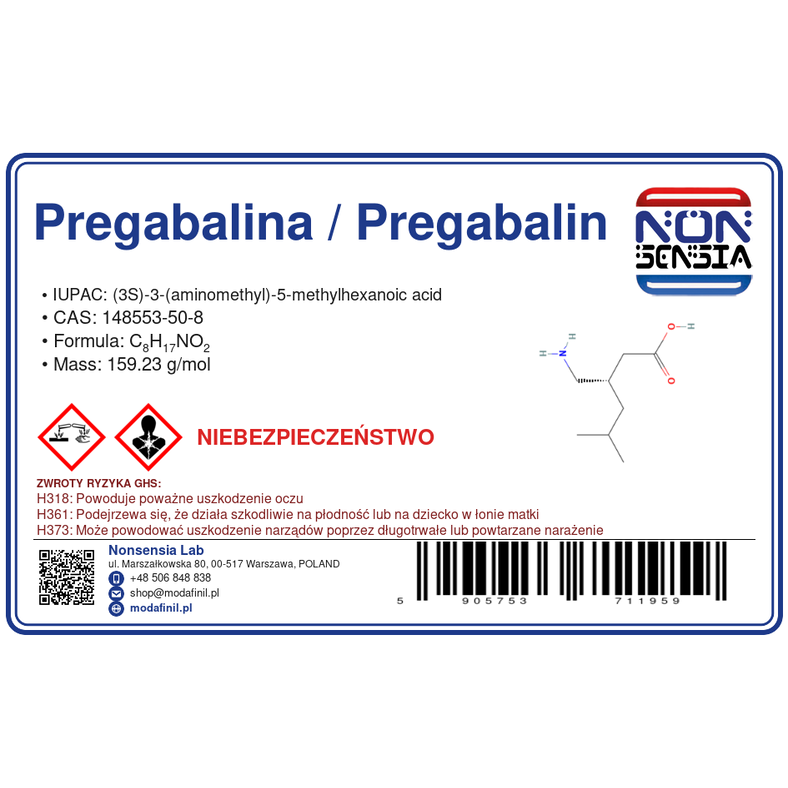
(3S)-3-(aminomethyl)-5-methylhexanoic acid, crystalline powder, 1000 mg package. Material intended exclusively for laboratory and analytical research use in vitro. The product is not intended for consumption by humans or animals, is not a medicinal product, a dietary supplement, a food product, or a cosmetic.
Three different entities that must not be confused
Pregabalin is one of the most extensively studied molecules among GABA analogues, which is why separating the layers matters here in particular. The same chemical name simultaneously functions as the active ingredient of a prescription-only medicinal product marketed under more than a dozen trade names. Three contexts, three entirely different legal statuses:
| Entity | What it is | What it concerns |
|---|---|---|
| Chemical substance pregabalin, CAS 148553-50-8 |
A chemical concept — a molecule of defined structure, an analogue of gamma-aminobutyric acid (GABA). In itself it is neither a drug nor a reagent; its status is conferred by the form in which it was manufactured and approved. | chemistry, substance registries |
| Medicinal product including Lyrica and generic equivalents (Pregabalin Sandoz, Pregabalin Zentiva, Vronogabic) |
A pharmaceutical preparation: a defined pharmaceutical form, manufacturing under GMP, registration documentation, safety oversight. In Poland dispensed only on a doctor’s prescription. | this entity is the subject of clinical trials involving humans |
| Chemical reagent the material offered here |
Material for laboratory and analytical work. It does not have and cannot have approval for use in humans or animals — it has no pharmaceutical form or medicinal product documentation. | analytics, chemistry, reference standards |
The consequence is unambiguous. The study results cited further on this page were obtained either using the registered medicinal product (clinical trials involving humans), or using the substance administered to laboratory animals or animal tissue under controlled experimental conditions (preclinical studies). None of these studies was conducted using the analytical reagent, and none of these results carries over to the material offered here. The reagent is not the form in which the substance has ever been studied in humans, and it cannot be used in that way.
Reagent identification card
| Systematic name (IUPAC) | (3S)-3-(aminomethyl)-5-methylhexanoic acid |
|---|---|
| Common name | pregabalin (pregabalina, pregabaline) |
| Development code | CI-1008 |
| CAS Number | 148553-50-8 |
| Molecular formula | C8H17NO2 |
| Molar mass | 159.23 g·mol−1 |
| Monoisotopic mass | 159.1259 Da |
| InChIKey | AYXYPKUFHZROOJ-ZETCQYMHSA-N |
| SMILES | CC(C)C[C@@H](CC(=O)O)CN |
| PubChem CID | 5486971 |
| ChEMBL ID | CHEMBL3978768 |
| Melting point | 187°C |
| Form | crystalline powder, white to off-white |
| Purity | ≥ 99% |
| Intended use | research reagent — not for consumption by humans or animals |
Molecular lineage: from gabapentin to a single enantiomer
Anticonvulsant drug discovery program
Pregabalin was not a chance discovery but the product of a deliberate, multi-year research program. The starting point was gabapentin — a compound registered as a medicinal product in 1993, the first success of the research line of gamma-aminobutyric acid (GABA) analogues. Chemist Richard B. Silverman (Northwestern University), working with Parke-Davis (later Warner-Lambert, part of Pfizer since 2000), built a series of branched GABA analogues and tested them for affinity to the same molecular target as gabapentin, searching for a molecule with stronger binding. Silverman himself described the discovery history in the first person in a retrospective article from 2008 [1].
Among the compounds tested, the best results were obtained for the isomer designated by the internal development code CI-1008 — numbering originating from Parke-Davis’s internal system. It was this very molecule that, after years of further research, went on to registration as a medicinal product — trade names are listed in the table above.
The synthesis challenge: obtaining a single enantiomer
The molecule has one stereogenic center — the carbon atom at position 3 — and only the (S) form was selected for further development. The industrial challenge became developing an efficient, selective synthesis of this single enantiomer at production scale, without costly after-the-fact separation of a racemic mixture. The solution turned out to be asymmetric hydrogenation catalyzed by rhodium complexes with chiral bisphosphine ligands. Hoge and coworkers described this synthetic route in two papers from 2003–2004: the first names CI-1008 (pregabalin) directly in the title as the reaction product [2], the second describes the design of the catalyst ligand itself [3].
Timeline
| 1993 | registration of gabapentin — the parent compound of the GABA analogue research line — as a medicinal product |
|---|---|
| 1990s | R. Silverman’s program seeking more strongly binding, branched GABA analogues; the compound coded CI-1008 is created [1] |
| 2003–2004 | development of an industrial asymmetric synthesis of the single (S) enantiomer [2][3] |
| 2004 | registration as a medicinal product in the European Union and the United States (trade names — table above) |
| 2006–2011 | studies of binding to the α2δ subunit of calcium channels on animal tissue ex vivo [6][7][8] |
| 2016 | publication of a method for direct enantiomer separation on a chiral column with MS and UV detection [12] |
| 2015–2017 | LC-MS/MS methods in environmental monitoring [15] and post-mortem toxicology [16] |
| 1 April 2019 | the United Kingdom classifies pregabalin as a Class C controlled substance — a regulatory fact concerning another country and another legal entity, not applicable to the offered reagent |
| 2019 | chiral GC-MS method for enantiomer identification in forensic toxicology [13] |
| 2023 | crystal engineering and co-crystals of pregabalin [14] |
Three research strands that shaped knowledge of the molecule
The literature on pregabalin is dispersed thematically more than geographically. For clarity it is worth separating it into three strands, each corresponding to a different research question.
The synthetic strand: producing a pure enantiomer at industrial scale
Process chemists (Hoge and coworkers) focused on asymmetric catalysis — a purely synthetic question, independent of any biological application [2][3].
The receptor pharmacology strand: a molecular target on animal tissue
The second strand covers studies of binding to the α2δ subunit of calcium channels — carried out on rodent brain tissue ex vivo and in synaptic models, not in humans. A review of the mechanism was published by Taylor and coworkers [5]; an autoradiographic study in genetically modified mice showed that the α2δ type 1 subunit is the main pregabalin-binding protein in the cortex, hippocampus, amygdala and spinal cord [6]; a synaptic model in mice showed a reduction in neurotransmission after binding to the presynaptic α2δ subunit [7]; and a selectivity analysis showed binding to both the α2δ-1 and α2δ-2 subunits [8]. A general review of the molecule’s development was published by Kavoussi [4]. All of these studies were conducted on animal tissue or in model systems, not in humans, and none of them describes any application of the analytical reagent.
The analytical-forensic strand: detection in various matrices
The third strand is the work of forensic and environmental toxicology laboratories, developing methods for detecting pregabalin in successive matrices: human plasma [9], municipal wastewater [15], post-mortem blood [16], and samples secured in drug-facilitated sexual assault cases [17].
Chemistry: a GABA analogue without an aromatic ring
Why the absence of a chromophore complicates detection
The structure of pregabalin — a branched aliphatic chain terminated by a carboxyl group and a primary amino group — contains no aromatic ring or other strong chromophore. This clearly distinguishes it from the other reagents in our catalog, such as modafinil or bromantane, whose phenyl rings give strong UV absorption. Standard UV detection is therefore made more difficult, which explains why some analytical methods rely on fluorescence detection after derivatization, validated for human plasma [9]. For the same reason, GC-MS methods require prior derivatization of polar groups.
The absence of a chromophore also carries a practical pitfall during HPLC sample preparation: Lin and coworkers described an artifactual degradation product formed by the addition of acetonitrile to pregabalin, catalyzed by alkaline impurities during sample preparation [10]. A validated “green” HPLC-DAD and HPTLC method was described by Naguib and coworkers [11].
Stereogenic center at carbon C3
Unlike bromantane (a symmetric adamantane cage, no stereogenic center) and modafinil (a stereogenic center on the sulfur atom), pregabalin has one stereogenic center on a carbon atom, at position 3 of the chain. Only the (S) form was selected for development — exactly the one encoded by this molecule’s canonical SMILES string. Separating the enantiomers requires chiral methods: direct separation on a chiral column with MS and UV detection was described by Chennuru and coworkers [12], and a method based on derivatization with the chiral reagent S-TPC for GC-MS was described by Hitchcock and Marginean [13].
Physicochemical characterization
| Parameter | Value | What this means |
|---|---|---|
| Partition coefficient (logP) | −1.6 | very low lipophilicity — high water solubility, poor retention in standard RP-HPLC |
| Topological polar surface area | 63.3 Å2 | a moderately polar molecule despite its small mass |
| Hydrogen bond donors | 2 | the amino group and the acid hydroxyl group — favors co-crystal formation |
| Hydrogen bond acceptors | 3 | carbonyl oxygen, hydroxyl oxygen, and amino nitrogen |
| Rotatable bonds | 5 | a flexible aliphatic chain — no rigid ring core |
| Melting point | 187°C | high for such a small molecule — indicates an ionized (zwitterionic) form in the crystal, typical of free amino acids |
| Solubility | very good in water and aqueous buffers; poor in nonpolar solvents | the inverse of the modafinil and bromantane profile — prepare stock solutions in water or buffer, not in DMSO |
The simultaneous presence of a carboxyl group and a primary amino group means that in the solid state pregabalin, like most free amino acids, adopts the form of a zwitterion. This accounts for both its relatively high melting point and its ability to form co-crystals with dicarboxylic acids — using maleic acid as a coformer, this was described by Komisarek and coworkers, comparing mechanochemistry with crystallization from solution [14].
Nomenclature and synonyms
Behind the same molecule bearing CAS number 148553-50-8 lie several names and codes used in the literature and chemical databases — apart from the trade names of medicinal products, which we discuss solely in the “Three different entities” table above:
- Pregabalin / Pregabalina / Pregabaline — the common name in English, Polish and French spelling;
- 3-isobutyl GABA, more precisely (S)-3-isobutyl GABA — a descriptive name indicating its relation to gamma-aminobutyric acid; the (R)-3-isobutyl GABA form denotes the opposite enantiomer, not used for production;
- CI-1008 — the development code from the period of laboratory work at Parke-Davis;
- PD-144723 — an alternative development code found in earlier pharmacological literature;
- (3S)-3-(aminomethyl)-5-methylhexanoic acid — the systematic IUPAC name, the only unambiguous one.
When conducting a bibliographic search, it is worth combining all variants — some older papers are indexed solely under the development code, not under the common name.
Laboratory applications of the reagent
- reference material for confirming identity and purity by HPLC-DAD and HPLC with fluorescence detection after derivatization [9][11];
- material for chiral methods separating the (S) and (R) enantiomers [13];
- model compound in crystal engineering and co-crystal studies [14];
- comparison material in ex vivo receptor binding studies on animal tissue [6];
- model compound in the chemistry of GABA analogues and branched-chain aliphatic amino acids.
Storage, handling and work safety
Store in the original, tightly closed packaging, protected from light and moisture, separately from food and feed and out of the reach of children. According to the manufacturer’s data, the material retains its declared shelf life (≥ 24 months) under refrigerated conditions at 2–8°C. Work only under laboratory conditions, using personal protective equipment: gloves, safety goggles and laboratory clothing; weigh the powder under conditions that limit dust generation. Avoid inhaling dust and contact with skin and eyes. Waste handling — in accordance with the regulations applicable to chemical waste at the site where the research is conducted.
GHS hazard classification (PubChem data, CID 5486971): pictograms GHS05 and GHS08, hazard statement H361 (suspected of damaging fertility or the unborn child), recommended precautionary statement P203, signal word Danger. Full safety data should be verified in the current Safety Data Sheet (SDS) before starting work.
Regulatory status
The substance is the active ingredient of medicinal products dispensed in Poland on a doctor’s prescription, available under the trade names listed in the table above. Trade in medicinal preparations is subject to separate pharmaceutical law provisions and this offer does not concern it. In the United Kingdom, since 1 April 2019, pregabalin — together with gabapentin — has been classified as a Class C controlled substance under the Misuse of Drugs Act; this is a regulatory fact concerning another country and another legal entity, unrelated to the offered chemical reagent. The material offered is a chemical reagent and has no approval for any use in humans or animals. The buyer is responsible for ensuring that the intended use complies with the law in force in the country of destination.
Frequently Asked Questions
How does pregabalin differ from gabapentin?
Both molecules belong to the same research line of gamma-aminobutyric acid (GABA) analogues and bind to the same molecular target — the α2δ subunit of calcium channels. Pregabalin was developed as a branched analogue created after gabapentin, in a program seeking more strongly binding molecules [1]. They differ in their carbon skeleton structure and CAS number.
Is pregabalin the same as the registered prescription drug?
Not in the legal sense. The trade names of medicinal products containing pregabalin as the active ingredient are listed in the “Three different entities” table above; pregabalin is the name of the chemical substance. The material offered here is not a medicinal product or a substitute for one.
What is the chemical formula and molar mass of pregabalin?
C8H17NO2; molar mass 159.23 g·mol−1, monoisotopic mass 159.1259 Da. CAS Number 148553-50-8, InChIKey AYXYPKUFHZROOJ-ZETCQYMHSA-N.
Is the reagent suitable for uses other than laboratory purposes?
No. The material is intended exclusively for laboratory and analytical research. It is not intended for consumption by humans or animals, is not a medicine, a dietary supplement, a food, or a cosmetic, and must not be used for medical, diagnostic or consumption purposes.
How should pregabalin be stored as a laboratory reagent?
In the original, tightly closed packaging, protected from light and moisture, under refrigerated conditions at 2–8°C according to the manufacturer’s data, separately from food and feed and out of the reach of children.
What solvent should be used to prepare a stock solution of pregabalin?
It dissolves very well in water and aqueous buffers, poorly in nonpolar solvents — with logP ≈ −1.6, this is the inverse of the solubility profile of modafinil or bromantane. Stock solutions are prepared in water or an aqueous buffer.
How is the purity and identity of pregabalin confirmed in the laboratory?
By the HPLC-DAD method against a reference material; due to the absence of an aromatic chromophore, fluorescence detection after derivatization is also used [9]. Distinguishing the (S) and (R) enantiomers requires a separate chiral method — chemical purity alone does not determine optical purity.
Is a safety data sheet provided with pregabalin?
We provide the Safety Data Sheet (SDS) on request to recipients engaged in research or analytical activity. According to PubChem data, the substance is subject to GHS classification with hazard statement H361 — details in the storage and work safety section above.
Is pregabalin legal in Poland?
Pregabalin is the active ingredient of medicinal products dispensed in Poland on a doctor’s prescription; trade in medicines is subject to separate regulations and this offer does not concern it. The material offered is a chemical reagent with no approval for use in humans. The buyer is responsible for ensuring that the intended use complies with the law of the country of destination.
Why can detecting pregabalin by mass spectrometry be more difficult than for aromatic compounds?
The molecule has no aromatic ring, no strong chromophore, and no characteristic isotope pattern such as the bromine in bromantane, and its small, fully aliphatic structure gives less specific ionization fragments. In practice this requires derivatization before GC-MS analysis or highly sensitive LC-MS/MS methods [16].
References
The entries come from the PubMed database and concern the discovery history, chemistry, preclinical pharmacology and analytics of this molecule. Entries [1]–[3] and [14] are synthetic and crystal chemistry papers; [4]–[8] are review and preclinical papers on animal tissue; [9]–[13] and [15]–[17] are methodological and analytical papers; [18] concerns a different molecule and is cited solely as context for the cross-link below. None of them describes any application of the analytical reagent or any present-tense effect in humans — they are cited as scientific context and a bibliographic pointer, not as information about the properties of the material offered or as encouragement for any use. The list is complete as of 2026-09-08, limited to entries not appearing in the bibliography of the nonsensia.pl website.
- Silverman RB (2008). “From basic science to blockbuster drug: the discovery of Lyrica.” (literal title of the scientific publication — does not refer to the offered reagent) Angew Chem Int Ed Engl. PMID 18307181. doi:10.1002/anie.200704280.
- Hoge G et al. (2003). “Synthesis of both enantiomers of a P-chirogenic 1,2-bisphospholanoethane ligand via convergent routes and application to rhodium-catalyzed asymmetric hydrogenation of CI-1008 (pregabalin).” J Am Chem Soc. PMID 12926944.
- Hoge G, Wu HP, Kissel WS et al. (2004). “Highly selective asymmetric hydrogenation using a three hindered quadrant bisphosphine rhodium catalyst.” J Am Chem Soc. PMID 15137752.
- Kavoussi R (2006). “Pregabalin: From molecule to medicine.” Eur Neuropsychopharmacol. PMID 16765030.
- Taylor CP, Angelotti T, Fauman E (2007). “Pharmacology and mechanism of action of pregabalin: the calcium channel alpha2-delta (alpha2-delta) subunit as a target for antiepileptic drug discovery.” Epilepsy Res. PMID 17126531.
- Bian F, Li Z, Offord J et al. (2006). “Calcium channel alpha2-delta type 1 subunit is the major binding protein for pregabalin in neocortex, hippocampus, amygdala, and spinal cord: an ex vivo autoradiographic study in alpha2-delta type 1 genetically modified mice.” Brain Res. PMID 16460711.
- Joshi I, Taylor CP (2006). “Pregabalin action at a model synapse: binding to presynaptic calcium channel alpha2-delta subunit reduces neurotransmission in mice.” Eur J Pharmacol. PMID 17064682.
- Li Z, Taylor CP, Weber M et al. (2011). “Pregabalin is a potent and selective ligand for α(2)δ-1 and α(2)δ-2 calcium channel subunits.” Eur J Pharmacol. PMID 21651903. doi:10.1016/j.ejphar.2011.05.054.
- Yoshikawa N, Naito T, Yagi T et al. (2016). “A Validated Fluorometric Method for the Rapid Determination of Pregabalin in Human Plasma Applied to Patients With Pain.” Ther Drug Monit. PMID 27465975. doi:10.1097/FTD.0000000000000325.
- Lin J, Liu X, Wang J et al. (2019). “An artifactual solution degradant of pregabalin due to adduct formation with acetonitrile catalyzed by alkaline impurities during HPLC sample preparation.” J Pharm Biomed Anal. PMID 31382116. doi:10.1016/j.jpba.2019.112788.
- Naguib IA, Ali NA, Elroby FA et al. (2021). “Green HPLC-DAD and HPTLC Methods for Quantitative Determination of Binary Mixture of Pregabalin and Amitriptyline Used for Neuropathic Pain Management.” J Chromatogr Sci. PMID 33778855. doi:10.1093/chromsci/bmab031.
- Chennuru LN, Choppari T, Nandula RP et al. (2016). “Direct Separation of Pregabalin Enantiomers Using a Zwitterionic Chiral Selector by High Performance Liquid Chromatography Coupled to Mass Spectrometry and Ultraviolet Detection.” Molecules. PMID 27869770.
- Hitchcock ML, Marginean I (2019). “Enantiomeric Identification of Pregabalin by GC-MS via Methylation and S-TPC Chiral Derivatization.” J Forensic Sci. PMID 30080926. doi:10.1111/1556-4029.13888.
- Komisarek D, Taskiran E, Vasylyeva V (2023). “Maleic Acid as a Co-Former for Pharmaceutically Active GABA Derivatives: Mechanochemistry or Solvent Crystallization?” Materials (Basel). PMID 36984121. doi:10.3390/ma16062242.
- Gurke R, Rossmann J, Schubert S et al. (2015). “Development of a SPE-HPLC-MS/MS method for the determination of most prescribed pharmaceuticals and related metabolites in urban sewage samples.” J Chromatogr B. PMID 25841203. doi:10.1016/j.jchromb.2015.03.008.
- Nahar L, Smith A, Patel R et al. (2017). “Validated Method for the Screening and Quantification of Baclofen, Gabapentin and Pregabalin in Human Post-Mortem Whole Blood Using Protein Precipitation and Liquid Chromatography-Tandem Mass Spectrometry.” J Anal Toxicol. PMID 28335036. doi:10.1093/jat/bkx019.
- Justo-Vega A, Jinadasa KK, Jayasinghe GDTM et al. (2023). “Ultrasound assisted membrane-assisted solvent extraction for the simultaneous assessment of some drugs involved in drug-facilitated sexual assaults by liquid chromatography-tandem mass spectrometry.” J Chromatogr A. PMID 37572537. doi:10.1016/j.chroma.2023.464284.
- Marques GVL, Braga AV, Silva IR et al. (2024). “Synthesis and Antiallodynic Activity of Cannabidiol Analogue on Peripheral Neuropathy in Mice.” Chem Biodivers. PMID 38363210. doi:10.1002/cbdv.202301935.
Identification data and computational descriptors from PubChem (CID 5486971) and the ChEMBL registry (CHEMBL3978768).
Related reagents in our catalog
- Taurine — another amino acid related to the GABAergic system, but acting directly on GABA-A and glycine receptors rather than on the auxiliary calcium channel subunit like pregabalin
- Cannabidiol — a compound from a distinct chemical family, a derivative of which was studied in the same rodent neuropathic pain model as pregabalin [18], allowing comparison of two different pharmacological approaches to the same study endpoint
- Magnesium L-threonate — an ionic contrast: there, NMDA channel blockade by the Mg²⁺ ion; here, modulation of the auxiliary calcium channel subunit by a small organic molecule
Statement of intended use
The material offered is a chemical reagent intended exclusively for research, analytical and laboratory purposes. It is not intended for consumption by humans or animals. It is not a medicinal product, a dietary supplement, a food product, a medical device, or a cosmetic. It must not be used for medical, diagnostic, therapeutic, prophylactic or consumption purposes, administered to humans or animals, applied to skin, or added to food, beverages or feed. Sold exclusively to recipients conducting research, scientific or analytical activity, with laboratory facilities and the knowledge needed to handle chemical reagents safely. The buyer bears sole responsibility for the lawful and safe use of the reagent and for complying with the regulations in force in the country of destination.