Description
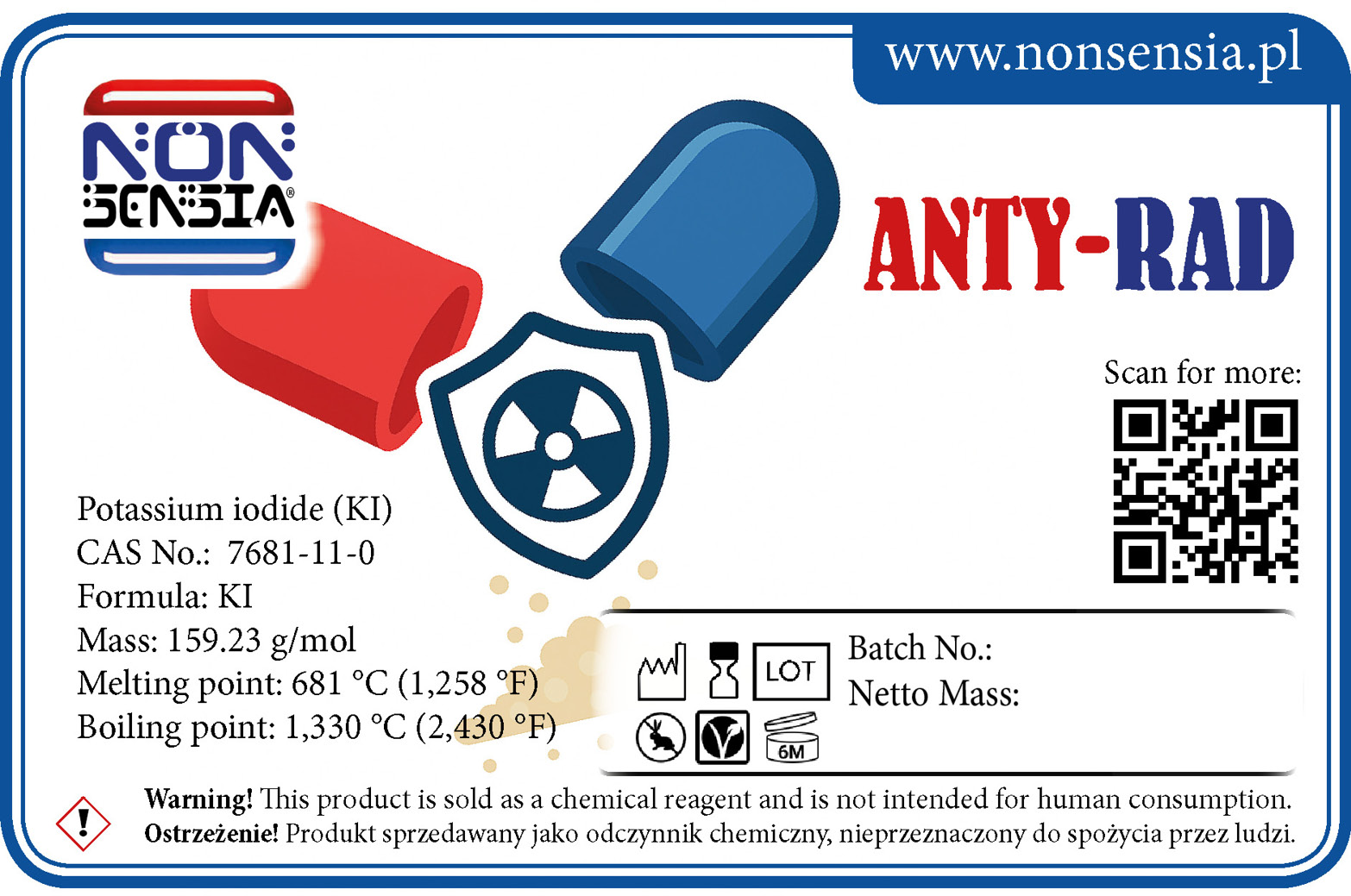
ANTI-RADIUM Potassium Iodide
CAS number: 7681-11-0
Molecular formula: KI
Molar mass: 166.00 g/mol
Purity: ≥99.0% (ACS)
Appearance: White, colorless, hygroscopic crystals or granular powder.
1. Chemical Characteristics and Physicochemical Properties
Potassium iodide is the inorganic potassium salt of hydroiodic acid. It is one of the main sources of iodine in an easily absorbable form. As a reagent, it has the following properties:
-
Solubility: Highly soluble in water (1 g/0.7 ml of water at 25°C), glycerol. Slightly soluble in ethanol.
-
Density: 3.13 g/cm³
-
Melting point: 681 °C
-
Boiling point: 1330 °C
-
pH (aqueous solution): approx. 7-9 (neutral or slightly alkaline solution)
-
Hygroscopicity: The compound exhibits strong hygroscopic properties – it absorbs moisture from the air, which can lead to clumping and loss of ease of dispensing. Requires airtight storage.
2. Laboratory Uses (Research Use Only – RUO)
Potassium iodide is widely used as a universal reagent in many fields of science and industry:
-
Analytical chemistry:
-
Detection and titration of oxidizing agents: Iodide ions (I⁻) are strong reducing agents. They are used to detect many oxidizing agents, such as ozone, hydrogen peroxide, and dichromates, in reactions where iodides are oxidized to free iodine (I₂), which is then titrated with sodium thiosulfate (iodometric method).
-
Determination of cadmium, zinc and lead: Forms soluble complexes with heavy metal ions, e.g. K₂[CdI₄], which is used in chemical analysis.
-
Reagent in precipitation reactions: It is used to identify lead ions (Pb²⁺), with which it forms a yellow precipitate of lead iodide (PbI₂), which is soluble in hot water and reprecipitates after cooling in the form of golden scales.
-
-
Molecular biology and biochemistry:
-
Component of Lugol’s solution: When combined with iodine (I₂), it forms Lugol’s solution, used as a dye for detecting starch (dark blue color) and as a reagent for staining biological preparations.
-
Reducing detergent toxicity: Added to cell lysing solutions to reduce the toxicity of detergents used (e.g. SDS) to proteins.
-
-
Organic synthesis: Used as a source of iodide ions in iodination and substitution reactions and as a catalyst in some reactions.
-
Industry: Used in the production of light-sensitive photographic emulsions.
3. Precautions (MSDS) and Storage
-
Hazard classification (GHS):
-
H302: Harmful if swallowed.
-
H315: Causes skin irritation.
-
H319: Causes serious eye irritation.
-
H335: May cause respiratory irritation.
-
-
Precautions (P):
-
P261: Avoid breathing dust/fume/gas/mist/vapours/spray.
-
P305+P351+P338: If in eyes: Rinse cautiously with water for several minutes. Remove contact lenses, if present and easy to do. Continue rinsing.
-
-
Handling: Avoid contact with skin and eyes. Work in a ventilated area and avoid inhaling dust. Wear appropriate personal protective equipment (PPE): nitrile gloves, a lab coat, and eye protection.
-
Storage: Store in a tightly closed container made of corrosion-resistant material (glass, plastic). Protect from moisture and light. Store in a cool, dry, and well-ventilated place.
1. How to Prepare Potassium Iodide Solution?
Potassium iodide in solid form requires appropriate preparation for laboratory and medical applications.
-
For laboratory use: Dissolve the precise amount of potassium iodide in distilled water to obtain the desired concentration (e.g., 0.1–10% solution). Stir until the crystals are completely dissolved.
-
For medical use: Potassium iodide tablets (e.g., GL Pharma Potassium Iodide ) should be taken orally with water. If tablets are unavailable, in emergency situations involving radioactive contamination, a solution of pure potassium iodide (65 mg per dose for children, 130 mg for adults) can be prepared, but only under medical supervision.
Note: Do not prepare potassium iodide solutions on your own without consulting a doctor!
2. How to use Lugol’s iodine?
Lugol’s solution is a solution of iodine in potassium iodide, used primarily as a disinfectant and in medical diagnostics.
-
For skin disinfection: Apply the liquid to a sterile cotton pad and wipe the skin before a medical procedure.
-
In the diagnosis of thyroid iodine deficiency: Lugol’s solution is administered orally in strictly defined doses (as prescribed by a doctor).
-
In laboratory starch tests: Add 1–2 drops of Lugol’s iodine to the test sample. The presence of starch is indicated by a characteristic navy blue color .
Contraindications: Hypersensitivity to iodine, thyroid disease.
3. How to proceed in case of radioactive contamination?
In situations where there is a risk of radioactive contamination, potassium iodide is administered only on the orders of the authorities or medical services.
-
Steps to follow:
-
Take shelter in a closed room immediately.
-
Listen to radio or television announcements.
-
Only take potassium iodide if officially recommended .
-
Dosage: Adults 130 mg, children 65 mg, infants 32 mg.
Note: Do not take potassium iodide “in bulk” – it may harm your thyroid!
-
4. How to Protect Your Thyroid Gland from Radiation?
Thyroid protection involves the rapid administration of potassium iodide, which blocks the entry of radioactive iodine-131 into the gland.
-
Mechanism: Potassium iodide “saturates” the thyroid gland with stable iodine, preventing the absorption of radioactive isotopes.
-
Effectiveness: Protection only works if potassium iodide is administered within 24 hours before or a maximum of 4 hours after exposure .
-
Preparations: Use only official medications (e.g. Potassium Iodide GL Pharma , Jodid 100 ). Avoid dietary supplements!
5. How to Prevent Iodine Deficiency?
Iodine deficiency can lead to thyroid disease, so prevention is important.
-
Naturalne źródła jodu: Ryby morskie, owoce morza, sól jodowana, jaja, mleko.
-
Suplementacja: W regionach z niedoborem jodu zaleca się stosowanie tabletek (np. Jodid 100, Jodid 200) w dawkach 150–200 µg/dobę dla dorosłych.
-
Dla kobiet w ciąży: Zapotrzebowanie wzrasta do 250 µg/dobę – konieczna konsultacja z lekarzem.
Uwaga: Przed rozpoczęciem suplementacji wykonaj badanie poziomu jodu w organizmie!
6. Jak Stosować Jodid 100?
Jodid 100 to tabletki zawierające 100 µg jodu, stosowane w leczeniu niedoborów.
-
Dawkowanie:
-
Dorośli: 1–2 tabletki na dobę.
-
Dzieci: Dawkę ustala lekarz.
-
-
Sposób użycia: Połknij tabletkę i popij wodą, najlepiej podczas posiłku.
-
Czas trwania terapii: Terapia może trwać kilka miesięcy – regularnie konsultuj się z lekarzem.
Przeciwwskazania: Nadczynność tarczycy, alergia na jod.
7. Jak Dawkować Jodek Potasu?
Dawkowanie jodku potasu zależy od wieku i wskazania:
-
Profilaktyka skażeń promieniotwórczych:
-
Dorośli: 130 mg.
-
Dzieci 3–12 lat: 65 mg.
-
Niemowlęta: 32 mg.
-
Noworodki: 16 mg.
-
-
Leczenie niedoborów jodu: 100–200 µg na dobę.
Uwaga: Zawsze stosuj się do zaleceń lekarza – nadmiar jodu jest szkodliwy!
8. Jak Wybrać Preparat z Jodkiem Potasu?
Preparaty z jodkiem potasu dostępne są w formie tabletek, kropli i płynów.
-
Do ochrony przed promieniowaniem: Wybierz tabletki o wysokiej dawce (65 mg lub 130 mg), np. Jodek Potasu G.L. Pharma.
-
Do suplementacji jodu: Wybierz niskodawkowe tabletki (100–200 µg), np. Jodid 100, Jodid 200.
-
Do użytku zewnętrznego: Stosuj Płyn Lugola lub jodynę do odkażania.
Konsultacja lekarska jest obowiązkowa przed użyciem!
4. Status Prawny i Informacja Handlowa
Jodek potasu jest powszechnie dostępnym związkiem chemicznym. W Polsce oraz Unii Europejskiej nie podlega kontroli na mocy ustawy o przeciwdziałaniu narkomanii. Jego obrót i posiadanie są legalne. Niniejszy produkt sprzedawany jest wyłącznie jako odczynnik chemiczny do celów badawczych i laboratoryjnych.
Zastrzeżenie:
Produkt jest przeznaczony wyłącznie do użytku przez wykwalifikowany personel laboratoryjny. Nie jest środkiem spożywczym, suplementem diety, ani produktem leczniczym. Nie jest przeznaczony do diagnostyki, leczenia, łagodzenia ani zapobiegania jakimkolwiek chorobom u ludzi lub zwierząt. Przed użyciem należy zapoznać się z Kartą Charakterystyki (SDS) produktu.
UWAGA!
ANTY-RAD jest sprzedawany wyłącznie jako odczynnik chemiczny nie do spożycia przez ludzi.
If you need a preparation containing iodine and not a chemical reagent, reach out to a competent
source of information.
Ps.
A competent source of information is not: Television, TikTok or YouTube.


Reviews
There are no reviews yet.