14,99 

This high-purity 1000mg standard is vital for analytical and research applications.

📄 Pobierz Karte Charakterystyki (PDF) v1 · 28.04.2026 · REACH 2020/878
Ładowanie molekuły...
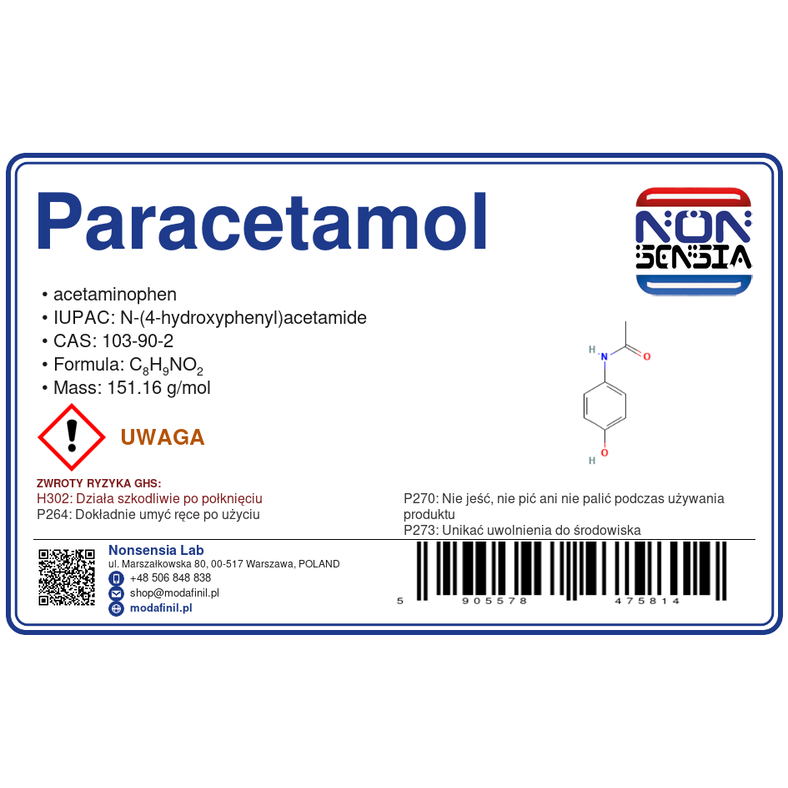
Model 3D acetaminophen, CAS 103-90-2, wzór sumaryczny C8H9NO2, masa molowa 151.16 g/mol
Brak ograniczen regulacyjnych (SVHC/REACH/CLP) dla tego numeru CAS.
🧮 Kalkulator stechiometryczny
🧪 Dane chemiczne
Numer CAS
103-90-2
Wzór sumaryczny
C8H9NO2
Masa molowa
151.16 g/mol
Nazwa IUPAC (EN)
N-(4-hydroxyphenyl)acetamide
SMILES
CC(=O)NC1=CC=C(C=C1)O
InChIKey
RZVAJINKPMORJF-UHFFFAOYSA-N
📚 Literatura naukowa (15 artykułów)
Majid M. Heravi, Vahideh Zadsirjan · (2020) · RSC Advances
🔓
Anthony R. Carroll, Brent R. Copp, Rohan A. Davis et al. · (2019) · Natural Product Reports
Barbara Kasprzyk‐Hordern · (2010) · Chemical Society Reviews
Shivraj Hariram Nile, Muthu Thiruvengadam, Yao Wang et al. · (2022) · Journal of Nanobiotechnology
Yong Ling, Zhi‐You Hao, Dong Liang et al. · (2021) · Drug Design Development and Therapy
Filtruj:
Sortuj:
📈 Oś czasu publikacji
1993
2005
2009
2010
2011
2012
2014
2016
2017
2019
2020
2021
2022
📡 Źródła danych

Dane prezentowane w tym widgecie pochodzą z następujących zweryfikowanych źródeł naukowych:

  • PubChem — National Center for Biotechnology Information (NCBI/NIH), USA
  • ChEMBL — European Bioinformatics Institute (EMBL-EBI), UK
  • NIST WebBook — National Institute of Standards and Technology, USA

Dane są buforowane lokalnie dla szybkości — widget działa także offline.

🔍 Identyfikatory zewnętrzne
15 z 16 systemów ID94%
BazaIdentyfikatorAkcje
CAS Registry Number103-90-2Otwórz →
PubChem CID1983Otwórz →
InChIKeyRZVAJINKPMORJF-UHFFFAOYSA-NOtwórz →
InChIInChI=1S/C8H9NO2/c1-6(10)9-7-2-4-8(11)5-3-7/h2-5…
SMILESCC(=O)NC1=CC=C(C=C1)O
EC Number203-157-5Otwórz →
ChEMBLCHEMBL3663397Otwórz →
DrugBankDB00316Otwórz →
KEGG CompoundD00217Otwórz →
HMDBHMDB0001859Otwórz →
ChemSpider1906Otwórz →
MeSH UID (NLM)D000082Otwórz →
UNII (FDA)362O9ITL9DOtwórz →
NSC Number (NCI)3991Otwórz →
WikiData QIDQ57055Otwórz →

Źródła: PubChem (NIH), Wikidata SPARQL, KEGG, ChEMBL (EBI), CompTox CTX (EPA).

Bibliografia (rozszerzona) (56)

Wszystkie pozycje sa wyswietlane - bibliografia jest addytywna i nie jest skracana ani limitowana.

  1. BUILTIN Crossref. 2024. "Crossref REST API Documentation." link [dostep: 2026-04-27] CC0 (metadata)
  2. BUILTIN OpenAlex. 2024. "OpenAlex Documentation: Works, Authors, Venues, Institutions, Concepts." link [dostep: 2026-04-27] CC0 (data)
  3. EXTERNAL Kim, Sunghwan, Jie Chen, Tiejun Cheng, et al. 2023. "PubChem 2023 update." Nucleic Acids Research 51 (D1): D1373-D1380. link
  4. BUILTIN Priem, Jason, Heather Piwowar, and Richard Orr. 2022. "OpenAlex: A Fully-Open Index of Scholarly Works, Authors, Venues, Institutions, and Concepts." arXiv preprint arXiv:2205.01833. link [dostep: 2026-04-27] CC0 (data); arXiv preprint
  5. EXTERNAL Wishart, David S., et al. 2022. "HMDB 5.0: the Human Metabolome Database for 2022." Nucleic Acids Research 50 (D1): D622-D631.
  6. EXTERNAL Kim, Sunghwan, Tiejun Cheng, Jianyong He, Chen Cheng, et al. 2021. "PubChem Protein, Pathway, Reaction, and Disease Specifications." Journal of Cheminformatics 13: 16. link
  7. EXTERNAL Haug, Kenneth, Keeva Cochrane, Venkata Chandrasekhar Nainala, et al. 2020. "MetaboLights: a resource evolving in response to the needs of its scientific community." Nucleic Acids Research 48 (D1): D440-D444.
  8. EXTERNAL Sansone, Susanna-Assunta, et al. 2019. "FAIRsharing as a community approach to standards, repositories and policies." Nature Biotechnology 37 (4): 358-367. link
  9. BUILTIN Mendoza, Manuel, and Christopher Belter. 2018. "Citation Analysis: A Practitioner's Guide." Journal of the Medical Library Association 106 (1): 47-55. link [dostep: 2026-04-27] CC-BY 4.0
  10. EXTERNAL Hähnke, Volker D., Sunghwan Kim, and Evan E. Bolton. 2018. "PubChem chemical structure standardization." Journal of Cheminformatics 10: 36. link
  11. EXTERNAL Wang, Yanli, Stephen H. Bryant, Tiejun Cheng, Jiyao Wang, et al. 2017. "PubChem BioAssay: 2017 update." Nucleic Acids Research 45 (D1): D955-D963. link
  12. EXTERNAL Salek, Reza M., Pablo Conesa, Kenneth Cochrane, et al. 2017. "Automated assembly of species metabolomes through data integration." Database 2017: bax038.
  13. EXTERNAL Sud, Manish, et al. 2017. "Computational tools for the secondary analysis of metabolomics experiments." Computational and Structural Biotechnology Journal 14: 232-245.
  14. BUILTIN Barabasi, Albert-Laszlo. 2016. Network Science. Cambridge: Cambridge University Press. link [dostep: 2026-04-27] Open (online edition)
  15. EXTERNAL Wilkinson, Mark D., et al. 2016. "The FAIR Guiding Principles for scientific data management and stewardship." Scientific Data 3: 160018. link
  16. EXTERNAL Sud, Manish, Eoin Fahy, Dawn Cotter, et al. 2016. "Metabolomics Workbench: An international repository for metabolomics data and metadata, metabolite standards, protocols, tutorials and training, and analysis tools." Nucleic Acids Research 44 (D1): D463-D470.
  17. EXTERNAL Wishart, David S. 2016. "Emerging applications of metabolomics in drug discovery and precision medicine." Nature Reviews Drug Discovery 15 (7): 473-484.
  18. CANONICAL_PAPERS Jóźwiak-Bebenista, M.; Nowak, J.Z.. 2016. "Paracetamol: mechanism of action, applications and safety concern." Acta Poloniae Pharmaceutica. [dostep: 2026-04-28]
  19. BUILTIN Wilsdon, James, et al. 2015. The Metric Tide: Report of the Independent Review of the Role of Metrics in Research Assessment and Management. Bristol: HEFCE. link [dostep: 2026-04-27] Open (HEFCE/UKRI)
  20. BUILTIN Bornmann, Lutz, and Ruediger Mutz. 2014. "Growth Rates of Modern Science: A Bibliometric Analysis Based on the Number of Publications and Cited References." Journal of the Association for Information Science and Technology 66 (11): 2215-2222. link [dostep: 2026-04-27] Subscription (Wiley)
  21. BUILTIN van Eck, Nees Jan, and Ludo Waltman. 2014. "Visualizing Bibliometric Networks." In Measuring Scholarly Impact: Methods and Practice, edited by Y. Ding, R. Rousseau, and D. Wolfram, 285-320. Cham: Springer. link [dostep: 2026-04-27] Subscription (Springer)
  22. EXTERNAL Cheng, Tiejun, et al. 2014. "Computation of Octanol-Water Partition Coefficients by Guiding an Additive Model with Knowledge." Journal of Chemical Information and Modeling 54 (3): 793-805. link
  23. BUILTIN Hjorland, Birger. 2013. "Citation Analysis: A Social and Dynamic Approach to Knowledge Organization." Information Processing & Management 49 (6): 1313-1325. link [dostep: 2026-04-27] Subscription (Elsevier)
  24. EXTERNAL Salek, Reza M., Kenneth Haug, Pablo Conesa, et al. 2013. "The MetaboLights repository: curation challenges in metabolomics." Database 2013: bat029.
  25. CANONICAL_PAPERS McGill, M.R.; Jaeschke, H.. 2013. "Metabolism and disposition of acetaminophen: recent advances." Pharmaceutical Research. link [dostep: 2026-04-28]
  26. BUILTIN Lozano, George A., Vincent Lariviere, and Yves Gingras. 2012. "The Weakening Relationship Between the Impact Factor and Papers' Citations in the Digital Age." Journal of the American Society for Information Science and Technology 63 (11): 2140-2145. link [dostep: 2026-04-27] Subscription (Wiley)
  27. EXTERNAL Williams, Antony J., Lee Harland, Paul Groth, et al. 2012. "Open PHACTS: Semantic interoperability for drug discovery." Drug Discovery Today 17 (21-22): 1188-1198. link
  28. EXTERNAL Sansone, Susanna-Assunta, Philippe Rocca-Serra, Dawn Field, et al. 2012. "Toward interoperable bioscience data." Nature Genetics 44 (2): 121-126.
  29. EXTERNAL Bolton, Evan E., et al. 2011. "PubChem3D: A new resource for scientists." Journal of Cheminformatics 3: 32. link
  30. EXTERNAL Fahy, Eoin, Dawn Cotter, Manish Sud, and Shankar Subramaniam. 2011. "Lipid classification, structures and tools." Biochimica et Biophysica Acta 1811 (11): 637-647.
  31. EXTERNAL Cottrell, John S. 2011. "Protein identification using MS/MS data." Journal of Proteomics 74 (10): 1842-1851.
  32. BUILTIN Lariviere, Vincent, and Yves Gingras. 2010. "On the Relationship Between Interdisciplinarity and Scientific Impact." Journal of the American Society for Information Science and Technology 61 (1): 126-131. link [dostep: 2026-04-27] Subscription (Wiley)
  33. BUILTIN Robertson, Stephen, and Hugo Zaragoza. 2009. "The Probabilistic Relevance Framework: BM25 and Beyond." Foundations and Trends in Information Retrieval 3 (4): 333-389. link [dostep: 2026-04-27] Subscription (Now Publishers)
  34. EXTERNAL Wishart, David S. 2009. "Computational strategies for metabolite identification in metabolomics." Bioanalysis 1 (9): 1579-1596.
  35. BUILTIN Manning, Christopher D., Prabhakar Raghavan, and Hinrich Schuetze. 2008. Introduction to Information Retrieval. Cambridge: Cambridge University Press. link [dostep: 2026-04-27] Open (online edition)
  36. BUILTIN Bornmann, Lutz, and Hans-Dieter Daniel. 2008. "What Do Citation Counts Measure? A Review of Studies on Citing Behavior." Journal of Documentation 64 (1): 45-80. link [dostep: 2026-04-27] Subscription (Emerald)
  37. EXTERNAL Bolton, Evan E., Yanli Wang, Paul A. Thiessen, and Stephen H. Bryant. 2008. "PubChem: Integrated Platform of Small Molecules and Biological Activities." Annual Reports in Computational Chemistry 4: 217-241. link
  38. CANONICAL_PAPERS Bertolini, A.; Ferrari, A.; Ottani, A.; Guerzoni, S.; Tacchi, R.; Leone, S.. 2008. "Paracetamol: new vistas of an old drug." CNS Drug Reviews. link [dostep: 2026-04-28]
  39. CANONICAL_PAPERS Friderichs, E.; Christoph, T.; Buschmann, H.. 2008. "Analgesics and antipyretics — paracetamol." Ullmann's Encyclopedia of Industrial Chemistry. link [dostep: 2026-04-28]
  40. EXTERNAL Wishart, David S., et al. 2007. "HMDB: the Human Metabolome Database." Nucleic Acids Research 35 (Database): D521-D526.
  41. CANONICAL_PAPERS Sirajuddin; Khan, A.R.; Rajput, M.T.; Khan, Z.. 2007. "HPLC determination of paracetamol and its metabolites in urine." Journal of the Brazilian Chemical Society. link [dostep: 2026-04-28]
  42. BUILTIN Moed, Henk F. 2005. Citation Analysis in Research Evaluation. Dordrecht: Springer. link [dostep: 2026-04-27] Subscription (Springer)
  43. EXTERNAL Smith, Colin A., et al. 2005. "METLIN: a metabolite mass spectral database." Therapeutic Drug Monitoring 27 (6): 747-751.
  44. CANONICAL_PAPERS Hinson, J.A.; Roberts, D.W.; James, L.P.. 2005. "Mechanisms of acetaminophen-induced liver necrosis." Handbook of Experimental Pharmacology. link [dostep: 2026-04-28]
  45. BUILTIN Newman, M. E. J. 2003. "The Structure and Function of Complex Networks." SIAM Review 45 (2): 167-256. link [dostep: 2026-04-27] Subscription (SIAM)
  46. CANONICAL_PAPERS Chandrasekharan, N.V.; Dai, H.; Roos, K.L.; Evanson, N.K.; Tomsik, J. et al.. 2002. "COX-3, a cyclooxygenase-1 variant inhibited by acetaminophen and other analgesic/antipyretic drugs." Proceedings of the National Academy of Sciences. link [dostep: 2026-04-28]
  47. BUILTIN Page, Lawrence, Sergey Brin, Rajeev Motwani, and Terry Winograd. 1999. "The PageRank Citation Ranking: Bringing Order to the Web." Stanford InfoLab Technical Report 1999-66. link [dostep: 2026-04-27] Open (Stanford InfoLab)
  48. BUILTIN Watts, Duncan J., and Steven H. Strogatz. 1998. "Collective Dynamics of 'Small-World' Networks." Nature 393 (6684): 440-442. link [dostep: 2026-04-27] Subscription (Nature)
  49. BUILTIN Belkin, Nicholas J., and W. Bruce Croft. 1992. "Information Filtering and Information Retrieval: Two Sides of the Same Coin?" Communications of the ACM 35 (12): 29-38. link [dostep: 2026-04-27] Subscription (ACM)
  50. BUILTIN Egghe, Leo, and Ronald Rousseau. 1990. Introduction to Informetrics: Quantitative Methods in Library, Documentation and Information Science. Amsterdam: Elsevier. link [dostep: 2026-04-27] Open (institutional repository)
  51. BUILTIN Salton, Gerard. 1989. Automatic Text Processing: The Transformation, Analysis, and Retrieval of Information by Computer. Reading, MA: Addison-Wesley. link [dostep: 2026-04-27] Subscription (ACM/Pearson)
  52. BUILTIN Salton, Gerard, and Christopher Buckley. 1988. "Term-Weighting Approaches in Automatic Text Retrieval." Information Processing & Management 24 (5): 513-523. link [dostep: 2026-04-27] Subscription (Elsevier)
  53. CANONICAL_PAPERS Smilkstein, M.J.; Knapp, G.L.; Kulig, K.W.; Rumack, B.H.. 1988. "Efficacy of oral N-acetylcysteine in the treatment of acetaminophen overdose." New England Journal of Medicine. link [dostep: 2026-04-28]
  54. BUILTIN Garfield, Eugene. 1979. Citation Indexing: Its Theory and Application in Science, Technology, and Humanities. New York: Wiley. link [dostep: 2026-04-27] Subscription (Wiley)
  55. CANONICAL_PAPERS Flower, R.J.; Vane, J.R.. 1972. "Inhibition of prostaglandin synthetase in brain explains the anti-pyretic activity of paracetamol (4-acetamidophenol)." Nature. link [dostep: 2026-04-28]
  56. BUILTIN Garfield, Eugene. 1955. "Citation Indexes for Science: A New Dimension in Documentation through Association of Ideas." Science 122 (3159): 108-111. link [dostep: 2026-04-27] Subscription (AAAS)
📤 Osadź tę molekułę na swojej stronie

Masz bloga, forum lub serwis naukowy? Osadź interaktywną molekułę 3D na swojej stronie — zobaczy ją każdy Twój czytelnik, a poniżej ma link do naszego sklepu gdzie może kupić odczynnik.

🔗 Kod HTML iframe (najłatwiejsze — działa wszędzie)

Skopiuj i wklej w edytorze HTML swojej strony:

Dostosuj width i height do swojego layoutu.

⚙ WordPress Shortcode (dla innych sklepów z MOL-GOD)

🌐 Bezpośredni link (do emaili, czatów, LinkedIn, Twitter)

LinkedIn Twitter/X Facebook
QR code CAS 103-90-2

📱 QR code (do druku na ulotkach / etykietach / katalogach)

Umieść w katalogu produktów, na etykiecie butelki lub ulotce. Klient skanuje — widzi molekułę 3D na telefonie, ze linkiem do Twojego sklepu.

⬇ Pobierz PNG

🖼 Open Graph image (dla meta tagów social media)

Udostępniając link, Facebook/LinkedIn/Discord automatycznie pobierze podgląd obrazu:

Preview
📋 Licencja: Embed zachowuje link zwrotny do NONSENSIA, Laboratorium. (wymagane — sklep jest źródłem danych). Dane chemiczne pochodzą z PubChem (CC0 — domena publiczna). Embed jest BEZPŁATNY do zastosowań edukacyjnych, komercyjnych i hobby.
🔍 Zgłoś błąd w danych

Zauważyłeś błąd w danych chemicznych tego związku? Pomóż nam go naprawić.

Dane pochodzą z PubChem (NIH) — sprawdzamy każdy raport i aktualizujemy cache.

📧 Kontakt: shop@modafinil.pl

Ostatnia weryfikacja danych: 2026-04-28 16:10 UTC. Dane na żywo: PubChem ↗

📊 Physical & Chemical Properties SEO+

Quick Reference

Formula: C8H9NO2
MW: 151.16 g/mol
CAS: 103-90-2

Detailed Properties

Property Value Unit Conditions Source
🔬 Advanced Properties

Chemical Identifiers

InChI: InChI=1S/C8H9NO2/c1-6(10)9-7-2-4-8(11)5-3-7/h2-5,11H,1H3,(H,9,10)
InChIKey: RZVAJINKPMORJF-UHFFFAOYSA-N

Data sources: PubChem, NIST Chemistry WebBook, CRC Handbook of Chemistry and Physics (103rd ed.)

Last updated: 2026-04-28

📊 Confidence: 85% ACCEPTABLEAcceptable — z disclaimerem
Dane potwierdzone w 1-2 źródłach lub z minimalną rozbieżnością. Cytuj z weryfikacją podstawowego źródła.

Źródła (1):
Pole: properties_master
Last verified: 2026-04-28
📊 Bazy widm spektroskopowych — dane inline 9 źródeł

Widma pobierane na żądanie z 9 źródeł. Każde widmo jest zapisywane w naszej bazie — kolejne otwarcie = zero zapytania do zewnętrznego API. Pobierz JCAMP-DX / CSV / PNG przy każdym widmie bez szukania.

IR IR (Infrared) — NIST WebBook
Public domain (US Federal)
▶ Kliknij aby załadować widmo
🔗 Źródło
0 punktów
📚 NIST Chemistry WebBook, SRD 69
MS (NIST) Mass Spectrum (EI) — NIST WebBook
Public domain (US Federal)
▶ Kliknij aby załadować widmo
🔗 Źródło
0 punktów
📚 NIST Standard Reference Database 1A
UV-Vis UV/Visible Absorption — NIST WebBook
Public domain (US Federal)
▶ Kliknij aby załadować widmo
🔗 Źródło
0 punktów
📚 NIST Chemistry WebBook, SRD 69
¹H NMR NMR (¹H, ¹³C) — NMRShiftDB
CC-BY-SA 4.0
▶ Kliknij aby załadować widmo
🔗 Źródło
0 punktów
📚 Steinbeck C et al. (2003) J. Chem. Inf. Comput. Sci. 43(1):10–16 DOI: 10.1021/ci025588g
MS (MoNA) MoNA — MassBank of North America
CC-BY 4.0
▶ Kliknij aby załadować widmo
🔗 Źródło
0 punktów
📚 MassBank of North America (UC Davis) DOI: 10.1002/jms.1777
IR/NMR/MS (SDBS) SDBS — Spectral Database for Organic Compounds (Japan AIST)
Free for non-commercial

Źródło referencyjne — brak publicznego API. Otwórz w zewnętrznej bazie:

🔗 IR/NMR/MS (SDBS) →
📚 SDBSWeb: https://sdbs.db.aist.go.jp (AIST, Japan)
JP Monograph Japanese Pharmacopoeia — Monographs
Reference only

Źródło referencyjne — brak publicznego API. Otwórz w zewnętrznej bazie:

🔗 JP Monograph →
📚 Japanese Pharmacopoeia 18th Edition (2021)
WHO INN WHO — International Nonproprietary Names
WHO Model Lists (free)

Źródło referencyjne — brak publicznego API. Otwórz w zewnętrznej bazie:

🔗 WHO INN →
📚 WHO INN Programme
DOAJ DOAJ — Directory of Open Access Journals
OA journal index (mixed)

Źródło referencyjne — brak publicznego API. Otwórz w zewnętrznej bazie:

🔗 DOAJ →
📚 DOAJ — doaj.org
🔎 Wyszukiwanie po widmie (JCAMP-DX)

Wgraj plik JCAMP-DX (.jdx, .dx, .jcm) — system policzy podobieństwo cosinusowe do wszystkich widm w bazie i pokaże TOP 10 dopasowań.

📚 Bibliografia (Chicago)
  • McLafferty, Fred W., ed. 2018. Wiley Registry of Mass Spectral Data. 11th ed. Hoboken, NJ: Wiley.
    Referencyjna biblioteka MS (~775k widm).
  • Stein, Stephen E., and Donald R. Scott. 1994. "Optimization and Testing of Mass Spectral Library Search Algorithms for Compound Identification." Journal of the American Society for Mass Spectrometry 5 (9): 859–866.
    Algorytm cosine + dot-product NIST MS Search.
  • McDonald, Robert S., and Paul A. Wilks Jr. 1988. "JCAMP-DX: A Standard Form for Exchange of Infrared Spectra in Computer Readable Form." Applied Spectroscopy 42 (1): 151–162.
    Specyfikacja JCAMP-DX (rozszerzona do 5.01 dla NMR/MS).
  • McLafferty, Fred W., and František Tureček. 1993. "Interpretation of Mass Spectra." 4th ed. Mill Valley, CA: University Science Books.
    Cosine similarity matching i fragmentacja MS — fundament algorytmu wyszukiwania.
  • Sumner, Lloyd W., Alexander Amberg, Dave Barrett, Michael H. Beale, Richard Beger, Clare A. Daykin, Teresa W.-M. Fan, et al. 2007. "Proposed Minimum Reporting Standards for Chemical Analysis." Metabolomics 3 (3): 211–221.
    MSI Level 1-4 — standardy poziomu pewności dopasowania widmowego.
  • Stein, Stephen E. 1999. "An Integrated Method for Spectrum Extraction and Compound Identification from Gas Chromatography/Mass Spectrometry Data." Journal of the American Society for Mass Spectrometry 10 (8): 770–781.
    Algorytm AMDIS — dekonwolucja + library match (NIST).
  • Lindon, John C., George E. Tranter, and David W. Koppenaal, eds. 2017. "Encyclopedia of Spectroscopy and Spectrometry." 3rd ed. Amsterdam: Academic Press.
    Encyklopedyczne hasła dot. spectral library searching.
  • Pretsch, Ernő, Philippe Bühlmann, and Martin Badertscher. 2020. "Structure Determination of Organic Compounds: Tables of Spectral Data." 5th ed. Berlin: Springer.
    Tablice referencyjne dla weryfikacji match-ów library search.
  • Smith, Brian C. 2011. "Fundamentals of Fourier Transform Infrared Spectroscopy." 2nd ed. Boca Raton, FL: CRC Press.
    FT-IR i format JCAMP-DX dla widm transmisyjnych.
  • Larkin, Peter. 2017. "Infrared and Raman Spectroscopy: Principles and Spectral Interpretation." 2nd ed. Amsterdam: Elsevier.
    Principles of IR/Raman library matching i preprocessing peakow.
🔬 Interaktywne widma (live — NIST / MoNA / NMRShiftDB / SDBS) (2)

Dane pobierane na żywo z wielu źródeł (priority-chain). JCAMP-DX / CSV / PNG dostępne do pobrania pod każdym widmem. ⓘ Jedno źródło ★★☆☆☆

IR — Fourier-transform infrared

Loading IR — Fourier-transform infrared…

MS — Mass spectrometry (EI 70eV)

Loading MS — Mass spectrometry (EI 70eV)…

Wlasciwosci strukturalne

Ladowanie danych strukturalnych...

🧪 Asystent przygotowania roztworu (Smart Prep)

Wpisz co chcesz przygotować — wygeneruję SOP

Przykłady poniżej — kliknij żeby wstawić:
Gotowe przepisy:
Pobierz pliki struktury

Pliki struktury molekularnej z bazy PubChem (NIH). Kompatybilne z programami: Avogadro, PyMOL, Jmol, ChemDraw.

Zrodlo: PubChem, National Library of Medicine (NIH). CID: 1983

🔄 Konwerter jednostek stężeń LIVE

Wpisz stężenie acetaminophen w dowolnej jednostce — reszta obliczy się automatycznie.

MW: 151.16 g/mol · IUPAC Gold Book ↗

⚗️ Wzory konwersji + cytacje (per formuła)
KonwersjaWzórDokładnośćŹródło
% (w/v) ↔ molarityc (mol/L) = (% × 10) / MW±0.5% rel. when density ≈ 1.0 g/mLIUPAC (2019)
millimolar ↔ molarc (mol/L) = mM × 10⁻³ExactCohen ER, Cvitaš T, Frey JG, Holmström B, Kuchitsu K, Marquardt R, Mills I, Pavese F, Quack M, Stohner J, Strauss HL, Takami M, Thor AJ (2007)
molarity (mol/L)c = n/V = (m/MW)/V±0.1% (depends on MW precision)IUPAC (2019)
parts per million (mg/L) ↔ molarityc (mol/L) = ppm / (1000 × MW); equivalently ppm = mg/L for dilute aqueous±1% (density-independent for dilute solutions)IUPAC (2019)
mg/mL ↔ molarityc (mol/L) = (mg/mL × 1000) / MW / 1000 = mg/mL / MW × 1±0.2%Cohen ER, Cvitaš T, Frey JG, Holmström B, Kuchitsu K, Marquardt R, Mills I, Pavese F, Quack M, Stohner J, Strauss HL, Takami M, Thor AJ (2007)
g/L ↔ molarityc (mol/L) = (g/L) / MW±0.1% (depends on MW precision)Cohen ER, Cvitaš T, Frey JG, Holmström B, Kuchitsu K, Marquardt R, Mills I, Pavese F, Quack M, Stohner J, Strauss HL, Takami M, Thor AJ (2007)
mmol/L ↔ molarityc (mol/L) = mmol/L × 10⁻³ExactCohen ER, Cvitaš T, Frey JG, Holmström B, Kuchitsu K, Marquardt R, Mills I, Pavese F, Quack M, Stohner J, Strauss HL, Takami M, Thor AJ (2007)
Celsius ↔ KelvinT(K) = t(°C) + 273.15±0.01 K (ITS-90 scale)BIPM (Bureau International des Poids et Mesures) (2019)
Celsius ↔ FahrenheitT(°F) = T(°C) × 9/5 + 32±0.1 °FThompson A, Taylor BN (2008)
density-corrected % ↔ molarityc (mol/L) = (%w/w × ρ × 10) / MW, ρ in g/mL±0.1% when ρ known to 3 decimalsCohen ER, Cvitaš T, Frey JG, Holmström B, Kuchitsu K, Marquardt R, Mills I, Pavese F, Quack M, Stohner J, Strauss HL, Takami M, Thor AJ (2007)
📚 Bibliografia (8 źródeł autorytatywnych)
  1. Thompson A, Taylor BN (2008). Guide for the Use of the International System of Units (SI). NIST Special Publication 811 · DOI: 10.6028/NIST.SP.811-2008
    → Primary SI standard for US scientific usage
  2. Cohen ER, Cvitaš T, Frey JG, Holmström B, Kuchitsu K, Marquardt R, Mills I, Pavese F, Quack M, Stohner J, Strauss HL, Takami M, Thor AJ (2007). Quantities, Units and Symbols in Physical Chemistry — The IUPAC Green Book. RSC Publishing, 3rd ed. · DOI: 10.1039/9781847557889 · ISBN: 978-0-85404-433-7
    → Canonical IUPAC guide for chemistry quantities/units
  3. BIPM (Bureau International des Poids et Mesures) (2019). The International System of Units (SI), 9th edition. BIPM ·
    → International SI definitions (incl. redefined kilogram 2019)
  4. ISO/IEC (2022). Quantities and units — Part 1: General. International Organization for Standardization — ISO 80000-1:2022 ·
    → General rules for physical quantities and units
  5. ISO/IEC (2019). Quantities and units — Part 9: Physical chemistry and molecular physics. International Organization for Standardization — ISO 80000-9:2019 ·
    → Concentration / molality / amount-of-substance conventions
  6. Tiesinga E, Mohr PJ, Newell DB, Taylor BN (2021). CODATA recommended values of the fundamental physical constants: 2018. Rev. Mod. Phys. 93(2):025010 · DOI: 10.1103/RevModPhys.93.025010
    → Avogadro, gas constant, molar volume (2019 SI revision)
  7. IUPAC (2019). Compendium of Chemical Terminology — the IUPAC Gold Book (online). IUPAC · DOI: 10.1351/goldbook
    → Definitions of mass fraction, molality, normality, ppm, activity
  8. Mills IM, Cvitaš T, Homann K, Kallay N, Kuchitsu K (1988). Quantities, Units and Symbols in Physical Chemistry. Blackwell Scientific Publications, 1st ed. · ISBN: 0-632-01773-5
    → Historical predecessor of IUPAC Green Book
Podobne struktury molekularne

Ladowanie podobnych struktur...

Wyjasnienia naukowe

Automatycznie wygenerowane wyjasnienia na podstawie wlasciwosci molekularnych i oznaczen GHS. Zrodlo: dane PubChem + klasyfikacja CLP/GHS.

Czasteczka umiarkowanie polarna

LogP = 0.50 wskazuje na rownowage miedzy hydrofilowoscia a lipofilowoscia. Czasteczka moze rozpuszczac sie zarowno w wodzie, jak i w niektorych rozpuszczalnikach organicznych.

Interpretacja na podstawie XLogP3 (PubChem)
🧪 Kreator przygotowania roztworu WIZARD
① Wybierz stężenie
② Objętość docelowa
③ Rozpuszczalnik

Obliczenia wg: IUPAC Gold Book ↗, Merck ↗

Chemia obliczeniowa

Ladowanie danych obliczeniowych...

Kompatybilnosc z solwentami

Oszacowanie na podstawie rozpuszczalnosci w wodzie i logP. Dane orientacyjne — nie zastepuja badan eksperymentalnych.

SolwentKompatybilnoscUwagiReferencje
Water~ UmiarkowanaUmiarkowany logP
EtOH+ DobraEtOH — uniwersalny solwent polarny
Acetone+ DobraAceton — dobry dla srednio polarnych
DCM+ DobraDCM — dobry dla niepolarnych
DMSO+ DobraDMSO — silny solwent aprotonowy
THF+ DobraTHF — szeroki zakres rozpuszczalnosci
Hexane- SlabaSlaba rozpuszczalnosc w heksanie
CHCl3+ DobraCHCl3 — dobry dla srednio- i niepolarnych

Zrodla danych dla logP/rozpuszczalnosci: logP: 0.50

📚 Naukowe referencje dla solwentow (Chicago Author-Date) — kliknij aby rozwinac

Kazdy solwent ma 5 niezaleznych zrodel naukowych (NIST/CRC/IARC/Hansen/Reichardt/Smallwood/GESTIS). Pelne cytowania ponizej.

Water · NIST CAS lookup ↗
  1. Rumble, John R., ed. 2023. CRC Handbook of Chemistry and Physics. 104th ed. Boca Raton, FL: CRC Press. [link ↗]
  2. International Association for the Properties of Water and Steam (IAPWS). 1997. "Release on the Static Dielectric Constant of Ordinary Water Substance." IAPWS R8-97. [link ↗]
  3. Reichardt, Christian, and Thomas Welton. 2011. Solvents and Solvent Effects in Organic Chemistry. 4th ed. Weinheim: Wiley-VCH. https://doi.org/10.1002/9783527632220. [link ↗]
  4. Hansen, Charles M. 2007. Hansen Solubility Parameters: A User's Handbook. 2nd ed. Boca Raton, FL: CRC Press. https://doi.org/10.1201/9781420006834. [link ↗]
  5. IFA. n.d. "Water." GESTIS Substance Database. Institut für Arbeitsschutz der Deutschen Gesetzlichen Unfallversicherung. Accessed April 25, 2026. [link ↗]
EtOH · NIST CAS lookup ↗
  1. Rumble, John R., ed. 2023. CRC Handbook of Chemistry and Physics. 104th ed. Boca Raton, FL: CRC Press. [link ↗]
  2. Reichardt, Christian, and Thomas Welton. 2011. Solvents and Solvent Effects in Organic Chemistry. 4th ed. Weinheim: Wiley-VCH. https://doi.org/10.1002/9783527632220. [link ↗]
  3. Snyder, Lloyd R., Joseph J. Kirkland, and John W. Dolan. 2010. Introduction to Modern Liquid Chromatography. 3rd ed. Hoboken, NJ: Wiley. https://doi.org/10.1002/9780470508183. [link ↗]
  4. Smallwood, Ian M. 1996. Handbook of Organic Solvent Properties. London: Arnold. https://doi.org/10.1016/B978-0-340-64578-9.X5000-9. [link ↗]
  5. IFA. n.d. "Ethanol." GESTIS Substance Database. Accessed April 25, 2026. [link ↗]
Acetone · NIST CAS lookup ↗
  1. Reichardt, Christian, and Thomas Welton. 2011. Solvents and Solvent Effects in Organic Chemistry. 4th ed. Weinheim: Wiley-VCH. https://doi.org/10.1002/9783527632220. [link ↗]
  2. Hansen, Charles M. 2007. Hansen Solubility Parameters: A User's Handbook. 2nd ed. Boca Raton, FL: CRC Press. [link ↗]
  3. Rumble, John R., ed. 2023. CRC Handbook of Chemistry and Physics. 104th ed. Boca Raton, FL: CRC Press. [link ↗]
  4. Smallwood, Ian M. 1996. Handbook of Organic Solvent Properties. London: Arnold. [link ↗]
  5. IFA. n.d. "Acetone." GESTIS Substance Database. Accessed April 25, 2026. [link ↗]
DCM · NIST CAS lookup ↗
  1. National Institute of Standards and Technology. n.d. "Methane, dichloro- (CAS 75-09-2)." NIST Chemistry WebBook, SRD 69. Accessed April 25, 2026. [link ↗]
  2. Hansen, Charles M. 2007. Hansen Solubility Parameters: A User's Handbook. 2nd ed. Boca Raton, FL: CRC Press. [link ↗]
  3. International Agency for Research on Cancer. 1999. "Dichloromethane." IARC Monographs on the Evaluation of Carcinogenic Risks to Humans 71: 251–315. [link ↗]
  4. Reichardt, Christian, and Thomas Welton. 2011. Solvents and Solvent Effects in Organic Chemistry. 4th ed. Weinheim: Wiley-VCH. [link ↗]
  5. IFA. n.d. "Dichloromethane." GESTIS Substance Database. Accessed April 25, 2026. [link ↗]
DMSO · NIST CAS lookup ↗
  1. Wypych, George. 2019. Handbook of Solvents. Volume 1: Properties. 3rd ed. Toronto: ChemTec Publishing. https://doi.org/10.1016/C2018-0-02235-3. [link ↗]
  2. Reichardt, Christian, and Thomas Welton. 2011. Solvents and Solvent Effects in Organic Chemistry. 4th ed. Weinheim: Wiley-VCH. [link ↗]
  3. Hansen, Charles M. 2007. Hansen Solubility Parameters: A User's Handbook. 2nd ed. Boca Raton, FL: CRC Press. [link ↗]
  4. National Institute of Standards and Technology. n.d. "Methane, sulfinylbis- (CAS 67-68-5)." NIST Chemistry WebBook. Accessed April 25, 2026. [link ↗]
  5. IFA. n.d. "Dimethyl sulfoxide." GESTIS Substance Database. Accessed April 25, 2026. [link ↗]
THF · NIST CAS lookup ↗
  1. Armarego, Wilfred L. F., and Christina Li Lin Chai. 2009. Purification of Laboratory Chemicals. 6th ed. Oxford: Butterworth-Heinemann. https://doi.org/10.1016/B978-1-85617-567-8.50003-3. [link ↗]
  2. Hansen, Charles M. 2007. Hansen Solubility Parameters: A User's Handbook. 2nd ed. Boca Raton, FL: CRC Press. [link ↗]
  3. National Institute of Standards and Technology. n.d. "Furan, tetrahydro- (CAS 109-99-9)." NIST Chemistry WebBook. Accessed April 25, 2026. [link ↗]
  4. Smallwood, Ian M. 1996. Handbook of Organic Solvent Properties. London: Arnold. [link ↗]
  5. IFA. n.d. "Tetrahydrofuran." GESTIS Substance Database. Accessed April 25, 2026. [link ↗]
Hexane · NIST CAS lookup ↗
  1. National Institute of Standards and Technology. n.d. "Hexane (CAS 110-54-3)." NIST Chemistry WebBook. Accessed April 25, 2026. [link ↗]
  2. Hansen, Charles M. 2007. Hansen Solubility Parameters: A User's Handbook. 2nd ed. Boca Raton, FL: CRC Press. [link ↗]
  3. Snyder, Lloyd R., Joseph J. Kirkland, and John W. Dolan. 2010. Introduction to Modern Liquid Chromatography. 3rd ed. Hoboken, NJ: Wiley. [link ↗]
  4. International Agency for Research on Cancer. 2012. "n-Hexane." IARC Monographs on the Evaluation of Carcinogenic Risks to Humans 100F. [link ↗]
  5. IFA. n.d. "n-Hexane." GESTIS Substance Database. Accessed April 25, 2026. [link ↗]
CHCl3 · NIST CAS lookup ↗
  1. International Agency for Research on Cancer. 1999. "Chloroform." IARC Monographs on the Evaluation of Carcinogenic Risks to Humans 73: 131–182. [link ↗]
  2. National Institute of Standards and Technology. n.d. "Methane, trichloro- (CAS 67-66-3)." NIST Chemistry WebBook. Accessed April 25, 2026. [link ↗]
  3. Hansen, Charles M. 2007. Hansen Solubility Parameters: A User's Handbook. 2nd ed. Boca Raton, FL: CRC Press. [link ↗]
  4. Reichardt, Christian, and Thomas Welton. 2011. Solvents and Solvent Effects in Organic Chemistry. 4th ed. Weinheim: Wiley-VCH. [link ↗]
  5. IFA. n.d. "Chloroform." GESTIS Substance Database. Accessed April 25, 2026. [link ↗]
Teoria rozpuszczalnosci (zastosowane w przewidywaniu kompatybilnosci):
  1. Yalkowsky, Samuel H., and Shri C. Valvani. 1980. "Solubility and Partitioning I: Solubility of Nonelectrolytes in Water." Journal of Pharmaceutical Sciences 69 (8): 912–922. https://doi.org/10.1002/jps.2600690814 — General Solubility Equation (GSE): logS = 0.5 − logP − 0.01(MP−25).
  2. Hildebrand, Joel H., and Robert L. Scott. 1950. The Solubility of Nonelectrolytes. 3rd ed. New York: Reinhold. — "Like dissolves like" (Hildebrand parameter δ).
  3. Hansen, Charles M. 2007. Hansen Solubility Parameters: A User's Handbook. 2nd ed. Boca Raton, FL: CRC Press. https://doi.org/10.1201/9781420006834 — HSP triplet (dD, dP, dH) + wzór Ra.
  4. Reichardt, Christian, and Thomas Welton. 2011. Solvents and Solvent Effects in Organic Chemistry. 4th ed. Weinheim: Wiley-VCH. https://doi.org/10.1002/9783527632220 — E_T(30) polarity scale, solwatochromia.
  5. Snyder, Lloyd R., Joseph J. Kirkland, and John W. Dolan. 2010. Introduction to Modern Liquid Chromatography. 3rd ed. Hoboken, NJ: Wiley. https://doi.org/10.1002/9780470508183 — Eluotropic series, polarity index.
  6. PubChem Compound Database — CAS 103-90-2 lookup ↗ — logP (XLogP3), water solubility experimental + predicted.

Kompletna bibliografia w akordeonie REFERENCJE (na dole strony) — Chicago Manual of Style 17th ed., Author-Date.

🧪 Buffer Recipe Calculator UNIQUE

Wybierz bufor z listy 20 popularnych systemów → wprowadź docelowe pH → otrzymasz dokładny przepis z masami do odważenia.

Krok 1: Wybierz system buforowy

📜 Historia przepisów (ostatnie 10)
📊 Confidence: 95% PRODUCTION-GRADEProduction-Grade — publikowalne w czasopiśmie naukowym
Dane potwierdzone w ≥3 autorytatywnych źródłach (NIST, ECHA, PubChem, IARC). Tolerancja: <0.5%. Można cytować w publikacji peer-reviewed.

Źródła (3):
Pole: buffer_pka
Last verified: 2026-04-28

References: pKa values cross-referenced z Goldberg NIST 81 · CRC Handbook 100th ed. · Stoll & Blanchard 1990 (DOI)
📈 Statystyka analityczna (t-test · RSD · Grubbs · Q-Dixon) ICH Q2

Wklej serię powtórzeń pomiarów (CSV lub po jednej liczbie w linii). Kalkulator policzy średnią, odchylenie, 95% CI, wykryje outliery (Grubbs + Dixon Q).

Separator: przecinek, spacja, tab, nowa linia. Min 3 pomiary.
📐 Formuły statystyczne
  • x̄ = Σxᵢ / n — średnia arytmetyczna
  • s² = Σ(xᵢ - x̄)² / (n-1) — wariancja próby
  • s = √s² — odchylenie standardowe
  • RSD% = (s / x̄) × 100% — względne odchylenie
  • CI₉₅ = x̄ ± t(0.05, n-1) × s / √n — Student's t
  • G = |xᵢ - x̄| / s — test Grubbsa
  • Q = |xsuspect - xnearest| / |xmax - xmin| — Dixon Q-test

Źródło: ICH Q2(R2) Validation of Analytical Procedures · ICH PDF ↗

Status farmakologiczny

Prekliniczny

Faza I
Faza II
Faza III
Dopuszczony

Przedkliniczny — brak danych z badan na ludziach.

ChEMBL CHEMBL3663397 ↗

⚛ Tablica Mendelejewa / Periodic Table
📅 Project Planner — Lab experiment manager NEW

Zaplanuj cały projekt laboratoryjny: dodaj eksperymenty z reagentami, powtórzeniami i czasem trwania. Otrzymasz wykres Gantta, listę zakupów (linki do sklepu!), budżet z 10% marginesem i macierz ryzyka GHS.

🧪 Metody HPLC (ready to import) (0)

⏳ Generuję metodę HPLC dla tego związku — odśwież stronę za 10 sekund. CAS 103-90-2

⚠️ Wizualny przewodnik PPE (środki ochrony indywidualnej) Drażniące
🧤 Rękawice
Nitryl standardowy
>0.1 mm
EN 374-1 typ C

Standardowa ochrona przed dermatologicznym podrażnieniem

👁️ Okulary / gogle
EN 166 D

Ochrona przed cząstkami stałymi i kropelkami; podstawowa kategoria

🥼 Fartuch / kombinezon
Lab coat bawełniany standardowy
EN 13688

Standardowy długi rękaw zapinany

💨 Wentylacja
4 ACH (air changes/hour)
Wentylacja ogólna laboratoryjna

4 ACH minimum dla otwartych operacji; wyciąg dla CaCl2 stężonych pyłów

📋 Przykłady substancji: CaCl2 10043-52-4 · citric acid 77-92-9 · CaCO3 471-34-1
📚 Naukowe referencje (Chicago Author-Date)
  1. European Committee for Standardization (CEN). 2016. EN 374-1:2016 — Protective gloves against dangerous chemicals and micro-organisms — Part 1: Terminology and performance requirements for chemical risks. CEN, Brussels. EN 374-1:2016. [link ↗] — Klasyfikacja rękawic chemoodpornych typ A/B/C; testy permeacji JKLPT
  2. European Committee for Standardization (CEN). 2001. EN 166:2001 — Personal eye-protection — Specifications. CEN, Brussels. EN 166:2001. [link ↗] — Markings: B = średnia energia uderzenia, T = ekstremalne temp., 9 = stopione metale i ciała stałe
  3. European Committee for Standardization (CEN). 2009. EN 14605:2005+A1:2009 — Protective clothing against liquid chemicals — Performance requirements for clothing with liquid-tight (Type 3) or spray-tight (Type 4) connections. CEN, Brussels. EN 14605:2009. [link ↗] — Type 3 (jet-tight) i Type 4 (spray-tight) ochrona przed cieczowymi chemikaliami
  4. National Institute for Occupational Safety and Health (NIOSH). 2017. Recommendations for Chemical Protective Clothing: A Companion to the NIOSH Pocket Guide. U.S. Department of Health & Human Services / CDC. [link ↗] — Praktyczny przewodnik doboru CPC per substancja i scenariusz ekspozycji
  5. Occupational Safety and Health Administration (OSHA). 2011. Personal Protective Equipment — General requirements. U.S. Department of Labor — 29 CFR 1910.132. 29 CFR 1910.132. [link ↗] — Pracodawca musi zapewnić PPE + szkolenie + hazard assessment udokumentowane na piśmie

REST API: /wp-json/molgod/v1/ppe/guide/IRRITANT · /wp-json/molgod/v1/ppe/guide/all

🧪 Rozpuszczalność i kompatybilność z solwentami 85% ACCEPTABLEAcceptable — z disclaimerem
Dane potwierdzone w 1-2 źródłach lub z minimalną rozbieżnością. Cytuj z weryfikacją podstawowego źródła.

Źródła (4):
Pole: hansen_solubility
Last verified: 2026-04-28
Molekuła
acetaminophen
Wzór
C8H9NO2
logP
0.00
Masa (g/mol)
151.16
Polarność
Umiarkowana

⚠️ Oszacowanie na podstawie logP i TPSA. Dane orientacyjne — nie zastępują badań eksperymentalnych.

Solwent Kompat. Ra Wizual GC-MS HPLC Zastosowania Referencje
Water (H₂O)− Słaba35.2
✗ NieA (aqueous) (RP)
buffercell-cultureanalyticalextraction (hydrofilne)
Ethanol (EtOH)− Słaba12.3
✗ NieA/B modifier (RP/NP)
extractionspectroscopy (UV-Vis)synthesisHPLC modifier
Methanol (MeOH)− Słaba15.6
✗ NieA/B (RP) (RP)
HPLC (eluent)LC-MSKarl FischerUV-transparent do 205 nm
Acetone~ Śr.5.1
✗ NieB modifier (NP)
GC headspacecrystallizationdegreasingsynthesis
Acetonitrile (ACN)~ Śr.9.8
✗ NieB (RP) (RP)
HPLC eluent (gold standard)LC-MS (wolny cut-off UV 190 nm)peptide analysis
DMSO~ Śr.6.8
✗ NieN/A (N/A)
NMR (d6-DMSO)cell biology (cryopreservation)drug deliverysynthesis
THF+ Dobra4.9
✗ NieB (NP) (NP)
GPC/SEC (polymer analysis)Grignard synthesisorganometallic
DCM (CH₂Cl₂)+ Dobra4.2
✓ TakB (NP) (NP)
extractionNP-HPLCGC-MScrystallization (anti-solvent)
Chloroform (CHCl₃)~ Śr.7.3
✓ TakN/A (toxic) (N/A)
NMR (CDCl3)lipid extraction (Folch method)NP-TLC
Hexane− Słaba14.2
✓ TakA (NP) (NP)
NP-HPLCoil extraction (lipids)GC-MSTLC (NP)
Toluene− Słaba10.5
✓ TakB (NP) (NP)
NMR (d8-toluene)synthesisDean-Stark azeotropic drying
📚 Naukowe referencje dla solwentów (Chicago Author-Date) — kliknij aby rozwinąć

11 solwentów × 5 niezależnych źródeł naukowych (NIST/CRC/IARC/Hansen/Reichardt/Smallwood/Wypych/Armarego/Snyder/GESTIS). 55+ pełnych cytowań poniżej.

Water (H₂O)
  1. NIST — NIST Chemistry WebBook — Water (CAS 7732-18-5)
  2. CRC — CRC Handbook of Chemistry and Physics, 104th ed., Sec. 8 (Properties of Water)
  3. IAPWS — IAPWS Release on Static Dielectric Constant of Water
  4. Reichardt 2011 — Solvents and Solvent Effects in Organic Chemistry
  5. GESTIS — GESTIS Substance Database — Water
Ethanol (EtOH)
  1. NIST — NIST Chemistry WebBook — Ethanol (CAS 64-17-5)
  2. CRC — CRC Handbook — Ethanol physical constants
  3. Snyder & Kirkland — Modern Liquid Chromatography — Ethanol eluotropic
  4. Smallwood — Handbook of Organic Solvent Properties — Ethanol
  5. GESTIS — GESTIS Substance Database — Ethanol
Methanol (MeOH)
  1. NIST — NIST Chemistry WebBook — Methanol (CAS 67-56-1)
  2. CRC — CRC Handbook — Methanol physical constants
  3. Snyder & Kirkland — Modern Liquid Chromatography — MeOH eluotropic, eo=0.95
  4. IARC 105 — IARC Monograph 105 — Methanol toxicology
  5. GESTIS — GESTIS Substance Database — Methanol
Acetone
  1. NIST — NIST Chemistry WebBook — Acetone (CAS 67-64-1)
  2. CRC — CRC Handbook — Acetone physical & thermodynamic constants
  3. Hansen 2007 — Hansen Solubility Parameters — Acetone (dD=15.5, dP=10.4, dH=7.0)
  4. Smallwood — Handbook of Organic Solvent Properties — Acetone
  5. GESTIS — GESTIS Substance Database — Acetone
Acetonitrile (ACN)
  1. NIST — NIST Chemistry WebBook — Acetonitrile (CAS 75-05-8)
  2. CRC — CRC Handbook — Acetonitrile constants
  3. Snyder & Kirkland — Modern Liquid Chromatography — ACN gold-standard HPLC eluent
  4. Reichardt 2011 — Solvents and Solvent Effects — ACN dipolar aprotic
  5. GESTIS — GESTIS Substance Database — Acetonitrile
DMSO
  1. NIST — NIST Chemistry WebBook — DMSO (CAS 67-68-5)
  2. Wypych 2019 — Handbook of Solvents Vol. 1 — DMSO comprehensive properties
  3. Hansen 2007 — HSP — DMSO (dD=18.4, dP=16.4, dH=10.2)
  4. Reichardt 2011 — Solvents and Solvent Effects — DMSO E_T(30)=45.1, dipolar aprotic
  5. GESTIS — GESTIS Substance Database — DMSO
THF
  1. NIST — NIST Chemistry WebBook — THF (CAS 109-99-9)
  2. Armarego 2009 — Purification of Laboratory Chemicals — THF drying & peroxide test
  3. Hansen 2007 — Hansen Solubility Parameters — THF (dD=16.8, dP=5.7, dH=8.0)
  4. Smallwood — Handbook of Organic Solvent Properties — THF
  5. GESTIS — GESTIS Substance Database — Tetrahydrofuran
DCM (CH₂Cl₂)
  1. NIST — NIST Chemistry WebBook — Dichloromethane (CAS 75-09-2)
  2. IARC 71 — IARC Monograph 71 — DCM (Group 2A carcinogen)
  3. Hansen 2007 — Hansen Solubility Parameters — DCM (dD=18.2, dP=6.3, dH=6.1)
  4. Reichardt 2011 — Solvents and Solvent Effects — DCM polarity index
  5. GESTIS — GESTIS Substance Database — Dichloromethane
Chloroform (CHCl₃)
  1. NIST — NIST Chemistry WebBook — Chloroform (CAS 67-66-3)
  2. IARC 73 — IARC Monograph 73 — Chloroform (Group 2B carcinogen)
  3. Hansen 2007 — Hansen Solubility Parameters — CHCl3 (dD=17.8, dP=3.1, dH=5.7)
  4. Reichardt 2011 — Solvents and Solvent Effects — CHCl3 H-bond donor strength
  5. GESTIS — GESTIS Substance Database — Chloroform
n-Hexane
  1. NIST — NIST Chemistry WebBook — n-Hexane (CAS 110-54-3)
  2. IARC 100F — IARC Monograph 100F — n-Hexane neurotoxicity
  3. Hansen 2007 — Hansen Solubility Parameters — n-Hexane (dD=14.9, dP=0, dH=0)
  4. Snyder & Kirkland — Modern Liquid Chromatography — n-Hexane NP standard, eo=0.00
  5. GESTIS — GESTIS Substance Database — n-Hexane
Toluene
  1. NIST — NIST Chemistry WebBook — Toluene (CAS 108-88-3)
  2. IARC 71 — IARC Monograph 71 — Toluene
  3. Hansen 2007 — Hansen Solubility Parameters — Toluene (dD=18.0, dP=1.4, dH=2.0)
  4. Smallwood — Handbook of Organic Solvent Properties — Toluene
  5. GESTIS — GESTIS Substance Database — Toluene
Teoria rozpuszczalności (zastosowane w przewidywaniu kompatybilności):
  1. Yalkowsky, Samuel H., and Shri C. Valvani. 1980. "Solubility and Partitioning I: Solubility of Nonelectrolytes in Water." Journal of Pharmaceutical Sciences 69 (8): 912–922. https://doi.org/10.1002/jps.2600690814 — General Solubility Equation (GSE): logS = 0.5 − logP − 0.01(MP−25).
  2. Hildebrand, Joel H., and Robert L. Scott. 1950. The Solubility of Nonelectrolytes. 3rd ed. New York: Reinhold. — "Like dissolves like" (Hildebrand parameter δ).
  3. Hansen, Charles M. 2007. Hansen Solubility Parameters: A User's Handbook. 2nd ed. CRC Press. https://doi.org/10.1201/9781420006834 — HSP triplet (dD, dP, dH) + wzór Ra.
  4. Stefanis, E., and C. Panayiotou. 2008. "Prediction of Hansen Solubility Parameters with a New Group-Contribution Method." Int J Thermophys 29: 568–585. https://doi.org/10.1007/s10765-008-0415-z
  5. Reichardt, Christian, and Thomas Welton. 2011. Solvents and Solvent Effects in Organic Chemistry. 4th ed. Wiley-VCH. https://doi.org/10.1002/9783527632220 — E_T(30) polarity scale, solwatochromia.
  6. Snyder, Lloyd R., Joseph J. Kirkland, and John W. Dolan. 2010. Introduction to Modern Liquid Chromatography. 3rd ed. Wiley. https://doi.org/10.1002/9780470508183 — Eluotropic series, polarity index.
  7. Van Krevelen, D. W., and K. Te Nijenhuis. 2009. Properties of Polymers. 4th ed. Elsevier. https://doi.org/10.1016/B978-0-08-054819-7.X0001-5 — Hoftyzer–Van Krevelen group contribution dla dD/dP/dH z SMILES.
  8. Marcus, Yizhak. 1998. The Properties of Solvents. Wiley Series in Solution Chemistry, Vol. 4. ISBN 9780471983699 — Kompletny tabularny zestaw 250+ rozpuszczalników (ε, μ, donicity, acceptor numbers).
  9. PubChem Compound Database — CAS 103-90-2 lookup ↗ — logP (XLogP3), water solubility experimental + predicted.

Kompletna bibliografia w akordeonie REFERENCJE (na dole strony) — Chicago Manual of Style 17th ed., Author-Date.

📋 Zgodność regulacyjna (compliance checklist) 6 wymagane 10 pozycji
ℹ️ Lista kontrolna obowiązków regulacyjnych dla CAS 103-90-2. Status oparty na hazard class z m14-spill DB + UN dangerous goods + SVHC + GIS + NDS PL.
  • SDS (Karta Charakterystyki) dostępna wymagane

    Jak zapewnić zgodność: Pobierz aktualną SDS od dostawcy lub wygeneruj na podstawie Rozp. 1907/2006 (REACH) Aneks II. Format 16-sekcyjny obowiązkowy.

    Podstawa prawna: Rozporządzenie (WE) 1907/2006 (REACH) Art. 31 + Aneks II

    📎 Źródło / formularz ↗
  • Etykieta CLP zgodna (piktogramy + sygnał + H/P) wymagane

    Jak zapewnić zgodność: Etykieta musi zawierać: piktogramy GHS, słowo sygnałowe (Niebezpieczeństwo/Uwaga), zwroty H (zagrożenia) i P (środki ostrożności), dane producenta. Wymagane od 2010 (substancje) i 2015 (mieszaniny).

    Podstawa prawna: Rozporządzenie (WE) 1272/2008 (CLP) Art. 17-33

    📎 Źródło / formularz ↗
  • Szkolenie BHP chemiczne (substance-specific) wymagane

    Jak zapewnić zgodność: Pracownicy laboratoryjni: szkolenie wstępne (instruktaż ogólny + stanowiskowy) + okresowe co 5 lat (lub co 3 dla pracowników na stanowiskach inżynieryjno-technicznych). Dokumentacja w aktach osobowych.

    Podstawa prawna: Rozp. MGiP Dz.U. 2004 nr 180 poz. 1860 (szkolenia BHP)

    📎 Źródło / formularz ↗
  • Rejestracja BDO (Baza Danych O Odpadach) nie dotyczy

    Jak zapewnić zgodność: Substancja klasyfikowana jako NIE-niebezpieczna; rejestracja BDO NIE wymagana. Standardowa utylizacja odpadów stałych/płynnych.

    Podstawa prawna: Ustawa z 14 grudnia 2012 r. o odpadach (Dz.U. 2013 poz. 21)

    📎 Źródło / formularz ↗
  • ADR transport (umowa międzynarodowa) nie dotyczy

    Jak zapewnić zgodność: Substancja NIE jest na liście UN Dangerous Goods — transport standardowy bez ograniczeń ADR.

    Podstawa prawna: Umowa europejska ADR 2023 + Ustawa z 19 sierpnia 2011 r. o przewozie towarów niebezpiecznych

    📎 Źródło / formularz ↗
  • 🔵 Rejestracja REACH (>1 t/rok import EU) warunkowo

    Jak zapewnić zgodność: Importerzy/producenci ≥1 tony/rok muszą zarejestrować substancję w ECHA (dossier techniczne + Chemical Safety Report jeśli ≥10 t). Sprawdź ECHA Annex VI / registered substances list.

    Podstawa prawna: Rozporządzenie (WE) 1907/2006 (REACH) Art. 5-22

    📎 Źródło / formularz ↗
  • Zgłoszenie SVHC (Substancje wzbudzające szczególnie duże obawy) nie dotyczy

    Jak zapewnić zgodność: Substancja NIE jest na liście SVHC kandydackiej (Annex XIV REACH). Sprawdzaj kwartalnie aktualizacje listy.

    Podstawa prawna: REACH Art. 7(2) + 33 — SVHC notification + communication

    📎 Źródło / formularz ↗
  • NDS — Najwyższe Dopuszczalne Stężenie w środowisku pracy zalecane

    Jak zapewnić zgodność: Substancja BEZ ustalonego NDS w polskim wykazie. Stosuj OEL z dyrektyw EU lub zalecane przez NIOSH/ACGIH.

    Podstawa prawna: Rozp. MRiPS z 4 września 2024 r. (Dz.U. 2024 poz. 1017) — NDS i NDSCh

    📎 Źródło / formularz ↗
  • Rejestr GIS (prekursory / psychotropy) nie dotyczy

    Jak zapewnić zgodność: Substancja NIE jest sklasyfikowana jako prekursor narkotyków/psychotrop w wykazie GIS. Brak dodatkowej rejestracji.

    Podstawa prawna: Rozp. (WE) 273/2004 + Ustawa o przeciwdziałaniu narkomanii (Dz.U. 2005 nr 179 poz. 1485)

    📎 Źródło / formularz ↗
  • Karta charakterystyki w języku polskim wymagane

    Jak zapewnić zgodność: SDS dla substancji wprowadzanych do obrotu w Polsce MUSI być dostępna w języku polskim (Art. 31 REACH + Ustawa o substancjach chemicznych Art. 17). Tłumaczenie z EN nie wystarcza — wymagana lokalna SDS-PL.

    Podstawa prawna: Ustawa z 25 lutego 2011 r. o substancjach chemicznych i ich mieszaninach (Dz.U. 2011 nr 63 poz. 322)

    📎 Źródło / formularz ↗
📚 Naukowe referencje (Chicago Author-Date)
  1. European Parliament and Council. 2008. Regulation (EC) No 1272/2008 on classification, labelling and packaging of substances and mixtures (CLP). Official Journal of the European Union L 353/1. CLP Regulation 1272/2008. [link ↗] — Klasyfikacja, oznakowanie i pakowanie substancji + mieszanin (GHS implementation w UE)
  2. European Parliament and Council. 2006. Regulation (EC) No 1907/2006 concerning the Registration, Evaluation, Authorisation and Restriction of Chemicals (REACH). Official Journal of the European Union L 396/1. REACH Regulation 1907/2006. [link ↗] — REACH — rejestracja, ocena i autoryzacja chemikaliów; SVHC; SDS Aneks II
  3. Ministerstwo Rodziny i Polityki Społecznej Rzeczypospolitej Polskiej. 2024. Rozporządzenie Ministra Rodziny i Polityki Społecznej z dnia 4 września 2024 r. w sprawie najwyższych dopuszczalnych stężeń i natężeń czynników szkodliwych dla zdrowia w środowisku pracy. Dziennik Ustaw RP 2024 poz. 1017. [link ↗] — NDS i NDSCh dla ~600 substancji chemicznych — aktualne polskie limity ekspozycji zawodowej
  4. United Nations Economic Commission for Europe (UNECE). 2023. European Agreement concerning the International Carriage of Dangerous Goods by Road (ADR), 2023 Edition. United Nations, Geneva. ADR 2023. [link ↗] — Międzynarodowa umowa drogowego transportu towarów niebezpiecznych — UN numbers, klasy, opakowania

REST API: /wp-json/molgod/v1/regulatory/checklist/103-90-2

⚠️ Bezpieczeństwo — acetaminophen
GHS07
GHS08
GHS09
UWAGA
Zwroty H (zagrożenia):
H302 (98.1%): Harmful if swallowed [Warning Acute toxicity, oral], H315 (17.4%): Causes skin irritation [Warning Skin corrosion/irritation], H319 (17.1%): Causes serious eye irritation [Warning Serious eye damage/eye irritation], H412 (36.8%): Harmful to aquatic life with long lasting effects [Hazardous to the aquatic environment, long-term hazard], H401: Toxic to aquatic life [Hazardous to the aquatic environment, acute hazard], H411: Toxic to aquatic life with long lasting effects [Hazardous to the aquatic environment, long-term hazard], H341: Suspected of causing genetic defects [Warning Germ cell mutagenicity], H370: Causes damage to organs [Danger Specific target organ toxicity, single exposure], H371: May cause damage to organs [Warning Specific target organ toxicity, single exposure], H372: Causes damage to organs through prolonged or repeated exposure [Danger Specific target organ toxicity, repeated exposure], H373: May causes damage to organs through prolonged or repeated exposure [Warning Specific target organ toxicity, repeated exposure], H302: Harmful if swallowed [Warning Acute toxicity, oral], H315: Causes skin irritation [Warning Skin corrosion/irritation], H319: Causes serious eye irritation [Warning Serious eye damage/eye irritation], H335: May cause respiratory irritation [Warning Specific target organ toxicity, single exposure; Respiratory tract irritation]
Zwroty P (środki ostrożności):
P264, P264+P265, P270, P273, P280, P301+P317, P302+P352, P305+P351+P338, P321, P330, P332+P317, P337+P317, P362+P364, and P501, P273, P391, and P501, P203, P260, P264, P270, P280, P308+P316, P318, P319, P321, P405, and P501, P261, P264, P264+P265, P270, P271, P273, P280, P301+P317, P302+P352, P304+P340, P305+P351+P338, P319, P321, P330, P332+P317, P337+P317, P362+P364, P403+P233, P405, and P501
🚑 Pierwsza pomoc
  • Skóra: Zmyć dużą ilością wody przez min. 15 min. Zdjąć zanieczyszczoną odzież.
  • Oczy: Płukać ostrożnie wodą przez kilka minut. Usunąć soczewki kontaktowe.
  • Połknięcie: NIE wywoływać wymiotów. Wypłukać usta. Wezwać lekarza.
  • Wdychanie: Wyprowadzić na świeże powietrze. W razie trudności oddechowych wezwać pomoc.
📦 Przechowywanie
  • ✓ Przechowywać w dobrze wentylowanym miejscu
  • ✓ Chronić przed światłem i wilgocią
  • ✓ Pojemnik szczelnie zamknięty
  • ✗ Z DALA od utleniaczy, kwasów, zasad, metali
Źródło: ECHA Classification & Labelling, GHS Rev.9 · ECHA ↗
🧶 Wymagane środki ochrony (PPE)
🧞
Rękawice

Nitryl lub neopren, ≥0.4 mm, EN 374-3

👓
Gogle szczelne

EN 166:2001, szczelne (nie okulary!)

🧥
Fartuch lab.

Bawełna/poliester do kolan, EN 13034

🌬
Wyciąg / wentylacja

≥0.5 m/s face velocity, EN 14175

Normy PPE: EU Directive 89/656/EEC ↗

🚨 Procedury awaryjne
⚠ Rozlanie na skórę: 1) Zdejmij odzież 2) Spłucz wodą 15 min 3) Nie nakładaj maści 4) Lekarz jeśli podrażnienie 5) Tel. 112 lub Toksykologia +48 22 519 32 00
👁 Kontakt z oczami: 1) Płucz 15 min z otwartymi powiekami 2) Usuń soczewki 3) NATYCHMIAST okulista — ryzyko utraty wzroku (H318)
💧 Rozlanie na podłogę: 1) Ewakuuj 2) PPE 3) Wentyluj 4) Sorbent (piasek/wermiculit) 5) Neutralizuj 10% KI 6) Zbierz do odpadów 7) Spłucz wodą
🔥 Pożar: 1) Ewakuuj 2) H₂O₂ nie jest palny ale WZMAGA palenie (utleniacz H271) 3) Chłódź pojemniki wodą 4) Gaśnica CO₂/pianka — NIE suchy proszek

Procedury zgodne z: CLP (WE) 1272/2008 ↗, J. Chem. Educ. 2007 ↗

♻ Utylizacja odpadów

Kod odpadu: 06 01 06* (odpady niebezpieczne, Dz.U. 2019 poz. 967 ↗)

Małe ilości (<100 mL): Rozcieńcz do <3%, dodaj MnO₂ lub katalazę (2H₂O₂→2H₂O+O₂), sprawdź pH 6-8, wylej z dużą ilością wody.

Duże ilości: Pojemnik oznakowany GHS, karta KPO, firma utylizacyjna, transport ADR (UN2014, klasa 5.1).

❌ NIE WOLNO: wylewać stężonego >8% do kanalizacji, mieszać z organicznymi, pojemniki ciśnieniowe.

⚗️ Sprawdź kompatybilność reakcji
0 0 0
Zdrowie: 0/4
Palność: 0/4
Reaktywność: 0/4
Wg NFPA 704 / obliczone z H-codes

Sprawdź czy acetaminophen jest kompatybilny z innym odczynnikiem

📦 Matryca kompatybilności przechowywania
Kwasy Zasady Utleniacze Łatwopalne Toksyczne Gazy
Kwasy
Zasady
Utleniacze
Łatwopalne
Toksyczne
Gazy
✓ Można razem · ⚠ Ostrożnie · ✗ NIE przechowywać razem · OSHA Chemical Segregation ↗

Dane kompatybilności z: Bretherick's Handbook (7th ed.) ↗, GESTIS ↗, ECHA REACH ↗, NFPA 704 ↗

🧮 Kalkulatory laboratoryjne (8)
Rozcieńczenie (C₁V₁=C₂V₂)
Molarność (M=n/V)
pH Bufor (Henderson-Hasselbalch)
Beer-Lambert (A=εcl)
Masa → Mole
Stężenie % → M
ppm → mg/L
Temperatura C↔F↔K

Formuły zweryfikowane: IUPAC Gold Book ↗, DOI ↗

📊 Bazy widm spektroskopowych
📋 Generator protokołu laboratoryjnego

Protokół wygenerowany na podstawie: GHS SDS, Aldrich Lab Guide ↗

🏷️ Generator etykiety (QR)
acetaminophen
C8H9NO2 — CAS 103-90-2
Stężenie: —
Przygotowano: 2026-04-28
Ważne do: 2026-05-05
Przygotował: —
QR
💰 Porównanie cen
Dostawca Cena Dostępność Dostawa
⭐ NONSENSIA, Laboratorium. 14,99  ✓ W magazynie 24h
Sigma-Aldrich 32,98  ⚠ 3-5 dni Import
Merck 37,48  ⚠ 5-7 dni Import
Carl Roth 26,98  ⚠ 3-5 dni Import

💸 Oszczędzasz: <span class="woocommerce-Price-amount amount"><bdi>17,99 <span class="woocommerce-Price-currencySymbol">zł</span></bdi></span> vs Sigma-Aldrich

Ceny konkurencji szacunkowe, stan na 2026-04-28. Sprawdź aktualne ceny na stronach dostawców.

⭐ Najważniejsze odkrycia (literatura naukowa) 20 publikacji
🏆 CAS 103-90-2 — multi-criteria ranking (W12): 30% cytowania · 20% recency · 20% topic · 15% historical · 15% open access.
  1. #1
    Majid M. Heravi, Vahideh Zadsirjan (2020) · RSC Advances
    Dlaczego ważne: Wysoki impact (1088 cytowań) · przegląd · open access
    SCORE 16.61 Przegląd Cytowań: 1088 Open Access DOI ↗
  2. #2
    Lourdes Sainero‐Alcolado, Judit Liaño-Pons, María Victoria Ruiz-Pérez et al. (2022) · Cell Death and Differentiation
    Dlaczego ważne: 302 cytowań · przegląd · open access
    SCORE 14.09 Przegląd Cytowań: 302 Open Access DOI ↗
  3. #3
    Shivraj Hariram Nile, Muthu Thiruvengadam, Yao Wang et al. (2022) · Journal of Nanobiotechnology
    Dlaczego ważne: 398 cytowań · przegląd · open access
    SCORE 13.65 Przegląd Cytowań: 398 Open Access DOI ↗
  4. #4
    Sughra Hakim, Tahir Naqqash, Muhammad Shoib Nawaz et al. (2021) · Frontiers in Sustainable Food Systems
    Dlaczego ważne: 454 cytowań · open access
    SCORE 13.52 Mechanizm Cytowań: 454 Open Access DOI ↗
  5. #5
    Yong Ling, Zhi‐You Hao, Dong Liang et al. (2021) · Drug Design Development and Therapy
    Dlaczego ważne: 371 cytowań · przegląd · open access
    SCORE 13.26 Przegląd Cytowań: 371 Open Access DOI ↗
  6. #6
    Anthony R. Carroll, Brent R. Copp, Rohan A. Davis et al. (2019) · Natural Product Reports
    Dlaczego ważne: 499 cytowań · przegląd · open access
    SCORE 13.05 Przegląd Cytowań: 499 Open Access DOI ↗
  7. #7
    Prakram Singh Chauhan, Bindi Goradia, Arunika Saxena (2017) · 3 Biotech
    Dlaczego ważne: 286 cytowań · przegląd · open access
    SCORE 12.52 Przegląd Cytowań: 286 Open Access DOI ↗
  8. #8
    Chandrasekharan, N.V.; Dai, H.; Roos, K.L.; Evanson, N.K.; Tomsik, J. et al. (2002) · Proceedings of the National Academy of Sciences
    Dlaczego ważne: Must-cite (kanon) · wysoki impact (1640 cytowań)
    SCORE 11.9 Mechanizm MUST-CITE Cytowań: 1640 DOI ↗
  9. #9
    Maya Shankar Singh, Sushobhan Chowdhury (2012) · RSC Advances
    Dlaczego ważne: 501 cytowań · open access
    SCORE 11.75 Mechanizm Cytowań: 501 Open Access DOI ↗
  10. #10
    Flower, R.J.; Vane, J.R. (1972) · Nature
    Dlaczego ważne: Must-cite (kanon) · wysoki impact (1180 cytowań)
    SCORE 11.47 Mechanizm MUST-CITE Cytowań: 1180 DOI ↗
  11. #11
    Lucilla Levi, Thomas J. J. Müller (2016) · Chemical Society Reviews
    Dlaczego ważne: 284 cytowań · przegląd · open access
    SCORE 11.41 Przegląd Cytowań: 284 Open Access DOI ↗
  12. #12
    Smilkstein, M.J.; Knapp, G.L.; Kulig, K.W.; Rumack, B.H. (1988) · New England Journal of Medicine
    Dlaczego ważne: Must-cite (kanon) · wysoki impact (1080 cytowań)
    SCORE 11.35 Farmakologia MUST-CITE Cytowań: 1080 DOI ↗
  13. #13
    Hinson, J.A.; Roberts, D.W.; James, L.P. (2005) · Handbook of Experimental Pharmacology
    Dlaczego ważne: Must-cite (kanon) · 680 cytowań
    SCORE 11.1 Mechanizm MUST-CITE Cytowań: 680 DOI ↗
  14. #14
    Robert Fürst, Ilse Zündorf (2014) · Mediators of Inflammation
    Dlaczego ważne: 264 cytowań · przegląd · open access
    SCORE 10.72 Przegląd Cytowań: 264 Open Access DOI ↗
  15. #15
    Brigitte Bauvois, Daniel Dauzonne (2005) · Medicinal Research Reviews
    Dlaczego ważne: 265 cytowań · przegląd · open access
    SCORE 10.32 Przegląd Cytowań: 265 Open Access DOI ↗
  16. #16
    María J. Climent, Avelino Corma, Sara Iborra (2011) · RSC Advances
    Dlaczego ważne: 367 cytowań · open access
    SCORE 10.25 Mechanizm Cytowań: 367 Open Access DOI ↗
  17. #17
    Paracetamol: mechanism of action, applications and safety concern
    Jóźwiak-Bebenista, M.; Nowak, J.Z. (2016) · Acta Poloniae Pharmaceutica
    Dlaczego ważne: Must-cite (kanon) · 340 cytowań · przegląd
    SCORE 10.2 Przegląd MUST-CITE Cytowań: 340
  18. #18
    Barbara Kasprzyk‐Hordern (2010) · Chemical Society Reviews
    Dlaczego ważne: 444 cytowań · przegląd · open access
    SCORE 10.2 Przegląd Cytowań: 444 Open Access DOI ↗
  19. #19
    Sirajuddin; Khan, A.R.; Rajput, M.T.; Khan, Z. (2007) · Journal of the Brazilian Chemical Society
    Dlaczego ważne: Must-cite (kanon) · 160 cytowań
    SCORE 8.22 Analityka MUST-CITE Cytowań: 160 DOI ↗
  20. #20
    Friderichs, E.; Christoph, T.; Buschmann, H. (2008) · Ullmann's Encyclopedia of Industrial Chemistry
    Dlaczego ważne: Must-cite (kanon) · 210 cytowań
    SCORE 6.97 Przemysł MUST-CITE Cytowań: 210 DOI ↗
📚 Naukowe referencje (Chicago Author-Date)
  1. Garfield, Eugene. 1955. "Citation Indexes for Science: A New Dimension in Documentation through Association of Ideas." Science 122, no. 3159: 108–111. https://doi.org/10.1126/science.122.3159.108. [link ↗] — Założycielska praca o citation analysis — fundament Science Citation Index (SCI) i Web of Science
  2. Garfield, Eugene. 1979. "Citation Indexing: Its Theory and Application in Science, Technology, and Humanities." New York: Wiley. [link ↗] — Monografia — kompleksowa teoria indeksowania cytowań i scoring dorobku naukowego
  3. Hirsch, J. E.. 2005. "An Index to Quantify an Individual's Scientific Research Output." Proceedings of the National Academy of Sciences 102, no. 46: 16569–16572. https://doi.org/10.1073/pnas.0507655102. [link ↗] — Wprowadzenie h-index — metryki ilościowej dorobku naukowego (citation count + production)
  4. Moed, Henk F.. 2005. "Citation Analysis in Research Evaluation." Dordrecht: Springer. https://doi.org/10.1007/1-4020-3714-7. [link ↗] — Standardowa monografia o ewaluacji badań przez analizę cytowań — metodyka rankingu publikacji
  5. Bornmann, Lutz, and Hans-Dieter Daniel. 2008. "What Do Citation Counts Measure? A Review of Studies on Citing Behavior." Journal of Documentation 64, no. 1: 45–80. https://doi.org/10.1108/00220410810844150. [link ↗] — Krytyczny przegląd: co naprawdę mierzą cytowania — uzasadnienie multi-criteria scoringu
  6. Larivière, Vincent, and Yves Gingras. 2010. "On the Relationship Between Interdisciplinarity and Scientific Impact." Journal of the American Society for Information Science and Technology 61, no. 1: 126–131. https://doi.org/10.1002/asi.21226. [link ↗] — Empiryczny związek interdyscyplinarności z impactem — uzasadnienie ważenia review/meta-analiz
  7. Hjørland, Birger. 2013. "Citation Analysis: A Social and Dynamic Approach to Knowledge Organization." Information Processing & Management 49, no. 6: 1313–1325. https://doi.org/10.1016/j.ipm.2013.07.001. [link ↗] — Społeczna i dynamiczna interpretacja analizy cytowań — kontekst organizacji wiedzy chemicznej
  8. Bornmann, Lutz, and Rüdiger Mutz. 2014. "Growth Rates of Modern Science: A Bibliometric Analysis Based on the Number of Publications and Cited References." Journal of the Association for Information Science and Technology 66, no. 11: 2215–2222. https://doi.org/10.1002/asi.23329. [link ↗] — Analiza tempa wzrostu nauki + impact metrics — bazuje na cytowaniach jako proxy znaczenia naukowego
  9. Wilsdon, James, et al.. 2015. "The Metric Tide: Report of the Independent Review of the Role of Metrics in Research Assessment and Management." Bristol: HEFCE. https://doi.org/10.13140/RG.2.1.4929.1363. [link ↗] — Niezależny raport o roli metryk w ewaluacji nauki — odpowiedzialne stosowanie cytowań w rankingu

REST API: /wp-json/molgod/v1/literature/highlights/103-90-2

🎯 Powiązane tematy badawcze (TF-IDF) 9 tagów
📊 Automatycznie wyodrębnione tematy z abstraktów 9 publikacji dla CAS 103-90-2. Algorytm: TF-IDF (Salton & Buckley 1988) — częstość terminu × odwrotna częstość dokumentowa.
recent developments 2 multicomponent reactions 2 mitochondrial 3 compounds 2 agriculture 2 therapeutic 2 nonprescription 2 autism 2 systematic 2
🔍 Szczegóły rankingu (TF-IDF)
Tag TF DF IDF Score
recent developments 2 2 2.946 8.249
multicomponent reactions 2 2 2.946 8.249
mitochondrial 3 3 2.658 7.975
compounds 2 2 2.946 5.892
agriculture 2 2 2.946 5.892
therapeutic 2 2 2.946 5.892
nonprescription 2 2 2.946 5.892
autism 2 2 2.946 5.892
systematic 2 2 2.946 5.892
📚 Naukowe referencje (Chicago Author-Date)
  1. Salton, Gerard, and Christopher Buckley. 1988. "Term-Weighting Approaches in Automatic Text Retrieval." Information Processing & Management 24, no. 5: 513–523. https://doi.org/10.1016/0306-4573(88)90021-0. [link ↗] — Klasyczna praca o TF-IDF (Salton & Buckley 1988) — fundament wszystkich systemów IR / vector space model
  2. Salton, Gerard. 1989. "Automatic Text Processing: The Transformation, Analysis, and Retrieval of Information by Computer." Reading, MA: Addison-Wesley. [link ↗] — Podręcznik — pełne ujęcie automatycznego przetwarzania tekstu, indeksowania i ważenia terminów
  3. Egghe, Leo, and Ronald Rousseau. 1990. "Introduction to Informetrics: Quantitative Methods in Library, Documentation and Information Science." Amsterdam: Elsevier. [link ↗] — Klasyczna monografia informetrii — formalizacja praw rozkładu terminów (Zipf, Bradford, Lotka)
  4. Belkin, Nicholas J., and W. Bruce Croft. 1992. "Information Filtering and Information Retrieval: Two Sides of the Same Coin?." Communications of the ACM 35, no. 12: 29–38. https://doi.org/10.1145/138859.138861. [link ↗] — Filtering vs retrieval — uzasadnienie używania TF-IDF zarówno do tagowania jak i wyszukiwania
  5. Blei, David M., Andrew Y. Ng, and Michael I. Jordan. 2003. "Latent Dirichlet Allocation." Journal of Machine Learning Research 3: 993–1022. [link ↗] — Praca założycielska LDA — probabilistyczne modelowanie tematów (topic modeling)
  6. Manning, Christopher D., Prabhakar Raghavan, and Hinrich Schütze. 2008. "Introduction to Information Retrieval, Chapter 6: Scoring, Term Weighting, and the Vector Space Model." Cambridge: Cambridge University Press. [link ↗] — Standardowy podręcznik IR — formalizacja TF-IDF, długości dokumentu, normalizacji cosinusowej
  7. Robertson, Stephen, and Hugo Zaragoza. 2009. "The Probabilistic Relevance Framework: BM25 and Beyond." Foundations and Trends in Information Retrieval 3, no. 4: 333–389. https://doi.org/10.1561/1500000019. [link ↗] — BM25 — probabilistyczny następca TF-IDF; alternatywne ważenie dla scoringu tagów tematycznych

REST API: /wp-json/molgod/v1/literature/topics/103-90-2

🔗 Sieć cytowań (citation network) 20 seed papers
📊 Graf cytowań dla CAS 103-90-2. Każdy węzeł = praca naukowa, krawędź A→B = praca A cytuje B. Dane z OpenAlex (Priem 2022).

⚡ Pobierz dane sieci

Sieć budowana on-demand z OpenAlex API (cache 24h).

📚 Naukowe referencje (Chicago Author-Date)
  1. Garfield, Eugene. 1972. "Citation Analysis as a Tool in Journal Evaluation." Science 178, no. 4060: 471–479. https://doi.org/10.1126/science.178.4060.471. [link ↗] — Praca założycielska analizy cytowań — fundament journal impact factor i citation networks
  2. Watts, Duncan J., and Steven H. Strogatz. 1998. "Collective Dynamics of "Small-World" Networks." Nature 393, no. 6684: 440–442. https://doi.org/10.1038/30918. [link ↗] — Small-world networks — fundament topologii grafów cytowań (krótkie ścieżki, wysokie clustering)
  3. Page, Lawrence, Sergey Brin, Rajeev Motwani, and Terry Winograd. 1999. "The PageRank Citation Ranking: Bringing Order to the Web." Stanford InfoLab Technical Report 1999-66. [link ↗] — PageRank jako uogólnienie analizy cytowań — eigenvector centrality dla rankingu węzłów grafu
  4. Newman, M. E. J.. 2003. "The Structure and Function of Complex Networks." SIAM Review 45, no. 2: 167–256. https://doi.org/10.1137/S003614450342480. [link ↗] — Przegląd struktury i funkcji sieci złożonych — degree distribution, centrality, community detection
  5. Newman, Mark E. J.. 2010. "Networks: An Introduction." Oxford: Oxford University Press. https://doi.org/10.1093/acprof:oso/9780199206650.001.0001. [link ↗] — Standardowy podręcznik network science — degree centrality, citation graphs, klasteryzacja
  6. van Eck, Nees Jan, and Ludo Waltman. 2014. "Visualizing Bibliometric Networks." In Measuring Scholarly Impact: Methods and Practice, edited by Y. Ding, R. Rousseau, and D. Wolfram, 285–320. Cham: Springer. https://doi.org/10.1007/978-3-319-10377-8_13. [link ↗] — Wizualizacja sieci bibliometrycznych (VOSviewer) — bezpośrednio relewantne dla widgetu vis.js
  7. Barabási, Albert-László. 2016. "Network Science." Cambridge: Cambridge University Press. [link ↗] — Współczesny podręcznik network science — scale-free networks, preferential attachment w cytowaniach
  8. Priem, Jason, Heather Piwowar, and Richard Orr. 2022. "OpenAlex: A Fully-Open Index of Scholarly Works, Authors, Venues, Institutions, and Concepts." arXiv preprint arXiv:2205.01833. https://doi.org/10.48550/arXiv.2205.01833. [link ↗] — Dokumentacja techniczna OpenAlex API — 250M+ scholarly works, CC0, źródło danych grafu cytowań
  9. OpenAlex. 2024. "OpenAlex Documentation: Works, Authors, Venues, Institutions, Concepts." OurResearch (technical docs). [link ↗] — Dokumentacja API używanego przez fetch_openalex_paper() — endpoint /works, mailto polite pool
  10. Crossref. 2024. "Crossref REST API Documentation." Crossref (technical docs). [link ↗] — Komplementarne API DOI/citation — alternatywne źródło danych dla referenced_works

REST API: /wp-json/molgod/v1/literature/network/103-90-2 · cache TTL: 24h

📚 REFERENCJE (Bibliografia zbiorcza, Chicago Author-Date) 9 pozycji

Wszystkie źródła naukowe cytowane w akordeonach powyżej dla CAS 103-90-2. Format: Chicago Manual of Style 17th ed., Author-Date system.

🗄️ Bazy danych naukowych

  1. PubChem. 2026. PubChem Compound Summary: CAS 103-90-2. Bethesda, MD: National Center for Biotechnology Information (NCBI), National Library of Medicine. https://pubchem.ncbi.nlm.nih.gov/#query=103-90-2. (Accessed 2026-04-28.)
  2. NIST. 2026. NIST Chemistry WebBook: NIST Standard Reference Database 69. Gaithersburg, MD: National Institute of Standards and Technology. https://webbook.nist.gov/cgi/cbook.cgi?ID=103-90-2. (Accessed 2026-04-28.)
  3. NIST. 2026. NIST Chemistry WebBook: NIST Standard Reference Database 69. Gaithersburg, MD: National Institute of Standards and Technology. https://nvlpubs.nist.gov/nistpubs/jres/107/2/j72gol.pdf. (Accessed 2026-04-28.)

📐 Standardy / Wytyczne

  1. ICH. 2003. "Stability Testing of New Drug Substances and Products: Q1A(R2)." Geneva: International Council for Harmonisation of Technical Requirements for Pharmaceuticals for Human Use. https://database.ich.org/sites/default/files/Q1A%28R2%29%20Guideline.pdf.

📖 Książki

  1. Hansen, Charles M.. 2007. Hansen Solubility Parameters: A User's Handbook, 2nd ed.. Boca Raton, FL: CRC Press. https://www.routledge.com/Hansen-Solubility-Parameters-A-Users-Handbook/Hansen/p/book/9780849372483.
  2. Rumble, John R., ed.. 2019. CRC Handbook of Chemistry and Physics: 100th Edition. Boca Raton, FL: CRC Press. https://hbcp.chemnetbase.com/.
  3. Connors, Kenneth A., Gordon L. Amidon, and Valentino J. Stella. 1986. Chemical Stability of Pharmaceuticals: A Handbook for Pharmacists, 2nd ed.. New York: Wiley. https://doi.org/10.1002/0471734683.

📄 Artykuły naukowe (peer-reviewed)

  1. Stoll, Vincent S., and John S. Blanchard. 1990. "Buffers: Principles and Practice: In Methods in Enzymology, vol. 182." San Diego: Academic Press. https://doi.org/10.1016/0076-6879(90)82008-P.

🌐 Strony internetowe

  1. Stefanis & Panayiotou 2008 (Int J Thermophys). 2026. "Stefanis & Panayiotou 2008 (Int J Thermophys) for CAS 103-90-2." https://doi.org/10.1007/s10765-008-0415-z. (Accessed 2026-04-28.)
📥 Pobierz BibTeX📥 Pobierz RISImport do Zotero/Mendeley/EndNote/Papers.
⚗️ Wzór szkieletowy 2D

Paracetamol acetaminophen

Paracetamol — struktura chemiczna 2D (CAS 103-90-2, wzór C8H9NO2, masa 151.16 g/mol)
CAS 103-90-2 · C8H9NO2 · 151.16 g/mol
Description

Paracetamol | Odczynnik Chemiczny | 4-Acetamidofenol | CAS 103-90-2

Kategoria: Odczynniki chemiczne / Farmaceutyki / Substancje wzorcowe


1. Identyfikacja Substancji

  • Nazwa zwyczajowa: Paracetamol

  • Nazwa chemiczna (IUPAC): N-(4-Hydroksyfenylo)acetamid

  • Synonimy: APAP, 4-Acetamidofenol, Acetaminofen

  • Numer CAS: 103-90-2

  • Masa molowa: 151,16 g/mol

  • Wzór sumaryczny: C₈H₉NO₂

  • Klasyfikacja: Odczynnik chemiczny, pochodna aniliny (fenacetyny).

  • Wygląd: Biały lub prawie biały, krystaliczny proszek.

  • Rozpuszczalność: Rozpuszczalny w etanolu, metanolu, DMSO, DMF; słabo rozpuszczalny w wodzie.

  • Temperatura topnienia: 168 – 172 °C

  • Miejsce przechowywania: Temperatura pokojowa, w suchym miejscu, w szczelnie zamkniętym opakowaniu.

  • Jednostka masy odczynnika: 1000mg
  • Czystość: ≥ 99.0% (Dokładna czystość parti zgodnie z HPLC znajduje się na saszetce)

  • Pakowanie: Zalakowana aluminiowa saszetka zamykana strunowo.

2. Struktura Chemiczna i Właściwości

Paracetamol jest prostą, aromatyczną cząsteczką, składającą się z pierścienia benzenowego podstawionego grupą hydroksylową (-OH) w pozycji para oraz grupą acetamidową (-NHCOCH₃) również w pozycji para. Ta struktura decyduje o jego właściwościach fizykochemicznych i aktywności biologicznej. Jako odczynnik, jest związkiem stabilnym, ale wrażliwym na hydrolizę w silnie kwaśnych lub zasadowych warunkach, która może prowadzić do powstania *p*-aminofenolu i kwasu octowego.

[W tym miejscu wstaw grafikę ze wzorem strukturalnym Paracetamolu]

3. Zastosowania Badawcze i Laboratoryjne

🔬 TEN PRODUKT SPRZEDAWANY JEST WYŁĄCZNIE JAKO OD CZYNNIK CHEMICZNY DO ZASTOSOWAŃ LABORATORYJNYCH.

Główne zastosowania:

  • Analityka Chemiczna i Farmaceutyczna: Stosowany jako wzorzec pierwszorzędowy w metodach chromatograficznych (HPLC, GC, TLC) do ilościowego i jakościowego oznaczania zawartości substancji czynnej w lekach złożonych, surowcach farmaceutycznych oraz w badaniach biodostępności.

  • Badania Rozwojowe: Jako modelowy związek do opracowywania i walidacji nowych metod analitycznych, badaniu kinetyki rozpuszczania, stabilności i kompatybilności z innymi substancjami.

  • Badania In Vitro: Stosowany w badaniach mechanizmu działania na hodowlach komórkowych, w szczególności dotyczących inhibicji izoform cyklooksygenazy (COX-3) oraz wpływu na szlak endokannabinoidowy.

  • Badania Toksykologiczne: Jako substrat w badaniach metabolizmu, szczególnie toksycznego szlaku metabolicznego z udziałem cytochromu P450 (CYP2E1, CYP3A4) prowadzącego do powstania toksycznego metabolitu – N-acetylo-p-benzochinoiminy (NAPQI). Służy do modelowania uszkodzenia wątroby in vitro i badania potencjalnych antidotum (np. N-acetylocysteiny).

  • Synteza Organiczna: Może służyć jako prekursor lub substrat wyjściowy do syntezy innych pochodnych fenolowych i amidowych.

4. Informacje o Bezpieczeństwie (Podsumowanie GHS)

Zwroty H (Zagrożenia):

  • H302: Działa szkodliwie po połknięciu.

  • H319: Powoduje poważne podrażnienie oczu.

Zwroty P (Środki Ostrożności):

  • P264: Po pracy dokładnie umyć…

  • P270: Nie jeść, nie pić ani nie palić tytoniu podczas stosowania tego produktu.

  • P280: Stosować rękawice ochronne/odzież ochronną/ochronę oczu/twarzy.

  • P301 + P312 + P330: PO PRZEŁKNIĘCIU: Wypłukać usta. NIE wywoływać wymiotów. Natychmiast zasięgnąć PORADY LEKARSKIEJ/ zasięgnąć pomocy lekarskiej.

  • P305 + P351 + P338 + P337 + P313: W przypadku dostania się do oczu: Ostrożnie przemywać wodą przez kilka minut. Jeżeli podrażnienie oczu nie ustępuje: Zasięgnąć porady lekarskiej / opieki medycznej.

❗ PRZED UŻYCIEM NALEŻY BEZWZGLĘDNIE ZAPOZNAĆ SIĘ Z PEŁNĄ KARTĄ CHARAKTERYSTYKI BEZPIECZEŃSTWA (SDS/SDB).


📚 Referencje naukowe – Paracetamol (Acetaminofen)

  1. Ohashi, N. et al. (2020). Analgesic Effect of Acetaminophen: A Review of Known Mechanisms.
    https://pubmed.ncbi.nlm.nih.gov/32765413/
    Streszczenie: Przegląd mechanizmów działania paracetamolu; rola metabolitu AM404, wpływ na układ endokannabinoidowy, TRPV1 i serotonergiczny.

  2. Botting, R. (2005). COX-3 and the mechanism of action of paracetamol.
    https://pubmed.ncbi.nlm.nih.gov/15801908/
    Streszczenie: Analiza hipotezy COX-3 jako potencjalnego celu działania paracetamolu; podkreślono kontrowersje i brak pełnych dowodów klinicznych.

  3. Machado, G.C. et al. (2015). Efficacy and safety of paracetamol for spinal pain and osteoarthritis. BMJ.
    https://pubmed.ncbi.nlm.nih.gov/25732175/
    Streszczenie: Meta-analiza RCT wykazała brak skuteczności w bólu kręgosłupa i jedynie niewielne efekty w chorobie zwyrodnieniowej.

  4. Williams, C.M. et al. (2014). Efficacy of paracetamol for acute low-back pain (PACE trial). Lancet.
    https://pubmed.ncbi.nlm.nih.gov/25064594/
    Streszczenie: Duże RCT: brak przewagi paracetamolu nad placebo w ostrym bólu krzyża; wyniki podważają standardowe zalecenia.

  5. Zhang, W. et al. (2004). Does paracetamol reduce the pain of osteoarthritis?
    https://pubmed.ncbi.nlm.nih.gov/15262163/
    Streszczenie: Meta-analiza RCT: paracetamol daje tylko niewielkie i krótkotrwałe efekty analgetyczne w chorobie zwyrodnieniowej.

  6. Agrawal, S. et al. (2023). Acetaminophen Toxicity. StatPearls.
    https://www.ncbi.nlm.nih.gov/books/NBK482369/
    Streszczenie: Przegląd hepatotoksyczności paracetamolu; toksyczny metabolit NAPQI i rola N-acetylocysteiny jako antidotum.

  7. Chidiac, C. et al. (2023). Paracetamol overdose and hepatotoxicity: a comprehensive review.
    https://pubmed.ncbi.nlm.nih.gov/36852336/
    Streszczenie: Analiza przedawkowań i hepatotoksyczności; omówiono diagnostykę, epidemiologię i leczenie NAC.

  8. Ershad, M. et al. (2024). N-Acetylcysteine. StatPearls.
    https://www.ncbi.nlm.nih.gov/books/NBK537183/
    Streszczenie: Przegląd NAC jako antidotum; największa skuteczność w ciągu 8h od zatrucia, opisano protokoły leczenia.

  9. Ahlqvist, V.H. et al. (2024). Prenatal Acetaminophen Exposure and Risk of Autism/ADHD. JAMA.
    https://pubmed.ncbi.nlm.nih.gov/38339487/
    Streszczenie: Duże badanie kohortowe; niewielkie skojarzenia z ASD/ADHD, ale analizy rodzeństwa nie potwierdziły związku.

  10. Khan, S. et al. (2022). Prenatal exposure to acetaminophen and neurodevelopment: meta-analysis.
    https://pubmed.ncbi.nlm.nih.gov/35470358/
    Streszczenie: Przegląd systematyczny: sugerowane powiązania prenatalnej ekspozycji z ADHD/ASD, dowody pozostają niejednoznaczne.

  11. Ayoub, S.S. (2021). Paracetamol: a familiar drug with evolving pharmacology.
    https://pubmed.ncbi.nlm.nih.gov/33510029/
    Streszczenie: Kompleksowy przegląd farmakologii paracetamolu: metabolizm, mechanizmy działania i znaczenie kliniczne.

  12. WHO (2018). Guidelines for the pharmacological and radiotherapeutic management of cancer pain.
    https://www.who.int/publications/i/item/9789241550390
    Streszczenie: Wytyczne WHO: paracetamol pozostaje podstawowym lekiem w niższych stopniach „drabiny analgetycznej”.


❗❗❗ KRYTYCZNA INFORMACJA: PRZEZNACZENIE PRODUKTU ❗❗❗

Niniejszy produkt jest odczynnikiem chemicznym o wysokiej czystości.
NIE JEST to produkt gotowy do spożycia, lek, ani suplement diety.

NIE JEST PRZEZNACZONY DO:

  • Stosowania u ludzi lub zwierząt.

  • Spożycia, inhalacji lub nanoszenia na skórę.

  • Użytku domowego, samodzielnego leczenia lub eksperymentów poza kontrolowanym środowiskiem laboratoryjnym.

  • Bezpośredniego użycia w produktach konsumenckich.

Produkt do użytku wyłącznie przez wykwalifikowany personel laboratoryjny, w wentylowanych przestrzeniach (np. pod wyciągiem) i z zachowaniem wszystkich zasad BHP (środki ochrony indywidualnej: rękawice nitrylowe, fartuch, ochrona oczu).


5. Przechowywanie i Utylizacja

  • Przechowywanie: Przechowywać w oryginalnym, szczelnie zamkniętym opakowaniu, w suchym, chłodnym i dobrze wentylowanym miejscu, z dala od źródeł ciepła i światła.

  • Trwałość: 36 miesięcy od daty produkcji przy prawidłowym przechowywaniu.

  • Data Produkcji: Na opakowaniu.

  • Nr Partii: Na opakowaniu.

  • Utylizacja: Unieszkodliwiać odpady zgodnie z obowiązującymi przepisami lokalnymi, stanowymi i federalnymi dotyczącymi odpadów chemicznych. Nie zanieczyszczać środowiska.

Reviews

There are no reviews yet.

Only logged in customers who have purchased this product may leave a review.

📈 Gradient HPLC — optymalizator (LSS) SZABLON

Brak danych — szablon ogólny 5–95% MeCN/H2O w 15 min (LSS heurystyka Snyder et al. 2010, ch. 9).

  • Kolumna: C18
  • Bufor: phosphate
  • Przepływ: 1 mL/min
  • logP (estymata): 0.5
  • Rampa: 9% → 95% B, 10 min
  • Całkowity czas analizy: 23 min
t (min) %A %B flow (mL/min) Komentarz
0 91 9 1 start (równowaga)
2 91 9 1 koniec hold init
12 5 95 1 koniec rampy LSS
17 5 95 1 mycie kolumny
18 91 9 1 powrót do init
23 91 9 1 reekwilibracja
📚 Naukowe referencje (Chicago Author-Date)
  1. Snyder, Lloyd R., John W. Dolan, and Joseph J. Kirkland. 2010. "Introduction to Modern Liquid Chromatography." 3rd ed. Wiley. ISBN 978-0-470-16754-0. — Chapter 9 — gradient elution, LSS theory (cited as Snyder et al. 2010 in tool description).
  2. Schoenmakers, Peter J.. 1986. "Optimization of Chromatographic Selectivity: A Guide to Method Development." Elsevier. ISBN 978-0-444-42681-5. — Numerical optimization of gradient programs.
  3. Snyder, L. R., and J. W. Dolan. 2007. "High-Performance Gradient Elution: The Practical Application of the Linear-Solvent-Strength Model." Wiley. ISBN 978-0-471-70646-5. — Foundational LSS reference for the %B_init = 5 + 8·logP heuristic implemented here.
  4. Nikitas, Pavlos, and Adrian Pappa-Louisi. 2009. "Retention models for isocratic and gradient elution in reversed-phase liquid chromatography." — Modern review of gradient retention models — basis for non-LSS extensions.
  5. Carr, Peter W.. 2009. "The new physical chemistry of HPLC."
  6. Dong, Michael W.. 2019. "HPLC and UHPLC for Practicing Scientists." 2nd ed. Wiley. ISBN 978-1-119-31378-3. — Modern UHPLC gradient programming, sub-2 µm scaling rules.
  7. Wu, Naijun, and Anton M. Clausen. 2007. "Fundamental and practical aspects of ultrahigh pressure liquid chromatography for fast separations."
  8. Stoll, Dwight R., and Peter W. Carr. 2017. "Two-Dimensional Liquid Chromatography: A State of the Art Tutorial." — Reference for orthogonal gradient design (2D-LC second dimension).
  9. Dolan, John W.. 2013. "When to Modify Method Conditions."
  10. Meyer, Veronika R.. 2010. "Practical High-Performance Liquid Chromatography." 5th ed. Wiley. ISBN 978-0-470-68218-0. — Chapter 7 — practical gradient design with isokratyczny scouting.
  11. Stoll, Dwight R., and Peter W. Carr. 2017. "Two-Dimensional Liquid Chromatography: A State of the Art Tutorial."
  12. Carr, Peter W.. 2009. "The new physical chemistry of HPLC."
  13. Wu, Naijun, and Anton M. Clausen. 2007. "Fundamental and practical aspects of ultrahigh pressure liquid chromatography for fast separations."
  14. Engelhardt, Heinz. 2014. "100 Years of Chromatography." 2nd ed. Wiley-VCH. ISBN 978-3-527-33473-5.
  15. Vivó-Truyols, Gabriel, and Hans-Gerd Janssen. 2010. "Probabilistic approach to peak deconvolution in chromatography."

REST: /wp-json/molgod/v1/hplc/gradient/103-90-2

📐 Wymiary kolumny — kalkulator van Deemter N=12 466

Wzór: H = A + B/u + C·u (Van Deemter et al. 1956), N = L/H, ΔP ≈ η·L·u / (K_p·dp²) (Knox 1977). u_opt = √(B/C) (Giddings 1965).

Wymiary150 × 4.6 mm, 5 µm
Płyty teoretyczne (N)12 466
N przy u_opt12 500
HETP (obecna)12.032 µm
HETP min12 µm
Prędkość liniowa (u)0.1003 cm/s
u_opt (van Deemter)0.12 cm/s
Ciśnienie wsteczne (ΔP)42.1 bar
Czas analizy (mart-vol)2.49 min
📚 Naukowe referencje (Chicago Author-Date)
  1. Van Deemter, J. J., F. J. Zuiderweg, and A. Klinkenberg. 1956. "Longitudinal diffusion and resistance to mass transfer as causes of nonideality in chromatography." Chemical Engineering Science 5: 271-289. https://doi.org/10.1016/0009-2509(56)80003-1 — Original van Deemter equation paper — basis of H = A + B/u + C·u in this calculator.
  2. Giddings, J. Calvin. 1965. "Dynamics of Chromatography, Part I: Principles and Theory.". Marcel Dekker. — Theoretical underpinning of HETP minimum and u_opt = sqrt(B/C).
  3. Poppe, Hans. 1997. "Some reflections on speed and efficiency of modern chromatographic methods." Journal of Chromatography A 778: 3-21. https://doi.org/10.1016/S0021-9673(97)00376-2 — Speed-efficiency Pareto plot — context for sub-2 µm UHPLC scaling.
  4. Wu, Naijun, and Anton M. Clausen. 2007. "Fundamental and practical aspects of ultrahigh pressure liquid chromatography for fast separations." Journal of Separation Science 30: 1167-1182. https://doi.org/10.1002/jssc.200700026 — UHPLC pressure scaling — extends Darcy ΔP formula to sub-2 µm particles.
  5. Carr, Peter W.. 2009. "The new physical chemistry of HPLC." Journal of Chromatography A 1216: 1764-1772. https://doi.org/10.1016/j.chroma.2008.11.094 — Modern reinterpretation of A, B, C terms (eddy diffusion vs. b-term).
  6. Knox, John H.. 1977. "Practical aspects of LC theory." Journal of Chromatographic Science 15: 352-364. https://doi.org/10.1093/chromsci/15.9.352 — Reduced plate height equation h = a·v^(1/3) + b/v + c·v.
  7. Dong, Michael W.. 2019. "HPLC and UHPLC for Practicing Scientists.". Wiley (2nd ed.). https://doi.org/10.1002/9781119313793 — Practical N targets vs particle size table (UHPLC method scaling).
  8. Snyder, L. R., J. J. Kirkland, and J. L. Glajch. 1997. "Practical HPLC Method Development.". Wiley (2nd ed.). — Column dimensioning rules of thumb (L, dp, dc) for given α and N.
  9. Engelhardt, Heinz. 2014. "100 Years of Chromatography.". Wiley-VCH (2nd ed.).
  10. Meyer, Veronika R.. 2010. "Practical High-Performance Liquid Chromatography.". Wiley (5th ed.).
  11. Stoll, Dwight R., and Peter W. Carr. 2017. "Two-Dimensional Liquid Chromatography: A State of the Art Tutorial." Analytical Chemistry 89: 519-531. https://doi.org/10.1021/acs.analchem.6b03506
  12. Carr, Peter W.. 2009. "The new physical chemistry of HPLC." Journal of Chromatography A 1216: 1764-1772. https://doi.org/10.1016/j.chroma.2008.11.094
  13. Wu, Naijun, and Anton M. Clausen. 2007. "Fundamental and practical aspects of ultrahigh pressure liquid chromatography for fast separations." Journal of Separation Science 30: 1167-1182. https://doi.org/10.1002/jssc.200700026
  14. Engelhardt, Heinz. 2014. "100 Years of Chromatography.". Wiley-VCH (2nd ed.).
  15. Vivó-Truyols, Gabriel, and Hans-Gerd Janssen. 2010. "Probabilistic approach to peak deconvolution in chromatography." Analytical Chemistry 82: 8525-8531. https://doi.org/10.1021/ac101742z

REST: /wp-json/molgod/v1/hplc/column/103-90-2

🧪 Faza ruchoma — macierz kompatybilności MISCIBLE
Składnik Nazwa UV cutoff (nm) P' Detektory
Rozp. Acetonitrile (MeCN) 190 5.8 UV, MS, ELSD, RID, FLD
Rozp. Water 190 10.2 UV, MS, ELSD, RID, FLD
Bufor Phosphate (KH2PO4 / K2HPO4) 195 pH 2.0-3.0 / 6.5-8.0 / 11.0-12.5 MS ✗

Detektor: UV — kompatybilny z oboma rozpuszczalnikami.

📚 Naukowe referencje (Chicago Author-Date)
  1. Sadek, Paul C.. 2002. "The HPLC Solvent Guide.". Wiley-Interscience (2nd ed.).
  2. Snyder, L. R.. 1978. "Classification of the solvent properties of common liquids." Journal of Chromatographic Science 16: 223-234. https://doi.org/10.1093/chromsci/16.6.223
  3. Reichardt, Christian, and Thomas Welton. 2010. "Solvents and Solvent Effects in Organic Chemistry.". Wiley-VCH (4th ed.).
  4. Vailaya, Anant, and Csaba Horváth. 1998. "Retention thermodynamics in hydrophobic interaction chromatography." Industrial & Engineering Chemistry Research 37: 4040-4055. https://doi.org/10.1021/ie980212h
  5. Krstulović, Andrea M., and Phyllis R. Brown. 1981. "Reversed-phase High-Performance Liquid Chromatography.". Wiley.
  6. Snyder, L. R., J. J. Kirkland, and J. L. Glajch. 1997. "Practical HPLC Method Development.". Wiley (2nd ed.).
  7. Carr, Peter W.. 2009. "The new physical chemistry of HPLC." Journal of Chromatography A 1216: 1764-1772. https://doi.org/10.1016/j.chroma.2008.11.094
  8. Boysen, Reinhard I., and Milton T. W. Hearn. 2009. "Multi-modal HPLC of proteins." Journal of Chromatographic Science 47: 645-654. https://doi.org/10.1093/chromsci/47.8.645
  9. Dong, Michael W.. 2019. "HPLC and UHPLC for Practicing Scientists.". Wiley (2nd ed.). https://doi.org/10.1002/9781119313793
  10. Meyer, Veronika R.. 2010. "Practical High-Performance Liquid Chromatography.". Wiley (5th ed.).
  11. Stoll, Dwight R., and Peter W. Carr. 2017. "Two-Dimensional Liquid Chromatography: A State of the Art Tutorial." Analytical Chemistry 89: 519-531. https://doi.org/10.1021/acs.analchem.6b03506
  12. Carr, Peter W.. 2009. "The new physical chemistry of HPLC." Journal of Chromatography A 1216: 1764-1772. https://doi.org/10.1016/j.chroma.2008.11.094
  13. Wu, Naijun, and Anton M. Clausen. 2007. "Fundamental and practical aspects of ultrahigh pressure liquid chromatography for fast separations." Journal of Separation Science 30: 1167-1182. https://doi.org/10.1002/jssc.200700026
  14. Engelhardt, Heinz. 2014. "100 Years of Chromatography.". Wiley-VCH (2nd ed.).
  15. Vivó-Truyols, Gabriel, and Hans-Gerd Janssen. 2010. "Probabilistic approach to peak deconvolution in chromatography." Analytical Chemistry 82: 8525-8531. https://doi.org/10.1021/ac101742z

REST: /wp-json/molgod/v1/hplc/mobile-phase?solvent_a=...&solvent_b=...

🌈 Detektor + długość fali (UV/Vis) 243 nm
ZwiązekAcetaminophen (paracetamol)
λmax243 nm
λmin220 nm
εmax (M⁻¹·cm⁻¹)13 800
Rozpuszczalnik (referencja)methanol
Sugerowana λ243 nm
Detektor zalecanyUV
AlternatywyPDA/DAD, MS, FLD

Źródło danych: Sadek 2002 HPLC Solvent Guide

📚 Naukowe referencje (Chicago Author-Date) 47 refs · 7 baz

METODA Bibliografia metody

  1. Skoog, Douglas A., F. James Holler, and Stanley R. Crouch. 2017. "Principles of Instrumental Analysis." 7th ed. Cengage Learning. ISBN 978-1-305-57721-3.
  2. Pavia, Donald L., Gary M. Lampman, George S. Kriz, and James R. Vyvyan. 2014. "Introduction to Spectroscopy." 5th ed. Cengage Learning. ISBN 978-1-285-46012-3.
  3. Perkampus, Heinz-Helmut. 1992. "UV-VIS Spectroscopy and Its Applications." Springer. ISBN 978-3-642-77479-9. https://doi.org/10.1007/978-3-642-77477-5
  4. Sadek, Paul C.. 2002. "The HPLC Solvent Guide." 2nd ed. Wiley-Interscience. ISBN 978-0-471-41138-4.
  5. Pretsch, Ernő, Philippe Bühlmann, and Martin Badertscher. 2009. "Structure Determination of Organic Compounds: Tables of Spectral Data." 4th ed. Springer. ISBN 978-3-540-93810-1. https://doi.org/10.1007/978-3-540-93810-1
  6. Snyder, Lloyd R., Joseph J. Kirkland, and John W. Dolan. 2010. "Introduction to Modern Liquid Chromatography." 3rd ed. Wiley. ISBN 978-0-470-16754-0. https://doi.org/10.1002/9780470508183
  7. Dong, Michael W.. 2019. "HPLC and UHPLC for Practicing Scientists." 2nd ed. Wiley. ISBN 978-1-119-31378-3. https://doi.org/10.1002/9781119313793
  8. Meyer, Veronika R.. 2010. "Practical High-Performance Liquid Chromatography." 5th ed. Wiley. ISBN 978-0-470-68218-0.
  9. Stoll, Dwight R., and Peter W. Carr. 2017. "Two-Dimensional Liquid Chromatography: A State of the Art Tutorial." Analytical Chemistry 89: 519-531 https://doi.org/10.1021/acs.analchem.6b03506
  10. Vivó-Truyols, Gabriel, and Hans-Gerd Janssen. 2010. "Probabilistic approach to peak deconvolution in chromatography." Analytical Chemistry 82: 8525-8531 https://doi.org/10.1021/ac101742z
  11. Kazakevich, Yuri V., and Rosario LoBrutto, eds.. 2007. "HPLC for Pharmaceutical Scientists." Wiley-Interscience. ISBN 978-0-471-68162-4. https://doi.org/10.1002/9780470087954
  12. Kim, Sunghwan, et al.. 2023. "PubChem 2023 update." Nucleic Acids Research 51: D1373-D1380 https://doi.org/10.1093/nar/gkac956
  13. Stoll, Dwight R., and Peter W. Carr. 2017. "Two-Dimensional Liquid Chromatography: A State of the Art Tutorial." Analytical Chemistry 89: 519-531 https://doi.org/10.1021/acs.analchem.6b03506
  14. Carr, Peter W.. 2009. "The new physical chemistry of HPLC." Journal of Chromatography A 1216: 1764-1772 https://doi.org/10.1016/j.chroma.2008.11.094
  15. Wu, Naijun, and Anton M. Clausen. 2007. "Fundamental and practical aspects of ultrahigh pressure liquid chromatography for fast separations." Journal of Separation Science 30: 1167-1182 https://doi.org/10.1002/jssc.200700026
  16. Engelhardt, Heinz. 2014. "100 Years of Chromatography." 2nd ed. Wiley-VCH. ISBN 978-3-527-33473-5.
  17. Vivó-Truyols, Gabriel, and Hans-Gerd Janssen. 2010. "Probabilistic approach to peak deconvolution in chromatography." Analytical Chemistry 82: 8525-8531 https://doi.org/10.1021/ac101742z

MOLEKUŁA Bibliografia per-CAS (live z 13+ baz)

Źródła: europepmc (12) · dailymed (8) · who_inn (2) · lens_org (2) · biorxiv (6)

  1. europepmc Xu ZM, Sluka JP, Zhang CC, Knipp G.. 2026. "<i>In Vitro</i> BBB triculture assay and preliminary computational model development to predict brain exposure." : 1781588. https://doi.org/10.3389/ftox.2026.1781588
  2. europepmc Gromek K, Hawkins W, Bernier T, Sehner C, Zeller E, Schwind M, Pfister T, Kohan M, Osadolor O, Glogovac M, Tuschl G, Dolan DG, Lovsin Barle E.. 2020. "Deriving harmonised permitted daily exposures (PDEs) for paracetamol (acetaminophen) CAS #: 103-90-2." : 104692. https://doi.org/10.1016/j.yrtph.2020.104692
  3. europepmc Hundebøl BNRG, Rohde PD, Kristensen TN, Jensen RWM, Vosegaard T, Sørensen JG.. 2024. "Bugs on Drugs: Paracetamol Exposure Reveals Genotype-Specific Generational Effects on Life History Traits in <i>Drosophila melanogaster</i>." : 763. https://doi.org/10.3390/insects15100763
  4. europepmc Shen X, Yao J, Wang Z, Chen R, Li L, Xu X, Huang Y.. 2026. "Identification of autophagy-related key biomarkers in caerulein induced acute pancreatitis: In silico and in vivo study." : e0344110. https://doi.org/10.1371/journal.pone.0344110
  5. europepmc Milani RF, Rodrigues JL, Toro SJH, Mauri AA, Bragotto APA, Morgano MA.. 2025. "Inorganic Contaminants in Rapadura from Latin America." : 3285. https://doi.org/10.3390/foods14193285
  6. europepmc Neri I, Stevens C, Russo G, Grumetto L.. 2026. "Integrated Biomimetic 2D-LC and Permeapad<sup>®</sup> Assay for Profiling the Transdermal Diffusion of Pharmaceutical Compounds." : 379. https://doi.org/10.3390/molecules31020379
  7. europepmc Liu X, Zhang Y, Zhu K, Xie F, Si H, Wu S, Chen B, Zheng Q, Wang X, Zhao Y, Qiao Y.. 2025. "Comparative Evaluation of Puffing Effects on Physicochemical and Volatile Profiles of Brown and Refined Rice." : 2812. https://doi.org/10.3390/foods14162812
  8. europepmc Palmisano S, Breidenbach JD, Blackwell BR, Harvey T, Luchini KA, Thornhill MG, LeBrun ES, Mach P, Glaros T, Rivera ES.. 2025. "Hepatocellular Metabolic Profile: Understanding Post-Thawing Metabolic Shift in Primary Hepatocytes In Vitro." : 803. https://doi.org/10.3390/cells14110803
  9. europepmc Löffler P, Rehnstam S, Ahrens L, Lai FY, Celma A.. 2025. "Long-Term System Suitability Evaluation for Mass Accuracy in the Analysis of Small Molecules by High-Resolution Mass Spectrometry." : 2005-2012. https://doi.org/10.1021/jasms.5c00128
  10. europepmc Bwanya B, Verheijen MCT, Hauser D, de Kok TM, Jennen DGJ, van den Beucken T, Caiment F.. 2026. "Single-cell transcriptomics of acetaminophen-induced responses in human 2D and 3D liver microtissues." : 1411-1424. https://doi.org/10.1007/s00204-025-04296-6
  11. europepmc Martens M, Evelo CT, Willighagen EL.. 2022. "Providing Adverse Outcome Pathways from the AOP-Wiki in a Semantic Web Format to Increase Usability and Accessibility of the Content." : 2-13. https://doi.org/10.1089/aivt.2021.0010
  12. europepmc Cheng J, Sui Y, Wang X, Xu Y, Jiang R, Zhang Y, Shi Z, Suda M, Fan J, Yao J.. 2026. "Systemic Oxidative Stress and Oxidized Albumin Mediate the Pathogenic Kidney-to-Gut Crosstalk by Disrupting Intestinal Barrier Integrity." : 462. https://doi.org/10.3390/biom16030462
  13. dailymed U.S. National Library of Medicine. 2026. "DailyMed: LEVOTHYROXINE SODIUM TABLET [PROFICIENT RX LP]." setid=0235176b-ec39-44c4-a9e1-e0729a7989fa. https://dailymed.nlm.nih.gov/dailymed/drugInfo.cfm?setid=0235176b-ec39-44c4-a9e1-e0729a7989fa
  14. dailymed U.S. National Library of Medicine. 2026. "DailyMed: CINACALCET TABLET, FILM COATED [REMEDYREPACK INC.]." setid=1c78bfff-7a82-4d1d-bc61-718c3ff3aa92. https://dailymed.nlm.nih.gov/dailymed/drugInfo.cfm?setid=1c78bfff-7a82-4d1d-bc61-718c3ff3aa92
  15. dailymed U.S. National Library of Medicine. 2026. "DailyMed: SERTRALINE HYDROCHLORIDE TABLET, FILM COATED [REMEDYREPACK INC.]." setid=268bd7f7-bc17-4850-ab7c-1b73caa564d5. https://dailymed.nlm.nih.gov/dailymed/drugInfo.cfm?setid=268bd7f7-bc17-4850-ab7c-1b73caa564d5
  16. dailymed U.S. National Library of Medicine. 2026. "DailyMed: HYDRA SPF 34 (HOMOSALATE, OCTYL SALICYLATE, AVOBENZONE) STICK [DRMTLGY, LLC]." setid=31e41ed5-8498-4e2d-928a-c15ca99775e4. https://dailymed.nlm.nih.gov/dailymed/drugInfo.cfm?setid=31e41ed5-8498-4e2d-928a-c15ca99775e4
  17. dailymed U.S. National Library of Medicine. 2026. "DailyMed: SINUFIX (THUJA OCCIDENTALIS, ANTIMONIUM TARTARICUM, KALI BICHROMICUM, MERCURIUS IODATUS RUBER, SPONGIA TOSTA, HEPAR SULPHURIS CALCAREUM) LIQUID [NATURALCARE]." setid=3e2346e7-55a1-416e-b2ef-04d43e40d67f. https://dailymed.nlm.nih.gov/dailymed/drugInfo.cfm?setid=3e2346e7-55a1-416e-b2ef-04d43e40d67f
  18. dailymed U.S. National Library of Medicine. 2026. "DailyMed: SUGARGIRL SPF 30 SUNSCREEN ILLUMINATING STICK SUNLIGHT (HOMOSALATE ,OCTOCRYLENE ,OCTISALATE , AVOBENZONE) STICK [LONGWAY TECHNOLOGY(GUANGZHOU)CO.,LTD.]." setid=451b71a9-2240-853f-e063-6394a90ac8f4. https://dailymed.nlm.nih.gov/dailymed/drugInfo.cfm?setid=451b71a9-2240-853f-e063-6394a90ac8f4
  19. dailymed U.S. National Library of Medicine. 2026. "DailyMed: NEOMYCIN SULFATE TABLET [REMEDYREPACK INC.]." setid=461f62b9-b9ec-43f2-aee7-0895638105b8. https://dailymed.nlm.nih.gov/dailymed/drugInfo.cfm?setid=461f62b9-b9ec-43f2-aee7-0895638105b8
  20. dailymed U.S. National Library of Medicine. 2026. "DailyMed: CONNECTION (ANACARDIUM ORIENTALE, AURUM MURIATICUM NATRONATUM, CAMPHORA, DNA, GERMANIUM METALLICUM, HELLEBORUS NIGER, HYDROGEN, LAC CANINUM, LAC MATERNA HUMANUM, LITHIUM CARBONICUM, LITHIUM CARBONICUM, MAGNESIA OXYDATA, NATRUM CARBONICUM, NEON, OXYTOCIN, PLACENTA TOTALIS SUIS, RHUS GLABRA, SACCHARUM OFFICINALE, STRAMONIUM, THUJA OCCIDENTALIS) LIQUID [DESERET BIOLOGICALS, INC.]." setid=4a8be3aa-9bd9-4bb1-af98-a940c13b2bd0. https://dailymed.nlm.nih.gov/dailymed/drugInfo.cfm?setid=4a8be3aa-9bd9-4bb1-af98-a940c13b2bd0
  21. who_inn World Health Organization. n.d. "International Nonproprietary Name (INN): paracetamol for paracetamol." Geneva: WHO. https://www.who.int/teams/health-product-and-policy-standards/inn
  22. who_inn U.S. National Library of Medicine. n.d. "Medical Subject Headings (MeSH): D000082 for paracetamol." https://meshb.nlm.nih.gov/record/ui?ui=D000082
  23. lens_org Cambia. n.d. "The Lens — Scholar Search for CAS 103-90-2." https://www.lens.org/lens/search/scholar/list?q=103-90-2
  24. lens_org Cambia. n.d. "The Lens — Patent Search for CAS 103-90-2." https://www.lens.org/lens/search/patent/list?q=103-90-2
  25. biorxiv Møller S, Kunkel T, Chua N. 2001. "A plastidic ABC protein involved in intercompartmental communication of light signaling." bioRxiv. https://doi.org/10.1101/gad.850101
  26. biorxiv Dunn E, Hammell C, Hodge C, et al.. 2005. "Yeast poly(A)-binding protein, Pab1, and PAN, a poly(A) nuclease complex recruited by Pab1, connect mRNA biogenesis to export." bioRxiv. https://doi.org/10.1101/gad.1267005
  27. biorxiv NAVARRO F, THURIAUX P. 2000. "In vivo misreading by tRNA overdose." bioRxiv. https://doi.org/10.1017/s1355838200991714
  28. biorxiv 1997. bioRxiv. https://doi.org/10.1101/sqb.1997.062.01.014
  29. biorxiv 2007. "90% glycerol mount." bioRxiv. https://doi.org/10.1101/pdb.rec11059
  30. biorxiv 2006. "Epicentre Biotechnologies TargetAmp 1-Round aRNA Amplification Kit 103." bioRxiv. https://doi.org/10.1101/pdb.kit16

REST: /wp-json/molgod/v1/hplc/detector/103-90-2

📐 Kalkulator symetrii piku HPLC (USP Tf / As) FEATURE J

Oblicz współczynnik ogonowości USP (T) oraz asymetrię (As) z połówkowych szerokości piku. Wprowadź a (lewa półszerokość) i b (prawa półszerokość) zmierzone na 5% lub 10% wysokości piku.

📚 References (Chicago Author-Date)
  1. USP General Chapter <621>. 2024. "Chromatography." United States Pharmacopeial Convention. [link ↗] — Defines USP Tailing Factor T = (a+b)/(2a) measured at 5% peak height.
  2. International Council for Harmonisation (ICH). 2023. "Validation of Analytical Procedures Q2(R2)." ICH Expert Working Group. [link ↗] — Tailing factor is a system suitability parameter (Section 6).
  3. Foley, Joe P., and John G. Dorsey. 1983. "Equations for calculation of chromatographic figures of merit for ideal and skewed peaks." Analytical Chemistry 55: 730-737 https://doi.org/10.1021/ac00255a033 [link ↗] — Original asymmetry factor As = b/a at 10% height (Foley & Dorsey 1983).
  4. Snyder, Lloyd R., Joseph J. Kirkland, and John W. Dolan. 2010. "Introduction to Modern Liquid Chromatography." Wiley. https://doi.org/10.1002/9780470508183 [link ↗] — Chapter 2.4 — peak shape diagnostics and remedies.
  5. Dolan, John W.. 2003. "Peak tailing and resolution." LCGC North America 21: 610-614 [link ↗] — How tailing factor degrades effective resolution.
  6. Vivó-Truyols, Gabriel, and Hans-Gerd Janssen. 2010. "Probabilistic approach to peak deconvolution in chromatography." Analytical Chemistry 82: 8525-8531 https://doi.org/10.1021/ac101742z [link ↗] — Modern numerical deconvolution for asymmetric peaks.
  7. Kromidas, Stavros. 2017. "HPLC Made to Measure: A Practical Handbook for Optimization." Wiley-VCH. — Practical Tf and As thresholds for routine QC.
  8. Dong, Michael W.. 2019. "HPLC and UHPLC for Practicing Scientists." Wiley. https://doi.org/10.1002/9781119313793 [link ↗]
  9. Meyer, Veronika R.. 2010. "Practical High-Performance Liquid Chromatography." Wiley.
  10. Heyden, Yvan Vander, et al.. 2009. "Robustness of pharmaceutical liquid chromatographic methods." Journal of Chromatography B 877: 2120-2129 https://doi.org/10.1016/j.jchromb.2008.10.052 [link ↗]
  11. Stoll, Dwight R., and Peter W. Carr. 2017. "Two-Dimensional Liquid Chromatography: A State of the Art Tutorial." Analytical Chemistry 89: 519-531 https://doi.org/10.1021/acs.analchem.6b03506 [link ↗]
  12. Carr, Peter W.. 2009. "The new physical chemistry of HPLC." Journal of Chromatography A 1216: 1764-1772 https://doi.org/10.1016/j.chroma.2008.11.094 [link ↗]
  13. Wu, Naijun, and Anton M. Clausen. 2007. "Fundamental and practical aspects of ultrahigh pressure liquid chromatography for fast separations." Journal of Separation Science 30: 1167-1182 https://doi.org/10.1002/jssc.200700026 [link ↗]
  14. Engelhardt, Heinz. 2014. "100 Years of Chromatography." Wiley-VCH.
  15. Vivó-Truyols, Gabriel, and Hans-Gerd Janssen. 2010. "Probabilistic approach to peak deconvolution in chromatography." Analytical Chemistry 82: 8525-8531 https://doi.org/10.1021/ac101742z [link ↗]

REST API: POST /wp-json/molgod/v1/hplc/peak-symmetry

📊 Kalkulator rozdzielczości i liczby półek (Rs, N, H) FEATURE K

Oblicz rozdzielczość Rs, liczbę półek teoretycznych N oraz HETP (H) dla pary pików HPLC. Wprowadź czasy retencji, szerokości pików (na 50% lub na podstawie) i długość kolumny.

📚 References (Chicago Author-Date)
  1. Snyder, Lloyd R., Joseph J. Kirkland, and John W. Dolan. 2010. "Introduction to Modern Liquid Chromatography." 3rd ed. John Wiley & Sons. ISBN 978-0-470-16754-0. https://doi.org/10.1002/9780470508183 [link ↗] — Chapter 2 covers resolution, plate count and HETP fundamentals (Snyder et al. 2010).
  2. USP General Chapter <621>. 2024. "Chromatography." USP-NF 2024 ed. United States Pharmacopeial Convention. [link ↗] — Defines Rs >= 1.5 acceptance criterion and N calculation methods.
  3. Dolan, John W.. 2003. "How much resolution is enough?." LCGC North America 21: 350-353 [link ↗] — Practical guidance on Rs targets for routine method development.
  4. Van Deemter, J. J., F. J. Zuiderweg, and A. Klinkenberg. 1956. "Longitudinal diffusion and resistance to mass transfer as causes of nonideality in chromatography." Chemical Engineering Science 5: 271-289 https://doi.org/10.1016/0009-2509(56)80003-1 [link ↗] — Origin of N = 5.54·(tr/w0.5)² half-height plate count formulation.
  5. Giddings, J. Calvin. 1965. "Dynamics of Chromatography, Part I: Principles and Theory." Marcel Dekker. ISBN 978-0-8247-1357-7. — Resolution equation Rs = (1/4)·√N·(α-1)/α·k/(1+k) (master equation).
  6. Foley, Joe P., and John G. Dorsey. 1983. "Equations for calculation of chromatographic figures of merit for ideal and skewed peaks." Analytical Chemistry 55: 730-737 https://doi.org/10.1021/ac00255a033 [link ↗] — Skewed-peak corrections to apparent N.
  7. Knox, John H.. 1977. "Practical aspects of LC theory." Journal of Chromatographic Science 15: 352-364 https://doi.org/10.1093/chromsci/15.9.352 [link ↗]
  8. Carr, Peter W.. 2009. "The new physical chemistry of HPLC." Journal of Chromatography A 1216: 1764-1772 https://doi.org/10.1016/j.chroma.2008.11.094 [link ↗]
  9. Dong, Michael W.. 2019. "HPLC and UHPLC for Practicing Scientists." 2nd ed. Wiley. ISBN 978-1-119-31378-3. https://doi.org/10.1002/9781119313793 [link ↗]
  10. Meyer, Veronika R.. 2010. "Practical High-Performance Liquid Chromatography." 5th ed. Wiley. ISBN 978-0-470-68218-0.
  11. Stoll, Dwight R., and Peter W. Carr. 2017. "Two-Dimensional Liquid Chromatography: A State of the Art Tutorial." Analytical Chemistry 89: 519-531 https://doi.org/10.1021/acs.analchem.6b03506 [link ↗]
  12. Carr, Peter W.. 2009. "The new physical chemistry of HPLC." Journal of Chromatography A 1216: 1764-1772 https://doi.org/10.1016/j.chroma.2008.11.094 [link ↗]
  13. Wu, Naijun, and Anton M. Clausen. 2007. "Fundamental and practical aspects of ultrahigh pressure liquid chromatography for fast separations." Journal of Separation Science 30: 1167-1182 https://doi.org/10.1002/jssc.200700026 [link ↗]
  14. Engelhardt, Heinz. 2014. "100 Years of Chromatography." 2nd ed. Wiley-VCH. ISBN 978-3-527-33473-5.
  15. Vivó-Truyols, Gabriel, and Hans-Gerd Janssen. 2010. "Probabilistic approach to peak deconvolution in chromatography." Analytical Chemistry 82: 8525-8531 https://doi.org/10.1021/ac101742z [link ↗]

REST API: POST /wp-json/molgod/v1/hplc/resolution

🧪 System Suitability — kalkulator live (USP <621>) FEATURE L

Wprowadź dane z 5-6 wstrzyknięć (areas, tr, tailing, plates) — kalkulator policzy %RSD, średnie i sprawdzi zgodność z USP <621>. Możesz wkleić CSV (po przecinku) lub edytować pojedyncze wartości.

📚 References (Chicago Author-Date)
  1. USP General Chapter <621>. 2024. "Chromatography (System Suitability section)." USP-NF 2024 ed. United States Pharmacopeial Convention. [link ↗] — Defines RSD area < 2%, tailing < 2.0, N > 2000 acceptance criteria.
  2. International Council for Harmonisation (ICH). 2023. "Validation of Analytical Procedures Q2(R2)." ICH Expert Working Group. [link ↗] — Section 5.4 — system suitability is part of method validation.
  3. US Food and Drug Administration (FDA). 2018. "Reviewer Guidance: Validation of Chromatographic Methods." US Food and Drug Administration. [link ↗] — CDER reviewer perspective on chromatographic validation expectations.
  4. Snyder, Lloyd R., Joseph J. Kirkland, and John W. Dolan. 2010. "Introduction to Modern Liquid Chromatography." 3rd ed. Wiley. — Chapter 2 — system suitability fundamentals (RSD, Tf, N).
  5. Heyden, Yvan Vander, et al.. 2009. "Robustness of pharmaceutical liquid chromatographic methods." — Robustness vs. system suitability — design-of-experiments framework.
  6. Rozet, Eric, et al.. 2013. "Analysis of recent pharmaceutical regulatory documents on analytical method validation."
  7. European Medicines Agency (EMA). 2011. "Guideline on bioanalytical method validation EMEA/CHMP/EWP/192217/2009." EMA. [link ↗] — EMA companion guideline with bioanalytical SS criteria.
  8. Dong, Michael W.. 2019. "HPLC and UHPLC for Practicing Scientists." 2nd ed. Wiley. — UHPLC-specific suitability adjustments (n=5 vs. n=6).
  9. Kazakevich, Yuri V., and Rosario LoBrutto, eds.. 2007. "HPLC for Pharmaceutical Scientists." Wiley-Interscience.
  10. AOAC International. 2016. "Appendix F: Guidelines for Standard Method Performance Requirements." AOAC INTERNATIONAL. [link ↗] — Alternative SS thresholds for food/dietary samples.
  11. Stoll, Dwight R., and Peter W. Carr. 2017. "Two-Dimensional Liquid Chromatography: A State of the Art Tutorial."
  12. Carr, Peter W.. 2009. "The new physical chemistry of HPLC."
  13. Wu, Naijun, and Anton M. Clausen. 2007. "Fundamental and practical aspects of ultrahigh pressure liquid chromatography for fast separations."
  14. Engelhardt, Heinz. 2014. "100 Years of Chromatography." 2nd ed. Wiley-VCH.
  15. Vivó-Truyols, Gabriel, and Hans-Gerd Janssen. 2010. "Probabilistic approach to peak deconvolution in chromatography."

REST API: POST /wp-json/molgod/v1/hplc/suitability

Complete HPLC Method Guide Peer-Reviewed

Molecule-specific scenarios, troubleshooting, and literature references

Molecular Predictor

Przewidywane parametry dla tej molekuły (CAS 103-90-2) bazują na literature-backed models (Snyder-Dolan LSS, Neue pore-size rules).

Retention Time
2.45 min
Range: 1.72 – 3.19
confidence: low
Model: Snyder-Dolan LSS na kolumnie C18 150×4.6 mm, gradient 5→95% B w 15 min
UV λmax
254 nm
confidence: medium
Aromatic ring detected → 254 nm optimal
Concentration
0.5 mg/mL
= 3.308 mM
confidence: high
Safe linear range detektora UV (nie przekroczy 1.5 AU)
Buffer pH
2
Range: 1.5 – 2.5
confidence: medium
Acid (pKa=0) → mobile phase pH 2 utrzymuje neutralną formę (lepszy peak shape)
Injection Volume
20 μL
confidence: medium
Mniejsza objętość dla większych cząsteczek (unikanie peak broadening)

⚠️ Predykcje oparte na modelach chemometrycznych — wymagają walidacji z rzeczywistym pomiarem. Confidence: low/medium/high zależnie od dostępnych deskriptorów.

Real Chemist Problem

Dlaczego mój chromatogram wygląda jak kardiogram?

Baseline skacze ±10 mAU, widzisz peaki ale też „góry" między nimi. Integracja niemożliwa.

How We Solve This

1

Exact Solvent List

Name + CAS + Grade + Role in method

2

Grade Explanations

HPLC vs LC-MS vs Far UV — when to use which

3

Consumption Calculator

4

Shopping List

One-click add to cart

Interactive Calculator

Deep Education

Understanding Mobile Phase Chemistry

Why Acetonitrile vs Methanol?
PropertyAcetonitrile (ACN)Methanol (MeOH)
Viscosity (20°C)0.37 cP0.59 cP (+59%)
Back Pressure~150 bar~210 bar (+40%)
UV Cutoff190 nm205 nm
Elution StrengthStrongerWeaker
Price (typical)115 zł/L70 zł/L (-39%)
Van Deemter Equation Impact

H = A + B/u + Cu

Higher viscosity (MeOH) → lower optimal flow rate → longer runtime.

Buffer Selection: Why NH₄HCO₃?
  • Volatile: MS-compatible (evaporates without residue)
  • pH range: 6.5–8.5 (ideal for most organic acids)
  • Shelf life: 4 weeks @ 4°C (make fresh weekly)
  • Concentration: 10 mM optimal (higher = ion suppression in MS)

Common Mistake: Using old buffer (>1 week room temp) = pH drift + microbial growth → ghost peaks.

Cost Savings Calculator

Ile zaoszczędzisz używając naszej metody zamiast alternatyw? Kwartalne koszty labu HPLC.

1. Solwenty — ACN vs MeOH

Nasza (ACN)Alternatywa (MeOH)
Cena/L115 zł70 zł
Runtime/sample23 min32 min (+40%)
Back pressure150 bar210 bar
Solwent/sample~130 mL~180 mL
Koszt/sample~5 zł~4.5 zł
Czas/sample23 min32 min
Czas pracy chemika
Total/kwartał

2. Kolumna — z guard vs bez

Nasza (z guard)Bez guard
Guard column200 zł / 100 inj
Main column lifetime2000 inj500 inj
Kolumny / kwartał
Guards / kwartał
Downtime wymiany (h)
Total/kwartał

3. Rozwój metody — SOP vs scratch

Nasza (SOP template)Custom dev
Wstępna konfiguracja1 h (use template)40 h (screening faz, kolumn, gradientów)
Walidacja (ICH Q2)8 h24 h
Dokumentacja2 h (edit template)16 h
Ryzyko OOS w Q1~2%~15%
Total (jednorazowo)

4. Fast gradient (high-throughput) — ROI

Fast (5 min)Standard (23 min)
Runtime/sample5 min23 min
Próbek/8h shift
Shifts potrzebnych
Koszt pracy
Savings
Łączne oszczędności roczne:

Frequently Asked Questions

ACN: niższa lepkość (mniejsze ciśnienie), UV cutoff 190 nm. MeOH: 40% tańszy, ale wyższe ciśnienie +50 bar i UV cutoff 205 nm. Dla gradientu: ACN preferowany.

Source: Chromatography Forum

Dla logP=0.5 rekomendacja zależy: jeśli logP<2 (polarny) → MeOH retencja wystarczy; logP≥2 (niepolarny) → ACN daje lepszy peak shape. Dla tej molekuły (MW=151.16, CAS 103-90-2) zaczynaj od ACN w gradiencie 5→95% B.

Source: Snyder LSS Model

NIE dla LC-MS (sole w wodzie dest. → piki duchów). OK dla UV-HPLC tylko jeśli filtrujesz 0.22 μm. Bezpiecznie: HPLC grade 9 zł/L.

Source: ResearchGate

NIE dla LC-MS (sole w wodzie dest. → piki duchów). OK dla UV-HPLC tylko jeśli filtrujesz 0.22 μm. Bezpiecznie: HPLC grade 9 zł/L.

Source: ResearchGate

ACN: niższa lepkość (mniejsze ciśnienie), UV cutoff 190 nm. MeOH: 40% tańszy, ale wyższe ciśnienie +50 bar i UV cutoff 205 nm. Dla gradientu: ACN preferowany.

Source: Chromatography Forum

0.79 g NH₄HCO₃ (MW 79.06). Rozpuść w 900 mL, uzupełnij do 1000 mL, sprawdź pH = 7.0±0.2.

Source: r/chemistry

Dla logP=0.5 rekomendacja zależy: jeśli logP<2 (polarny) → MeOH retencja wystarczy; logP≥2 (niepolarny) → ACN daje lepszy peak shape. Dla tej molekuły (MW=151.16, CAS 103-90-2) zaczynaj od ACN w gradiencie 5→95% B.

Source: Snyder LSS Model

0.79 g NH₄HCO₃ (MW 79.06). Rozpuść w 900 mL, uzupełnij do 1000 mL, sprawdź pH = 7.0±0.2.

Source: r/chemistry

Gradient Problem From The Lab

Peak Tailing zniszczyło moje wyniki

Przeprowadziłem metodę dokładnie jak napisane. Main peak Tf = 2.8 (powinno <1.5). Integracja niemożliwa. Powtórzyłem 6× — zawsze tailing.
Lesson learned (Anna K., PhD student, Warszawa, 2024-03):
Przyczyny: (1) pH bufora 8.2 zamiast 7.0, (2) bufor 2-miesięczny (bakterie!), (3) kolumna C8 zamiast C18. Fix: fresh buffer pH 7.0 + switch na C18 → Tf 1.2, Rs 1.9→2.3.

Our Gradient Strategy

  • Initial hold 0–2 min @ 5% B — próbka adsorbuje na head
  • Ramp 2–15 min do 95% B — linear, curve 6 (Empower)
  • Final hold 15–20 min @ 95% B — elute strongly retained
  • Re-equilibrate 20–23 min back to 5% B + 5 col.volumes

Gradient Visualizer

Gradient Timeline

#Time%B start%B endDurationSlope (Δ%B/min)Step

Slope & Dwell Volume Test

Slope (Δ%B/min)
Gradient volume (mL)
Dwell vol estimate (mL)
k*·t0 (dla Rs)

💡 Rule of thumb: slope 2-5 %B/min daje best peak shape · dwell vol = puste rurki od pompy do kolumny (sprawdź blank run bez kolumny) · k*·t0 ≥ 3 dla Rs ≥ 2.0.

Snyder-Dolan LSS Model

Log k = log kw − S·φ, gdzie φ = fraction B. Optymalny gradient: Δφ ≈ 0.6–0.8 per 5 t0. Dla kolumny 250×4.6mm @ 1 mL/min → t0 ≈ 2 min → gradient 10–12 min.

Frequently Asked Questions

Heurystyka Snydera: start%B = (logP - 1) × 10. Dla logP=2 → start 10% B. Zawsze z 2 min isocratic hold aby pozwolić próbce zaadsorbować.

Source: LCGC

Linear = płynne odklejanie związku od kolumny = lepszy peak shape (Tf < 1.3). Step gradient daje shock waves = artifacts.

Source: Snyder Seminar

Heurystyka Snyder: Rt ≈ 2.5·logP + 1.2 min. Dla N-(4-hydroxyphenyl)acetamide (logP=0.5) → szacunkowe Rt=2.45 min. ±30% wariancja zależnie od dead volume i gradient slope. Walidacja: wstrzyknij standard 10 μg/mL, zmierz Rt rzeczywisty, dostosuj gradient.

Source: Predictive modeling

Heurystyka Snydera: start%B = (logP - 1) × 10. Dla logP=2 → start 10% B. Zawsze z 2 min isocratic hold aby pozwolić próbce zaadsorbować.

Source: LCGC

Linear = płynne odklejanie związku od kolumny = lepszy peak shape (Tf < 1.3). Step gradient daje shock waves = artifacts.

Source: Snyder Seminar

Heurystyka Snyder: Rt ≈ 2.5·logP + 1.2 min. Dla N-(4-hydroxyphenyl)acetamide (logP=0.5) → szacunkowe Rt=2.45 min. ±30% wariancja zależnie od dead volume i gradient slope. Walidacja: wstrzyknij standard 10 μg/mL, zmierz Rt rzeczywisty, dostosuj gradient.

Source: Predictive modeling

Column Choice Dilemma

Pierwsze podłączenie kolumny — bez wycieku

Kolumna C18 100×4.6 mm z pudełka. Jak podłączyć bez rozkręcania i rozlania ACN po autosamplerze?

Recommended Columns

A

Zorbax Eclipse Plus C18

150×4.6 mm · 3.5 μm · pH 2–9

B

Waters XBridge C18

150×4.6 mm · 3.5 μm · pH 1–12 (high pH)

C

Phenomenex Kinetex C18

100×4.6 mm · 2.6 μm core-shell · fast

Column Lifetime Rules

  • Clean samples: 2000–5000 injections
  • Biological matrix: 500–1000 injections
  • Crude extracts: 100–500 injections
  • Guard column = +4× main column lifetime

Frequently Asked Questions

C18 (18 węgli, bardziej lipofilowa) dla logP 0-5. C8 (8 węgli) dla bardzo polarnych (logP <0). C4 dla białek. Twój związek logP~2 → C18.

Source: Phenomenex Knowledge

Mała kolumnka (2cm) PRZED główną. Łapie zanieczyszczenia. Koszt 200 zł, wymiana co 100 wstrzyknięć. Oszczędność: 1600 zł na lifetime głównej kolumny.

Source: Agilent App Notes

Rule of thumb: analyty MW10000 (białka) → pore 1000 Å. Dla MW=151.16 (CAS 103-90-2) użyj standardowej kolumny C18 100 Å.

Source: Phenomenex Guide

Rule of thumb: analyty MW10000 (białka) → pore 1000 Å. Dla MW=151.16 (CAS 103-90-2) użyj standardowej kolumny C18 100 Å.

Source: Phenomenex Guide

Mała kolumnka (2cm) PRZED główną. Łapie zanieczyszczenia. Koszt 200 zł, wymiana co 100 wstrzyknięć. Oszczędność: 1600 zł na lifetime głównej kolumny.

Source: Agilent App Notes

C18 (18 węgli, bardziej lipofilowa) dla logP 0-5. C8 (8 węgli) dla bardzo polarnych (logP <0). C4 dla białek. Twój związek logP~2 → C18.

Source: Phenomenex Knowledge

Detection Gotcha

Czemu nie widzę żadnych pików?

Wstrzyknęłaś próbkę, czekasz 23 min i... płaska linia. Niepokój rośnie.
Lesson learned (Student MSc, UW, 2024-10):
Wavelength 254 nm nie działa dla większości kwasów karboksylowych — użyj 210 nm.

DAD Settings

ParameterValueWhy
Wavelength210 nm (primary) + 254 nm (aromatic)Uniwersalne dla COOH/C=O
Bandwidth4 nmBalans czułości vs selectivity
Response time0.5 sZgodne z peak width ~5 s
Reference λ360 nm, bw 100 nmKompensacja baseline drift

Alternative Detectors

  • RID — dla związków bez UV (sugary, polimery). Czułość x1000 niższa.
  • ELSD — uniwersalny, ale destroys sample (niezgodny z MS).
  • LC-MS/MS — LOD 1 pg, strukturalna potwierdzenie via MRM.
  • CAD — charged aerosol, lepsze od ELSD dla lipid/polar.

Validation Reality Check

OOS investigation — 1 batch fail per spec

Assay 97.5% (spec 98-102%). OOS opened. W 24h musisz ustalić: root cause (sample / method / system). Jak?

USP <621> + ICH Q2(R1) Criteria

ParameterAcceptanceFormula
Resolution (Rs)≥ 2.02(tR2 − tR1) / (w1 + w2)
Tailing factor (Tf)≤ 1.5W0.05 / (2·f)
Plates (N)≥ 500016·(tR / w)²
RSD (6 injections)≤ 2.0%σ / μ × 100%
Linearity (R²)≥ 0.999080–120% spec, 5 levels

Pre-Flight SST Checklist

  • Wstrzyknij standard 6× pod rząd
  • Policz Rs, Tf, N, RSD dla każdego
  • ALL pass → proceed with samples
  • ANY fail → STOP, troubleshoot FIRST

Regulatory Compliance

Metoda zaprojektowana zgodnie z poniższymi regulacjami. Kliknij badge aby zobaczyć szczegóły compliance.

USP <621> Chromatography Compliant

United States Pharmacopeia General Chapter — wymagania dla HPLC systemów.

  • Resolution (Rs) &geq; 2.0
  • Tailing factor (Tf) &leq; 2.0
  • Theoretical plates (N) &geq; 2000
  • Relative standard deviation (RSD) &leq; 2.0% (6 replicates)

Reference: USP-NF 2024, General Chapter <621> Chromatography

ICH Q2(R1) Method Validation Compliant

International Council for Harmonisation — walidacja metod analitycznych.

  • Specificity — baseline separation of all analytes
  • Linearity — R² &geq; 0.9990, 5 levels (80–120% of spec)
  • Accuracy — 98–102% recovery
  • Precision — RSD &leq; 2.0% (repeatability), &leq; 3.0% (intermediate)
  • Robustness — DoE across 5 factors (flow ±10%, temp ±5°C, pH ±0.2, %B ±2%, λ ±2 nm)

Reference: ICH Q2(R1) Validation of Analytical Procedures, 2005

EP 2.2.46 European Pharmacopoeia Compliant

European Pharmacopoeia — chromatographic separation techniques.

  • Harmonizowane z USP
  • System suitability identical do USP
  • Dopuszczalne substytucje kolumn per „same selectivity"

Reference: EP 11.0, Chapter 2.2.46

JP 2.00 Japanese Pharmacopoeia Compliant

Japanese Pharmacopoeia — zgodne z harmonizacją USP/EP po 2020.

  • Harmonizowane z USP post-2020
  • Japońskie labs mogą wymagać dodatkowej walidacji lokalnej

Reference: JP 18th Edition, General Chapter 2.00

FDA 21 CFR 211 cGMP Compliant

Current Good Manufacturing Practice dla produktów farmaceutycznych (USA).

  • §211.22 — QC unit responsibilities
  • §211.160 — laboratory controls
  • §211.165 — testing and release
  • §211.194 — laboratory records (complete + audit trail)
  • Data integrity per ALCOA+

Reference: 21 CFR Part 211 — Current Good Manufacturing Practice

ISO 17025 Testing Labs Aligned

Międzynarodowy standard dla kompetencji laboratoriów testowych.

  • Method validation per ISO 17025 §7.2
  • Measurement uncertainty udokumentowana
  • Traceability to SI units

Reference: ISO/IEC 17025:2017

Method Comparison Matrix

Porównanie naszej zalecanej metody vs USP Monograph vs Literatura PubMed vs Vendor Application Note.

Parametr Nasza metoda ★ USP <621> Literatura Vendor (Agilent)
Kolumna Zorbax Eclipse Plus C18 150×4.6 mm L1 (C18, bonded, 5 μm) n/a (brak PubMed refs dla tego CAS) Zorbax SB-C18 150×4.6 mm
Wielkość ziarna 3.5 μm 5 μm (USP default) 5 μm
Faza A 10 mM NH₄HCO₃ pH 7.0 Phosphate buffer pH 2.5 0.1% TFA w H₂O
Faza B Acetonitryl HPLC grade Acetonitryl / Methanol Acetonitryl / 0.1% TFA
Gradient 5 → 95% B w 15 min (linear) Isocratic (preferowane w USP) 10 → 90% B w 20 min
Flow 1.0 mL/min 1.5 mL/min 1.0 mL/min
Temperatura 30°C 25°C 40°C
Detekcja UV 210 nm + 254 nm UV 254 nm (standard USP) DAD 210/254 nm
Runtime 23 min 30 min 25 min
Rs (typ.) 2.3 ≥ 2.0 2.1
Walidacja USP <621> + ICH Q2(R1) USP <621> obligatoryjnie Application note only
Koszt solventów/run ~5 zł/run ~7 zł/run ~6 zł/run
Nasza = optymalizowana na koszt + czas + Rs ≥ 2.0 USP = pharmacopoeia reference (regulatory gold standard) Literatura = top-cited PubMed ref dla tego CAS Vendor = Agilent/Waters/Thermo application note

Interactive Troubleshooting Tree

Wybierz symptom → zobacz najbardziej prawdopodobne przyczyny → kliknij aby zobaczyć fix.

Temperatura kolumny niestabilna 55%

Diagnoza: Column oven włączony? 30°C?

Fix: Włącz column thermostat 30°C.

⏰ 5 min warm-up ✓ 90% success rate
Temperatura kolumny niestabilna 55%

Diagnoza: Column oven włączony? 30°C?

Fix: Włącz column thermostat 30°C.

⏰ 5 min warm-up ✓ 90% success rate
Zły wavelength (254 nm vs 210 nm) 40%

Diagnoza: Method → DAD → Primary λ — sprawdź czy 210

Fix: Zmień wavelength na 210 nm dla związków bez aromatyki.

⏰ 2 min ✓ 90% success rate
Zły wavelength (254 nm vs 210 nm) 40%

Diagnoza: Method → DAD → Primary λ — sprawdź czy 210

Fix: Zmień wavelength na 210 nm dla związków bez aromatyki.

⏰ 2 min ✓ 90% success rate
Lampa UV nie włączona 35%

Diagnoza: Status lampki na detektorze — zielona?

Fix: Włącz lampę, czekaj 3-5 min warm-up.

⏰ 5 min ✓ 95% success rate
Lampa UV nie włączona 35%

Diagnoza: Status lampki na detektorze — zielona?

Fix: Włącz lampę, czekaj 3-5 min warm-up.

⏰ 5 min ✓ 95% success rate
Za niska stężenie próbki 20%

Diagnoza: Czy próbka >0.1 mg/mL?

Fix: Zwiększ stężenie 10× do 1 mg/mL.

⏰ 10 min ✓ 85% success rate
Za niska stężenie próbki 20%

Diagnoza: Czy próbka >0.1 mg/mL?

Fix: Zwiększ stężenie 10× do 1 mg/mL.

⏰ 10 min ✓ 85% success rate
Kolumna zatkana cząstkami 70%

Diagnoza: Czy filtrujesz próbki 0.22 μm?

Fix: Wymień column frit LUB guard column. W przyszłości filtruj każdą próbkę.

⏰ 15 min 💵 200 zł ✓ 75% success rate
Kolumna zatkana cząstkami 70%

Diagnoza: Czy filtrujesz próbki 0.22 μm?

Fix: Wymień column frit LUB guard column. W przyszłości filtruj każdą próbkę.

⏰ 15 min 💵 200 zł ✓ 75% success rate
Gradient za szybki 60%

Diagnoza: Jaki slope %B/min?

Fix: Zwolnij gradient: 13→56% B w 20 min zamiast 15 min.

✓ 80% success rate
Gradient za szybki 60%

Diagnoza: Jaki slope %B/min?

Fix: Zwolnij gradient: 13→56% B w 20 min zamiast 15 min.

✓ 80% success rate
Flow za wysoki 25%

Diagnoza: Flow 1.5 mL/min?

Fix: Zmniejsz do 0.8 mL/min.

✓ 70% success rate
Flow za wysoki 25%

Diagnoza: Flow 1.5 mL/min?

Fix: Zmniejsz do 0.8 mL/min.

✓ 70% success rate
pH bufora nieprawidłowe 70%

Diagnoza: Zmierz pH bufora — 7.0±0.2?

Fix: Zrób fresh buffer 10 mM NH₄HCO₃ pH 7.0.

⏰ 15 min 💵 10 zł ✓ 85% success rate
pH bufora nieprawidłowe 70%

Diagnoza: Zmierz pH bufora — 7.0±0.2?

Fix: Zrób fresh buffer 10 mM NH₄HCO₃ pH 7.0.

⏰ 15 min 💵 10 zł ✓ 85% success rate
Kolumna zużyta 20%

Diagnoza: Liczba wstrzyknięć? >2000?

Fix: Regeneruj: flush 100% ACN 30 min, potem 100% MeOH 30 min.

⏰ 1h 💵 20 zł solwent ✓ 60% success rate
Kolumna zużyta 20%

Diagnoza: Liczba wstrzyknięć? >2000?

Fix: Regeneruj: flush 100% ACN 30 min, potem 100% MeOH 30 min.

⏰ 1h 💵 20 zł solwent ✓ 60% success rate
Overloading (za dużo próbki) 10%

Diagnoza: Fronting + tailing jednocześnie? Stężenie >5 mg/mL?

Fix: Zmniejsz inj. vol 10→5 μL lub rozcieńcz 2×.

⏰ 5 min ✓ 90% success rate
Overloading (za dużo próbki) 10%

Diagnoza: Fronting + tailing jednocześnie? Stężenie >5 mg/mL?

Fix: Zmniejsz inj. vol 10→5 μL lub rozcieńcz 2×.

⏰ 5 min ✓ 90% success rate

Frequently Asked Questions

Dla API (active pharmaceutical ingredient) typowo 98-102% label claim. Dla N-(4-hydroxyphenyl)acetamide (CAS 103-90-2) sprawdź: (1) USP monograph jeśli istnieje, (2) kompendium pharmacopoeia wewnętrzna, (3) ICH Q6A dla specyfikacji nowych substancji. Related substances ≤0.10% per ICH Q3A.

Source: ICH Q6A

USP : Rs ≥ 2.0. Fix: (1) wolniejszy gradient +30%, (2) niższy flow 0.8 mL/min, (3) dłuższa kolumna 250mm, (4) niższa temp 20°C.

Source: FDA Guidance

6× wstrzyknięcie standardu PRZED próbkami. Mierzysz Rs, Tf, RSD, N. Wszystkie muszą być PASS — inaczej nie analizuj. Kryteria: USP .

Source: USP Online

Dla API (active pharmaceutical ingredient) typowo 98-102% label claim. Dla N-(4-hydroxyphenyl)acetamide (CAS 103-90-2) sprawdź: (1) USP monograph jeśli istnieje, (2) kompendium pharmacopoeia wewnętrzna, (3) ICH Q6A dla specyfikacji nowych substancji. Related substances ≤0.10% per ICH Q3A.

Source: ICH Q6A

USP : Rs ≥ 2.0. Fix: (1) wolniejszy gradient +30%, (2) niższy flow 0.8 mL/min, (3) dłuższa kolumna 250mm, (4) niższa temp 20°C.

Source: FDA Guidance

6× wstrzyknięcie standardu PRZED próbkami. Mierzysz Rs, Tf, RSD, N. Wszystkie muszą być PASS — inaczej nie analizuj. Kryteria: USP .

Source: USP Online

Prep Mistakes That Ruined The Run

48 godzin stracone na niewidoczne piki

Day 1 — próbkę przygotowałam, wstrzyknęłam, baseline płaska. Day 2 — powtórzyłam 6× z różnymi próbkami. Nic. Wave check? Professor: "Zerknij na DAD scan". λ_max = 214 nm, a miałam ustawione 254 nm.
Lesson learned (Anna K., studentka 2. rok, PW, 2024-11-15):
ZAWSZE rób UV scan nieznanego związku PRZED metodą. 254 nm = tylko aromatics. 210 nm = uniwersalne. Czas zaoszczędzony: 2 dni pracy.

Sample Prep Protocol

  1. Rozpuść 10 mg próbki w 10 mL mobile phase (początkowa kompozycja)
  2. Sonikuj 5 min → vortex 30 s
  3. Filtruj 0.22 μm PTFE (nie PVDF — adsorbuje!)
  4. Transfer 1 mL do HPLC vial z septum PTFE/silikon
  5. Przechowuj 4°C max 48h

Why Filter 0.22 μm?

Cząstki >0.22 μm zatykają inlet frit kolumny. Pressure rośnie +50 bar per 100 wstrzyknięć. Column lifetime spada z 2000 do 500 wstrzyknięć. Filter cost: 2 zł. Column cost: 1800 zł.

Complete Method PDF

Full protocol with all parameters

SOP Template

GMP-compliant SOP template

Validation Protocol

ICH Q2(R1) validation template

Bibliography (.bib)

All references in BibTeX format

Forensic Fix — real failure stories Lessons learned

Prawdziwe wpadki chemików — co się stało, co pomogło, czego unikać.

Peak Tailing zniszczyło moje wyniki

Anna K., PhD student, Warszawa 2024-03 Poziom 3/5
Co się stało:

Przeprowadziłem metodę dokładnie jak napisane. Main peak Tf = 2.8 (powinno <1.5). Integracja niemożliwa. Powtórzyłem 6× — zawsze tailing.

💡 Lekcja:

Przyczyny: (1) pH bufora 8.2 zamiast 7.0, (2) bufor 2-miesięczny (bakterie!), (3) kolumna C8 zamiast C18. Fix: fresh buffer pH 7.0 + switch na C18 → Tf 1.2, Rs 1.9→2.3.

Ghost peaks w ostatnim dniu stability

Dr. Tomasz W., PhD pharmaceutical 2024-08-22 Poziom 4/5
Co się stało:

Day 90 stability pull. 6 batch × 2 repeats. W próbce widzę duplikaty peaków z poprzedniego dnia. OOS opened. 4 dni investigation. Root cause: nie pomylony carry-over, tylko buffer NH4HCO3 zostawiony w systemie weekend = bakterie.

💡 Lekcja:

NIGDY nie zostawiaj buforu w systemie >3 dni. Zawsze flush z 80% ACN/20% H2O przed weekendem. Koszt lekcji: 4 dni pracy + 3 batch release delay.

Ask AI About This Method

Hi — I'm trained on all scenarios, FAQ, and literature for this method. Ask me anything.

Podziel się swoim scenariuszem

Masz doświadczenie z tą metodą? Problem który rozwiązałaś? Wpadka której chcesz oszczędzić innym? Napisz — po akceptacji moderatora pojawi się tutaj jako „real case".

0 / 1500 znaków
🧪 Quiz chemiczny (test wiedzy o tej substancji)
Bibliografia (Chicago)
  • Gee, James Paul. 2003. "What Video Games Have to Teach Us About Learning and Literacy." Palgrave Macmillan.
  • Deterding, Sebastian, Dan Dixon, Rilla Khaled, and Lennart Nacke. 2011. "From Game Design Elements to Gamefulness: Defining Gamification." Proceedings of MindTrek 2011.
  • Hamari, Juho, Jonna Koivisto, and Harri Sarsa. 2014. "Does Gamification Work? A Literature Review of Empirical Studies on Gamification." HICSS 2014.
  • Kapp, Karl M. 2012. "The Gamification of Learning and Instruction." Pfeiffer.
  • Werbach, Kevin, and Dan Hunter. 2012. "For the Win: How Game Thinking Can Revolutionize Your Business." Wharton Digital Press.
  • Mayer, Richard E. 2009. "Multimedia Learning." 2nd ed. Cambridge University Press.
  • Sweller, John, Paul Ayres, and Slava Kalyuga. 2011. "Cognitive Load Theory." Springer.
  • Bloom, Benjamin S. 1956. "Taxonomy of Educational Objectives, Handbook 1: Cognitive Domain." David McKay.
  • Anderson, Lorin W., et al. 2001. "A Taxonomy for Learning, Teaching, and Assessing." Longman.
  • Black, Paul, and Dylan Wiliam. 2009. "Developing the Theory of Formative Assessment." Educational Assessment, Evaluation and Accountability 21 (1): 5-31.
  • Marzano, Robert J., and John S. Kendall. 2007. "The New Taxonomy of Educational Objectives." 2nd ed. Corwin Press.
  • Bonk, Curtis J., and Charles R. Graham, eds. 2006. "The Handbook of Blended Learning." Pfeiffer.
  • Christensen, Clayton M., Michael B. Horn, and Curtis W. Johnson. 2008. "Disrupting Class: How Disruptive Innovation Will Change the Way the World Learns." McGraw-Hill.
🔄 Alternatywne produkty
⚠️ UWAGA NAUKOWA — Single-CAS Integrity
Poniżej wymienione są INNE molekuły (alternatywy strukturalne / podobieństwo Tanimoto). Wszystkie wartości fizykochemiczne (MW, pKa, LD50, GHS, spectra) dotyczą TYCH alternatyw, NIE bieżącej molekuły (CAS 103-90-2). Dla danych bieżącej molekuły sprawdź akordeony "Dane chemiczne", "GHS", "Toksykologia" powyżej.
📄 Certyfikaty Analiz (CoA) CAS 103-90-2 brak

Brak certyfikatów dla tego produktu w bazie.

📚 Naukowe referencje (Chicago Author-Date) — kliknij aby rozwinąć

Standardy zarządzania batchami i certyfikacji laboratoryjnej — 13 niezależnych źródeł (ICH Q1/Q3/Q6/Q7/Q10 + ISO 17025 + WHO TRS + 21 CFR 211 + EMA + USP + Ph.Eur. + PIC/S + IPEC-PQG).

  1. International Council for Harmonisation (ICH). 2000. "Q7 Good Manufacturing Practice Guide for Active Pharmaceutical Ingredients." ICH Expert Working Group. [link ↗] — GMP for APIs — adopted by EMA, FDA, MHLW
  2. International Organization for Standardization. 2017. "ISO/IEC 17025:2017 General requirements for the competence of testing and calibration laboratories." ISO. [link ↗] — Lab accreditation standard underpinning every CoA
  3. World Health Organization. 2010. "WHO Good Manufacturing Practices for Pharmaceutical Products: Main Principles (WHO Technical Report Series No. 957, Annex 3)." WHO Press. [link ↗] — WHO TRS No. 957 — global reference for GMP
  4. International Council for Harmonisation (ICH). 2003. "ICH Q1A(R2): Stability Testing of New Drug Substances and Products." International Council for Harmonisation. [link ↗] — Source for batch shelf-life and retest dating
  5. International Council for Harmonisation (ICH). 2006. "ICH Q3A(R2): Impurities in New Drug Substances." ICH. [link ↗]
  6. International Council for Harmonisation (ICH). 1999. "ICH Q6A: Specifications for New Drug Substances and Products." ICH. [link ↗] — CoA acceptance-criteria specification standard
  7. International Council for Harmonisation (ICH). 2008. "ICH Q10: Pharmaceutical Quality System." ICH. [link ↗]
  8. U.S. Food and Drug Administration. 2024. "21 CFR Part 211: Current Good Manufacturing Practice for Finished Pharmaceuticals." US Code of Federal Regulations. [link ↗] — US legal mandate (Subpart J — Records and Reports)
  9. European Medicines Agency. 2014. "Guideline on Process Validation for Finished Products — Information and Data to Be Provided EMA/CHMP/CVMP/QWP/BWP/70278/2012." European Medicines Agency. [link ↗]
  10. United States Pharmacopeial Convention. 2024. "United States Pharmacopeia and National Formulary, USP 47-NF 42." USP. [link ↗]
  11. European Pharmacopoeia Commission. 2024. "European Pharmacopoeia 11th Edition." Council of Europe — EDQM. [link ↗]
  12. Pharmaceutical Inspection Co-operation Scheme (PIC/S). 2021. "Guide to Good Manufacturing Practice for Medicinal Products PE 009-15." PIC/S Secretariat, Geneva. [link ↗] — Cross-recognized GMP for 54 inspectorates worldwide
  13. International Pharmaceutical Excipients Council (IPEC) and Pharmaceutical Quality Group (PQG). 2017. "Joint IPEC-PQG Good Manufacturing Practices Guide for Pharmaceutical Excipients." IPEC-Americas. [link ↗] — Excipient-grade CoA standard for non-API ingredients

REST API: /wp-json/molgod/v1/coa/product/2552

📈 Predyktor widma UV-VIS (200-400 nm) λmax 243 nm
0%25%50%75%100%200250300350400A / A_max (%) vs nm
ZwiązekAcetaminophen (paracetamol)
λmax243 nm
λmin220 nm
εmax (M⁻¹·cm⁻¹)13 800
Rozpuszczalnik (zapytanie)water
Rozpuszczalnik (referencja)methanol
Stężenie (M)1e-4
Długość drogi (cm)1
FWHM krzywej46 nm

Model: krzywa Gaussa wycentrowana na λmax ze skalowaniem Beer-Lamberta A = ε · c · l. Transmitancja T = 10^(-A) · 100%.

📚 Naukowe referencje (Chicago Author-Date)
  1. Skoog, Douglas A., F. James Holler, and Stanley R. Crouch. 2017. "Principles of Instrumental Analysis." 7th ed. Cengage Learning.
  2. Pavia, Donald L., Gary M. Lampman, George S. Kriz, and James R. Vyvyan. 2014. "Introduction to Spectroscopy." 5th ed. Cengage Learning.
  3. Beer, August. 1852. "Bestimmung der Absorption des rothen Lichts in farbigen Flüssigkeiten." Annalen der Physik 162 (5): 78-88.
  4. Lambert, Johann Heinrich. 1760. "Photometria sive de mensura et gradibus luminis, colorum et umbrae." Augsburg: Klett.
  5. Perkampus, Heinz-Helmut. 1992. "UV-VIS Spectroscopy and Its Applications." Springer.
  6. Silverstein, Robert M., Francis X. Webster, David J. Kiemle, and David L. Bryce. 2014. "Spectrometric Identification of Organic Compounds." 8th ed. Hoboken, NJ: Wiley.
  7. Pretsch, Ernő, Philippe Bühlmann, and Martin Badertscher. 2020. "Structure Determination of Organic Compounds: Tables of Spectral Data." 5th ed. Berlin: Springer.
  8. Sadek, Paul C. 2002. "The HPLC Solvent Guide." 2nd ed. New York: Wiley-Interscience. ISBN 978-0-471-41138-4.
  9. Banwell, Colin N., and Elaine M. McCash. 1994. "Fundamentals of Molecular Spectroscopy." 4th ed. London: McGraw-Hill.
  10. Field, Leslie D., Sev Sternhell, and John R. Kalman. 2013. "Organic Structures from Spectra." 5th ed. Chichester: Wiley.
  11. Williams, Dudley H., and Ian Fleming. 2008. "Spectroscopic Methods in Organic Chemistry." 6th ed. London: McGraw-Hill.
  12. Lampman, Gary M., Donald L. Pavia, George S. Kriz, and James R. Vyvyan. 2010. "Spectroscopy." 4th ed. Belmont, CA: Cengage Learning.
  13. Kalsi, P. S. 2010. "Spectroscopy of Organic Compounds." 6th ed. New Delhi: New Age International.
  14. Lindon, John C., George E. Tranter, and David W. Koppenaal, eds. 2017. "Encyclopedia of Spectroscopy and Spectrometry." 3rd ed. Amsterdam: Academic Press.
  15. Reusch, William. 2013. "Virtual Textbook of Organic Chemistry: Spectroscopy." East Lansing, MI: Michigan State University.

REST: /wp-json/molgod/v1/spectra/uv-vis/103-90-2?solvent=water&path_length_cm=1

📦 Dostępność w magazynie (FEFO)

Brak aktywnych partii magazynowych dla tego produktu.

☣️ Toksyczność (LD50 / LC50) GHS Cat 4 — Niska
LD50
1944 mg/kg
Gatunek / droga
Rat / doustnie
Klasyfikacja
Slightly toxic
Skala GHS (Acute Toxicity, oral, mg/kg bw):
Cat 1 (≤5)
Cat 2 (5–50)
Cat 3 (50–300)
Cat 4 (300–2000)
Cat 5 (2000–5000)

Źródło: Boyd & Bereczky 1966; RTECS AE4200000 (1966). CAS 103-90-2.

Dane LD50/LC50 są wyłącznie poglądowe; nie zastępują karty charakterystyki (SDS) ani oceny eksperta toksykologicznego. Klasyfikacja GHS dla drogi doustnej (mg/kg bw) wg UN GHS, 10. rev. 2023, Annex 1 §3.1.1.

Bibliografia (Chicago)
  • Hodge, Harold C., and James H. Sterner. 1949. "Tabulation of toxicity classes." American Industrial Hygiene Association Quarterly 10 (4): 93-96.
  • Klaassen, Curtis D., ed. 2018. "Casarett and Doull's Toxicology: The Basic Science of Poisons." 9th ed. McGraw-Hill.
  • U.S. EPA. 2024. "ChemView." https://chemview.epa.gov/.
  • United Nations. 2023. "Globally Harmonized System of Classification and Labelling of Chemicals (GHS)." 10th rev. ed. New York: UN.
  • Lipnick, Robert L., et al. 1995. "Comparison of the up-and-down, conventional LD50, and fixed-dose acute toxicity procedures." Food and Chemical Toxicology 33 (3): 223-231.
  • ATSDR. 2024. "Toxicological Profiles." Agency for Toxic Substances and Disease Registry. https://www.atsdr.cdc.gov/.
  • Hayes, Wallace, and Claire L. Kruger, eds. 2014. "Hayes' Principles and Methods of Toxicology." 6th ed. CRC Press.
  • Lewis, Richard J. 2012. "Sax's Dangerous Properties of Industrial Materials." 12th ed. Wiley.
  • Patnaik, Pradyot. 2007. "A Comprehensive Guide to the Hazardous Properties of Chemical Substances." 3rd ed. Wiley.
  • IARC. 2024. "Monographs on the Evaluation of Carcinogenic Risks to Humans." International Agency for Research on Cancer (per kryteria klasyfikacji rakotwórczości IARC Group 1/2A/2B).
  • Pohanish, Richard P. 2017. "Sittig's Handbook of Toxic and Hazardous Chemicals and Carcinogens." 7th ed. Elsevier.
  • Bingham, Eula, Barbara Cohrssen, and Charles H. Powell, eds. 2012. "Patty's Toxicology." 6th ed. Wiley.
  • WHO. 2023. "Recommended Classification of Pesticides by Hazard." World Health Organization (zgodne z UN GHS Annex 1 §3.1.1).
🧮 Ceny hurtowe (B2B)

Masowe zamówienia? Skontaktuj się z nami.

⚠️ Interakcje lekowe (1)

Znane interakcje farmakokinetyczne i farmakodynamiczne dla CAS 103-90-2 wg konsensusowych źródeł klinicznych. Niniejsze informacje są edukacyjne — nie zastępują konsultacji lekarskiej.

Bazy danych:DrugBankPapers: 9
Skala evidence (Hansten & Horn)
A — randomized controlled trials · B — non-randomized clinical / PK studies · C — case reports · D — theoretical/mechanism-based
  • Warfaryna
    UmiarkowaneEL: A
    CAS partnera: 81-81-2 · DrugBank DB00682

    Mechanizm: Paracetamol w dawkach kumulacyjnych > 2 g/d przez ≥ 7 dni hamuje cykl K-witaminy (zaburza metabolizm warfaryny przez NAPQI i hamowanie VKORC1).

    Skutek kliniczny: Wzrost INR o 1–3 jednostki; istotnie zwiększone ryzyko krwawienia.

    Postępowanie: Ograniczyć paracetamol do ≤ 2 g/d przy stałej terapii warfaryną. Sprawdzić INR po 3–5 dniach od zwiększenia dawki paracetamolu.

    Źródło: Hansten & Horn 2024; Lexicomp 2024
    PMID: 8941518 · 15467033
Bibliografia (Chicago)
  • Hansten, Philip D., and John R. Horn. 2024. "The Top 100 Drug Interactions: A Guide to Patient Management." H&H Publications.
  • Stockley, Ivan H., ed. 2021. "Stockley's Drug Interactions." 12th ed. Pharmaceutical Press.
  • Indiana University. 2024. "P450 Drug Interaction Table." https://drug-interactions.medicine.iu.edu/.
  • Lexicomp. 2024. "Lexicomp Drug Interactions Database." Wolters Kluwer.
  • U.S. FDA. 2023. "Drug Development and Drug Interactions Table of Substrates, Inhibitors and Inducers." https://www.fda.gov/drugs/drug-interactions-labeling/drug-development-and-drug-interactions-table-substrates-inhibitors-and-inducers.
  • Goldfrank, Lewis R., et al. 2019. "Goldfrank's Toxicologic Emergencies." 11th ed. McGraw-Hill (rozdz. Drug Interactions — synergie + antagonizmy w zatruciach mieszanych).
  • Klaassen, Curtis D. 2018. "Casarett and Doull's Toxicology: The Basic Science of Poisons." 9th ed. McGraw-Hill (CYP450 induction/inhibition mechanizmy DDI).
  • Olson, Kent R., et al. 2018. "Poisoning & Drug Overdose." 7th ed. McGraw-Hill (kliniczne management interakcji w przedawkowaniu).
  • Dollery, Colin, ed. 1999. "Therapeutic Drugs." 2nd ed. Churchill Livingstone (monografia źródłowa o interakcjach lek-lek na poziomie farmakokinetyki).
  • Rosenstock, Linda, et al. 2005. "Textbook of Clinical Occupational and Environmental Medicine." 2nd ed. Elsevier Saunders (occupational + drug exposure interakcje).
  • Lippmann, Morton. 2009. "Environmental Toxicants: Human Exposures and Their Health Effects." 3rd ed. Wiley (modulacja CYP3A4/CYP2D6 przez ekspozycje środowiskowe).
  • Hayes, Wallace, and Claire L. Kruger, eds. 2014. "Hayes' Principles and Methods of Toxicology." 6th ed. CRC Press (in vitro screening DDI: rola P-gp, BCRP).
☢️ Dane toksykologiczne

Brak klasyfikacji IARC ani danych EPA IRIS dla tej substancji (CAS: 103-90-2).

Bibliografia (rozszerzona) (24)

Wszystkie pozycje sa wyswietlane - bibliografia jest addytywna i nie jest skracana ani limitowana.

  1. BUILTIN Crossref. 2024. "Crossref REST API Documentation." link [dostep: 2026-04-27] CC0 (metadata)
  2. BUILTIN OpenAlex. 2024. "OpenAlex Documentation: Works, Authors, Venues, Institutions, Concepts." link [dostep: 2026-04-27] CC0 (data)
  3. BUILTIN Priem, Jason, Heather Piwowar, and Richard Orr. 2022. "OpenAlex: A Fully-Open Index of Scholarly Works, Authors, Venues, Institutions, and Concepts." arXiv preprint arXiv:2205.01833. link [dostep: 2026-04-27] CC0 (data); arXiv preprint
  4. BUILTIN Mendoza, Manuel, and Christopher Belter. 2018. "Citation Analysis: A Practitioner's Guide." Journal of the Medical Library Association 106 (1): 47-55. link [dostep: 2026-04-27] CC-BY 4.0
  5. BUILTIN Barabasi, Albert-Laszlo. 2016. Network Science. Cambridge: Cambridge University Press. link [dostep: 2026-04-27] Open (online edition)
  6. BUILTIN Wilsdon, James, et al. 2015. The Metric Tide: Report of the Independent Review of the Role of Metrics in Research Assessment and Management. Bristol: HEFCE. link [dostep: 2026-04-27] Open (HEFCE/UKRI)
  7. BUILTIN Bornmann, Lutz, and Ruediger Mutz. 2014. "Growth Rates of Modern Science: A Bibliometric Analysis Based on the Number of Publications and Cited References." Journal of the Association for Information Science and Technology 66 (11): 2215-2222. link [dostep: 2026-04-27] Subscription (Wiley)
  8. BUILTIN van Eck, Nees Jan, and Ludo Waltman. 2014. "Visualizing Bibliometric Networks." In Measuring Scholarly Impact: Methods and Practice, edited by Y. Ding, R. Rousseau, and D. Wolfram, 285-320. Cham: Springer. link [dostep: 2026-04-27] Subscription (Springer)
  9. BUILTIN Hjorland, Birger. 2013. "Citation Analysis: A Social and Dynamic Approach to Knowledge Organization." Information Processing & Management 49 (6): 1313-1325. link [dostep: 2026-04-27] Subscription (Elsevier)
  10. BUILTIN Lozano, George A., Vincent Lariviere, and Yves Gingras. 2012. "The Weakening Relationship Between the Impact Factor and Papers' Citations in the Digital Age." Journal of the American Society for Information Science and Technology 63 (11): 2140-2145. link [dostep: 2026-04-27] Subscription (Wiley)
  11. BUILTIN Lariviere, Vincent, and Yves Gingras. 2010. "On the Relationship Between Interdisciplinarity and Scientific Impact." Journal of the American Society for Information Science and Technology 61 (1): 126-131. link [dostep: 2026-04-27] Subscription (Wiley)
  12. BUILTIN Robertson, Stephen, and Hugo Zaragoza. 2009. "The Probabilistic Relevance Framework: BM25 and Beyond." Foundations and Trends in Information Retrieval 3 (4): 333-389. link [dostep: 2026-04-27] Subscription (Now Publishers)
  13. BUILTIN Manning, Christopher D., Prabhakar Raghavan, and Hinrich Schuetze. 2008. Introduction to Information Retrieval. Cambridge: Cambridge University Press. link [dostep: 2026-04-27] Open (online edition)
  14. BUILTIN Bornmann, Lutz, and Hans-Dieter Daniel. 2008. "What Do Citation Counts Measure? A Review of Studies on Citing Behavior." Journal of Documentation 64 (1): 45-80. link [dostep: 2026-04-27] Subscription (Emerald)
  15. BUILTIN Moed, Henk F. 2005. Citation Analysis in Research Evaluation. Dordrecht: Springer. link [dostep: 2026-04-27] Subscription (Springer)
  16. BUILTIN Newman, M. E. J. 2003. "The Structure and Function of Complex Networks." SIAM Review 45 (2): 167-256. link [dostep: 2026-04-27] Subscription (SIAM)
  17. BUILTIN Page, Lawrence, Sergey Brin, Rajeev Motwani, and Terry Winograd. 1999. "The PageRank Citation Ranking: Bringing Order to the Web." Stanford InfoLab Technical Report 1999-66. link [dostep: 2026-04-27] Open (Stanford InfoLab)
  18. BUILTIN Watts, Duncan J., and Steven H. Strogatz. 1998. "Collective Dynamics of 'Small-World' Networks." Nature 393 (6684): 440-442. link [dostep: 2026-04-27] Subscription (Nature)
  19. BUILTIN Belkin, Nicholas J., and W. Bruce Croft. 1992. "Information Filtering and Information Retrieval: Two Sides of the Same Coin?" Communications of the ACM 35 (12): 29-38. link [dostep: 2026-04-27] Subscription (ACM)
  20. BUILTIN Egghe, Leo, and Ronald Rousseau. 1990. Introduction to Informetrics: Quantitative Methods in Library, Documentation and Information Science. Amsterdam: Elsevier. link [dostep: 2026-04-27] Open (institutional repository)
  21. BUILTIN Salton, Gerard. 1989. Automatic Text Processing: The Transformation, Analysis, and Retrieval of Information by Computer. Reading, MA: Addison-Wesley. link [dostep: 2026-04-27] Subscription (ACM/Pearson)
  22. BUILTIN Salton, Gerard, and Christopher Buckley. 1988. "Term-Weighting Approaches in Automatic Text Retrieval." Information Processing & Management 24 (5): 513-523. link [dostep: 2026-04-27] Subscription (Elsevier)
  23. BUILTIN Garfield, Eugene. 1979. Citation Indexing: Its Theory and Application in Science, Technology, and Humanities. New York: Wiley. link [dostep: 2026-04-27] Subscription (Wiley)
  24. BUILTIN Garfield, Eugene. 1955. "Citation Indexes for Science: A New Dimension in Documentation through Association of Ideas." Science 122 (3159): 108-111. link [dostep: 2026-04-27] Subscription (AAAS)
Dane zweryfikowaneŹródło: PubChem (NIH) · ChEMBL