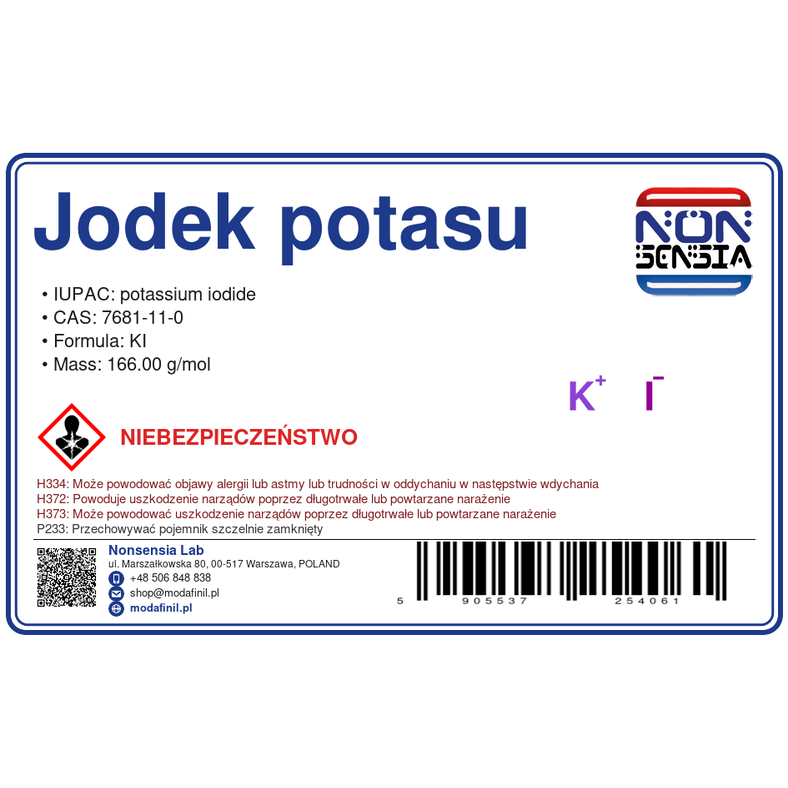

Description
Potassium iodide (KI), an inorganic potassium salt of hydroiodic acid, white or colorless hygroscopic crystals or granular powder, 1000 mg package. Material intended exclusively for in vitro laboratory and analytical research. The product is not intended for human or animal consumption, is not a medicinal product, dietary supplement, food, or cosmetic.
Three distinct entities that must not be confused
This molecule requires separating layers for a different reason than most of our catalog: potassium iodide is not a modern compound designed in a pharmaceutical laboratory, but an inorganic salt that has been widely used for decades, present simultaneously in analytical chemistry, industry, and medicine. Three contexts, three entirely different legal statuses:
| Entity | What it is | Status of potassium iodide |
|---|---|---|
| Chemical substance potassium iodide, CAS 7681-11-0 |
A chemical concept — an ionic salt composed of a potassium cation and an iodide anion. By itself it is neither a drug nor a reagent; its status is conferred only by the form in which it is manufactured and approved. | inorganic chemistry, substance registries |
| Medicinal products preparations for iodine prophylaxis and thyroid blocking |
Pharmaceutical preparations: a defined pharmaceutical form (tablets, solution), manufacturing under GMP, registration documentation, distribution within national radiological protection programs. The PubChem registry (CID 4875) links this CAS number to the names of registered pharmaceutical products for thyroid blocking with stable iodine, including Thyrosafe, Thyroshield, Iosat, Pima, Thyro-Block, Kisol, Joptone, Potide — and to Lugol’s solution, used in medicine since the 19th century. | the public health programs and clinical literature cited below pertain to this entity |
| Chemical reagent the material offered here |
Material for laboratory and analytical work. It does not have, and cannot have, approval for use in humans or animals — it has no pharmaceutical form or medicinal product documentation. | analytics, chemistry, reference standards |
The consequence is unambiguous. The data and publications cited further on this page, concerning iodine prophylaxis, thyroid blocking in the event of radioactive iodine-131 contamination, or iodization of table salt, refer exclusively to registered medicinal products or to public health programs conducted using them. None of these applications applies to the analytical reagent, and none of these results carries over to the offered material. The reagent is not the form in which this substance is administered to humans, and cannot be used in that way.
Reagent identification card
| Systematic name (IUPAC) | potassium iodide |
|---|---|
| Common name | potassium iodide (KI) |
| CAS number | 7681-11-0 |
| Molecular formula | KI |
| Molar mass | 166.00 g·mol−1 |
| Monoisotopic mass | 165.8682 Da |
| InChIKey | NLKNQRATVPKPDG-UHFFFAOYSA-M |
| SMILES | [K+].[I-] |
| PubChem CID | 4875 |
| ChEMBL | CHEMBL3672512 |
| Form | white, colorless, hygroscopic crystals or granular powder |
| Solubility | very good in water (approx. 1 g / 0.7 ml water at 25°C), good in glycerol, poor in ethanol |
| Density | 3.13 g/cm3 |
| Melting point | 681 °C |
| Boiling point | 1323 °C |
| Purity | ≥ 99.0% |
| Intended use | research reagent — not for human or animal consumption |
A simple salt with two centuries of applications
Potassium iodide differs from most entries in our catalog in that it cannot be described as a link in a single research lineage. It is not an organic molecule designed and modified by one team within a single decade — it is a simple ionic salt, known to chemists for nearly two hundred years, which independently took root in several distinct fields: analytical chemistry, the photographic industry, iodine deficiency prophylaxis, and radiological protection. We state this plainly because the “from discovery to today’s laboratory” narrative template, appropriate for synthetic compounds, does not fit here — the history of this salt is multi-track, not linear.
From molecular iodine to the iodide salt
The starting point is the discovery of elemental iodine — Bernard Courtois isolated it in 1811 from the ash of seaweed during saltpeter production. Potassium iodide, as a salt of hydroiodic acid, entered chemical and medical practice shortly afterward. In 1829, the French physician Jean Lugol developed a solution of iodine in an aqueous potassium iodide solution — the iodide plays a purely auxiliary role there, increasing the solubility of poorly water-soluble molecular iodine by forming the soluble triiodide ion. This same mechanism, described further in the chemistry section, underlies the classical iodometric methods still used today.
Four independent paths of application
From the mid-19th century, potassium iodide developed in parallel across four unrelated contexts: as a redoximetric reagent in the then-emerging field of analytical chemistry, as a component of light-sensitive photographic emulsions (reacting with silver nitrate to form silver iodide), as a public health tool in table salt iodization programs against endemic goiter, and — from the second half of the 20th century — as an agent blocking thyroid uptake of radioactive iodine-131 in cases of radiological contamination. We describe the last of these contexts in more detail below, since it carries the greatest risk of confusing the reagent with a registered medicinal product.
Timeline
| 1811 | Bernard Courtois isolates elemental iodine from the ash of seaweed |
|---|---|
| 1829 | Jean Lugol develops a solution of iodine in potassium iodide for medical use [13] |
| 2nd half of the 19th c. | development of classical iodometric methods in analytical chemistry based on oxidation of the iodide ion |
| turn of the 19th/20th c. | application in the photographic industry as a precursor of light-sensitive silver iodide |
| 1920s | first national table salt iodization programs against endemic goiter |
| 1968 | publication of a 16-year study of iodide prophylaxis in Tasmania, WHO Bulletin [11] |
| 1983 | FDA update on the use of potassium iodide as a thyroid-blocking agent in radiation accidents [9] |
| 1985 | publication of criteria for administering KI for thyroid blocking in radioiodine contamination [8] |
| 1996 | assessment of potassium iodide content in Polish table salt, Roczniki PZH [12] |
| 1986 / 2011 | the Chernobyl and Fukushima accidents renew international attention to the role of potassium iodide in radiological protection |
| 2016 | systematic review of the effects of iodine blocking after nuclear accidents, Journal of Radiological Protection [10] |
Four fields, one molecule
Unlike the organic compounds in our catalog, whose literature arose in one or a few related research centers, the literature on potassium iodide is scattered across fields that rarely intersect.
- Analytical chemistry. Potassium iodide is one of the oldest and most widespread redoximetric reagents — iodometric methods are still used today to determine peroxides, organic acids, or sulfur compounds [1][2][3], and methods for determining the iodide ion itself have been developed from pharmacopoeial titration procedures to modern liquid chromatography and microextraction [4][5][6].
- Radiological protection. Since the 1980s, regulatory agencies have published criteria for the use of registered potassium iodide preparations as an agent blocking thyroid uptake of radioiodine [9][8]; more recent systematic reviews assess the effectiveness of these programs following actual nuclear accidents [10].
- Public health and iodine deficiency prophylaxis. Table salt iodization programs have been studied for decades — from a 16-year study in Tasmania [11] to an assessment of iodide content in Polish table salt [12].
- History of medicine. Lugol’s solution, in which potassium iodide serves an auxiliary function as an iodine-solubilizing agent, has been described in the medical literature since the mid-20th century [13].
Caveat for the entire section above. The publications concerning thyroid blocking, iodine prophylaxis, and Lugol’s solution describe applications of registered medicinal products and public health programs, not the chemical reagent. This is not a description of the properties of the offered material and cannot serve as a basis for any use of it outside the laboratory.
Chemistry: an ionic salt and its redox behavior
Why there is no chirality here
Unlike the organic molecules in our catalog, where a stereogenic center is often significant (e.g., the sulfur atom in the sulfoxide of modafinil), potassium iodide is a simple ionic compound: a K+ cation and an I− anion joined by an ionic bond, with no covalent bonds that could carry a center of chirality. Questions about enantiomers or optical resolution do not apply here — for the laboratory, this means the only quality parameter remains chemical purity and the absence of impurities, not an isomer ratio.
Iodine is monoisotopic — a contrast with bromine
Natural iodine occurs almost exclusively as a single stable isotope, 127I — like fluorine in flmodafinil, iodine is practically monoisotopic. In a mass spectrum, an ion containing iodine therefore does not show the characteristic isotope cluster we describe for bromantane, where two stable bromine isotopes produce a pair of peaks in an approximately 1:1 ratio. The presence of iodine is recognized by exact mass and by the specific behavior of metal–iodide ion clusters in mass spectrometry, studied using ion mobility analysis methods [7].
Iodide as a reducing agent: the basis of iodometry
The iodide ion is a moderately strong reducing agent — under the action of many oxidizers (hydrogen peroxide, dichromates, ozone), iodide is oxidized to molecular iodine (I2), which then forms the soluble triiodide ion (I3−) with excess iodide and gives a characteristic dark blue color with iodine-starch. All of classical iodometry rests on this reaction — titration of the liberated iodine with sodium thiosulfate, used since the 19th century to determine oxidizers, lipid peroxides, and sulfur compounds [1][2][3]. The iodide ion also forms sparingly soluble precipitates with heavy metal cations — yellow PbI2 with lead(II) is a classic identification reaction, and soluble iodide complexes with cadmium and zinc are used in quantitative analysis.
Computed descriptors and why they must be read with caution
PubChem generates standardized computed descriptors for every compound, designed primarily with drug-like organic molecules in mind. For a diatomic ionic compound, some of these lose substantive meaning — we present them honestly, with commentary, rather than omitting them silently.
| Parameter | Value | Comment |
|---|---|---|
| Partition coefficient (XLogP) | no defined value | the compound dissociates completely into ions in water — the octanol/water partition model appropriate for neutral molecules does not apply here |
| Topological polar surface area (TPSA) | 0 Å2 | a descriptor calculated for covalent bonds; in the absence of such bonds it is zero by definition and does not reflect the salt’s actual polarity |
| Hydrogen bond donors / acceptors | 0 / 1 | a formal atom count, with no practical significance for a non-covalent compound |
| Heavy atoms | 2 | one cation, one anion — the simplest possible formula after hydrogen and helium |
| Solubility | very good in water, good in glycerol, poor in ethanol | typical of an ionic salt with high solvation energy; stock solutions are prepared in water, not in organic solvents |
Nomenclature and synonyms
Potassium iodide is known under several equivalent chemical and pharmacopoeial names, collected in the PubChem registry (CID 4875):
- Jodek potasu — the Polish name, most common in domestic literature and the reagent trade;
- Potassium iodide — the English name, present in international databases and on the labels of imported reagents;
- Kali iodide / Kalii iodidum — Latin pharmacopoeial names, found in older medical literature and on pharmacy compounding labels;
- Potassium monoiodide — a descriptive variant emphasizing the 1:1 stoichiometric ratio;
- Kaliumiodid — the German form;
- Iodure de potassium — the French form;
- KI — the molecular formula used interchangeably with the common name in a laboratory context.
CAS number 7681-11-0 remains the only unambiguous identifier independent of language and trade context.
Laboratory use of the reagent
- reducing agent and source of the iodide ion in classical iodometry — determination of oxidizers, peroxides, and sulfur compounds by titration [1][2][3];
- standard in pharmacopoeial and chromatographic methods for determining iodides in aqueous and food matrices [4][5][6];
- model material in studies of metal–iodide ion clusters using mass spectrometry and ion mobility methods [7];
- precipitating reagent for the identification of lead, cadmium, and zinc ions by classical analytical reactions;
- component of staining solutions for starch in qualitative analysis (iodine-starch complex);
- source of the iodide ion in organic synthesis, in iodination and substitution reactions.
Storage, handling, and work safety
Store in the original, tightly closed packaging made of a corrosion-resistant material (glass, plastic), in a dry and cool place, protected from light, separately from food and feed and out of the reach of children. The compound is strongly hygroscopic — it absorbs moisture from the air, which leads to caking and makes weighing more difficult; inadequately sealed storage and prolonged exposure to light and air can also lead to slow oxidation of the iodide ion and yellowing of the material. Work only under laboratory conditions, using personal protective equipment: nitrile gloves, safety goggles, and laboratory clothing; weigh the powder under conditions that limit dust generation, avoid inhaling dust and contact with skin and eyes. Waste handling — in accordance with the regulations applicable to chemical waste at the site where the research is conducted. Before use, consult the current Safety Data Sheet (SDS) for the product.
Regulatory status
Potassium iodide as a chemical compound is not controlled under the Act on Counteracting Drug Addiction or under precursor regulations — its trade and possession as a chemical reagent are legal in Poland and the European Union. Separately from the chemical substance, there are registered medicinal products based on potassium iodide, used in iodine prophylaxis and radiological protection (see the table at the start of the page) — their trade is subject to pharmaceutical law, and this offer does not pertain to them. The offered material is a chemical reagent and does not have approval for any use in humans or animals. The buyer is responsible for ensuring that the intended use complies with the law applicable in the country of destination.
Frequently Asked Questions
How does this reagent differ from the potassium iodide in medicinal products for iodine prophylaxis?
The offered material is a chemical reagent for laboratory and analytical use — it has no pharmaceutical form, is not manufactured under GMP, and is not accompanied by medicinal product documentation. Registered preparations for thyroid blocking or iodine prophylaxis are separate legal entities, subject to pharmaceutical law, to which this offer does not pertain.
What is the chemical formula and molar mass of potassium iodide?
KI; molar mass 166.00 g·mol−1, monoisotopic mass 165.8682 Da. CAS number 7681-11-0, InChIKey NLKNQRATVPKPDG-UHFFFAOYSA-M.
Is potassium iodide the same thing as iodine?
No. Iodine (I2) is the element in the form of a diatomic molecule; potassium iodide (KI) is an ionic salt containing the reduced form of iodine — the iodide anion (I−). The two compounds are often confused because they frequently occur together, for example in Lugol’s solution, where potassium iodide increases the solubility of molecular iodine in water.
Why must potassium iodide be stored tightly closed?
Because of its strong hygroscopicity — the compound absorbs moisture from the air, which leads to caking of the crystals and makes precise weighing more difficult. Inadequately sealed packaging and prolonged contact with light and air can additionally lead to slow oxidation of the iodide ion.
Is the reagent suitable for uses other than laboratory purposes?
No. The material is intended exclusively for laboratory and analytical research. It is not intended for human or animal consumption, is not a drug, dietary supplement, food, or cosmetic, and cannot be used for medical, diagnostic, or consumption purposes.
How should potassium iodide be stored as a laboratory reagent?
In the original, tightly closed, corrosion-resistant packaging, in a dry and cool place, protected from light, separately from food and feed and out of the reach of children.
What does potassium iodide dissolve in and how is a stock solution prepared?
Very well in distilled water (approx. 1 g per 0.7 ml of water at 25°C), well in glycerol, poorly in ethanol. Unlike the organic molecules in our catalog, stock solutions are prepared in water, not in organic solvents — the ionic compound requires neither DMSO nor methanol.
How is potassium iodide used in iodometry?
The iodide ion is oxidized by the oxidizer under investigation to molecular iodine, which forms the triiodide ion with excess iodide; this is then titrated with sodium thiosulfate until the dark blue color with iodine-starch disappears. This method has been the basis for determining peroxides, organic acids, and sulfur compounds since the 19th century.
Is a safety data sheet included with the potassium iodide?
We provide the Safety Data Sheet (SDS) upon request to recipients conducting research or analytical activities.
Is potassium iodide legal as a reagent in Poland?
Yes — as a chemical compound it is not controlled under the Act on Counteracting Drug Addiction or under precursor regulations, and its trade as a laboratory reagent is legal in Poland and the European Union. Registered medicinal products based on the same substance exist separately, and this offer does not pertain to them.
Why does potassium iodide have no stereogenic center?
Because it is an ionic, not a covalent, compound — the K+ cation and I− anion do not form a spatial structure that could carry chirality. Unlike the organic sulfoxides in our catalog, where the stereogenic center lies on the sulfur atom, the question of enantiomers simply does not apply to this salt.
How is iodine recognized in mass spectrometry?
By exact mass, not by isotope pattern — natural iodine is practically monoisotopic (127I), like fluorine, so it does not produce the characteristic peak cluster seen with bromine compounds. The presence of iodine is confirmed based on the exact mass of the ion and the characteristic behavior of metal–iodide ion clusters.
What is the potassium iodide standard used for in an analytical laboratory?
Primarily as a reducing agent in iodometry and as a standard for determining the iodide ion by chromatographic and electromigration methods in aqueous and food samples; additionally as a precipitating reagent for identifying lead ions and other heavy metals.
References
The entries are drawn from the PubMed database. Entries [1]–[7] are methodological and analytical papers concerning the chemistry of the iodide ion and its determination — they relate directly to the chemistry of this substance, not to its administration to humans. Entries [8]–[14] concern registered medicinal products and public health programs (thyroid blocking, iodine prophylaxis, salt iodization, Lugol’s solution) — not the chemical reagent. They are cited as scientific context and a bibliographic pointer, not as information about the properties of the offered material or as an encouragement toward any use.
- Nema SN, Verma RM (1978). “Iodometric microdetermination of certain organic acids.” Talanta. PMID 18962284. doi:10.1016/0039-9140(78)80122-2.
- Cramer GL et al. (1991). “Iodometric measurement of lipid hydroperoxides in human plasma.” Anal Biochem. PMID 1872469. doi:10.1016/0003-2697(91)90010-q.
- Mizoguchi T et al. (1980). “Analytical applications of condensed phosphoric acid III — iodometric determination of sulphur after reduction of sulphate with sodium hypophosphite and either tin metal or potassium iodide.” Talanta. PMID 18962717. doi:10.1016/0039-9140(80)80074-9.
- Hilp M, Senjuk S (2001). “Determination of iodide with 1,3-dibromo-5,5-dimethylhydantoin (DBH) in comparison with the ICl-method.” J Pharm Biomed Anal. PMID 11377015. doi:10.1016/s0731-7085(00)00505-7.
- Rong L, Takeuchi T (2004). “Determination of iodide in seawater and edible salt by microcolumn liquid chromatography with poly(ethylene glycol) stationary phase.” J Chromatogr A. PMID 15296397. doi:10.1016/j.chroma.2004.05.032.
- Zaruba S et al. (2016). “A novel vortex-assisted liquid-liquid microextraction approach using auxiliary solvent: determination of iodide in mineral water samples.” Talanta. PMID 26717821. doi:10.1016/j.talanta.2015.11.049.
- Oberreit D et al. (2015). “Analysis of heterogeneous water vapor uptake by metal iodide cluster ions via differential mobility analysis-mass spectrometry.” J Chem Phys. PMID 26374028. doi:10.1063/1.4930278.
- Meck RA et al. (1985). “Criteria for the administration of KI for thyroid blocking of radioiodine.” Health Phys. PMID 3882630. doi:10.1097/00004032-198502000-00001.
- Shleien B et al. (1983). “Recommendations on the use of potassium iodide as a thyroid-blocking agent in radiation accidents: an FDA update.” Bull N Y Acad Med. PMID 6582962.
- Pfinder M et al. (2016). “The effects of iodine blocking on thyroid cancer, hypothyroidism and benign thyroid nodules following nuclear accidents: a systematic review.” J Radiol Prot. PMID 27655110. doi:10.1088/0952-4746/36/4/R112.
- Clements FW et al. (1968). “Goitre studies in Tasmania. 16 years’ prophylaxis with iodide.” Bull World Health Organ. PMID 5302305.
- Andrzejewska E et al. (1996). “Ocena zawartości jodku potasu w polskiej soli jadalnej.” Rocz Panstw Zakl Hig. PMID 9102797.
- Nicholson DP (1948). “Lugol’s solution in failing lactation.” Br Med J. PMID 18860442. doi:10.1136/bmj.1.4560.1029.
- Torti JF, Correa R (2026). “Potassium Iodide.” Review. PMID 31194460.
Identification data and computed descriptors from PubChem (CID 4875) and the ChEMBL registry.
Related reagents in our catalog
- Bromantane (CAS 87913-26-6) — isotopic contrast: bromine shows a characteristic 1:1 pattern in the mass spectrum, iodine (like fluorine) is practically monoisotopic
- Flmodafinil (CAS 90280-13-0) — an organic compound with two fluorine atoms, another monoisotopic element; a methodological contrast to the ionic, inorganic structure of potassium iodide
Statement of product purpose
The offered material is a chemical reagent intended exclusively for research, analytical, and laboratory purposes. It is not intended for human or animal consumption. It is not a medicinal product, dietary supplement, food, medical device, or cosmetic. It must not be used for medical, diagnostic, therapeutic, prophylactic, or consumption purposes, administered to humans or animals, applied to the skin, or added to food, beverages, or feed. Sold exclusively to buyers conducting research, scientific, or analytical activities, who have laboratory facilities and the knowledge needed to safely handle chemical reagents. The buyer bears sole responsibility for the lawful and safe use of the reagent and for compliance with the regulations applicable in the country of destination.

