
Description
N-(4-hydroxyphenyl)acetamide, crystalline powder, 1000 mg package. Material intended exclusively for in vitro laboratory and analytical research. The product is not intended for human or animal consumption, and is not a medicinal product, dietary supplement, food, or cosmetic.
Three Different Entities That Must Not Be Confused
For this molecule, separating the layers matters more than usual, because unlike most entries in our catalog, the corresponding medicinal product is one of the most widely used over-the-counter medicines in the world. The widespread availability of the pharmaceutical preparation does not transfer to the status of the reagent offered here — these are two separate legal entities, regardless of how readily available the former is:
| Entity | What It Is | Status |
|---|---|---|
| Chemical substance paracetamol / acetaminophen, CAS 103-90-2 |
A chemical concept — a molecule with a defined structure. On its own it is neither a drug nor a reagent; its status is conferred by the form in which it is manufactured and placed on the market. | — |
| Medicinal product e.g. Apap, Acenol, Panadol, Codipar, Efferalgan |
A pharmaceutical preparation: a defined pharmaceutical form, manufacturing under GMP conditions, registration documentation, safety surveillance. In Poland available both over the counter (selected oral forms) and on prescription (including intravenous forms). | clinical trials in humans concern this entity |
| Chemical reagent the material offered here |
Material for laboratory and analytical work. It does not hold, and cannot hold, approval for use in humans or animals — it has no pharmaceutical form and no medicinal product documentation, regardless of the fact that the same molecule in a different form is a drug sold over the counter in every pharmacy. | analytics, chemistry, reference standards |
The consequence is unambiguous. The data referenced further down this page come either from chemical and analytical research on the molecule itself (crystal structure, stability, determination methods), or from toxicity-mechanism research conducted on animal models and in vitro. The one human clinical study cited below concerns exclusively the registered medicinal product, never the analytical reagent. None of this information transfers to the material offered here, and none of it is a basis for using it outside the laboratory. The reagent is not the form in which the substance is administered to humans, and cannot be used that way — the widespread availability of the pharmacy preparation does not change this.
Reagent Identification Card
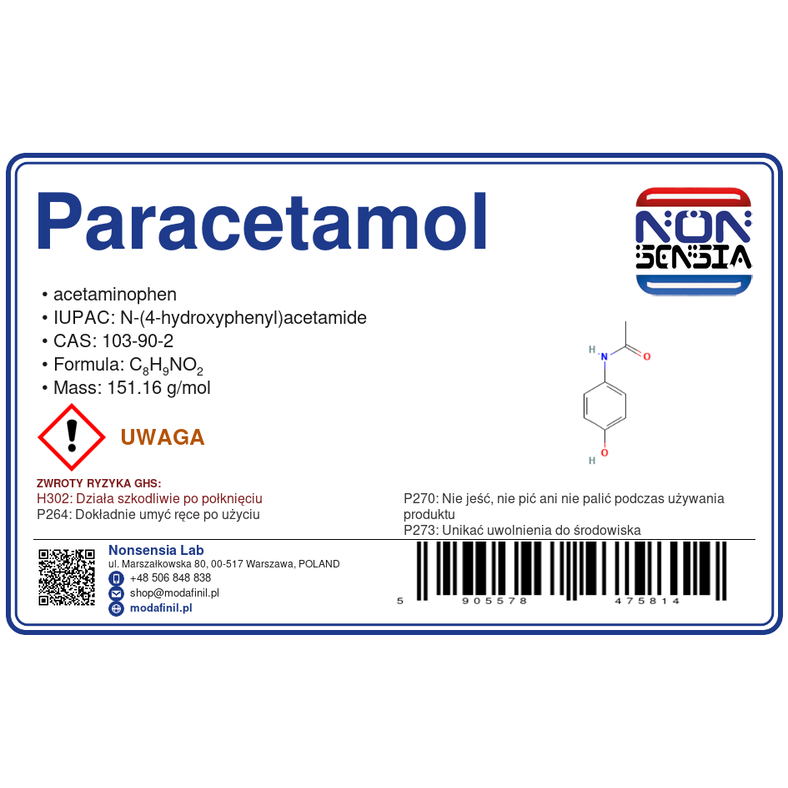
| Systematic name (IUPAC) | N-(4-hydroxyphenyl)acetamide |
|---|---|
| Common name | paracetamol (Europe), acetaminophen (North America, Japan) |
| CAS number | 103-90-2 |
| Molecular formula | C8H9NO2 |
| Molar mass | 151.16 g·mol−1 |
| Monoisotopic mass | 151.0633 Da |
| InChIKey | RZVAJINKPMORJF-UHFFFAOYSA-N |
| SMILES | CC(=O)NC1=CC=C(C=C1)O |
| PubChem CID | 1983 |
| Form | crystalline powder, white to almost white |
| Melting point | 169.8 °C (PubChem reference value); the exact melting point and HPLC purity of a given batch are stated on the certificate of analysis enclosed with the shipment |
| Purity | ≥ 99.0% |
| Intended use | research reagent — not for human or animal consumption |
Lineage of the Molecule: From Acetanilide to Paracetamol
Paracetamol is not a molecule designed from scratch for analgesic action — it is a purified metabolite of two earlier compounds that proved too toxic to remain in use. The history of this family dates back to the late 19th century and is well documented in the literature on the history of pharmacology [1].
The Shadow of Acetanilide and Phenacetin
The starting compound was acetanilide, introduced into medicine in the 1880s and quickly withdrawn because of methemoglobinemia. Its successor was phenacetin — an ether derivative considered safer and widely used throughout most of the 20th century, until it was withdrawn in one country after another because of nephrotoxicity and suspected carcinogenicity associated with long-term use.
Discovery of the True Carrier of Activity
Critical to paracetamol’s present-day status was the mid-20th-century finding that it — not phenacetin or acetanilide — is the main active metabolite responsible for the analgesic and antipyretic action of this family of compounds, with substantially lower toxicity than the parent compounds. This precursor–metabolite relationship is analogous to the one described in our catalog for the modafinil/adrafinil pair — with the difference that, in paracetamol’s case, it was the metabolite, not the precursor, that became the independently registered compound placed on the market in the late 1950s.
Timeline
| 1886 | introduction of acetanilide into medicine; rapid withdrawal because of methemoglobinemia |
|---|---|
| 1887–1893 | introduction of phenacetin as the successor to acetanilide; decades of widespread use |
| 1878 | first documented synthesis of paracetamol (Morse), outside the mainstream of pharmacology at the time |
| mid-20th century | identification of paracetamol as the main active metabolite of phenacetin/acetanilide, with lower toxicity [1] |
| 1950s–1960s | registration as an independent medicinal product in the United States and Europe; gradual withdrawal of phenacetin |
| 2000 | resolution of the crystal structure of the polymorphic form under high pressure [2] |
| 2011 | determination method in plasma and urine by isotope-labeled GC-MS [6] |
| 2020 | description of a new, elusive crystal form in the Journal of the American Chemical Society [3] |
| 2021 | methodological recommendations for the hepatotoxicity model in laboratory animals [12] |
Chemistry: The Amide Bond, Polymorphism, and What They Mean for the Laboratory
Why the Amide Bond Determines Stability
The paracetamol molecule is a phenol ring substituted with a hydroxyl group in the para position relative to the acetamide group. It is precisely the amide bond that is susceptible to hydrolysis: under strongly acidic or basic conditions, and under elevated temperature, it breaks down into p-aminophenol and acetic acid. The kinetics of this degradation — including identification of the products by HPLC coupled with electrospray ionization — were described by Gilpin and Zhou [4], and the effect of time and temperature on the observed color changes of the solution — as an indicator of progressing degradation — by Mochizuki and Takayama [5]. For the laboratory this has a practical consequence: stock solutions should be prepared fresh and prolonged storage under elevated temperature or extreme pH should be avoided.
Two Crystal Forms, Two Behaviors
Paracetamol crystallizes in more than one polymorphic form — the most common, monoclinic form is the thermodynamically stable form under ambient conditions, but under high hydrostatic pressure it undergoes anisotropic distortion of the crystal lattice, as described by Boldyreva and co-workers using X-ray diffraction [2]. The existence of harder-to-obtain, less stable crystal forms — including forms previously considered impossible to isolate — was recently confirmed by Liu, Gabriele, and Davey in the Journal of the American Chemical Society [3]. For analytical practice this means that identifying the compound by melting point or simple powder diffraction alone does not always settle which polymorphic form is present — and different forms can differ in solubility and dissolution rate.
Physicochemical Characterization
| Parameter | Value | Significance |
|---|---|---|
| Partition coefficient (XLogP) | 0.5 | low lipophilicity — elutes early in an RP-HPLC gradient, requires careful mobile-phase selection when analyzed in mixtures with more lipophilic analgesics |
| Topological polar surface area | 49.3 Å2 | moderate; the hydroxyl and amide groups are active in infrared and NMR |
| Hydrogen bond donors | 2 | the phenolic OH group and the amide N–H |
| Hydrogen bond acceptors | 2 | the phenolic and carbonyl oxygens |
| Rotatable bonds | 1 | the molecule is nearly planar, with limited conformational freedom |
| Solubility | good in ethanol, methanol, DMSO, and DMF; poor in water and nonpolar solvents | prepare stock solutions in a polar protic or aprotic solvent, not in water |
Why One Molecule Has Several Systematic Names
In the chemical and pharmacopoeial literature, the same substance with CAS number 103-90-2 appears under several names, depending on region and context — none of them is a trade name of a medicinal preparation; all of them refer to the molecule itself:
- Paracetamol — the international nonproprietary name (INN) used in Europe, Poland, and most of the world outside North America;
- Acetaminophen — the common name dominant in the United States, Canada, and Japan, derived from N-acetyl-para-aminophenol;
- APAP — a pharmacopoeial abbreviation derived from the same full name, common in laboratory and toxicological documentation;
- 4-acetamidophenol — a descriptive name indicating the position of the substituent;
- p-hydroxyacetanilide — an older common name, emphasizing the structural relationship with acetanilide;
- N-(4-hydroxyphenyl)acetamide — the systematic IUPAC name, the only unambiguous one.
This naming divergence has a bibliographic consequence: a significant part of the analytical and toxicological literature is indexed under the term acetaminophen, not paracetamol — when querying databases such as PubMed it is worth combining both variants.
Laboratory Applications of the Reagent
- a reference material (primary standard) for confirming identity and purity by HPLC-UV;
- a standard in RP-HPLC methods for the simultaneous determination of several analgesics in a single formulation — such an approach, covering paracetamol alongside caffeine and acetylsalicylic acid, was described by Yenda et al. [7] and Ivanovic et al. [8];
- a standard in isotope-dilution GC-MS methods for determination in biological matrices [6] and in high-throughput LC-MS techniques based on solid-phase microextraction [9];
- a comparison material in forensic toxicology and the analysis of seized substances — paracetamol is sometimes used as a diluting agent (a so-called cutting agent) in illegal preparations, which makes it a routine element of GC-MS reference libraries in forensic laboratories [10];
- a substrate in studies of the bioactivation mechanism by cytochrome P450 enzymes (mainly CYP2E1 and CYP3A4) leading to the reactive metabolite NAPQI — studied on human liver microsomes and animal microsomes in vitro [11];
- a model compound in experimental hepatotoxicity models in laboratory animals, including studies of protective mechanisms at the cellular level [12][14] and in the determination of metabolites (the glutathione conjugate and glucuronide) by LC-MS/MS techniques [13];
- a model compound in studies of the chemistry of phenolic amides and their hydrolytic stability.
Storage, Handling, and Work Safety
Store in the original, tightly closed container, in a dry, cool, well-ventilated place, away from sources of heat and light, separately from food and feed and out of the reach of children. Because the amide bond is susceptible to hydrolysis (see the Chemistry section), avoid prolonged contact of solutions with extreme pH and elevated temperature. Work exclusively under laboratory conditions, using personal protective equipment: nitrile gloves, safety goggles, and a laboratory coat; weigh the powder under conditions that limit dust formation, preferably under a fume hood. Avoid inhaling dust and contact with skin and eyes. Handle waste in accordance with the regulations applicable to chemical waste at the site where the research is conducted; do not contaminate the environment, including surface waters.
GHS classification. Pictograms: GHS07, GHS08, GHS09; signal word: Warning. Hazard statements: H302 (harmful if swallowed), H319 (causes serious eye irritation), H315, H335, H341, H370, H371, H372, H373, H401, H411. Precautionary statements: P203, P261, P264, P273. The full, binding wording of the H and P statements is available exclusively in the current safety data sheet (SDS), provided on request to recipients engaged in research activity.
Regulatory Status
The substance is the active ingredient of widely available medicinal products, sold in Poland both over the counter (selected oral forms) and on prescription (including forms for intravenous administration). The trade in medicinal preparations is governed by separate pharmaceutical law provisions, and this offer does not concern it — regardless of how readily available the corresponding drug is in a pharmacy. The substance is not listed among substances prohibited in sport. The material offered is a chemical reagent and holds no approval for any use in humans or animals. The buyer is responsible for ensuring that the intended use complies with the law applicable in the country of destination.
Frequently Asked Questions
What is the difference between paracetamol and acetaminophen?
Nothing, in the chemical sense — it is the same molecule with CAS number 103-90-2. Paracetamol is the international nonproprietary name (INN) used in Europe; acetaminophen is the name dominant in the United States and Japan. The difference is purely regional, not structural.
What is the chemical formula and molar mass of paracetamol?
C8H9NO2; molar mass 151.16 g·mol−1, monoisotopic mass 151.0633 Da. CAS number 103-90-2, InChIKey RZVAJINKPMORJF-UHFFFAOYSA-N.
What is the difference between paracetamol, phenacetin, and acetanilide?
These are three different molecules from the same historical family of aniline-derived analgesics. Paracetamol is the main active metabolite of the two earlier compounds — it is formed as a product of their metabolism in the body and proved less toxic than the parent compounds, which led to the withdrawal of acetanilide and phenacetin from medical use [1].
Is paracetamol as a reagent the same thing as the over-the-counter drug sold in pharmacies?
Not in the legal sense. The over-the-counter drug is a registered medicinal product: a defined pharmaceutical form, manufacturing under GMP conditions, registration documentation. The material offered here is a chemical reagent without such documentation and without approval for use in humans — the widespread availability of the pharmacy drug does not confer this status on the reagent.
Is the reagent suitable for uses other than laboratory ones?
No. The material is intended exclusively for laboratory and analytical research — not for human or animal consumption; it is not a drug, dietary supplement, food, or cosmetic, and must not be used for medical, diagnostic, or consumption purposes.
How should paracetamol be stored as a laboratory reagent?
In the original, tightly closed container, in a dry, cool, well-ventilated place, away from sources of heat and light, separately from food and feed and out of the reach of children. Prepare stock solutions fresh, because the amide bond undergoes hydrolysis at extreme pH and elevated temperature.
What should paracetamol be dissolved in to prepare a stock solution?
It dissolves well in ethanol, methanol, DMSO, and DMF; poorly in water and nonpolar solvents. With XLogP = 0.5, stock solutions are best prepared in a polar solvent, not in pure water.
How is the purity of paracetamol confirmed as an analytical standard?
By HPLC-UV against a reference material, in accordance with the certificate of analysis enclosed with the batch. Because the compound exists in more than one crystal form, the melting point alone does not always unambiguously determine the polymorphic form — for work requiring this information, X-ray diffraction is used [2].
Is a safety data sheet provided with paracetamol?
We provide the safety data sheet (SDS) on request to recipients engaged in research or analytical activity — it contains the full, binding wording of the H and P statements.
Is paracetamol legal in Poland?
Paracetamol is the active ingredient of medicinal products available in Poland both over the counter and on prescription; the trade in drugs is governed by separate regulations and this offer does not concern it. The substance is not listed among substances prohibited in sport. The material offered is a chemical reagent with no approval for use in humans. The buyer is responsible for ensuring that the intended use complies with the law of the country of destination.
Why is paracetamol sometimes detected in forensic analysis of illicit substances?
Because of its low price, easy availability, and physicochemical similarity in chromatographic behavior to certain psychoactive substances, it is sometimes used as a filler/diluent (cutting agent) in illegal preparations — which is why forensic toxicology laboratories keep its reference GC-MS and LC-MS/MS spectra in standard libraries [10].
What is the paracetamol standard used for in an analytical laboratory?
For confirming identity and purity by HPLC-UV, as a standard in RP-HPLC methods for the simultaneous determination of several analgesics, in isotope-dilution GC-MS and LC-MS, in forensic toxicology, and as a substrate in experimental toxicity-mechanism models conducted in laboratory animals and in vitro.
References
The entries come from the PubMed database, retrieved and verified on 2026-09-06. They concern history, chemistry, analytics, and toxicity mechanisms studied in animal models and in vitro. Entry [15] is the only human study in this list — it concerns exclusively the registered medicinal product, not the analytical reagent. None of the remaining entries describe any use of the analytical reagent in humans — they are cited as scientific context and a bibliographic reference, not as information about the properties of the material offered, nor as an encouragement for any use.
- Aronoff DM et al. (2002). "Aspirin and Reye’s syndrome: discovery of aspirin and paracetamol." Drug Saf. PMID 12167070.
- Boldyreva EV, Shakhtshneider TP, Vasilchenko MA (2000). "Anisotropic crystal structure distortion of the monoclinic polymorph of acetaminophen at high hydrostatic pressures." Acta Crystallogr B. PMID 10794283. doi:10.1107/s0108768199013634.
- Liu Y, Gabriele B, Davey RJ (2020). "Concerning Elusive Crystal Forms: The Case of Paracetamol." J Am Chem Soc. PMID 32216346. doi:10.1021/jacs.0c00321.
- Gilpin RK, Zhou W (2004). "Studies of the thermal degradation of acetaminophen using a conventional HPLC approach and electrospray ionization-mass spectrometry." J Chromatogr Sci. PMID 14965410. doi:10.1093/chromsci/42.1.15.
- Mochizuki K, Takayama K (2016). "Prediction of color changes in acetaminophen solution using the time-temperature superposition principle." Drug Dev Ind Pharm. PMID 26559666. doi:10.3109/03639045.2015.1107091.
- Trettin A et al. (2011). "Quantification of acetaminophen (paracetamol) in human plasma and urine by stable isotope-dilution GC-MS and GC-MS/MS as pentafluorobenzyl ether derivative." J Chromatogr B. PMID 21733763. doi:10.1016/j.jchromb.2011.06.012.
- Yenda P et al. (2023). "An effective and stability-indicating method development and optimization … for the simultaneous determination of acetaminophen, caffeine, and aspirin in tablet formulation." Biomed Chromatogr. PMID 36692333. doi:10.1002/bmc.5585.
- Ivanovic D et al. (2003). "Optimization of the RP-HPLC method for multicomponent analgetic drug determination." Boll Chim Farm. PMID 14971306.
- Shiea J et al. (2020). "Rapid quantification of acetaminophen in plasma using solid-phase microextraction coupled with thermal desorption electrospray ionization mass spectrometry." Rapid Commun Mass Spectrom. PMID 31490602. doi:10.1002/rcm.8564.
- Fiorentin TR et al. (2019). "Determination of cutting agents in seized cocaine samples using GC-MS, GC-TMS and LC-MS/MS." Forensic Sci Int. PMID 30634141. doi:10.1016/j.forsciint.2018.12.016.
- Laine JE, Auriola S, Pasanen M (2009). "Acetaminophen bioactivation by human cytochrome P450 enzymes and animal microsomes." Xenobiotica. PMID 19219744. doi:10.1080/00498250802512830.
- Jaeschke H et al. (2021). "Recommendations for the use of the acetaminophen hepatotoxicity model for mechanistic studies and how to avoid common pitfalls." Acta Pharm Sin B. PMID 35024303. doi:10.1016/j.apsb.2021.09.023.
- Zhang X et al. (2018). "A reliable LC-MS/MS method for the quantification of N-acetyl-p-benzoquinoneimine, acetaminophen glutathione and acetaminophen glucuronide in mouse plasma, liver and kidney." Biomed Chromatogr. PMID 29978489. doi:10.1002/bmc.4331.
- Fang Z et al. (2023). "Narirutin activates TFEB (transcription factor EB) to protect against Acetaminophen-induced liver injury by targeting PPP3/calcineurin." Autophagy. PMID 36779633. doi:10.1080/15548627.2023.2179781.
- Williams CM, Maher CG et al. (2014). "Efficacy of paracetamol for acute low-back pain: a double-blind, randomised controlled trial." Lancet. PMID 25064594. doi:10.1016/S0140-6736(14)60805-9. Human study, concerns exclusively the registered medicinal product.
Identification data and computed descriptors from PubChem (CID 1983); GHS data from PubChem Safety and Hazards.
Related Reagents in Our Catalog
- Caffeine — a frequent analytical partner: RP-HPLC methods for the simultaneous determination of paracetamol, caffeine, and acetylsalicylic acid in a single formulation are part of the standard repertoire of a quality-control laboratory [7]
- Modafinil (CAS 68693-11-8) — a regulatory contrast: modafinil is available in Poland by prescription only, while paracetamol is also available over the counter — two different approval regimes for the same legal category of “active ingredient of a medicinal product”
Statement on the Intended Use of the Product
The material offered is a chemical reagent intended exclusively for research, analytical, and laboratory purposes. It is not intended for human or animal consumption. It is not a medicinal product, dietary supplement, food, medical device, or cosmetic. It must not be used for medical, diagnostic, therapeutic, prophylactic, or consumption purposes, administered to humans or animals, applied to the skin, or added to food, beverages, or feed. Sold exclusively to recipients engaged in research, scientific, or analytical activity who have laboratory facilities and the knowledge required for the safe handling of chemical reagents. The buyer bears sole responsibility for the lawful and safe use of the reagent and for compliance with the regulations applicable in the country of destination.